





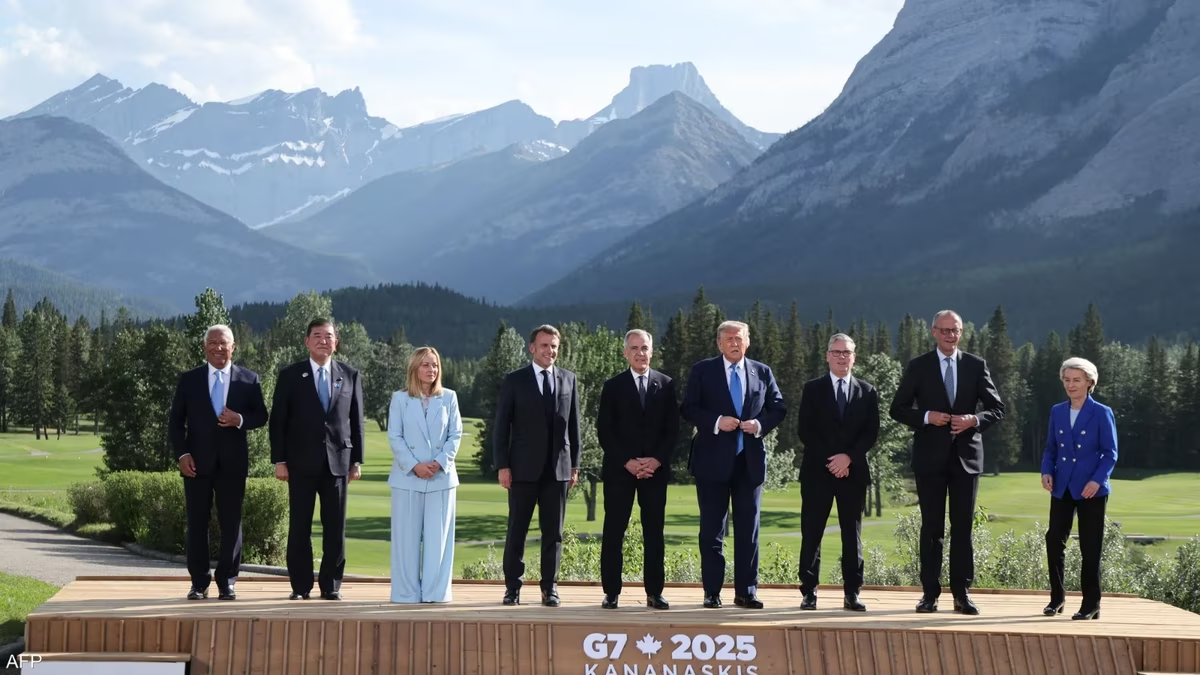
- Participants affirm that establishing a ceasefire in Gaza and Lebanon requires a sustainable political settlement - The US-Iranian agreement receives cautious welcome amid Western differences - The ceasefire in Gaza and Lebanon is merely a fragile truce, and transforming it into lasting peace requires radical approaches - Washington assumes the group's presidency in 2027 amid questions about the future of its role Paris - Mohamed Abu Khdeir - In a year described as one of the most sensitive for the Middle East and the world, leaders of the Group of Seven (G7) major industrial nations (United States, France, Britain, Germany, Italy, Canada, and Japan) met at the French resort of Evian-les-Bains, in a summit dominated by intertwined political, security, and economic crises. French officials described the meeting as a “crisis summit,” given the trade tensions between several member states, the accelerating developments in the Iranian and Ukrainian files, and the accompanying repercussions on international security and stability. Regional Proposals to Enhance Stability in the Middle East Several analysts and experts participating in the discussions accompanying the summit concluded that the current ceasefire in the Gaza Strip and southern Lebanon represents an important step towards de-escalation, but it does not in itself guarantee lasting stability in the region. One of the visions discussed during the summit is based on what has become known as the “Peace Triangle,” which connects Palestine, Jordan, and Israel within a broader framework of economic integration and regional infrastructure, extending from Egypt to Lebanon and Syria, with the aim of enhancing common interests and reducing the chances of returning to conflict. This proposal is based on the idea of making peace a strategic option based on mutual economic and developmental interests, so that the cost of conflict becomes higher than the gains of cooperation, similar to the European experience after World War II. Palestinian Dimensions of the Proposed Initiatives Some experts believe that the reconstruction of the Gaza Strip within a broader regional framework could create new economic opportunities for Palestinians, through infrastructure development, enhanced trade movement, and the reactivation of communication between the West Bank and the Gaza Strip, in addition to benefiting from available energy resources off the Palestinian coast. They point out that the success of any future economic projects remains dependent on the availability of a stable political and security environment that allows for attracting investments and implementing long-term projects. Political and Security Challenges to Implementing the Vision Despite the ambitions of this vision, it faces a set of complex challenges. The state of security instability in the region still poses a concern for investors, especially in light of the war on Gaza, developments in southern Lebanon, attacks on navigation in the Red Sea, and tensions related to Iran. Political obstacles also arise concerning the future of the Palestinian-Israeli political process, as Saudi Arabia, which is seen as a key partner in any broad regional project, emphasizes the necessity of an independent Palestinian state. In contrast, observers believe that the chances of progress towards this goal remain limited given the continued settlement expansion and the stalled political track. At the European level, the proposed regional projects face competition between several countries over hosting the main centers and stations for the planned economic corridors, which reflects a divergence of interests within the European Union. Palestinian and Arab analysts affirm that achieving any real progress in regional integration projects remains linked to finding a just political solution to the Palestinian issue that guarantees the establishment of an independent Palestinian state with East Jerusalem as its capital. Cautious Welcome for the US-Iranian Agreement The announcement of the initial understanding between the United States and Iran was the most prominent event during the summit. US President Donald Trump and Vice President JD Vance signed a memorandum of understanding for a ceasefire with Iranian Parliament Speaker Mohammad Bagher Ghalibaf, opening a sixty-day window for negotiations on the Iranian nuclear file and the issue of economic sanctions. Trump described the agreement as a step that could lead to positive results for regional stability. Western Divergences on Implementation Mechanism Despite the initial European welcome for the agreement, the positions of Western capitals reflected differences regarding the conditions for its implementation. French President Emmanuel Macron announced his country's readiness to contribute to securing navigation in the Gulf region in coordination with Britain, Italy, and the Netherlands, confirming the readiness of the French aircraft carrier "Charles de Gaulle" to move if needed. At the same time, Macron stressed his rejection of imposing transit fees in the Strait of Hormuz, considering that this could open the door to undesirable international precedents. For her part, European Commission President Ursula von der Leyen affirmed that any easing of sanctions imposed on Iran must be linked to concrete steps on the ground and progress in files related to the nuclear program and issues related to regional security. European leaders also held consultations with a number of Arab and regional leaders to discuss the implications of the agreement on regional security and the situations in Lebanon and the Gulf. Ukraine Continues to Impose its Presence on the Summit Agenda In addition to the Iranian file, European leaders sought to keep the Russian-Ukrainian war at the forefront of international attention. Ukrainian President Volodymyr Zelensky participated in the summit sessions, calling for continued Western support for his country and increased sanctions on Moscow. European countries affirmed the necessity of continuing military and economic aid to Ukraine, while some European capitals still express reservations about some of the initiatives proposed to end the war. In parallel, European sources revealed efforts led by Germany, France, and Britain to revive a new negotiation track involving Ukraine, Russia, and the United States. The European Union also officially announced the launch of negotiations for Ukraine's accession to the Union, a step that European officials considered a significant development in the relationship between the two sides. Summit Outcomes.. Limited Consensus and Existing Differences The summit failed to issue a unified final statement for the second consecutive year, which reflected the continued differences among member states on a number of key issues. Among the most prominent outcomes of the summit were: Confirmation of the initial understanding regarding the US-Iranian agreement, and the continuation of negotiations during the next sixty days. Confirmation of the European position based on linking any easing of sanctions to practical steps from the Iranian side. Continued trade disputes between the United States and some European partners, especially regarding digital taxes and technological trade. Continued European support for Ukraine with ongoing discussions on ways to end the war. Global Economy and Artificial Intelligence In addition to political and security issues, leaders discussed challenges related to the global economy, including supply chain disruptions and the need to diversify sources of critical minerals that modern industries rely on. The summit also dedicated part of its work to discussing the regulation of the artificial intelligence sector, with the participation of representatives from major global technology companies, including "OpenAI," "Anthropic," and "Mistral AI," where discussions focused on regulatory aspects, child protection, and promoting the responsible use of modern technologies. Questions about the Future Role of the Group The Evian summit reflected the magnitude of the challenges facing the G7 in light of the rapid transformations in the international system. While the group still represents one of the most important global economic and political platforms, discussions showed clear differences among its members on the issues of Iran, Ukraine, and international trade. With the presidency of the group transferring to the United States in 2027, attention turns to Washington's ability to narrow the gaps of disagreement between Western partners and maintain the group's role in a world increasingly moving towards multipolar centers of power and influence.

الأربعاء 17 يونيو 2026 12:28 مساءً - بتوقيت القدس
Summit Outcomes.. Limited Consensus and Messages Reflecting Divergent Positions... G7 Summit Confronts Middle East Crises and International Tensions
شارك برأيك
Summit Outcomes.. Limited Consensus and Messages Reflecting Divergent Positions... G7 Summit Confronts Middle East Crises and International Tensions