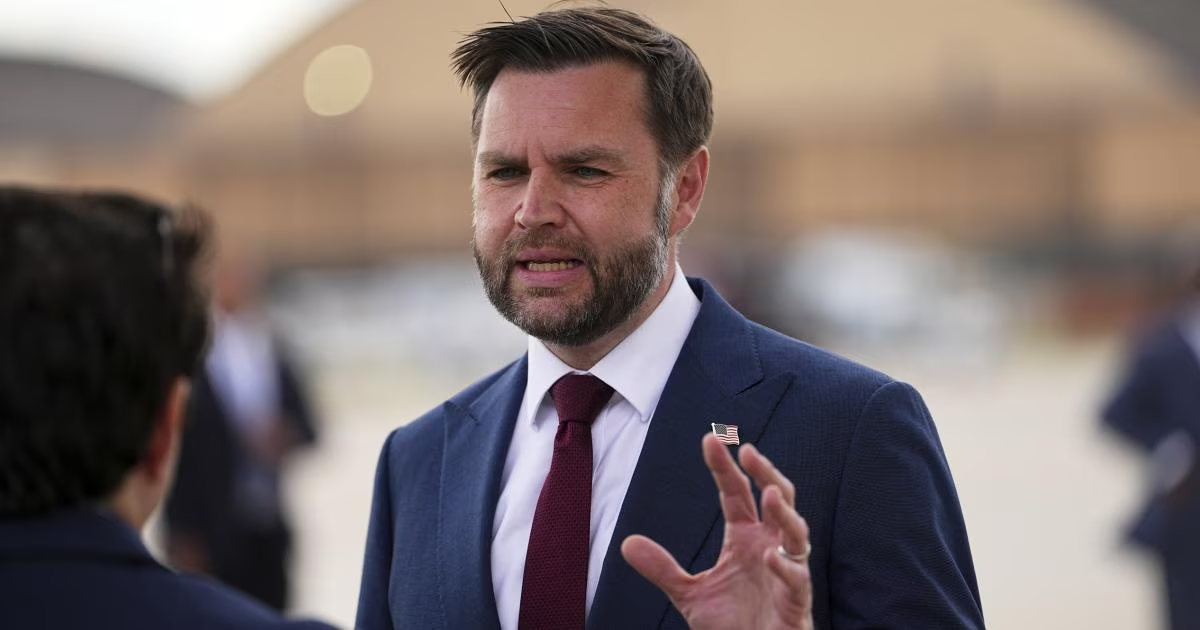







US Vice President J.D. Vance made important statements revealing that the recently signed memorandum of understanding between the United States and Iran is a very brief and general document. Vance clarified that the precise and final details of this agreement will be drafted during rounds of technical negotiations scheduled for later stages, noting that the current goal is to lay the groundwork for ending the conflict.
Washington and Tehran, mediated by Pakistan, announced earlier this week that they had reached an agreement to end the war that erupted on February 28th. This development comes after months of military escalation that included multiple fronts, with both parties now seeking through this memorandum to transition from direct confrontation to a diplomatic path.
In an interview with international media, Vance confirmed that the document does not exceed one and a half pages, and is limited to defining the basic principles that will govern the future relationship between the two countries. He stressed that this general framework ensures Iran will receive economic and political benefits if it fully adheres to the provisions contained in the memorandum, especially regarding regional security.
The US Vice President indicated that the first paragraph of the agreement primarily focuses on Tehran's commitment to 'regional peace and stability'. He explained that this commitment necessarily includes Iran ceasing to fund organizations that Washington considers terrorist groups, which is a fundamental condition for continuing to operate under these new understandings.
For his part, US President Donald Trump announced that the agreement has already been signed, confirming that the strategic Strait of Hormuz will return to full operation for international navigation starting next Friday. This announcement represents a major breakthrough in the global energy crisis, which has been severely affected by military tensions in vital waterways.
In contrast, Tehran confirmed that the official signing ceremony of the memorandum will take place in Geneva, Switzerland, next Friday. Iranian sources described this step as the beginning of a new phase of negotiations that will last for 60 days, focusing particularly on the issues of lifting economic sanctions and Iran's nuclear program.
Iranian President Masoud Pezeshkian commented on the agreement, saying that it represents an 'honorable document' for the Islamic Republic if all its provisions are implemented faithfully and accurately. Pezeshkian noted in a post that the understanding received the support of the vast majority of members of Iran's Supreme National Security Council, giving it strong legal and political cover within the country.
Pezeshkian expressed his gratitude to the Iranian negotiating team, praising the efforts of Parliament Speaker Mohammad Bagher Ghalibaf and Foreign Minister Abbas Araghchi. He considered what has been achieved a fundamental step towards stopping the bloodshed of war and initiating serious dialogue, despite his affirmation that the final comprehensive agreement has not yet fully materialized.
Additional reports indicate that the agreement includes 14 clauses covering an immediate and comprehensive cessation of hostilities on all fronts, including the Lebanese arena. Leaks also speak of financial arrangements including the release of approximately $12 billion in frozen Iranian assets as a gesture of goodwill, with the possibility of the amount reaching $24 billion later.
On the ground, the naval blockade imposed on Iranian ports since mid-April is expected to be lifted, coinciding with the withdrawal of US forces from areas surrounding Iran. Tehran will manage the arrangements for reopening the Strait of Hormuz in cooperation with the Sultanate of Oman, with fees imposed on maritime services provided to passing ships.
Regarding the nuclear file, sources quoted President Trump as saying that an agreement could be reached to suspend uranium enrichment in Iran for a period ranging from 15 to 20 years. However, Iranian media reports indicate that the ballistic missile program and support for resistance factions in the region were not included in the agenda of the current negotiations.
The agreement has been widely welcomed by Arab and international countries and organizations, with Saudi Arabia, Qatar, Egypt, the UAE, and Jordan praising the mediation efforts made by Pakistan and Turkey. These countries called for the necessity of building on this understanding to achieve sustainable stability in the Middle East and end the state of tension that has plagued the region throughout the past months.
It is worth noting that this conflict began in February 2026 with military attacks launched by the United States and Israel against Iranian targets, to which Tehran responded with strikes targeting American interests. Intensive diplomatic efforts succeeded in reaching a temporary ceasefire last April, before these efforts culminated in the current memorandum of understanding.
The memorandum of understanding does not exceed one and a half pages, and it establishes a framework that ensures Iranians benefit from the agreement in exchange for fulfilling their obligations.
شارك برأيك
Vance reveals details of the memorandum of understanding with Iran, and Pezeshkian describes it as a 'honorable document'