






By Said Arikat
June 15, 2026
News Analysis
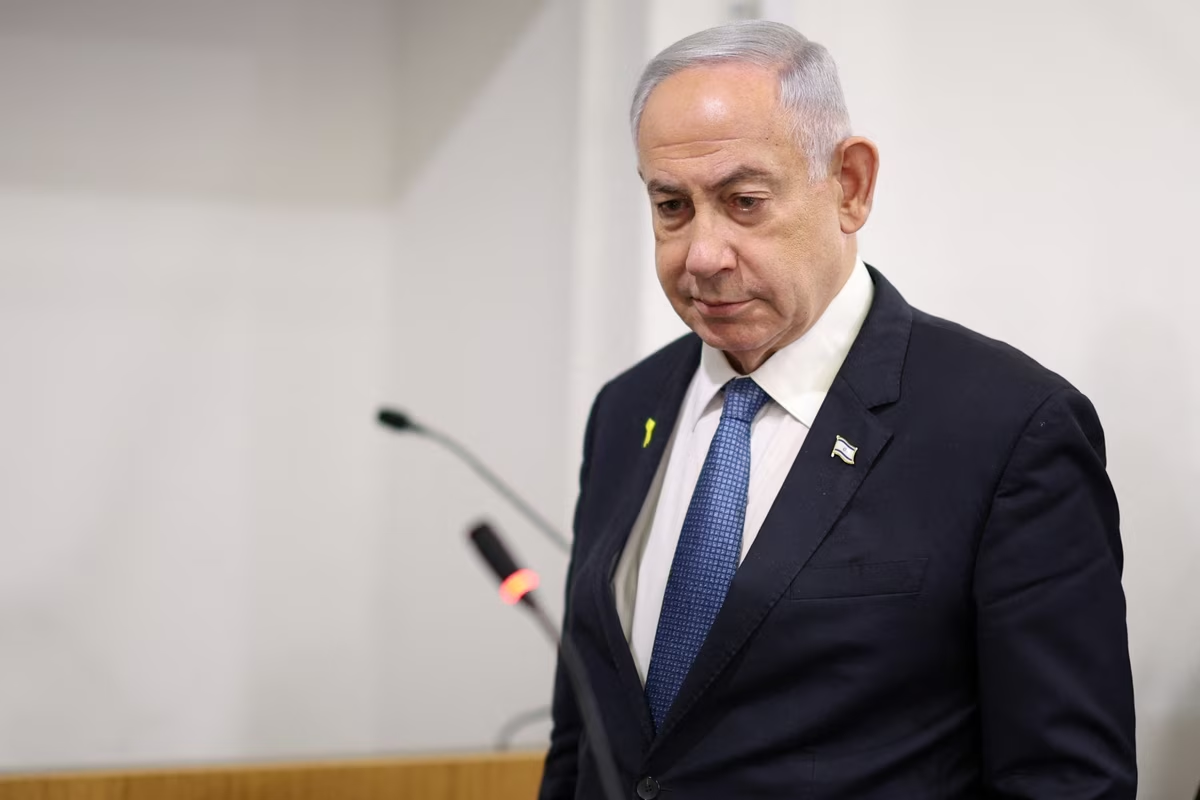
Washington, D.C. — The emerging U.S.-Iran agreement may ultimately be remembered not as a diplomatic breakthrough alone, but as a devastating indictment of the war that preceded it. If the deal succeeds, it will expose one of the most consequential strategic failures in recent Middle Eastern history: the ability of Israeli Prime Minister Benjamin Netanyahu to lure President Donald Trump into a costly confrontation that achieved virtually none of its stated objectives and ended precisely where diplomacy could have begun.
For more than twenty years, Netanyahu built his political identity around the argument that Iran represented an existential threat requiring relentless pressure and, if necessary, military action. He dismissed negotiations as naïve, portrayed compromise as surrender, and repeatedly urged Washington to abandon diplomatic engagement in favor of confrontation. Successive American presidents resisted him at various moments, recognizing the risks of another regional conflict. Trump ultimately did not.
The result was a war that generated destruction, economic uncertainty, and widespread fears of regional escalation while producing remarkably little strategic gain. Iran’s government remains in power. Its political system survived. Its military capabilities were damaged but not eliminated. Its influence across the region persists. Most importantly, Tehran has returned to negotiations without accepting the sweeping capitulation that advocates of military action had promised would inevitably follow.
That reality raises a simple but devastating question: if the conflict ends through negotiation, what exactly was the war supposed to accomplish?
The answer appears increasingly uncomfortable for Netanyahu and those who promoted confrontation. The war failed because it was built on flawed assumptions. Its architects believed that overwhelming pressure would force Iran into submission. Instead, the conflict demonstrated the limits of military coercion and reinforced a lesson repeatedly confirmed throughout modern history: wars often destroy lives and resources while leaving the underlying political problems unresolved.
The economic consequences were equally revealing. Even before any formal agreement was signed, markets responded positively to indications that tensions were easing. Expectations of stable shipping through the Strait of Hormuz and the gradual normalization of Iranian energy exports helped reduce anxiety in global markets. Investors welcomed diplomacy because diplomacy offered what war could not: predictability, stability, and economic opportunity.
For the United States, the agreement also underscores the extent to which American interests were never fully aligned with Netanyahu’s objectives. Washington’s priorities include global economic stability, secure trade routes, manageable military commitments, and avoidance of prolonged regional wars. Netanyahu’s priorities were different. His overriding goal was to keep Iran permanently isolated and to prevent any meaningful rapprochement between Washington and Tehran.
In that sense, the emerging agreement represents a direct repudiation of Netanyahu’s central strategic argument. For years he insisted that diplomacy with Iran was dangerous. Yet after months of fighting, Washington appears ready to embrace the very diplomatic process he spent decades trying to block. The irony is extraordinary. The war did not validate Netanyahu’s worldview. It discredited it.
More troubling is the question of how the conflict began. Trump entered office promising strength but also promising to avoid unnecessary wars. He frequently criticized previous administrations for costly foreign interventions that consumed enormous resources without producing lasting results. Yet Netanyahu successfully appealed to Trump’s instinct for projecting power, framing confrontation with Iran as both necessary and unavoidable. The result was a conflict that contradicted Trump’s own stated skepticism toward open-ended military adventures.
Now Trump appears prepared to support an agreement that implicitly acknowledges the failure of the very strategy he was encouraged to adopt. The administration’s apparent return to diplomacy suggests an unspoken recognition that military escalation could not achieve the political outcomes its advocates promised. That recognition inevitably raises questions about the judgment of those who pushed hardest for war in the first place.
The broader regional implications are equally significant. Saudi Arabia emerges from the crisis with enhanced diplomatic credibility, having maintained communication channels across multiple fronts while encouraging de-escalation. Pakistan’s reported role in facilitating dialogue highlights the growing influence of regional powers in shaping outcomes once dominated by Washington and other global actors. The crisis demonstrated that diplomacy increasingly depends on diverse coalitions rather than unilateral pressure.
The agreement may also reshape the strategic calculations of Russia and China. Years of sanctions and isolation pushed Tehran closer to both powers. Improved relations between Washington and Tehran would provide Iran with greater flexibility and potentially reduce its dependence on either Moscow or Beijing. Such an outcome would further illustrate how diplomacy can accomplish strategic objectives that military pressure often fails to deliver.
Perhaps the greatest political consequence concerns Palestine. Netanyahu long benefited from placing Iran at the center of regional discussions, often diverting international attention from the unresolved Palestinian question. A reduction in U.S.-Iran tensions could make that strategy harder to sustain. As the Iranian issue recedes, pressure may grow for renewed engagement with the realities of occupation, statehood, and Palestinian rights.
None of this guarantees lasting peace. The agreement could fail, hardliners could sabotage progress, and Netanyahu may continue efforts to undermine any rapprochement he considers threatening. Yet one conclusion already appears unavoidable. The war did not create the conditions for diplomacy; it merely delayed diplomacy while imposing immense costs. If the agreement endures, history may judge the conflict not as a necessary struggle for security, but as a tragic exercise in political manipulation, strategic miscalculation, and personal ambition. Its most enduring lesson may be that Netanyahu succeeded in selling Washington a war that never needed to be fought and could not deliver what it promised.
شارك برأيك
The U.S.-Iran Agreement: Netanyahu’s Failed War and the Diplomacy That Was There All Along