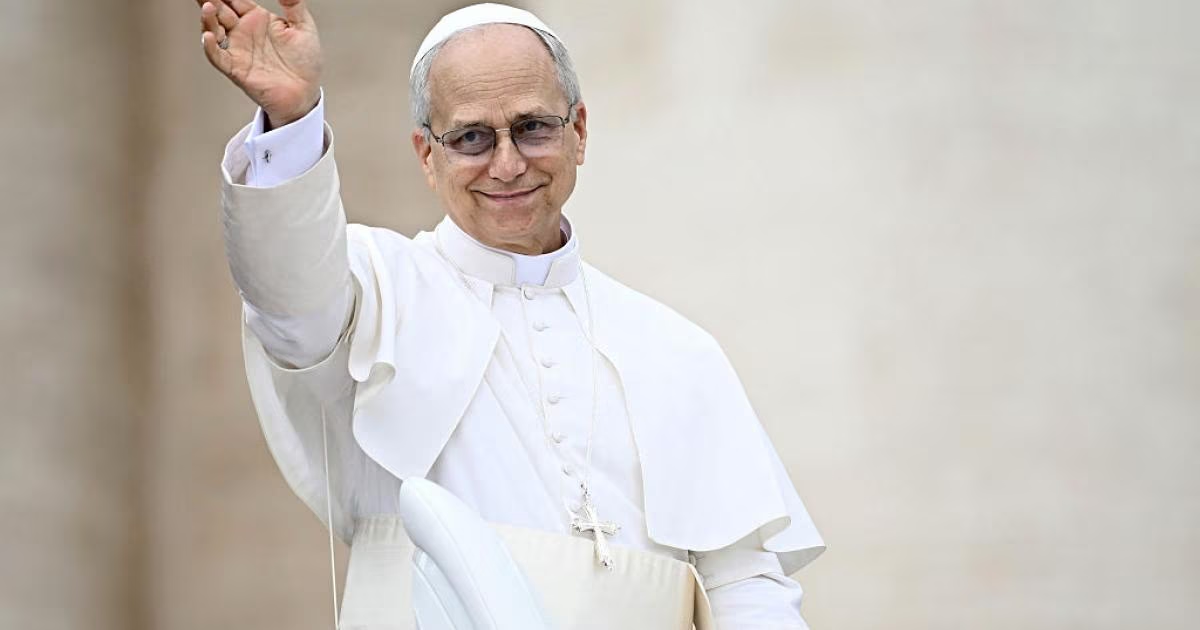







Since ascending to the Holy See in May 2025, Pope Leo XIV of the Vatican has pursued a cautious path towards the American administration, avoiding mentioning President Donald Trump by name until last March. This break from silence came in the form of a rare appeal to end military operations against Iran, warning of the escalating hatred in the Middle East. Reports reveal a deep chill in bilateral relations, with no meeting between the two parties yet, despite repeated invitations.
Pope Leo, who made history as the first pontiff of American origin, succeeded the late Pope Francis, who passed away in April 2025. Although his election was a source of pride for many Americans, including President Trump, expectations of a rapprochement quickly faded. Subsequent positions showed a radical divergence in ethical and political views on issues of immigration and international armed conflicts.
In a move reflecting the extent of the coolness, press sources reported the Pope's refusal of an official invitation to attend the celebrations of the 250th anniversary of the founding of the United States. Reports quoted Vatican officials confirming no intention to visit Washington as long as the current policies of the American administration continued. This stance comes despite the participation of senior American officials, such as J.D. Vance and Marco Rubio, in the Pope's inauguration ceremony in their capacity as Catholics.
Tensions escalated publicly after the Pentagon summoned the Vatican's representative to Washington, Cardinal Christophe Pierre, last January. This action came in response to the Pope's criticisms of the use of military force, with American officials informing the Holy See's representative that Washington had the ability to impose its will militarily. The United States Ambassador to the Vatican later attempted to downplay the incident, describing the meeting as a frank discussion about political ethics.
With the outbreak of the American-Israeli war on Iran on February 28, 2026, the confrontation entered a new phase of verbal and moral escalation. The Pope considered the recourse of leaders involved in the conflict to religious discourse to justify the war as utterly unacceptable. He emphasized in his homilies that 'God does not listen to those who make war,' a clear reference to rejecting the use of Christian symbols in armed conflicts.
On the ground, the war caused devastating human losses, including the assassination of senior Iranian leaders and the destruction of extensive infrastructure, which raised deep concern in the Vatican. The Pope expressed his profound sorrow for the killing of civilians, including Father Pierre Raad of the Lebanese town of Qleia, who died in an Israeli bombardment. These events prompted the Holy See to intensify its calls to stop the 'cycle of violence' that now threatens global stability unprecedentedly.
The Vatican strongly criticized what it described as 'power diplomacy' and the decline of international multilateralism in favor of military fervor that began to spread in various regions. The Pope warned that war had once again become 'the fashion of the age,' criticizing the undermining of state sovereignty and direct military interventions. These positions placed the Catholic Church as a moral force in direct confrontation with the military and political ambitions of the current American administration.
In contrast, the American administration was quick to respond, with the White House spokesperson describing the Pope's statements as weak, considering prayer for military personnel a noble act. This disagreement highlights the significant gap between the Vatican's vision of global peace and Washington's vision, which relies on military superiority. Observers interpreted this debate as a direct response to the US Secretary of Defense, who uses religious language associated with historical wars.
The final days of March witnessed an escalation in the Pope's tone, as he explicitly called on President Trump to seek a peaceful resolution to the conflict. This call came at a time when tensions were at their peak, with Washington threatening to completely destroy Iranian civilization. The Pope considered such threats unacceptable and contrary to the most basic human and religious values advocated by the Church.
Despite the announcement of a temporary ceasefire on April 8, doubts still surround the prospects for lasting peace given the complex conditions of both parties. Sources indicate that the first round of negotiations failed after long hours of discussions due to conflicting American and Iranian demands. The exclusion of the Lebanese front from the truce further complicated the humanitarian and political landscape in the region.
Incoming reports confirm that the American administration's bet on regime change in Tehran in a short period did not materialize, leading to increased global economic pressures. The closure of the Strait of Hormuz continues to cast a shadow over supply chains and energy supplies, putting the world before a suffocating economic crisis. In this context, the Vatican believes that military solutions have proven ineffective in achieving the desired stability.
This conflict brings to mind the legacy of the late Pope Francis, whose relationship with Trump was also strained due to immigration and climate change issues. It seems that Pope Leo XIV is following the same approach but with greater intensity imposed by the conditions of direct war. The current tension goes beyond political differences to reach the core of religious identity and how it is represented in the public sphere.
The Catholic Church continues to exert its moral pressure by calling on citizens of the concerned countries to contact their leaders to reject the option of war. The Vatican believes that solidarity with the victims in schools, hospitals, and residential areas is the primary duty under these circumstances. The Pope's calls for peace remain a cry against what he describes as the 'absurd claim' that conflicts can be resolved through armed force.
In conclusion, the world awaits what the coming days will bring amidst the fragility of the announced truce and the continued military buildup in the region. The Vatican's position remains firm in opposing the 'logic of force,' emphasizing that true peace is not built on the ruins of civilizations. With diplomatic channels remaining closed, the clash between the Holy See and the White House is poised for more chapters under an administration that places military power above all else.
God does not listen to the prayers of those who make war, and their hands are stained with blood.
شارك برأيك
Clash of Values and Interests: Pope Leo XIV Confronts Trump's 'Power Diplomacy' in the Iran War