






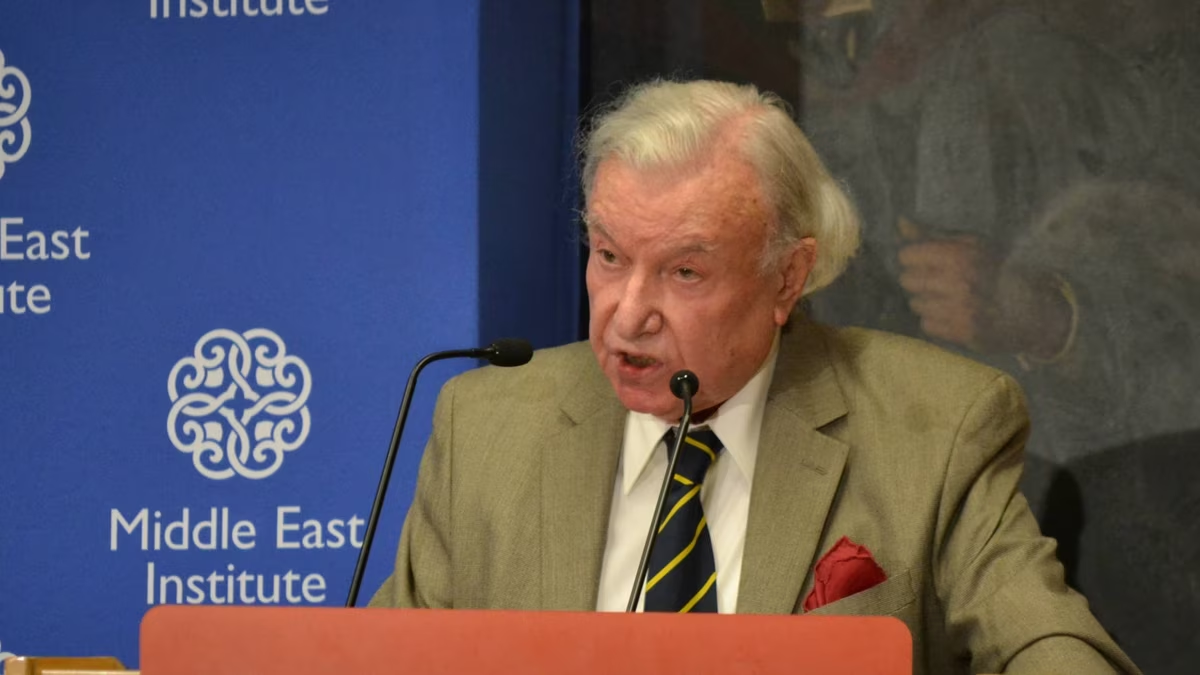
Palestine and international academic circles lost on Sunday the great historian and thinker Professor Walid Khalidi, who passed away in Cambridge, Massachusetts, at the age of 101. The deceased is considered one of the most prominent pillars of contemporary Palestinian thought, and one of the few who dedicated their scientific and practical lives to documenting the details of the Palestinian cause and the crimes of the Israeli occupation since the Nakba.
Palestinian President Mahmoud Abbas mourned the deceased with great sadness, praising his career full of national and intellectual contributions. The President affirmed in his statement that Khalidi was a faithful guardian of the Palestinian historical narrative, as through his rigorous research and his works, which were translated into several languages, he was able to prove the Palestinian right in international academic forums, pointing to his pioneering role in establishing major research institutions.
For its part, the Institute for Palestine Studies mourned its honorary president and one of its early founders, stressing that his passing represents a tremendous loss for the Arab and international libraries. The Institute indicated in its statement issued from its offices in Beirut, Ramallah, and Washington, that Khalidi remained, until his last years, an inspiring reference for researchers and scholars, and supervised the most precise details of research work related to the Arab-Israeli conflict.
Walid Khalidi was born in the heart of Jerusalem in 1925, where he grew up in a distinguished Jerusalemite family known for its knowledge and literature. He received his early education at the Friends School in Ramallah and then St. George's School in Jerusalem, before traveling to Britain to complete his higher education and graduate from the prestigious Oxford University in 1951, after which he began an exceptional academic career.
Khalidi held high academic positions, working as a lecturer in political studies at the American University of Beirut for three decades, then moving to work as a researcher at the Harvard Center for International Affairs. He also lectured at Princeton and Oxford universities and was elected a fellow of the American Academy of Arts and Sciences, reflecting the prestigious position he enjoyed in Western academic circles.
History records that Walid Khalidi was one of the first to lay the foundations of what is known as 'Nakba studies,' as he did not merely narrate events but delved into the analysis of Zionist documents. He was credited with exposing 'Plan Dalet' to the world in the 1960s, which was the main military plan implemented by Zionist gangs to occupy Palestinian cities and villages and displace their inhabitants in 1948.
Khalidi's works are indispensable references for any researcher on Palestinian affairs, foremost among them his encyclopedic book 'All That Remains' which documented the destroyed Palestinian villages, and the book 'Before Their Diaspora'. His scientific output exceeded forty books, in addition to hundreds of research papers and articles published in major peer-reviewed scientific journals around the world.
In 1963, Khalidi participated in the founding of the Institute for Palestine Studies in Beirut alongside Constantine Zurayk and Burhan Dajani, to be the first independent research institution specializing in Palestinian affairs. Under his administration, the Institute transformed into an intellectual beacon and a primary reference providing decision-makers and researchers with accurate information and deep analyses of the conflict.
The deceased received wide official recognition, as President Mahmoud Abbas awarded him the Star of Honor of the State of Palestine of the highest class in 2015. This honor came in appreciation of his scientific contributions that formed a cultural shield against attempts to falsify history, and in recognition of his role in consolidating Palestinian national identity through systematic scientific research.
Khalidi's contributions did not stop at official awards; he also received a special honor in 2025 with the Lifetime Achievement Award during the fourteenth session of the Palestine Book Award. The Journal of Palestine Studies also issued a special supplement on the occasion of his hundredth birthday, reviewing a century of intellectual contributions that never ceased despite the conditions of displacement and diaspora.
Khalidi's methodology was characterized by extreme precision and reliance on original archives, which made it difficult for Israeli historians to refute his conclusions. His efforts contributed to changing the perspective of many Western academics towards the roots of the conflict, as he presented the Palestinian narrative in a rigorous scientific language, devoid of mere emotion, which earned it international credibility.
Even after his retirement from Harvard University, Khalidi continued to follow the daily affairs of the Institute for Palestine Studies from his residence in Boston until 2017. He saw institutional work as the only guarantee for the continued defense of Palestinian rights, and he remained convinced that knowledge is the strongest weapon in confronting the settlement project.
Sources close to the deceased's family reported that his body will be laid to rest in the United States, with memorial services befitting his national stature to be held in Ramallah, Beirut, and Amman. Palestinian factions, national forces, and cultural institutions mourned him, considering his passing to close a chapter of the Palestinian intellectual struggle that spanned more than seven decades.
Walid Khalidi leaves behind a great legacy and students spread across universities worldwide who carry the torch of scientific research he ignited. His name will remain etched in the memory of the Palestinian people as one of the giants who were not broken by exile, nor deterred by the years from continuing the battle of consciousness and preserving collective memory from oblivion.
The deceased dedicated his life to defending the Palestinian historical narrative and documenting the history of Palestine and its people, and contributed to establishing the truth in international academic circles.



شارك برأيك
The passing of the great Palestinian historian Walid Khalidi.. A hundred years of documenting the Nakba and protecting the narrative