







Under a pale sun and in a rubble-strewn square in front of the gates of the Palestinian side of the Rafah crossing, white ambulances line up like last bridges of hope, trying to connect Gaza's pain with opportunities for healing abroad. The dust in the air does not obscure the details of the surrounding destruction, where shell-pierced buildings stand as silent witnesses to a forced escape from continuous suffering.
Behind the iron fence of the Palestinian Red Crescent hospital, children who have not yet reached their dreams watch the convoys of departing wounded with astonishment, considering these buses 'lifeboats' carrying their loved ones into the unknown. For these little ones, the crossing represents a harsh geographical and psychological divide, as they bid farewell to patients who may not be able to return home soon due to circumstances.
Inside one of the ambulances, young Mahmoud Al-Abd lay on a narrow bed, surrounded by oxygen tubes like fragile threads of life, while a paramedic wiped the sweat of pain from his forehead. Every movement in this place is precisely calculated, and every glance from the relatives of the wounded carries a silent question about the chances of survival and return amidst complex health conditions.
Hajja Khadija, Mahmoud's mother, summarized two years of suffering, explaining that her son sustained severe damage to the bone mass of his leg after a missile strike on his workplace in the Al-Bureij area. The mother recounts bitterly how other shrapnel lodged in his chest and stomach, making his treatment inside the Strip impossible, according to specialized doctors.
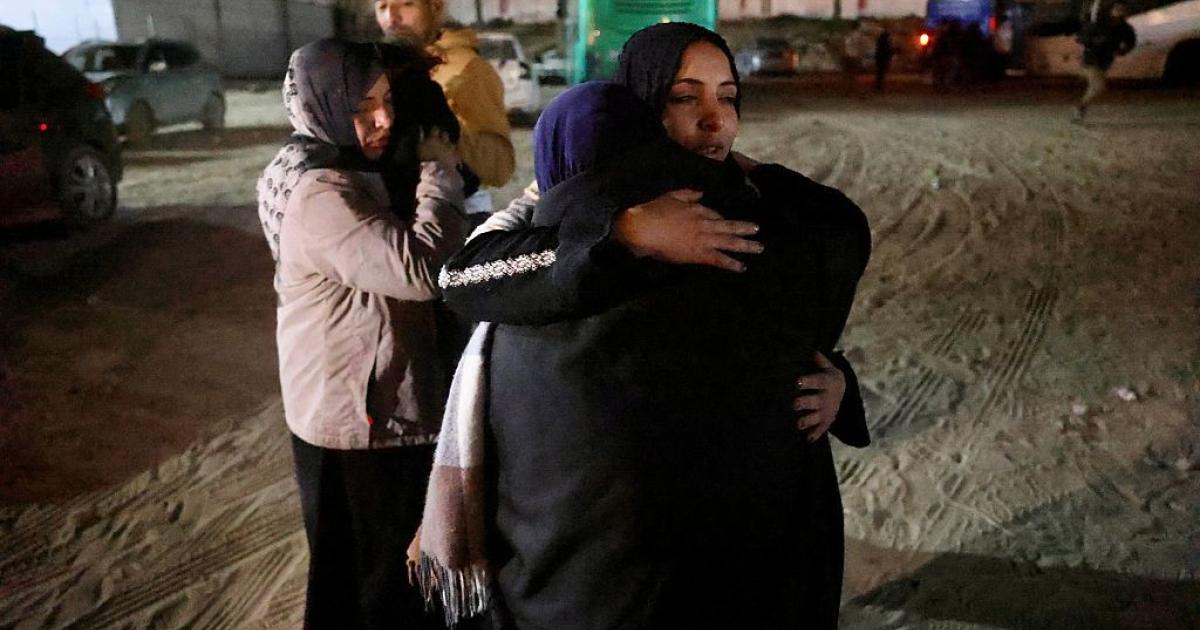
The mother adds, with tears filling her eyes, that separation is difficult for the soul, but the desire to see her son walk again overcame the pain of farewell. Mahmoud underwent numerous operations in Gaza hospitals, but the need for advanced reconstructive surgeries made traveling abroad the only remaining option to save his leg from amputation.
The Rafah crossing had seen a partial opening for humanitarian cases before being re-closed on February 2nd for security reasons imposed by the occupation authorities. This mechanism allowed about 60 patients to pass daily, but the sudden closure returned thousands of names to long and harsh waiting lists, exacerbating the deterioration of critical cases.
Mahmoud Al-Abd was one of the few who were lucky enough to cross days before the last closure, where he confirmed to journalistic sources his insistence on remaining composed in front of his mother despite his severe pain. He recalled the moment he was hit by a missile while installing solar energy systems, describing feeling a burning heat in his body before losing all sensation in his limbs.
Behind Mahmoud's story, the tragedy of thousands of other wounded, like Mohammed Ayyad, who was injured in the Shuja'iyya neighborhood and suffers from a fractured femur, emerges. Mohammed is still waiting for his name on travel lists for months, indicating that the pain increases daily as he sees the dream of treatment close behind the borders but cannot reach it.
In the Nuseirat camp, young Abdul Rahman Abu Awda faces the risk of losing the ability to move due to a precise injury to the spinal nerves. Doctors confirmed his need for urgent surgery, the capabilities of which are not available in Gaza, making every day of delay an additional step towards permanent disability.
For his part, Dr. Samer Hamdan from Al-Shifa Hospital explained that Mahmoud Al-Abd's case represents a model of complex injuries that require specialized intervention in international bone reconstruction centers. Hamdan warned that the severe shortage of equipment and staff within Gaza makes it impossible to deal with severe bone damage and associated neurological complications.
Data from the World Health Organization and the United Nations Office for the Coordination of Humanitarian Affairs (OCHA) indicate that more than 18,000 patients and wounded in Gaza are in urgent need of medical evacuation. UN estimates confirm that the current pace of evacuation is too slow and disproportionate to the scale of the health catastrophe, putting thousands of lives at immediate risk.
In turn, Amjad Al-Shawa, director of the network of non-governmental organizations, considered that preventing the wounded from traveling represents a blatant violation of international humanitarian law, which guarantees the right to treatment. Al-Shawa stressed that the restrictions imposed on the movement of individuals and medical equipment have led to a near-complete collapse of the health system, necessitating the immediate opening of safe and sustainable medical corridors.
The reality of the 'medical exodus' in Gaza turns borders into a harsh test of patience and hope, where healing becomes a dream suspended between the rubble of war and the bars of waiting. Every ambulance that leaves leaves behind hundreds of families raising their hands in prayer, awaiting the moment when the gates will open again to save what can be saved from bodies exhausted by war.
As Mahmoud's car moves away towards the other side, Hajja Khadija stands in her place, watching the dusty trail of the vehicle with tearful eyes. She is one of thousands of mothers who face the daily fate of waiting, amidst a bitter health reality that makes traveling for treatment a journey fraught with risks and tears.
I know my mother is in more pain than I am, but I have to travel; I just want to return standing on my feet again.
شارك برأيك
The Exodus of Pain at the Gates of Rafah: 18,000 Wounded Face Death Awaiting 'Lifeboats'