






The Director-General of the International Atomic Energy Agency (IAEA), Rafael Grossi, announced that the agency has not yet observed any concrete evidence indicating damage to Iran's nuclear infrastructure as a result of recent attacks. These statements were made during the opening of an extraordinary session of the IAEA Board of Governors in Vienna, dedicated to discussing escalating tensions and threats facing Iran's nuclear program amidst ongoing military operations.
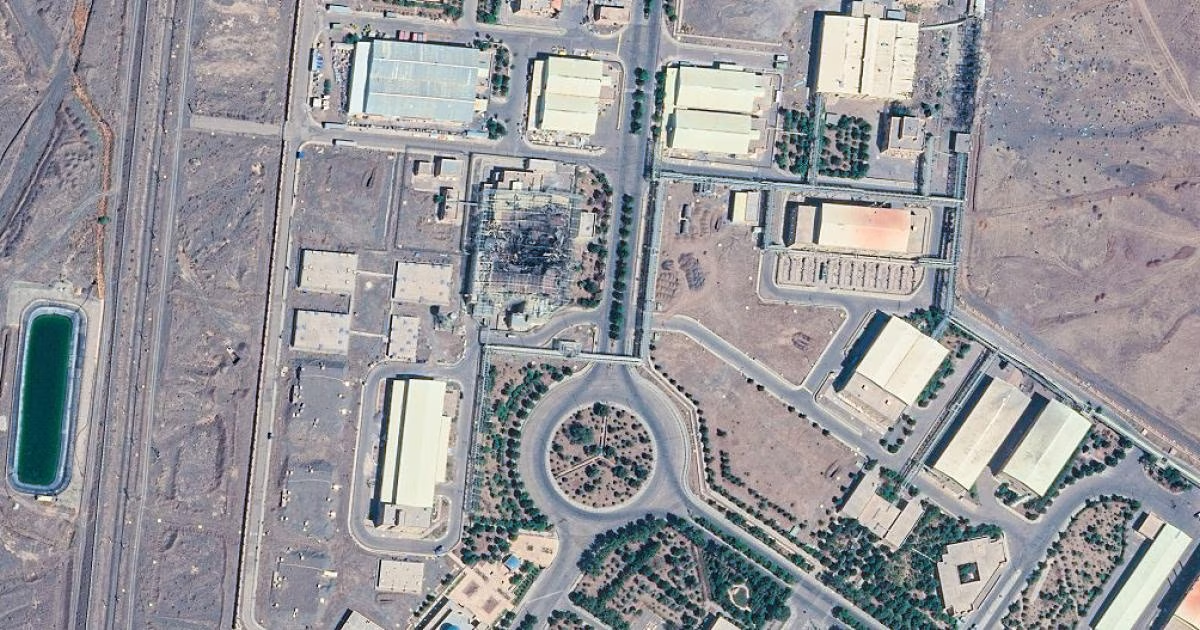
In contrast, the Iranian Ambassador to the IAEA, Reza Najafi, presented a different account confirming a direct targeting of the vital Natanz uranium enrichment facility. Najafi clarified that Tehran officially informed the Director-General via a message from the head of the Atomic Energy Organization of Iran, stating that the facility, which is subject to international safeguards, had been subjected to military aggression during the latest wave of Israeli and American attacks.
Grossi, in his address to member states, emphasized the necessity of exercising maximum restraint to avoid the region sliding into an unprecedented nuclear catastrophe. He indicated that initial assessments included the Bushehr power plant and the Tehran research reactor, confirming that technical communication channels with the Iranian side still face difficulties in rapid response, expressing hope for full coordination to be restored as soon as possible.
The Director-General of the agency warned that the continuation of military operations in the vicinity of nuclear facilities raises the risk to critical levels that could lead to widespread radioactive leakage. He added that the repercussions of such a scenario would not be limited to the targeted sites but could necessitate forced evacuations of residents from major cities, posing an existential threat to regional and international security.
The international warning was not limited to inside Iran but extended to include nuclear facilities in neighboring countries that could be affected by the armed conflict. Grossi pointed to the presence of four civilian nuclear reactors in the UAE, in addition to research reactors in both Jordan and Syria, considering all these sites to be within the circle of security concern as a result of the continuous military escalation.
These developments follow a request by Russia and Iran to hold an emergency meeting of the Board of Governors, which includes 35 member states, to discuss the repercussions of attacks on sensitive facilities. This extraordinary meeting precedes a regular session of the Board, reflecting the state of diplomatic alert to confront the possibilities of the conflict getting out of control in the nuclear file.
Reports indicate that the Natanz site, which is the backbone of Iran's enrichment operations, has been a repeated target of military and cyber operations in recent years. The latest Iranian accusations further complicate the scene, especially since Tehran considers the targeting of its internationally protected facilities a grave violation of conventions and norms that exempt nuclear sites from armed conflicts.
In a related context, sources reported that international concern is growing about retaliatory actions that could affect vital energy facilities in the region, potentially igniting a comprehensive regional war. The IAEA is closely monitoring any field movements or changes in radiation levels through monitoring stations, in an attempt to ensure that nuclear facilities do not become tools in the ongoing military conflict.
The possibility of a radioactive leak with serious consequences cannot be ruled out, which means the need to evacuate areas the size of major cities or larger.
شارك برأيك
Conflicting Reports on Targeting of Natanz Nuclear Facility and International Warnings of a Radiation Catastrophe