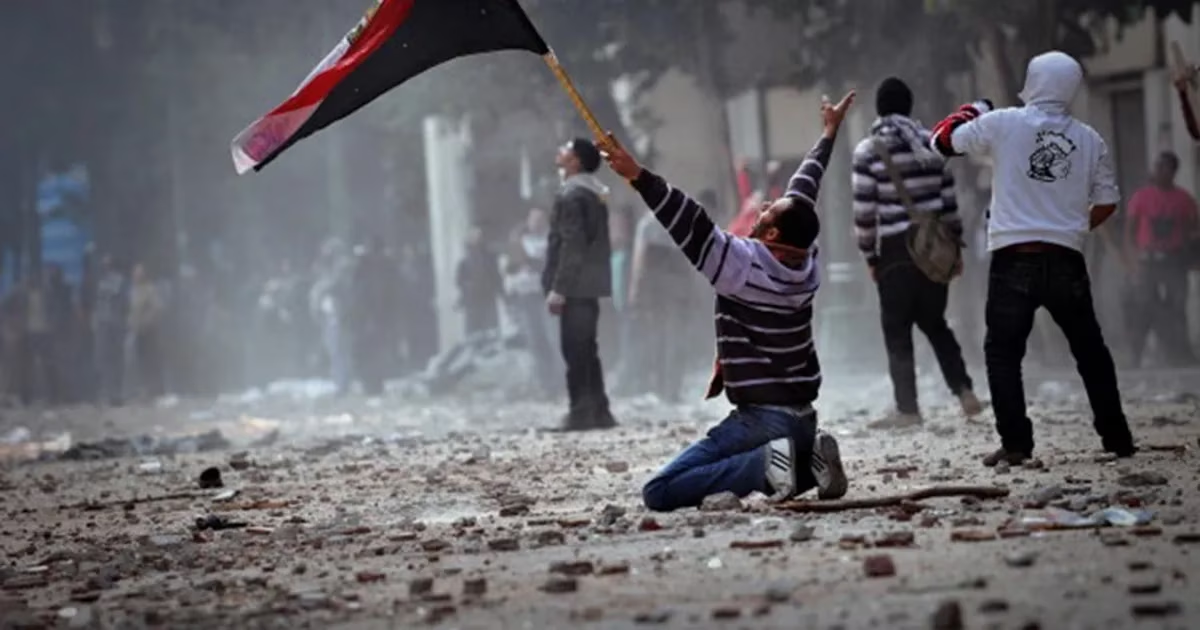







Discourse strategy is one of the fundamental pillars upon which revolutionary situations and exceptional transitional phases are based, with its levels varying between public, political, and media affairs. Analysis indicates that distinguishing between these levels requires in-depth studies of vocabulary and contexts to ensure scientific and practical effectiveness in influencing the masses.
The entirety of the discourse of Islamic movements stemmed from perceptions and understandings marred by some imbalances, which made the resulting discourse afflicted with ailments that limited its ability to achieve desired goals. The political arena witnessed adverse outcomes in many scenes due to the inadequacy of this rhetorical performance in addressing complex realities.
It is observed that the Arab revolutions, in their entirety, lacked a clear strategic discourse, which allowed for the emergence of conflicting discourses that created division instead of unity. This absence led to an imbalance in communication tools with the revolutionary situation, causing the paths of change to falter and lose their compass midway.
One of the most prominent observed errors is the lack of attention to the discourse of 'people's livelihoods' and their daily issues, as the forces that participated in power focused on the purely political aspect. This oversight created a loophole through which counter-discourse penetrated to cast doubt on achievements and create a state of hatred and demonization for national projects.
The discourse that touches the aspirations of the people is one that sincerely expresses the values of living, human dignity, and social justice. This discourse must pay special attention to the groups targeted by impoverishment policies and rising prices, to counter attempts at subjugation through intimidation and starvation.
Social and political organizations face a significant challenge in developing a discourse that keeps pace with the current stage and leverages the context to confront fierce media attacks. The ability to influence the masses requires a deep awareness of how to build popular support around a project that expresses the hopes and pains of the street.
Authoritarian regimes entered the conflict over religious discourse, attempting to promote special editions of religion that serve their interests and create a religious backing for their tyranny. This intervention led to the state's nationalization of religion and its political exploitation to strike opponents and justify repressive policies.
The phenomenon of political exploitation of religion emerged through the establishment of official and semi-official institutions that support autocratic regimes, in addition to exploiting certain religious orientations such as the Madkhali and some loyal Salafi currents. These forces used accusatory language and created hatred towards opposing formations to justify arrest and persecution.
Analyzing and self-reviewing discourse is a vital matter for Islamic currents, as it must be based on a conscious critique of past practices. This requires adopting a discourse of transparency with other political forces to determine the minimum consensus to confront counter-revolutions.
The upcoming discourse strategy must be based on the 'two-leg theory,' which is the balance between the political leg and the revolutionary leg without prioritizing one over the other. This balance is capable of preparing the ground for change and restoring the popular base that has lost confidence in traditional discourses.
Renewal in Islamic discourse represents an intrinsic necessity, and it requires recalling solid intellectual contributions such as those presented by Dr. Abdelwahab El-Messiri in 'Milestones of the New Islamic Discourse.' Building a comprehensive strategy requires integrating questions related to revolution, international relations, and societal effectiveness.
Previous discourses suffered from structural ailments and shortcomings in comprehension, as they were affected by a collective psychological state characterized by political one-upmanship and machinations. These complexities led to the failure of elites to build positive relationships based on consensus and trust, which weakened the entire revolutionary situation.
In contrast, the discourse of military coups relied on falsification and distortion to justify control over state institutions and economic arenas. This negative discourse contributed to the militarization of society and institutions, and exerted immense pressure on the Islamic phenomenon through paths of temptation and distortion.
In conclusion, the true renewal of discourse must stem from the principles of civilizational self-renewal, far from being dazzled by or subservient to others. 'Nurseries of change' require formulating a strategy that considers objectives and possesses the effectiveness to engage with people's concerns, and resist all forms of conventionality and intellectual stagnation.
The lack of a discourse strategy led to the process of change moving along paths, some of which went astray, and many of which distorted reality.
شارك برأيك
The Crisis of Discourse in Political Movements: Between Authoritarian Exploitation and the Necessities of True Renewal