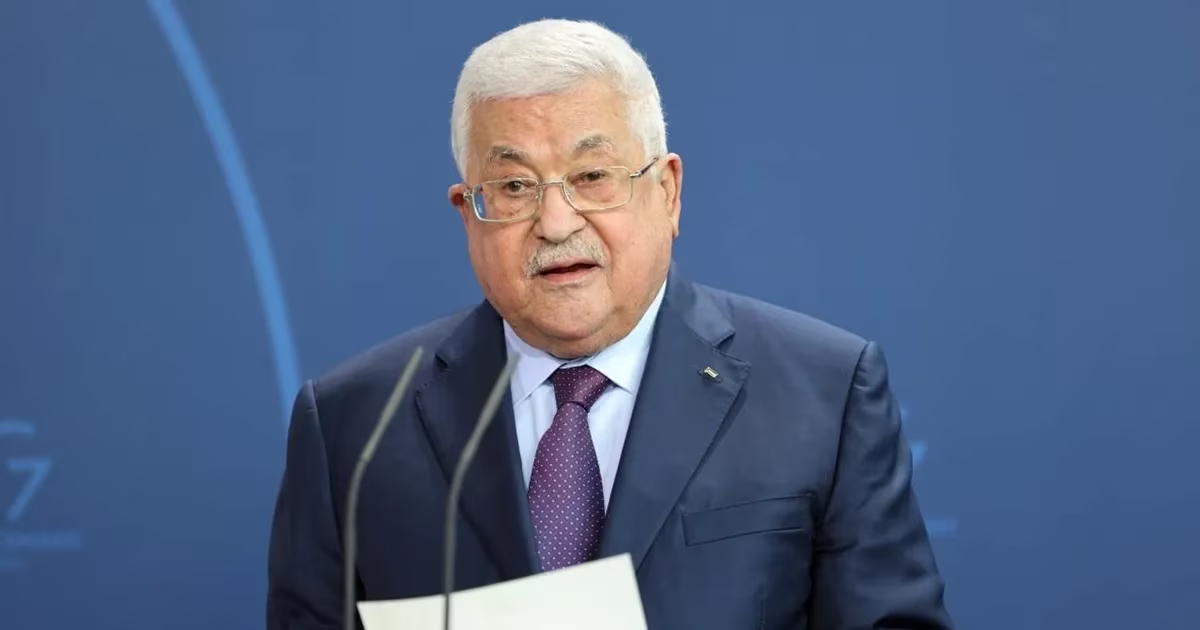







The presidential decree issued by Palestinian Authority President Mahmoud Abbas regarding holding general elections has sparked a wave of Israeli analyses questioning the feasibility of this step and its repercussions on regional stability. The decree called for elections for the Palestinian National Council on November 1, 2026, to include Palestinians in the West Bank, Gaza Strip, and the diaspora, according to a full proportional representation system.
In this context, Israeli writer Segev Steinberg, communications director at the 'Jerusalem Center for Foreign Affairs and Security,' published an article in 'Maariv' newspaper in which he considered these steps to outwardly appear as a response to international demands for PA reform. However, Steinberg believes that the initiative is doomed to fail, describing it as a 'survival mechanism' for an authority suffering from a severe erosion of its popular legitimacy.
These moves coincide with May 14, 2026, being set as the date for the eighth General Conference of the Fatah movement in Ramallah, while the Palestinian government had previously announced local elections in April of the same year. Observers believe that including the Gaza Strip in these election dates represents a significant logistical and political challenge given the absence of effective PA control over the Strip since 2006.
The Israeli analysis was based on shocking digital data from opinion polls conducted by the 'PSR' institute, headed by Khalil Shikaki, which revealed that between 80 and 88 percent of Palestinians are demanding President Abbas's departure. The results show that the Palestinian street views the current PA institutions as entities lacking true representation and suffering from structural crises and administrative corruption.
Regarding party balances, hypothetical parliamentary election polls indicated an overwhelming lead for the Hamas movement, which could garner about 60 percent of the votes. In contrast, Fatah's support does not exceed 30 percent, threatening a repeat of the 2006 election scenario that overturned Palestinian political balances.
Despite the widespread destruction witnessed in the Gaza Strip in recent months, the writer believes that the Hamas movement has not lost its popular momentum; rather, it has managed to strengthen it in some circles. About 53 percent of Palestinians still support the movement's strategic decisions, considering that it has achieved tangible successes in prisoner issues and confronting Israeli military pressures.
In the West Bank, data indicates that 87 percent of the population opposes the idea of disarming factions, with a clear tendency to support the continued presence of armed forces as a guarantee for achieving political gains. These figures reflect a deep gap between the international vision of a 'renewed authority' and the aspirations of the street, which sees armed resistance as a more effective path than the faltering diplomatic one.
Steinberg recalled the 2021 experience, when Abbas announced legislative elections and then backed down, citing the issue of Jerusalem, which Hamas exploited to present itself as the leader of the national project. The writer believes that the current announcement of polling stations in devastated Gaza may be merely a 'propaganda maneuver' aimed at creating future justifications for postponing the electoral process again.
The article touched upon the state of exhaustion in the Gaza Strip and the desire for reconstruction, noting that the rise in support for the two-state solution to 61 percent does not necessarily mean acceptance of the PA's conditions. Rather, this support is conditional on the continued effectiveness of armed forces, which makes any political horizon proposed by Ramallah lack the credibility and legitimacy necessary for implementation on the ground.
The analysis concluded with a warning to the political level in Israel and the West against betting that the democratic process will automatically lead to strengthening the 'moderate camp.' Steinberg considered that the existing reality indicates that elections, if held, could become the bridge through which Hamas crosses to consolidate its political and legal influence over the ruins of the current Palestinian Authority.
Elections may turn into an additional tool to consolidate Hamas's influence instead of a genuine renewal of Palestinian governance.
شارك برأيك
Israeli warnings of 'political suicide': Abbas's elections could grant Hamas absolute legitimacy