






News Analysis
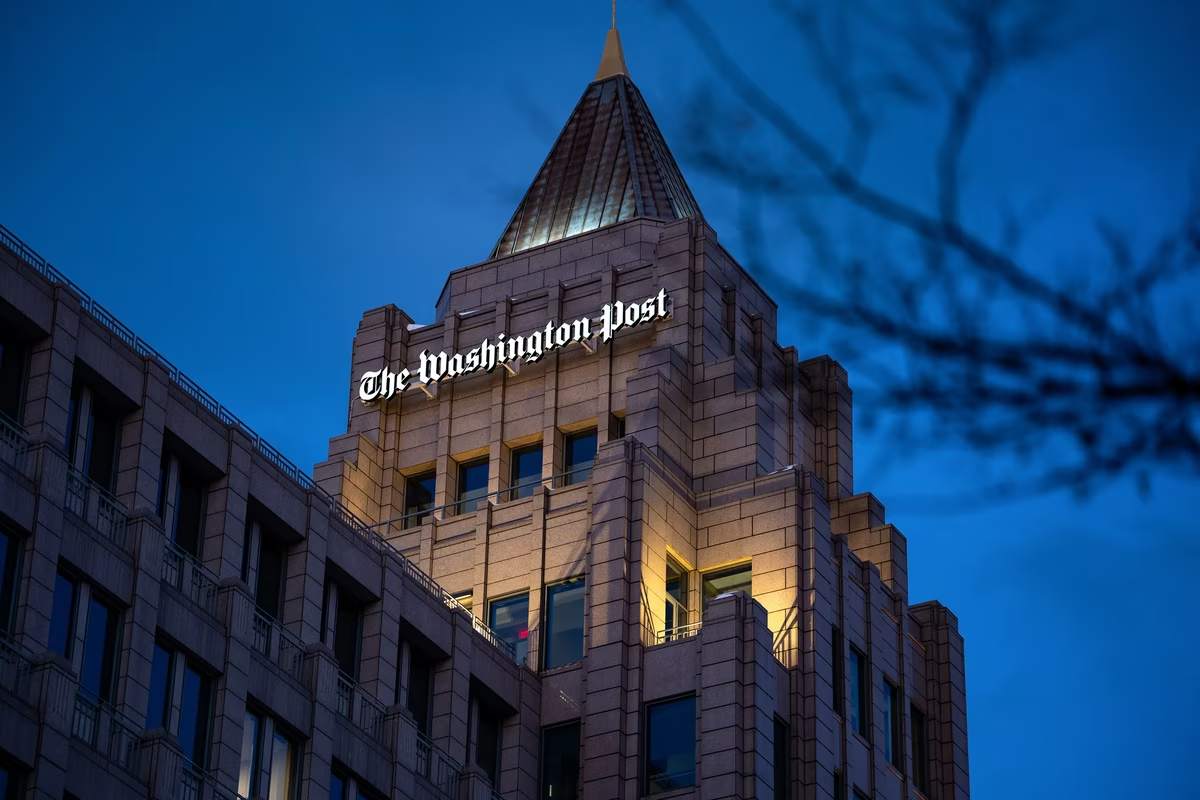
In a move that signals a profound transformation in the identity of one of America's most venerable journalistic institutions, The Washington Post management announced a widespread wave of staff reductions and newsroom restructuring. This decision will affect most departments and will practically lead to a reduction in the newspaper's local and international presence, and the closure of editorial units that were a fixed part of its professional structure.
During a comprehensive phone call with employees on Wednesday morning, Matt Murray, the executive editor, along with Wayne Connell, chief human resources officer, stated that "every department across the newsroom will be affected to some degree." According to a recording of the call circulated within media circles, the plan includes closing the sports and books sections, suspending a political podcast titled Post Reports, in addition to restructuring the "Metro" team responsible for covering the capital and its suburbs. Murray clarified that the number of editors would be "significantly" reduced, and the art and design teams would be merged, in a move he described in a tone that seemed closer to an admission than a justification: "These moves are painful... this is a difficult day."
However, the most significant item was the management's announcement to reduce the newspaper's international footprint, while maintaining a "strategic external presence" in "about a dozen locations," with a stated focus on national security issues. This shift, which may seem like resource organization, is interpreted within the institution as a gradual contraction of field journalism in favor of "major files" journalism that is managed from offices rather than created from the ground.
In this context, the decision to cancel the newspaper's correspondent position in occupied Jerusalem stood out among the terminations that affected the entire Middle East coverage team, a decision that goes beyond being an administrative measure. Jerusalem, with its political, religious, and symbolic centrality to the conflict, is not just a point on the international coverage map, but an area where news intertwines with history, and reality with narrative, requiring a steady journalistic eye on the ground, not "remote coverage" managed from capitals.
In addition to Jerusalem, the layoffs affected Ukraine bureau chief Siobhán O'Grady and correspondent Lizzy Johnson, reflecting a broader trend towards reducing field coverage in conflict zones, at a time when international journalism should be more, not less, necessary. The list of laid-off journalists also included prominent journalists such as Ishaan Tharoor, Isha Do, Jesus Rodriguez, Dino Grandoni, and Nilo Tabrizy, who had only days earlier received professional acclaim for his personal coverage of events in Iran, in addition to Caroline O'Donovan, who covered Amazon, as well as the entire Middle East team.
Although Murray emphasized that political and government coverage would remain the "largest part" of The Washington Post's operations, he spoke of a long-overdue "strategic reset," saying that the institution "has not evolved its model or its operations as it should," and that the crisis is not the result of "a single event" or an "easy blame point," but rather long accumulations. However, this discourse seemed to many within the newsroom closer to an attempt to arrange the narrative after the shock, rather than a convincing explanation for its causes.
Rumors of layoffs had been circulating for weeks, but the sense of danger was older than that. One employee described the crisis management method as closer to "psychological warfare," while another said that media links discussing the reductions were circulated within the institution "as if they were secret publications," and that the general feeling was like "a guillotine hanging over their heads." Nevertheless, the same employee added, the newspaper "was doing good journalism," which made the shock double: rising professional performance against a declining administrative decision.
Fingers of blame within the institution point towards Jeff Bezos, the Amazon founder who bought the newspaper in 2013, and to Will Lewis, the publisher who took office in 2024, coming from Rupert Murdoch's media environment. One employee described Lewis as "better at talking than building." In an attempt to contain the anger, Murray said he wanted to be "clear" that the newspaper's commitment to "high-impact journalism that holds power accountable without fear or favor" remains "steadfast," affirming his confidence that this commitment "reaches the highest levels of the company."
But this official language clashed with a strongly worded statement from Marty Baron, the former executive editor, who said that what is happening is "among the darkest days in the history of one of the world's greatest news organizations," warning that the newspaper's ambitions "will be severely curtailed," and that the public will be deprived of "fact-based field reporting" in American society and around the world.
In the background, many within The Washington Post view Bezos's recent decision to withdraw the editorial board's endorsement of Kamala Harris as a pivotal moment. In the days following the decision, more than 250,000 readers canceled their subscriptions. Journalists believe that the financial crisis was already present, but that step deepened the crisis and led to a mass exodus of subscribers, in parallel with the management's failure to create new revenue sources.
Sensitivity also increased after the FBI raided the home of journalist Hannah Natanson in the context of a leak investigation, with employees expressing particular dismay that Bezos "said nothing," at a moment when ownership was supposed to stand behind its journalists.
The deeper irony is that what is happening is not just layoffs, but a redefinition of what journalism is in the age of billionaire owners. When an institution transforms into a project managed by brand logic rather than public service logic, the less profitable sections—such as sports, books, and international coverage—become the first victims, even though they are what give the newspaper its cultural and human depth. The danger is that the editorial role will be reduced to "national security and Washington politics," making journalism closer to an eye for power than a watchdog over it.
The crisis also reveals the paradox of the AI era: the technology that was supposed to relieve pressure on newsrooms has become a factor accelerating the erosion of their revenues through a culture of "summaries" that draws audiences away from the original source, and then is later invoked as a ready excuse for staff reductions. But what management ignores is that the solution does not lie in more deletions, but in restoring trust and repairing editorial identity. Journalism that removes its correspondent from occupied Jerusalem and closes culture and sports units does not just lose employees; it gradually relinquishes a fundamental part of its ability to tell the world as it is: from the field, not from behind screens.
شارك برأيك
Dismantling The Washington Post and Redefining Journalism Within the Newsroom