






Washington – Said Arikat
News Analysis
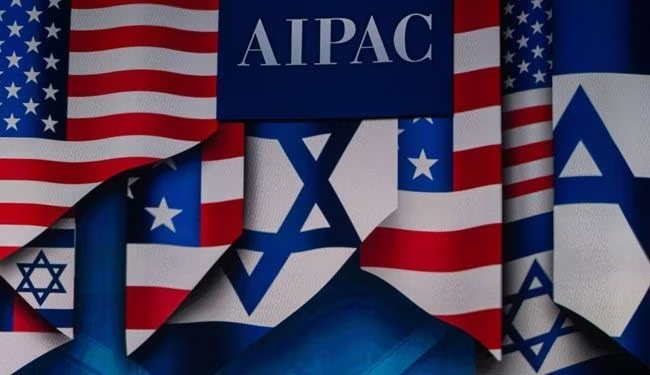
The disagreement with the "American Israel Public Affairs Committee" (AIPAC) is no longer confined to traditional critics of Israeli policies; it now extends to yesterday's allies themselves, whenever they show even limited hesitation in granting unconditional support to Israel. This was revealed in a New York Times report, which turned an early local election race in New Jersey into an explicit testing ground for the influence of political money, and for the narrow definition of "loyalty" within American politics.
The race is for a vacant congressional seat, but what is happening in it transcends its geographical boundaries. A super PAC known as "United Democracy Project," AIPAC's electoral arm, launched an aggressive advertising campaign against Tom Malinowski, a former Democratic congressman who was long classified among traditional supporters of Israel in Congress. The targeting did not come from his ideological opponents, but from the entity that previously supported him, in a scene that summarizes the profound shift in the behavior of pro-Israel lobbying groups.
The advertisement, which began airing weeks before a rare primary election held in February, attacked Malinowski under the pretext of his vote on legislation related to funding federal immigration law enforcement, in an attempt to link him to harsh deportation policies attributed to the Donald Trump administration. However, this pretext seemed flimsy, even contradictory, given the man's well-known fierce opposition to Trump, and his personal history as a former immigrant from communist Poland. It soon became clear that immigration was merely a cover, and that the real motive was deeper and more explicit.
According to those behind the campaign, Malinowski's actual "sin" lies in his hinting at the possibility of linking US aid to Israel with political or human rights conditions. This stance, which until recently was considered part of a legitimate debate within the Democratic Party, has become, in AIPAC's logic, a departure from the ranks, and even a sufficient reason to launch a costly exclusion campaign. Thus, support for Israel is no longer enough in itself, unless it is complete, absolute, and unquestionable support.
In this sense, the campaign does not express a fleeting disagreement, but rather a strict redefinition of the boundaries of what is "acceptable and unacceptable" politically. According to AIPAC's new definition, there is no room for the middle ground, and no recognition of multiple forms of support. Either full alignment without conditions, or exclusion from the "club of supporters." This is a shift that reflects the organization's transition from building broad alliances within both parties to imposing a narrow loyalty test that tolerates no differentiation.
The committee has spent more than $800,000 in this race alone, a huge sum in a local primary election involving 11 candidates. This financial generosity cannot be separated from a broader context, as AIPAC spent nearly $35 million in the 2024 elections, and contributed to the defeat of prominent progressive representatives such as Jamaal Bowman and Cori Bush. However, the irony in New Jersey is that this attack may benefit an explicitly progressive candidate, Analilia Mejia, known for her sharp criticism of the war on Gaza, which sometimes exposes the counterproductive effect of electoral intimidation policies.
Malinowski's response was not without warning, as he considered that narrowing the definition of "support for Israel" to this extent would ultimately empty it of its content. Prominent Jewish leaders criticized this approach, including Jeremy Ben-Ami of "J Street," who warned that turning political disagreement into a tool of exclusion could generate anger that extends beyond Israel to affect the American Jewish community itself. Former US Ambassador to Israel, Daniel Shapiro, also described the campaign as misleading and dishonest.
At the heart of this battle is a question simple in its formulation, profound in its implications: Is American support for Israel an absolute right that is not to be debated, or a policy that, like others, is subject to ethical and legal standards? AIPAC's insistence on the first answer, and the demonization of anyone who adopts the second, does not reflect strength as much as it reveals the fragility of a discourse that cannot tolerate dissent.
Malinowski's case reveals a more dangerous shift in the role of lobbying groups, from influencing policies to attempting to engineer the democratic landscape itself, by drawing the boundaries of debate and determining who has the right to run and who should be excluded. In this equation, not only are opponents punished, but a clear warning is issued to allies: thinking aloud may come at the cost of political execution.
Thus, limited-participation local elections become a mirror of the future of American politics, where the influence of external money is increasing, and the margin for legitimate disagreement is shrinking. The question is no longer who wins at the ballot box, but who has the power to determine the options available to voters in the first place, and who imposes on them a monolithic definition of loyalty that recognizes only one hundred percent support.
شارك برأيك
AIPAC Targets Former Allies Under the Pretext of Their Lack of Blind Support for Israel