






Published an exclusive in-depth report on how Israel is working to undermine the new Syrian government.
The report, prepared by four of the newspaper's correspondents from Jerusalem, states that Israel's strategy for carrying out its covert operations against the Syrian government includes supporting Druze militias to enhance their role in the region and confront Damascus's influence, in addition to occupying strategic areas and conducting airstrikes to prevent weapons from reaching Damascus.
The report indicates that Israeli operations in Syria began immediately after the overthrow of Bashar al-Assad's regime in December 2024, as Israel viewed Syrian President Ahmed al-Sharaa as a continuing threat to it, given his history and previous affiliations, prompting it to develop covert strategies to deal with him.
The most prominent Israeli activities, according to the report, were providing comprehensive support to Syrian Druze militias from the outset. On December 17, 2024, Israeli helicopters began transporting shipments of weapons and military equipment to southern Syria.
These shipments included 500 rifles, ammunition, and body armor, which were airdropped to arm a Druze militia called the "Military Council." This support comes as part of efforts to back the Druze, a religious minority with long historical ties to Israel.
In addition to the arms shipments, the report adds, Israel provided monthly financial payments ranging from 100 to 200 dollars to approximately 3,000 Druze fighters, with the aim of enhancing their capabilities in confronting Syrian government forces.
Furthermore, the report notes that Druze fighters, including women, continued to receive training before the fall of the Assad regime in the Kurdish areas in the north of the country by the Syrian Democratic Forces, a militia led by Kurds that maintains close relations with Israel.
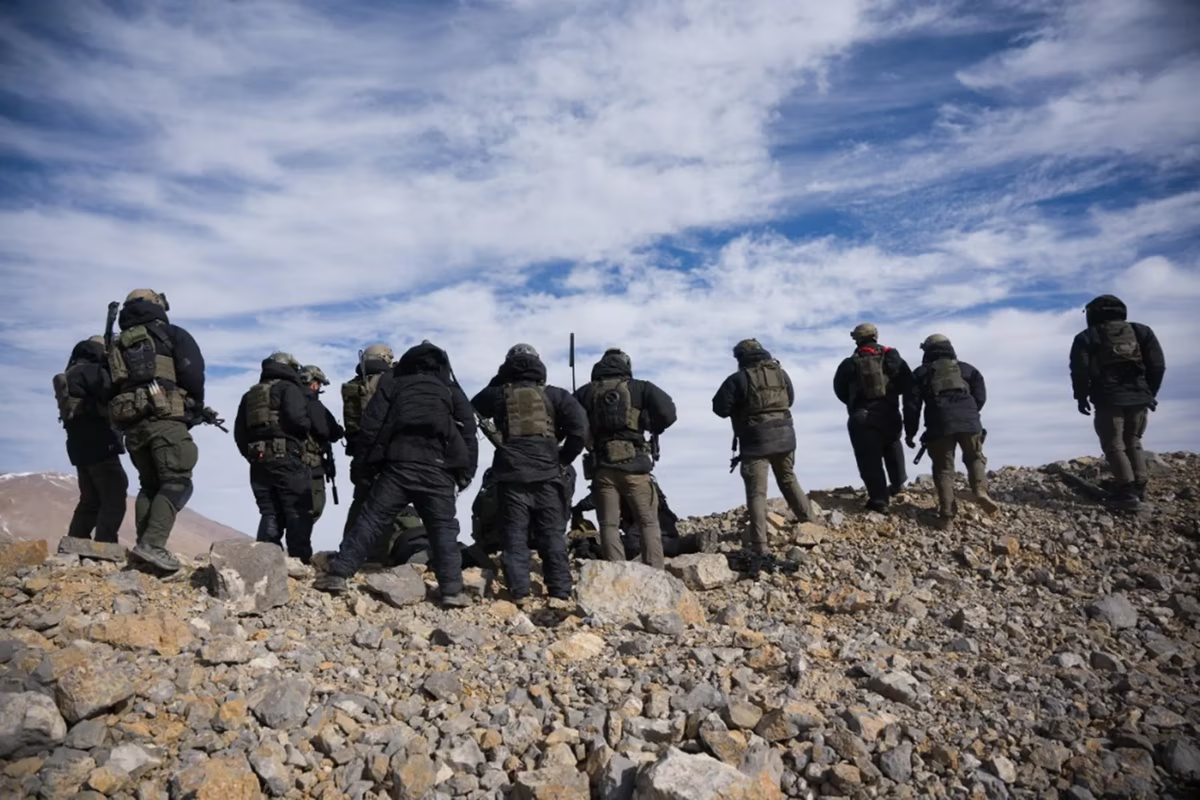
Upon the fall of Assad, Israeli ground forces quickly moved to occupy 155 square miles of Syrian territory, including additional sites on Mount Hermon, a strategic peak on the Syrian-Lebanese border.
In addition, the Israeli Air Force launched hundreds of airstrikes on Syrian military facilities to prevent the new government from accessing weapons, to weaken its ability to unify the country.
The other aspect of this strategy lies in supporting Druze figures such as Sheikh Hikmat al-Hijri, who called for secession and affirmation of Druze self-rule, and received Israeli support in this endeavor.
The report mentioned that al-Hijri prepared maps for a proposed Druze state extending to Iraq and presented them to at least one major Western government in early 2025.
However, some internal conflicts emerged among Druze leaders, leading to rifts within the Druze community. For example, Tariq al-Shoufi, leader of the "Suwayda Military Council" and former officer in the Assad regime's army, was accused of collaborating with al-Sharaa, forcing him to hide for fear of arrest by al-Hijri's men.
At the same time, al-Hijri and his son faced accusations of involvement in kidnapping operations and dealings with regional drug trafficking networks, including Hezbollah.
Israel understood from the beginning that achieving "power balance" in Syria requires precision in execution and tactical flexibility; therefore, it continued to provide humanitarian aid and non-lethal military supplies such as medicines and protective vests to Druze fighters, and in late September, Israeli helicopters secretly transported these aids to Suwayda.
At the same time, Israel sought to benefit from negotiations with al-Sharaa, aiming to secure a form of self-rule for the Druze within any future security agreement.
Al-Sharaa sometimes rejected Israel's demands, such as disarming the southern Damascus area, but expressed readiness to reach a de-escalation agreement when necessary.
The report explains that Israeli activities in Syria provoked sharp tension with the Syrian government and also with US President Donald Trump's administration, which considers support for al-Sharaa part of its strategy to achieve stability in Syria. It also led to widespread criticism from several countries in the region that view these steps as threatening the stability of the Middle East.
The newspaper noted al-Sharaa's confirmation, in a recent interview with it in Washington before his meeting with Trump at the White House, that Israel's "expansionist" policy prolongs the conflict and threatens the entire regional security, including Jordan, Iraq, Turkey, and Gulf countries.
The report says that Israel's goals in Syria include providing support to the Druze as a religious minority facing threats amid a complex conflict, and not allowing a new system hostile to Israel to unify Syria and turn into a future threat.
It stated that there is strong support within Israel for intervention in Syria by the security establishment and the army as a means to enhance regional security and achieve stability. This support is led by prominent figures such as the Israeli Druze Hasson Hasson, former Israeli brigadier general and presidential military secretary, who advocated for comprehensive intervention to support the Druze and turn them into reliable allies for Israel.
The report confirmed that Israel faces, despite its well-studied strategies and ongoing support, major challenges in achieving its goals in Syria, the most prominent of which are continued coordination with other international powers, maintaining a precise balance in relations with various factions in Syria, and dealing with increasing criticism from the international community and regional countries.
The newspaper said in its report that Israel realizes that heavy reliance on Druze factions may not be sustainable in the long term, due to internal conflicts among Druze leaders and the fragility of their internal situations, therefore, it adopts a pragmatic approach that relies on continuous adaptation and rapid response to changing conditions on the ground.
The newspaper concluded that Israel's covert activities and its policy towards supporting the Druze remain directed towards achieving deeper strategic objectives, such as shaping the balance of power in Syria and preventing the emergence of new threats on its borders with Israel.
Israel's "expansionist" policy prolongs the conflict and threatens the entire regional security, including Jordan, Iraq, Turkey, and Gulf countries.
شارك برأيك
How is Israel working to undermine the new Syrian government?