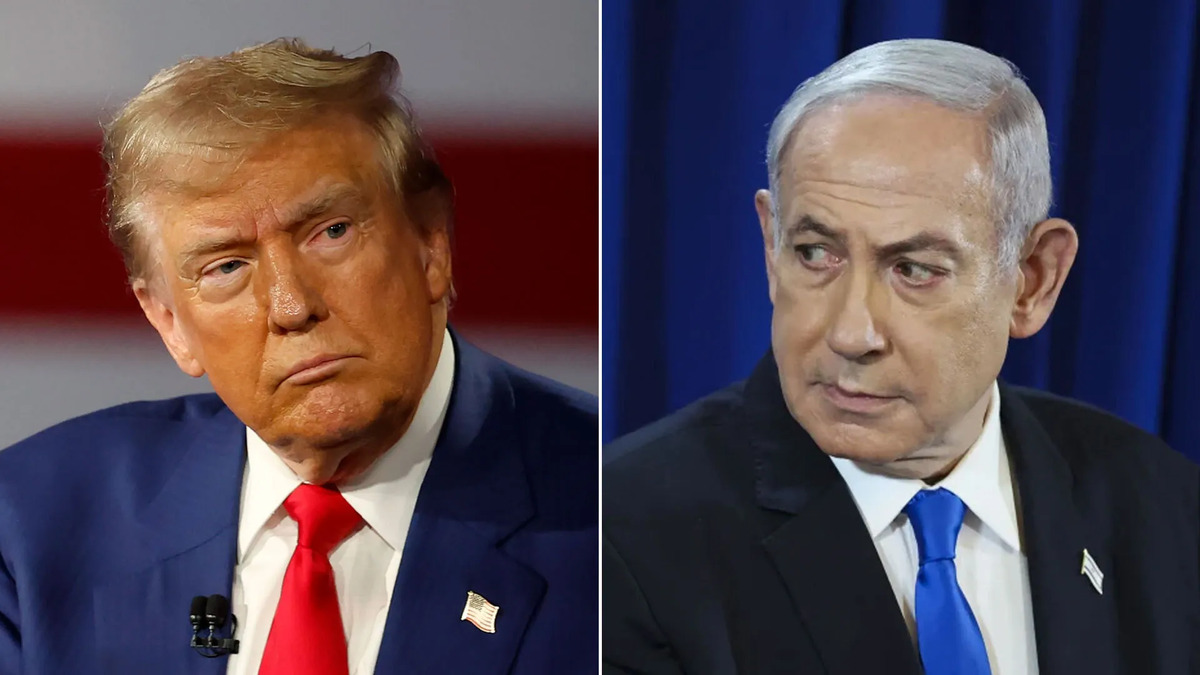







Israeli media reported what it described as a harsh reprimand directed by U.S. President Donald Trump at Israeli Prime Minister Benjamin Netanyahu during communications between them regarding his plan to end the war in the Gaza Strip and return Israeli prisoners.
Political affairs correspondent for Channel "12" in Israel, Barak Ravid, reported that Trump made a phone call to Netanyahu last Friday after receiving reports from his team indicating that the response from the Islamic Resistance Movement (Hamas) to the U.S. proposal included positive signals allowing for continued negotiations.
However, according to Ravid, Netanyahu responded skeptically, saying that "Hamas's response is meaningless and does not warrant celebration."
Ravid explained that Trump was furious at Netanyahu's pessimistic tone, sharply asking him: "Why are you always negative?" adding that this stance clearly reflects that what is happening now is the implementation of Trump's plan, not Netanyahu's.
In the same context, strategic and political advisor Attila Somfalvi revealed that Trump did not limit himself to a verbal warning but sent a series of consecutive messages to Netanyahu and his aides, telling them: "Every two hours you will receive something from me... a tweet, or a map, or a statement, or a recording."
He added that Trump spoke directly to Netanyahu, saying: "You and your entire group that you call a small council and government need to get in line, for you are now part of my plan, not the other way around."
Former advisor to Defense Minister Barak Sari considered Netanyahu's recent optimistic statements an attempt to cover up the reality of his submission to pressures from Washington.
He explained that the Israeli Prime Minister realizes that the ongoing operation cannot be stopped, so he seeks to market it internally as a personal achievement for Israel, even though it is essentially a direct implementation of Trump's vision.
Sari added that Netanyahu is trying to convince public opinion that "the deal is good and agreed upon with Trump," while the latter, he said, has put him in a reality where he threatened him clearly with political bombardment through media and statements if he does not adhere to Washington's directions.
For his part, the head of the Palestinian studies department at Tel Aviv University, Mikhail Milshtein, noted that recent days have revealed a fundamental shift in the U.S. position.
He said that "Trump has clearly adopted Qatar's position, which differs from his previous statements, making Doha's influence more dramatic than ever."
Milshtein pointed out that observers in the Arab world are wondering about the reason for the sudden shift in Washington's position, but what is certain, according to him, is that "Qatari influence in the negotiation process has increased after the Israeli media attack on it, which has strengthened its position in the regional equation."
In a related security analysis, the newspaper "Yedioth Ahronoth" quoted military affairs analyst Ron Ben-Yishai as saying that security agencies in Israel feel there is a real opportunity for the proposed deal to succeed, but they also realize that Hamas will seek to finalize it completely before giving up the prisoner card, which represents its most significant element of strength.
Ben-Yishai noted that this awareness makes Hamas move cautiously, seeking prior guarantees to prevent a repetition of previous scenarios where the other party's commitments were lost, complicating the task of mediators despite Washington's optimism.
In contrast, senior researcher at the American "Rand" Institute, Shira Afron, confirmed that Hamas's positions have not fundamentally changed since the beginning of negotiations, as she stated, it refuses to disarm or make concessions that affect the essence of its strength, adding sarcastically that "this will only happen if Christ returns and a Palestinian state is declared."
Commenting on the course of negotiations, researcher at the Israeli National Security Institute, Ofer Shelach, said that the chances of the deal's success are directly linked to Trump's commitment to his firm stance towards Netanyahu, explaining that the Israeli Prime Minister would not dare to rebel as long as the U.S. president is sticking to his plan.
Shelach viewed the issue not as a disagreement over details but rather as a test of Washington's ability to impose political discipline on its allies in Israel, adding that "Trump's endurance is what will ultimately determine the outcome."
You and your entire group need to get in line, for you are now part of my plan, not the other way around.


شارك برأيك
Israeli media: Trump told Netanyahu you need to behave or I will bomb you.