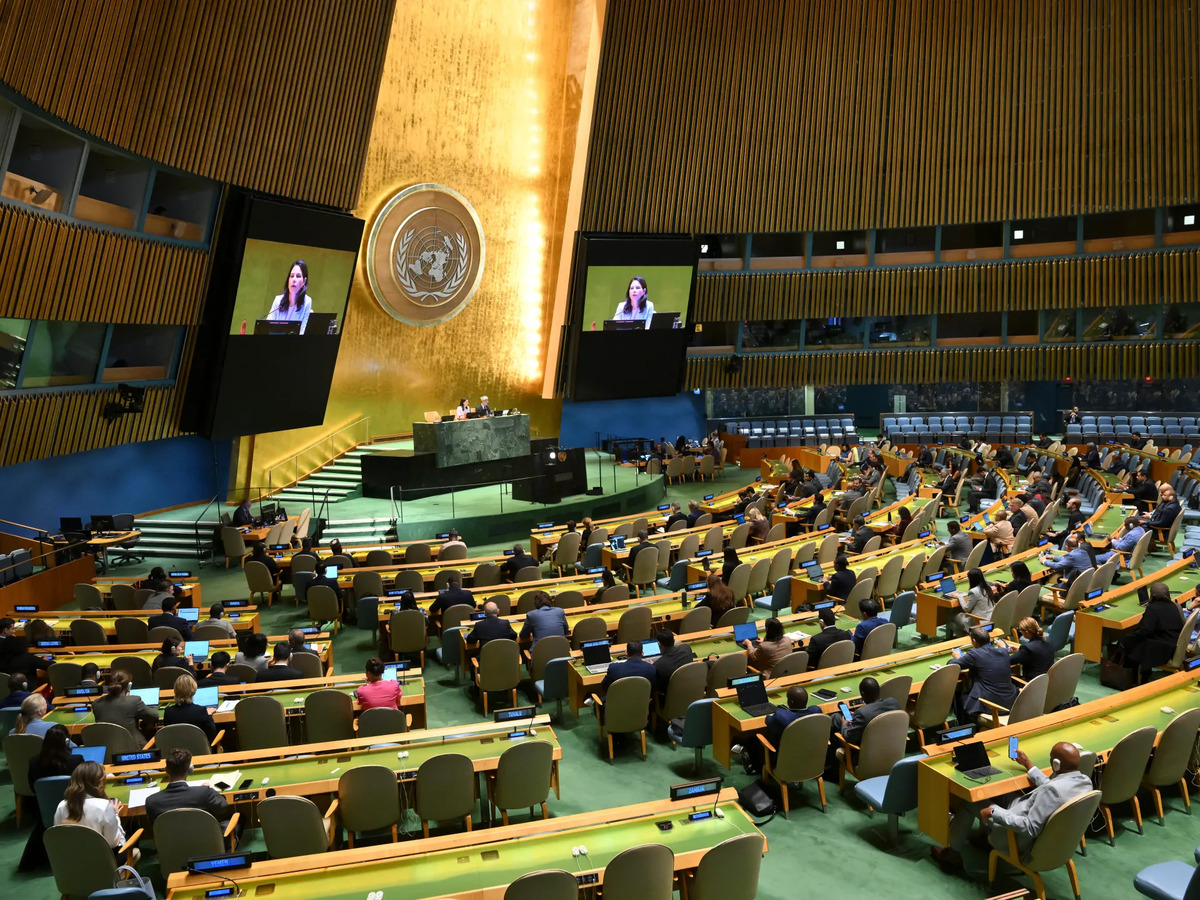







World leaders gather in New York every September to deliver speeches over several days at the United Nations General Assembly, which begins its eightieth session on Tuesday.
World leaders will seek solutions to global challenges in order to promote peace, security, and sustainable development, under the theme "Better Together: 80 Years and More for Peace, Development, and Human Rights."
After 8 decades since its establishment, the United Nations remains the only place on Earth where countries can meet to address their differences and find common ground that contributes to shaping their shared future.
The United Nations was founded in 1945 with the original membership of 51, and its membership has since increased to 193.
Leaders of two non-member states with observer status - known in the UN as the Holy See and the State of Palestine - as well as a member observer, the European Union, can also speak.
It has been customary for Brazil to always be the first member state to speak.
This is attributed, according to UN officials, to Brazil having volunteered to speak first in the early years of the international organization when other countries were hesitant to do so.
As the host country of the UN headquarters in New York, the United States is the second country to deliver its speech at the General Assembly.
From there, the list is arranged based on hierarchy and order of appearance.
Leaders are asked to adhere to a voluntary time limit of 15 minutes.
According to UN records, one of the longest speeches delivered during the opening of the General Assembly was in 1960 by Cuban leader Fidel Castro, who spoke for nearly 4 and a half hours.
Each session of the General Assembly has a specific theme.
Leaders may briefly address the specified theme before moving on to any other issue of their choosing.
This year's theme is "Better Together: 80 Years and More for Peace, Development, and Human Rights."
Other topics likely to be addressed by leaders include Gaza, as leaders gather with the war in Gaza nearing its two-year mark.
Israeli Prime Minister Benjamin Netanyahu is scheduled to deliver a speech at the General Assembly next Friday.
Palestinian President Mahmoud Abbas will not attend in person as the United States, a strong ally of Israel, has stated it will not grant him a visa.
Ukrainian President Volodymyr Zelensky will seek global support for Kyiv.
Iranian President Masoud Bezhashkian and Foreign Minister Abbas Araghchi are expected to head to the United Nations.
Syrian President Ahmad al-Shara will participate for the first time this year in the United Nations General Assembly.
Some leaders are likely to discuss the ongoing war in Sudan next week.
As the world struggles to curb global warming, leaders of small island states and other countries most affected by climate change are expected to urge action once again.
One day before the speeches begin, leaders will gather on Monday to celebrate the thirtieth anniversary of a historic women's rights conference.
Next year, the United Nations will select a new Secretary-General.
The United Nations remains the only place on Earth where countries can meet to address their differences.
شارك برأيك
Who will speak at the United Nations and what is the agenda?