ARAB AND WORLD

Tue 23 Jun 2026 7:11 am - Jerusalem Time

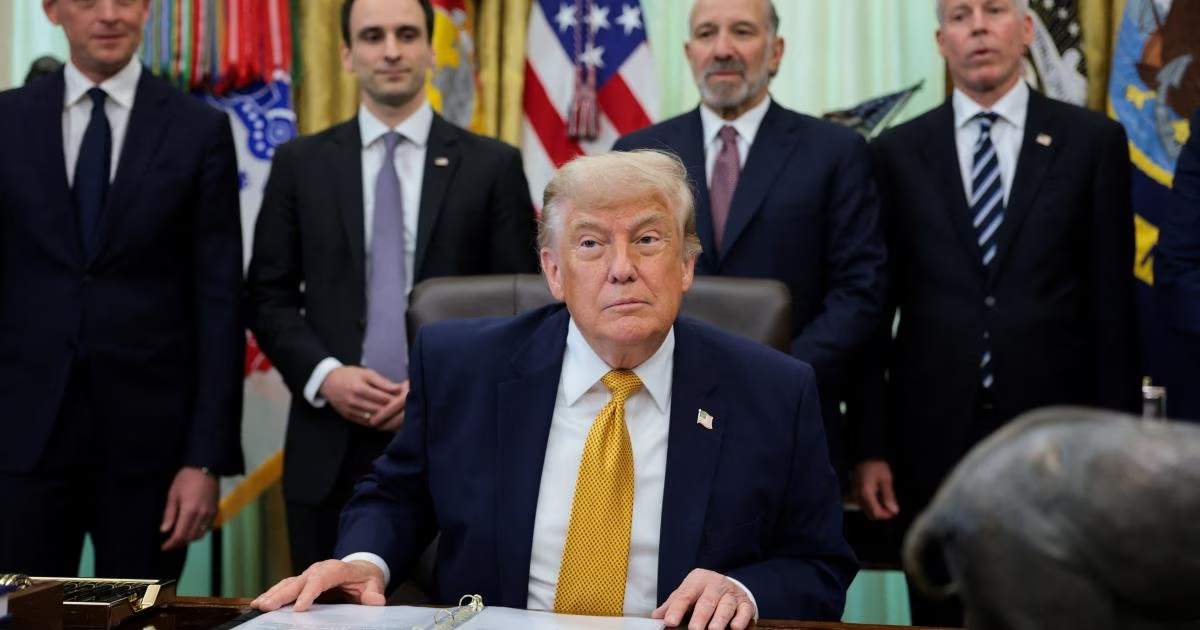
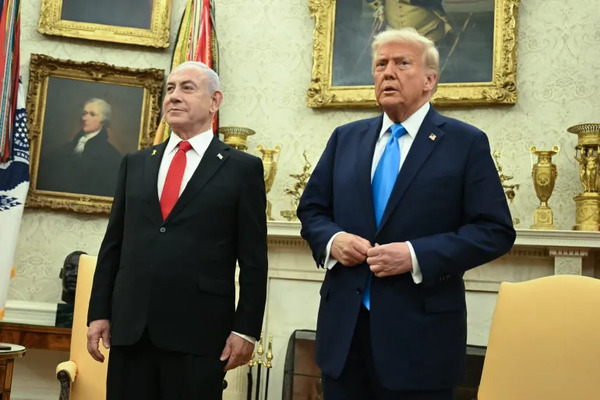
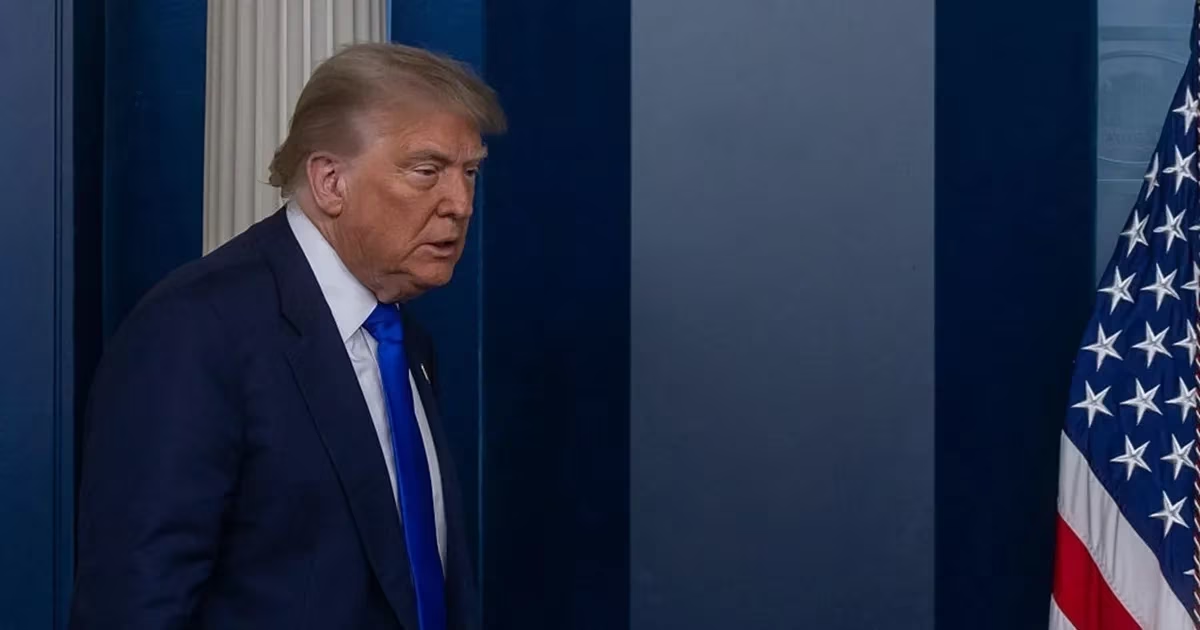
Trump threatens military option against Iran, stipulates purchase of food from American farmers

US President Donald Trump issued a stern warning to the Iranian leadership, emphasizing that the United States would not hesitate to take all necessary measures to ensure Tehran's adherence to its international commitments. Trump clarified that Washington is closely monitoring Iranian behavior and will not hesitate to act in a manner it deems appropriate to protect its interests and regional security.

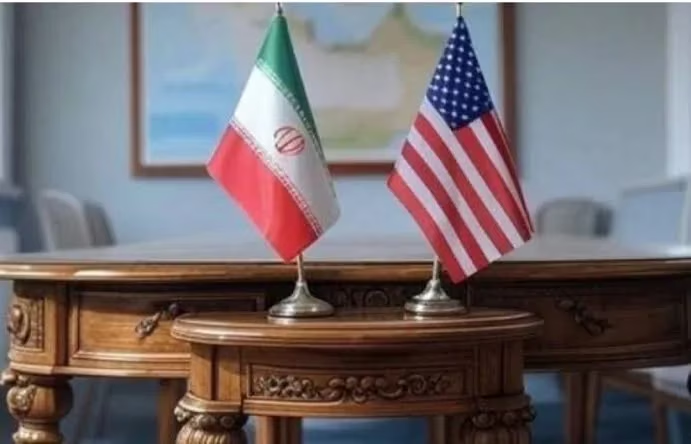
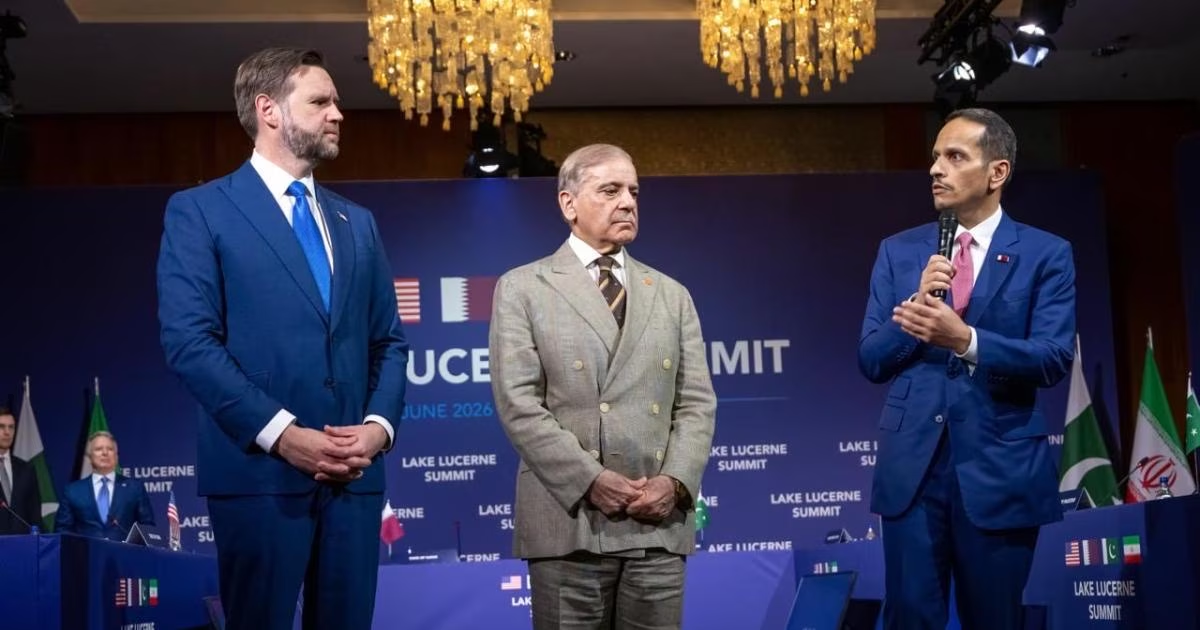
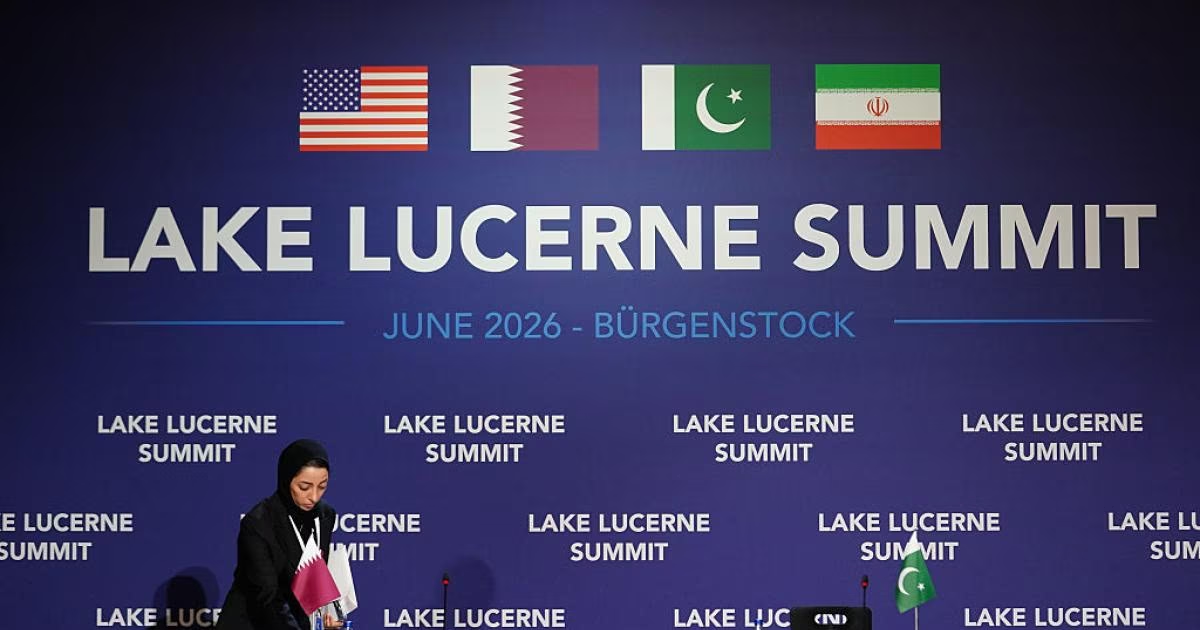
These statements follow an intensive round of negotiations hosted at the Bürgenstock Resort in Switzerland last Sunday, bringing together delegations from the United States and Iran. These talks fall under what is known as the 'Islamabad Memorandum of Understanding,' primarily aimed at ending the declared US-Israeli state of war against Iranian targets.

For their part, Qatar and Pakistan, as key mediators in this diplomatic process, confirmed that the negotiations had made 'encouraging progress,' inspiring cautious optimism. The participating parties agreed to extend the discussions until the end of this week, with the establishment of a technical mechanism to follow up on outstanding issues and ensure the implementation of initial understandings.

In a press conference held on Monday, Trump responded to journalists' questions about the possibility of resorting to military force if the diplomatic path fails. He clearly stated that Iran's non-compliance with the agreement or inappropriate behavior would compel him to do 'what needs to be done,' a clear reference to the tough options the US administration has on the table.

Regarding concerns about a potential economic crisis or global recession resulting from possible military action, the US President downplayed these expectations. Trump considered that the threat posed by Iran's possession of a nuclear weapon far outweighs any economic damage that might be inflicted on global markets, describing a nuclear weapon as an imminent and rapidly impactful danger.

Trump also revealed details concerning frozen Iranian funds that might be released as part of the deal, clarifying that they would be subject to strict conditions. He indicated that Tehran would be obliged to use this liquidity exclusively to purchase food products from the United States, which would directly benefit the American agricultural sector.

The US President further elaborated on his economic perspective, pointing out that Iran, with a population of about 91 million, suffers from severe food crises. Accordingly, the released funds would translate into massive purchases from American farmers, ensuring that these amounts are not diverted to finance military activities or destabilization.

In a related context, J.D. Vance, the US Vice President, made statements confirming that Washington would adopt the principle of 'actions, not words' in its assessment of the Iranian side. Vance expressed satisfaction with the progress made, especially regarding Tehran's preliminary agreement to allow international inspectors to monitor its controversial nuclear facilities.

Despite this satisfaction, Vance stressed that allowing inspectors access is merely a first step that requires scrutiny of the powers granted to them within Iranian sites. He affirmed that the United States would work to strengthen oversight mechanisms to ensure Iran's inability to develop a nuclear arsenal under any circumstances, emphasizing a lack of trust in verbal promises.

These developments conclude a complex political scene, where the relationship between Washington and Tehran oscillates between the language of military threat and opportunities for diplomatic settlement. The stakes remain high for what the coming days in Switzerland will bring, and the extent to which mediators can bridge the gap between the White House's demands and the Islamic Republic's conditions.

If Iran does not comply with its agreement, or if it does not act appropriately, I will do what I have to do.

PALESTINE

Tue 23 Jun 2026 7:11 am - Jerusalem Time

Occupation prevents student from taking high school exams in Hebron amid escalating arrests

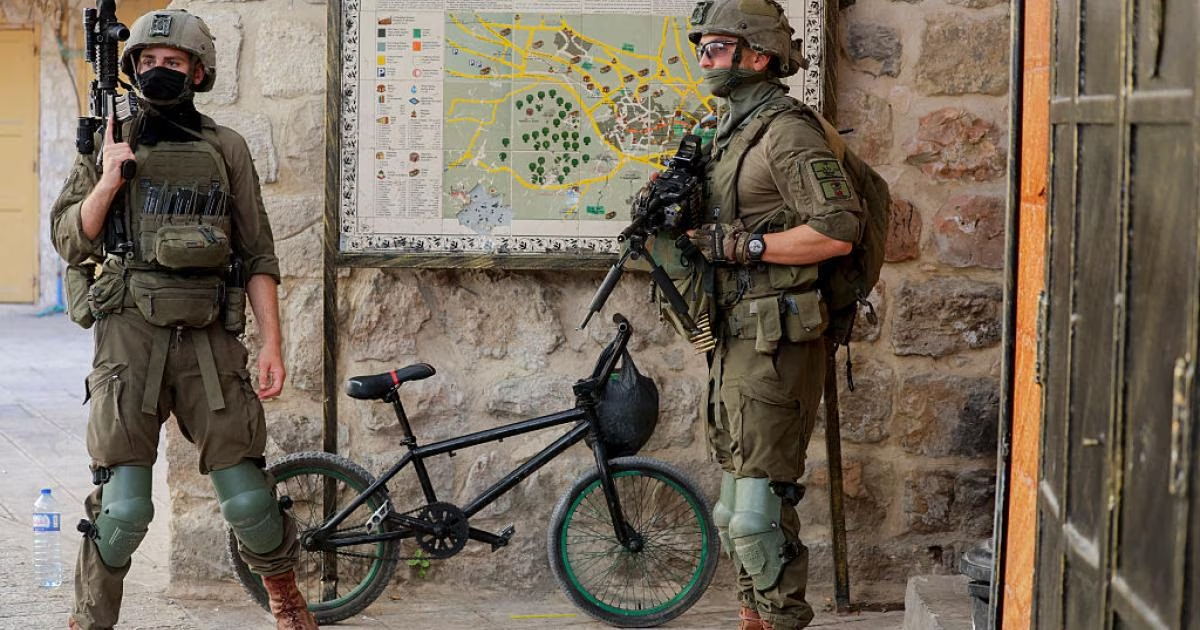
Human rights sources reported that Israeli occupation forces carried out an arrest operation on Monday morning against a high school student from Hebron Governorate, just hours before he was scheduled to take his ministerial exam. The Palestinian Prisoner's Club clarified that the detainee is 18-year-old Fajar Ahmed Al-Mashni, from the town of Al-Shuyoukh, located northeast of the governorate, where he was taken to an unknown destination.

According to data issued by the Prisoner's Club, Al-Mashni's arrest raises the number of high school students detained in Israeli prisons to 66 students this year alone. This step comes at a time when thousands of Palestinian students are taking their final exams, which began last Saturday uniformly across the West Bank and Gaza Strip, in a clear challenge to the ongoing war conditions.

Human rights organizations considered the targeting of students at this sensitive stage to be part of a systematic policy aimed at obstructing the educational process and destroying the future of Palestinian youth. Sources confirmed that Israeli authorities have escalated the pursuit of students at various educational levels since last October, with detainees subjected to harsh detention conditions, including abuse and deprivation of communication with their families.

In a related context, Hebron Governorate witnessed additional attacks, including the arrest of two brothers from the Masafer Yatta area to the south, coinciding with attacks carried out by settlers targeting and vandalizing citizens' property. These violations are part of a wide-ranging campaign launched by the Israeli army and settlers in the West Bank, which has resulted in the martyrdom of hundreds, the injury of thousands, and the displacement of entire families since late last year.

In occupied Jerusalem, occupation forces arrested a child from the town of Silwan, south of the blessed Al-Aqsa Mosque, amid ongoing incursions and raids on Palestinian villages and towns. Official reports confirm that the number of detainees in the West Bank has approached the 23,000 mark since the beginning of the latest escalation, reflecting the scale of the security campaign targeting all segments of Palestinian society.

Official statistics indicate that the West Bank has lost 1,173 martyrs since October 2023, while the number of injuries has exceeded 12,666 cases, amid extremely complex humanitarian and economic conditions. High school exams continue in the West Bank until July 8, while they extend in the Gaza Strip until the end of the same month, despite the massive destruction that has affected educational institutions there.

The Prisoner's Club stressed that students inside prisons face multiplied challenges, as they are deprived of their basic right to education guaranteed by international laws, in addition to being subjected to physical and psychological torture methods. Human rights bodies called on the international community to intervene immediately to stop the targeting of the educational process and protect Palestinian students from arbitrary arrests that pursue them even in examination halls.

The continued detention of high school students represents a direct violation of their right to education and reflects a systematic policy targeting the educational path of Palestinians.

PALESTINE

Tue 23 Jun 2026 7:11 am - Jerusalem Time

US Pressure Imposes Restrictions on Israeli Army Movements in Lebanon and Gaza

The political leadership in Israel has issued new directives imposing clear restrictions on the movements of the Israeli army in southern Lebanon, a step reflecting increasing pressure from the administration of US President Donald Trump. These pressures aim to push Tel Aviv to adhere to the terms of the memorandum of understanding concluded with Iran to end the conflict and pave the way for comprehensive negotiations on contentious issues in the region.

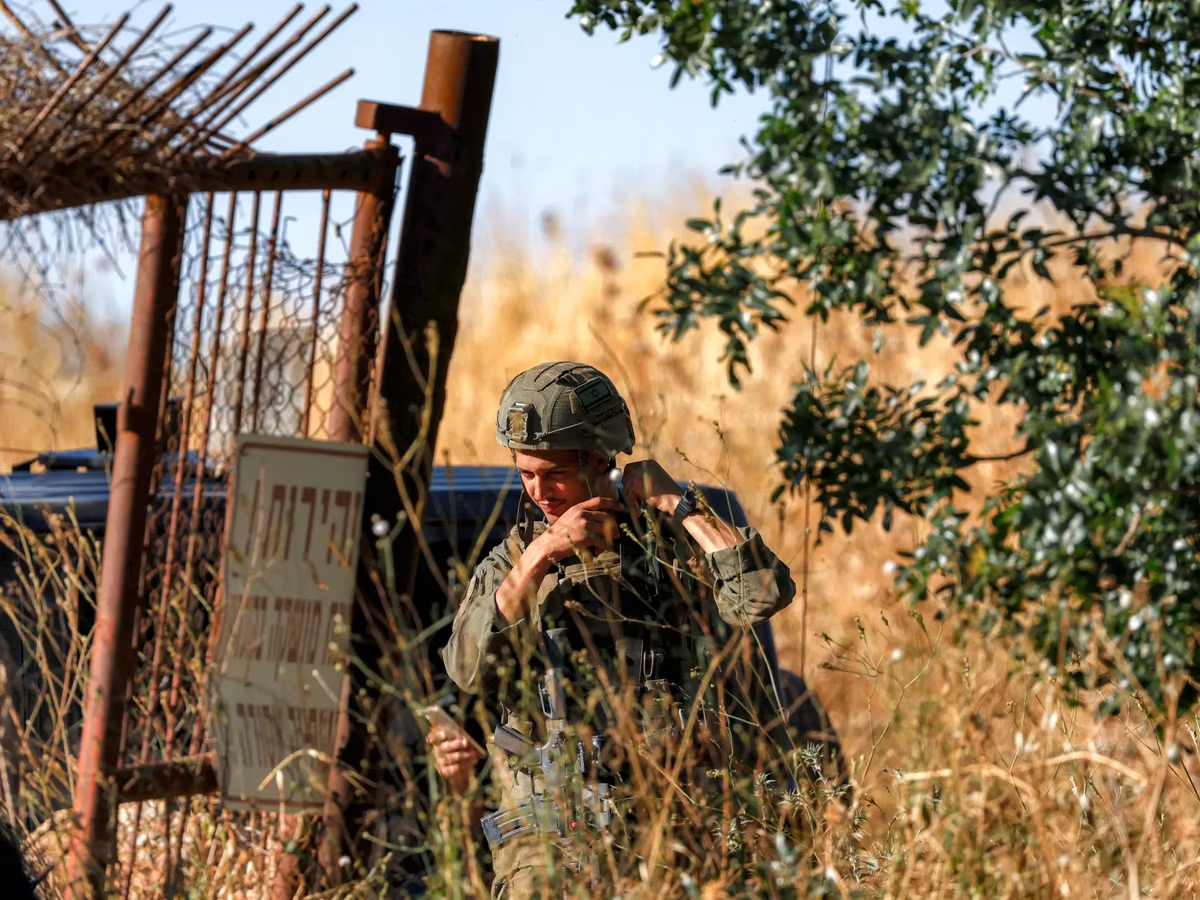
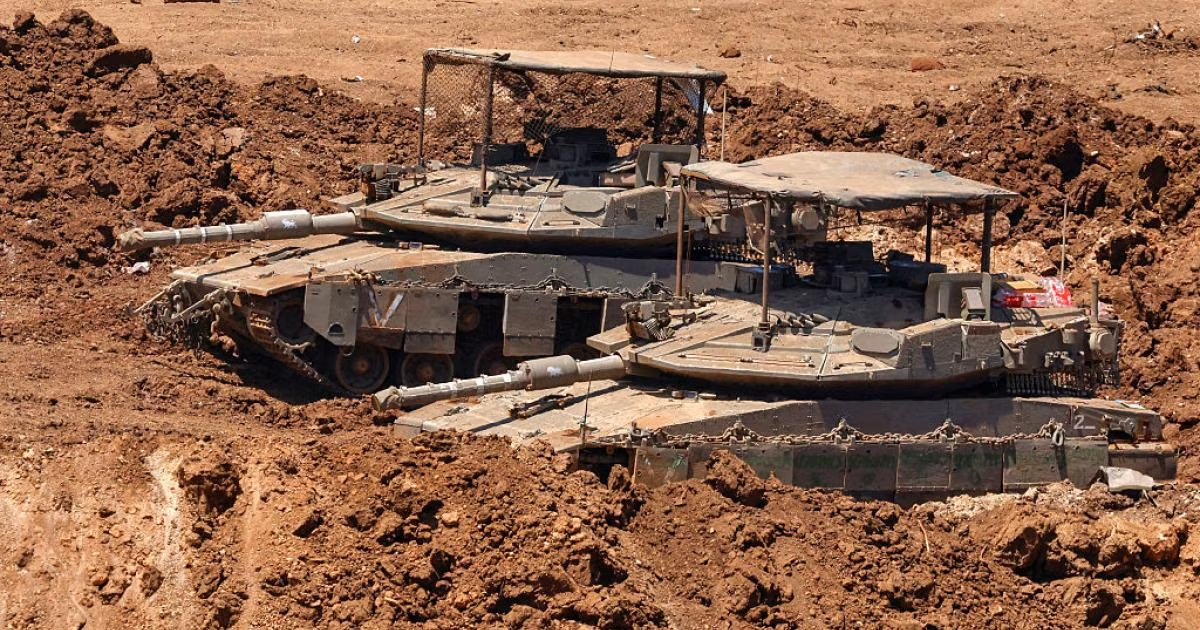
Media sources reported that the new regulations define the army's scope of operations within what is known as the 'Yellow Line' only, for the purpose of confronting direct and immediate threats. In contrast, these directives prohibit the execution of any military operations in distant areas or deep inside Lebanese territory, specifically in the cities of Beirut and Tyre, thereby reducing the maneuverability previously available.

Reports indicate that this step reflects a new direction for the Trump administration aimed at curbing Israeli military excesses not only in the Lebanese arena but also on multiple other fronts. Sources quoted a senior Israeli official as saying that recent American messages were firm regarding the end of the right to military action without prior restrictions.

This new American approach directly contradicts previous statements by Israeli Prime Minister Benjamin Netanyahu, who repeatedly affirmed that his army has complete freedom to operate in the Lebanese security sector. Netanyahu had stressed in video recordings that military operations would continue without a time or spatial limit to ensure the security of northern residents.

In a related context, press reports revealed a deep divergence in views between Washington and Tel Aviv regarding handling the Lebanese file and its regional repercussions. The United States believes that the stability of southern Lebanon is linked to major issues such as navigation security in the Strait of Hormuz and the stability of global energy prices, in addition to the Iranian nuclear file.

Meanwhile, the Israeli government views any retreat or withdrawal from areas it controlled in southern Lebanon as a sign of weakness that Hezbollah might exploit to strengthen its position. Military circles in Tel Aviv fear that these restrictions could lead to the loss of field gains achieved during military confrontations that erupted in the last two years.

This shift comes after the US-Iran agreement came into effect on June 18, an agreement signed by Trump and his Iranian counterpart Masoud Pezeshkian. The agreement includes an explicit clause emphasizing the need to respect Lebanon's territorial integrity and sovereignty, placing Israel before new international obligations that did not exist before.

On the Gaza Strip front, Israeli Chief of Staff Eyal Zamir discussed with senior military commanders the possibility of launching a wide-ranging operation aimed at disarming the Hamas movement. These moves come amid Israeli intelligence reports indicating the increasing influence and organizational capabilities of the movement within the Strip despite years of protracted war.

Despite the proposed military plans, there is a state of concern within the Israeli security establishment regarding President Trump's stance on any widespread escalation in Gaza. Estimates anticipate that the White House will oppose any major military operation that could undermine new regional understandings, or show unexpected flexibility regarding the issue of factional weapons.

On the ground, the ceasefire agreement in Gaza, signed in October 2025, continues to witness daily Israeli violations in the form of intermittent shelling and gunfire. These continuous violations have resulted in hundreds of martyrs and wounded, threatening the collapse of the fragile calm that followed a devastating war lasting more than two years.

It is worth noting that the Israeli aggression on the Gaza Strip since October 2023 has resulted in a heavy toll exceeding 73,000 martyrs and more than 173,000 wounded. Military operations have also caused the destruction of nearly 90% of civilian infrastructure, leaving the Strip in an unprecedented humanitarian crisis in modern history.

International political circles are monitoring the extent of Israel's commitment to the new American restrictions and whether they will effectively lead to de-escalation in the region. It appears that the coming phase will witness a conflict between the Israeli desire for military decisive action and the American vision seeking to achieve major diplomatic accomplishments before the upcoming elections.

The message we received in recent weeks from the Americans is clear: you had the right to operate without restrictions, and that has ended.

OPINIONS

Tue 23 Jun 2026 7:11 am - Jerusalem Time

Sixty Days on a Hot Plate: How Oil Became a Test of Intentions Between Washington and Tehran

Washington's Message

Washington – Said Arikat – 23/6/2026

News Analysis

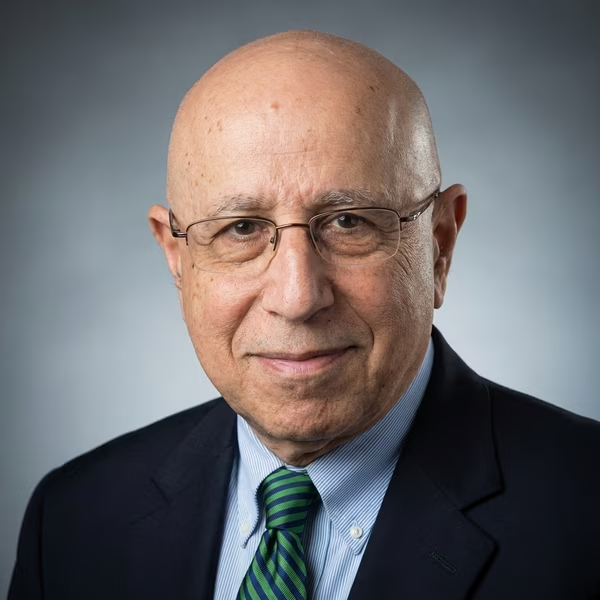
In a notable shift in American policy, President Donald Trump's administration announced on Monday a temporary lifting of oil sanctions on Iran for sixty days, allowing the purchase of Iranian crude with US dollars. This move could grant Tehran significant financial revenues after years of selling at discounts to buyers avoiding sanctions. Treasury Secretary Scott Bessent stated that the decision was the culmination of "continuous and fruitful" talks in Bürgenstock, Switzerland. Vice President J.D. Vance, the chief US negotiator, confirmed that Iran had agreed to receive UN inspectors at its nuclear sites, describing it as a "major achievement for the American people." However, Iranian Foreign Ministry spokesman Ismail Baqaei quickly denied that Tehran had made any new commitments, emphasizing that cooperation with the International Atomic Energy Agency would remain governed solely by "existing procedures." The Agency has not yet commented on Trump's and Vance's statements, casting thick shadows over the essence of the announced understandings.

The contradiction between American statements and Tehran's denial highlights the core of the dilemma: while the Trump administration seeks to market a quick diplomatic achievement that allows for a partial lifting of sanctions, Iran adheres to its traditional rhetoric rejecting any new concessions. This gap reflects a lack of solid trust after years of military escalation and assassinations. Without an independent and binding verification mechanism, the oil waiver could turn into a tactical maneuver that repeats the collapse of the 2015 agreement, and reliance on good intentions remains fragile given Tehran's insistence that it has made no new commitments. Experts warn that the American gamble could backfire if promises are not translated into inspections.

Vance added that the Geneva talks, which began on Sunday and were overseen by Qatari and Pakistani mediators, laid a "very good foundation" for a final peace agreement. He unveiled the establishment of direct communication channels to de-escalate tensions in the Strait of Hormuz and in Lebanon, where the intensity of clashes between Israel and Hezbollah has decreased. Vance considered these arrangements to prevent the "situation from getting out of control," noting that Iran had pledged to ensure freedom of navigation in the vital waterway that was closed during the June 2025 war, which drove global energy prices higher.

On the ground, these developments follow the 12-day lightning war in the summer of 2025, in which Israel and the United States bombed Iranian nuclear facilities, leading to the expulsion of IAEA inspectors. Since then, the fate of highly enriched uranium quantities, which Tehran claims were destroyed or buried, has been shrouded in mystery. Under the memorandum of understanding signed last week, Iran agreed to reduce that stockpile under Agency supervision, in a step aimed at restoring international confidence. Tehran had accused the IAEA of providing political cover for the Israeli-American raids after a resolution accusing it of non-compliance. Analysts believe that Iran's insistence on the right to enrichment, despite its commitment to reducing the stockpile, reflects its desire to maintain its nuclear infrastructure as a strategic bargaining chip. But President Masoud Pezeshkian reiterated that his country "will not back down an inch" from its right to peaceful enrichment.

As for the economic package, the US Treasury Department issued a 60-day license allowing the production, delivery, and sale of Iranian oil, which grants Tehran much-needed dollar liquidity. In parallel, Iranian Central Bank Governor Abdolnaser Hemmati announced the signing of memoranda to begin the release of $24 billion in frozen assets. However, US officials did not confirm this step, and Vance stipulated that any released funds be directed to purchase American goods such as soybeans and wheat, with a ban on their use to finance terrorism, an idea he attributed to Jared Kushner, with Washington and Doha overseeing the mechanism.

The temporary exemption from oil sanctions represents a lifeline for a suffocated Iranian economy, but the details of the agreement show that Washington has not given Tehran a blank check. Linking the release of frozen assets to the purchase of American agricultural products serves Trump's electoral base, turning the crisis into an opportunity to support American farmers. In return, the influx of dollars gives Iran liquidity that may alleviate internal protests, but it keeps it at the mercy of the expiration of the sixty-day deadline, which could end with the return of sanctions if nuclear inspections falter, making the recovery fragile and dependent on commitments whose seriousness has not yet been proven. Thus, it becomes a dual pressure tool in Washington's hands.

It is worth noting that the partial lifting of sanctions and the allowance of inspections practically restore the core of the 2015 nuclear deal, from which Trump withdrew in 2018, describing it as the "worst deal in history." Diplomatic circles fear that conflicting interpretations could lead to the collapse of the negotiation process, similar to what happened previously, especially since Iran began reducing its inspection cooperation after the US withdrawal, and then stopped it completely after the 2025 bombing.

Iran's closure of the Strait of Hormuz during the war represented a geostrategic weapon that disrupted global energy markets. Today, Washington offers financial rewards for reopening the vital passage, an implicit acknowledgment that military deterrence alone is not enough. However, linking oil flow to inspection commitments places global energy security at the mercy of fragile negotiations. If the closure scenario is repeated in the future, the Trump administration will face two difficult choices: returning to maximum pressure, which failed previously, or making additional concessions that might encourage Tehran to use the Strait as a permanent blackmail tool. Thus, Washington moves from being a hostage of escalation to a hostage of timed de-escalation.

Nevertheless, the gap between American victory rhetoric and Iran's adherence to red lines makes it premature to speak of a real breakthrough. While awaiting the outcome of the next sixty days, the world cautiously watches this new test of intentions between Washington and Tehran. While Trump sees the oil waiver as a passport to a diplomatic legacy that ends decades of hostility, Tehran treats it as an entitlement for its steadfastness under the weight of "maximum pressure." Between two conflicting narratives, only facts on the ground can confirm whether peace is truly under construction, or if we are facing a tactical truce that hides embers that have not yet been extinguished beneath its ashes.

PALESTINE

Tue 23 Jun 2026 7:10 am - Jerusalem Time

Israel Awaits US Pressure for Gradual Withdrawal from Southern Lebanon, Netanyahu Clings to 'Security Zone'

Hebrew sources reported that the security establishment in Israel is considering the possibility of a US decision for a gradual withdrawal of Israeli forces from areas in southern Lebanon. This development coincides with the start of a new round of indirect talks, aimed at formulating initial concepts for the deployment of the Lebanese army in those areas within the framework of an internationally supported pilot program.

These discussions are scheduled to take place in Washington with the participation of ambassadors from both sides and high-ranking officers with the rank of brigadier general, under direct American patronage. The meetings, which will continue until June 25, aim to bridge the gap between Israeli security demands and international pressure to end the military presence deep within Lebanese territory.

Israeli assessments indicate that the US administration may demand the Israeli army withdraw from some positions in what is known as the 'security zone' as a confidence-building measure. This measure would pave the way for Lebanese army units to deploy and assume security tasks, which Washington sees as a necessary step for the stability of the border region.

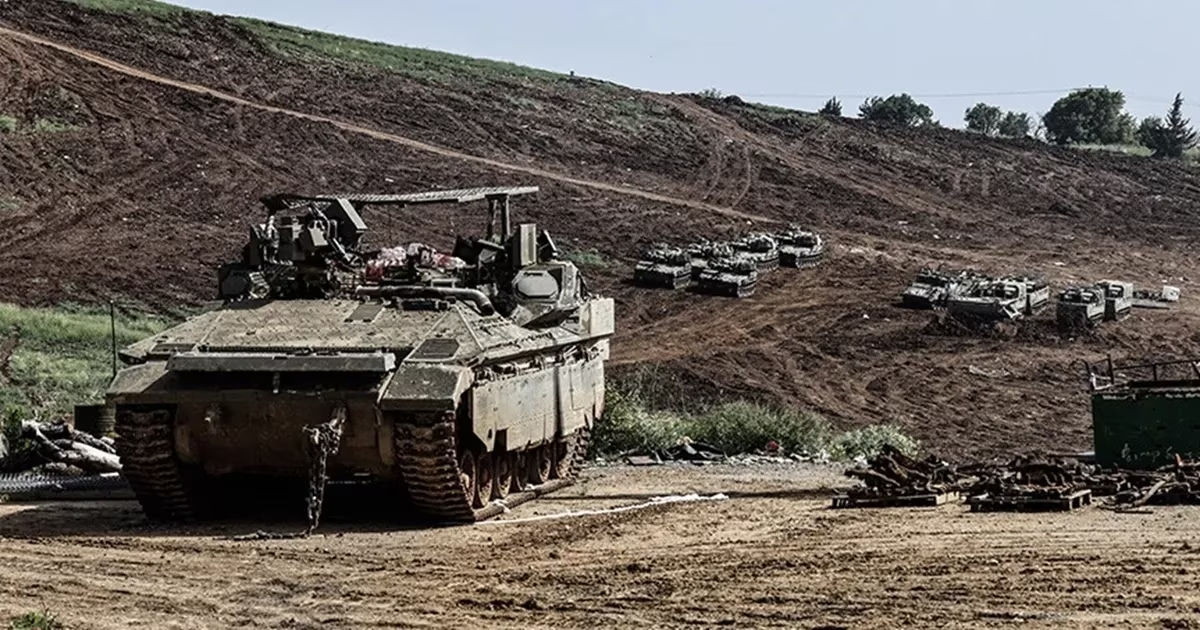
On the ground, reports have monitored Israeli army movements over the past twenty-four hours, with units beginning to reorganize their ranks and move some field sectors. These forces await decisions from the political level that will determine the shape of future military deployment in light of increasing diplomatic pressure.

Media sources quoted a senior Israeli official as saying that messages received from Washington in recent weeks have been firm and clear. The official confirmed that the previous authorization that granted Israel freedom of military action without restrictions in Lebanese territory has effectively ended, imposing a new reality on the negotiating table.

In a related context, press reports revealed a deep divergence in views between Tel Aviv and Washington regarding the future of southern Lebanon. While the US administration views the issue from a regional perspective that includes navigation and energy security, Israel focuses on preventing any political or moral gains that Hezbollah might achieve as a result of a withdrawal.

US President Donald Trump's administration seeks to achieve a quick diplomatic breakthrough in the Middle East that links complex issues including Iran and the security of waterways. This American ambition clashes with an Israeli view that sees an early withdrawal as an indication of military retreat and a weakening of the field position against Lebanese factions.

Despite these pressures, Israeli Prime Minister Benjamin Netanyahu and his security minister, Yisrael Katz, issued a joint statement affirming the continued occupation of the so-called 'security zone'. The statement, in which Chief of Staff Eyal Zamir participated, stressed that the army would continue to work to prevent any threats targeting northern settlements or the forces stationed there.

This rigid Israeli stance comes despite the entry into force of the US-Iranian memorandum, which explicitly stipulates respect for Lebanon's sovereignty and territorial integrity. It appears that the Israeli leadership is trying to balance external pressures with internal criticism accusing the government of restricting the army's freedom of action on the northern front.

Informed sources clarified that the last meeting, which included the Northern Command, focused on the necessity of maintaining field security superiority regardless of the results of political negotiations. Netanyahu affirmed that the security of Israelis remains the top priority, indicating that no concessions would be made that would affect the army's deterrent capability in confronting border threats.

In conclusion, these developments reflect a state of cautious anticipation in political and military circles, as everyone awaits the results of the fifth Washington round. While Israel insists on the presence of its forces, international powers are pushing to impose a new reality based on recently signed agreements, leaving the region facing open scenarios.

American messages that reached Tel Aviv made it clear that the previous authorization for unrestricted movement in Lebanon has ended.

PALESTINE

Tue 23 Jun 2026 7:10 am - Jerusalem Time

Jeremy Corbyn demands independent inquiry into Britain's complicity in 'Gaza genocide'

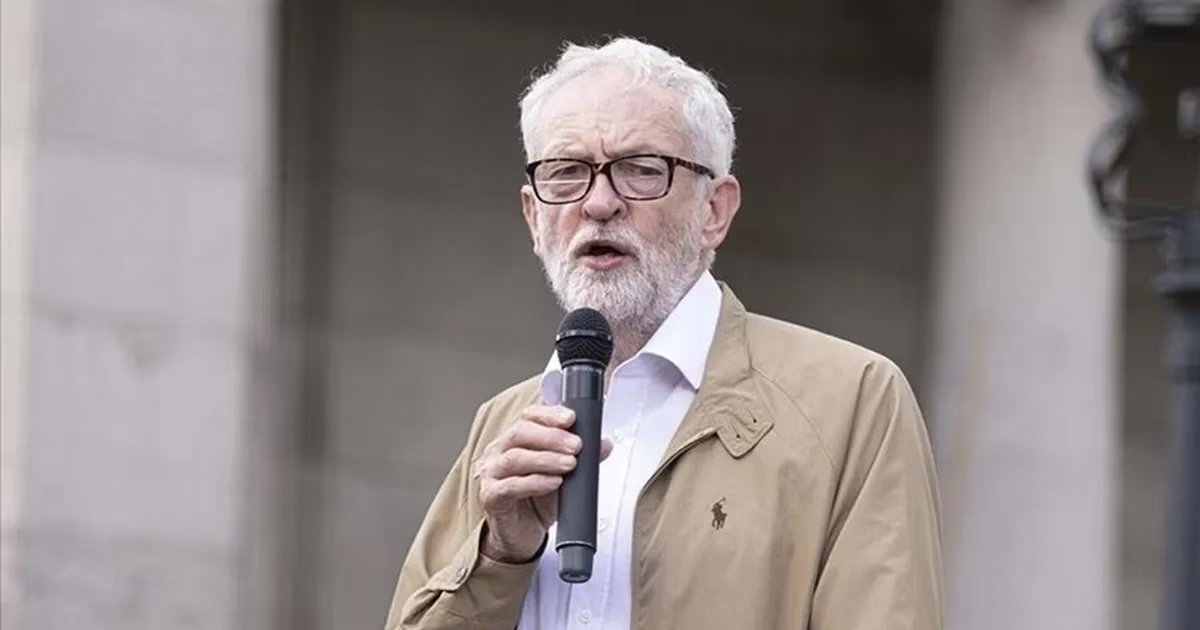
British Member of Parliament, Jeremy Corbyn, renewed his attack on his country's foreign policy, emphasizing the necessity of not overlooking the support provided by Keir Starmer's government for what he described as 'genocide' in the Gaza Strip, coinciding with the latter's departure from office.

Corbyn announced via his official account on the 'X' platform the reintroduction of a bill aimed at opening an independent and comprehensive inquiry into the nature of British complicity in the crimes committed in the Gaza Strip, stressing that these events represent the greatest crime in modern times and cannot be overlooked without legal accountability.

This parliamentary move comes within the framework of continuous pressure exerted by the left-wing current in Britain to reveal the extent of military and political support provided by London to the Israeli occupation during the war, amidst popular and human rights demands to stop arms exports and ensure the government's adherence to international law.

"We will never forget the role played by the Starmer government in the greatest crime of our era, and I have reintroduced my bill for an independent inquiry into Britain's complicity."

ARAB AND WORLD

Tue 23 Jun 2026 7:10 am - Jerusalem Time

Gradual Breakthrough in Navigation in the Strait of Hormuz Following Iran's Announcement of its Closure

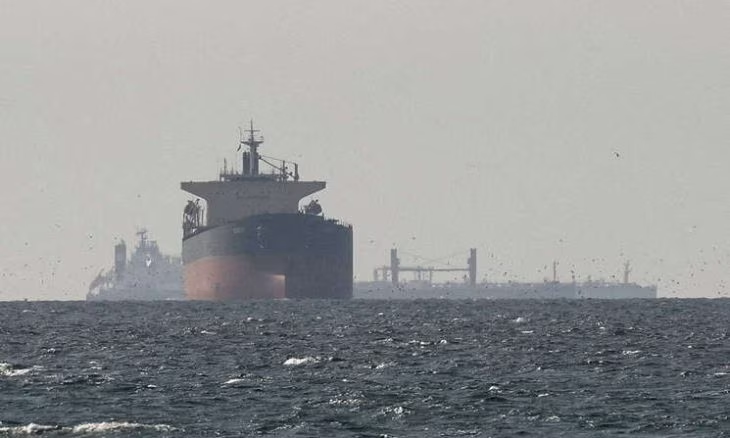
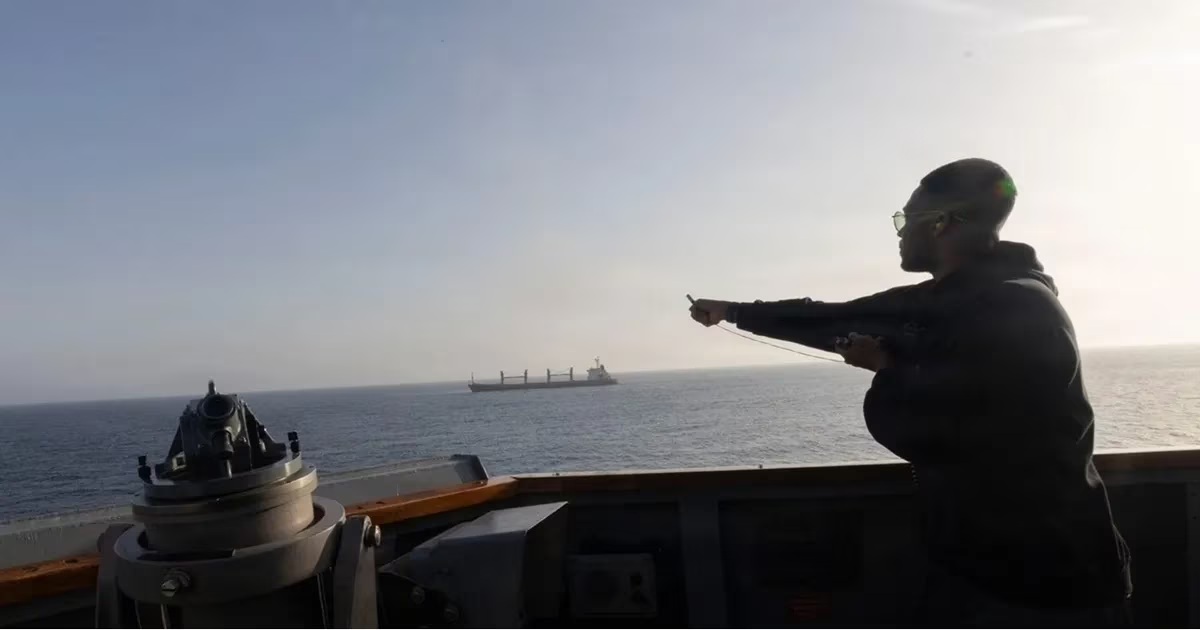
Recent navigation data has indicated a gradual improvement in the movement of oil and liquefied natural gas (LNG) tankers through the Strait of Hormuz today, Monday. This development comes after a state of partial paralysis and slowdown that prevailed in the strategic waterway following the Iranian Revolutionary Guard's announcement of the strait's re-closure earlier this week.

Informed sources reported that the recent Iranian move was a direct response to attacks launched by Israel on Lebanese territories, which led to an immediate decline in the number of passing ships. Tehran had ended a previous closure of the strait last week after understandings with Washington that stipulated a 60-day ceasefire extension to open the door for diplomatic negotiations.

Analysis by 'Kpler,' a company specializing in ship tracking, showed that four Qatari LNG tankers headed towards the strait today, Monday. This is the first time these tankers, namely 'Wadi Al Sail,' 'Mekaines,' 'Al Sadd,' and 'Mesaimeer,' have passed through the Iranian route since the recent military tensions began in the region.

In a related context, two giant tankers, each with a capacity of two million barrels of crude oil, entered the Gulf waters, with one of them announcing its final destination as the Iraqi port of Basra. These movements reflect shipping companies' desire to resume operations despite high security risks and continuous threats of closing the waterway.

For its part, the 'Marine Traffic' platform indicated that two smaller crude oil tankers departed the strait towards the Gulf of Oman, carrying a total of two million barrels of crude. This coincided with a report by 'Clarkson's' shipping brokerage firm confirming that the general trend of navigation has started to become positive, although the number of ships remains below pre-conflict levels.

Kpler data revealed a sharp disparity in traffic, with only five ships crossing the strait on Sunday, compared to about 26 ships the previous day. The passing ships included three giant tankers carrying Saudi crude oil and fuel oil, one of which was en route to Japanese ports.

The Joint Maritime Information Center, led by the US Navy, confirmed a significant increase in commercial navigation traffic using the southern routes through Oman's territorial waters. The statement also indicated that some ships continue their course through the northern passage under Iranian control, suggesting a kind of undeclared de-escalation on the ground.

Regarding Iranian exports, the head of the National Iranian Oil Company stated that more than 25 million barrels of oil have crossed the 'siege line' since last Monday. London Stock Exchange data monitored the departure of three sanctioned giant tankers, 'Elfa,' 'Virgo,' and 'Vigor,' loaded with Iranian oil from Kharg Island.

In an attempt to secure energy supplies, Abu Dhabi National Oil Company (ADNOC) and Kuwait Oil Company offered tenders for crude oil sales with flexible loading options. These options include the possibility of loading from within the Strait of Hormuz or from external terminals to avoid any sudden disruption that might affect navigation in the waterway.

The South Korean Ministry of Oceans and Fisheries announced that two of its vessels successfully crossed the strait following the signing of a temporary ceasefire agreement between Washington and Tehran. The ministry did not disclose the names of the vessels for security reasons, amid the continued caution among global shipping companies.

In Japan, a spokesperson for the Shipowners' Association stated that the number of Japanese-linked ships in the Gulf region has decreased to 37 vessels. This figure represents a decline compared to about 45 vessels present in the region at the start of the military conflict, reflecting Tokyo's risk reduction strategy.

Navigation data showed that two gas tankers controlled by ADNOC, 'Al Hamra' and 'Mubaraz,' delivered shipments to gas terminals in India today, Monday. These two tankers had undertaken what were described as 'dark' voyages, where their Automatic Identification System (AIS) was turned off while crossing sensitive areas in the strait.

Sources in the shipping sector explained that ships resorting to turning off transponders has become a common tactic to avoid targeting or detection amid current tensions. This measure sometimes leads to a lack of accurate data available to global tracking systems, meaning the actual number of passing ships may be higher than recorded.

Finally, the US Central Command stated that on Saturday, 55 commercial vessels crossed the strait, carrying more than 17 million barrels of oil for global markets. This convoy included giant tankers from the UAE, Kuwait, and Iraq, confirming the continued flow of global energy supplies despite repeated Iranian threats.

Daily ship traffic remains below 125 vessels, which is the usual rate before the outbreak of hostilities, but the general trend is positive.

OPINIONS

Mon 22 Jun 2026 1:11 pm - Jerusalem Time

Emerging Israeli Phenomena

These are not ordinary manifestations that are sweeping the Israeli settler society, manifestations that indicate a state of anxiety, tension, and a search for exits to address the unclear predicament that is sweeping Israeli society, certainly carrying a state of contradiction in dealing with Palestinian society. These manifestations are not limited to one area over another, to the 48 areas, without the 67 areas, but there is an unannounced acknowledgment that Israeli superiority, expansion, settlement, and oppression have not abolished the Palestinian people, nor have they ended them, which is an expression of the strategic failure of the Israeli settler project that managed to occupy the entire map of Palestine, but failed to expel, displace, and deport the entire Palestinian people. Unprecedented manifestations, even if heterogeneous, but they all pour into one stream, which is the existence of a Palestinian people, whom the settler project, with all its components, capabilities, and superiority, has not been able to end, and the impact of this existence on the components of Israeli society. Initially, slight manifestations, attempts to create and acknowledge the existence of two parties, Israeli and Palestinian, Arab and Hebrew, among the existing human condition in the 48 areas, and if we exclude the experience of Zionist parties, from the Labor Party, to the Likud, and the Meretz movement and others, and their repeated attempts to win Palestinian tools in their ranks, which practically diminished after the Land Day uprising in 1976, which formed a state of awakening led by the Communist Party and the Democratic Front, and the emergence of Arab parties at the beginning of the nineties: the Arab Democratic Party, the Islamic Movement, the National Democratic Assembly, the Arab Movement for Change, the Arab Nationalist Party, and the Sons of the Village movement and others, and the significance of this and its striking impact is that the Palestinian vote reached 54% in favor of Zionist parties, and decreased in 2022 to only 13%. The first prominent phenomenon is the birth of organizations, however small and modest they may seem, but they reflect a state of focus on combining the Israeli element with the Palestinian element, Arab with Hebrew, with emerging parties that do not yet have popular credibility, but these are ongoing attempts: 1- The "All its Citizens" party, led by Avraham Burg, former Speaker of the Knesset. 2- The "Together We Succeed" party, led by Israeli businessman Avi Shaked. 3- "A Place for All of Us," led by Rula Daoud and political activist Alon Lee Green. These emerging party attempts clearly carry a partnership between the Israeli and Palestinian parties, Hebrew and Arab, similar to the Communist Party, which has made deep strides and now has credibility in partnership and members of the Knesset from both sides, but the ongoing attempts reflect the realization that there are two parties that have become partners, neither of whom has been able to eliminate the other, or end its existence despite the deep political, economic, national, and ethnic differences between the two parties due to the legacy of authoritarianism, oppression, and cancellation of everything Palestinian and Arab in the 48 areas, but the initial acknowledgment through these party attempts reflects a state of development that the careful observer cannot overlook or underestimate its motives, or not consider it as an indication of the Israeli party's acknowledgment of the existence of a partner it has not been able to expel and cancel its existence on its homeland, which it has no other. This phenomenon will have consequences, especially since Arab parties have failed to penetrate Israeli society and gain an Israeli partnership working within their ranks, with the exception of the Communist Party, in order to achieve equality in the 48 areas, and independence and an end to the occupation in the 67 areas.

OPINIONS

Mon 22 Jun 2026 1:02 pm - Jerusalem Time

Palestine and Israel: When the Fear of Peace Reveals a Crisis of Trust in Legitimacy

Dr. Ibrahim Nairat

Opinion Writer

The most dangerous ideologies are not only those that glorify war, but those that are unable to imagine a world outside of it. When war transforms from an exceptional tool into a permanent lens for understanding reality, peace itself becomes suspect, and any attempt at a settlement turns into a threat to be resisted, not an opportunity to be seized.

This phenomenon is not merely a psychological or rhetorical matter, but a deep political problem that affects the fate of peoples and nations. Nations that succeed in transforming their power into peace build long-term stability, while nations that remain captive to the logic of perpetual conflict find themselves unable to reap the fruits of their power, no matter how great.

From this perspective, one of the most prominent contradictions in the contemporary Israeli scene can be understood. For many decades, Israel has presented itself as a strong, stable, and well-established state, possessing clear military, technological, and economic superiority, and enjoying widespread international recognition and growing relations with many countries. However, this image is accompanied at the same time by a continuous fear of any real historical settlement with the Palestinians, as if peace itself has become an existential threat.

Here arises a question that is difficult to ignore: If Israel is confident in its legitimacy and its ability to endure, why does peace seem so frightening?

A self-confident state does not fear political settlements; rather, it seeks them when it realizes that continued conflict consumes its resources and restricts its future. But when every peace initiative becomes a source of suspicion, every mention of Palestinian rights a cause for concern, and every potential settlement a step towards an "existential danger," the issue is no longer related to security alone, but extends to the nature of the relationship with the concept of legitimacy itself.

In this context, the spread of discourses that treat any initiative to stop the war or reduce tension as a prelude to a strategic catastrophe can be understood. In this type of thinking, peace is not seen as a means to achieve security, but as a danger that could destabilize an entire system built on the continuation of conflict.

The real problem is that this discourse does not treat peace as a political possibility that can succeed or fail, but as impossible in principle. Here, the discussion shifts from evaluating facts to defending a closed political doctrine. If a war breaks out, it is said to be proof of the impossibility of peace; if a truce succeeds, it is said to be merely a temporary trick; and if a settlement lasts for decades, it is said to be the result of a balance of power, not the agreement itself.

And when all facts become evidence for the same hypothesis, the hypothesis turns into a doctrine, not a political analysis.

This mentality is not new. It has appeared in many historical experiences of states and movements that have lived through long conflicts until they began to see the world from a purely security perspective. In the modern Israeli case, the ideas of the "Iron Wall" have left a deep impact on shaping part of the Israeli strategic mind, as they started from the assumption that the adversary would not voluntarily accept the existing reality, and that the only way to impose it is through overwhelming military superiority.

This perception has contributed to entrenching the idea that security is achieved primarily through force, and that political settlements come later. However, the problem arises when this idea transforms from a tool into a doctrine, from a means to an end, and from a circumstantial strategy to a comprehensive worldview.

Military force can deter adversaries, prevent defeat, and impose facts, but it cannot by itself produce legitimacy. It can control land, but it cannot by itself produce political acceptance or end the deep causes of conflict. This is why many great powers throughout history have failed to transform their military victories into lasting stability.

Here lies the fundamental paradox in the Israeli case. The more Israeli military superiority increased, it was theoretically supposed that the ability to move from managing the conflict to resolving it would also increase. But what often happened was the opposite; superiority itself became a justification for postponing political solutions instead of using it to establish sustainable peace.

The result is that peace has become, in the view of some currents, more disturbing than war itself. War allows for the postponement of difficult questions, while peace compels answering them. War allows for managing reality, while peace requires reshaping it. War keeps major issues pending, while peace necessitates dealing with borders, sovereignty, rights, and mutual recognition.

Therefore, the fear of peace does not only reveal a security crisis, but also a crisis of political trust. A state confident in its legitimacy does not fear mutual recognition, nor does it see the legitimate rights of another people as a threat to its existence. But when the mere recognition of Palestinian rights is viewed as a strategic danger, the question becomes: What is truly frightening? Peace, or what peace might reveal?

Self-confident states do not fear recognizing others, because they do not see their rights as a negation of their own. But when the recognition of another people's rights is presented as an existential threat, it suggests that the political identity still views its existence as a project that needs continuous conflict to justify itself. Here, peace becomes a test of self-confidence before it is a test of security.

True legitimacy is not measured by a state's ability to impose a fait accompli by force, but by its ability to transform this reality into a stable political order that enjoys a degree of acceptance and recognition. Therefore, what weakens the world's trust in the justice and sustainability of the legitimacy on which Israel is based is not the search for a just settlement with the Palestinians, but the insistence on managing the conflict indefinitely.

States confident in their existence seek to end wars, not to turn them into a permanent state. States confident in their legitimacy do not see peace as a threat, but as an opportunity to consolidate that legitimacy on more stable foundations.

Therefore, the question facing Israel today is not whether peace serves the Palestinians or not, but whether the continued fear of peace reveals, in its essence, a deep crisis of confidence in the ability of the Israeli project itself to live under a just and stable peace. History teaches us that force can impose facts, but it cannot by itself produce legitimacy. Sustainable legitimacy, however, is born when states have the courage to move from the logic of permanent war to the logic of peace that recognizes rights and establishes stability.

Here lies the great paradox: the more peace is presented as a threat, the more questions arise about the extent of trust in the foundations that peace itself is supposed to consecrate. A state that possesses a strong army, an advanced economy, and broad international alliances, and then sees peace as an existential danger, does not only reveal security fears, but a deeper anxiety related to its ability to transform power into stable legitimacy.

Force can impose reality, but it cannot by itself convince others of its justice. It can ensure survival for long periods, but it cannot by itself produce the political and moral acceptance that gives any historical project long-term stability. Therefore, peace, not war, remains the true test for any political project that claims confidence in itself and its future.

The question that will remain as long as the conflict persists is not whether the Palestinians need peace, but whether Israel is truly ready to test the confidence it claims to possess. Because a just peace not only tests the strength of states, but also tests the extent of their belief in the legitimacy of their foundations and their ability to coexist with the rights of others without fear or suspicion.

And whoever fears this test for too long may discover that the problem was never in peace itself, but in the questions that peace reveals when its time comes. A state that trusts in the justice of its cause does not fear settlement, and a state that trusts in the legitimacy of its existence does not see the recognition of others' rights as a threat to itself. But when peace becomes a constant source of fear, the question is no longer about the intentions of adversaries or the balance of power, but about the extent of trust in the foundation that this peace is intended to consecrate and grant stability and continuity.


PALESTINE

Mon 22 Jun 2026 1:01 pm - Jerusalem Time

Trump and Netanyahu's Disputes: Interests Reshape the Alliance's Path

Nihad Abu Ghosh: The fundamental American message is to affirm that Israel is an important partner, but it is not the decision-maker in defining American interests or directing its regional policies.Yasser Manna: The escalation of disputes between Trump and Netanyahu reflects a clear divergence in defining interests and political goals, but it does not undermine the foundations of the strategic relationship.Nizar Nazzal: Talk of the American administration seeking political alternatives to Netanyahu reflects a decline in the level of personal and political trust in the current Israeli leadership.Fayez Abbas: Trump has become more skeptical of Netanyahu's policies, and repeated calls and Israeli attempts at justification no longer receive the same response within the White House.Suleiman Bisharat: The American administration realizes that continued conflicts threaten its traditional influence in the Middle East and give rival powers, primarily China, wider opportunities.Mohammed Abu Allan Dragmeh: The tension may negatively impact Netanyahu's future and his chances of forming a new government, but it will not affect the core of strategic relations between Washington and Tel Aviv.

Ramallah - Exclusive to "Al-Quds" -

US-Israeli relations are witnessing an unprecedented phase of political tension with the escalation of public disputes between US President Donald Trump and Israeli Prime Minister Benjamin Netanyahu, a development that indicates increasing divergences in defining interests and regional priorities, especially regarding the Iranian file and the future of political and security arrangements in the Middle East.These disputes, according to writers, political analysts, and specialists in separate conversations with "Al-Quds," go beyond the personal dimension between Trump and Netanyahu to touch upon strategic issues related to managing regional conflicts and the limits of Israeli influence on American decision-making, amidst indications that Washington is seeking to readjust its relationship with Tel Aviv in line with its direct interests and internal and external calculations, without this meaning undermining the foundations of the historical alliance between the two parties.In light of the ongoing wars and tensions in the region, questions are increasing about the repercussions of this divergence on Netanyahu's political future and on Israel's ability to influence the American administration's orientations, while Washington appears more inclined to contain crises through political and diplomatic channels, at a time when it is trying to protect its regional influence and confront escalating international challenges, making the current phase an important test for the nature of the relationship between the two allies and the limits of the interests that govern it.A different phase from previous disputesWriter and political analyst Nihad Abu Ghosh believes that the escalating disputes between US President Donald Trump and Israeli Prime Minister Benjamin Netanyahu represent a different phase from previous disputes witnessed in US-Israeli relations, not only because of their nature and intensity, but also because they are taking place between Netanyahu and the person he has always considered the closest and most supportive ally of Israel in US history.Abu Ghosh points out that Netanyahu largely built his political bets on Trump and declared his alignment with him in various American election stages, whether during his competition with Joe Biden or later with Kamala Harris.Abu Ghosh confirms that the current causes of the dispute combine personal, political, and strategic factors; on a personal level, accusations emerged within American circles that Netanyahu provided Trump with misleading assessments regarding the war on Iran, convincing him that achieving the war's objectives would be guaranteed by targeting Iranian leaders and mobilizing opposition forces against the regime.Abu Ghosh indicates that American military and intelligence circles opposed this approach, but the Israeli government pushed for the option of confrontation based on intelligence reports and pressure from influential figures within the American administration.According to Abu Ghosh, the United States had multiple political and diplomatic alternatives, and a number of its European and regional allies did not support the option of war, which later contributed to deepening the gap between the American administration and the Israeli government when the war did not achieve the results that were being promoted.Abu Ghosh explains that the dispute widened further with the approach of reaching political understandings, as Washington accused Netanyahu's government of seeking to obstruct any negotiation path and return the region to an atmosphere of military confrontation.Resorting to reducing Netanyahu's roleAccording to Abu Ghosh, the American administration resorted to reducing Netanyahu's role in some sensitive contacts and negotiations, while the Israeli government tried to influence American decision-making through pressure groups and its supportive lobbies within the United States.Abu Ghosh points out that American media reports spoke of organized Israeli moves to influence the course of proposed agreements through pressure groups and influential figures within Congress, which caused increasing resentment within the American administration, which considered interference in the American internal political arena a crossing of red lines.Disputes do not affect the core of the strategic relationshipDespite this, Abu Ghosh confirms that these disputes do not affect the core of the strategic relationship between the United States and Israel, explaining that the relationship between the two parties is deeper than individuals and governments, and is linked to established strategic interests and roles. Abu Ghosh believes that the fundamental American message to Netanyahu is to affirm that Israel is an important partner, but it is not the decision-maker in defining American interests or directing its regional policies.Abu Ghosh points out that Netanyahu, despite his objections to any American-Iranian understanding, does not have a wide margin to confront American will, and therefore will continue his attempts to influence the course of negotiations and the drafting of final agreements through political and media means and pro-Israel lobbies, while seeking to exploit any loopholes or different interpretations of the agreed texts.More hardline behavior from NetanyahuAbu Ghosh notes that the next phase may witness more hardline behavior from Netanyahu as Israeli election deadlines approach, in light of his declining political chances according to opinion polls.Abu Ghosh indicates that some Israeli circles fear that Netanyahu may resort to escalatory options in Gaza or Lebanon, or push for unilateral measures in the West Bank, in an attempt to strengthen his political position.Abu Ghosh believes that Netanyahu will remain compelled to adapt to the new American ceiling, while Washington continues to readjust the relationship to ensure the protection of its strategic interests and prevent any party from imposing its own agenda on American decision-making.Clear divergence in defining interestsWriter and researcher specializing in Israeli affairs Yasser Manna believes that the escalating disputes between US President Donald Trump and Israeli Prime Minister Benjamin Netanyahu reflect a clear divergence in defining interests and political goals between the two sides, but it does not rise to the level of undermining the foundations of the strategic relationship or American support for Israel.Manna explains that Netanyahu continues to bet on a policy of military pressure and prolonging the confrontation, considering it part of his political survival equation and strengthening his internal image as a leader who leads a continuous state of conflict, while the Trump administration tends to invest military results in formulating political and security arrangements aimed at stabilizing regional conditions and preventing a slide into wider confrontations.Manna indicates that what is being circulated about searching for an alternative to Netanyahu carries a political pressure message more than a strategic shift, meaning that Washington may disagree with the Israeli prime minister and pressure him, but it distinguishes between its position on him personally and its firm commitment to Israel.Scenario of containing the disputeManna suggests that the scenario of containing the dispute and continuing coordination between the two parties is the most likely, with the possibility of escalating American pressure if Washington considers that Netanyahu is obstructing paths of de-escalation or regional understandings.Manna believes that the success of these pressures may open the way for limited settlements and reduce the chances of escalation, while their failure may lead to new rounds of tension in Gaza, Lebanon, and Iran, emphasizing that the importance of this dispute goes beyond the bilateral framework due to its repercussions on energy security, navigation, and regional and international stability.A shift in the nature of the relationship between Washington and Tel AvivResearcher specializing in Israeli affairs and conflict issues Nizar Nazzal explains that the increasing indicators of escalating dispute between US President Donald Trump and Israeli Prime Minister Benjamin Netanyahu reflect an important shift in the nature of the relationship between Washington and Tel Aviv, although these disputes have not yet reached the level of strategic rupture between the two parties.Nazzal points out that US-Israeli relations have witnessed in previous stages divergences and tensions with different American presidents, but what distinguishes the current phase is that the disputes have become public and personal, and are directly related to the management of the war, the Iranian file, and a number of other regional issues, which gives them broader political and strategic dimensions.Nazzal notes that talk of the American administration searching for political alternatives to Netanyahu reflects a decline in the level of personal and political trust in the current Israeli leadership, indicating that Washington has come to view Netanyahu as a burden on its regional project, at a time when the United States is seeking to end open wars and devote itself to confronting major international challenges, primarily competition with China, in addition to advancing regional normalization paths.The dispute over how to deal with the Iranian fileAccording to Nazzal, the most prominent dispute revolves around how to deal with the Iranian file, as Netanyahu continues to push for continued pressure and military confrontation, while Trump appears more inclined towards reaching understandings or political deals that prevent the conflict from widening.Nazzal points out that military confrontation with Iran did not achieve the desired results, but rather led to widespread economic and security repercussions that affected American interests, which reinforced the American administration's desire to avoid returning to the path of war.Nazzal believes that electoral calculations play an important role in this divergence, as continued escalation may serve Netanyahu domestically, while it does not serve Trump's interests as American political deadlines approach, amidst fears of growing Democratic influence in Congress.Nazzal indicates that the most likely scenario is to contain the disputes and maintain military and intelligence cooperation between the two countries, given the depth of the US-Israeli alliance and its connection to American state institutions, not just individuals.Rise of alternative Israeli figuresNazzal points to the possibility of weakening Netanyahu's position and the rise of alternative Israeli figures, while the scenario of the dispute turning into a comprehensive strategic crisis remains the least likely, despite being the most dangerous.Nazzal believes that the region is entering a phase of political and regional repositioning that reflects Netanyahu's declining ability to fully impose his agenda on Washington, and indicates the beginning of a clearer American discussion about the future of the Israeli leadership and the shape of future regional arrangements.Netanyahu's contribution to the confrontation with IranWriter specializing in Israeli affairs Fayez Abbas believes that the relationship between US President Donald Trump and Israeli Prime Minister Benjamin Netanyahu is undergoing a remarkable transformation, in light of the growing conviction within the American administration that Netanyahu contributed to pushing Washington towards a confrontation with Iran without being able to achieve the goals he announced for that war, which was reflected in the nature of the relationship between the two sides during the recent period.Abbas points out that Netanyahu, who entered the war on Iran betting on continued full American support, is now looking for a way out of its repercussions after failing to achieve decisive results. Abbas indicates that Netanyahu tried, during the past period, to obstruct any American-Iranian understanding that could lead to an end to the state of hostility between the two countries, benefiting from various regional files, primarily the Lebanese arena.According to Abbas, Netanyahu believed that his close relationship with Trump would give him the ability to convince the American administration to continue pressure and confrontation with Iran, but the positions of influential figures within the White House, along with growing popular opposition to continued escalation, pushed Washington towards adopting a more serious negotiating path, leading to the signing of understandings and the start of direct talks between the two sides.Abbas notes that the Israeli escalation in Lebanon and the subsequent Iranian threats related to regional navigation and energy raised the concern of the American administration, which prompted it to demand that Israel stop military operations, which the Israeli government ultimately responded to.Trump more skeptical of Netanyahu's policiesAbbas confirms that Trump has become more skeptical of Netanyahu's policies, indicating that repeated calls and Israeli attempts at justification no longer receive the same response within the White House.Abbas believes that the coming weeks may be decisive for Netanyahu's political future, especially if American efforts succeed in reaching a comprehensive peace agreement with Iran or developing relations between the two parties, considering that such a development could be a harsh political blow to Netanyahu and place him before unprecedented challenges on the domestic scene.Public disputes reflect deeper transformationsWriter and political analyst Suleiman Bisharat believes that the escalating disputes between US President Donald Trump and Israeli Prime Minister Benjamin Netanyahu are no longer just fleeting differences in positions, but have turned into public disputes that reflect deeper transformations in the nature of the relationship between the two parties, indicating that the transfer of these disputes to the media and mutual statements reflects the existence of internal political and electoral calculations on both sides.Bisharat explains that Trump and the Republican Party are preparing for the upcoming midterm elections in the United States, while Netanyahu and his partners in the Israeli right are preparing for any potential election, which pushes both parties to try to deny the accusations leveled against them regarding dependence on the other party.Bisharat notes that Trump faces internal criticism accusing him of succumbing to Netanyahu's influence, while the latter is accused within Israel of becoming a captive of American orientations, which is reflected in the nature of their mutual political discourse.Bisharat indicates that the war on the Gaza Strip and the subsequent widening of the conflict in the region contributed to deepening the gap within American society regarding Israeli policies, especially with the growing criticism of American support for Israel during the war.Israeli skepticism about the effectiveness of Netanyahu's policiesBisharat believes that Israeli society, in turn, is witnessing a state of skepticism about the effectiveness of the policies pursued by Netanyahu, in light of Israel's inability to achieve a complete resolution in the wars it has fought, which reinforced the belief among Israeli sectors that these wars are linked to Netanyahu's personal and political interests more than to long-term strategic goals.Bisharat believes that the United States and Israel have faced failures in dealing with the Iranian file, explaining that Trump believed that escalation towards Iran would add to his political capital and give him a new achievement, and that Israel was capable of creating conditions that would push Tehran towards retreat or collapse, but subsequent developments showed that the American administration made inaccurate assessments, which put Trump in a political dilemma and made him seek to hold Netanyahu partly responsible for the failure to avoid bearing its political cost alone.America and bringing about change in the Israeli political sceneBisharat believes that part of the American political establishment is now inclined to bring about a change in the Israeli political scene, considering that the signals emanating from Trump during the recent period suggest a desire to push towards a post-Netanyahu phase.Bisharat indicates that some American decision-making circles view Netanyahu's continuation as an obstacle to reshaping American strategy in the Middle East in line with direct American interests.Bisharat believes that the region is witnessing what he described as a "labor" in US-Israeli relations, represented by the transition from a phase of complete identification between the two parties to a phase that focuses more on interest calculations.Bisharat confirms that the question now being raised within the United States is whether the priority should be American interests or Israeli interests, especially in light of Washington's declining ability to fulfill its promises regarding calming the region and improving its internal economic conditions.Bisharat explains that the American administration also realizes that the continuation of regional conflicts threatens its traditional influence in the Middle East and gives rival powers, primarily China, wider opportunities to strengthen their presence, in addition to the growing regional roles of other powers.Criticism of Israel does not mean abandoning strategic supportAccording to Bisharat, from this perspective, recent American criticism of Israel does not mean abandoning its strategic support, as much as it reflects an attempt to reshape tools and policies to preserve American interests.Bisharat confirms that the future of the relationship between Trump and Netanyahu will remain linked to the American administration's ability to protect its interests and achieve its regional goals. If Washington succeeds in containing the repercussions of the current phase, the disputes may remain within their temporary limits, but if it sees that Netanyahu is obstructing its future vision, it may move towards supporting new political arrangements within Israel that lead to his removal from the political scene.The dispute and consistency with Trump's personalityWriter specializing in Israeli affairs Mohammed Abu Allan Dragmeh believes that the escalating disputes between US President Donald Trump and Israeli Prime Minister Benjamin Netanyahu reflect a special nature in the American president's personality, whose positions are difficult to predict or whose political orientations are difficult to read accurately.Dragmeh points out that Trump has shown, over the past years, a willingness to make decisions that contradict prevailing expectations, which was embodied in a series of contradictory statements and positions, especially during the war with Iran and the subsequent political and security arrangements.Dragmeh explains that the core of the current dispute is not limited to the personal dimension, but is also linked to a clear divergence in American and Israeli goals towards Iran.According to Dragmeh, while the American administration primarily focuses on the Iranian nuclear file and ensuring regional stability and preventing the conflict from widening, the Israeli government seeks to achieve broader goals that include curbing Iranian missile capabilities, weakening Tehran's regional influence, and ending the role of its allies in the region, in addition to betting on bringing about a radical change in the structure of the Iranian regime.Military options are no longer capable of achieving goalsDragmeh indicates that the American administration has become more convinced that military options are no longer capable of achieving the desired goals in dealing with Iran, which has pushed it to search for alternative political and diplomatic paths.According to Dragmeh, on the other hand, Netanyahu still adheres to the option of military pressure as the only way to deal with Tehran, which has led to a widening gap in the dispute between the two parties, especially in light of Israel's failure to achieve the goals it set during the recent confrontation.Political messages to weaken Netanyahu's imageRegarding the talk of Washington seeking an alternative to Netanyahu, Dragmeh believes that it is too early to definitively state that there is a clear American trend in this direction, but recent American statements carried political messages aimed at weakening Netanyahu's image within Israeli society and pressuring him to modify his political behavior, more than being an explicit declaration of a desire to replace him.He confirms that the existing tension may negatively affect Netanyahu's political future and his chances of forming the next Israeli government, but it will not affect the core of strategic relations between the United States and Israel, as Washington will continue its commitment to Israel's security, military superiority, and political and economic support.Dragmeh believes that any potential impact will remain linked to Netanyahu personally more than to the nature of the existing alliance between Washington and Tel Aviv, expecting that relations will return to their traditional course, whether through a new Israeli government or even if Netanyahu continues, but within the ceiling and vision determined by the American administration.

PALESTINE

Mon 22 Jun 2026 1:01 pm - Jerusalem Time

Israeli Moves to Reduce Forces in Lebanon Amid Anticipation of Switzerland Negotiations Outcomes

Informed sources revealed that the Israeli occupation army intends to begin reducing its military presence within Lebanese territory in the coming days. This step comes after the army announced the completion of specific offensive military missions, considering that there is no longer an operational necessity to keep large numbers of soldiers in the areas it penetrated.

These field movements coincide with a state of anticipation and concern prevailing in political circles in Tel Aviv due to the ongoing negotiations in Switzerland between Washington and Tehran. Despite official attempts to downplay these discussions, reports indicate that they primarily focus on ending the hostile situation on all fronts, especially the Lebanese front.

In contrast, conflicting statements emerge within the occupation government, reflecting a state of confusion; where Defense Minister Yisrael Katz affirmed that Israel will not withdraw from strategic sites such as Beaufort Castle and its surroundings. These positions express a current that rejects making any field concessions before ensuring strict security arrangements that meet Israeli conditions.

For his part, National Security Minister Itamar Ben-Gvir called for rejecting any ceasefire agreement or imposing restrictions on the Israeli army's movements in Lebanon. Ben-Gvir described the Lebanese state as a supporter of terrorism, emphasizing the necessity of keeping all Lebanese territories an open arena for Israeli military operations without international restrictions.

Observers believe that the imminent withdrawal from areas north of the Litani River represents a preemptive step aimed at extricating Israel from a growing strategic predicament. It appears that the Israeli leadership fears that the American administration will impose an agreement that forces it to a complete withdrawal, especially with information leaking about a US-Iranian mechanism to prevent clashes.

Israeli security agencies are anxiously monitoring the outcomes of the negotiation round in Switzerland, especially after optimistic statements from Iranian and American officials about substantial progress. Tel Aviv fears that any agreement could lead to the unfreezing of Iranian funds and the loss of leverage related to the nuclear and ballistic missile files.

Iranian Foreign Minister Abbas Araghchi indicated that Qatari and Pakistani mediation contributed to drafting a roadmap for sixty-day negotiations to determine the form of the final agreement. This diplomatic progress places Israel under increasing international pressure to accept a political settlement that ends the ongoing war of attrition on its northern borders.

Domestically, pressure is escalating on the Netanyahu government due to the high cost of continued military operations in southern Lebanon and the increasing human losses. Experts warn that the Israeli army has begun to repeat past mistakes by getting involved in a long-term guerrilla war that drains soldiers' capabilities and fuels public anger.

In a related context, press reports revealed a severe psychological crisis affecting Israelis, with the number of people officially diagnosed with psychological crises rising to about 70,000. This massive increase from 7,000 before October reflects the extent of societal trauma and the impact of multiple wars on the home front.

Military analysts in Tel Aviv propose a 'rescue plan' aimed at avoiding direct confrontation with the administration of US President-elect Donald Trump. The proposals include demanding that Washington pressure Tehran to rein in Hezbollah, in exchange for Israeli flexibility on the ceasefire and gradual withdrawal file.

There are also calls to strengthen the role of the Lebanese government and the Lebanese army to be a party to any future agreement, instead of leaving the arena for Iran and Hezbollah to impose their conditions. This approach aims to ensure that the Israeli withdrawal is part of an international political arrangement that saves the occupation's face.

General Dani Strenovich criticized the absence of well-thought-out strategic thinking in dealing with the Lebanese crisis, describing current decisions as based on intuition and improvisation. He stressed that excessive reliance on military force will not solve the complex political problems associated with Iranian influence in the region.

Strenovich believes that current Israeli behavior has contributed to strengthening the position of Hezbollah and Iran as the only parties capable of imposing a ceasefire. It was supposed, according to his vision, to grant the Lebanese government achievements that enhance its position as a political alternative, instead of weakening it through continuous military operations.

Ultimately, Israel finds itself between two difficult choices; either remaining in a state of continuous bleeding in southern Lebanon, or withdrawing to the 'Yellow Line' and appearing as the broken party. It seems that the decision to reduce forces is an attempt to maneuver between these successive field and political pressures.

Israel today stands before two bitter choices: either keep its army in Lebanon amid a state of bleeding, or withdraw and appear as a defeated fugitive.

PALESTINE

Mon 22 Jun 2026 1:01 pm - Jerusalem Time

Church Properties in the Eye of the Storm: How Does the Orthodox Patriarchate Defend Its Historical Rights?

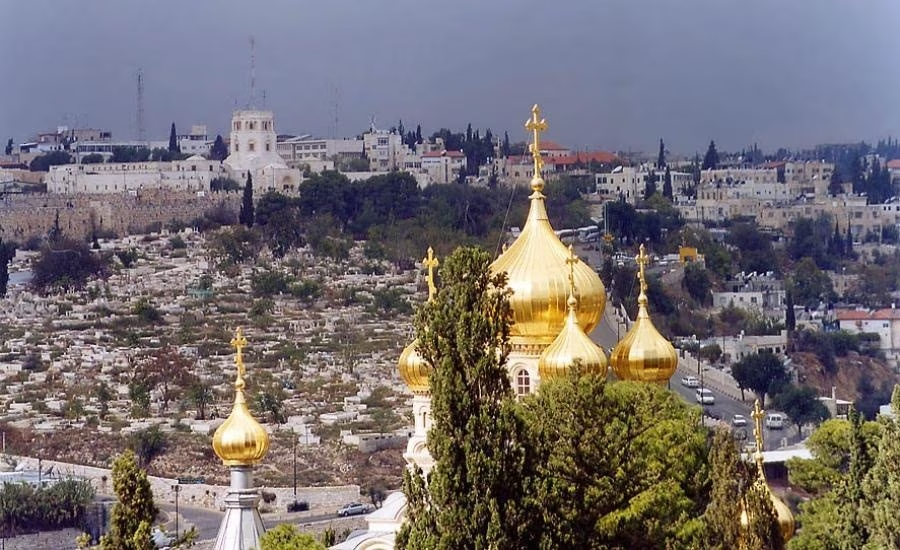
Jerusalem - "Al-Quds" Special Correspondent - In the city of Jerusalem, faith intertwines with history, and politics with real estate. Church properties are not merely financial assets or traditional real estate; rather, they constitute part of a broader battle related to the identity and Christian Palestinian presence in the Holy City. A report on Christian properties in the Holy City and the Palestinian interior, and the role of the Orthodox Patriarchate in preserving them, prepared by Wasel Al-Khatib, Director of the Media Department at the National Popular Conference for Jerusalem, stated that since the election of Patriarch Theophilos III as Patriarch of Jerusalem in 2005, the Orthodox Patriarchate has placed the file of protecting and restoring church properties at the forefront of its priorities, in the face of continuous settlement and legal attempts targeting one of the largest land-owning institutions in historical Palestine. The Patriarchate indicates that its strategy over the past two decades has not been limited to legal defense of disputed properties, but has also included the recovery of lands that had fallen out of its control due to old lease contracts or complex legal arrangements dating back to previous decades. Al-Khatib added in his report that among the most prominent successes announced by the Patriarchate in this context is the recovery of strategic land in the Abu Tor neighborhood, south of Jerusalem. After more than a decade of legal and financial follow-up, the Patriarchate was able in 2023 to recover its full rights to the land for approximately 80 million shekels, freeing it from legal restrictions and reservations resulting from previous agreements and leases. This land is of particular importance due to its location next to a historic Orthodox church and its containing Byzantine ruins, which led the Patriarchate to consider its recovery a model for the policy of "recovering and protecting Orthodox properties" that it has adopted for years. Tangible Successes Al-Khatib said in his report: The Patriarchate also succeeded in recovering vast areas of land belonging to the Qasr al-Yahud Monastery in the Jordan Valley area on the banks of the Jordan River, lands that had been under Israeli occupation control since 1967. Patriarch Theophilos III then considered this step to confirm the possibility of restoring the historical rights of the Church through long-term legal and diplomatic work, stressing that the battle to preserve Christian properties is not over yet. Complex Files The report added: However, the recovery file does not negate the existence of more complex files that are still subject to open dispute with the occupation authorities and settlement associations. Foremost among these files is what is known as the Jaffa Gate properties case at the entrance to the Old City of Jerusalem, which includes hotels and historical properties acquired by a settlement association through deals dating back to the era of the former Patriarch Irenaios. The Patriarchate, led by Patriarch Theophilos III, fought long legal battles to annul those deals, considering that they were based on forgery, corruption, and extortion, and that they aim to change the demographic and Christian character of the Old City. Despite the judicial setbacks suffered by the Patriarchate before the Israeli courts, it still considers the issue open politically, legally, and internationally. Silwan Issue The report stated: As for the Silwan neighborhood, which is witnessing one of the most sensitive real estate confrontations in occupied Jerusalem, some lands and properties belonging to the churches have become a focal point of escalating conflict between church institutions and settlement associations that seek to expand their presence around the Old City and Al-Aqsa Mosque. The Patriarchate affirms that any attempt to harm church properties in Silwan cannot be separated from a broader project aimed at encircling the Old City with a settlement ring that limits both the Islamic and Christian presence. The report added: These lands acquire exceptional importance due to their geographical location adjacent to the southern walls of Old Jerusalem, making them a constant target for settlement projects seeking to impose new realities on the ground. The Patriarchate bases its defense of these properties on the fact that it is one of the largest landowners in Jerusalem and Palestine. The Orthodox institution has accumulated over many centuries vast areas of land and endowments extending from Jerusalem to Bethlehem, the Jordan Valley, and parts of Galilee, and these properties have over time become one of the most important elements of Christian Palestinian steadfastness. Therefore, the Church views the protection of properties as a protection of the Christian presence itself, not merely a protection of real estate wealth. Parallel Tracks In this context, Al-Khatib's report indicated that the Patriarchate affirms that its efforts are distributed among several parallel tracks: litigation before the courts, recourse to international legal expertise, preserving Palestinian tenants in threatened properties, in addition to diplomatic work with governments and international churches to keep the issue of Christian properties present on the international agenda. Patriarch Theophilos III reiterates on many occasions that the real battle is not only over stones, but over the identity of Jerusalem and its religious and cultural diversity. The Historical Jordanian Role At the heart of these efforts, the Jordanian role stands out as one of the most important political protection umbrellas for Christian and Islamic holy sites in Jerusalem. Under the Hashemite custodianship led by King Abdullah II, the historical churches in Jerusalem enjoy continuous political and diplomatic support, and the Orthodox Patriarchate considers this support a fundamental pillar in confronting the pressures its properties are subjected to. Patriarch Theophilos III has on more than one occasion thanked the Jordanian monarch for his continuous support in the battles to establish property rights and defend the Christian presence in the Holy Land, stressing that the Hashemite custodianship is not limited to protecting holy sites, but includes defending the historical and religious character of Jerusalem with all its components. Continuous Confrontation over the Narrative Thus, the battle for Orthodox properties in Jerusalem appears to be larger than just a dispute over plots of land or historical buildings. It is a continuous confrontation over narrative, identity, and existence, in which court decisions intertwine with political and diplomatic calculations. While the Patriarchate has succeeded in recent years in recovering some strategic lands and thwarting attempts to control others, files such as Silwan, Jaffa Gate, and others confirm that the conflict over Christian properties in Palestine is still open, and that the preservation of these endowments has become part of a broader battle to defend the Arab Christian presence in Jerusalem and the Holy Land.
OPINIONS

Mon 22 Jun 2026 1:01 pm - Jerusalem Time

Blowing Up the Iranian-American Memorandum of Understanding from the Beirut Gateway

It seems that the harsh and unprecedented Israeli reactions, both from political and media elites, who said that the Iranian-American memorandum of understanding constituted a resounding defeat for America, greater than its defeat in the Vietnam War, and that it is also tantamount to selling Israel for the cheapest prices, and this was expressed by hostile statements against the two Jews, Steve Witkoff and Jared Kushner, saying that they were bought with Qatari money to support the agreement and the Iranian-American memorandum of understanding, while the fiercest campaign was against US Vice President J.D. Vance, who said that 80% of the weapons Israel fights with are from America. Ben-Gvir told him that Israel is capable of defending itself and does not need anyone's help, and whoever opposes Israel loses, and whoever stands by it wins. It seems that the gap between the priorities of American interests and the requirements of Israeli policy is widening, and this agreement, which granted Iran significant political and economic gains, did not take into account the goals raised by Israel at the beginning of the two wars on Iran (June/2025 and February/2026). Netanyahu, Katz, and Zamir, along with Ben-Gvir, Smotrich, Sokot, Strock, and others, said that they would not withdraw from Lebanon or from the Lebanese territories that were occupied, and they would seek to establish new security and political realities, so that any withdrawal from Lebanon would be linked to the disarmament of Hezbollah, and that they would have, even after the withdrawal, freedom of action in Lebanese territories, and security and buffer zones to protect their northern settlements. This was responded to by Sheikh Naim Qassem in his Ashura celebrations speech by saying: There will be no yellow, red, or green lines, no buffer zones, no security zones, and you will leave, and there will be no agreement that infringes on Lebanon's sovereignty and is at the expense of its geography, land, and the rights of its people, their right to return to their villages and land and rebuild them, and through an agreement in which security is mutual, otherwise the field will be the judge. Israel, which rejects the Iranian-American memorandum of understanding, wants to blow up the memorandum and the agreement from the Lebanese gateway, and its military and security leadership said that the American-Iranian agreement does not obligate it. Iran suspended its delegation's trip to Switzerland until America obliges its ally Israel to adhere to the text of the memorandum, which confirmed in its first clause the guarantee of Lebanon's territorial integrity and safety. In contrast, Israel, in its attempt to blow up the agreement, expanded its aggression against Lebanon and against the city of Nabatieh, Kafr Tibnit, and Ali Al-Taher Hill, and launched the widest and fiercest raids since its aggression against Lebanon, which resulted in more than 24 martyrs and dozens of wounded, but it failed to occupy the hill or advance towards the town of Kafr Tibnit, and suffered heavy losses in its soldiers, as four soldiers were killed, including the commander of Battalion 52, and dozens were wounded in ambushes set by the party for them, in which their tanks, armored vehicles, and vehicles were burned and their advance was prevented. The violent Israeli reactions to these heavy losses and the war of attrition by the party, which manages the battle with great efficiency and qualitative tactics, create a state of confusion, turmoil, and fear among the occupation army and its military leaders, which pushed the leaders of the occupation state to say that the southern suburb should be wiped off the map. Ben-Gvir says for every tear of an Israeli mother, there should be a thousand tears for a Lebanese mother, and Smotrich says after the difficult incident in Lebanon: "It's time to speak with fire, open the gates of hell." As for Avigdor Lieberman, leader of "Israel Our Home," he says: "If the Beirut suburb remains as it is after this harsh incident, in which four Israeli army soldiers and officers were killed, it will be a direct failure for the prime minister and the minister of defense." It seems that these people want to get out of the dilemma of the agreement that now threatens their political future, and has brought them harsh reactions from Israeli society, political and media elites, Israeli opposition leaders, and settlement leaders and settlers, which led journalist Avi Eisenkot to say that the campaign known as "Lion's Roar" was nothing but "cat's meow." If Israel undertakes a wide military operation in the southern suburb, and carries out widespread assassinations of military, security, and political leaders of the party and the Lebanese resistance, this means that Iran, which does not see Lebanon as merely an area of influence, but rather as part of its strategic security and national identity, the collapse of the memorandum of understanding with America, and through harsh Iranian military responses, and going to a wider and more comprehensive military round than before, but I do not think that America will fully stand behind Israel in this round, as it will create and deepen the division in the American political stance, and there will be more cracks between the American administration and the occupation state, which may go beyond tactical differences, as well as the Arab Gulf states, perhaps this time they will wake up from their political coma and their detachment from reality, and will not allow Israel to use their airspace and territories to launch its aggression against Iran, and the same applies to America if it participates with Israel in this aggression. In my opinion, the region is heading towards a more comprehensive and wider escalation, as the occupation state will not surrender to the new balance of power, and to Iran being the decision-maker in the region and the area, but this new war and round will not only fail the ambitions of Israel's war-loving leaders and their industry, with the collapse of the goals of those wars to establish what is known as "Greater Israel" and "Great Israel," but will impose new political and security realities on it, and perhaps if the opportunity is seized and the Arab position is united, Israel will be forced to withdraw from all the Lebanese, Syrian, and Palestinian territories it occupied.

OPINIONS

Mon 22 Jun 2026 1:01 pm - Jerusalem Time

Ideology in the Service of the State: What Did Gaza Reveal About Iran and Its Axis?

The war on Gaza, and the subsequent regional confrontations and American-Iranian negotiations, brought back an old question about the nature of the relationship between ideology and politics in the behavior of the Islamic Republic of Iran. Does Iran govern with a transnational revolutionary doctrine that places Palestine and the “Axis of Resistance” at the core of its strategic decisions? Or is it a state that ultimately acts according to national interest calculations like other states? The reality is that the answer does not lie in one extreme, but in combining both. Since the establishment of the Islamic Republic, Iran has not been merely a traditional nation-state, but it has also not been a purely ideological state. Over decades, it has succeeded in integrating doctrine with interest, transforming ideology into a tool of regional influence and a source of internal and external legitimacy. Within this framework, the Palestinian issue has occupied a central position in Iranian discourse. Palestine was not merely a solidarity issue; it became part of the regime's political and revolutionary identity, and a fundamental pillar in building the network of regional alliances later known as the “Axis of Resistance.” However, events of recent years have revealed that the centrality of Palestine in discourse does not necessarily mean it occupies the same position in the hierarchy of strategic priorities. During the war on Gaza, the Palestinian issue did not become a condition in Iranian negotiations with the United States, nor did stopping the war or ending the siege become part of the understandings Tehran sought. Although Gaza is presented as one of the most important battlefields with Israel, negotiations focused on issues directly related to Iran: sanctions, security, economy, and regime stability. Here arises another question that concerns not only Iran but also Hamas. The movement entered the battle of October 7 based on its own calculations, and perhaps on the assumption that the expansion of the confrontation would lead to broader involvement from axis parties under the slogan of “unity of fronts.” However, the course of the war revealed that each party has its own calculations, limits, and priorities. States, even when adopting a common ideological discourse, do not abandon the logic of national interest when making fateful decisions. From this perspective, the issue does not seem to be related only to the limits of Iran's commitment to its allies, but also to Hamas's understanding of the nature of the relationship between resistance movements and their supporting states. Political and military support does not necessarily mean unity of decision or unity of destiny, just as alliance does not negate the differences between the logic of a state and the logic of a movement. Perhaps one of the questions that will impose itself on the movement after the war is whether it will re-evaluate some of its previous bets on the role of allies and the limits of their intervention in moments of major confrontation. This problem becomes more complex when it comes to the Shiite forces within the axis. The relationship between these forces and Iran is not based solely on political or military interests; it intertwines doctrinal, sectarian, and political elements, which for some of these forces are linked to the concept of Wilayat al-Faqih and the role they grant to the Iranian leadership. However, the recent war showed that this ideological dimension, despite its importance, did not negate the fact that the final decision remains that of a state governed by calculations of power, survival, and Iranian national interest. While some of these forces view the relationship with Iran as both a political and ideological partnership, Tehran views the axis from a broader perspective related to Iranian state security and its strategic interests. Hence, the inherent tension between the logic of the state and the logic of ideology, and between the calculations of the center and the expectations of the periphery, emerges. This does not mean that Iran has abandoned Palestine or its allies, but rather that support for these allies has remained constrained by a ceiling that does not threaten the supreme interests of the Iranian state. When ideology aligns with interest, they move together; when there is a conflict between them, national interest takes precedence over everything else. Here appears one of the most important paradoxes within the axis itself. While Tehran treats its revolutionary slogans with a great deal of political pragmatism, some allied forces, especially those that derive their legitimacy from the ideological dimension, still treat these slogans as a fixed and unwavering commitment regardless of circumstances. Therefore, what is legitimate for Iran in terms of negotiation, settlements, and understandings seems illegitimate when it concerns its allies or their political environments. The recent war revealed that the so-called “Axis of Resistance” is not a homogeneous ideological bloc, but an unequal network of alliances led by a state with its own interests and national calculations. In this network, Iran reserves the right to make fateful decisions according to its national priorities, even when allies bear heavy costs in defense of the common project. The war on Gaza revealed that ideology in the Iranian project is not a substitute for the state, but one of its tools. Iran does not abandon its slogans, but it always reinterprets them to serve its strategic interests. This is where the strength and continuity of the Iranian project lie, on the one hand, and the source of constant tension between it and its allies, on the other. The closer the moment of truth, the clearer the difference between a state that sees ideology as a tool to serve its interests, and forces that see ideology as an end that takes precedence over other calculations. Perhaps the most important question after all that has happened remains: Have Iran's allies, especially Hamas after October 7, realized that “unity of fronts” does not necessarily mean unity of decision or unity of destiny? And that alliance, no matter how strong its ideological and military power, does not negate the fact that states ultimately act according to their national interests first and foremost?

OPINIONS

Mon 22 Jun 2026 1:01 pm - Jerusalem Time

Washington Shakes Tel Aviv: Political Rift After Trump's Criticisms

The Israeli political arena has recently witnessed significant tension following public statements made by US President Donald Trump and Vice President J.D. Vance, which included direct criticisms of Israeli Prime Minister Benjamin Netanyahu. These statements sparked a wide-ranging debate within Israel, due to their implications for the nature of the relationship between Tel Aviv and Washington, and what they reveal about internal divisions within Israel itself. This article aims to analyze this development from an academic perspective, focusing on its political and strategic repercussions.First: The General Context of the American StatementsTrump's statements came at a sensitive moment when the region is experiencing escalating tension, especially on the Lebanese front and amidst discussions about the US-Iranian agreement. These statements included clear criticisms of Netanyahu's approach to managing security files, in addition to hints about Israel's excessive reliance on American support. As for Vice President J.D. Vance, he went further by directly reprimanding ministers in the Israeli government for their opposition to American directions, warning that continuing this approach could affect the level of military and political support provided by Washington.Second: Reactions within IsraelThese statements created a clear rift within Israel on three main levels. At the governmental level, Netanyahu found himself facing a dual challenge: on one hand, unprecedented American pressure; and on the other hand, criticisms from far-right ministers who believe that Washington is interfering in Israeli sovereignty. This internal tension reflects the fragility of the ruling coalition and reveals fundamental differences in vision among the government's components.As for the security establishment, military leaders and security agencies expressed concern about the deteriorating relationship with the United States, given Israel's significant reliance on American military support. Israeli reports indicate that the security establishment tends towards de-escalation with Washington, contrary to some political voices pushing for escalation.At the public opinion level, the American statements sparked a wide debate in the Israeli media, some of which described them as a "strategic warning" to the government. Opinion polls also showed a division between those who believe Netanyahu is risking the relationship with Washington and those who consider the United States to be exerting undue pressure.Third: Strategic ImplicationsThese developments reveal a significant shift in the relationship between the United States and Israel. Public statements from the highest echelons of power in Washington indicate an American desire to reset the relationship, especially concerning the Iranian and Lebanese files. They also reflect a decline in Netanyahu's ability for political maneuvering, after he had historically relied on strong personal relationships with Washington leaders.On the other hand, the internal rift in Israel emerges as a factor that further complicates the scene. The divergence between the government and the security establishment, and among the coalition components themselves, indicates an internal leadership crisis that could affect Israel's ability to make coherent strategic decisions.It can be said that Trump's and his vice president's statements were not just fleeting criticisms, but rather constituted a turning point in the relationship between Washington and Tel Aviv, and revealed the fragility of the Israeli political structure. They also exposed deep internal divisions that could affect the future of the government and Israel's ability to deal with regional challenges. The question remains open as to whether this crisis will lead to an internal reassessment of Israel's political approach, or whether it will develop into a deeper crisis in the relationship with the United States.* Specialist in Israeli Affairs

PALESTINE

Mon 22 Jun 2026 8:18 am - Jerusalem Time

Naim Qassem Rejects Israeli 'Freedom of Movement' and Affirms: Occupation's Stay in Lebanon is Impossible

Hezbollah's Secretary-General, Naim Qassem, emphasized in a televised speech broadcast on Sunday that any future ceasefire agreement cannot grant the Israeli occupation freedom of movement within Lebanese territories. Qassem considered that accepting such a condition would mean legitimizing aggression under the guise of de-escalation, which is completely and utterly rejected by the resistance.

Qassem clarified that some circulating proposals attempt to impose an equation that stipulates the silencing of Hezbollah's weapons in exchange for Israel's free hand in killing and battlefield advancement. He affirmed that this logic does not represent a cessation of hostilities, but rather a continuation of aggression in another form that the party will not accept, regardless of the field or political pressures.

In his definition of a ceasefire, the Secretary-General pointed to the necessity of a complete halt to Israeli military operations in the air, land, and sea. He also stressed that any agreement must include a halt to systematic demolition operations and the termination of the Israeli military presence in all areas occupied during the recent incursion.

On the ground, Qassem described the continued presence of occupation army forces on Lebanese territory as 'impossible' and unsustainable. He categorically rejected Israeli talks about establishing security or buffer zones within Lebanese borders, considering them an infringement on national sovereignty that is indivisible.

Qassem affirmed that the responsibility for preserving Lebanese sovereignty and protecting its borders primarily rests with the Lebanese army, which enjoys cooperation and coordination from all relevant parties. He called for strengthening the military institution's role in extending state authority and preventing any future Israeli violations of recognized international borders.

In a related context, Qassem urged the Lebanese government to benefit from regional diplomatic channels, specifically the recent Iranian-American memorandum of understanding. He called for the necessity of addressing and developing Lebanese relations with Tehran, similar to what the United States and other Arab countries are doing in the search for regional stability.

These positions come in response to repeated statements from occupation leaders, where Israeli Prime Minister Benjamin Netanyahu vowed to continue controlling what he described as the 'security strip'. Tel Aviv insists on remaining in the areas of incursion to ensure the security of northern settlements, which is categorically rejected by official Lebanon and the resistance.

Qassem's speech coincides with intensive diplomatic activity in Switzerland between Washington and Tehran, following the signing of the 'Islamabad Understanding' aimed at ending the broader war. Despite this understanding, the continued fierce fighting in southern Lebanon threatens to undermine efforts to reach a comprehensive and sustainable de-escalation.

Iran and the United States had reached a 14-point understanding in mid-June, mediated by Pakistan, to end regional conflicts. This understanding came into effect after electronic signing by Presidents Pezeshkian and Trump, including provisions for opening the Strait of Hormuz and lifting the naval blockade on Iran.

On the ground, Israeli forces continue their operations in what they call the 'Yellow Line', a strip ten kilometers deep inside Lebanese territory. This incursion began in early March and has caused widespread destruction in border villages and attempts to establish permanent military outposts for the occupation.

Statistics from the Lebanese Ministry of Health indicate that the ongoing aggression since March 2026 has led to the martyrdom of more than 4,100 people and the injury of thousands. The intense shelling and ground incursion have also caused the displacement of more than a million Lebanese from their villages and towns, creating a worsening humanitarian crisis in the country.

A fifth round of direct talks between Lebanon and Israel, under international patronage, is scheduled to begin next Tuesday, despite Hezbollah's repeated rejection of them. The Lebanese authorities seek in these negotiations to separate the Lebanese file from other regional tracks to ensure a complete and rapid Israeli withdrawal.

There is no such thing as a ceasefire with freedom of movement for Israel; this represents a continuation of aggression, not a cessation of it.

PALESTINE

Mon 22 Jun 2026 8:18 am - Jerusalem Time

Thirst of the Land in the Jordan Valley: Water Cut-off Policies Devastate Farmers' Crops and Threaten Palestinian Existence

The Atouf plain area, located east of the city of Tubas in the West Bank, is experiencing a suffocating agricultural crisis, where natural drought is no longer the only threat to crops. Field sources reported that the deliberate cutting of water lines supplying the area led to the wilting of vast areas of vineyards and the complete destruction of seasonal crops, amid strict restrictions preventing farmers from accessing alternative sources.

Farmer Dirgham Bisharat recounts the details of his devastating loss, as tons of grapes he had waited all year to ripen turned into dry, worthless branches. Bisharat confirmed that the interruption of irrigation water for three consecutive months not only caused the loss of the current season but also damaged old trees that had been producing for many years, meaning the loss of future production as well.

Financial estimates indicate that the scale of the economic catastrophe exceeds the farmers' ability to cope, as the loss per dunam of grapes reaches about one million shekels, equivalent to approximately 270,000 dollars. These figures reflect a tragic reality experienced by landowners who find themselves facing accumulated debts and an unknown future amid the continuation of systematic thirst policies against Palestinian villages and towns.

In the Al-Ras Al-Ahmar area, the scene is no less bleak, as farmer Lotfi Bani Odeh faces daily challenges related to livestock farming and providing pastures. Bani Odeh explained that the closure of vast areas of land and their conversion into closed military zones, in addition to continuous settler attacks, has forced dozens of families to forcibly leave the area in search of safer livelihoods.

These crises coincide with field movements to construct new settlement and military roads that penetrate the heart of agricultural lands in the Jordan Valley. Local officials warned that one of the roads currently under construction extends for 22 kilometers and is up to 50 meters wide, which will lead to the seizure of thousands of agricultural dunams and the isolation of other areas behind security zones that Palestinians are prohibited from entering.

As for the Auja area, the crisis of discrimination in water resource distribution is most evident, as the area contains dozens of high-flow artesian wells. Despite this water abundance, local sources complain that surrounding settlements receive huge water allocations that exceed their needs, while Palestinian farmers are left to struggle with thirst to preserve what remains of their crops.

The conflict in the Jordan Valley remains a struggle for survival and identity, where the water crisis intertwines with land confiscation policies and security restrictions. Despite all these harsh conditions of settler harassment and declining agricultural production, farmers in Atouf, Tamoun, and various areas of the Jordan Valley continue to cling to their lands, considering that steadfastness in the face of these pressures is the only way to prevent the emptying of the area of its original inhabitants.

The loss per dunam of grapes reaches about one million shekels, and the three-month irrigation stoppage not only killed the harvest season but also destroyed the trees' ability to produce for years to come.

ARAB AND WORLD

Mon 22 Jun 2026 8:18 am - Jerusalem Time

New York Times: How Did Trump's Military Ambition Against Iran Turn Into a 'Conditional Surrender'?

American writer Nicholas Kristof, in an article published by the 'New York Times,' considered President Trump's announcement of reaching an agreement to end the escalation with Iran to be, in essence, a 'conditional surrender' on Washington's part. The writer pointed out that previous demands for unconditional surrender from Tehran faded in the face of the new negotiation reality, which granted the Islamic Republic broad gains.

The terms of the preliminary agreement caused astonishment and anger among hawks within the Republican Party, with Senator Ted Cruz describing the granting of billions of dollars to the Iranian regime as a catastrophic idea. Critics believe that this step strengthens extremist religious factions that pose a direct threat to American interests and its allies in the region.

The leaked details of the agreement include providing immediate financial aid to Tehran, including the release of billions of dollars frozen in international banks as a first step to build trust. A proposal for establishing a massive fund worth $300 billion, allocated for rebuilding what years of confrontation and economic sanctions have destroyed, also looms on the horizon.

One of the most controversial points in the agreement is the understandings related to the Strait of Hormuz, where it appears that Washington has opened the door for Tehran to exercise partial sovereignty over this vital shipping lane. This includes the possibility of imposing fees on passing ships after a 60-day transitional period, which gives Iran a global economic leverage.

Republican Senator Bill Cassidy described this approach as the 'worst foreign policy mistake in decades,' considering that the current administration abandoned its leverage without real compensation. However, Kristof believes that the fundamental mistake was not in ending the war but in sliding into it from the beginning without a clear strategy.

Trump defended his decision to back down, asserting that continued bombing for additional weeks or months would not have opened the Strait of Hormuz or achieved a decisive victory. He clarified in his statements that he sought to avoid a global economic catastrophe that would have rocked markets and directly affected the Republicans' chances in the upcoming elections.

The analysis indicates that Iran succeeded in its procrastination strategy, realizing that Trump was looking for a face-saving exit after the failure of military pressure. This failure led Washington to accept an agreement that many consider 'humiliating,' given the extent of concessions made on issues that were considered red lines.

The lesson learned from this crisis, according to Kristof, is the necessity of humility in military objectives and greater reliance on proactive diplomacy. It seems that the hawks who pushed for the destruction of the Iranian regime have, unwittingly, contributed to strengthening it and increasing its regional influence.

The writer recalled the nuclear deal concluded by Barack Obama in 2015, considering it to have provided a reasonable solution to the nuclear problem through strict international oversight. However, Trump's withdrawal from it, encouraged by Benjamin Netanyahu, pushed Tehran to rapidly develop its nuclear program until it reached the brink of the current crisis.

Reckless policies led to the absence of a clear exit strategy, as Trump began the bombing campaign without accurate calculation of potential Iranian reactions, especially regarding the closure of waterways. This military confusion ultimately led to a return to the negotiating table from a position of weakness, not strength.

Observers fear that the new agreement will postpone fundamental questions about Iran's nuclear ambitions instead of resolving them definitively. There are concerns that Tehran might exploit the sixty-day period to procrastinate, while Trump loses interest in the file, as happened with other international issues such as the Gaza Strip.

Domestically in the US, the desire to engage in new wars in the Middle East has declined, which might push the Iranian Revolutionary Guard to adopt a 'North Korean model.' This approach aims to build a deterrent nuclear arsenal that ensures the regime's survival and consolidates its regional hegemony away from American threats.

The human and material cost of this confrontation reached shocking figures, with Harvard University estimates suggesting that the total bill could reach one trillion dollars. These costs include repairing military bases, replacing ammunition, and caring for veterans, in addition to the loss of American soldiers' lives and civilians in the region.

Kristof concluded his analysis by pointing out that the biggest losers are ordinary Iranians who were left to face a more oppressive regime after false American promises of change. He warned against following 'war hawks' who promise easy victories, emphasizing that the tragedy of history repeats itself when caution is absent in the face of uncalculated military ambition.

The bitter truth confirms that Iran won the war, and for this reason, it won the negotiations, and the failure of the war left Trump with no satisfactory exit.

PALESTINE

Mon 22 Jun 2026 8:17 am - Jerusalem Time

Attempt to recruit a businessman in Britain to spy on the 'Palestine Action' movement

Businessman Shams Sadiq, 51, faced a harsh experience that began immediately upon his arrival at Manchester Airport in northern England on the dawn of May 11, 2026. As he was looking forward to returning to his normal life after a short vacation, authorities stopped him at the passport control section for an unexpected security interview.

Sadiq was subjected to strict procedures under 'Schedule 7' of the British Terrorism Act, a legal provision that grants security agencies broad powers to stop and search travelers at airports and border crossings. These powers allow for questioning even in the absence of any clear suspicion of committing a specific legal offense.

Sources reported that two plainclothes officers took Sadiq to an isolated interrogation room, where all his electronic devices and personal belongings were immediately confiscated. The investigators demanded that he provide passwords for his phone and personal accounts, threatening legal action if he refused.

Sadiq's interrogation lasted for more than three continuous hours, during which the questions focused on precise details of his personal and social life. The questions included the nature of the mosque he attends, his relationships with community members, and how he deals with anyone who might hold ideas described as extremist.

Several days after the incident, Sadiq received a call to retrieve his belongings, where he met the two officers at an airport cafe to collect his devices. Although the officers offered a formal apology for what happened, the case took a more serious and complex turn in the following days.

New chapters of security pressure began when Sadiq was summoned to Ashton Police Station to retrieve other devices that had been confiscated from him in October 2025. The officers then informed him that they had reviewed the contents of his messages and videos, claiming there was a link connecting him to the 'Palestine Action' group.

Sadiq was surprised by a clear offer from the officers to cooperate with them and work as an informant for the British police. The offer included promises of substantial financial compensation, in addition to overlooking any minor legal violations he might face in the future.

Sadiq expressed his extreme astonishment at this offer, especially since he faced no existing criminal charges, and the previous case for which he was stopped had been completely closed. He described the attempt to recruit him as an attempt to turn him into a 'secret agent' against human rights activists.

Following his categorical refusal to cooperate, Sadiq decided to resort to his legal team, who advised him of the necessity of exposing these practices to public opinion to ensure his protection. Lawyers have already begun to take formal steps by filing complaints against the counter-terrorism unit and the security agencies involved in the recruitment attempt.

This incident once again highlights the ongoing debate in Britain about the expanded use of counter-terrorism laws to target those who sympathize with the Palestinian cause. Sadiq hopes that his story will encourage others who have faced similar pressures to break the silence and expose these security practices.

I used to imagine the idea of a secret agent as it appears in movies, but I discovered that reality is completely different, and that is why I refused the offer.

ARAB AND WORLD

Mon 22 Jun 2026 8:17 am - Jerusalem Time

Washington and Tehran Truce: Fragile Gains and Implementation Challenges Amidst Distrust

The recently signed memorandum of understanding between the American administration and the Iranian side comes in the context of both parties' attempts to market political achievements to their domestic fronts. While the American president faces sharp criticism for making concessions described as exceeding those of the 2015 agreement, a faction in Iran views the agreement as a retreat from the sacrifices of military and political leaders.

The reality on the ground indicates that the state of exhaustion that afflicted Washington and Tehran after 111 days of conflict, interspersed with 39 days of direct military confrontation, was the biggest motivator for sitting at the negotiating table. Logistical and political factors, such as the United States hosting the World Cup and the approaching congressional midterm elections, contributed to accelerating the pace of signing.

The current American administration needs to focus on pressing domestic issues, primarily rising inflation and increasing parliamentary opposition to the continuation of the war. American forces also suffer from a shortage of ammunition and unrest among soldiers, in addition to the urgent need to repair military bases damaged in Gulf states and Jordan during recent confrontations.

On the other hand, Iran seeks through this truce to catch its breath and reorganize its military and social conditions damaged by the bombing. The Iranian regime aims to alleviate the effects of the naval blockade, which led to a crazy rise in prices and a shortage of basic goods, directly affecting the labor market and foreign trade.

The memorandum's texts included mutual gains; Tehran secured the lifting of the naval blockade on its ports in exchange for guaranteeing freedom of navigation in the Strait of Hormuz without fees. The understandings also included allowing Iran to export its oil and petroleum products and restoring banking and insurance services, in exchange for assurances not to seek to develop nuclear weapons.

The problem of trust remains the biggest obstacle to transforming this memorandum into a permanent agreement, especially with the American record of breaking promises. Observers recall Washington's withdrawal from the 2015 agreement, and the attacks launched in June 2025 and February 2026, which makes current promises highly questionable to Iranian decision-makers.

In the Palestinian file, disappointment emerges from American promises, as Washington did not adhere to its previous commitments regarding a ceasefire in Gaza. Despite talk of a peace council, the number of martyrs in the Strip has risen to 1008 people since the last agreement was approved, amidst continued Israeli intransigence and prevention of entry of reconstruction materials.

The situation in Lebanon is no better, as American pledges to a ceasefire have been repeatedly violated, most recently the breach of the truce scheduled to begin last Friday. Israeli forces continue their military operations at a high killing rate, ignoring the memorandum's texts calling for a permanent end to the war on all fronts.

Informed sources indicate that Washington violated the first clause of the memorandum, which stipulates refraining from threatening to use force, as hostile statements continued from senior American officials. Moreover, interpretations regarding ending the war in Gaza remain vague, with no American reaction to Israeli settlement and military expansion.

Iran achieved implicit recognition of its influence in the region through the text stipulating its joint sovereignty with the Sultanate of Oman over the Strait of Hormuz, and emphasizing its role in Lebanon. However, these gains remain contingent on the extent of Israeli commitment to withdraw from recently occupied Lebanese territories, which Israeli officials openly reject.

Analysts believe that Iran succeeded in pushing Trump to accept the principle of fragmented negotiation, which he previously rejected, as the nuclear weapons issue was postponed to a later stage. This approach drew criticism for Trump, who seemed to prioritize opening the Strait of Hormuz over the nuclear file, which was a main reason for entering the war.

The United States and Israel follow a strategy of linking issues, where the implementation of Iran's reconstruction plan, estimated at $300 billion, is contingent on definitively resolving the nuclear file. The release of frozen Iranian assets and the lifting of sanctions are also linked to the progress in nuclear weapons negotiations, which could take many months.

Historical experiences indicate that nuclear file negotiations are extremely complex and cannot be resolved within the specified two-month period, given that the 2015 agreement took years of discussions. Western powers are expected to insist on including the ballistic missile and drone files in any final agreement to ensure Israel's security.

Tehran understands the nature of American political fluctuations, and is currently betting on prolonging negotiations until the results of the upcoming congressional elections become clear. Iran aims through this de-escalation to repair its civilian and military facilities, and prepare for a potential round of confrontation that Trump might initiate under Israeli pressure before the end of his term.

The exhaustion that afflicted both parties after 111 days of conflict is the main reason for signing the memorandum of understanding despite the absence of trust and the divergence of real positions.

PALESTINE

Mon 22 Jun 2026 8:17 am - Jerusalem Time

Occupation Considers Limited Withdrawals from Southern Lebanon Ahead of Washington Negotiations Round

Hebrew media sources revealed on Sunday evening that deliberations are underway within the security establishment and political level in the occupation state regarding the possibility of implementing 'limited' withdrawals from some points controlled by Israeli forces in southern Lebanon. These moves come amidst ongoing diplomatic efforts and direct negotiations aimed at formulating border and security understandings between Beirut and Tel Aviv.

Sources reported that intensive consultations held in recent hours focused on assessing the field situation in areas beyond the 10-kilometer range inside Lebanese territory. Reports indicate that these proposed withdrawals may include strategic locations reached during recent ground operations, in order to strengthen the Israeli negotiating position ahead of upcoming rounds.

The 'Beaufort Castle' area stands out as one of the most prominent candidates for this partial withdrawal, a region that the occupation army announced control over at the beginning of June. The castle gains symbolic and military importance due to its commanding location, despite previous assurances from Lebanese parties that its control did not require direct military confrontation as it was free of armed presence.

In contrast, officials in Tel Aviv stressed that any field movement would not affect the so-called 'Yellow Line,' which the Israeli military command considers a red line that cannot be conceded. The occupation believes that maintaining this line is an utmost necessity to secure northern settlements and prevent any infiltration or future attacks targeting the Israeli interior.

On the political front, Hebrew sources claimed that the occupation government had not received any official requests or pressure from the US administration to evacuate its positions in southern Lebanon. They clarified that the move towards redeployment aims to show 'goodwill' and a self-initiative towards the Lebanese government, away from portraying it as a response to external dictates or international pressure.

Political circles in Tel Aviv consider that continued control over some advanced points represents a strong bargaining chip in the ongoing negotiations, where withdrawal from them is exchanged for security gains and long-term border arrangements. This tactic aims to ensure the achievement of maximum Israeli conditions in the final agreement being worked on in international capitals.

These leaks coincide with the US State Department's announcement of a new round of direct negotiations between the Lebanese and Israeli sides in Washington, scheduled to be held between June 23 and 25. This is the fifth such round since the start of the negotiation process last April, amidst international hopes of reaching an agreement that ends the escalation.

The occupation army had promoted its control over Beaufort Castle as a major military achievement, while Hezbollah described these movements as mere photographic operations aimed at media propaganda. The party confirmed in previous statements that Israeli forces infiltrated militarily uninhabited locations to claim field progress, which casts a shadow on the true motives behind the currently proposed withdrawal.

The border region is experiencing a state of anticipation for the outcome of the upcoming Washington round, especially with increasing calls within Israel to turn parts of southern Lebanon into a buffer zone. These Israeli desires clash with a categorical Lebanese rejection of any infringement on national sovereignty or the imposition of a new geographical reality that goes beyond the internationally recognized Blue Line.

Questions remain about the seriousness of the occupation in implementing these 'small' withdrawals, and whether they will pave the way for a comprehensive agreement or are merely a tactical repositioning. The field still witnesses intermittent tensions, while diplomacy races against time to establish pillars of stability that prevent the situation from sliding into a wider and more comprehensive confrontation in the region.

Any adjustment in troop deployment will be presented as an Israeli initiative within the framework of dialogue with the Lebanese government, and not as a result of external pressure.

ARAB AND WORLD

Mon 22 Jun 2026 8:17 am - Jerusalem Time

Ahead of Trump meeting.. Al-Zaidi's government races against time to resolve vacant ministerial portfolios

Steps are accelerating in the Iraqi capital, Baghdad, to arrange internal affairs before Prime Minister Ali Al-Zaidi heads to the United States of America. The Iraqi government officially announced that the first half of next July will be the final deadline to complete the stalled cabinet formation, to ensure entering Washington negotiations with full governmental representation and absolute powers.

Government spokesman Haider Al-Aboudi explained in press statements that current efforts are focused on resolving the nine remaining portfolios in the ministerial cabinet. Al-Aboudi indicated that this move comes as a proactive step preceding the anticipated meeting between Al-Zaidi and US President Donald Trump, to strengthen Iraq's negotiating position on sensitive issues.

The Iraqi parliament had granted confidence to Al-Zaidi with only 14 ministers in mid-May, while sovereign ministries such as defense and interior remained pending due to political tug-of-war. The government faces pressure from political forces participating in the political process that have not yet agreed on the distribution of remaining shares, which has hindered the completion of the ministerial quorum for weeks.

Security sources indicate that Al-Zaidi's government has set a clear 'roadmap' aimed at achieving tangible progress in high-level appointments and sovereign positions before leaving the country. This visit is Al-Zaidi's first abroad since taking office, which gives it exceptional importance in shaping Iraq's new foreign policy and consolidating the pillars of internal stability.

Regarding relations with Washington, the US administration is awaiting practical steps from Baghdad regarding restricting weapons to official state institutions. These demands come as a basic condition for continued military and economic support, as Washington seeks to reduce the influence of armed factions and ensure the independence of Iraqi security decisions away from external interference.

In an initial response to these pressures, recent weeks have witnessed announcements from prominent armed factions, including Asa'ib Ahl al-Haq, about handing over the administration of their brigades within the Popular Mobilization Forces to government control. However, challenges remain with other factions that refuse to give up their weapons, especially given the continued presence of international coalition forces in the northern bases.

In addition to the security file, Al-Zaidi carries heavy economic files aimed at attracting American investments to rebuild the dilapidated infrastructure. Baghdad is particularly seeking to develop the oil and energy sector through international partnerships, which could contribute to alleviating the severity of the living crises that the Iraqi street has suffered from for years.

It is worth noting that Ali Al-Zaidi's appointment came after a difficult birth and agreements within the 'Coordination Framework', following the exclusion of previous options that caused widespread controversy. Al-Zaidi received an official invitation from President Trump during a phone call last April, which reflected an international desire to support the new government provided that structural reforms are implemented in the state structure.

The completion of the ministerial cabinet will be in the first half of next July, before the visit to Washington.

ARAB AND WORLD

Mon 22 Jun 2026 8:17 am - Jerusalem Time

Qatar welcomes Switzerland talks between Washington and Tehran and calls for a comprehensive settlement

The Prime Minister and Minister of Foreign Affairs of Qatar, Sheikh Mohammed bin Abdulrahman Al Thani, expressed Qatar's welcome for the continuation of the ongoing round of talks between the United States of America and the Islamic Republic of Iran in Switzerland. He affirmed in an official statement that Doha hopes these diplomatic efforts will form a fundamental pillar for reaching a comprehensive agreement that puts an end to existing conflicts and strengthens the foundations of stability and security in the region.

The Qatari Prime Minister stressed the importance of the Lucerne Lake Summit and the discussions that began today, Sunday, indicating his country's aspiration to build on what will be achieved in these sessions. These Qatari moves come within Doha's continuous endeavor to bridge views between international parties and address thorny issues through diplomatic channels and direct dialogue.

In a related context, a new round of direct negotiations began in the Swiss resort of Bürgenstock under the umbrella of the 'Islamabad Understanding'. This negotiating framework primarily aims to end direct and indirect military confrontations between Tehran and Washington, in addition to finding radical solutions to the outstanding issues that have caused an escalation of tension during the past period.

Despite the diplomatic atmosphere, a state of tension loomed over the negotiation hall following statements made by US President Donald Trump, in which he demanded that Tehran curb its allies in Lebanon. Trump warned that the United States is prepared to launch harsher military strikes against Iranian targets if the escalation continues, casting a shadow of doubt over the possibility of achieving a quick breakthrough in the crisis.

News conflicted about the continuation of the sessions, as media sources stated that the Iranian delegation withdrew from the talks after about 80 minutes of discussions in protest of the American tone. However, informed diplomatic sources later denied the cessation of dialogue, confirming that Iranian negotiators are still involved in the negotiation process, and that international mediators have not received any official notification of withdrawal.

For his part, the Iranian response came quickly from the Speaker of the Shura Council and chief negotiator, Mohammad Bagher Ghalibaf, who affirmed the readiness of the Iranian armed forces to deal with any external threats. Ghalibaf stressed that Tehran will not succumb to the policy of maximum pressure and will not retreat from its principled positions under the weight of military threats brandished by the US administration.

Informed sources reported that the first round of discussions focused intensively on the mechanisms for implementing the provisions of the 'Islamabad Understanding' and discussing field developments in Lebanon, without addressing the nuclear file at this stage. The fate of the upcoming sessions remains shrouded in mystery, as mediators await an evaluation of the results of the first day to determine the chances of continuing the dialogue in light of the sharp tensions between the two parties.

We look forward to these efforts paving the way for a final agreement that ends the war and enhances stability in the region.

ARAB AND WORLD

Mon 22 Jun 2026 8:16 am - Jerusalem Time

Fidan warns of Israeli attempts to undermine US-Iranian agreement and reveals a quadrilateral regional move

Turkish Foreign Minister Hakan Fidan affirmed that Israel is awaiting any possible opportunity to undermine the understandings recently reached between the United States and Iran. Fidan clarified, in statements made during his official visit to the Egyptian capital Cairo, that there is a tangible political will shown by both the American and Iranian sides to overcome major obstacles, stressing that the intensive work expected in the coming period will play a crucial role in overcoming the remaining difficulties despite continuous Israeli attempts to disrupt this path.

These Turkish warnings come after the signing of a historic memorandum of understanding at the Palace of Versailles in France in mid-June, which included 14 clauses establishing a 60-day transitional phase before the final agreement is concluded. These understandings include American commitments to finance the reconstruction of Iran with an amount of up to 300 billion dollars, in addition to field measures including a ceasefire in Lebanon, lifting the naval blockade on Tehran, and opening the Strait of Hormuz, reflecting a radical shift in US foreign policy towards the region.

Regarding regional moves, Fidan revealed that a lengthy working session was held involving the foreign ministers of Turkey, Saudi Arabia, Egypt, and Pakistan, with the aim of formulating a unified regional vision for the post-war and current crisis phase. He indicated that these four countries are striving to shape the future of the region in cooperation with the international community, while emphasizing the rejection of any externally imposed perceptions, as work is currently underway to mature this common vision to present it at the appropriate time to ensure regional stability.

In contrast, political circles in Israel are in a state of turmoil, as demands for Prime Minister Benjamin Netanyahu's resignation have escalated after the US-Iranian agreement was considered a grave strategic failure for Tel Aviv. Sources reported that intense American pressure had previously prevented an imminent Israeli attack to invade the remaining areas in the Gaza Strip, at a time when Qatari, Omani, and Pakistani mediations succeeded in bringing Washington and Tehran closer despite previous targeting of Iranian infrastructure.

Israel is always watching and waiting for the first opportune moment to disrupt issues and spoil the course of negotiations between the United States and Iran.

ARAB AND WORLD

Mon 22 Jun 2026 8:16 am - Jerusalem Time

'Right-wing alliance' cracks: How Trump became an electoral burden for Meloni?

The relationship, once described as the strongest across the Atlantic, has entered a phase of sharp public confrontation, with Italian Prime Minister Giorgia Meloni and US President Donald Trump exchanging harsh criticisms. This dramatic shift reveals the extent of political pressure facing Rome as elections approach, and reflects Trump's declining appeal even among his traditional allies on the old continent.

The spark for the latest crisis ignited when Trump told media outlets that Meloni 'begged' him for a commemorative photo during the last G7 summit hosted by France. This statement provoked widespread anger in Italian circles, prompting Meloni to respond firmly via social media platforms, asserting that the American president's narrative was 'completely fabricated' and had no connection to reality.

Political observers believe that Trump's attack went beyond traditional political disagreement to become a personal insult that touched the dignity of the Italian leadership. Experts pointed out that Meloni views these claims as a matter of national honor, considering that insulting her person in an international forum is an insult to the Italian flag and the state she represents, which cannot be overlooked.

This clash comes at a very sensitive time, as Meloni prepares for her re-election battle amidst a changing European political climate. There is a growing conviction within the corridors of power in Rome that a close association with Trump no longer represents an electoral gain, but has turned into something akin to 'political poison' that could alienate moderate voters and harm the country's image.

The current confrontation offers Meloni a strategic opportunity to present herself as a strong national leader who defends her country's sovereignty in the face of external pressures. The image of a leader standing up to political 'bullying' from Washington forms an attractive narrative for the Italian public, which could boost her popularity as a protector of national interests and Italian dignity.

Looking back at the history of their relationship, Meloni was one of Trump's most prominent supporters, being the only European leader to attend his second inauguration ceremony. This rapprochement extended to Trump's inner circle, with his son Donald Trump Jr. and his deputy J.D. Vance contributing to introducing Meloni's works to the English-speaking public, reflecting a deep ideological alliance.

However, this alliance did not yield tangible economic results for Italy; on the contrary, Italian exports faced major challenges due to tariffs imposed by the Trump administration. This contradiction between political rapprochement and economic harm began to raise questions within Italy about the feasibility of continuing a policy of absolute dependence on the 'America First' approach.

The gap between the two sides widened sharply following the US-Israeli military operations against Iran, and the subsequent turmoil in global energy markets. Despite Rome's attempt to maintain a delicate balance, it took a practical stance by refusing to allow its airbases to be used for American operations, which the White House considered a stab in the back and a failure to provide military support.

To make matters worse, Trump attacked Pope Leo XIV for his peace-advocating stances and criticism of the war, which Meloni considered a red line that could not be crossed. The Prime Minister responded by describing Trump's statements against Italy's most prominent religious symbol as 'unacceptable,' prompting Trump to publicly accuse her of lacking political courage.

Today, Italian diplomacy finds itself facing a difficult test to rebalance its foreign policy between partnership with Washington and maintaining its European identity. Analysts believe that Meloni's international policy is in a state of disarray, requiring deep rethinking to avoid appearing inconsistent, while preserving national interests in a turbulent world.

Trump has become electorally toxic in Europe, even within right-wing circles, and positioning against him could yield political gains.

PALESTINE

Mon 22 Jun 2026 8:16 am - Jerusalem Time

UNRWA terminates services of 70 employees in Gaza in response to Israeli allegations without investigation

Dozens of employees at the United Nations Relief and Works Agency for Palestine Refugees (UNRWA) in the Gaza Strip were surprised by mass termination decisions sent to them unexpectedly via email. This shocking move came at a time when employees were anticipating their weekly leave, turning their professional lives into a legal and livelihood nightmare that threatens the stability of their families.

Informed sources reported that the number of employees whose services were terminated reached 70, with the UN organization's management justifying this action as being 'in the interest of the agency.' These decisions come in response to allegations made by the Israeli occupation authorities accusing the workers of belonging to political and military organizations in the Strip.

Rabie Al-Tannani, an Arabic language teacher and one of the terminated employees, recounted the details of receiving the news, which he described as severely unjust and unfair. Al-Tannani affirmed that he does not belong to any political or military party, pointing out that his work is limited to teaching language and the Holy Quran, expressing his astonishment at the decision to terminate him without being called for investigation or confronted with any evidence.

Al-Tannani explained that the consequences of this decision would be very harsh on the humanitarian level, as he is the sole provider for three families, including his own, his sister's family, and his father. He bitterly wondered about the fate of these seventy families displaced by the decision, and how they would be able to secure their livelihood amidst the deteriorating economic conditions in the Gaza Strip.

For his part, Mohammed Shweidah, a school principal and secretary of the Employees' Union, revealed the termination of his services after a long and distinguished career spanning more than 26 years within the agency. Shweidah indicated that the Commissioner-General sent a general message to employees stating that the termination was based on Israeli claims suggesting that employees were working within armed apparatuses, which the employees deny entirely.

Shweidah criticized the blatant legal paradox in this decision, as Acting Commissioner-General Christian Saunders acknowledged that the agency had requested evidence from the Israeli side to support its claims but had received nothing. He considered that making a termination decision despite the absence of evidence represents a dangerous precedent in the history of international organizations, where 'proof of innocence itself has become the cause of accusation.'

Observers believe that this stance legitimizes the occupation's targeting of workers in international institutions and sends a message that any Palestinian employee is automatically accused until proven otherwise. The Employees' Union also criticized the absence of the agency's legal department and the reliance on clauses that grant the Commissioner absolute power to terminate employees without following customary disciplinary procedures.

In a related context, Mustafa Al-Ghoul, head of the Employees' Union in Gaza, described the behind-the-scenes of the decision as lacking the minimum standards of human and legal justice. Al-Ghoul affirmed that the Union demanded that the Commissioner-General listen to the employees and conduct transparent investigations with them before taking any action, but these demands were met with complete disregard by the agency's senior management.

Al-Ghoul stressed that the excuse of 'protecting the institution' is a flimsy one that has not proven effective in previous instances, recalling that the termination of 15 employees earlier did not change the occupation's policy towards the agency. Despite these concessions, Israel continues to prevent senior UNRWA officials from entering Gaza and obstructs the delivery of vital humanitarian aid to the population.

A state of anger and concern prevails among UNRWA employees in the Gaza Strip, fearing that this batch of terminated employees is just the beginning of a series of other decisions targeting the Palestinian presence in the organization. Employees demand the intervention of international and human rights bodies to stop these violations that disregard international labor laws and human rights.

Union sources concluded by emphasizing that terminating employees based on unsubstantiated intelligence reports represents submission to political pressures aimed at liquidating the refugee issue. They affirmed that the Union will continue its protest and legal actions to secure the rights of employees who have dedicated their lives to serving their community under the umbrella of the United Nations.

We have not heard in any earthly law or heavenly religion of an employee being thrown onto the street without investigation, and what is happening in an international institution is a dangerous phenomenon.

ARAB AND WORLD

Mon 22 Jun 2026 8:16 am - Jerusalem Time

Tension in Switzerland Talks: Iranian Delegation Threatens to Leave After Trump's Threats to Strike Tehran

A state of extreme tension prevailed in the corridors of the ongoing talks in the Swiss resort of Bürgenstock between the Iranian and American delegations, following reports that the Iranian delegation had left the meeting venue on Sunday evening. This sudden move came after harsh statements made by US President Donald Trump, in which he threatened to target the Islamic Republic militarily if Lebanese Hezbollah did not stop what he described as 'causing trouble'.

Official media sources in Tehran reported that the delegation left the building where the negotiations were being held after about 80 minutes of discussions described as difficult. The sources explained that the message published by Trump on his social media platform was considered 'offensive' and provocative, which prompted Iranian negotiators to take a protest stance by suspending their presence in the meeting room.

In contrast, there was conflicting news about the reality of a complete withdrawal, as diplomatic sources quoted Qatari and Pakistani mediators as saying that the Iranian delegation was still engaged in the negotiation process. A well-informed diplomat confirmed that the mediators had not been informed of any official intention for a final departure, indicating that what happened might be a temporary suspension of sessions in protest against the escalating rhetoric coming from Washington.

Earlier, the US President had posted a strongly worded warning on his 'Truth Social' platform, demanding that Iran immediately rein in its allies in the region. Trump threatened to launch a military strike more powerful than the attacks carried out by the United States last week, which the Iranian side considered to undermine the foundations of the recently signed 'Islamabad Understanding' between the two parties.

For his part, the Speaker of the Iranian Parliament and chief negotiator, Mohammad Bagher Ghalibaf, responded to these threats by calling on the US administration to be cautious in its statements. Ghalibaf affirmed that the Iranian armed forces are on high alert and ready to respond to any military adventure in an unexpected manner, stressing that Tehran holds the initiative in the field.

Regarding the progress of the talks, Iranian state television clarified that the first session did not address the controversial nuclear file, but focused primarily on the mechanisms for implementing the memorandum of understanding. The discussions also included the volatile situation in Lebanon and the necessity of stopping the war on all fronts as a fundamental condition for moving to advanced stages of the final agreement.

Despite the charged atmosphere, US Vice President J.D. Vance expressed cautious optimism about the possibility of opening a new chapter in bilateral relations. Vance, who is accompanied by a high-level team including Jared Kushner, described the meeting as historic, wondering whether the two sides would succeed in bringing about lasting change in the Middle East or return to past confrontations.

In Doha, Qatari Prime Minister Sheikh Mohammed bin Abdulrahman welcomed the continuation of talks in Switzerland, emphasizing his country's aspiration to build on these steps to reach a comprehensive agreement. Qatar, along with Pakistan, plays a pivotal role in bridging the views between Tehran and Washington to end the war and address decades-old outstanding differences.

These negotiations are based on the 'Islamabad Memorandum of Understanding' which came into effect on June 18 after electronic signing by Presidents Pezeshkian and Trump. The understanding includes 14 clauses aimed at halting military operations, reopening the Strait of Hormuz, and lifting the US naval blockade imposed on Iranian ports.

However, Iranian Foreign Ministry spokesman Ismail Baqaei stressed that the implementation of the first clause related to stopping the war on all fronts, including Lebanon, is the real key to moving forward. Baqaei indicated that without clear guarantees to stop the attacks, it would not be possible to delve into the details of the final agreement sought by international parties.

Regarding the nuclear issue, Iranian President Masoud Pezeshkian affirmed that his country will not relinquish its sovereign right to enrich uranium for peaceful purposes. Pezeshkian expressed Tehran's readiness to provide written guarantees confirming that it does not seek to possess an atomic bomb, provided that this is done under the supervision of the International Atomic Energy Agency and within a framework that preserves Iran's rights.

On the other hand, the Israeli side is monitoring these talks with extreme caution, as Prime Minister Benjamin Netanyahu reiterated his pledges to prevent Iran from acquiring a nuclear weapon under any circumstances. Netanyahu affirmed that the ongoing political developments will not change Israel's strategy aimed at thwarting Iranian nuclear ambitions, which adds a new complexity to the negotiating landscape.

Reports indicate that the first session in Bürgenstock saw an Iranian request for journalists to leave the hall before the official deliberations began, signaling the sensitivity of the issues at hand. The question remains about the ability of mediators to contain the repercussions of Trump's recent statements and restore momentum to the diplomatic path that has begun to falter under the weight of mutual threats.

If the talks continue, they are expected to extend for a period of 60 days, renewable, as stipulated in the initial memorandum of understanding. The international community seeks through these rounds to defuse a widespread regional explosion, especially after the closure of the Strait of Hormuz and the escalation of military operations in Lebanon that now threaten the stability of global energy supplies.

Iran must immediately stop its proxies in Lebanon from causing trouble, and if it does not, we will strike it with greater force than we did last week.

OPINIONS

Mon 22 Jun 2026 8:16 am - Jerusalem Time

Trump faces agreement obstacles: Hormuz, the right, and Israel threaten settlement

Washington Message

Washington, Said Arikat – 22/6/2026

News Analysis

As US President Donald Trump seeks to solidify a fragile ceasefire and turn it into a permanent agreement with Iran, three major obstacles have emerged threatening the entire negotiation process, according to a report published by "The Washington Post". While Tehran demonstrates its control over the Strait of Hormuz by partially disrupting navigation, clashes continue between Israel and Hezbollah, and the anger of the Republican Party's right wing, which accuses the President of making free concessions, escalates. These challenges reveal the fragility of Trump's negotiating position after a short war that destabilized energy markets and proved Iran's resilience, raising existential questions about the future of the fragile nuclear deal.

Vice President J.D. Vance meets with senior Iranian officials in pursuit of an agreement that prevents Tehran from acquiring nuclear weapons in exchange for sanctions relief. However, American leverage has significantly diminished since last February, when the Iranian leadership feared that strikes would lead to the collapse of the regime. Today, after the death of Supreme Leader Ayatollah Ali Khamenei on February 28, the Islamic Republic has succeeded in demonstrating its institutional cohesion and even re-establishing its legitimacy under fire. Aaron David Miller, a Middle East expert, comments that "Trump's room for maneuver has become extremely narrow; any attempt to pressure Iran practically means resuming the war or imposing a naval blockade, which carries economic consequences he wants to avoid at all costs." He concludes his warning with a harsh statement: "We have undermined our own deterrence with Iran."

Concessions made by the White House to revive negotiations have become a central line of attack for Trump's opponents. The President no longer demands regime change in Tehran and has shown understanding for Iran's need for ballistic missiles, which has alarmed Washington's allies in the Gulf and Israel. While these positions weaken American negotiating power, internal pressures on Trump are escalating ahead of the November midterm elections, as a "Fox News" poll showed that 58 percent of voters believe military action against Iran was wrong, compared to only 35 percent who approve of the President's handling of this issue. Nevertheless, Vance expressed cautious optimism, saying that the administration hopes to make progress on the nuclear and Lebanese files "to make the entire region safe and stable."

The Strait of Hormuz was the most prominent title for the test of strength. Before the war, Iran's ability to close this vital artery, which carries a fifth of the world's oil supplies, was merely theoretical. Now, Tehran has proven its practical ability to lay mines and launch drones to disrupt navigation. The tanker tracking company "Kepler" confirmed a decrease in transit traffic to 20 ships per day, compared to 130 ships before the escalation, indicating that merely threatening is enough to raise insurance premiums and deter captains from taking risks. Trump responded via social media with threats to impose "American transit fees" in exchange for "protection services," deepening the impression of Washington's declining naval dominance.

On the Israeli-Lebanese front, continued clashes threaten to undermine the fragile agreement. Four Israeli occupation soldiers were killed in a Hezbollah ambush on Friday, followed by other Israeli occupation soldiers killed and wounded on Saturday, while US intelligence agencies warn that Tel Aviv may seek to thwart understandings. Sharp criticism was not limited to Democrats but extended to the heart of the Republican camp, when Brian Kilmeade, the "Fox & Friends" anchor known for his strong support for Israel and traditional support for Trump, launched a fierce attack, saying: "If you want Israel to go along with the plan, you have to tell them what's in it. They weren't even part of the talks." This anger reflects growing concern that the President has shifted from a strategic ally of Israel to a mediator – seemingly in the mind of an Israel supporter – biased towards the Iranian proposal, threatening a deep rift within the conservative electoral coalition.

Amidst this, Trump and his team insist that the Iranian navy has been destroyed, that the new leadership under Ayatollah Mojtaba Khamenei is more willing to reform and negotiate, and that Tehran is further away from nuclear weapons. But this narrative clashes with a ground reality that shows Iran holding the keys to energy and benefiting from Washington's hesitation to escalate in a way that would destabilize financial markets ahead of a pivotal election.

Recent developments show that the Trump administration has entered a dark strategic tunnel; its major concessions, from abandoning regime change to understanding Iran's need for ballistic missiles, have emptied its military campaign of its substance. The regime in Tehran, which was thought to be on the verge of collapse after Khamenei's death, has rebuilt its internal legitimacy and cohesion. Thus, Iran has transformed from a party fearing an American strike to a power testing the limits of Washington's deterrence capability, while Trump awaits the repercussions of any new confrontation on oil prices and markets, which have become his only compass in an equation that leaves him no room for maneuver or turning back.

Trump's electoral calculations collided with the wall of division within his camp; the voices that cheered for the air strikes in February have today turned into a torrent of accusations of betrayal after the President publicly criticized Israel and seemed to side with the Iranian narrative in the clashes with Hezbollah. Brian Kilmeade, the "Fox & Friends" anchor, represents a model of rebellion against the President's approach when he stated that Israel was "boxed into an agreement it didn't help draft." This anger reflects a feeling that Trump has given Iran gains disproportionate to the scale of American military sacrifices, threatening a rift in the domestic front ahead of crucial elections.

Perhaps the most dangerous thing revealed by the Strait of Hormuz crisis is that Tehran no longer views the American fleet as an existential deterrent, but rather as a factor that can be circumvented. Partially closing the passage with mines and drones proved Iran's ability to control the pace of global energy markets without entering into a full-scale confrontation. Trump's warnings of imposing American transit fees seemed more like an outlier, at a time when the prestige of naval power, unable to guarantee freedom of navigation, is crumbling. Thus, Tehran now holds the key to the American economy and negotiates on its own terms, having transformed its geographical weakness into a painful economic deterrent weapon that imposes new equations.

OPINIONS

Mon 22 Jun 2026 8:13 am - Jerusalem Time

Netanyahu’s War, America’s Isolation: How Israel Drew the United States Into a Strategic Defeat


By: Said Arikat


June 22, 2026


News analysis


Washington, D.C—The most consequential lesson of the recent U.S.-Iran war is not that Iran defeated the United States militarily. It did not. Nor is American military power suddenly inadequate. The deeper lesson is that Washington emerged from the war on Iran more isolated, less respected, and strategically weaker than when it entered.


That outcome is striking given the imbalance of power. Iran entered burdened by sanctions and diplomatic isolation. Yet when the fighting subsided, it was the United States—not Iran—that faced allied skepticism, criticism, and growing doubts about its judgment as a global leader.


The reason lies not in the military dimensions of the conflict but in its political origins. This was a conflict Israel had sought for years. Prime Minister Benjamin Netanyahu repeatedly cast Iran as an imminent existential threat, pressed successive U.S. administrations to adopt increasingly confrontational policies, opposed diplomacy, and consistently advocated military solutions. In the end, Washington allowed itself to be drawn into a war that served Israel’s priorities far more than America’s interests.


For Netanyahu, the war capped a long campaign to align U.S. power with Israel’s regional agenda. For the United States, it exposed the dangers of letting a regional ally’s calculations dictate the actions of a superpower. Once again, America assumed the costs, risks, and international consequences while Israel stood to reap the principal strategic benefits. The result was not a decisive shift in the regional balance but a further erosion of American standing.


The reluctance of many traditional allies to support the war reflected this reality. Several governments restricted airspace, bases, or logistical support. Others publicly distanced themselves. Even countries that shared concerns about Iran’s regional activities refused to endorse a military campaign they regarded as unnecessary, destabilizing, or lacking legitimacy. The extraordinary image that emerged was of the world’s sole superpower fighting largely alongside one regional ally while much of its alliance network stood aside.


The episode exposed a truth that Washington’s foreign-policy establishment has often been reluctant to acknowledge: military supremacy cannot compensate for diplomatic isolation. Force can destroy facilities and weaken adversaries; it cannot create legitimacy, build consensus, or secure durable political outcomes. Those require allies, credibility, and trust.


This is why Oona Hathaway’s argument in the New York Times on Sunday deserves serious attention. She correctly observes that America’s greatest strategic asset after World War II was not merely its military strength but its ability to build an international order that magnified its influence. That order was never simply a benevolent project devoted to peace and cooperation. It was also an architecture of American hegemony.


The United Nations, World Bank, IMF, and NATO were presented as pillars of a rules-based system. They undoubtedly contributed to stability and economic growth, but they also served as instruments through which Washington projected and legitimized its dominance—centering the global economy on the dollar, extending strategic influence through NATO, and furnishing political legitimacy for U.S.-aligned policies. The genius of the postwar order was that it persuaded other nations to participate willingly in a system largely designed and led by the United States. American leadership was accepted because it appeared to serve broader interests, not just Washington’s. Power was reinforced by legitimacy.


The Iran war undermined that foundation. It reinforced a growing perception that the United States increasingly acts outside the order it once championed and that its Middle East policy remains vulnerable to the preferences of Israel’s leadership. For many countries, the conflict raised uncomfortable questions about whether Washington still acts as the steward of a global system or merely as the military guarantor of a particular regional agenda.


Those questions are harder to dismiss. For decades, American leaders justified support for Israel as consistent with broader U.S. strategic interests. Yet the Iran war highlighted that the relationship can also impose significant costs. Washington absorbed diplomatic isolation, economic disruption, and political backlash for a conflict widely perceived as serving Israeli objectives first and American interests second.


The strategic consequences extend well beyond the Middle East. Every time the United States alienates allies, sidelines institutions, or subordinates global stability to a partner’s priorities, it weakens its own leadership. Rivals like China gain opportunities to present themselves as more predictable and less disruptive on the world stage.


The war’s broader issue, therefore, is not whether America remains powerful—it clearly does—but whether it can continue leading while disregarding the alliances, institutions, and legitimacy that made its dominance possible. History is clear: no great power sustains primacy through force alone. Lasting influence rests on alliances, credibility, and the ability to persuade others that one’s leadership serves a larger purpose. The postwar order succeeded not because Washington was feared, but because it was followed.


The Iran war revealed how fragile that foundation has become. By allowing itself to be drawn into a conflict long sought by Netanyahu, the United States may have achieved tactical objectives while suffering a strategic defeat. It demonstrated overwhelming power yet exposed declining diplomatic influence, weakening alliances, and a diminished ability to mobilize international support.


That may prove to be the war’s most enduring legacy. Iran did not need to defeat the United States on the battlefield. Netanyahu’s war accomplished something more damaging: it exposed the widening gap between American power and American influence. For a superpower, influence is ultimately the more important measure of strength.

ARAB AND WORLD

Sun 21 Jun 2026 8:50 pm - Jerusalem Time

Switzerland Negotiations Begin: Tehran Conditions Halting Lebanon War to Open Nuclear File

The Swiss city of Lucerne witnessed on Sunday the start of a crucial round of negotiations bringing together representatives from the Islamic Republic of Iran and the United States of America, under the direct sponsorship of Qatar and the Republic of Pakistan. These meetings, part of the 'Lucerne Lake Summit,' aim to establish executive mechanisms for the recently signed memorandum of understanding between Tehran and Washington, with a primary focus on ending the armed conflict in Lebanon and solidifying the pillars of stability in the Middle East.

The Qatari Ministry of Foreign Affairs, as a key mediator, confirmed the commencement of the high-level committee's work with the participation of significant diplomatic and economic delegations. Doha expressed its hope that these meetings would lead to a comprehensive and lasting agreement addressing all outstanding issues included in the memorandum signed last Wednesday, thereby ensuring a reduction in military and political escalation in the region.

For its part, Iranian media sources clarified that the trilateral talks in Switzerland are not limited to political aspects but also include complex files related to frozen Iranian assets abroad and the ongoing war between Israel and Hezbollah. Through these meetings, Tehran seeks to extract practical guarantees that ensure the lifting of restrictions on its vital sectors in exchange for proceeding with other diplomatic paths.

Ismail Baghaei, spokesperson for the Iranian Foreign Ministry, stressed that his country would not move to the negotiation phase for a 'final agreement' unless Washington commits to implementing the provisions related to halting the war on all fronts, especially the Lebanese front. Baghaei indicated that the implementation of the American commitments contained in the memorandum is the essential condition for opening any future expanded discussions.

In a notable escalation, sources close to the Iranian negotiating team reported that Tehran closely links the stability of navigation in the Strait of Hormuz with respect for the ceasefire in Lebanon. The sources confirmed that the full restoration of fluidity in the strait is also contingent on clear American exemptions allowing Iran to sell its oil and recover its financial revenues without obstacles.

On the other hand, Israeli Security Minister Yoav Gallant expressed a rigid stance, affirming that the Israeli army would continue its operations in Lebanon to remove what he described as threats without any temporal or political restrictions. Gallant stressed that Israeli forces would not withdraw from the security zone in southern Lebanon, which places additional pressure on the Switzerland negotiations.

Reports indicated that the US administration exerted intense pressure on Tel Aviv in recent hours to avoid any major military escalation that could lead to the collapse of the ongoing talks with the Iranians. Washington believes that the success of the Lucerne summit represents a last chance to avoid a comprehensive regional explosion, which requires simultaneous de-escalation on the ground with political dialogue.

Iran's vision at this stage focuses on implementing five basic provisions of the memorandum of understanding, related to ending military operations and ensuring the flow of oil exports. Tehran considers obtaining sanctions waivers during the next 60 days to be the real test of the American side's seriousness in reaching a final settlement for the nuclear file.

Informed sources revealed that a parallel technical meeting was held between the Governor of the Central Bank of Iran and American officials to discuss the legal mechanisms for releasing frozen funds. This financial track aims to provide liquidity for the Iranian economy, which suffers from record inflation rates exceeding 50%, making the living situation a top priority for the Iranian leadership.

Inside Iran, President Masoud Pezeshkian affirmed that the decision to engage in these negotiations was not individual but resulted from a national consensus within the Supreme National Security Council. Pezeshkian explained that the leaders of the Revolutionary Guard and the army support this political path as part of a comprehensive strategy to protect national interests and alleviate economic pressures on citizens.

The Iranian President revealed for the first time the extent of the challenges his country recently faced, pointing to the disruption of oil exports through the Gulf for fifty days, which forced the state to rely on costly alternative routes. He added that the government provided significant financial support to the armed forces equivalent to the value of 20 million barrels of oil to enhance defensive capabilities during the period of tension.

The composition of the Iranian delegation in Switzerland reflects the nature of current priorities, with the absence of technical nuclear experts and a strong presence of financial, oil, and international law experts. The legal aspect is led by Kazem Gharibabadi, the former representative to the Atomic Energy Agency, indicating that Tehran is now focusing on drafting legal guarantees before delving into the technical details of the nuclear program.

Tehran adheres to Article Thirteen of the memorandum of understanding, which stipulates that any breach of any part of the agreement gives the other party the right to withdraw from its commitments. This approach reflects a deep crisis of trust between the two parties, as Iran demands tangible guarantees that are not limited to verbal promises but translate into actions on the ground and in global markets.

In conclusion, the Lucerne summit remains a pivotal testing ground for the future of the Middle East, where issues of Lebanese sovereignty intertwine with Iranian nuclear ambitions and economic interests. The coming days will have the final say on the ability of mediators to bridge the views between Washington and Tehran and avoid scenarios of comprehensive military escalation.

Starting negotiations on a final agreement with Washington will not be possible unless the clause on ending the war, including the Lebanese arena, is implemented.