ARAB AND WORLD

Fri 19 Dec 2025 6:39 pm - Jerusalem Time

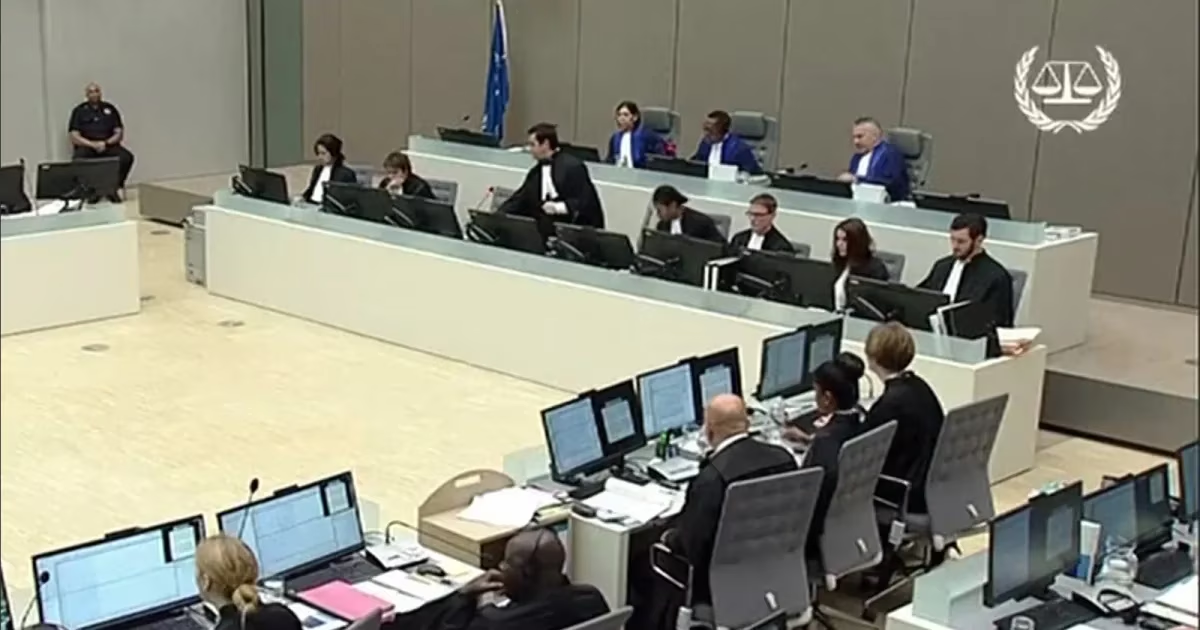
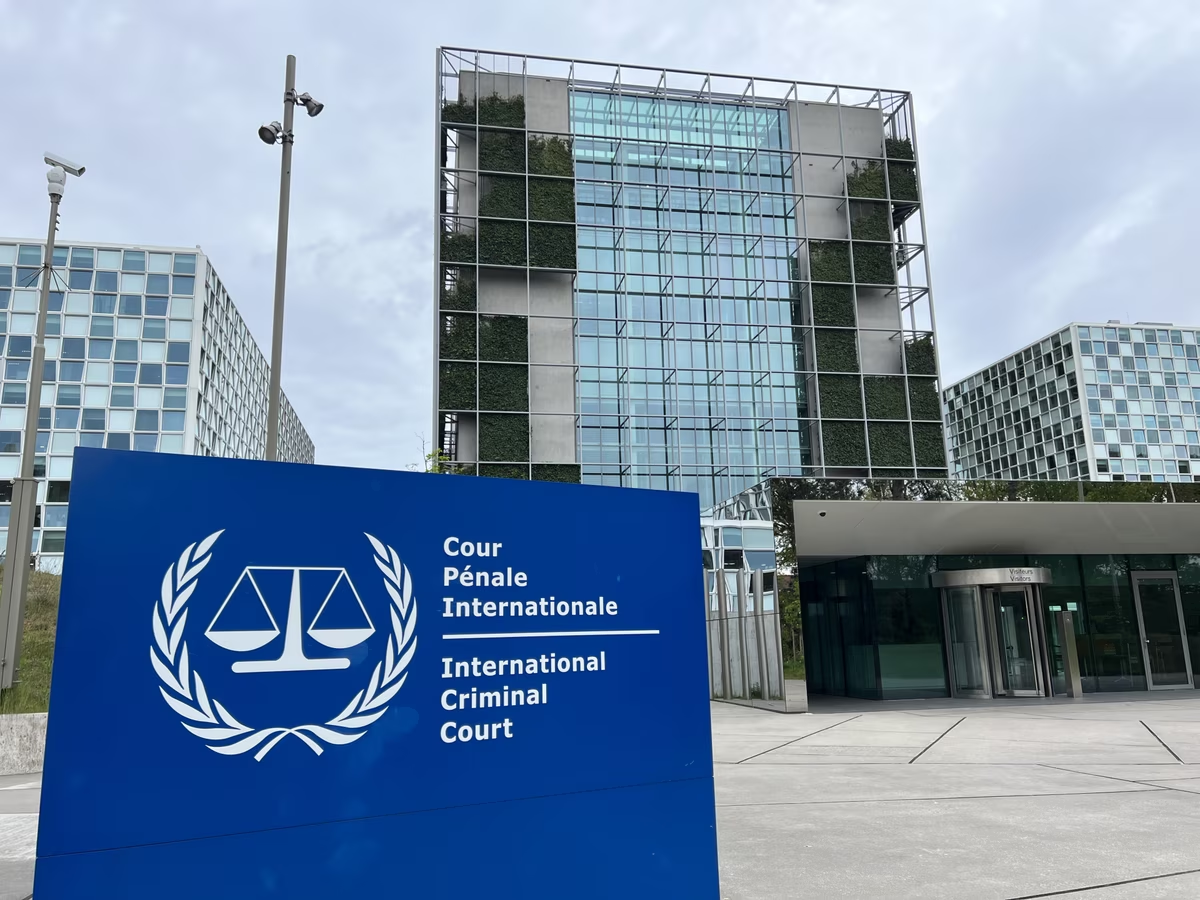
The United States Imposes Sanctions on Two Judges at the International Criminal Court

The United States imposed sanctions on two judges at the International Criminal Court, in a move that sparked widespread criticism, after they voted against an appeal filed by Israel regarding the court's jurisdiction to investigate suspected crimes in the Gaza Strip.

U.S. Secretary of State Marco Rubio announced the sanctions, justifying the decision by saying that the judges targeted a state "defending its sovereignty," referring to Israel, a step welcomed by the Israeli government and considered a political and legal defense of it.

According to the data, the two judges, one from Georgia and the other from Mongolia, voted earlier this week against Israel's appeal regarding the court's jurisdiction, which Washington described as a "legal war" on Israel.

For its part, the International Criminal Court expressed rejection of the U.S. sanctions, considering them a blatant assault on the independence of an international judicial body and an attempt to intimidate judges and influence the course of justice.

The U.S. move sparked widespread reactions among activists and international law experts around the world, with many questioning American double standards, as noted by the "Hashtag" program in its episode (2025/12/18).

In this context, journalist Natalia Morris commented, criticizing the U.S. position and its complete bias towards Israel, saying:

"The United States and Israel are not members of the International Criminal Court; imposing sanctions on its judges while denying its jurisdiction is a clear contradiction. Define your position, and just a reminder, you do not represent Israel."

From a legal perspective, human rights activist Sarah Leah Whitson considered the International Criminal Court's response insufficient, and wrote:

"Rejecting these sanctions alone is not enough; the court should legally pursue this blatant interference and intimidation of judges under Article 70 of the Rome Statute, which criminalizes any interference or tampering with the administration of justice within the International Criminal Court, to protect the court and its judges from political pressure and blackmail."

In a direct political question, Tom Elliott wrote, criticizing Washington's position and its role as the "world's policeman":

"Why should the United States intervene at all? What happened to what the administration initially said about the United States stepping back from its supposed role as the world's policeman?"

As for Marcus, he summed up his criticism with biting sarcasm, saying:

"We love imposing sanctions on judges instead of criminals; it seems we have to live with this."

In a broader comment on the impact of this step, an account concerned with international law wrote, warning of the repercussions of the U.S. move:

"Such actions targeting judges and prosecutors elected by the state parties undermine the rule of law, and when judicial actors are threatened for applying the law, the international legal system itself is at risk."

In conclusion of the interactions, a blogger expressed his fundamental skepticism about the viability of the international legal system, saying:

"Overall, this reinforces what I have always believed: international law has no real existence. This does not mean it should not usually be adhered to, but ultimately it is just a political theater, and it is better to master this game."

These sanctions come in a recurring context, as the United States previously imposed sanctions in March 2025 on two judges from France and Canada, in addition to two prosecutors at the court, on the grounds of their participation in efforts to investigate or issue arrest warrants against American or Israeli citizens.

The United States and Israel base their position on the fact that they have not signed the Rome Statute that established the International Criminal Court, considering that the court has no authority to prosecute them, in a message described as clear and loud, meaning that any legal actions against non-signatory states will face consequences.

PALESTINE

Fri 19 Dec 2025 5:55 pm - Jerusalem Time

Hamas: Miami talks must lead to stopping Israeli violations

The Hamas leader, Bassem Naim, said today, Friday, that the talks scheduled in Miami to move to the second phase of the ceasefire agreement in Gaza must lead to stopping Israeli violations.

He quoted Naim as saying that "the Palestinian people expect from these talks that the attendees agree to put an end to the ongoing Israeli rampage, stop all violations and breaches, and oblige the occupation to the requirements of the Sharm el-Sheikh agreement."

The member of the Hamas Political Bureau expressed hope that the talks would lead to obliging Israel "to the requirements of the Sharm el-Sheikh agreement, foremost among them the clauses related to humanitarian conditions, entry of aid, opening the Rafah crossing in both directions, and introducing all reconstruction and infrastructure rehabilitation needs."

The Hamas leader also emphasized the necessity for the discussions during these meetings to include "how to implement what remains of the Trump plan, in a way that achieves sustainable stability, launches a comprehensive reconstruction process, and establishes a political path through which the Palestinian governs himself, ending with an independent state with full sovereignty."


"Political Marathon"


The United States is hosting talks in Miami, Florida, today, where the special envoy of President Donald Trump, Steve Witkoff, is expected to meet senior officials from the mediating countries Qatar, Egypt, and Turkey, to advance the second phase of the agreement.

The Axios website quoted a White House official and two other sources as saying that Steve Witkoff will meet today, Friday, in Miami with Qatar's Prime Minister and Foreign Minister Sheikh Mohammed bin Abdulrahman Al Thani, and Foreign Ministers Turkish Hakan Fidan and Egyptian Badr Abdel Ati to discuss the next phase of the Gaza agreement.

American media describe the Miami meeting as a "political marathon," and said it is an attempt to prevent the return of war in Gaza and to save the entire peace plan, which they see as approaching imminent collapse.

As for the New York Times, it sees a kind of evasion of the commitments of the second phase, according to what journalist Abdul Rahman Yusuf reported.

Yusuf explained in his talk from Washington that from the perspective of American journalism, Hamas is evading the disarmament issue, while Israel is evading the abolition of the buffer zones idea and the gradual withdrawal from the entire sector.


Egyptian call to stop breaching the agreement


Meanwhile, Egypt - which plays the role of mediator between Israel and Hamas - affirms that it is pushing for a quick implementation of the second phase of the war ceasefire agreement in Gaza.

Egyptian Foreign Minister Badr Abdel Ati said that speed of implementation is necessary to achieve all elements of the agreement, but he emphasized at the same time the need to take steps to stop ceasefire violations.

Abdel Ati affirmed in a press conference in Cairo the "importance of the international community assuming its responsibilities and exerting real and effective pressures to stop all violations that occur daily to the ceasefire agreement."

Qatar and Egypt, which act as mediators and guarantors for the ceasefire in Gaza, have recently urged the transition to the next phase of US President Donald Trump's plan.

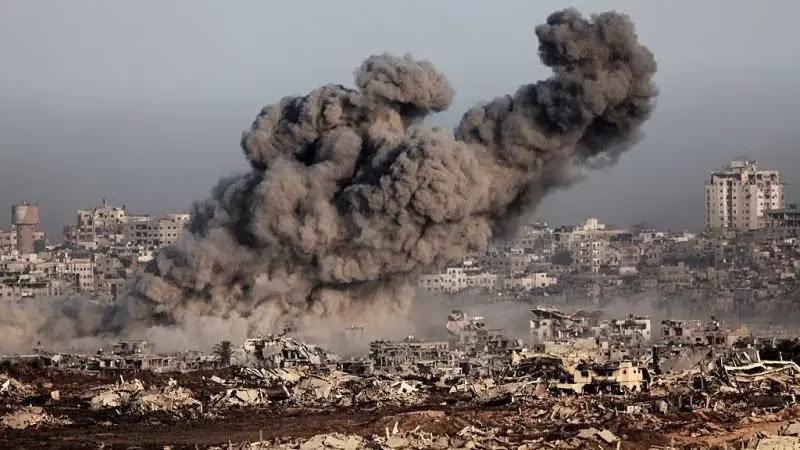
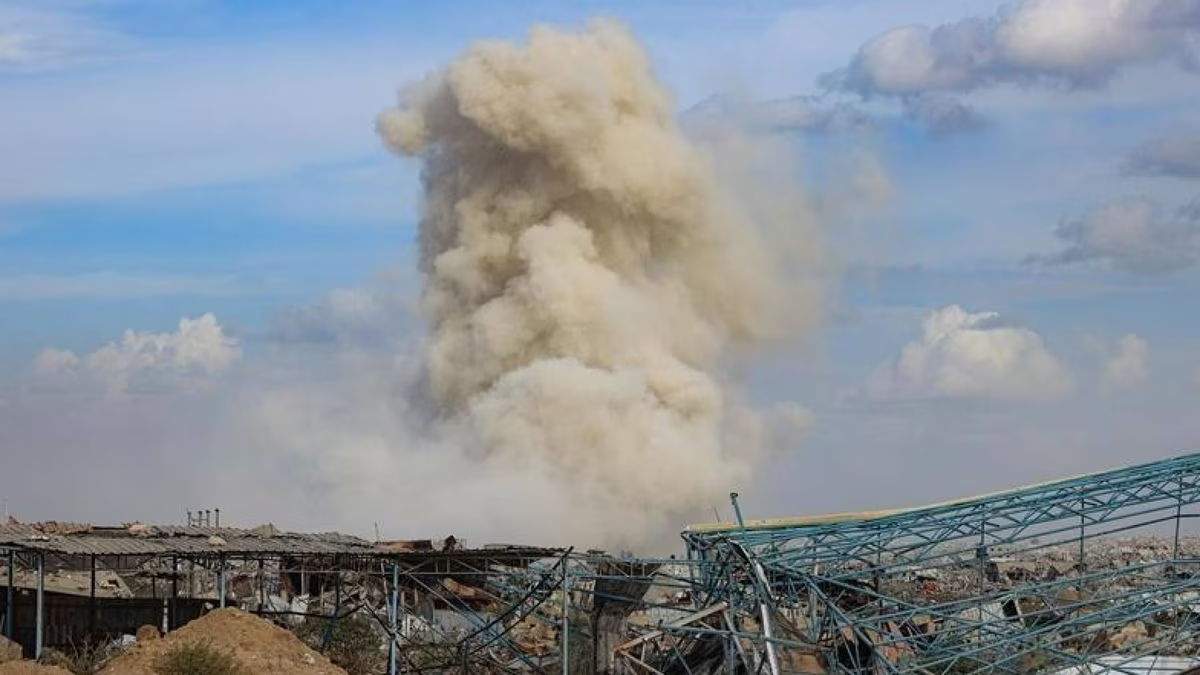
Amid these calls, the Israeli army continues its violations of the ceasefire in Gaza, the latest of which was launching air raids and artillery shelling this morning, Friday, on several areas of the sector.

The scene was not limited to direct targeting, but also included intense hovering of Israeli drones, which have not left the skies of the sector since the start of the war, and continued even after the ceasefire entered into force.

PALESTINE

Fri 19 Dec 2025 5:43 pm - Jerusalem Time

Palestinians Injured by Israeli Army Gunfire in Ramallah

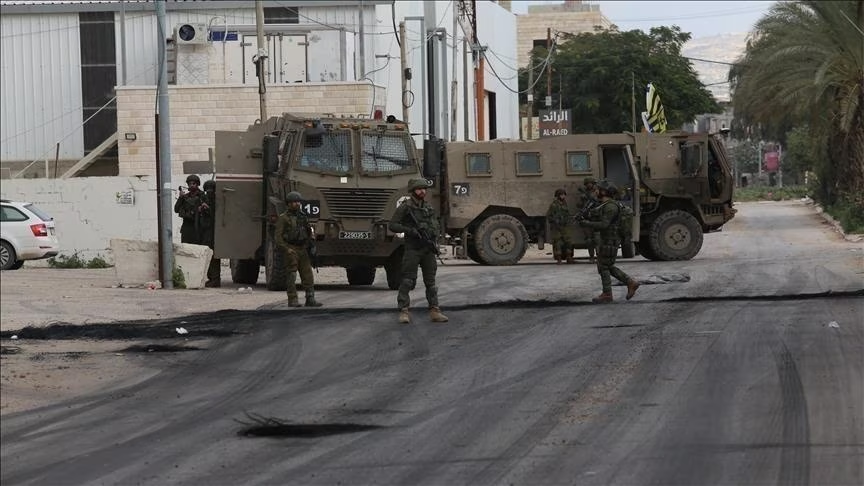
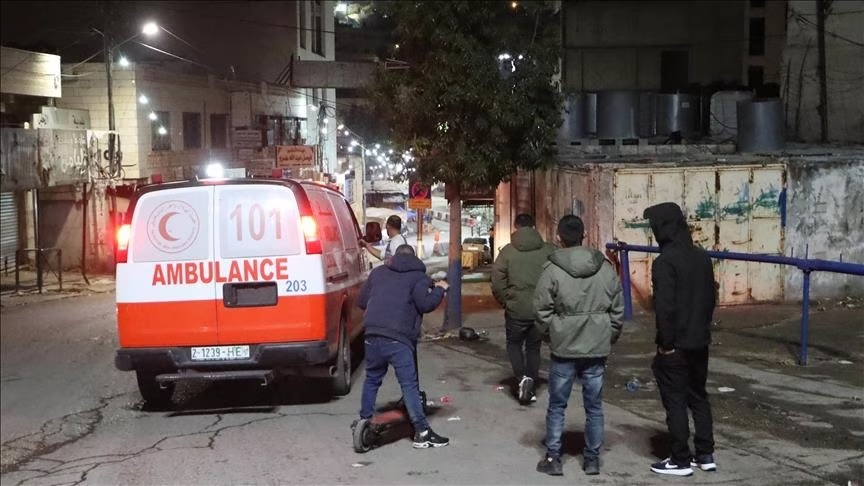
Two Palestinians were injured, on Friday, by gunfire from the Israeli army during its raid on Jalazone camp north of Ramallah in the occupied West Bank.

The Palestinian Red Crescent said in a statement that its crews in Ramallah treated two gunshot wounds, one in the abdomen and the other in the foot during the camp's raid.

Local sources reported that Israeli forces raided Jalazone camp, positioned themselves between the houses, and fired bullets and tear gas canisters towards the residents.

Since Israel began its genocide war in Gaza, its army and settlers in the West Bank have killed more than 1100 Palestinians, injured about 11,000, in addition to arresting more than 21,000.

Meanwhile, the genocide supported by the United States and lasting two years has left more than 70,000 Palestinian dead and 171,000 injured, mostly children and women, and massive destruction with reconstruction costs estimated by the UN at about 70 billion dollars.

PALESTINE

Fri 19 Dec 2025 3:40 pm - Jerusalem Time

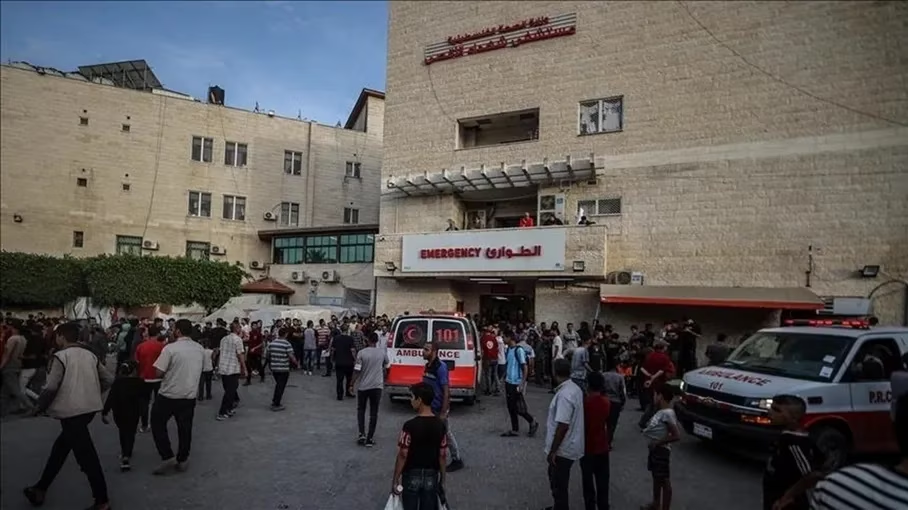
World Health Organization: 1092 Patients Died in Gaza Awaiting Medical Evacuation

The Director-General of the World Health Organization, Tedros Adhanom Ghebreyesus, confirmed that 1092 patients who were awaiting medical evacuation from the Gaza Strip lost their lives during the period between July 2024 and November 28, 2025.

Ghebreyesus said in a post on the "X" platform (formerly Twitter) on Friday: "The World Health Organization and its partners have evacuated more than 10,600 patients suffering from serious health issues from Gaza since October 2023, including more than 5,600 children."

Ghebreyesus added: "A much larger number of patients in Gaza are still awaiting evacuation to receive appropriate healthcare. According to the Ministry of Health, 1,092 patients died while waiting for medical evacuation during the period between July 2024 and November 28, 2025, and nevertheless, this number is believed to be lower than the actual figure probably."

He pointed out that they are demanding more countries open their doors to patients coming from Gaza, and resume medical evacuation operations in the occupied West Bank, including East Jerusalem.

It is worth noting that "Israel" prevents the entry of sufficient amounts of food, medicine, and medical supplies into Gaza, where about 2.4 million Palestinians live in catastrophic inhuman conditions.

It was supposed that the ceasefire agreement in effect since October 10 last year would end the genocide war launched by "Israel" on Gaza on October 8, 2023, which left more than 70,000 Palestinian martyrs and 170,000 injured, most of them children and women.

The occupation army launched air raids and artillery shelling on the Gaza Strip on Friday morning, within the areas it continues to occupy. Eyewitnesses reported that the Israeli attacks targeted the eastern areas of Gaza City in the north of the sector, in addition to the northern and eastern areas of Khan Yunis city in the south of the sector.

In the eastern areas of Khan Yunis, Israeli warplanes carried out raids coinciding with artillery shelling that hit several areas, amid the sound of violent explosions.

Those areas also witnessed intermittent gunfire since dawn hours from Israeli military vehicles.

In the west of Khan Yunis, Israeli warships fired their machine guns towards fishing boats in the sea.

PALESTINE

Fri 19 Dec 2025 2:26 pm - Jerusalem Time

Israeli Human Rights Organization: Israel is Carrying Out Genocide in Gaza and Deliberate Starvation

The Israeli human rights organization B'Tselem published a detailed report on Israeli crimes in the Gaza Strip, particularly the forced displacement of the sector's residents during the war period, confirming that the Israeli regime has been carrying out ongoing genocide in the sector since October 2023.

The organization's report first addresses the numbers of victims, martyrs, and injured during the war, relying on reports from the Palestinian Ministry of Health in Gaza, which estimated the number of deaths resulting from the direct attack at around 68,519 people, the vast majority of whom were civilians who did not participate in the fighting, while estimating the number of injured at around 170,382 people.

However, the organization noted that a series of studies published over the months of the attack indicate that these figures represent an underestimate of the number of deaths, and that there is reasonable cause to believe that the number of victims claimed by Israeli attacks is much higher.

The organization discusses in its report -among other things- the main "waves of displacement" in the Gaza Strip since October 2023, noting that dividing what happened into "waves" is a simplification of the routine of displacement and the dynamic and continuous pushing of residents to flee their areas, which dictated the life path of Gaza Strip residents without interruption since October 2023.

It stated that between October 2023 and October 2025, the Israeli army issued at least 161 evacuation orders to the sector's residents, many of which ordered the evacuation of dozens of areas at the same time.

The organization mentioned in its report that the Israeli army issued on October 13, 2023 (that is, only 6 days after the outbreak of the war) the first collective evacuation orders for Gaza Strip residents, which ordered about 1.1 million people from the northern sector to leave their homes and head south within 24 hours.

It said that hundreds of thousands of people -who were exposed to intense bombing at the time- were forced to make a hasty decision about where to flee, without knowing if they would be able to return to their homes and when. As a result, many began fleeing to the central and southern sectors with little equipment that they could carry on their bodies.

The second wave came in December 2023, that is, about two months after the start of the war, coinciding with the start of the attack on the Khan Yunis city area in the south of the sector, where the Israeli army ordered about half a million people who were in Khan Yunis and the central sector, half of whom were approximately displaced people who had arrived in those areas from the north during the previous two months, to evacuate an area of 80.8 square kilometers, which is about 22% of the sector's area. Most of them reached the Rafah city area.

On May 6, 2024, the army issued new evacuation orders asking those in Rafah city to move to what it described as the "new and expanded humanitarian zone" in the Moasi area, which shrank from December 2023 to May 2024 from about 22% to about 17% of the sector's area, according to the report.

October 2024 witnessed another wave of displacement, following the launch of what was known as the Generals' Plan, which sought to attempt to displace the remaining civilians in northern Gaza through starvation and siege.

During that time, residents of Gaza City and the towns of Beit Hanoun, Beit Lahia, and Jabalia were asked to head south to the "humanitarian zone" in the Moasi area.

The organization mentioned that Israel's practices in the northern sector, including the policy of starvation, widespread destruction, and displacement of hundreds of thousands of residents from their homes, were considered by many experts -including the UN Secretary-General- as an attempt to implement ethnic cleansing.

Between January and March 2025, about half a million displaced people returned to the north, after the ceasefire signed at the beginning of 2025, and many spoke of the immense destruction and devastation they saw with their own eyes in the places where their homes, neighborhoods, and cities once stood.

The organization said that since the violation of the ceasefire on March 18, 2025, until September 2025, Israel completely stopped designating "humanitarian zones" in the evacuation orders it distributed to the sector's residents, but at the same time continued to displace people from their homes in various areas, whether in the northern sector or in the south.

By the end of August and the beginning of September 2025, Israel launched a large-scale attack on Gaza City, and for the first time since March 2025, designated a new "humanitarian zone" around Khan Yunis, extending over about 11% of the sector's area.

The organization extensively discussed the harsh conditions prevailing in the displaced camps, including severe overcrowding, acute shortages of food and clean water, and basic services, in addition to the spread of epidemics, lack of care for the injured and disabled, and the prevention of entry of basic necessities such as crutches and sanitary pads.

It also discussed the ongoing effects of displacement, including severe effects on the mental health of Gaza Strip residents.

It pointed to a study on the displaced in the sector, conducted in October 2024, which found that between 70% and 90% of participants met the diagnostic criteria for post-traumatic stress disorder.

The study also showed that 63% of them had serious indicators of anxiety, depression, and post-traumatic stress disorder at the same time.

Researchers believed that unlike previous conflicts, where displaced people were able to find alternative shelter at some point, displaced people in the sector this time remained trapped inside a raging war zone for several months, without the possibility of resettling or ensuring basic security for themselves or starting the recovery process, according to the report.

In addition to the successive waves of collective displacement, the organization said in its report that famine in Gaza is not a secondary result of the war, but the expected result of Israel's deliberate and declared starvation policy, after it systematically destroyed and disrupted most of the food production and distribution systems that existed in the sector.

It said that while systematically preventing the entry of food into the sector, an American entity called the "Gaza Humanitarian Foundation" (GHF) began operating 4 "relief centers" in the sector at the end of May 2025, and these centers, which were established with encouragement and support from Israel, aimed -according to the report- among other things, to force the sector's residents to gather in the crowded areas designated by Israel as humanitarian zones.

It mentioned that from the first days of its activity, a UN representative described these complexes as "death traps," where crowds of starving and exhausted people are forced to stand in severe congestion and compete among themselves for the few aid packages, under the fire of Israeli forces present in the area, which were ostensibly securing the distribution of food.

It added that almost every day the centers were operated, dozens of people were killed by gunfire in their vicinity, most of them from displaced camp residents who arrived there in an attempt to obtain a little food for themselves and their families.

At the end of the report, the organization confirmed that in light of the seriousness of the crimes for which the Israeli leadership bears responsibility, it is the duty of the international community to act immediately and decisively to ensure that Israeli decision-makers are brought to justice and held accountable for their actions.

It also confirmed that -in addition to that- the international community must ensure the entry of the required humanitarian aid in the immediate term, then begin the process of rebuilding the Gaza Strip, which is expected to last for decades, without delay and in an effective manner, overcoming the difficulties and obstacles placed by Israel, and which it is expected to continue placing in front of the reconstruction process as stated in the report.

PALESTINE

Fri 19 Dec 2025 1:45 pm - Jerusalem Time

The Palestinian-Israeli Issue Tops Global Newspaper Coverage

The Palestinian-Israeli issue tops the coverage of major global newspapers, with notable focus on the future of the war in the Gaza Strip and its political and humanitarian repercussions.

The Wall Street Journal viewed US President Donald Trump's peace plan for Gaza as widely considered a "victory" despite major obstacles, primarily the issue of disarming the Islamic Resistance Movement (Hamas).

It quoted analysts as saying that Washington is ready to proceed with implementing the plan even without a clear commitment from Hamas to disarm.

In the same context, former US Ambassador to Israel Daniel Shapiro said that Trump opposes Israel resuming its major military operations, fearing damage to his credibility linked to ending the war, revealing the US administration's efforts to deploy a force of 10,000 soldiers in Gaza under American command, which will take most of next year to prepare.

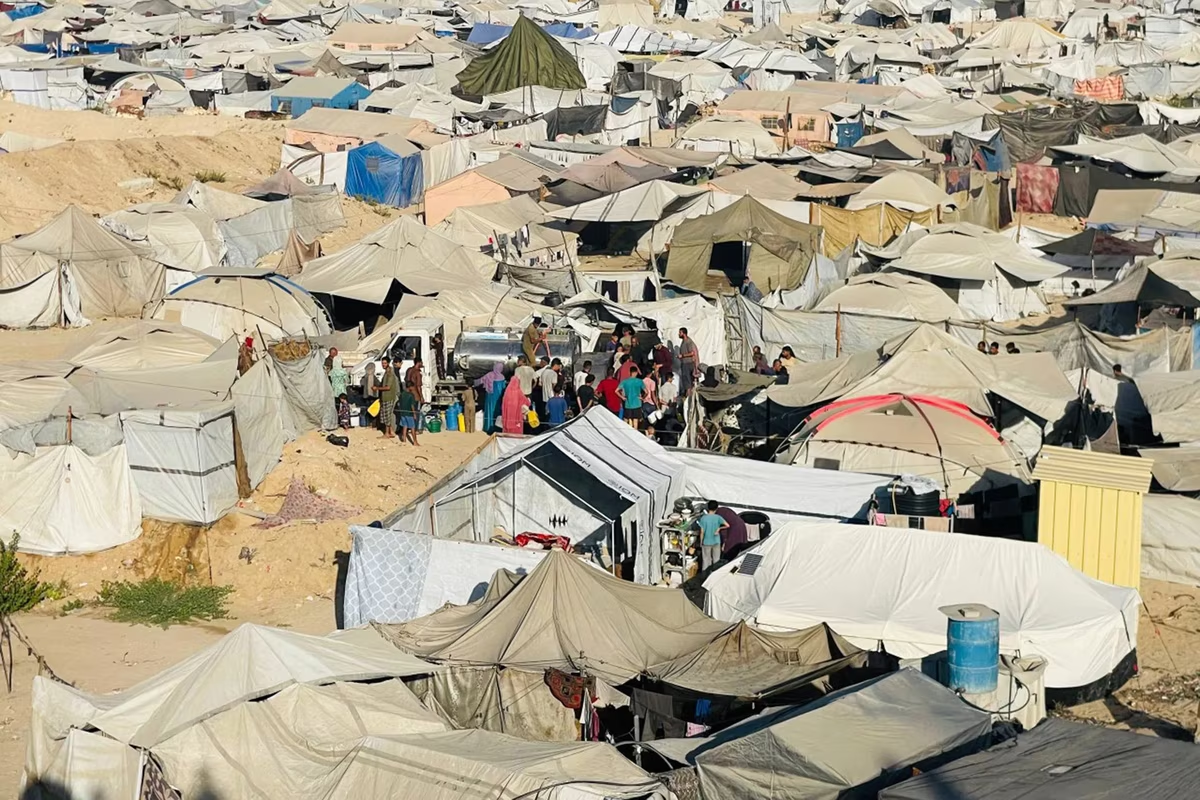
The British Financial Times addressed the catastrophic conditions in Gaza amid winter storms, noting the suffering of residents trapped in tents.

It quoted Erika Guevara Rosas, senior researcher at Amnesty International, as saying that scenes of tents flooded with water and collapsed buildings are not the result of weather alone, but the inevitable outcome of the ongoing genocide and Israel's deliberate policy of preventing the entry of shelter and reconstruction materials for the displaced.

On the Israeli side, Haaretz in its editorial said that Benjamin Netanyahu's government passed a series of laws threatening democracy in Israel, considering that these legislations do not address post-war crises in Gaza, but strengthen government control and "make the state more corrupt, indebted, and less democratic."

The newspaper warned that the upcoming elections will be a referendum on "the future of Israel itself, not on the Palestinian issue."

Internationally, Politico reported that the US State Department decided to impose sanctions on two judges at the International Criminal Court, alleging they carried out "political and unlawful" actions against Israel, a step reflecting ongoing US pressure on international institutions to prevent criticism of Tel Aviv.

In other files, the American "Washington Post" quoted David Miliband, head of the International Rescue Committee, describing the situation in Sudan as a glaring example of the new global chaos and the international system's inability to deal with it.

As for the British Times, it reported that European leaders agreed to grant Ukraine a loan worth 90 billion euros after a grueling summit in Brussels, considered the most tense and decisive in the modern history of the European Union.

The New York Times addressed Trump's escalation against Venezuela, warning of his use of misleading legal justifications, while the British Independent concluded by noting Britain's commitment to confronting violence against women as a threat on the scale of terrorism.

ARAB AND WORLD

Fri 19 Dec 2025 1:40 pm - Jerusalem Time

5 False Claims in Trump's Speech.. Highlighting Inflation and Immigration

A report published by an American magazine reviewed 5 pieces of information mentioned in the year-end speech delivered by US President Donald Trump the day before yesterday, Wednesday, which mixed inaccurate claims and exaggerations partially based on real data, according to the magazine.

The speech comes amid declining political support for Trump and political pressures within the Republican Party to improve the economic situation ahead of the 2026 midterm elections.

Instead of outlining his future policies, the President chose to highlight his achievements and declared that 'America is the best in the world,' but avoided discussing sensitive issues such as tensions with Venezuela or relations with China and Russia, according to the magazine's correspondent Jesus Mesa.

Trump mentioned that 25 million immigrants entered the United States during the tenure of former President Joe Biden, describing it as an invasion, but official data from border protection forces recorded less than that.

Trump mentioned that more than 11,000 criminals entered the country, but the report confirmed that this statistic dates back to cumulative data over 40 years, and is not linked only to Biden's period.

Trump announced that he completely stopped inflation after it peaked in 2022. However, the report clarified that inflation did decrease but did not stop, relying on data from the Bureau of Labor Statistics showing inflation rising by 3% in September 2025, according to the magazine.

The report also debunked the President's claim that the inflation he inherited was 'the worst historically,' explaining that inflation rates reached 14.8% in 1980 and more than 23% in 1920, which are much higher than the levels Trump faced.

The magazine added that what it described as the third misleading claim was about fuel prices, as Trump said that the price per gallon (the American gallon equals about 3.7 liters) dropped to $1.99 in several states.

The magazine noted that the national average price is around $2.94, and any prices below $2 were individual cases at limited stations, and there is no single state where the average prices reach the low figure mentioned by the President.

Trump announced in his speech that his administration secured new investments worth $18 trillion since taking office, but a review of White House figures shows that the announced investments do not exceed $9.6 trillion.

Economists confirmed that even this figure is higher than the actual investments, as it includes 'commitments and proposals' in their early stages that have not yet been implemented.

Finally, the President said that the number of employed Americans is the highest in history, but the writer warned that this claim is 'partially true' but misleading, as the increase simply stems from overall population growth.

He explained that the employment rate compared to the population—which is the more accurate measure of market strength—actually decreased from 60.1% in January to 59.7% in September 2025.

ARAB AND WORLD

Fri 19 Dec 2025 12:04 pm - Jerusalem Time

Eurovision.. European countries withdraw from the competition due to Israel's participation

American-European journalist Dave Keating said that if new countries join those that have announced they will not participate in the European Song Contest "Eurovision" in protest against allowing Israel to participate, the competition will not be able to continue.

Keating noted that the European Broadcasting Union will not be able to make the necessary reforms to ensure the return of the countries that withdrew from the competition.

Recently, five European countries—Spain, the Netherlands, Ireland, Slovenia, and Iceland—officially announced their withdrawal from the European Song Contest in protest against allowing Israel to participate, shortly after the European Broadcasting Union announced allowing Israel to participate.

Keating pointed out that the withdrawal decisions from the competition were not only due to the situation in Gaza, but were also influenced by the ongoing controversy over the politicization of the voting process.

He added: "Last year, Israel took first place in the public vote. It also achieved a very high score the year before. Since the song last year or in the last competition did not perform well on the 'Spotify' platform, this seemed suspicious to many. No one was really listening to that song."

Keating mentioned that the Israeli government paid a consulting firm to manage a campaign urging people to vote for Israel as a form of support.

He continued: "I have friends in the United States who received these text messages, even though the United States does not broadcast the Eurovision contest. No one in America knows what this event is. I have some friends who voted for Israel despite never having watched this competition in their lives."

Keating noted that Israel thus "politicized the voting," pointing out that the Israeli government did not violate the written rules, but violated the "spirit of the competition."

He mentioned that the European Broadcasting Union, despite warnings from many countries, did not make the required updates to the voting and campaign rules.

He concluded: "The reason for that is that the European Broadcasting Union does not want to appear as if it is saying that Israel made some mistake."

He pointed out that participating countries will face difficulty in finding singers to send to the competition in the coming phase. He mentioned that 16 singers who competed to represent Portugal in Eurovision announced that they would refuse to participate in the competition if selected.

Keating confirmed that this situation may occur in other participating countries, such as Sweden, which is a cornerstone in Eurovision.

He continued: "If Sweden does not participate in the Eurovision 2026 contest, the whole thing will end."

He pointed out that the Eurovision Song Contest is the most watched television event in the world after sports, and it is the only large-scale cultural event organized without the participation of the United States.

He added: "If Europe loses the Eurovision contest due to discussions related to Israel, it will be a very big loss and truly regrettable."

On Thursday, 170 Belgian artists condemned the decision of the Belgian Broadcasting and Television Authority to participate in the European Song Contest "Eurovision 2026," due to Israel's participation in it.

In May last year, about 4,000 artists from five Scandinavian countries (Norway, Denmark, Sweden, Iceland, and Finland), including artists who had previously participated in the Eurovision contest, demanded Israel's exclusion from the competition and considered its participation "whitewashing" the genocide being committed in the Gaza Strip.

The Israeli genocide war in Gaza, which began on October 8, 2023, and lasted for two years, left more than 70,000 dead and over 171,000 injured, mostly children and women.

PALESTINE

Fri 19 Dec 2025 11:28 am - Jerusalem Time

The occupation intends to demolish 25 homes in Nour Shams camp

The Israeli occupation army intends to demolish 25 homes in Nour Shams camp, threatening between 90 and 100 Palestinian families with an unknown fate, according to local estimates.

This came after the Israeli Supreme Court rejected a petition submitted by the "Adalah" legal center to stop the demolition operations, considering that the authority to make this decision belongs to the military authority of the occupation army.

Christine Rinawi reported that this decision is a formal procedure that allows the occupation army to invade the area and begin implementing the demolition operations, noting that the demolition notices were delivered to the Palestinian side last Sunday.

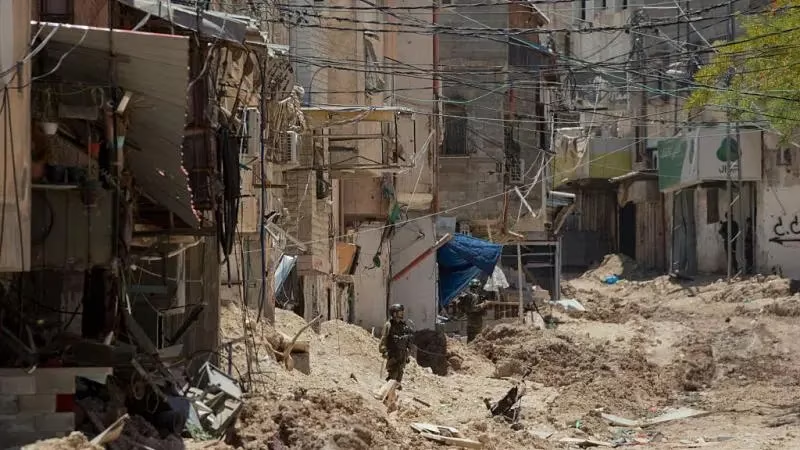
The correspondent explained that this step comes within the framework of the ongoing aggression on Nour Shams camp since February last year, as part of a military operation named "Iron Walls" by the occupation army, which targeted a number of Palestinian camps, and included demolishing homes, bulldozing roads, and carrying out extensive arrest campaigns.

She added that these operations led to radical changes in the geographical features of the camp, after the occupation forces dug wide roads inside it, confirming, quoting Palestinian sources, that the upcoming demolition operations will prevent about half of the camp's residents from returning to their homes.

The occupation army had linked its previous withdrawal from the camp to a set of conditions, including stopping dealings with the United Nations Relief and Works Agency for Palestine Refugees in the Near East (UNRWA), which it describes as "terrorist," and transforming the camps from refugee gatherings into neighborhoods affiliated with neighboring cities, conditions that the Palestinian side rejected.

While the occupation army justifies the demolition operations as "operational requirements," Palestinians see what is happening as having political dimensions rather than security ones, aiming to undermine the right of return and the refugee issue, and affecting the core of the constants and Palestinian identity

OPINIONS

Fri 19 Dec 2025 10:24 am - Jerusalem Time

Palestine's Educational Cry… Generations Lost… A System Dismantled

Tharwat Zaid Al-Kilani

Tharwat Zaid Al-Kilani

Opinion Writer

The Palestinian educational system is subjected to a systematic war of extermination waged by the occupation on all aspects of life and education, aiming to dismantle the educational structure and empty the future of its essence and true value. The danger is compounded by the conditions imposed by donors, which impose restrictions that limit educational sovereignty and hinder the ability to protect time and curricula. The national response has been made within the limits of possibilities and pressures, but it has faced serious challenges that led to the loss of the educational compass, and the emergence of decisions that lead to a gradual collapse of the system, and the reduction of educational time and content, depriving students of their right to comprehensive, dignified learning with depth of knowledge.

The leniency in reducing time and content does not represent a solution to the issue of teachers' rights in regular salaries and preserving their professional and occupational dignity, but rather constitutes a direct threat to the stability and sovereignty of the system, and to the ability of Palestinian generations to build knowledge, awareness, values, and achieve the educational mission. Education is not a privilege that can be relinquished, but rather a national existential pillar and a safety valve for the individual and society, and any tampering with it is tampering with the Palestinian entity and the future of its generations.

First: Educational time as a pillar for building and meaning

The class period in its complete educational structure is 45 minutes long, and the complete school break is an integral part of the school day, so it is not permissible to reduce it or treat it as a superficial transient service. These time frames are not mere formal numbers, but foundational standards on which curricula and their deep structure were built, designed to ensure balanced distribution of content, regulate cognitive load, and organize gradual transitions between concepts, while considering the psychological and cognitive rhythm of learners, and the individual characteristics of each child, their level of comprehension, and their mental and attentional abilities, that is, considering psychometrics in its full educational sense.

Each educational unit, each learning objective, and each classroom activity is designed according to this framework to establish gradual knowledge accumulation and achieve organized methodological continuity that ensures the achievement of national and educational goals, making learning a comprehensive process in which knowledge, skills, values, and awareness are formed, and the physical, psychological, and emotional structure of the student interacts together, achieving balance between mind, body, sentiment, and spirit, and granting the learner the ability to transform knowledge into true meaning, and deep understanding that enables them to consciously interact with their environment and society.

This construction extends over 180 actual days distributed throughout the academic year according to a specific weekly schedule, ensuring the regularity of classes and completion of breaks, forming the time structure that creates understanding and gradually builds knowledge accumulation. Any reduction from this framework is not considered an organizational adjustment, but a direct assault on the educational structure and the curriculum itself, and a gradual demolition of knowledge accumulation and students' skills, transforming learning from meaning to mere formal passing, which cannot be repaired by reduction or forced adaptation.

Second: The gradual collapse and the logic of retreat

The current reality reveals a gradual deterioration in the education system, manifested in reducing the class time from 45 to 40 minutes, deducting 10 minutes from the daily break time, reducing weekly working days from six to five, then four, and finally three days, with simultaneous miniaturization of educational content, while formally maintaining the number of annual working days at 180 days. These measures do not express phased organization or technical crisis management, but rather a cumulative path of reduction that reshapes school time in a lower manner, emptying it of its educational function in building gradual learning and cognitive meaning.

This retreat occurred without any scientific redesign of curricula, or adjustment of their educational structure, or consideration of the necessary knowledge accumulation and methodological continuity to achieve national and educational goals. This has led to a structural flaw that touches the core of the educational process, undermining the official school's ability to perform its mission in building cohesive knowledge, solid skills, and critical values and awareness among students. What is happening, no matter how many justifications it has, does not represent circumstantial management of a sudden financial crisis, but rather gradual normalization with reduction, and a silent path that redefines education as managed time, not a national educational project to be built.

The numbers are shocking: the annual loss of class and break time approaches 27 days, and if the school week is reduced to 4 days without redistributing classes, an additional weekly school day is added, bringing the loss to about 63 days. If attendance is transformed to 3 days, the loss rises to about 99 days, that is, more than half of the complete academic year. The student is asked to deal with a curriculum designed for time that no longer exists.

This is not an educational loss in the narrow sense, but a collapse in methodological continuity and knowledge accumulation. The sequence of concepts is broken, and forced cognitive leaps are imposed on the student without foundation, transforming learning from real building to formal passing. Lessons that are supposed to be built on what preceded them become separate units, understanding becomes fragile, comprehension superficial, and learning incomplete.

The impact extends to the psychological, social, and emotional structure of students. The ability to consider individual differences decreases, support spaces narrow, and the classroom becomes an environment of constant pressure. The child is deprived of time for consolidation, questioning, and organized social interaction. Even the break, as a tool for restoring emotional balance and organizing attention, is fragmented, as if the body and emotions are surplus to the educational process.

Third: The financial crisis and occupation as restrictions on educational rights

Silence on this issue is not neutrality, but conscious relinquishment of one of the pillars of national resilience, and adaptation to the ongoing reduction of educational time is not realism, but hidden normalization with a path that dismantles the educational system from within. Responsibility here is not limited to a ministry or institution, but a collective national responsibility that requires a radical vision and comprehensive mobilization of all expertise: economists and public finance experts, educators, national capital owners, research centers, and unions, to jointly work on fair and sustainable solutions that protect the teacher's dignity, ensure the student's full right to comprehensive and balanced learning, and fortify educational sovereignty and independence away from any external or circumstantial conditions that crises or donors may impose.

The financial crisis facing Palestinian schools is not a mere passing incident, but an extension of a rooted economic and social reality, intertwined with the occupation of Palestinian lands and the piracy of clearance funds, which limits the state's ability to fully and sustainably finance education. Nevertheless, no circumstance, whether resulting from occupation or conditional funding from donors, should turn the fixed educational right into a hostage. These crises cannot be used as a pretext for deducting educational time, reducing classes and breaks, fragmenting the curriculum, or depriving Palestinian generations of their full right to comprehensive and conscious learning.

This ongoing reduction of educational time and content, in the context of the financial crisis, directly harms the role of the official public institution in providing free and equitable education to all students, as it weakens its ability to fulfill its educational responsibilities, leading to the transfer of some students to private schools, which consolidates class differences and creates unfair educational discrimination, weakening the public right to equal and comprehensive education. This reality threatens the stability and sovereignty of the educational system, transforming education from a constitutional and social right into a commodity subject to variation between affluent and non-affluent families, exacerbating social inequality and undermining national educational justice.

Fourth: The stern call for full attendance and protection of school time

Palestinian education constitutes a pillar of the nation's future, and any reduction from it does not affect students and teachers alone, but touches the core of the state and society as a whole. Protecting educational rights is not a choice or luxury, but a national duty imposed by reality, requiring the affirmation of the stability of the educational system and the sustainability of the teacher's dignity, and ensuring the student's right to free, comprehensive, meaningful, and dignified learning. Any financial solutions must be built on the foundations of efficiency and justice, not on depriving future generations of equal and free education that preserves educational values, ensures salary regularity and protection of teachers' professional and occupational rights, and preserves the stability and sovereignty of the system.

The call is clear and decisive: the second semester must be implemented with full attendance, with complete time slots (45 minutes) and complete breaks, and every school day preserved out of 180 actual days, with a comprehensive educational program that includes curricula, classes, breaks, and classroom activities and educational programs, without any reduction or fragmentation. Protecting school time and the complete educational program is not merely organizing time or distributing content, but preserving the future, securing the Palestinian human, and enhancing national sovereignty. Palestinian education cannot tolerate any further retreat, because reducing time or curriculum content constitutes the beginning of dismantling the human, and breaking the human is dismantling the nation in the long term.


PALESTINE

Fri 19 Dec 2025 10:16 am - Jerusalem Time

The West Bank and the United States: Managing the Explosion, Not Preventing It

In a rare yet revealing scene, the U.S. Ambassador to Israel, Mike Huckabee, met with Palestinian Authority Deputy Chairman Hussein Al-Sheikh in Ramallah, a step that reflects the confusion in U.S. policy more than it reflects a genuine shift in its approach to the conflict. The meeting, only the second since the start of U.S. President Donald Trump's second term, came at a moment of slow explosion in the West Bank, where settler violence escalates unchecked, Israeli military operations expand, while Washington settles for the role of a concerned observer rather than an influential actor.

The meeting was not the fruit of a well-studied U.S. political initiative, but rather a forced response to a field deterioration that threatens the collapse of what remains of the fragile "stability" in the West Bank. Nevertheless, the content of the discussion reveals the limits of the U.S. role: verbal concern, behind-the-scenes pressures, and the near-total absence of any real coercive tools toward Israel, the ally that is practically granted freedom of action.

One of the most prominent files discussed was settler violence, which has transformed from a marginal phenomenon into a fait accompli policy enjoying implicit protection from the Israeli army. Despite U.S. officials' acknowledgment that Washington urges Israel to act, this "urging" has not gone beyond soft diplomatic rhetoric, at a time when the U.S. administration refuses to use available pressure tools, from conditional aid to political accountability. Thus, U.S. policy appears as a passive partner in perpetuating impunity.

The financial file is no less indicative of this approach. Israel's continued withholding of Palestinian clearance funds, which constitute the backbone of the Authority's budget, has turned the political crisis into a suffocating livelihood crisis. Despite Washington's knowledge that this measure pushes the Authority toward paralysis and possibly collapse, its intervention remained superficial, governed by internal U.S. calculations and a constant fear of any clash with the Israeli government, especially given the influence of the far-right within it.

The paradox is that the U.S. administration claims concern over the weakness of the Palestinian Authority, yet it tolerates Israeli policies that undermine this Authority daily. This contradiction reveals the essence of the U.S. approach: preserving the Authority as an administrative and security apparatus without empowering it politically or financially, ensuring the management of occupation rather than its end.

The religious and humanitarian aspect of the meeting, related to the freedom of movement for Palestinian Christians during the holidays, also reveals the narrow horizon of U.S. intervention. Instead of addressing the structure of Israeli control that chokes the West Bank with checkpoints, the issue is reduced to seasonal facilitations, as if the problem is a temporary humanitarian one rather than a structural political one.

Politically, the meeting carries an additional significance related to redefining the U.S.-Palestinian relationship. The closure of the U.S. Consulate in Jerusalem during Trump's first term was not just an administrative measure, but a political declaration of downgrading the Palestinians' status in U.S. calculations. Today, despite the resumption of dialogue, this downgrading remains in place, as relations with the Palestinian Authority are managed from the U.S. Embassy to Israel, practically consecrating the Israeli narrative.

The Palestinian Authority's acceptance of this reality does not reflect satisfaction, but compulsion. Political isolation, financial pressure, and declining international interest have pushed Ramallah to adopt a pragmatic approach based on the minimum communication with Washington, even if at the expense of the political position. However, this pragmatism may turn into an internal burden if it continues without tangible results.

In conclusion, the Huckabee-Al-Sheikh meeting does not appear as an indicator of a shift in U.S. policy, so much as additional evidence of a crisis management policy instead of resolving it. Washington, preoccupied with its internal calculations and traditional alliances, prefers to keep the conflict in a state of "fragile balance," even if the price is more violence and political erosion in the Palestinian territories.

The fundamental problem in U.S. policy lies in its separation between diagnosis and action. Washington fully understands the risks of settler violence and the collapse of the Palestinian Authority, but it lacks, or feigns the lack of, the political will to use its real influence. This hesitation does not reflect weakness, but a conscious choice to prioritize the alliance with Israel over any commitment to international law or long-term stability.

As for the Palestinian side, the continued reliance on a biased U.S. role has proven its failure repeatedly. Engagement with Washington, without rebuilding political and popular strength cards, turns the Authority into a party receiving promises instead of imposing facts. Amid the blockage of the political horizon, this approach may become one of the factors eroding internal legitimacy, rather than an entry point to alleviate the crisis.


PALESTINE

Fri 19 Dec 2025 9:42 am - Jerusalem Time

Palestinian Media:Death of 4 Palestinians in Occupation Army Raids on Eastern Khan Yunis

Continuation of military escalation in the Palestinian territories

Four Palestinians, including a woman, were martyred in the past 24 hours as a result of airstrikes launched by the occupation army on the town of Bani Suhaila east of Khan Yunis in the south of the Gaza Strip, and the civil defense has not yet been able to extract them from the targeted areas, according to Palestinian media sources.

Occupation aircraft carried out attacks on several areas in the Gaza Strip, amid the ongoing military escalation in the Palestinian territories.

Palestinian sources reported that the attacks targeted the eastern areas of Gaza City in the north of the Strip, in addition to the northern and eastern areas of Khan Yunis in the south of the Strip.

In Khan Yunis, the airstrikes coincided with artillery shelling that hit several areas, amid loud explosions, while sporadic gunfire continued from military vehicles since dawn hours.

The warships also fired their machine guns towards fishing boats in the sea off the west of Khan Yunis, while the Shujaiya neighborhood east of Gaza City witnessed rising columns of smoke following the airstrikes, and the nature of the targets hit by the airstrikes and artillery shelling has not yet been clarified.

Continuous violations and a high reconstruction bill

The Gaza Strip continues to record repeated violations of the ceasefire since October 10 last year, and the operations have resulted in the martyrdom of hundreds of Palestinians, and extensive destruction of infrastructure, where the United Nations estimated the cost of reconstruction at around 70 billion dollars.

PALESTINE

Fri 19 Dec 2025 8:55 am - Jerusalem Time

Palestinian youth injured with fractures after being run over by a settler in Nablus

A Palestinian youth was injured on Friday morning with fractures in his feet after being run over by an Israeli settler in the city of Nablus in the northern occupied West Bank.

Local sources reported that settlers stormed the eastern area of the city with their vehicles, and one of them deliberately ran over the youth while he was passing through Oman Street, resulting in fractures in his feet, after which he was taken to the hospital.

Eyewitnesses added that two settler vehicles stormed the area in an attempt to reach the shrine of "Joseph's Tomb", noting that one of the vehicles overturned during its escape, while the settlers fled on foot outside the city.

Setters usually storm the shrine of "Joseph's Tomb" located in the eastern part of the city of Nablus, within an area under Palestinian control, under the protection of the Israeli army, to perform religious rituals.

"Joseph's Tomb" is located in the eastern part of Nablus within an area under Palestinian control, and Jews consider it a religious site since the occupation of the West Bank in 1967, while researchers and scholars indicate that the shrine is not linked to the Prophet Joseph, suggesting it is the tomb of a Muslim sheikh named Yusuf Dweikat.

Since October 8, 2023, the Israeli army and settlers in the West Bank, including East Jerusalem, have killed more than 1,100 Palestinians, injured about 11,000, in addition to arresting more than 21,000.

ARAB AND WORLD

Fri 19 Dec 2025 7:58 am - Jerusalem Time

Lebanon.. Intense diplomatic activity and fears of Israeli escalation

Lebanon is witnessing a week full of Arab and international diplomatic activity, focusing on supporting the army and enhancing stability in the south of the country, amid the continuation of daily Israeli aggressions despite the ceasefire agreement in effect since late November 2024.

This diplomatic activity, according to political analysts who spoke, combines efforts to strengthen the national legitimacy of the Lebanese army and raise challenges against any possible military action by Israel.

However, analysts' opinions differed on future scenarios, between one who rules out war because it would legitimize "Hezbollah" by justifying any response it might issue, another who is certain that war is inevitable due to Lebanon's slowness in implementing commitments to monopolize arms in the hands of the state, and a third who sees the possibility of war but not its inevitability.

On Monday, the diplomatic week began in the south with a tour of Arab and foreign ambassadors accompanied by the Lebanese army commander Rudolph Hikel, set to end on Friday with the conclusion of the 15th meeting of the "Mechanism" committee during 2025.

The "Mechanism" committee was established pursuant to the ceasefire agreement between Israel and "Hezbollah", and monitors its implementation, comprising military representatives from Lebanon, France, Israel, the United States, and the United Nations Interim Force in Lebanon "UNIFIL".

In parallel with the diplomatic activity inside Lebanon, the capital Paris hosted, on Thursday, expanded talks that brought together French, Saudi, and American officials with the Lebanese army commander, and concluded with "renewing their support for the Lebanese army and the government's plan aimed at disarming non-governmental actors", in reference to "Hezbollah's" arms.

Paris also announced in an official briefing following the meeting that France, Saudi Arabia, and the United States "will hold an international conference in February 2026 to support the Lebanese army", without specifying the venue or the exact date.

Within the same diplomatic activity framework, Beirut was visited on Thursday by Egyptian Prime Minister Mostafa Madbouly, who will meet on Friday with the presidents of the republic Joseph Aoun, the ministers Nawaf Salam, and the parliament Nabih Berri.

Political analyst and journalist Ghassan Rifai says that "Lebanon is receiving a large number of diplomats and international envoys, but these visits do not translate practically on the ground, amid Israel's continuation of its daily aggressions without paying attention to these movements".

He believes that "the world has become convinced that Lebanon has done everything required of it, whether at the government level that implemented international conditions, or at the level of the Lebanese army that performed the tasks entrusted to it according to available capabilities".

Rifai points out that "the diplomatic tour organized by the Lebanese army in the south to inspect the measures taken confirmed this, and left a positive impression on Arab and foreign ambassadors about what the army is doing".

But this positive picture is not complete because "the party obstructing the work of the Lebanese government and army is Israel, which still occupies the five points in the south, preventing the Lebanese army from deploying there".

Rifai notes that the Lebanese army's entry into the five hills occupied by Israel during the last war, in addition to areas it has occupied for decades, means either clashing with the Israeli forces there or normalizing with them in case of no confrontation, and in both cases, there is no (Lebanese) decision on that".

Regarding the chances of a new aggression erupting, Rifai rules out Israel launching a war at the present time, considering that it would legitimize "Hezbollah" if it responds after its long commitment to the ceasefire.

He believes that any war would lead to inciting global public opinion against Israel, amid international conviction that "Hezbollah" has not violated the ceasefire agreement, that the Lebanese government has complied with the conditions, that the army has fulfilled its duties, and with the testimony of ambassadors.

For her part, political analyst and journalist Misa Abdel Razek estimates that "Lebanon remains exposed to the possibility of intensifying Israeli aggressions or a new war, despite adopting the diplomatic option, especially after appointing Ambassador Simon Karam as head of the Lebanese delegation in the Mechanism committee, to be the first non-military official assigned to a similar mission".

The Lebanese presidency's assignment of the chairmanship to Karam came after Joseph Aoun's confirmation in October last year that "there must be negotiation" with Israel to resolve the "pending" problems, a step criticized by "Hezbollah" and considered "a slip for the government and a violation of all statements that said involving any civilian is conditional on stopping hostile actions".

In this context, Abdel Razek points out that "the official Lebanese position, as expressed by the president of the republic, affirms that the negotiation option is the alternative to war".

She confirms that "Lebanon has committed to the ceasefire agreement, while Israeli violations have exceeded 10,000 violations".

Abdel Razek points out that "Israel justifies its violations with Hezbollah's arms despite the Lebanese government's decision in August last year to monopolize arms in the hands of the state, and the measures implemented by the Lebanese army, where it completed more than 90% of the mission south of the Litani River".

She goes further, seeing that "despite what has been achieved, a new Israeli aggression cannot be ruled out under the pretext of (targeting) Hezbollah's arms".

She considers that the visit of the Egyptian Prime Minister to Lebanon on Thursday "carries diplomatic messages in the context of calming and preventing escalation".

As for political analyst and journalist George Akouri, he sees that Lebanon faces "always playing on the edge of the abyss", pointing out that "it is living today the killer time period, not the wasted time".

Akouri speaks of "delays by Hezbollah in doing what it committed to when it supported the oath speech (of President Aoun), the ministerial statement, and the ceasefire agreement".

He points to "the party's insistence on clinging to its arms and boasting about rebuilding its arsenal", and touches on "the blatant Iranian support for Hezbollah through positions and meetings held in public".

The writer warns of "the danger of Lebanon being subjected to a major Israeli strike despite the efforts of the army and the Lebanese state, due to the slow pace (of monopolizing arms) in the face of regional developments", in reference to fundamental changes in the scene, the most important of which is the fall of the Baath regime in Syria and the decline of Iran's influence in the region.

He also points out that "the diplomatic visits and delegations that went to Lebanon carried clear warning messages that time is not in the country's favor, and that there is a real threat from Israel".

Akouri sees that "the decisive phase will be linked to the meeting of Israeli Prime Minister Benjamin Netanyahu with US President Donald Trump at the end of this month, which may determine the possibility of granting Lebanon a short time period to catch up on the delay in confronting Hezbollah's arms".

He says that "the United States, through its officials, demanded the end of the party's arms before the end of the year, but it is unknown whether it will succeed in convincing Israel to grant Lebanon additional time".

Under American-Israeli pressures, the Lebanese government approved on August 5 the monopolization of arms in the hands of the state, including what "Hezbollah" possesses, before announcing in September last year its welcome to the plan prepared by the army to implement the decision, consisting of 5 stages.

However, it did not specify a time frame for its implementation, although the first stage includes withdrawing "Hezbollah's" arms from south of the Litani until the end of this year.

In contrast, Hezbollah's Secretary-General Na'im Qassem said on more than one occasion that the party rejects that and demands the withdrawal of the Israeli army from all Lebanese territories.

This comes while Hebrew media has been talking since last week about "completing" the Israeli army's preparation of a plan to launch a "wide attack" against sites affiliated with the party, if the Lebanese government and army fail to implement their commitment to dismantle its arms before the end of 2025".

Israel killed more than 4,000 people and injured about 17,000 others during its aggression on Lebanon, which it began in October 2023, before turning it into a comprehensive war in September 2024, which stopped with a ceasefire agreement that entered into force on November 27 of the same year.

It also violated the ceasefire agreement more than 4,500 times, resulting in hundreds of deaths and injuries, in addition to its occupation of 5 Lebanese hills it controlled in the last war, in addition to other areas it has occupied for decades.

ARAB AND WORLD

Fri 19 Dec 2025 7:04 am - Jerusalem Time

US envoy meets officials from Qatar, Egypt, and Turkey in Miami to discuss the next phase of the ceasefire in Gaza

The US envoy Steve Witkoff meets officials from Qatar, Egypt, and Turkey in Miami on Friday to discuss the next phase of the ceasefire in the Gaza Strip, according to a White House official.

Mohammed Badeen quoted a senior White House source as saying that the meeting will be attended by Qatar's Prime Minister and Foreign Minister Sheikh Mohammed bin Abdulrahman Al Thani, Turkish Foreign Minister Hakan Fidan, and Egyptian Foreign Minister Badr Abdel Ati.

Recently, Qatar and Egypt, the mediators and guarantors of the truce in the sector devastated by a war that lasted two years, called for moving to the second phase of the agreement based on the plan of US President Donald Trump, which includes in particular the withdrawal of Israeli forces and the deployment of an international stabilization force.

In this context, Israeli Prime Minister Benjamin Netanyahu held a small security meeting today, Thursday, to discuss developments in the second phase in the Gaza Strip, and the possible scenarios in light of the regional and international political movements related to the file.

Regarding what is expected from the meeting in Miami on Friday, our correspondent said that the international stabilization force will be on the table to reach a vision of its form or an agreement on the principles from which it should start, especially since the US efforts are now heading towards approving agreed principles by the mediators and parties regarding the roles of the international force.

The correspondent pointed to the words of Qatar's Prime Minister and Foreign Minister Sheikh Mohammed bin Abdulrahman Al Thani yesterday, that there is no comprehensive vision for all parties regarding this international force, as Doha sees it as necessary for it to be a separation force and not to protect one party at the expense of another.

He explained that the meeting seeks to achieve a breakthrough in the matter, especially since there is frustration among the mediators, including the United States, with the stagnation of matters and holding both sides responsible for not implementing all the clauses as agreed.

The mediators, according to the correspondent, seek to push the Israeli side and "Hamas" to move forward towards the subsequent phases by reaching a final vision before the meeting that is supposed to be held later in Mar-a-Lago between the Israeli Prime Minister and US President Donald Trump.

In the same context, the channel affiliated with the official broadcasting authority reported that the small Israeli security meeting discussed the possibilities of a change in the US position, including a scenario of Washington's withdrawal from direct engagement in the Gaza file or supporting solutions that do not enjoy the approval of Netanyahu's government, in addition to the repercussions of that on the security and political situation in the region.

The channel quoted a senior Israeli official as saying that the chances of Trump abandoning the de-escalation path in Gaza remain limited, noting that the US administration is concerned with maintaining the existing calm in the sector.

However, he confirmed that the Israeli security establishment also discussed alternative options, including carrying out a new military maneuver inside the Gaza Strip, claiming to completely dismantle the "Hamas" movement, in case of a radical change in the US position or the failure of the current political efforts.

ARAB AND WORLD

Fri 19 Dec 2025 4:30 am - Jerusalem Time

Statement by US Vice President Raises Questions in Israeli Circles

A comment by US Vice President JD Vance on distinguishing between criticizing the occupation and antisemitism has raised questions in Israeli circles, especially since the ready-made accusation for attackers on the occupation and its critics is antisemitism.
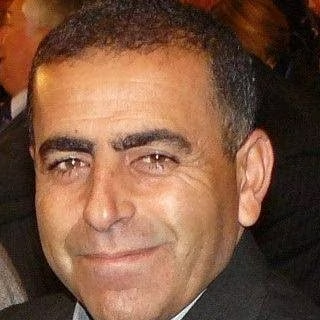
JD Vance said that one should not confuse disliking Israel or criticizing it with antisemitism.

These statements have raised questions in Tel Aviv regarding the direction of US policy, and whether the interests of the occupation and the United States might clash in the near future.

Anna Barsky, political correspondent for the Maariv newspaper, said this message is alarming in Tel Aviv. She added: "This is a major warning sign for Israel. Vance wrote that one should not link disliking Israel or criticizing it with antisemitism. These are trends that go beyond being just a passing statement, and when they come from the Vice President of the United States, it is something not to be taken lightly."

Barsky also addressed the prevailing perception among the occupation, specifically in certain right-wing circles, towards the Trump administration, saying: "There was a perception that it was an absolutely pro-Israel administration, to the extent that it would fulfill the dreams of the right. I have a feeling that we might see indications of a reversal in approach."

Regarding the upcoming meeting between President Donald Trump and Benjamin Netanyahu, scheduled in Florida on the 29th of this month, Barsky noted that Trump is operating from a broad perspective: "He does not necessarily want Turkey to be part of the international stabilization force in Gaza. He is thinking of the big picture."

And for him, the logic is: "Hey guys, move forward. I want to move to the next goal, including the Nobel Peace Prize. There's no time."

Nevertheless, Barsky confirmed that the gap between the two approaches might complicate things for Israel. She explained: "For Israel, it doesn't work that way. Netanyahu will come and say: For us, this is a matter of life or death. We can't just give in to keep up with your pace."

PALESTINE

Thu 18 Dec 2025 11:42 pm - Jerusalem Time

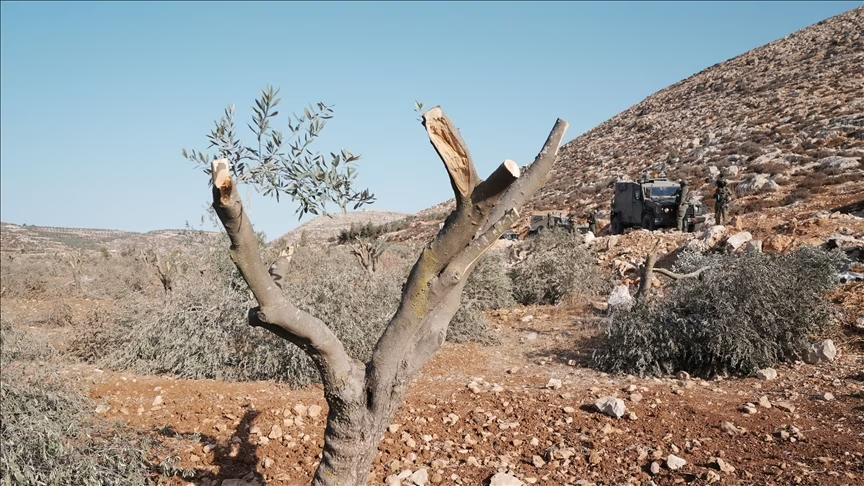
Palestinian Report: Occupation Damaged 3,413 Trees in the West Bank During a Week

A Palestinian official report documented, on Thursday, the damage to nearly 3,413 trees, most of them olive trees, in scattered areas of the West Bank, as a result of Israeli assaults in the period between December 11-18 of the current month.

The Palestinian Ministry of Agriculture explained, in a report published on the American platform "Facebook", that last week witnessed a noticeable escalation in assaults by the Israeli army and settlers, which caused severe damage to the agricultural sector.

The ministry indicated that its teams documented the damage to 3,413 trees, most of them olive trees, with the governorates of Ramallah and Al-Bireh (center) and Nablus (north) accounting for the largest share of the damages resulting from Israeli assaults.

The report clarified that those assaults during the mentioned period included land leveling, tree uprooting, destruction of hundreds of meters of irrigation networks, killing and stealing sheep, destroying fodder, and demolishing poultry farms.

According to the report, the total value of damages during the mentioned period exceeded two and a half million dollars.

The ministry stated that "Israel continues its policies of land seizure, issuing demolition notices, and forcing farmers to uproot their trees with their own hands, in an attempt to cause psychological and moral breakdown, in a direct targeting of the olive tree that represents a symbol of Palestinian identity and steadfastness".

Previously, a report by the Palestinian governmental Anti-Wall and Settlement Resistance Commission revealed Israel's seizure of 2,800 dunams (a dunam equals 1,000 square meters) of lands owned by Palestinians during the past month of November, through orders of "land seizure and expropriation and modification of state land boundaries".

Meanwhile, the commission's data indicated that Israel has issued, since the beginning of 2025, a total of 53 orders for land seizure for military purposes, in a noticeable intensification of the use of this type of orders that pretext military reasons to control Palestinian lands.

Since the start of the genocide war in Gaza, the Israeli army and settlers in the West Bank, including East Jerusalem, have killed more than 1,100 Palestinians, injured nearly 11,000, in addition to arresting more than 21,000.

Meanwhile, Israel's genocide war in Gaza has left more than 70,000 Palestinian dead and 171,000 injured, mostly children and women, along with immense destruction with a reconstruction cost estimated by the United Nations at about 70 billion dollars.

PALESTINE

Thu 18 Dec 2025 11:40 pm - Jerusalem Time

Smotrich Approves Establishment of New Settlement City East of Jerusalem

On Thursday, Israeli Finance Minister and extremist Bezalel Smotrich approved a plan to establish a new settlement city east of Jerusalem, comprising approximately 3,380 housing units.

It indicated that Smotrich approved the establishment of a new settlement city named "Mishmar Yehuda" east of Jerusalem, including 3,380 housing units.

In turn, Smotrich claimed in a post on the American company "X" platform that "the new settlement city is considered a strategic stronghold to protect Jerusalem from the eastern side as part of the ongoing policy of strengthening control over the area".

Despite the illegality of settlement, the extremist minister added that the new city "will provide tens of thousands of housing units and will contribute to strengthening the eastern ring around Jerusalem".

The project was considered "an additional step in consolidating sovereignty over the land, and will contribute to thwarting the idea of establishing an Arab (Palestinian) state in Judea and Samaria (the West Bank)".

On December 11 of this month, the Israeli mini-cabinet "Cabinet" approved a plan to legalize 19 settlements.

The announcement of the new project comes on Thursday amid growing international criticism of expansionist settlement policies, which are considered violations of international law, amid warnings of their implications for political solution opportunities and the establishment of an independent Palestinian state.

This also comes amid escalating attacks by the army and settlers in the West Bank and Jerusalem coinciding with the start of the Israeli genocide war in Gaza on October 8, 2023, which lasted for a year and ended with a ceasefire agreement that entered into force on October 10 last year.

Since the start of the Israeli genocide, the army and settlers have killed 1,094 Palestinians in the West Bank and injured about 11,000 others, in addition to arresting more than 21,000.

PALESTINE

Thu 18 Dec 2025 9:55 pm - Jerusalem Time

Committee to Protect Journalists Expresses Concern Over Testimony of Palestinian Journalist Who Was Subjected to Torture and Sexual Violence

The Committee to Protect Journalists expressed deep concern over the horrifying testimony given by the independent Palestinian journalist Sami Al-Sa'i during a public event organized recently by the Palestinian Center for Development and Media Freedoms "Mada", where he described being subjected to torture and sexual violence during his detention in an Israeli prison.

The journalist Al-Sa'i recounted harsh details about being raped during his administrative detention between February 2024 and June 2025, particularly in Majd and Ramon prisons in the north and south of the occupied territories.

Al-Sa'i said that the Israeli guards beat him, blindfolded him, shackled him, humiliated him, sexually assaulted him, and raped him with a stick.

In one incident, he detailed, saying "A group of at least 4 soldiers took me to an area with a foul smell, while they were beating me and humiliating me continuously", adding that he was forced to "sit in a prostration position", and continued "I initially thought it was part of their usual routine for humiliation, until I felt them inserting a hard object into my rectum".

The regional director of the Committee to Protect Journalists, Sarah Kaddah, said "The account given by journalist Al-Sa'i is extremely troubling and tragically aligns with the testimonies received by the Committee to Protect Journalists from his colleagues detained in Israeli prisons".

Kaddah called for urgent and independent investigations to hold accountable all those responsible for these systematic violations.

The treatment of Palestinian prisoners in occupation prisons has resurfaced again after repeated talk of unprecedented torture and horrifying violations faced by prisoners at the hands of Israeli guards.

A leaked video clip showed 5 soldiers brutally assaulting, sexually and physically, a Palestinian prisoner from the Gaza Strip with his hands tied, in the infamous Sde Teiman camp last year.

The leak of the clip led to the dismissal of the Israeli military prosecutor Yafit Tomer Yerushalmi, and Israeli Prime Minister Benjamin Netanyahu, who is wanted by the International Criminal Court, described it as "the biggest public relations attack" Israel has faced since its establishment.

The Committee to Protect Journalists said that Al-Sa'i's account - who noted that what he experienced was accompanied by a threat of a similar fate for all journalists - aligns with what human rights organizations have mentioned regarding the treatment of Palestinians in Israeli prisons.

To this day, about 30 Palestinian journalists are behind bars in Israeli prisons, according to the international committee.

About two weeks ago, the Palestinian Journalists Protection Center revealed that a Palestinian journalist was subjected to rape and sexual torture using a trained dog during his detention in the Israeli Sde Teiman camp, resulting in severe psychological trauma that deprived him of his mental balance for more than two months.

The center conveyed horrific details from the testimony of the journalist who did not disclose his real name to protect the safety of his family members, during his 20-month detention in occupation prisons, including 3 months in Sde Teiman and one month in Ofer prison.

The center detailed in a statement what it considered one of the most serious documented crimes against detained journalists, where the journalist, along with 7 other prisoners, was subjected to group sexual assaults lasting about 3 minutes, after being shackled, blindfolded, and dragged to an isolated area inside the infamous camp.

The journalist in his testimony indicated that what he faced was not an isolated incident, pointing to a systematic torture policy through which Israel sought to break the will of the prisoners and humiliate them psychologically and physically.

Israeli and Palestinian human rights data revealed mid-last month the death of 98 Palestinians during their detention in Israeli prisons and detention centers since October 7, 2023, a figure described by human rights organizations as unprecedented, reflecting a widespread collapse in detention standards and almost complete absence of legal and medical oversight.

According to the data obtained by the organization "Physicians for Human Rights-Israel", and published by the Israeli magazine (972+), a large part of the victims were civilians not suspected of involvement in combat activities.

PALESTINE

Thu 18 Dec 2025 9:25 pm - Jerusalem Time

The White House Informed Netanyahu That the Assassination of Raed Saad Violates the Gaza Ceasefire

An Israeli channel said on Monday that the White House informed the occupation government’s prime minister Benjamin Netanyahu that the assassination of Hamas leader Raed Saad constitutes a violation of the ceasefire in the Gaza Strip.

On Saturday, the occupation army carried out a raid on a vehicle west of Gaza City, resulting in the martyrdom of 4 Palestinians, and the army stated in its announcement that among them was Saad, the commander of the manufacturing wing in the Qassam Brigades, and one of the engineers of Operation Al-Aqsa Flood on October 7th.

The private channel quoted American officials as saying: "The White House sent strong messages to Netanyahu over the past two days, stating that the assassination of the prominent Hamas leader Raed Saad in Gaza was a violation of the agreement reached to end the war through the mediation of US President Donald Trump."

The two officials, unnamed by the channel, said that US Secretary of State Marco Rubio, White House envoy Steve Witkoff, and Trump's advisor and son-in-law Jared Kushner "are deeply frustrated with Netanyahu and his decisions."

The channel noted that "the angry message from the White House came amid escalating tensions between the Trump administration and Netanyahu's government regarding the next phase of the agreement to end the war in Gaza and Israel's policy in the region in general."

American officials say that "the Israeli government did not inform the United States in advance of its intention to assassinate Saad and did not consult with the White House on this matter in advance," according to the channel.

An American official told the channel: "The White House expressed its anger over the attack and clarified to Netanyahu that it constitutes a violation of the ceasefire agreement."

The official added: "The White House's message to Netanyahu was: If you want to destroy your reputation and show your lack of commitment to agreements, do as you wish, but we will not allow you to destroy President Trump's reputation after his success in reaching an agreement in Gaza."

The channel confirmed the escalation of tensions between Netanyahu and the Trump administration due to the occupation's policy in Gaza, just two weeks before an upcoming meeting between Netanyahu and the American president at Mar-a-Lago resort in Florida.

It pointed out that the tensions surrounding the assassination of Raed Saad "are just the latest episode in a series of disputes between the White House and Netanyahu's government in recent weeks."

The channel indicated that "the White House sees Netanyahu acting shortsightedly on many issues related to the implementation of the agreement in Gaza, especially regarding the transition to the second phase, which includes additional Israeli withdrawal."

The channel said that "the White House has been focusing in recent weeks on strengthening the ceasefire, reducing tensions in the region, and transitioning from the Gaza war to rebuilding relations between Israel and the Arab world, and expanding normalization agreements."

However, high-level American officials say they "have faced significant distrust towards Netanyahu in the region, and strong opposition in many Arab countries to cooperating with him," according to the same source.

ARAB AND WORLD

Thu 18 Dec 2025 8:34 pm - Jerusalem Time

Gideon Sa'ar is considering closing the Israeli embassy in Oslo

It was reported that Israeli Foreign Minister Gideon Sa'ar is seriously considering closing the Israeli embassy in the Norwegian capital Oslo, which has been operating without an ambassador since May 2024.

This consideration comes in the context of increasingly strained relations between the two sides, where disagreements have escalated regarding Israeli policies in the occupied Palestinian territories.

It considered that Norway is among the most hostile countries towards Israel since the Al-Aqsa Flood on October 7, 2023, rivaled only by Ireland and Spain.

This comparison reflects the intensity of the tension in relations, placing Norway at the forefront of European countries criticizing Israeli policies.

Norway recently filed a lawsuit before the International Court of Justice in The Hague regarding Israeli measures against the United Nations Relief and Works Agency for Palestine Refugees (UNRWA), in an international legal step representing a qualitative escalation in the Norwegian position.

This lawsuit is like the straw that could break the back of official diplomatic relations between the two countries.

In another matter, writer Alexander Langlois addressed the Arab Spring revolutions in an article in the 'National Interest' magazine, considering that the West did not realize that supporting authoritarian regimes was no longer a sustainable option after 15 years of the Arab Spring.

He affirmed that the peoples of the region still suffer from the burden of authoritarianism, and that the frustrations that ignited the uprisings persist amid the destruction.

The writer emphasized that real change must be led by the people in pursuit of their hopes and dignity, and that values can remain part of the state's interests and foreign policy, while recognizing the painful lessons of the Arab Spring on its 15th anniversary.

In the context of the Ukraine war, it was revealed that the United States warned European leaders against seizing frozen Russian assets and using them to finance Ukraine.

It clarified that Washington is pressuring the European Union and Britain to back down from plans to seize about 210 billion euros in Russian assets.

It added that the upcoming meeting of European leaders may open a political confrontation with US President Donald Trump, at a time when Russia threatened a harsh response to any such step.

This American position reflects a shift in approach towards the war and mechanisms of pressure on Moscow.

ARAB AND WORLD

Thu 18 Dec 2025 8:28 pm - Jerusalem Time

Cairo: The Gas Deal with Israel is Purely Commercial and Does Not Entail Any Political Dimensions

Cairo affirmed today, Thursday, that the gas deal with Israel is a "purely commercial deal concluded based on purely economic and investment considerations, and does not entail any political dimensions or understandings."

This statement comes the day after Israeli Prime Minister Benjamin Netanyahu announced the approval of the gas deal with Egypt, which he said is "the largest in Israel's history," valued at about 35 billion dollars, allowing the export of gas from Israel's Leviathan field to Egypt until 2040.

Diaa Rashwan, head of the General Authority for Information affiliated with the Egyptian Presidency, said in a statement that what happened is a commercial contract subject to market rules and international investment mechanisms, far from any political exploitation or interpretation.

He emphasized that Egypt's position on the Palestinian issue "is steadfast and will not change, and is based on supporting the legitimate rights of the Palestinian people, rejecting forced displacement, and adhering to the two-state solution."

Rashwan added that this agreement achieves "a clear strategic interest for Egypt, manifested in strengthening its position as the only regional center for gas trading in the Eastern Mediterranean, relying on advanced infrastructure and huge investments."

He pointed out that "what happened is a commercial contract subject to market rules and international investment mechanisms, far from any political exploitation or interpretation."

He added that the parties to the agreement are well-known international commercial companies in the energy sector, including the American company "Chevron," alongside Egyptian companies specialized in receiving, transporting, and trading gas, without any direct government intervention in concluding these contracts.

He emphasized that the timing of the announcement does not change the fact that the agreement is the result of commercial negotiations that took place during a previous period.

PALESTINE

Thu 18 Dec 2025 8:24 pm - Jerusalem Time

White House official: Trump and Witkoff will discuss Gaza agreement with Qatari, Egyptian, and Turkish officials

A White House official said on Thursday that US President Donald Trump and his special envoy Steve Witkoff will meet on Friday with Qatari, Egyptian, and Turkish officials in Miami, Florida, to discuss the Gaza agreement.

The meeting, which was initially announced to bring together Witkoff with officials from those countries, a White House official mentioned that President Trump will also attend.

For his part, Qatar's Prime Minister and Minister of Foreign Affairs Sheikh Mohammed bin Abdulrahman bin Jassim Al Thani said that the meeting will aim to develop a complete vision for how to transition to the second phase of the agreement to end the war in the Gaza Strip.

During his visit to Washington, Al Thani stated in a statement that he agrees with US Secretary of State Marco Rubio on doubling efforts to reach the second phase of the ceasefire agreement in Gaza.

Al Thani said there was an opportunity to discuss the ceasefire agreement and the urgent need to move to the second phase of the agreement and form the Palestinian civilian administration as soon as possible, because the current situation endangers the agreement with each passing day, as he put it.

Since the signing of the ceasefire agreement on October 10th, the occupation army has committed daily violations that have resulted in hundreds of martyrs, in addition to deaths due to the severe cold due to the deterioration of humanitarian conditions, and the prevention of importing sufficient quantities of fuel and gas.

PALESTINE

Thu 18 Dec 2025 8:06 pm - Jerusalem Time

The film "Hind Rajab's Voice" is preparing for screening in 167 cinemas across the Arab world

Cinemas are preparing to welcome the film "Hind Rajab's Voice" by the Tunisian director Kaouther Ben Hania, as part of the "Sinamad" initiative dedicated to screening films participating in international festivals and forums in cinema halls.

The film is scheduled to be shown in about "167 cinemas" in various parts of the Arab world, including "22 cinemas in Egypt", "51 in Saudi Arabia", "37 in the UAE", "12 in Qatar", "12 in Iraq", "9 in Oman", "8 in Kuwait", "9 in Bahrain", "6 in Jordan", in addition to "one cinema in Syria".

The film, which won the "Silver Lion" award from the Venice Film Festival 2025, was recently screened in Ankara under the patronage of the Presidency, according to a statement issued by the Turkish Ministry of Culture, where the Turkish President Recep Tayyip Erdoğan received members of the family of the martyred child Hind Rajab, who was killed by the Israeli occupation army

The wife of the Turkish President, Mrs. Emine Erdoğan, interacted with the film and wrote on her account on the "X" platform that the work "awakens consciences and keeps memory alive", noting that she watched its screening "with a lump in the throat".

She said that the voice of the Palestinian child Hind Rajab (6 years old), who was brutally snatched from life in Gaza, was like a "cry for help heard by the whole world but no one responded to it".

The wife of the Turkish President praised the film, considering it "did not allow that cry to fade into darkness", praying for the soul of the child Hind and all Palestinian martyrs, and expressing hope that the "unfinished story of Hind" will continue to awaken the world, congratulating the team and those responsible for producing the film.

The American Academy of Motion Picture Arts and Sciences (Oscar) has announced the inclusion of the film "Hind Rajab's Voice" in the shortlist for the 98th edition of the Oscar Awards, where it competes in the Best International Film category dedicated to works produced outside the United States, alongside three other Arab films: "What's Left of You" by director Sherine Dabbas, "Palestine 36" by director Annemarie Jacir, and "The President's Cake" by Iraqi director Hassan Hadi.

This nomination is the third in five years for a film directed by Kaouther Ben Hania to enter the Oscar race, after the films "The Man Who Sold His Skin" and "Four Daughters".

Ben Hania expressed her happiness at the film's entry into the shortlist, through a post on her Facebook page, saying that the nomination represents a moment of pride and gratitude for everyone who believed in the film and contributed to its support, and considered it the beginning of a new journey.

The film "Hind Rajab's Voice" tells the story of the killing of the Palestinian child Hind Rajab (5 years old) in the Gaza Strip during the Israeli war on the sector. The film witnessed its world premiere within the official competition of the Venice Film Festival 2025, where it won the Silver Lion award.

PALESTINE

Thu 18 Dec 2025 7:54 pm - Jerusalem Time

A martyr falls due to the explosion of 3 explosives from occupation remnants in scattered areas in the Gaza Strip

A martyr falls and fires break out, in addition to significant material damages, due to the explosion of 3 explosive devices.

The Civil Defense Department in the Gaza Strip announced the martyrdom of a martyr and the outbreak of fires, in addition to significant material damages, due to the explosion of 3 explosive devices from occupation remnants in scattered areas of the sector.

The Civil Defense in its statement held the occupation and the American Coordination Center fully responsible for the lives of civilians who lose their lives as a result of the explosion of these dangerous remnants.

It indicated that these unexploded ordnance pose a continuous threat to the lives of residents in the sector.

ARAB AND WORLD

Thu 18 Dec 2025 6:52 pm - Jerusalem Time

Japanese facility refuses bookings for Israelis due to 'the treatment Palestinians are subjected to'

A tourist facility in the Japanese city of Nagano refused bookings for Israelis who had applied through a travel company.

After reviewing the booking request by the management of ski facilities in Japan, which had received inquiries about accommodation and reservations in the winter season, the response was rejection.

The facility justified this with 'the treatment Palestinians are subjected to'.

The facility manager said: 'We have decided not to accept requests from Israeli citizens from now on. We are disturbed by what your government imposes on the Palestinian people, and we do not see it right for you to think about spending a vacation while residents of a neighboring country have no place to stay and suffer from hunger.'

The incident prompted the Israeli ambassador to Tokyo, Gilad Cohen, to send a message to the governor of Nagano Prefecture in Japan, protesting what happened and demanding an investigation into the matter.

The investigation resulted in a verbal warning to the facility manager and a demand not to 'refrain from any discriminatory practices'.

This incident is not the only one in Japan, as a hotel operating company in Kyoto previously imposed in May 2025 on its Israeli clients to sign a pledge not to be involved in war crimes before allowing them to stay.

ARAB AND WORLD

Thu 18 Dec 2025 6:24 pm - Jerusalem Time

The International Criminal Court rejects US sanctions and considers them an assault on its independence

The International Criminal Court expressed today, Thursday, its rejection of the sanctions imposed by the United States on two members of the Court's body, considering it "a blatant assault on the independence of an international judicial body."

US Secretary of State Marco Rubio said in a statement that the two judges, from Mongolia and Georgia, voted earlier this week against Israel's challenge to the Court's jurisdiction in the investigation "into crimes allegedly committed in the Gaza Strip."

This step comes after previous US sanctions in March last year, which included two judges from France and Canada and two prosecutors in the Court, on the grounds of their participation in investigation efforts or issuing arrest warrants against American or Israeli citizens.

Earlier this month, the President of the International Criminal Court, Judge Tomoko Akane, said that the US sanctions imposed on senior officials and judges of the Court directly affected the personal lives of the targeted judges and officials.

Akane emphasized, in the opening of the meetings of the Assembly of States Parties in The Hague, that the judicial body "will not accept any pressure of any kind."

Previously, the Appeals Chamber in the International Criminal Court rejected Israel's objection to the arrest warrants issued against Prime Minister Benjamin Netanyahu and former Defense Minister Yoav Gallant, in November 2024. After the Court accused them of committing war crimes and crimes against humanity in the Gaza Strip.

PALESTINE

Thu 18 Dec 2025 5:04 pm - Jerusalem Time

Netanyahu Approves Bill to Try Palestinian Prisoners Who Participated in October 7 Attack

Israeli Prime Minister Benjamin Netanyahu has given the green light to a bill that allows the trial of Palestinian prisoners accused by Tel Aviv of participating in the October 7, 2023 attack.

The Yedioth Ahronoth newspaper reported on Thursday that Netanyahu "gave the green light to a bill presented by Knesset members Simcha Rothman (Religious Zionism) and Yulia Malinovsky (Israel Our Home), which allows the trial of detained Palestinians who carried out the October 7 attacks".

It noted that "Netanyahu thereby rejected the request of National Security Minister Itamar Ben-Gvir to include them in the death penalty law he is promoting".

It added: "The bill is expected to be voted on in its first reading next week".

It further stated: "The law will also apply to those who held hostages (Israeli prisoners) in Gaza".

It explained that the trial will take place before a military court established for this purpose, authorized to try what it calls "crimes of genocide, violation of state sovereignty, incitement to war, and aiding the enemy, which are punishable by death".

Any bill must be voted on in three readings before becoming an effective law.

Israel has not disclosed the number of Palestinian prisoners it accuses of participating in the October 7, 2023 attack.

However, "Yedioth Ahronoth" indicated that the talk is of more than 300 detainees.

It is recalled that on October 7, 2023, "Hamas" attacked military bases and settlements adjacent to the Gaza Strip, killing and capturing Israelis, in response to "the daily crimes of the occupation against the Palestinian people and its sanctities, especially Al-Aqsa Mosque", according to the movement.

Since then, Israel, with American support, has waged a war of extermination in Gaza that has left more than 70,000 dead and over 171,000 injured, mostly children and women, and caused massive destruction, with the United Nations estimating the cost of reconstruction at around $70 billion.

PALESTINE

Thu 18 Dec 2025 9:37 am - Jerusalem Time

The occupation army continues aerial and artillery bombardment on the Gaza Strip

On Thursday, the occupation army launched a series of intense aerial raids and artillery bombardment on the Gaza Strip, targeting the eastern and northern areas of the sector's cities.

Palestinian sources reported that the Shujaiya neighborhood east of Gaza City witnessed fierce artillery bombardment, while warplanes carried out raids on the cities of Khan Yunis and Rafah, leading to rising columns of smoke from the targeted areas. Military vehicles also opened fire from their heavy machine guns towards several areas east of Gaza City and Rafah.

The sources did not specify the nature of the targets hit by the raids, while the occupation continues its ongoing violations of the ceasefire with Hamas since October 10 last year, recording about 738 violations, resulting in the martyrdom of more than 394 Palestinians, according to the Government Media Office in Gaza last Tuesday.

The effects of the genocide war launched by the occupation on Gaza since October 2023, which lasted for two years, continue, leaving more than 70,000 dead and more than 171,000 injured Palestinians, mostly children and women, in addition to massive destruction in the infrastructure, with the United Nations estimating the cost of reconstruction at about 70 billion dollars.

OPINIONS

Thu 18 Dec 2025 8:47 am - Jerusalem Time

Why Did the Trump Administration Adopt Israeli Fears of a Palestinian State?

Dr. Ibrahim Na'irat

Dr. Ibrahim Na'irat

Opinion Writer

The position of the administration of former U.S. President Donald Trump on the issue of a Palestinian state was not a reflection of a traditional American vision for managing the conflict, nor the product of an independent strategic review of security and stability equations in the Middle East, but rather a clear expression of nearly complete adoption of the Israeli narrative, especially that related to security and demographic fears of the establishment of a sovereign Palestinian state. These fears, which have long formed the core of the Israeli discourse opposing any genuine political settlement, were conveyed to Washington as established facts, not as political assumptions subject to debate or evaluation.

From the administration's early days, it seemed that the Palestinian-Israeli conflict was read from a narrow perspective that reduces the issue to a purely security equation. The Trump administration adopted the Israeli view that the establishment of an independent Palestinian state restricts Israel's military and geographical control, limits its security movement freedom, and opens the door to international legal accountability that it has long sought to avoid. Instead of addressing these fears within a political framework that balances security and rights, an approach based on risk management was adopted, not on addressing the roots of the conflict, which practically led to disabling any meaningful political path.

However, the security dimension, despite its importance in the Israeli discourse, was not the sole driver behind this American adoption. The demographic factor constituted a no less present and influential obsession. Recognizing Palestinian political rights, whether through the establishment of an independent state or through a path of genuine political equality, poses a fundamental challenge to Israel's nature as a state based on a specific national supremacy. This demographic concern, which pushes towards permanent separation and control instead of settlement, found in the Trump administration a political partner that adopts the logic of preserving the 'existing facts' instead of seeking to change them.

This adoption was reflected in a series of practical policies and measures that redefined the American role in the conflict. Settlement was dealt with not as an obstacle to peace, but as a fait accompli that can be legitimized or ignored. The concept of the two-state solution was also emptied of its political content, to be replaced by vague discourse lacking any clear commitment to Palestinian sovereignty. In this context, what was known as 'economic peace' was promoted, where the Palestinian issue was reduced to livelihood improvements and development projects, with complete disregard for the issue of national rights and political representation.

With this approach, security and demography were transformed from elements that should be addressed within a comprehensive political solution into pretexts used to justify the continuation of control and the disabling of solutions. Occupation was no longer viewed as a problem in itself, but as a tool for managing stability according to the Israeli vision, which constituted a clear deviation from the traditional American discourse, even in its most biased phases.

After the events of October 7, these Israeli fears were redeployed in the same way, to affirm the narrative that full control is the only guarantee of security, and that any independent Palestinian entity constitutes an existential threat. However, field realities have proven that this logic did not prevent the explosion, but contributed to creating its conditions. The absence of a political horizon, the continuation of occupation, and managing the conflict instead of resolving it—all these factors accumulated tension and produced the moment of explosion, not the opposite.

In conclusion, the Trump administration's fear of a Palestinian state did not stem from the weakness of this potential entity, but from its symbolic and political strength. The establishment of a sovereign Palestinian state re-raises fundamental questions about security, demography, legitimacy, and the limits of power. Under the weight of these questions, the American administration chose to adopt a vision that sees occupation as a long-term temporary solution, and rights as a danger to be contained.

However, history has proven that ignoring rights does not provide security, and that managing the conflict does not create permanent stability. The Palestinian state has never been the essence of the problem, but its absence. Any approach that does not start from this understanding will remain incapable of producing genuine peace, no matter how many tools of power and influence it possesses.