ARAB AND WORLD

Sun 21 Dec 2025 6:32 pm - Jerusalem Time

Jared Kushner Returns to the American Foreign Policy Arena

After nearly a year into the presidency of US President Donald Trump, his son-in-law Jared Kushner has returned to the foreign policy circle and is playing a larger role in sensitive peace negotiations after his role diminished throughout the previous period, joining Stephen Witkoff, the special envoy of the US President.

This change reflects a prevailing sentiment among Trump's close associates that Kushner, who has diplomatic experience, complements Witkoff's negotiation style and can bridge the seemingly intractable gaps to reach an agreement, according to several current and former administration officials who spoke, like others, on condition of anonymity to discuss internal deliberations.

This role became evident at the end of this week when Kushner and Witkoff hosted the Russian negotiator Kirill Dmitriev in Miami for talks on the latest proposals to end the Russian war in Ukraine, and they also met with Turkish and Qatari officials to discuss the fragile ceasefire between Israel and the Islamic Resistance Movement (Hamas) in Gaza, as they look to implement the second phase of Trump's plan to stop the firing.

The extended session on Saturday with Dmitriev came after several weeks of shuttle diplomacy, where Witkoff and Kushner recently met with Russian President Vladimir Putin in Moscow and Ukrainian and European diplomats in Germany. The two American envoys were scheduled to hold more talks with Dmitriev on Sunday, according to a White House official.

Witkoff, a longtime friend of Trump, is considered by some officials within the administration to be a prominent figure who has traveled the world in diplomatic negotiations on his private plane, and does not miss any opportunity to publicly praise the President for his acumen in foreign policy, according to the officials.

A Western diplomat says Kushner has complex business interests in the Middle East, sometimes known as "deal diplomacy," which has annoyed some officials in European capitals.

However, Kushner is seen as a more credible negotiator than Witkoff, who is considered by many Ukrainian and European officials to be excessively lenient towards Russian interests during the war in Ukraine that began in February 2022, according to the diplomat.

Ian Kelly, a retired diplomat and former US ambassador to Georgia, who is currently a professor of diplomacy at Northwestern University, says, "Kushner has a slightly more impressive record than Trump's first administration." But Kelly emphasized that judgment on Kushner's involvement has not yet been issued.

Trump views Kushner as "a trusted family member and talented advisor" who played a pivotal role in some of his biggest foreign policy successes, according to Anna Kelly, White House deputy spokesperson.

Kelly added that Trump and Witkoff "often seek Kushner's opinion given his experience in complex negotiations, and Kushner has been generous in providing his valuable expertise when asked."

The official spokesperson for the US State Department, Tommy Bigot, described Kushner as "a world-class negotiator." Bigot noted that Secretary of State Marco Rubio is grateful to Kushner "for his willingness to serve the country and help President Trump resolve some of the world's most complex challenges."

Kushner spoke in an interview with the program "60 Minutes" on CBS in October, about his unconventional approach to diplomacy, saying: "I actually trained in foreign policy during President Trump's first term by seeing a president come to Washington with a different school of foreign policy than what had prevailed during the previous twenty or thirty years."

However, some Democrats and government watchdog groups have expressed doubts about Kushner's role in shaping the administration's policies in the Middle East, while managing investments worth billions of dollars. Similarly, Witkoff has faced scrutiny due to his deep business relationships and his family's ties to Gulf countries.

Commenting on that, Kushner said that "what people call a conflict of interest, Witkoff and I call experience and reliable relationships we have around the world."

White House advisor David Warington said in a statement that Kushner's efforts on behalf of Trump "are in full compliance with the law."

Kelly and other veterans of American diplomatic meetings with the Russians over many years doubt Kushner's ability to secure an agreement between Russia and Ukraine because Witkoff is still technically in the lead.

Kelly said: "I don't see Witkoff's approach succeeding." "He doesn't understand the Russians well. He misunderstands what they say and conveys this misunderstanding to Washington and the Europeans."

Kelly said: "It seems they have the idea that the magic key is money: investment and development." "But these men don't care about that; they are not real estate men except in that they want the land, period."

Kushner had told Trump and others that although he would not join the White House in his second term, he was ready to offer his advice if they wished. This role he also played on a few occasions during the years of former President Joe Biden, when the Democratic administration tried, unsuccessfully, to expand the Abraham Accords.

With Trump's efforts to reach an agreement to end the war between Israel and Hamas in Gaza stalling during the summer, Kushner intervened, leveraging his experience and relationships in negotiating the Abraham Accords to help Witkoff push Trump's plan to the finish line.

The 20-point plan was agreed upon in late September after frantic talks on the sidelines of the United Nations General Assembly meetings, and it is still being implemented, but Kushner and many members of the Abraham Accords team are coordinating its implementation.

Trump told the Israeli parliament, the Knesset, shortly after the agreement: "We always call on Kushner when we want to close that deal. We need his mind sometimes."

Once the Gaza plan is completed, Kushner said he would return to his family and his daily job in Miami, where he heads a private investment company worth billions of dollars. Kushner said his involvement in the high-risk peace-making process was temporary only, joking that his wife Ivanka might change the locks if he didn't return home soon.

But within weeks of reaching the ceasefire in Gaza, Trump again turned to his problem-solving son-in-law to engage in negotiations between Russia and Ukraine. The negotiations had been at a standstill for months despite the White House's ongoing efforts to persuade Putin and Ukrainian President Volodymyr Zelenskyy to reach an agreement.

Trump hinted at the time that he would continue to rely on Kushner when the stakes are at their highest, just as he had done before.

PALESTINE

Sun 21 Dec 2025 6:28 pm - Jerusalem Time

International newspapers and websites: The cost of supporting Palestinians.. Besieged villages in the West Bank.. Activists on hunger strike in Britain

International newspapers and websites addressed the cost of supporting Palestinians amid the Israeli war, shedding light on the reality of besieged villages in the West Bank, the suffering of activists on hunger strike in Britain, alongside the repercussions of the starvation policy in Gaza and other regional developments.

In the West Bank, the British Guardian newspaper reported that international volunteers have become a line of protection for Palestinians from settler attacks, especially in the village of Ras Ein al-Auja, where residents live besieged and deprived of pastures and springs, amid attempts to force them to leave.

The newspaper added that the volunteers themselves are subjected to direct attacks, which forced some of them to wear protective vests while accompanying the locals, in a scene that reflects the escalation of settler violence and the residents' inability to protect themselves in the absence of accountability.

In London, the Sunday Times revealed the hunger strike of one pro-Palestine activist inside prison, warning of the risk of his death before his trial, as part of a case involving 6 activists who protested Britain's support for Israel during the Gaza war.

The newspaper mentioned that Kamran Ahmed, aged 28, continues his strike for 6 weeks, relying on faith and reading to endure, and said that the strike has highlighted their cause, despite the psychological pressure it caused on his family and friends.

For its part, the Israeli Haaretz newspaper published an analysis that spoke of a relative improvement in food availability in the Gaza Strip, but emphasized that this does not absolve the Israeli government of responsibility for a deliberate starvation policy that resulted in the deaths of hundreds and left tens of thousands at risk of severe hunger.

As for outside the Palestinian file, the New York Times covered American raids on ISIS sites in Syria, considering that they reveal the magnitude of challenges facing the new Syrian authorities, while the Wall Street Journal defended the American security strategy and called on Europe to bear its defense responsibilities.

PALESTINE

Sun 21 Dec 2025 5:24 pm - Jerusalem Time

Stagnation of the Palestinian Economy and Sharp Decline in Gross Domestic Product During 2025

Ayser Al-Eis / Anadolu

* Data from the Palestinian Central Bureau of Statistics and the Monetary Authority: - The Gross Domestic Product recorded a "sharp decline" in the Gaza Strip during 2025 by 84 percent and 13 percent in the West Bank - Construction activity recorded the highest decline by 41 percent, with 29 percent in the West Bank and 99 percent in Gaza - The volume of foreign trade recorded a decline of 12 percent, and imports recorded a decline of 17 percent - The unemployment rate recorded 46 percent, with 28 percent in the West Bank and 78 percent in Gaza

The Palestinian Central Bureau of Statistics and the Monetary Authority revealed, on Sunday, stagnation in the Palestinian economy and a sharp decline in the Gross Domestic Product during 2025.

This came in a joint statement from the Palestinian Central Bureau of Statistics and the Monetary Authority regarding the Palestinian economic harvest for 2025 and economic forecasts for 2026.

The statement mentioned that the Gross Domestic Product in Palestine recorded a "sharp decline" in the Gaza Strip by 84 percent compared to 2023, in addition to a decline in the West Bank by 13 percent during the same period.

It noted that construction activity recorded the highest decline by 41 percent, with 29 percent in the West Bank and 99 percent in Gaza.

Meanwhile, services activity recorded a general decline of 25 percent; 12 percent in the West Bank and 82 percent in Gaza, while agricultural activity declined by 92 percent in Gaza, compared to stability in the West Bank during the same period.

According to the statement, the volume of trade exchange in Palestine with the outside world recorded a decline of 12 percent, with imports recording a decline of 17 percent during 2025 compared to 2023.

It indicated that this decline "reflects the extent of the cumulative damage that has befallen the economy since the start of the Israeli aggression on the West Bank and Gaza Strip, more than two years ago, which led to damage to production capacity and the continuation of bottlenecks in economic activities".

Despite the West Bank recording a limited increase of 4.4 percent in 2025 compared to 2024, the Gross Domestic Product in the Gaza Strip continued to shrink, recording an additional decline of 8.7 percent during the same period, according to the statement.

The statistics indicate that nearly half of the workforce in Palestine is disrupted, with the unemployment rate reaching 46 percent during 2025, with 28 percent in the West Bank and 78 percent in Gaza, with more than 650,000 unemployed.

The forecasts indicate that the Palestinian economy will record a growth of between 4.1-4.5 percent during 2026, indicating the continuation of gradual recovery that began after the sharp contraction recorded in 2024.

This growth is attributed, according to the statement, to a limited improvement in the components of aggregate demand, especially final consumption, supported by the continued flow of humanitarian aid and private transfers, in addition to a partial positive contribution from investment spending.

This comes as the Israeli army and settlers escalate their attacks in the West Bank since the start of the genocide war in Gaza that lasted two years, resulting in the killing of more than 1,102 Palestinians, injuring about 11,000, in addition to arresting more than 21,000.

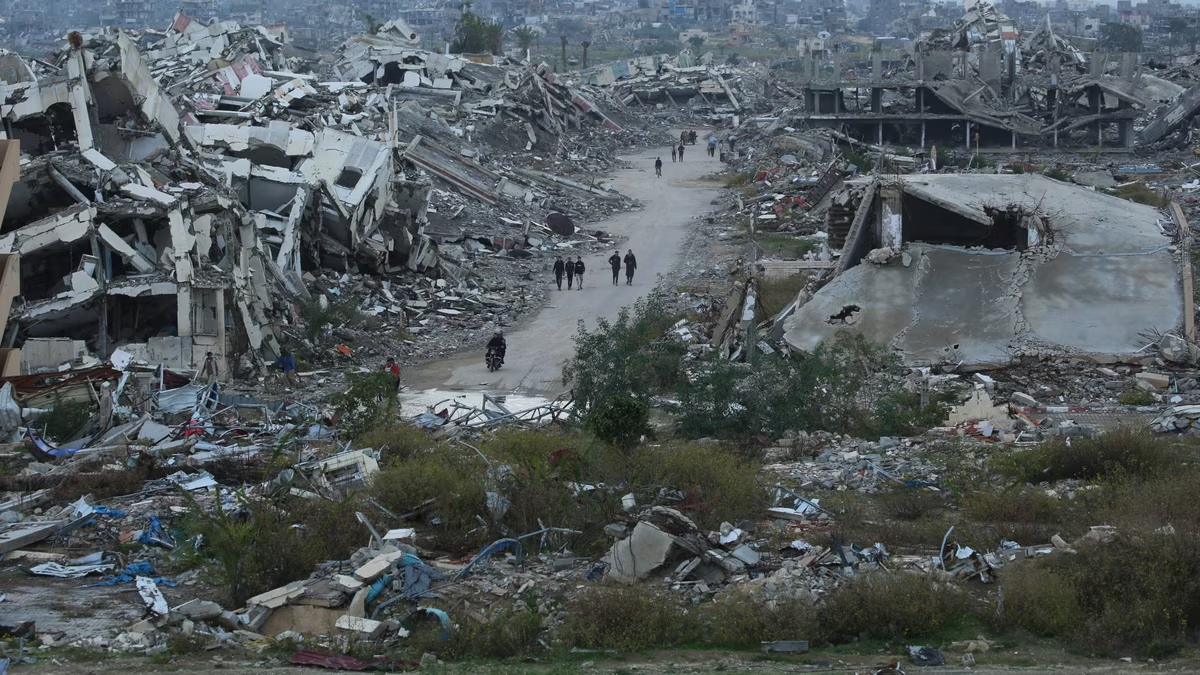
Meanwhile, the Israeli genocide war in Gaza left about 71,000 Palestinian dead and 171,000 injured, mostly children and women, and massive destruction with a reconstruction cost estimated by the United Nations at about 70 billion dollars.

PALESTINE

Sun 21 Dec 2025 11:57 am - Jerusalem Time

The Director General of the Gaza Health Ministry: The lives of thousands of patients are hanging in the balance due to lack of medicine and destruction of hospitals

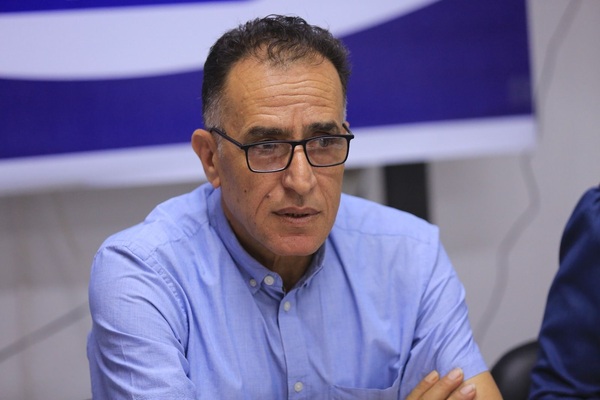
The Director General of the Health Ministry in the Gaza Strip, Dr. Munir Al-Barsh, warned that the lives of thousands of patients in Gaza are hanging in the balance, amid shortages of medicine, destruction of hospitals, and absence of doctors.

Al-Barsh stated that the Palestinian citizen in the Gaza Strip is suffering from another hidden war, which is the shortage of medicine, noting that the medicine catastrophe is reflected in the numbers, as there are more than 80,000 diabetic patients at risk of relapses due to the unavailability of diabetes medications.

He mentioned that more than 5,100 hypertension patients are threatened with fatal clots due to the unavailability of basic services such as cardiac catheterization and open-heart surgery.

Moreover, about 2,000 cancer patients face the risk of death due to the absence of medications and treatment protocols, and about 45,000 heart patients are threatened with heart crises, in addition to 1,100 kidney patients needing regular dialysis, and more than 24,000 psychiatric patients without medications, as Al-Barsh confirms.

The Director General of the Health Ministry in Gaza listed the missing medicines in Gaza, which include antibiotics, fever reducers, and sterile gauze for wounds, in addition to other medicines and supplies that the occupation prevents from entering.

Figures from the World Health Organization indicate the death of 1,092 patients awaiting medical evacuation during the past months in Gaza, and confirm that 50% of the sector's hospitals are operating partially.

Al-Barsh affirmed that the Israeli occupation has prevented the entry of medicines into Gaza since October 2023, and only allows the entry of small quantities not exceeding 10% of urgent needs, and has divided the sector and destroyed 324 licensed pharmacies and 128 drug companies and warehouses.

PALESTINE

Sun 21 Dec 2025 11:56 am - Jerusalem Time

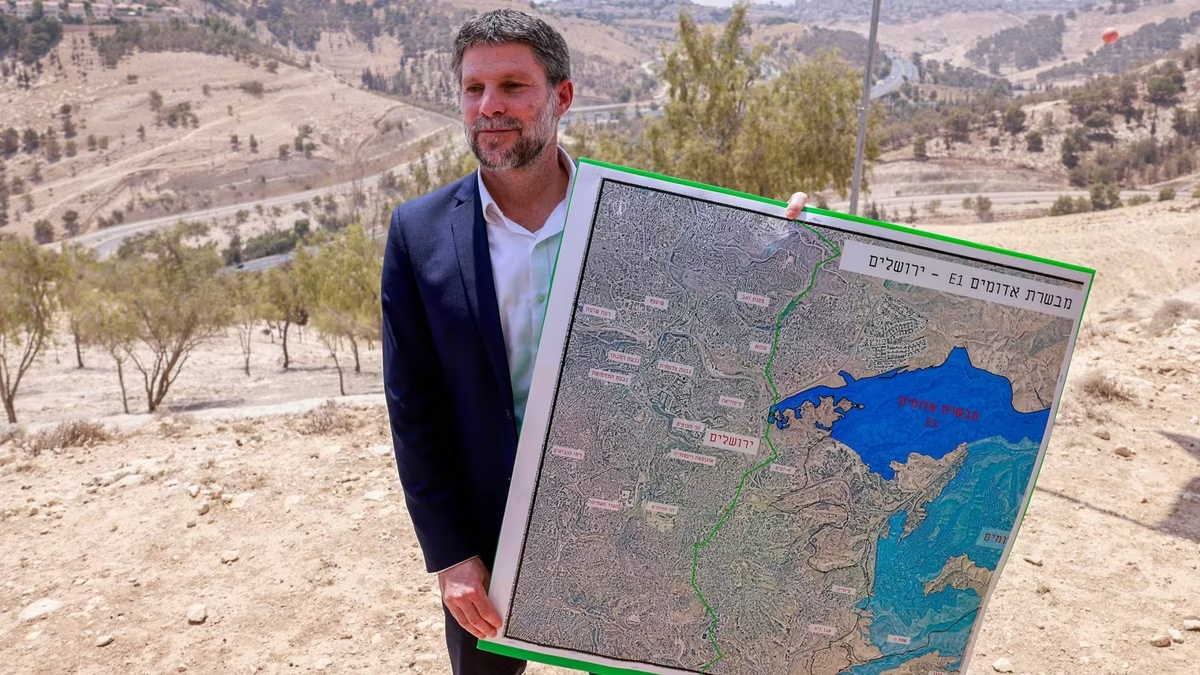
New settlement escalation.. The occupation approves the construction of 19 settlements in the West Bank

In a settlement escalation described by officials in the occupation government as "historic," the mini-ministerial council of the occupation authorities approved, on Sunday, the establishment of 19 new settlements deep in the occupied West Bank.

With this decision, the number of settlements approved over the past three years rises to 69 settlements, enhancing the policy of imposing a fait accompli and fragmenting Palestinian lands.

A statement issued by the office of Finance Minister Bezalel Smotrich stated that this step was coordinated with Defense Minister Yoav Gallant to approve and organize these spatial outposts that are characterized by high strategic importance.

Prominent among these projects is the re-establishment of the "Ganim" and "Kedem" settlements in the north of the West Bank, which had been evacuated in previous years.

Concurrently with this announcement, UN Secretary-General António Guterres warned in an official report submitted to the Security Council that settlement expansion reached a "record" level this year 2025, the highest since the start of regular monitoring in 2017.

Guterres revealed that 2025 saw the approval or tendering of approximately 47,390 settlement housing units, compared to about 26,170 units in 2024, representing a huge leap from the previous years' average of around 12,800 units annually.

Guterres condemned this ongoing expansion, affirming that it undermines the possibility of a contiguous and sovereign Palestinian state, and constitutes a flagrant violation of international law.

He indicated that these developments work to "entrench the illegal occupation" and deprive Palestinians of their right to self-determination.

The UN report did not limit itself to the settlement file but condemned the "alarming" increase in settler violence against Palestinian civilians, noting that some of these attacks occur in the presence or with the support of occupation security forces.

Guterres expressed his deep concern over the occupation's military operations that led to hundreds of deaths and the destruction of infrastructure and homes.

It is noteworthy that the number of settlers in the West Bank (excluding East Jerusalem) has exceeded 500,000 settlers, living amidst about three million Palestinians.

Since the outbreak of the war in Gaza in October 2023, and despite the ceasefire that came into effect on October 10 last year, violence in the West Bank has not subsided; where more than a thousand Palestinians have been killed by the fire of occupation soldiers or settlers, while 44 "Israelis" fell in attacks or during military operations, according to official statistics.

PALESTINE

Sun 21 Dec 2025 11:34 am - Jerusalem Time

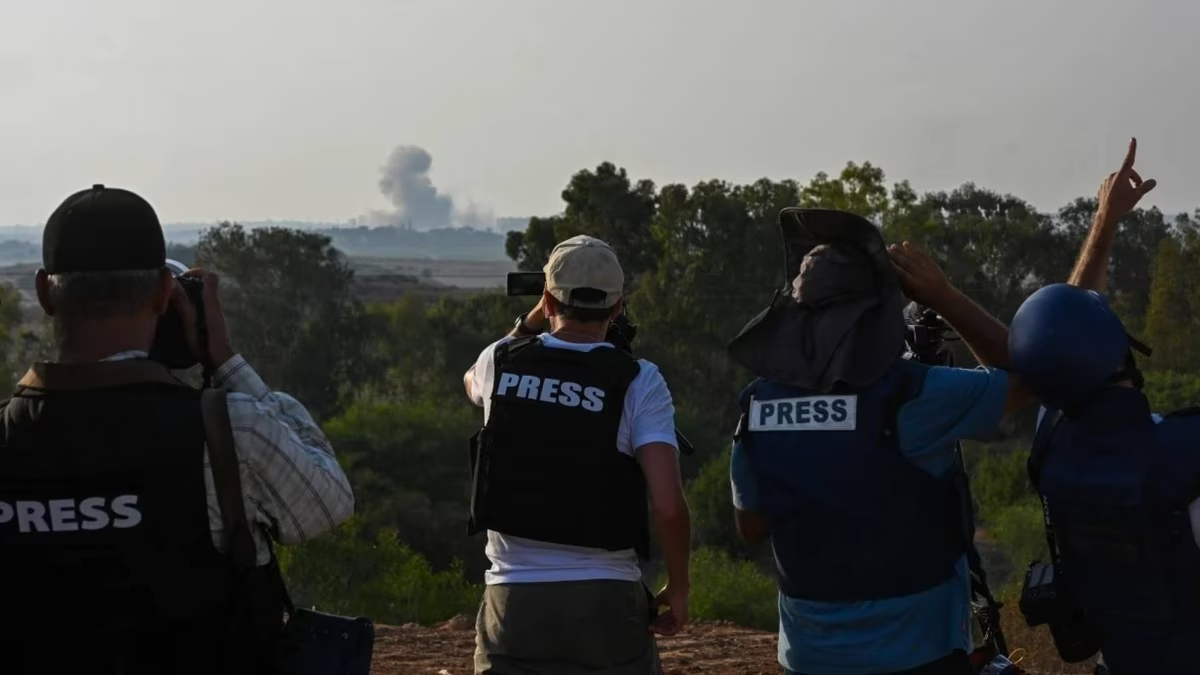
For the tenth time.. the occupation government procrastinates in responding to the petition for the entry of international press into Gaza

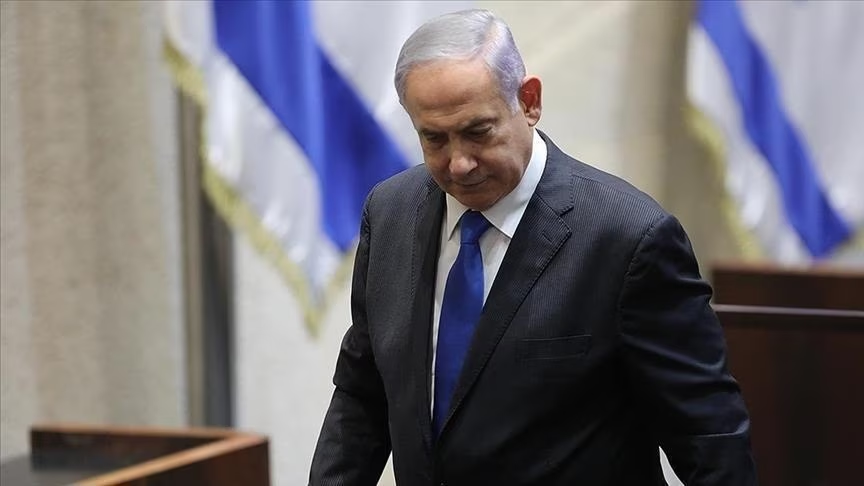
The occupation government, led by Benjamin Netanyahu, continues its systematic policy of procrastination to prevent independent media coverage of what is happening inside the Gaza Strip.

On Sunday, the government requested the occupation's Supreme Court to extend the deadline granted to it to respond to the petition submitted by the Foreign Press Association, which demands allowing international media free and independent access to the sector.

This request is the tenth in a row within an extended judicial process, where the occupation side repeatedly postpones ruling on the case without providing any practical plan to allow the entry of foreign crews, after the government submitted the ninth extension request on December 4th of this month.

Since the outbreak of the war on October 7, 2023, the occupation has imposed a complete closure on the sector for international media, limiting entry to very limited tours organized by the occupation army under strict conditions, including permanent military accompaniment and subjecting all journalistic materials to military censorship before publication.

The Foreign Correspondents Association, which represents hundreds of global media institutions, demanded that the Supreme Court oblige the government to allow journalists to enter without military accompaniment.

Despite the ceasefire entering into force on October 10th last year pursuant to US President Donald Trump's plan, the court continues to reject the petitions under the pretext of "military operations", while the government continues to use the weapon of "one postponement after another".

This policy provokes widespread international criticism, as it is considered an attempt to conceal facts from the world. Despite Benjamin Netanyahu mentioning the issue twice recently and affirming that he will instruct the army to prepare to open the sector to the media, no tangible practical decision has seen the light yet, leaving international journalists prohibited from independently monitoring field conditions.
PALESTINE

Sun 21 Dec 2025 11:24 am - Jerusalem Time

Anticipation for the 'Trump-Netanyahu' Summit in Miami to Decide the Second Phase of the Gaza Reconstruction Plan

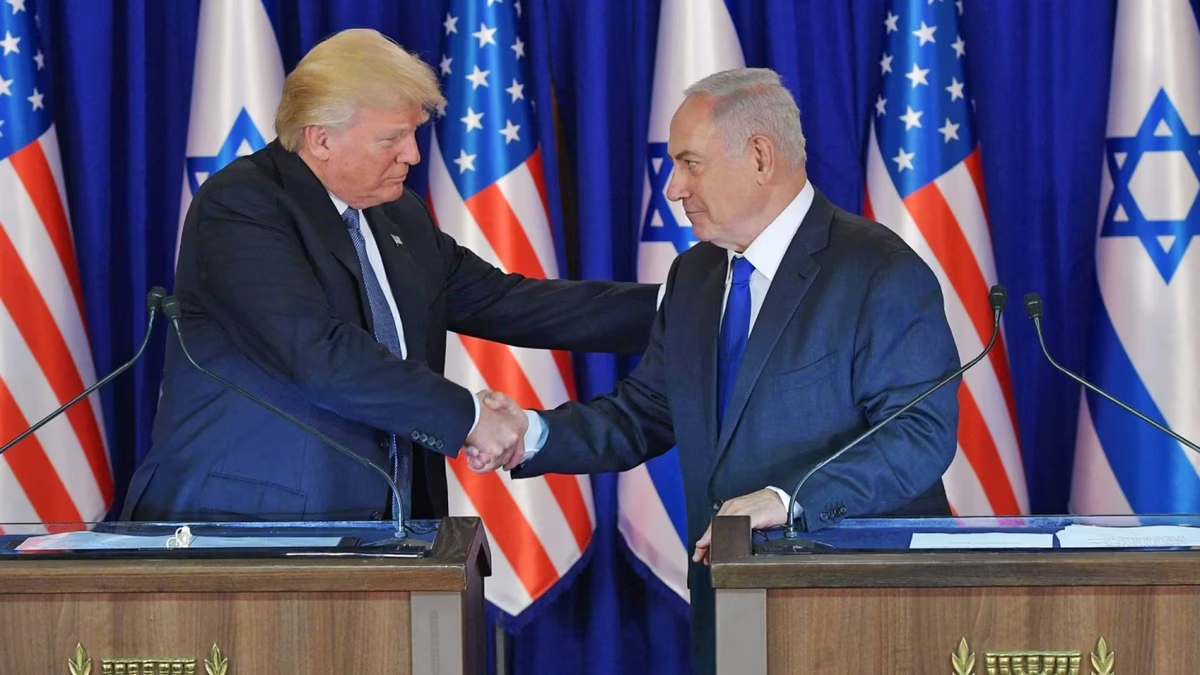
The newspaper affiliated with the occupation reported on Sunday that the political level in the occupation authorities is eagerly anticipating the upcoming meeting scheduled for next Monday in the American city of Miami between President Donald Trump and the occupation's Prime Minister Benjamin Netanyahu.

The meeting aims to make decisive decisions on how to prepare for implementing the second phase of the plan related to rebuilding the Gaza Strip.

The newspaper quoted informed sources that President Trump will present to Netanyahu the American administration's mechanism for pushing this step towards implementation, in addition to a package of related decisions.

Reports indicate that the concern within the occupation circles revolves around linking the 'disarmament of the Hamas movement' with the continuation of the occupation army's withdrawal from the sector's lands, in addition to demands related to uncovering the remaining tunnels and destroying them definitively.

In a related context, Washington, Qatar, Egypt, and Turkey - as mediators in the indirect negotiations - agreed to continue consultations in the coming weeks to accelerate the implementation of the second phase of Trump's plan.

This agreement came after a series of talks that brought together the foreign ministers of these countries with the American envoy to the Middle East, Steve Witkoff, in Miami.

The mediators confirmed in a statement issued after those meetings: 'We emphasize full commitment to all provisions of Trump's peace plan for Gaza, and we call on all parties to fulfill their inevitable obligations to ensure the success of this path.' The field anticipation remains the master of the situation for what the Monday meeting will yield in procedural details that may change the approach to the sector's file.

PALESTINE

Sun 21 Dec 2025 10:53 am - Jerusalem Time

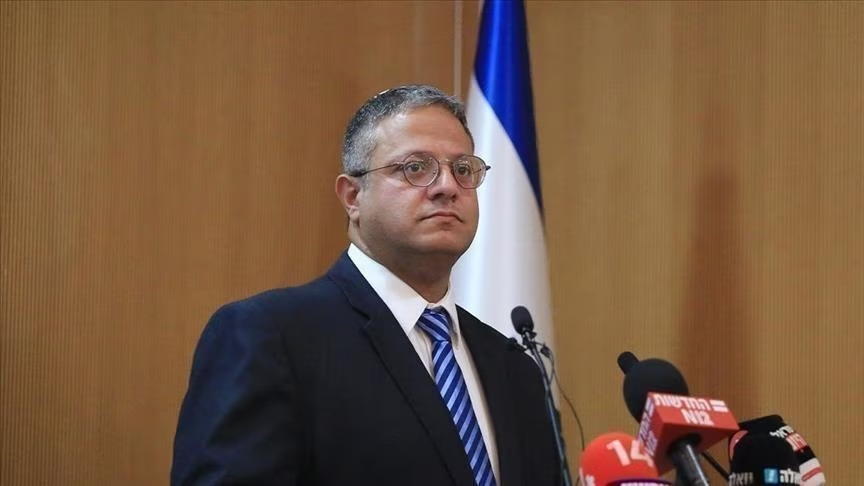
Ben Gvir proposes establishing a detention facility surrounded by crocodiles for Palestinian prisoners

The Hebrew Channel 13 reported on Sunday that Israeli National Security Minister Itamar Ben Gvir proposed establishing a "detention facility surrounded by crocodiles" to detain Palestinian prisoners in it.

The channel added: "In the Israeli Prison Service, they are studying an unusual proposal presented by the National Security Minister, which calls for establishing a detention facility for security prisoners surrounded by crocodiles, in order to prevent escape attempts."

It indicated that the proposed location is near the Haimat Gader area in northern Israel.

According to the channel, Ben Gvir, head of the "Jewish Power" party, presented his proposal during an assessment session he held with Prison Service Commissioner Kobi Yaakovi last week.

The proposed area is located near the occupied Syrian Golan Heights and the border with Jordan, and contains a crocodile farm and a zoo.

This comes at a time when the Knesset (Israeli parliament) intends to vote in the coming days in the second and third readings on a bill proposed by Ben Gvir to execute Palestinian prisoners accused by Israel of planning or participating in attacks against it.

On November 11 last year, the Knesset plenum approved the bill in the first reading, and it must be voted on in the second and third readings to become an enforceable law.

On December 8 this year, Israeli data reported the death of 110 Palestinian prisoners in Israeli prisons since Ben Gvir assumed his duties as National Security Minister at the end of 2022.

Israel holds more than 9,300 Palestinian prisoners, including children and women, who suffer from torture, starvation, and medical neglect, which has led to the death of many of them, according to Palestinian and Israeli human rights reports.

Israel's crimes against Palestinian prisoners have escalated alongside a genocide war it waged on the Gaza Strip for two years since October 2023, resulting in the killing of about 71,000 Palestinians and injuring more than 171,000.

ARAB AND WORLD

Sun 21 Dec 2025 10:44 am - Jerusalem Time

The Israeli Army Escalates Its Violations of Syrian Sovereignty with 42 Incursions in 21 Days

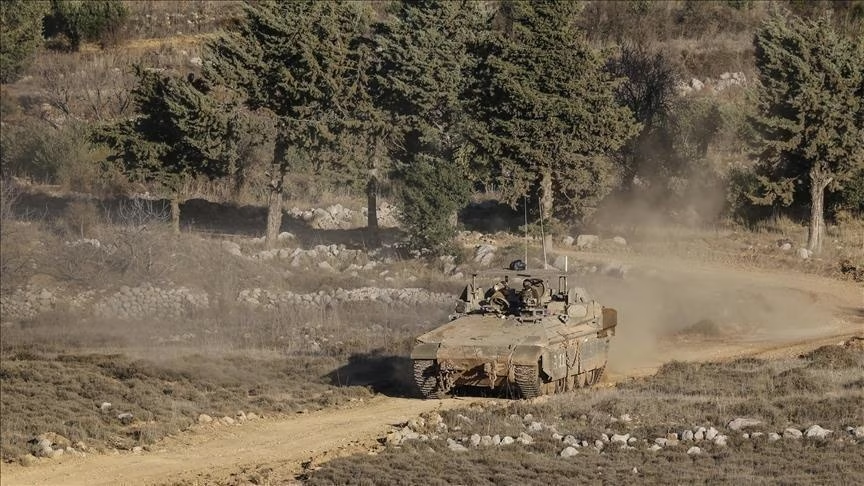
The Israeli army escalated its violations of Syrian sovereignty on Sunday through three ground incursions in Quneitra province and its surroundings (southwest).

Thus, the total number of incursions since the beginning of December of the current year, that is, in 21 days, rises to 42 incursions, some of which involved arrests.

The incursions come within an Israeli strategy to nibble additional areas of land and impose a new geographical and field reality that transcends the historical disengagement lines, according to Syrians.

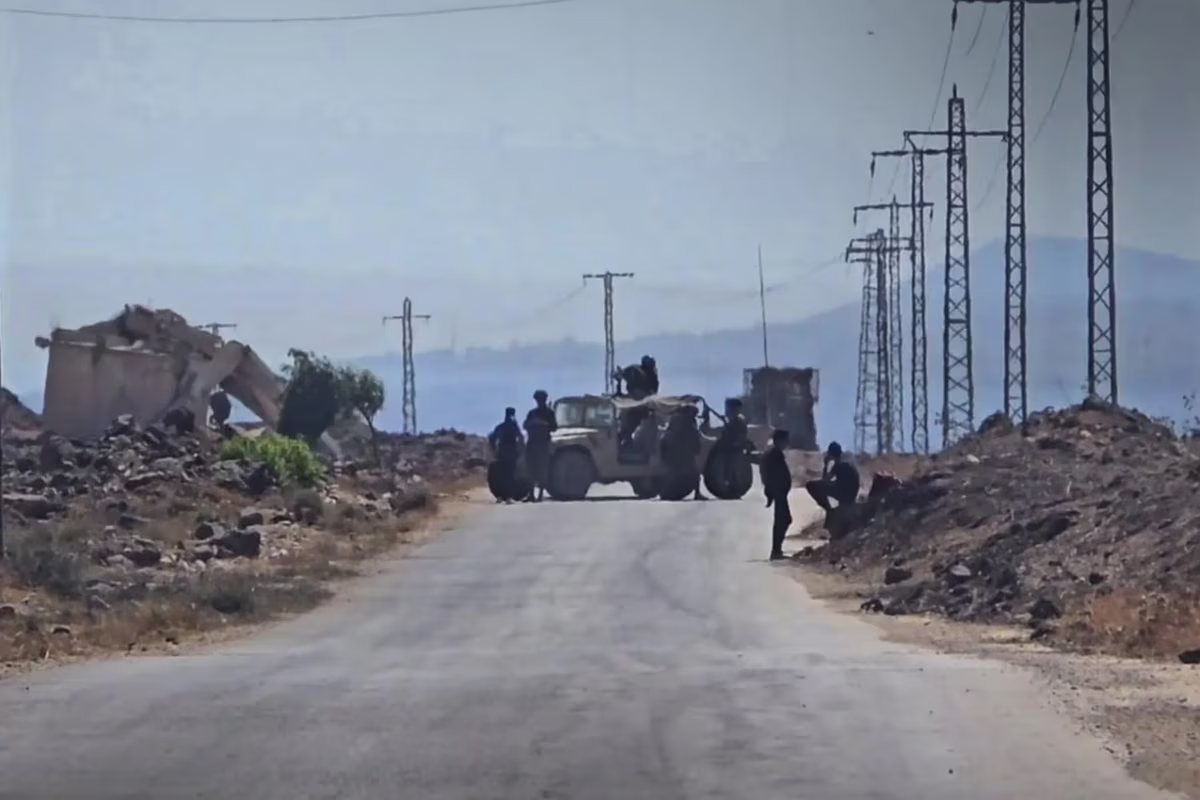
On Sunday, the official Syrian News Agency (SANA) reported that "an occupation patrol, consisting of two military vehicles, intruded from the Al-Adnaniya point in the northern countryside of Quneitra".

It added that it "set up a barrier at the intersection of the village of 'Um al-Azham' which connects it to the villages of Ruwayhinah and Al-Mashayrifah".

Another patrol intruded west of the town of Al-Rafid in the southern countryside of Quneitra, and fired randomly into the air, according to the agency.

The agency continued that a patrol consisting of 5 military vehicles intruded into the village of Sayda Hanout in the southern countryside of Quneitra.

According to a count, based on the "SANA" agency, the Israeli forces committed 42 incursions and land assaults since the beginning of the current December, distributed across 4 main axes.

In the axis of the central countryside of Quneitra, the number of incursions reached 18, and the villages of Bir Ajam, Bariqa, and Kodana topped these assaults.

These villages witnessed repeated incursions of heavy military vehicles, accompanied by digging trenches, building large earthen barriers, and uprooting thousands of fruit and forest trees.

In the axis of the northern countryside of Quneitra, the number of incursions reached 12, and they were concentrated in the areas of Jbata al-Khashab, Tarinjeh, Mazra'at al-Amal, and al-Hamidiyah, and bulldozers destroyed agricultural areas and water wells, and prevented farmers from accessing their lands.

In the axis of the southern countryside of Quneitra, the Israeli army carried out 9 incursions, targeting the villages of Al-Rafid, Al-Asha, Al-Qahtaniyah, and Al-Huriyah, and dug a "dirt road" military, and placed barbed wire.

As for the fourth axis area, although it administratively belongs to the countryside of Damascus governorate, it is located in the northern sector completely adjacent to the borders of Quneitra and falls within the "Golan Front".

3 assaults in this axis affected the slopes of Mount Hermon and the surroundings of the town of Beit Jann, and there were Israeli attempts to establish technical surveillance points in elevated areas overlooking the Syrian depth.

Although the Syrian government does not pose a threat to Tel Aviv, the Israeli army launched air raids that killed civilians and destroyed sites, vehicles, weapons, and ammunition belonging to the Syrian army.

Damascus and Tel Aviv are negotiating to reach a security agreement, and Syria first requires the return of the situation on the map to "what it was before December 8, 2024", when the revolutionary factions overthrew the regime of the deposed President Bashar al-Assad.

On that day, Israel announced the collapse of the 1974 disengagement agreement concluded with Syria, and occupied the Syrian buffer zone, exploiting the security conditions that accompanied the overthrow of al-Assad.

Since 1967, Israel has occupied most of the area of the Syrian Golan Heights.

Syrians say that the continuation of Israeli violations limits their ability to restore stability, and hinders government efforts to attract investments to improve the economic reality.

Israel also occupies Palestine and Lebanese lands, and refuses to withdraw and establish an independent Palestinian state with East Jerusalem as its capital on the borders before the 1967 war.

PALESTINE

Sun 21 Dec 2025 9:52 am - Jerusalem Time

Imposing a New Reality in Gaza: The Occupation Declares the End of 'Purification' Operations East of the Sector

The occupation announces control over 52% of Gaza's area and the "Shabak" rings the bell of "Hamas's return".

In a notable field development after about two and a half months since the ceasefire agreement with the Gaza Strip came into effect, an Israeli security source confirmed that the occupation army forces operating on what is militarily known as the "Yellow Line" have practically ended, on Saturday, December 20, 2025, the "area purification" operations in the area under their full control, declaring the imposition of a new geographical and security reality inside the sector.

In the details reported by Channel 12 Hebrew, the source clarified that the occupation army is very close to completing the disarmament in an area estimated at about 52% of the total area of the Gaza Strip, which is the area it currently controls.

It revealed that six military brigades continued their intensive work over the past months within the range between the "Yellow Line" and the border fence, where they carried out systematic destruction operations that affected dozens of kilometers of infrastructure, whether above or below ground, including tunnel networks belonging to various Palestinian factions.

According to field data, the occupation forces escalated their targeting during this week alone, carrying out attacks on about 90 different targets in the sector as part of what they described as completing the "security space purification" operations, confirming that the mission along the Yellow Line has been completed almost definitively, while keeping the possibility of dealing with any "future additions" to the infrastructure that Tel Aviv describes as "terrorist".

In a related context that reinforces this strategy, the Chief of Staff of the occupation army, Eyal Zamir, stated that the "Yellow Line" currently represents the "new borders" of the entity, considering that the main task of the forces is limited to completely purifying this area and destroying any armed infrastructure in it, sending a firm message by saying: "We will not allow any agent to position itself, neither in Lebanon nor in Syria nor in Gaza".

On the other side of the scene, outside the Israeli control borders, Channel 12 revealed serious concerns and warnings issued by the occupation's General Security Service (Shabak) regarding developments in the areas still under the influence of the "Hamas" movement.

The security discussions held this week showed the Shabak's conviction that the movement has managed to "reconsolidate its rule" in those areas, exceeding the terms of the ceasefire agreement that stipulates its disarmament and non-participation in administration.

The report quoted a Shabak source as saying that "Hamas is showing displays of power we have not seen in years, and is practicing unprecedented cruelty to instill terror among the population," citing recently circulated video clips showing elements of the movement punishing those whom Israel describes as collaborators or violators of the movement's orders.

In the face of this complex reality, the occupation affirmed its adherence to its position rejecting the transition to the second phase of the agreement, or withdrawal from the "Yellow Line," unless its basic condition is met, represented by "disarming Hamas" and completely stripping the Gaza Strip of weapons.

OPINIONS

Sun 21 Dec 2025 9:25 am - Jerusalem Time

Will Trump Force Netanyahu to Move Forward... or Will He Accelerate the Implementation of the Israeli Agenda in Gaza?

Mustafa Ibrahim

Mustafa Ibrahim

Opinion Writer


Israeli media presents the current scene as escalating tension between US President Donald Trump and Prime Minister Benjamin Netanyahu, over the 'day after' in Gaza. However, a deeper reading from a Palestinian perspective reveals that the issue is not about disagreement on the essence, but on the pace and execution. Trump is not working against Israeli goals, but seeks to accelerate their consolidation, before they stumble or face new field and political realities.

Netanyahu, known for his evasion and buying time, enters a more sensitive phase ahead of his upcoming visit to Washington. Trump, unpredictable in his behavior, wants a quick achievement in Gaza presented as a political breakthrough, not out of humanitarian motives, but to preserve his image as a 'peacemaker.' Hence his public insistence that the transition to the second phase of his plan is a settled matter, despite the facts on the ground contradicting that.

Israeli media itself acknowledges that the American plan, which talks about an international stabilization force, reconstruction projects, and transitional arrangements, faces major obstacles. Only a few countries have shown preliminary readiness to participate, and no country is willing to send its forces to areas that Israel insists on describing as 'under Hamas control.' This description is not innocent, but a political tool to disrupt any path that does not guarantee Israel freedom of military action and control over the field.

More importantly, the Israeli establishment, army and security agencies, does not truly believe in the possibility of dismantling 'Hamas' or disarming it peacefully, relying on what is called 'Trump's deterrence force.' Nevertheless, this illusion continues to be marketed because it allows Gaza to remain politically suspended, without a real solution, and without sovereignty.

The tension between Trump and Netanyahu came to light after the assassination of the Hamas leader Ra'id Saad, as revealed by leaks from Nahum Barnea and Barak Ravid. True, Trump does not object to assassinations in principle, but his anger, according to Israeli media, stems from his fear that Netanyahu's government might use measured escalation to deliberately sabotage the path of subsequent phases and fail any political announcement that Trump needs.

In contrast, Israeli estimates indicate that 'Hamas' itself is interested in moving to the next phase, after being convinced that there is no immediate threat to its rule in large parts of the sector. For this reason, it has intensified efforts to close the file of the dead prisoners. Here the question arises: Will Trump force Netanyahu to move forward, or will he continue to give him room for maneuvering?

But the more important Palestinian question is deeper than that. Trump, even when 'pressing,' does not go beyond the Israeli ceiling. He does not seek to end the genocide or lift the siege radically, but to manage its results quickly. What is called the 'day after' is not presented as a liberation project or national rebuilding, but as a management system: a peace council, a stabilization body, a technocratic government.

These names raise serious questions: Who forms the peace council? Who gives it legitimacy? Will the stabilization body be a civilian force or a security arm? And to whom will it be subordinate? As for the technocratic government, it is often used to bypass politics and disable popular representation, not to solve it. A government without sovereignty, without control over land, crossings, and resources, will be nothing but a facade for crisis management.

Then comes the issue of funding and reconstruction: Who will fund it? Under what conditions? Previous experiences indicate that reconstruction may turn into a tool of blackmail, linked to disarmament, security control, and neutralizing any resistance, while Israel remains immune from any accountability for the destruction it caused.

And at the heart of all that stands the security question: disarmament. It is presented as a condition for stability, without any commitment to ending the occupation or guaranteeing the protection of Palestinians. Disarmament without sovereignty means deepening the imbalance of power, turning Gaza into an entity stripped of its ability to defend itself.

No less dangerous is the deliberate ambiguity regarding the Israeli withdrawal. The talk is about redeployment or partial withdrawal, with continued control over the eastern areas, crossings, and air and sea spaces. Withdrawal without sovereignty is not the end of war, but its continuation by other means.

The disagreement between Trump and Netanyahu is not about Gaza's fate, but about how to manage this fate. Trump wants speed and achievement according to his plan, and Netanyahu wants to prolong control and evasion. As for Gaza, it remains hostage to this cold clash, its suffering managed instead of ended, and the price paid from the suffering of Palestinians and their future.

PALESTINE

Sun 21 Dec 2025 8:39 am - Jerusalem Time

The humanitarian situation in Gaza deteriorates amid the severe cold.. and the occupation continues to fire

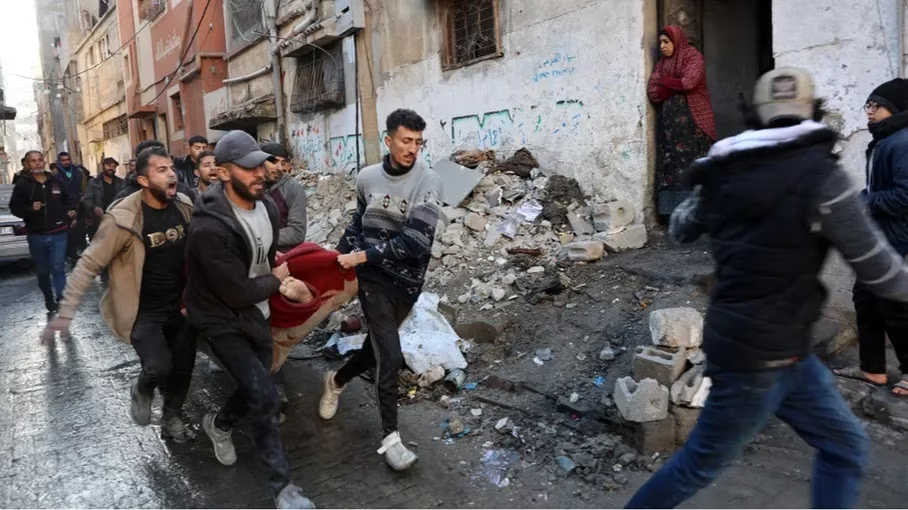
The humanitarian situation in the Gaza Strip is witnessing rapid deterioration amid the severe cold, and amid the continuation of Israeli military operations and the exacerbation of living crises, according to what Islam Badr reported from Gaza City.

On the ground, the firing continues from the occupation army on the areas adjacent to what is called the "yellow line", starting from advanced Israeli military positions inside the sector, where the sound of gunfire is heard repeatedly, alongside bombing carried out by warplanes and extensive demolition operations.

And he confirmed that the war has not practically stopped in those areas, with the continued destruction of residential buildings, alongside intensive flights of Israeli reconnaissance aircraft at low altitude and loud noise throughout the sector, not only in specific areas.

Homes at risk of collapse in Gaza

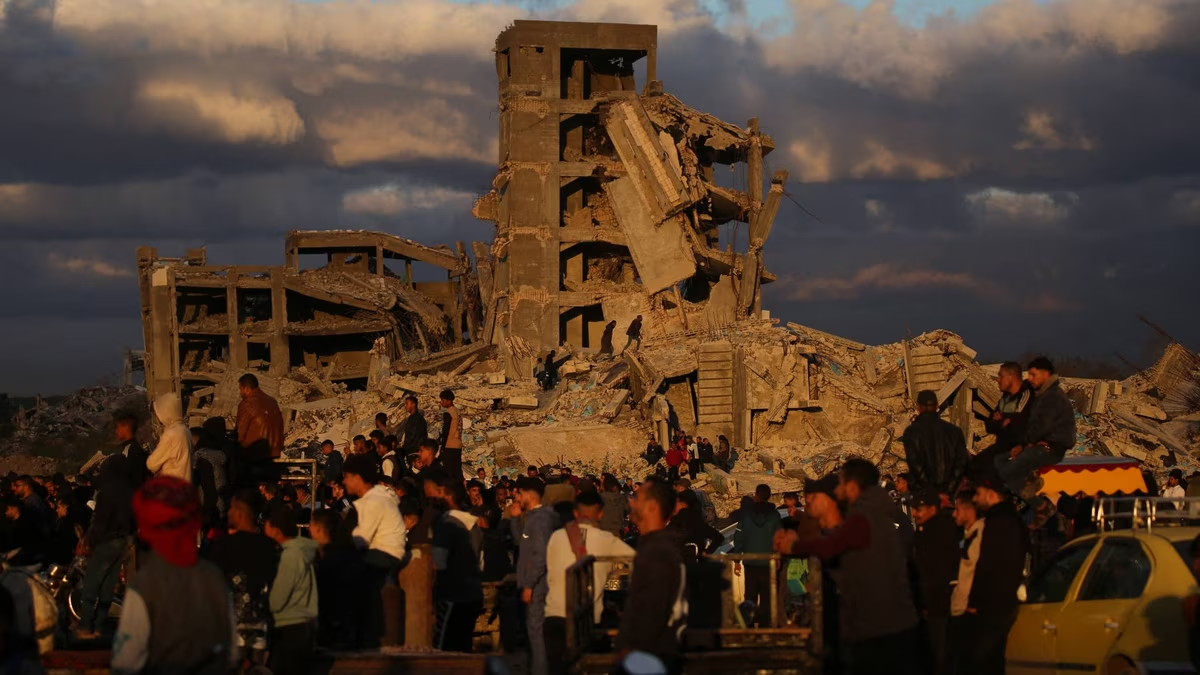
And last night witnessed the collapse of a multi-story residential building for the Labad family in the Sheikh Radwan neighborhood north of Gaza City, in an incident added to a series of collapses that affected other homes in recent weeks, whether due to weather depressions or as a result of their impact from previous Israeli bombing.

And estimates from the civil defense indicate the existence of hundreds of homes classified as at risk of collapse and unfit for habitation, yet Palestinian families still reside in them out of necessity, amid the lack of alternatives, which exposes them to serious risks.

Humanitarianly, the crisis in the Gaza Strip is exacerbating on various levels, amid a new reality imposed by the war and the widespread destruction it left behind, in addition to the strict Israeli restrictions on the entry of humanitarian aid.

And he explained that Israel only allows the entry of a small portion of what the sector actually needs, where what enters does not exceed a quarter of the basic needs, including food, medicine, clothing, and medical supplies.

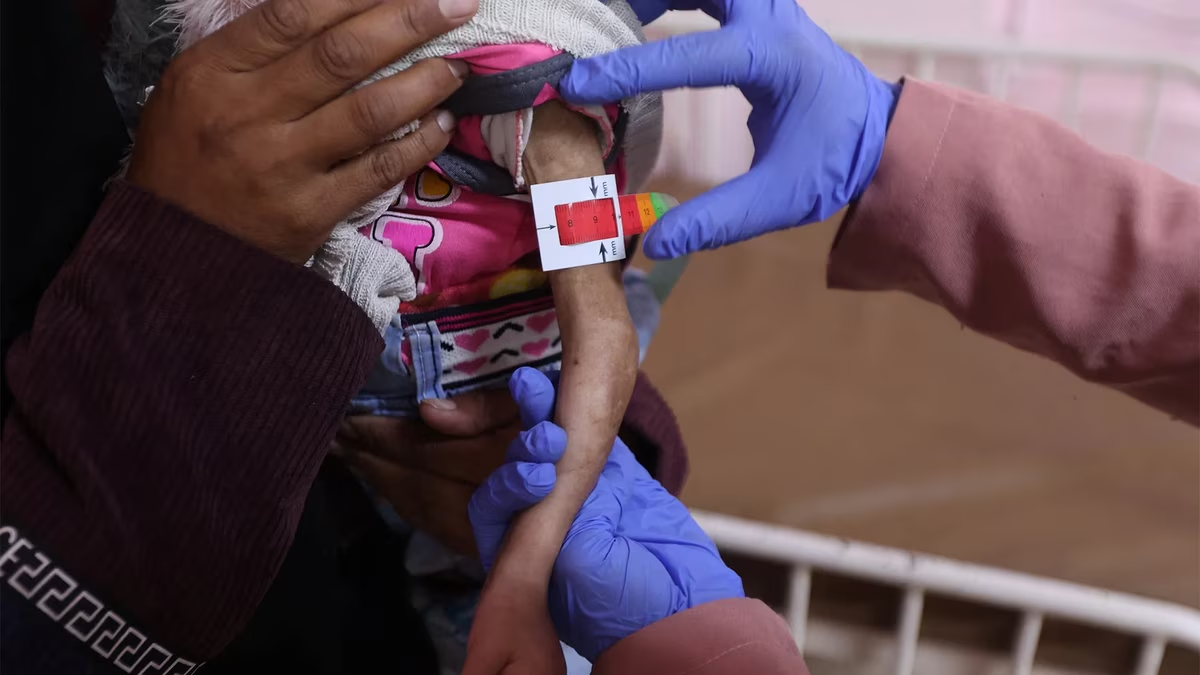
According to the United Nations, the famine classification in Gaza has decreased from level five to four, but the difference remains limited, as the sector is still on the brink of famine, amid a severe shortage of basic materials.

And the data indicates the near absence or complete absence of building materials, reconstruction supplies, communication networks, energy, and fuel, at a time when Israel imposes a long list of materials classified under the "dual-use" category, and prevents their entry on the pretext of their possible use in resistance activities.

Israel also restricts the entry of additional materials except under exceptional conditions and high-cost arrangements, such as solar panels, batteries, and even car tires, which leads to a significant increase in their prices and doubles the living burdens on the residents, contributing to deepening the humanitarian crisis to levels that are difficult to contain.

Await what the international meetings and communications may bring

Politically, the residents of the Gaza Strip await what the coming days may bring, amid the recent international meetings and communications, and the upcoming meeting between Israeli Prime Minister Benjamin Netanyahu and US President Donald Trump.

And attention is directed towards the "second phase" of the ceasefire agreement, on which many Palestinians pin their hopes, not only to stop the war, but to open horizons for returning to their homes.

And the number of Palestinians who have not been able to return to their homes is estimated at about one million people, due to their areas being behind the yellow line, including entire cities and neighborhoods such as Rafah and Beit Hanoun, and large parts of Bani Suhaila and Absan, in addition to large areas

PALESTINE

Sat 20 Dec 2025 7:54 pm - Jerusalem Time

Khalil al-Hayya meets Turkish intelligence chief to discuss second phase of Gaza agreement

The head of Hamas in the Gaza Strip and its chief negotiator, Khalil al-Hayya, met today, Saturday, with the head of Turkish intelligence, Ibrahim Kalin, and discussed the necessary measures to move to the second phase of the ceasefire agreement in the sector.

Turkish security sources stated that Kalin met with the Hamas delegation in Istanbul as part of the ceasefire agreement in Gaza, and that the two sides discussed the necessary steps to prevent what they described as Israeli violations of the ceasefire.

The sources added, without going into details, that they also discussed the necessary measures to resolve outstanding issues in preparation for moving to the second phase of the plan.

The Hamas delegation affirmed during the meeting with the head of Turkish intelligence its commitment to the rules of the ceasefire, and provided information regarding the violations committed by the Israeli side.

The meeting focused on the intensive efforts made by Turkey, as a guarantor state, to implement the ceasefire in Gaza. The steps that can be taken to prevent Israeli violations were also evaluated.

The two sides consulted on preparing the necessary conditions to move to the second phase of the peace plan in Gaza, and the necessary measures to address existing problems.

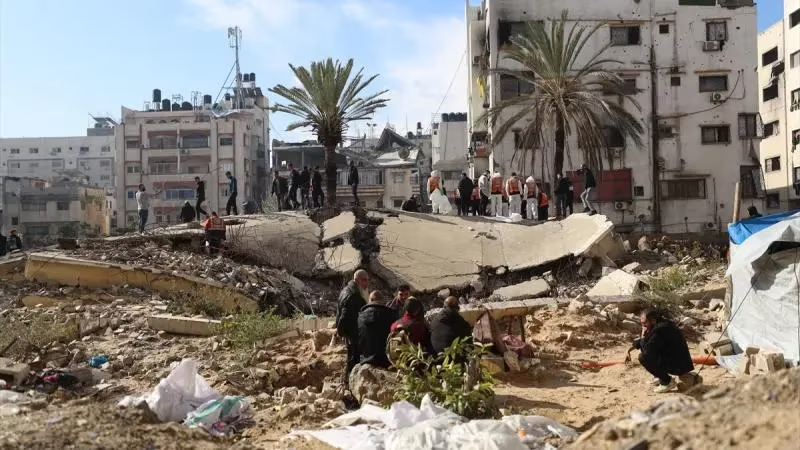
On the ground, the Civil Defense Department in the Gaza Strip announced on Saturday the recovery of the bodies of 94 Palestinians who were buried haphazardly in one of the streets of Gaza City during the Israeli genocide war, in preparation for transferring them to official cemeteries.

During two years of the Israeli genocide war, thousands of Palestinians were forced to bury their relatives in temporary and mass graves, and in school yards, hospitals, and streets, due to the impossibility of reaching official cemeteries under the intense Israeli bombardment.

The Civil Defense said in a statement that its crews, in cooperation with the families, "transferred the bodies of 94 martyrs who had been buried during the war in a random cemetery on al-Sahaba Street in the center of Gaza City".

The statement clarified that the bodies were handed over to the forensic medicine department at al-Shifa Medical Complex to take the necessary measures, in preparation for burying them in the Martyrs' Cemetery in Deir al-Balah city in the center of the sector.

The Civil Defense indicated that in cooperation with the Ministries of Health and Endowments, it has completed during the past period the transfer of the bodies of thousands of killed people who were buried in random places as a result of war conditions, noting that part of the bodies have unidentified owners.

Civil Defense members have been working since the beginning of the genocide war in a highly dangerous health environment, due to the spread of bodies in open places and the sector's lack of protective equipment and biological testing tools.

The Israeli restrictions and the prevention of entry of basic medical supplies have complicated the crews' tasks, making them susceptible to diseases and infections during the recovery and transfer of bodies operations.

On October 10 of the current month, an agreement for a ceasefire in Gaza and prisoner exchange between Hamas and Israel came into effect, according to the plan of US President Donald Trump.

The agreement ended the genocide war committed by Israel with American support in Gaza, which resulted in about 71,000 Palestinian martyrs and 171,000 injured, most of them children and women, in addition to massive destruction, with the cost of rebuilding the sector estimated at about 70 billion dollars, according to the United Nations.

Nevertheless, the Israeli occupation army continues to violate the ceasefire agreement in the Gaza Strip, with the resumption of gunfire and artillery shelling.

Areas east of Gaza City are witnessing building demolition operations, continuous artillery shelling, and gunfire from occupation helicopters.

In the center of the sector, occupation vehicles continue their artillery shelling east of al-Maghazi camp.

East of Khan Yunis and Rafah city in the south of the sector are also subjected to continuous gunfire from occupation vehicles and artillery shelling.

It is noteworthy that 6 Palestinians were martyred yesterday evening, Friday, after artillery shelling by the Israeli occupation on a training center affiliated with the Ministry of Education that shelters displaced families in al-Tuffah neighborhood east of Gaza City.

ARAB AND WORLD

Sat 20 Dec 2025 10:04 am - Jerusalem Time

New Israeli incursion into the countryside of Quneitra and establishment of a military checkpoint

A patrol belonging to the Israeli occupation army infiltrated today, Saturday, into the village of Ain Ziwan in the countryside of Quneitra governorate in southern Syria, where the infiltrating forces proceeded to establish a military checkpoint to inspect passersby.

The Israeli army renewed its violation of Syrian sovereignty through this incursion, noting that the occupation army used 5 military vehicles to install the inspection checkpoint in the village.

This development comes one day after Israeli forces infiltrated towards the towns of Al-Asha, Bir Ajam, Briqa, Um Al-Othaim, and Ruweihina in the southern countryside of Quneitra.

Yesterday, Friday, the city of Salam in Quneitra governorate witnessed a protest stand where dozens of Syrians participated, condemning the ongoing Israeli aggressions against citizens and their property.

The participants in the stand - organized by "Syrians with Palestine" in cooperation with the governorate's sons - raised banners affirming popular rejection of the occupation's repeated violations of Syrian lands.

The occupation forces have been carrying out semi-daily incursions in southern Syria, specifically in Quneitra governorate, interspersed with arrests, setting up barriers, and land leveling, which has sparked a rising wave of popular anger.

Despite the decline in direct military threats, the Israeli army continues to launch air raids that result in civilian casualties and the destruction of sites and facilities belonging to the Syrian army.

It is worth noting that Israel had announced following the fall of Bashar al-Assad's regime on December 8, 2024, the collapse of the "disengagement agreement" concluded in 1974, and began occupying the buffer zone and infiltrating deep into Syrian territories.

Syrians see that the continuation of these violations hinders efforts to restore stability in the region and undermines initiatives aimed at improving the economic reality in southern Syria.

OPINIONS

Sat 20 Dec 2025 10:03 am - Jerusalem Time

Disarmament Without Settlement: An Open Recipe for Sustaining the War in Gaza

Mustafa Ibrahim

Mustafa Ibrahim

Opinion Writer

The political and security indicators coming from Doha, particularly the meeting held by the US Central Command regarding the “international force” in Gaza, converge on one conclusion: no real breakthrough, no practical answers, and no international consensus that can be built upon. According to media reports, the meeting was not decisive or fruitful compared to the expectations of the US administration, and the abstention of several countries from participating constituted a clear signal of the fragility of the idea itself and the depth of the international division regarding it.


From the Israeli perspective, these indicators appear overwhelmingly negative. Israel insists on reducing the role of any potential international force to a single issue: disarming Gaza. However, at the same time, it does not hide its lack of confidence in these forces and practically declares that it is the only entity capable – or authorized – to carry out this task, even if the price is returning to war or imposing a long-term attrition plan. The direct result of this approach is the consolidation of the status quo in Gaza: no actual cessation of the war, no reconstruction, and no political horizon.


In this context, it becomes clear that disarmament outside the framework of a comprehensive political settlement, in which “Hamas” is a key party, is nothing but an empty slogan. Experience, as well as field realities, proves that any purely security approach, detached from a realistic political solution, is doomed to failure. And if Israel's and “Hamas's” positions do not change, and mediations fail to produce sustainable solutions, the final decision will remain in the hands of the US administration, which will sooner or later be forced to deal with this complex dilemma, not just manage it.


Within this scene, the Israeli government continues to evade forward through a policy of assassinations. The assassination of the Hamas leader Raed Saad, whom Israel describes as one of the planners of the October 7 attack and responsible for rehabilitating the movement's military wing, was met with widespread welcome in Israel. However, this celebration conceals Israel's true intentions: non-commitment to the agreement and evasion of any serious political path.


Even Israeli military analysts acknowledge that Saad's death does not constitute a decisive blow to “Hamas.” Despite losing a large part of its senior leadership and suffering heavy losses, the movement remains the only party capable of imposing itself in Gaza. As one of them wrote: “There is no one in Gaza who challenges Hamas, which has quickly returned, frustratingly, to be the undisputed master of the house,” at a time when the United States has failed to formulate a multinational force capable of assuming security responsibility or enforcing a disarmament path.


According to Israeli analysts, concern is rising in Israel with the emergence of the “Eight Countries Alliance,” which includes five Arab countries (Saudi Arabia, Egypt, Jordan, the UAE, Qatar) and three Islamic countries (Turkey, Pakistan, Indonesia). This alliance is considered a new phenomenon in regional political arrangements, as it links geographically non-adjacent countries with diverse political orientations and interests.


The roots of this alliance go back to the Arab-Islamic summit in Riyadh in November 2023, an exceptional step aimed at demonstrating a unified position on the war in Gaza, which worries Israel and prompts it to work diligently to dismantle it.


In the same context, the disagreement between Tel Aviv and Washington over Turkey's role deepens. While US officials believe that Ankara should be part of the stabilization force, given its military capabilities and influence channels in Gaza, Israel considers that a red line. From its perspective, a party that maintains relations with “Hamas” cannot be classified as a stabilization force; rather, its inclusion could undermine the very essence of the declared goal of the international force.


This disagreement reflects a broader crisis in vision: the United States is seeking crisis management, while Israel insists on perpetuating it under the banner of “security.”


According to Israeli analysts, it seems that US President Donald Trump's patience is beginning to run out. Netanyahu's upcoming visit comes within a political hourglass aimed at preparing the ground for a decisive meeting between them. Washington wants to verify whether Netanyahu is ready to move to the next phase of the US plan and what the limits of his flexibility are on the Gaza file and the international force.


From Israel's perspective, this moment represents a test of how to say “yes” to a political path without conceding, even symbolically, to the “red lines” of security. From the United States' perspective, the question is simpler and more dangerous: Is Netanyahu a reliable partner, or a leader who prefers to keep the arenas ablaze?


It is no longer possible to describe what is happening in Gaza as a failure in mediation or American inability to exert pressure. The accumulating data clearly indicates that the United States is not incapable of pressuring Israel, but chooses not to do so. Washington, which possesses unprecedented political, military, and financial leverage tools, continues to grant Tel Aviv an open margin to sabotage any serious political path, under security pretexts that have become exposed.


Israel, for its part, systematically works to obstruct everything that could end the war. It empties the idea of the international force of its content, reduces it to the disarmament issue, then doubts its usefulness and insists on monopolizing its implementation by force, even if that leads to new rounds of fighting or a long-term attrition war. Thus, every political initiative turns into a tool for managing the war, not ending it.


The US administration also provides political cover for this behavior by continuing to talk about “calm planning” and “permanent peace,” while allowing Israel to set new conditions, delay the transition to the second phase, and link any withdrawal to open-ended temporal criteria related to disarmament. More dangerously, the US administration knows that disarming “Hamas” outside a comprehensive political settlement is an unrealistic demand, but continues to present it as a prerequisite, giving Israel the perfect pretext to perpetuate occupation and war.


Therefore, sustaining the war in Gaza is not the result of miscalculation, but the product of a complete political partnership: Israel refuses to end the war, and the United States refrains from imposing that on it. Between this refusal and that abstention, Gaza is left hostage to killing, starvation, and destruction, while the discourse of “stability” is recycled to justify the continuation of the crime.


The Israeli government is not ready to advance in any serious political path, nor to formulate the day after or launch a real reconstruction process in Gaza. What is happening is not a pursuit of stability, but a conscious management of an open-ended war in various forms, for which Israel and the US administration bear direct responsibility.

ARAB AND WORLD

Sat 20 Dec 2025 9:56 am - Jerusalem Time

Emirati Humanitarian Institutions Collaborate in Preparing the Cargo of the Ship 'Mohammed Bin Rashid' Heading to Gaza

In response to the directives of the Emirati President, Sheikh Mohammed bin Zayed Al Nahyan, the UAE announced the launch of the humanitarian ship "Mohammed Bin Rashid " from Khalifa Port, and these steps come within the framework of Operation "The Brave Knight 3", as part of the ongoing humanitarian efforts exerted by the UAE to support the brothers in the Gaza Strip, and embodying its established approach in extending a helping hand and relief during humanitarian crises.

Various Reliefs 

The ship carries on board various humanitarian and relief aids, with a total cargo exceeding 7,300 tons, distributed as 65% food items, 27% winter clothing, tents, and shelter supplies, in addition to 8% nutritional supplements dedicated to children and women, in response to the urgent humanitarian needs in the Gaza Strip.

This step is part of the initiative of the Mohammed Bin Rashid Al Maktoum Global Initiatives Foundation, which contributed to preparing 10 million food meals for the people of the sector, within the framework of the Emirati humanitarian work aimed at enhancing food security and meeting the basic needs of the most affected groups.

Collaboration of Humanitarian Institutions

A number of charitable and humanitarian institutions in the UAE contributed to preparing the ship's cargo, in a manner that reflects the integration of national efforts and the cohesion of humanitarian work institutions, where each of the Mohammed Bin Rashid Al Maktoum Initiatives Foundation, the UAE Red Crescent Authority, the Khalifa Bin Zayed Al Nahyan Foundation for Humanitarian Works, the Zayed Foundation for Charitable and Humanitarian Works, the Mohammed Bin Rashid Al Maktoum Foundation for Charitable and Humanitarian Works, Dar Al Ber Association, the Union Charitable Foundation, Sharjah Charitable Association, Dubai Charitable Association, the Global Charitable Works Authority, and the Ihsaan Charitable Association participated.

Through Operation "The Brave Knight 3", the UAE affirms its steadfast humanitarian commitment to stand by the brotherly Palestinian people, and support the relief efforts aimed at alleviating the suffering of civilians in the Gaza Strip, in cooperation with various humanitarian partners, and in accordance with the highest humanitarian and regulatory standards.

ARAB AND WORLD

Sat 20 Dec 2025 9:54 am - Jerusalem Time

Washington Presses Quietly: Dual American Messages to Israel on Settler Violence, Gaza, and Disarming Hamas

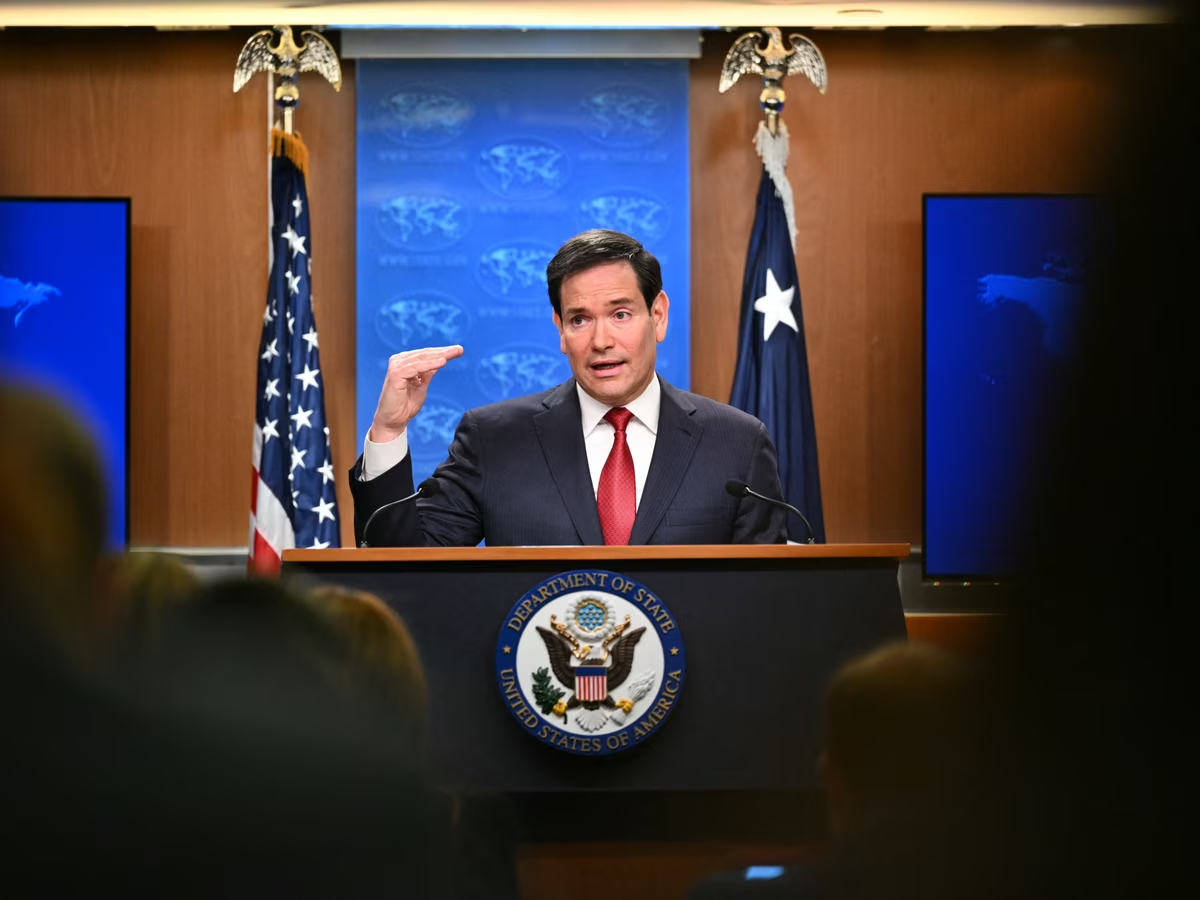
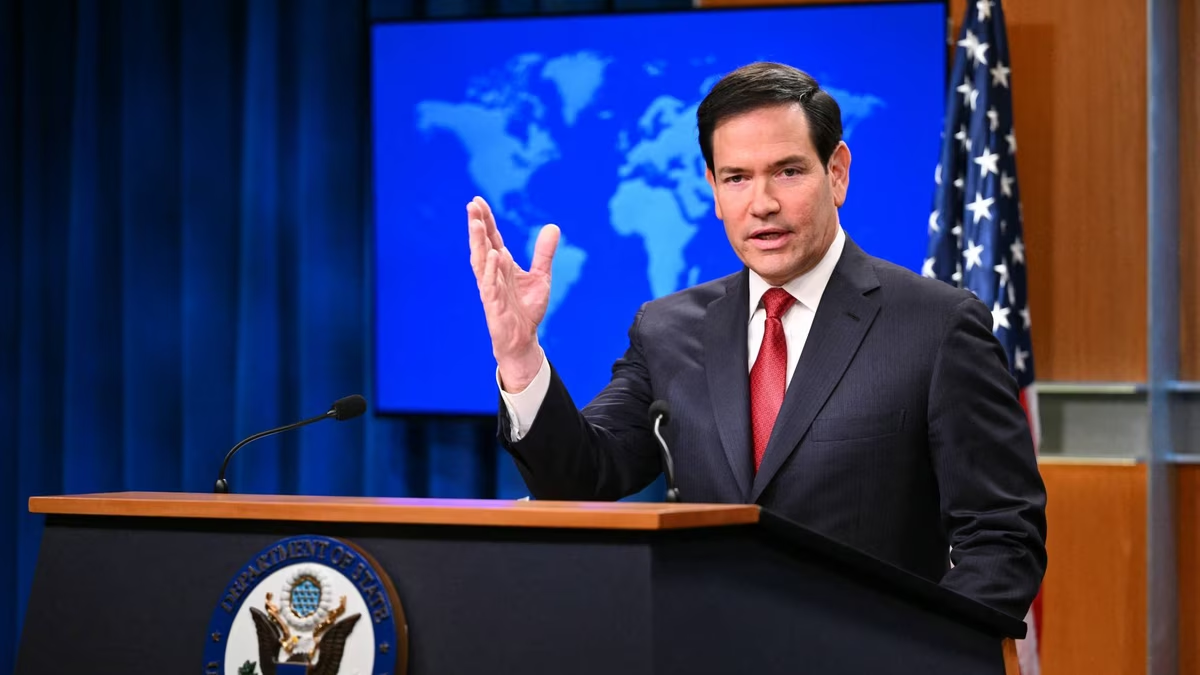
US Secretary of State Marco Rubio's statements during a press conference at the State Department reflect a cautious but multi-faceted American approach toward Israel and the intertwined regional issues, from settler violence in the West Bank, to the humanitarian catastrophe in Gaza, and the file of disarming Hamas and tensions on the Lebanese front.


Without explicitly naming the phenomenon, Rubio acknowledged that Washington is exerting special pressure on Israel regarding the escalation of settler violence against Palestinians in the West Bank, which has become, according to previous American descriptions, almost unchecked by accountability. He pointed out that the US Embassy has issued public statements about specific incidents that 'raise concern' and constitute a 'point of severe friction' in the broader efforts to achieve stability. He also recalled that the US Ambassador to Israel, Mike Huckabee, recently addressed this issue 'in a firm tone,' indirectly referring to his description of this violence as 'terrorism.'


Rubio's language here reveals a familiar American paradox: acknowledgment of the problem, measured criticism, but without moving to overt coercive actions or directly linking the continuation of violence to tangible political repercussions on the bilateral relationship. The Secretary emphasized that Washington 'will continue to convey its position' regarding the impact of this violence on the 'broader challenges,' suggesting that the issue is managed through closed diplomatic channels, avoiding direct confrontation with the Israeli government.


In parallel, Rubio addressed the ongoing humanitarian crisis in Gaza, affirming the US administration's desire to increase the volume of aid allowed into the sector. He spoke of efforts to activate what he called a 'Peace Council,' alongside post-war mechanisms, in an attempt to show that Washington is not only thinking about managing the war but also the day after it. However, these statements remain general and do not address the political and security obstacles that Israel places in front of the flow of aid or any actual arrangement for managing Gaza in the future.


As for the Hamas file, Rubio did not implicitly rule out a scenario of 'selective' disarmament, distinguishing between heavy and light weapons, a proposal that has been circulating in diplomatic backchannels for months. Despite refusing to delve into negotiation details, he stressed that any disarmament formula must prevent Hamas from possessing capabilities that enable it to threaten Israel. He directly linked disarmament to the possibility of achieving peace and attracting investments for Gaza's reconstruction, arguing that the absence of this condition will keep the specter of war present in the coming years.


Rubio confirmed that any potential agreement must have Israel's approval and be imposed on Hamas through pressure from 'partners,' referring to regional and international parties. This position reflects American insistence on prioritizing Israeli security, even when discussing solutions that are supposed to be political or transitional.


On the Lebanese front, Rubio expressed cautious optimism regarding direct talks between Israel and Lebanon, expressing hope that they lead to a path that prevents sliding into a new confrontation. But he acknowledged at the same time that Israel reserves the right to continue military operations against Hezbollah if it feels threatened. The solution, from his perspective, lies in a 'strong Lebanese state' capable of asserting its sovereignty and stripping Hezbollah of its 'armed threat' status, whether for Israel or for the Lebanese state itself.


Rubio's statements reveal an American policy based on managing crises rather than resolving them, and on sending contradictory messages to the parties: measured criticism of Israel on one hand, and constant affirmation of the centrality of its security on the other. The pressure on settler violence remains verbal, while any solutions in Gaza or Lebanon are tied to strict Israeli security conditions. This approach may temporarily alleviate tensions, but it fails to address the roots of the conflict, leaving Washington captive to an old equation: fragile stability, without political justice, and without a real horizon for a sustainable settlement.

PALESTINE

Sat 20 Dec 2025 9:51 am - Jerusalem Time

Injury of Palestinians and Arrest of 3 Others in the West Bank

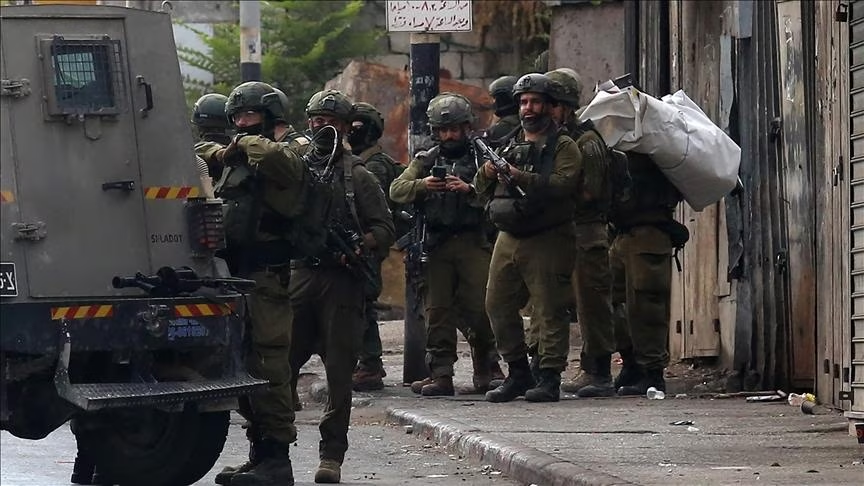
On Saturday, the Israeli army injured two Palestinians with gunfire and beatings, and arrested 3 others, in a campaign of raids that covered various areas of the occupied West Bank.

The Palestinian Red Crescent Society stated in a statement that its crews "dealt with a serious injury to a young man shot in the head, in the town of Qarawa Bani Zeid northwest of Ramallah in the center of the West Bank, and he was transferred to the hospital".

In the town of Al-Zawiya west of Salfit (north), Israeli forces conducted house raids, accompanied by operations to smash their contents, and arrested one of the young men and assaulted another with beatings.

Local sources indicated that those forces "assaulted the citizen Iyad Abdul Halim with beatings, and he was subsequently transferred to the Al-Zawiya Specialized Center for treatment".

The Israeli army also arrested the young man Muhammad Shaqir, son of the mayor of Al-Zawiya, after raiding his family's home, according to the same sources.

In the south of the West Bank, the Israeli army raided the town of Al-Karmel south of Hebron, and arrested the released prisoner Montaser Abu Aram, after raiding and searching his home, according to local sources.

The army also raided the town of Dura southwest of Hebron, and arrested the young man Muadh Ibrahim Nassar, after raiding and searching his home and tampering with its contents, according to eyewitnesses.

Israeli forces usually raid cities and towns in the West Bank, and arrest citizens on the pretext that they are wanted for security reasons.

Since the start of the genocide war on the Gaza Strip that lasted two years, the Israeli army and settlers in the West Bank have killed more than 1100 Palestinians, injured about 11,000, in addition to arresting more than 21,000.

Meanwhile, the Israeli genocide war in Gaza has left more than 70,000 Palestinian dead and 171,000 injured, mostly children and women, along with massive destruction with a reconstruction cost estimated by the United Nations at about 70 billion dollars.

PALESTINE

Sat 20 Dec 2025 9:45 am - Jerusalem Time

Collapse of two damaged buildings due to previous bombing in Gaza

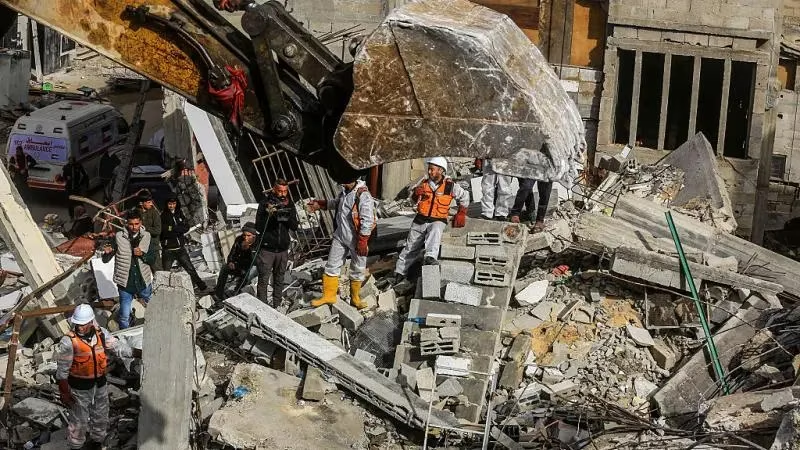
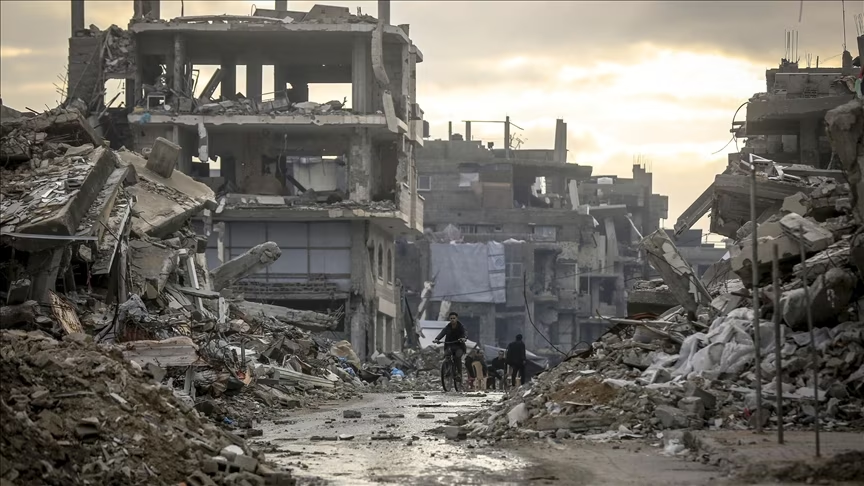
Two buildings damaged by previous Israeli bombing in Gaza City, northern Gaza Strip, collapsed early Saturday morning due to the effects of the recent low-pressure system accompanied by heavy rains.

The Gaza Civil Defense announced that its crews managed to evacuate residents of the "Return 6" tower, consisting of 7 floors in the Tel al-Hawa area southwest of Gaza City, after cracks and collapse occurred in the last four floors.

The statement indicated that no injuries were recorded due to the incident.

On the other hand, local sources and eyewitnesses reported the collapse of a building belonging to the Mughni family in al-Nasr neighborhood in Gaza City, without any deaths or injuries.

The sources added that the building had been previously evacuated and damaged by Israeli bombing during the years of the genocide.

Recently, the Gaza Strip has witnessed incidents of collapse of several homes and residential buildings previously damaged by Israeli bombing, due to the impact of heavy rains and winds, leading to the death and injury of a number of Palestinians, according to government sources.

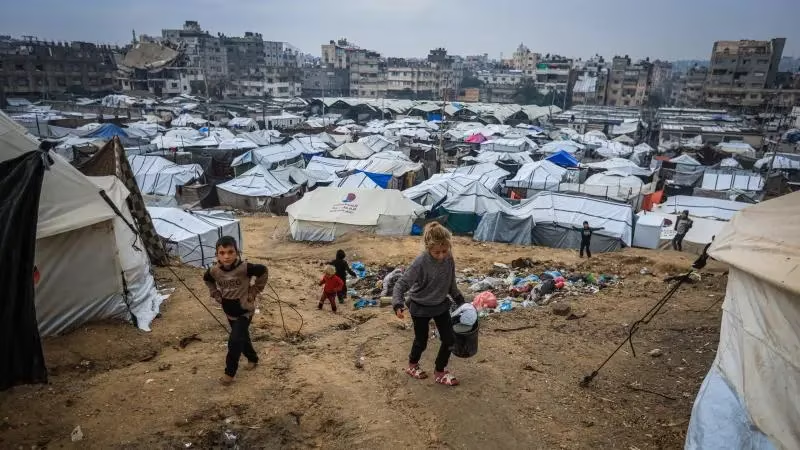
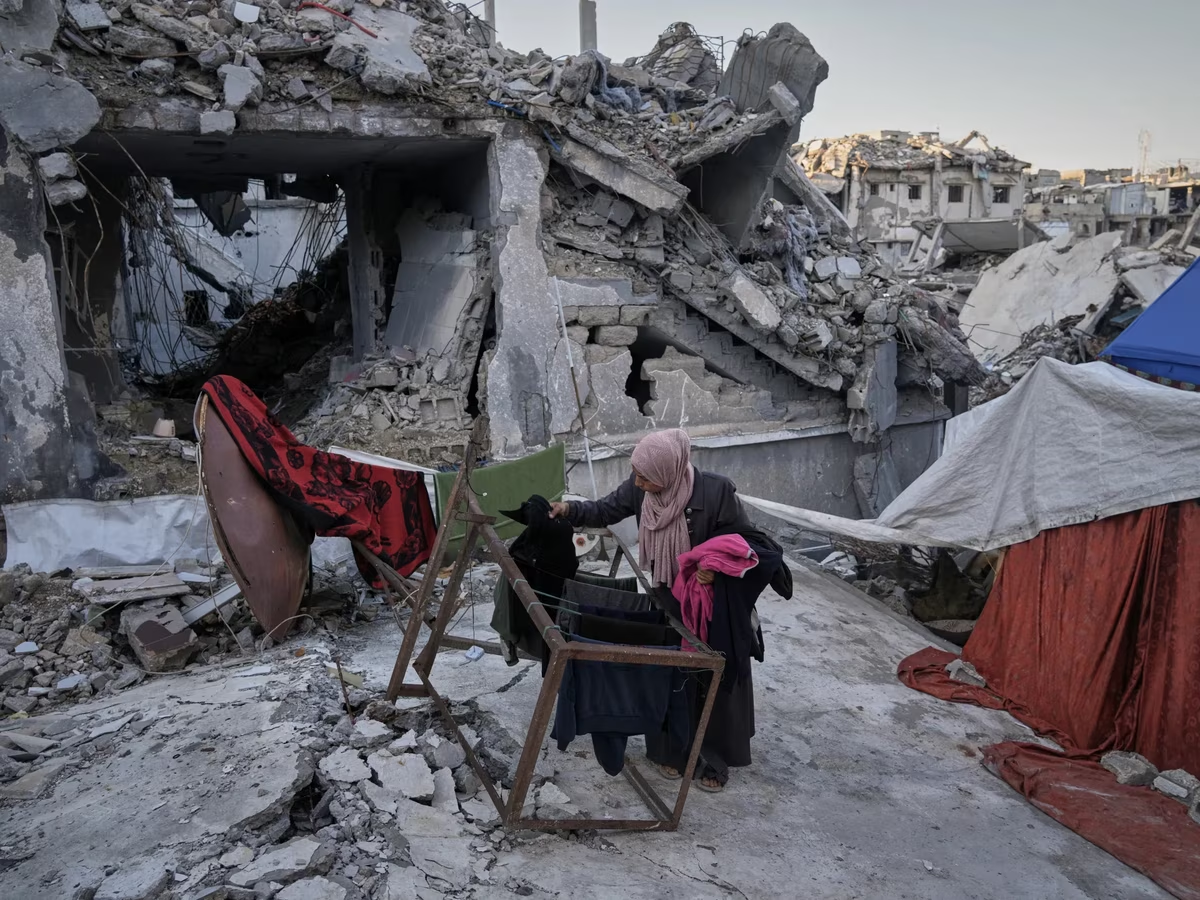
Palestinians are forced to reside in cracked and dilapidated buildings due to the lack of options amid Israel's destruction of most buildings in the sector, and its prevention of importing mobile homes and construction materials and reconstruction, despite more than two months having passed since the ceasefire agreement in effect since October 10 last year.

The low-pressure systems that struck the sector caused thousands of tents inhabited by displaced people to flood and fly away, greatly exacerbating their suffering.

Since the beginning of December this year, the repercussions of the low-pressure systems that struck the Gaza Strip have resulted in the death of 17 Palestinians, including 4 children, and the collapse of 17 homes and the flooding of about 90% of the shelters for displaced people whose homes were destroyed by Israel, according to a Wednesday statement from Civil Defense.

Israel shirks its commitments stipulated in the agreement, including opening the crossings and allowing the entry of 300,000 tents and mobile homes to secure the basic level of housing after the massive destruction left by the genocide, which affected 90% of the civilian infrastructure.

The agreement ended a genocide started by Israel on October 8, 2023, lasting two years, leaving more than 70,000 Palestinian deaths and over 171,000 injured, with reconstruction costs estimated by the United Nations at about 70 billion dollars.

PALESTINE

Sat 20 Dec 2025 8:58 am - Jerusalem Time

Intensive communications to push the Gaza agreement to the second phase.. What are the alternative options?

Diplomatic communications are intensifying in an attempt to push the Gaza agreement to a new phase, with increasing focus on transitioning to the second phase of the ceasefire, amid efforts led by the United States with the participation of active regional parties.

While the city of Miami hosted a meeting between US President’s envoy Steve Witkoff and Qatari Prime Minister and Foreign Minister Sheikh Mohammed bin Abdulrahman Al Thani, and Turkish Foreign Minister Hakan Fidan and Egyptian Foreign Minister Badr Abdel Ati, US Secretary of State Marco Rubio announced that the war in Gaza has ended, and that work is underway to transition to the second phase of the agreement, noting that the current situation in the sector is unsustainable.

Rubio revealed that the United States is working on creating a new governance structure for Gaza, based on an international council and a Palestinian body of technocrats, followed by the deployment of an international force to achieve stability, in an effort to consolidate the fragile ceasefire.

He explained that progress has been made in identifying the names of Palestinians who will join the technocrats group, and that Washington aims to form governance bodies soon, without providing a specific timeline.

For its part, the Islamic Resistance Movement "Hamas" has clearly set its conditions, where it quoted the movement's leader Bassem Naim as saying that the Miami talks must put an end to Israeli violations, and obligate the occupation to the requirements of the Sharm el-Sheikh agreement, emphasizing that the Palestinian people are waiting for practical steps, not statements.

As for the Israeli side, it reported that the occupation government held a meeting on Thursday evening led by Israeli Prime Minister Benjamin Netanyahu to discuss scenarios for the next phase of the agreement to end the war on Gaza, without reaching clear decisions.

It indicated that all battlefields in Gaza and Lebanon remain in a state of stagnation until the date of Netanyahu's meeting with US President Donald Trump scheduled for the 29th of this month in Florida, to determine the shape of the next phase.

It quoted the broadcasting authority that the meeting held by Netanyahu on Thursday evening discussed several scenarios, including: the possibility of Washington reducing its intervention in the Gaza Strip, or the involvement of forces through private companies and private entities on the ground, and a scenario in which Israel disarms the "Hamas" movement by force, even if it ultimately leads to the formation of an Israeli military government in the sector.

According to reports, Tel Aviv realizes that the next phase of the Gaza agreement will include fulfilling the commitments related to the second phase, opening the Rafah crossing in both directions, allowing reconstruction, and a greater withdrawal of occupation forces, which the occupation government has so far evaded, claiming that it is still waiting for the body of the last prisoner from inside the Gaza Strip.

From the United Nations headquarters, Secretary-General Antonio Guterres emphasized the necessity of transitioning to the second phase of the ceasefire agreement, warning against obstructing this path.

Amid diplomatic pressures and arrangements that have not yet been completed, the transition to the second phase of the Gaza agreement remains subject to political understandings and field commitments.

PALESTINE

Sat 20 Dec 2025 7:53 am - Jerusalem Time

Israeli occupation army expresses 'regret' for harming civilians and claims to investigate the bombing of 'Al-Tuffah neighborhood'

The Israeli occupation opens an investigation into targeting Al-Tuffah neighborhood.

The Israeli occupation army announced the opening of an investigation into a bombing operation that targeted Al-Tuffah neighborhood in the Gaza Strip, while expressing regret for casualties among those it described as "uninvolved."

Investigation and regret

The occupation army confirmed in its statement that it is conducting an official investigation into the circumstances of the recent bombing that hit Al-Tuffah neighborhood in Gaza City.

In a related context, the occupation army stated that it "regrets any harm to the uninvolved in Gaza," emphasizing that its forces work as much as possible to minimize the harm that may befall them during military operations.

Suspicion and gunfire

On the ground level in the north of the sector, the occupation army clarified that its forces proceeded to fire at a group of people after suspecting them while they were inside buildings located west of what is called the "yellow line" in the north of the Gaza Strip.

Read also: A young man injured with fractures in his feet after being run over by settlers east of Nablus - Video

Local Palestinian sources had reported on Friday that at least six Palestinians were martyred and others injured as a result of an Israeli occupation air strike targeting a school near Al-Durra Hospital in Al-Tuffah neighborhood east of Gaza City.

The sources explained that the raid occurred while the school was sheltering hundreds of displaced people, leading to a state of panic and widespread destruction in the building's facilities, which is used as a shelter for families fleeing military operations.

Eyewitnesses stated that the Israeli bombing focused on the second floor of the school building, at a sensitive time when a wedding ceremony was being held in its corridors, turning manifestations of joy into a tragedy after the fall of the dead and wounded among civilians.

PALESTINE

Fri 19 Dec 2025 11:01 pm - Jerusalem Time

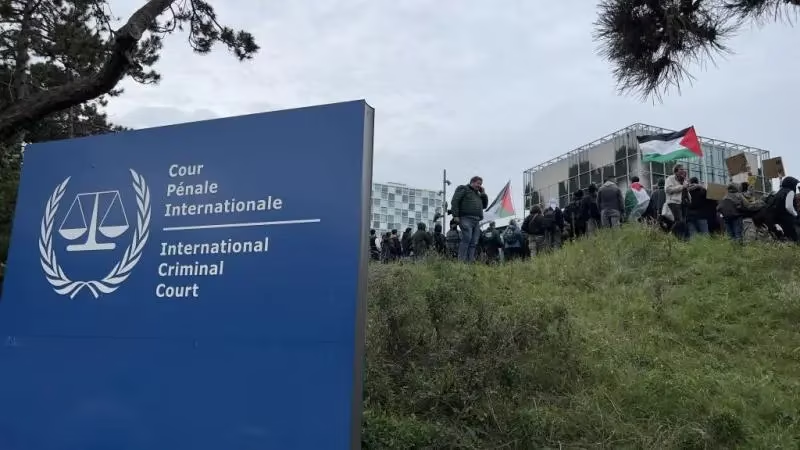
The United Nations condemns US sanctions on two judges in the International Criminal Court

The United Nations condemned, on Friday, the sanctions imposed by the administration of US President Donald Trump on two judges in the International Criminal Court due to investigations related to Israel.

The office of the UN High Commissioner for Human Rights said on the X platform that the sanctions imposed on the two judges represent a new escalation in "retaliatory measures" against international institutions.

The UN Commissioner's office confirmed that "sanctions on judges, prosecutors, or experts at the United Nations contradict the rule of law and the administration of justice".

The two judges sanctioned by the US are: Georgian Gucha Lordkipanidze, and Mongolian Erdenedalai Batbayar, who had voted this week against a challenge submitted by Israel to close an investigation into war crimes in Gaza.

These measures come as part of a series of US sanctions that previously targeted nine judges and prosecutors in the court over the investigation into war crimes allegedly committed by Israel in the Gaza Strip.

The sanctions are linked to the International Criminal Court's decision in November 2024 to issue arrest warrants for Israeli Prime Minister Benjamin Netanyahu and former Defense Minister Yoav Gallant on charges of war crimes and crimes against humanity.

US Secretary of State Marco Rubio said that the two judges covered by the sanctions voted this week in favor of maintaining the two arrest warrants.

In July, Washington also imposed sanctions on the UN Special Rapporteur on human rights in the occupied Palestinian territories, Francesca Albanese, after her repeated accusations against Israel of committing genocide in Gaza.

PALESTINE

Fri 19 Dec 2025 10:56 pm - Jerusalem Time

Rubio: Implementing the second and third phases of the Gaza agreement will take more than 3 years

US Secretary of State Marco Rubio said that the work on implementing the second and third phases of the Gaza agreement will take a long period exceeding 3 years, while the two American envoys will hold another meeting today with officials from Qatar, Egypt, and Turkey regarding Gaza.

Rubio added -in a press conference in Washington- that it is important to complete the first phase of the ceasefire agreement in Gaza and move to the second phase. He explained, "We are in a hurry to end this phase of the agreement so that aid flows and we move to reconstruction."

The US Secretary of State continued, "We want to reach a stage where security is a fundamental part of the process of providing humanitarian aid."

Rubio expressed Washington's desire to accelerate steps to establish a stabilization force in Gaza and form a technocratic government, "because that will lead to the delivery of aid," and acknowledged -at the same time- that the matter is not easy.

He pointed out that the Gaza war is one of the biggest challenges facing President Donald Trump's administration, confirming that the ceasefire in Gaza is one of the greatest achievements that the US administration is proud of.

Rubio said, "I have great confidence that we have a number of countries acceptable to all parties in this matter, and they are ready to participate in the stabilization force." He explained that Pakistan has offered to participate in this force.

The US Secretary of State accused the Islamic Resistance Movement (Hamas) of "violating the ceasefire agreement in Gaza by firing at Israeli soldiers," and emphasized that "if Hamas is able in the future to threaten or attack Israel, there will be no peace, and it will not be possible to convince anyone to invest money in Gaza if they believe that a new war will erupt within two or three years."

He emphasized that a successful donors' conference on Gaza cannot be held before ensuring who will take charge of security in the sector.

The US Secretary of State accused the United Nations Relief and Works Agency for Palestine Refugees (UNRWA) of "corruption," saying that "it cannot be reformed, and we can provide aid in the Gaza Strip without the need for the United Nations."

In the meantime, attention is turning to Miami, where a White House spokesperson said that the American envoys Steve Witkoff and Jared Kushner will hold another meeting today with officials from Qatar, Egypt, and Turkey.

The spokesperson explained that Witkoff will discuss in Miami with the Qatari, Egyptian, and Turkish mediators the transition to the second phase of the ceasefire agreement.

The Axios website had reported, citing sources, that the officials Witkoff will meet are Qatari Prime Minister and Foreign Minister Sheikh Mohammed bin Abdulrahman Al Thani, and Turkish Foreign Minister Hakan Fidan, and Egyptian Foreign Minister Badr Abdel Ati.

In this context, Hamas Political Bureau member Bassem Naim said that the talks scheduled in Miami to move to the next phase of the ceasefire in Gaza must lead to stopping Israel's violations of the truce.

Naim added to Agence France-Presse, "Our people expect from these talks that the attendees agree to put an end to the ongoing Israeli recklessness and stop all violations and breaches and oblige the occupation to the requirements of the Sharm el-Sheikh agreement."

Qatar and Egypt -which play the role of mediators and guarantors for the ceasefire in Gaza- recently urged moving to the next phase of the American president's plan.

The second phase stipulates that Hamas hands over its weapons and Israel withdraws from its current positions in Gaza, and a transitional authority takes over governance in the sector with the deployment of an international stabilization force.

PALESTINE

Fri 19 Dec 2025 10:34 pm - Jerusalem Time

Netanyahu awaits meeting with Trump to decide on Gaza file.. and political stagnation dominates the sector

The Israeli Prime Minister Benjamin Netanyahu is awaiting his anticipated meeting with US President Donald Trump in Florida at the end of December of this month, while the Gaza Strip file is witnessing a state of political stagnation, according to what an informed Israeli source told the official broadcasting authority on Friday.

The Hebrew authority quoted the unnamed source as saying that Netanyahu prefers to postpone taking decisive decisions related to the Gaza Strip until after his meeting with Trump, noting that the vision regarding the sector's future is still immature, amid the absence of clear consensus on the next steps.

The source clarified that the field and political scene in various areas, including the Gaza Strip, Lebanon, and Syria, has not witnessed major changes, and that developments are linked to the results of the planned meeting between Netanyahu and Trump.

He added that the recent discussions regarding the next phase of Trump's plan for the Gaza Strip ended without taking practical decisions, despite addressing essential files, including disarming Hamas movement, a broader withdrawal of Israeli army forces from the sector, in addition to launching a path for reconstruction.

According to the source, several possible scenarios for dealing with the Gaza Strip were raised during these discussions, ranging between a complete American withdrawal from any direct role, and an American field presence through private security companies, as well as the possibility that the Israeli army itself would undertake the task of disarming Hamas, which may ultimately lead to imposing military administration on the sector.

Earlier this December, the Israeli government spokesperson said that Netanyahu will meet Trump on the 29th of the same month, to discuss the next stages in the ceasefire agreement in Gaza.

Yesterday Thursday, Trump said that Netanyahu will likely visit him in Florida during the Christmas holiday, without mentioning a specific date.

It is recalled that on September 29 last year, Trump announced a peace plan and ceasefire in Gaza consisting of 20 points, including: the release of Israeli prisoners, ceasefire, disarming Hamas movement, Israeli withdrawal from the sector, forming a technocratic government, and deploying an international stabilization force.

On October 10 last year, the first phase of the ceasefire agreement came into effect, while Israel violated some of its provisions and delayed transitioning to the second phase, claiming the remaining of one of its soldiers captive in Gaza, despite the Palestinian factions continuing their search operations amid the massive destruction caused by the Israeli genocide that lasted for two years.

The agreement was supposed to end a genocide committed by Tel Aviv over two years starting from October 8, 2023, which resulted in the killing of more than 70,000 Palestinians, and injuring more than 171,000, but Israel continues its violations and suffocating blockade on the sector to this day.

PALESTINE

Fri 19 Dec 2025 8:42 pm - Jerusalem Time

Heavy artillery bombardment east of Gaza kills and injures displaced people

A heavy artillery bombardment that targeted the Tuffah neighborhood east of Gaza City on Friday evening resulted in the martyrdom and injury of a number of Palestinian civilians displaced in the area, while the occupation forces deliberately prevented rescue and ambulance crews from reaching the targeted location.

A local source said that artillery shelling targeted the training building affiliated with the Directorate of Education and Training in the Tuffah neighborhood east of Gaza, which is located opposite the Dar Al-Shifa Hospital for Children, targeting displaced people inside it and in the vicinity of the hospital, causing a number of martyrs and injured, some of whom were torn to pieces due to the intensity of the bombardment.

The source emphasized that the occupation forces prevented the entry of ambulances to the targeted location to retrieve the martyrs and injured, as the occupation forces impose a aerial siege on the area and prevent approaching the place.

The targeted area is one of the areas from which the occupation army withdrew, in implementation of the ceasefire agreement in force in the Gaza Strip since October 11.

Since that date, the occupation forces have continued their violations of the agreement that ended the Israeli genocide war in the sector, committing about 738 violations, killing more than 395 Palestinians, according to the latest report from the Government Media Office in Gaza.

The genocide left more than 70,000 Palestinian martyrs and 171,000 injured, most of them children and women, and massive destruction with a reconstruction cost estimated by the United Nations at about 70 billion dollars.

PALESTINE

Fri 19 Dec 2025 8:30 pm - Jerusalem Time

US Secretary of State: Hamas cannot remain in a position threatening 'Israel'

US Secretary of State: Agreement to end the war in Gaza is moving forward

US Secretary of State Marco Rubio confirmed that the United States adheres to its position rejecting the survival of the "Hamas" movement in a position that allows it to threaten the security of the Israeli occupation entity, emphasizing that any political settlement must ensure the complete dismantling of the movement's military capabilities.

Rubio explained that this measure primarily aims to prevent the recurrence of any future attacks similar to the Al-Aqsa Flood operation on October 7, 2023, where Washington sees the dismantling of the movement's infrastructure as an utmost necessity for achieving lasting stability in the region.

In the context of ongoing diplomatic efforts, Rubio indicated that the agreement aimed at ending the war in the Gaza Strip "is moving forward" despite field challenges, noting the existence of tangible progress in formulating details that ensure the cessation of combat operations alongside achieving security objectives.

This statement comes at a time when the US administration is intensifying its communication with regional parties to implement the "Trump Peace Plan," which includes deploying an international stabilization force and forming a peace council to manage the sector's affairs in the coming phase.

It is expected that the US envoy Steve Witkoff will hold high-level meetings with foreign ministers of Qatar, Egypt, and Turkey to discuss mechanisms for transitioning the agreement to its second phase.

Washington emphasizes in its talks that the next phase requires establishing a Palestinian civil authority that assumes responsibility away from the control of armed factions, while ensuring the opening of crossings and the unconditional delivery of humanitarian aid to the population, to avoid the collapse of the understandings recently reached.

PALESTINE

Fri 19 Dec 2025 8:12 pm - Jerusalem Time

A complex and organized network stands behind operations to transfer hundreds of Palestinians from the Gaza Strip to third countries

A journalistic report revealed a complex and organized network behind operations to transfer hundreds of Palestinians from the Gaza Strip to third countries such as South Africa, Malaysia, Indonesia, and primarily involving the Majd Company and the newly established Israeli Voluntary Migration Office.

The report stated that a group of about 100 Palestinians from Gaza left Israel on the evening of Wednesday, November 12, 2025, having left Gaza early in the morning of Wednesday, and after undergoing Israeli security checks at the Kerem Shalom crossing, they were transported by buses to Ramon Airport near Eilat, where they boarded a chartered flight to Nairobi in Kenya, and from there transferred to another chartered plane that landed in Johannesburg on Thursday morning.

However, the Gazans were shocked that the South African government refuses to accept them and wants to return them to Gaza, and according to sources at the airport who were waiting for the group, they said they were informed that South African authorities refuse to allow the passengers to disembark, and that they are not injured or sick and do not hold dual citizenship.

The newspaper added that this is the second group of Gazans traveling to South Africa in the past two weeks, noting that the previous group followed the same route and entered Johannesburg without any problem.

The Coordinator of Government Activities in the Territories (COGAT) stated that the departure of Gazans is usually coordinated directly between Israeli authorities and the receiving countries in the case of dual citizens or students with study visas, or through the World Health Organization, which oversees the evacuation of the injured and sick to host countries.

The newspaper concluded that before reaching a ceasefire in Gaza, a security source said that after the announcement by US President Donald Trump of a plan to transfer Gaza residents out of the sector, the Israeli government decided to ease restrictions on Palestinians wishing to leave, and among the measures is significantly easing security standards. According to the source, at least 95% of exit requests are now approved, compared to a much lower rate before the government decision.

Israel currently allows Gaza residents to leave through two main routes: transferring them to Ramon Airport if the receiving country sends a plane to pick them up, or through the Allenby Bridge crossing to Jordan. So far, about 7,000 Palestinians have left Gaza through the Kerem Shalom crossing, either towards Jordan or to travel abroad via Ramon Airport, while about 30,000 others have left to Egypt through the Rafah crossing.

General background: From “voluntary migration” to soft displacement from Gaza

Suspicious air flights: Documenting displacement routes from Ramon to Africa and Asia

The “Majd Europe” Association: A humanitarian front for displacing Gazans and collecting their data

The Voluntary Migration Office in Israel: The official cover for emptying Gaza of its population

Tomer Lind and the network of fake companies: The hidden role in managing displacement projects

Kobi Blitzstein and the Israeli right: The political dimension of the plan to empty Gaza

Aviation data documents the flights

According to information obtained by Haaretz newspaper, the latest flight that took place in November 2025 left Gaza early in the morning of Wednesday.

From the Kerem Shalom crossing, they were transported by buses to Ramon Airport near Eilat, where they boarded a chartered flight to Nairobi in Kenya. There, they transferred to another chartered plane that landed in Johannesburg on Thursday morning.

By reviewing the records of planes that left Eilat towards Kenya, it was found that there was a plane belonging to the FLYYO company, a Romanian commercial airline company led by CEO Ziv Maybridge, who is Israeli.

The company began its operations in Israel in February of this year, which raises suspicions about the company's dealings with Israel, and after only one month, the Israeli Migration Office announced the start of transferring Gazans in the same month to countries in Africa and Asia.

By searching the company's aircraft records, it was found that one of them bears the registration number YR-ADD, and by reviewing its records, it had no flights from Israel to Africa except this flight on November 12.

This plane left Ramon Airport near Eilat on Wednesday, November 12, at 17:00 GMT (7:00 PM Israel time), and arrived in the Kenyan capital Nairobi at 21:59 GMT (11:59 PM Israel time).

Flight path from Eilat to Nairobi (Al Jazeera)

Then we moved to track the plane that transported the passengers from Nairobi to South Africa, and by reviewing Johannesburg airport records, we found only one plane that landed in the morning at the airport coming from Nairobi on Thursday, November 13, 2025.

It turned out that the plane belongs to the South African company Global Aviation, with registration number ZS-GAC, and it is a commercial transport plane that usually operates on the passenger line between South Africa and Kenya, and the plane took off at 02:07 GMT — that is, about 5 hours after the arrival of the flight believed to have carried the Gazans — and arrived in Johannesburg at 06:19 GMT.

Flight path from Nairobi to South Africa (Al Jazeera)

Not the first time

And this was not the first time it is believed to have transported Gazans from Gaza, as according to reports, the first flights to transport Gazans were on March 19, 2025, when 70 Gazans holding foreign nationalities or with family ties abroad left Ramon Airport in southern Israel on a Romanian military plane heading to Europe, and Israeli authorities said they assisted in the evacuation operation as part of the migration policy they adopt.

And we actually found a Romanian military plane that left Ramon Airport heading to Romania on March 19, 2025, with registration number 6166 of the C130 model.

This flight was repeated on September 17, 2025, when a Romanian military plane with number 9143 of the C130 model also moved from Ramon Airport to Romania, and on the same day, several Israeli sources reported that 550 people left Gaza to various destinations (including Romania), where the Coordination Office (COGAT) said that most of those who left Gaza that day were Palestinian patients and their caregivers.

Other flights

Haaretz said that a group of Gaza residents, consisting of 57 people, left the sector on May 27, 2025, and on the night before their departure, dozens of residents received a message via the “WhatsApp” app containing a specific address in the sector to go to, and from there, they headed by buses to the “Kerem Shalom” crossing.

The bus departed after Israeli inspection to Ramon Airport, where the group boarded a chartered plane from the Romanian company “Flylili”, which headed to Budapest, and from there the travelers continued their journey to Indonesia and Malaysia.

By reviewing Flylili company flights, we found that it had a flight from Eilat to Budapest in Hungary on May 27, 2025, with number FL7000, which was not recorded on any similar flight, unlike the repeated second plane flights.

PALESTINE

Fri 19 Dec 2025 8:05 pm - Jerusalem Time

UN Report: 1.6 Million People in Gaza Face Acute Food Insecurity Until 2026

A UN report revealed on Friday that at least 1.6 million people in the Gaza Strip are facing a high level of acute food insecurity until mid-April 2026.

This comes according to the Integrated Food Security Phase Classification report prepared by UN agencies, which includes projections of the situation in Gaza during the period from December 1, 2025, to April 15, 2026.

The report stated, "According to the latest analysis of the Integrated Food Security Phase Classification following the announcement of the ceasefire on October 10, 2025, significant improvements in food security and nutrition were observed compared to the previous analysis, which indicated famine in August 2025."

It added, "Despite recent improvements, at least 1.6 million people will continue to face a high level of acute food insecurity until mid-April 2026."

The report predicts recording about 101,000 cases of acute malnutrition among children aged 6 to 59 months in Gaza between October 2025 and October 2026, of which 31,000 cases are expected to be severe.

It indicated that about 37,000 pregnant and lactating women will need urgent nutritional support.

The report emphasized that the situation in Gaza is extremely fragile, and any improvements recorded so far depend on the sustainable, expanded, and uninterrupted access of humanitarian and commercial aid.

It warned that in the worst-case scenarios, including the resumption of conflict and the cessation of humanitarian aid, the entire Gaza Strip could face the risk of famine by mid-April 2026.

It is worth noting that the population of Gaza has declined to 2,114,301 people, according to a report prepared by the Palestinian Central Bureau of Statistics on the occasion of World Population Day in July.

Before the start of the genocide war launched by Israel on Gaza, the population of the Strip was about 2,226,544 people, according to Palestinian statistics.

Hundreds of thousands of displaced people in the Strip are suffering from harsh living conditions after the destruction of their homes and forced displacement, amid a severe shortage of blankets and heating means, and a widespread deterioration in humanitarian conditions with the onset of winter.

This suffering comes amid Israel's failure to fulfill its commitments stipulated in the ceasefire of October 10 and its humanitarian protocol, including the entry of shelter materials and 300,000 tents and mobile homes, as confirmed repeatedly by the Gaza Government Media Office.

The genocide that began on October 8, 2023, supported by Washington and lasted two years, has left more than 70,000 Palestinian dead and 171,000 injured, mostly children and women, and immense destruction with reconstruction costs estimated by the United Nations at about $70 billion.

PALESTINE

Fri 19 Dec 2025 7:08 pm - Jerusalem Time

Guterres: War must be stopped to save Gaza from imminent famine

The UN Secretary-General, António Guterres, issued stark warnings about the humanitarian situation in the Gaza Strip, confirming that 1.6 million people are expected to face extreme levels of acute food insecurity.

The Secretary-General emphasized that there is an urgent need for a permanent ceasefire to save lives and provide necessary aid.

Guterres strongly called for the immediate transition to the second phase of the agreement to end the war in Gaza, stating that "there should be no excuses" for delaying this decisive step, and saw that the agreement is the only path to achieving stability, with the necessity to move forward towards a two-state solution as a comprehensive political framework for the conflict.

In the context of relief efforts, the Secretary-General emphasized the need to respect the safety of UN staff stationed in the sector, reiterating his full support for the "UNRWA" agency as the backbone of humanitarian work in Gaza, and rejecting any interference with its vital role.

PALESTINE

Fri 19 Dec 2025 6:44 pm - Jerusalem Time

The United Nations Emphasizes the Need for a Permanent Ceasefire in Gaza

The United Nations emphasized today, Friday, the need for a permanent ceasefire in Gaza, confirming that life-saving shelter aid does not reach Palestinians in the sector on a wide scale, due to the lack of urgent access and the restrictions imposed on it.

The UN Secretary-General Antonio Guterres said in a press conference that it is necessary to move to the second phase of the agreement and fully implement the terms of the agreement, which contributes to stabilizing the calm and improving the humanitarian situation in the Gaza Strip.

He confirmed that 1.6 million people in Gaza are expected to face extreme levels of acute food insecurity, amid Israel's prevention of the entry of sufficient aid as stipulated in the ceasefire agreement that came into effect on October 10 last year.

Guterres renewed his support for the United Nations Relief and Works Agency for Palestine Refugees (UNRWA) amid the Israeli campaign it has faced for more than two years, emphasizing Israel's need to respect the safety of United Nations staff in Gaza.

He added that we must move towards a two-state solution. He also highlighted the dire conditions in the occupied West Bank, saying that tens of thousands have been displaced due to operations carried out by Israeli forces in the north of the West Bank.

In a related context, the spokesperson for the United Nations International Organization for Migration, Afand Aziz Agha, said that Gaza residents need improved conditions to ensure access to clean water, sanitation services, and toilets, in addition to protection from living in cold conditions.

This came in statements made by Agha alongside the spokesperson for the World Health Organization, Tarik Jasarevic, during the weekly press conference of the United Nations office in Geneva.

He noted that winter conditions, including heavy rains and storms that cause floods in destroyed neighborhoods and flood tents, currently lead to people being exposed to diseases more and facing increased risks.

He called for urgent and unrestricted access of humanitarian aid to the Gaza Strip, at a time when Israel does not allow the entry of tents and shelter materials into the Gaza Strip, forcing hundreds of thousands of residents to live in dilapidated and rudimentary tents.

For its part, the World Health Organization said that 1,092 patients died in the Gaza Strip while waiting for medical evacuation between July 2024 and November last year.

The ceasefire agreement was supposed to end the genocide, but Israel continues its violations, killing hundreds of Palestinian civilians between martyrs and wounded, in addition to violating the humanitarian protocol related to aid and shelter supplies.