PALESTINE

Thu 05 Dec 2024 7:39 pm - Jerusalem Time

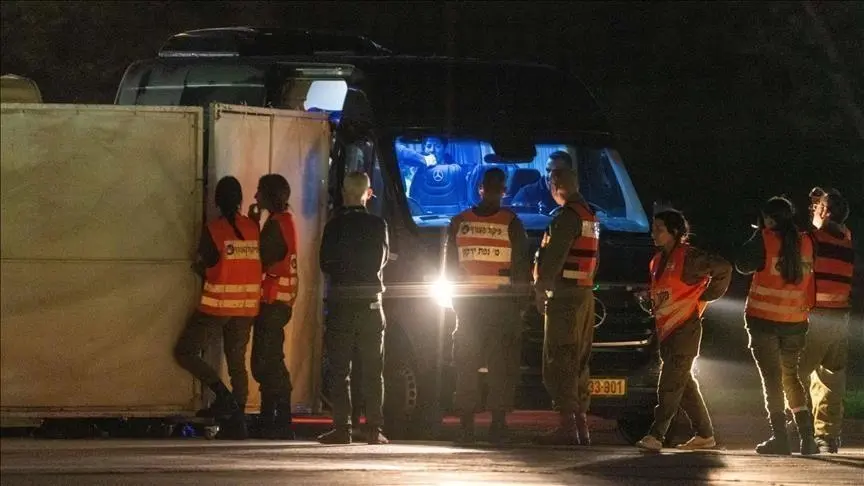
Israeli occupation releases the two detainees, Lian Nasser and Lian Kayed


This evening, Thursday, the Israeli occupation authorities released the two detainees, Lian Nasser and Lian Kayed, after an administrative detention that lasted for 8 months.


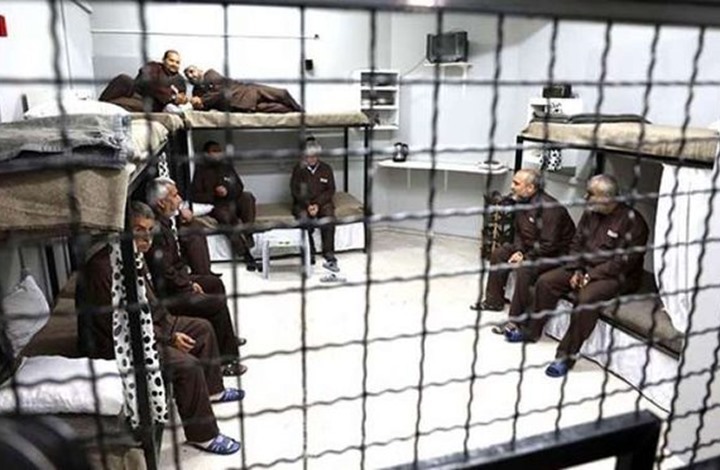
The Prisoners Club stated in a statement that the number of female detainees in Al-Damon prison, after the release of the two detainees Nasser and Kayed, is 89, including four detainees from Gaza, noting that this data does not include all female detainees from Gaza who are being held in the camps affiliated with the occupation army.

PALESTINE

Thu 05 Dec 2024 6:35 pm - Jerusalem Time

Benjamin Netanyahu's desperate declaration and the detainees' file

October 7th, a day that will remain etched in the memory of Israelis as one of the most difficult historical milestones, and a specter that haunts everyone who has worked or will work in the Israeli security and political institutions. This day was a resounding slap in the face to the security establishment that has always boasted of its military and intelligence strength, after the Hamas movement managed to penetrate all Israeli security barriers in a qualitative and precise operation

The Al-Qassam Brigades, the military wing of Hamas, carried out a sophisticated military intelligence operation during which it was able to capture a large number of Israelis and transfer them to Gaza. This unprecedented achievement made these detainees a strategic bargaining chip in negotiations with Israel, with the aim of releasing Palestinian prisoners held for years, and forcing Israel to give up some of its policies and grant the Palestinians their legitimate sovereign rights.


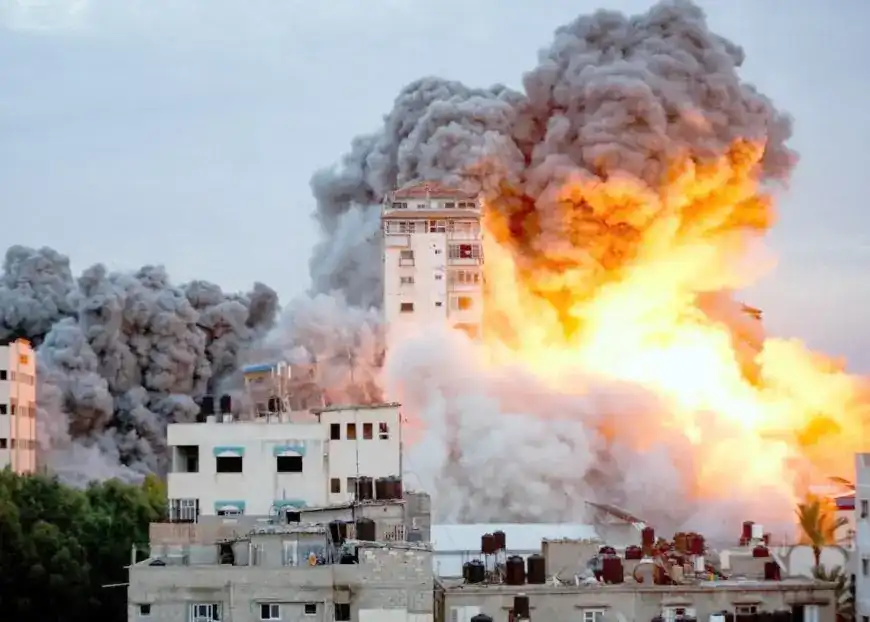
However, Israel, unable to bear this insult, responded by launching a large-scale military aggression on the Gaza Strip, which led to the killing of tens of thousands of civilians, most of them women and children, and the complete destruction of the Strip’s infrastructure, under the pretext of eliminating Hamas and recovering the detainees.


More than a year after the events, more than 100 Israelis are still being held in Gaza, while the Israeli military continues to claim that it has destroyed Hamas’s military capabilities and taken full control of the Strip. Despite using all available intelligence means, including spy devices and field agents, it has so far been unable to locate the captives.


In a desperate attempt to calm Israeli public opinion and its concern about the detainees’ file, Prime Minister Benjamin Netanyahu announced an increase in the financial reward from one million to five million for anyone who provides information leading to the locations of the detainees, raising it from one million shekels to five million dollars, while guaranteeing a safe passage and a new life for him and his family for anyone who provides this information and leaves Gaza. This announcement was made in a recorded video of him and was published on social media networks with sponsored advertisements to ensure that this desperate offer reaches the largest number of Palestinians.

The announcement sparked mixed reactions. While some saw it as a move that could help free prisoners, others saw it as an attempt to exploit the difficult economic conditions of Gazans, which could push some to cooperate with the Israeli authorities in light of the urgent financial need. Some also warned that the move could spark strife among Palestinians themselves.


It is worth noting that this is not the first time that Israel has resorted to offering financial rewards in exchange for security information. It has previously announced similar rewards in cases related to the activities of resistance factions or weapons caches. However, raising the value of the reward to this extent reflects the extent of the dilemma facing the Israeli government and its inability to achieve its goals despite possessing enormous military and intelligence capabilities.


Netanyahu’s latest decision reflects the complexity of the current scene and the difficulty of the challenges facing the Israeli government in the issue of the detainees. The question that arises is: Will this step succeed in accelerating the process of releasing the prisoners? Or will it lead to repercussions that further complicate the political and security scene in the region? Only time will tell.

ARAB AND WORLD

Thu 05 Dec 2024 5:45 pm - Jerusalem Time

Armed factions enter Hama city in central Syria

Armed factions entered the strategic city of Hama in central Syria on Thursday, where they are engaged in "fierce" battles with Syrian forces inside the city's neighborhoods, according to the Syrian Observatory for Human Rights.

The Observatory reported that Hay'at Tahrir al-Sham and allied factions "entered the city of Hama from several directions, and are waging a street war against (Syrian forces) in several neighborhoods." Reuters quoted a leader of the armed groups as saying that "hundreds of prisoners were freed from Hama Central Prison." For its part, the Syrian army announced the withdrawal of its forces from the city of Hama to redeploy and reposition outside the city.


A statement issued by the General Command of the Army and Armed Forces said: "In order to preserve the lives of civilians in the city of Hama and not to involve them in battles inside the cities, the military units stationed there have redeployed and repositioned outside the city."

Thus, Hama became the second city to which the armed factions advanced within days, after Aleppo, located to the north, was completely outside the control of the Syrian forces for the first time since the outbreak of the conflict in 2011.

PALESTINE

Thu 05 Dec 2024 5:41 pm - Jerusalem Time

Death of a Palestinian prisoner Alaa Marwan Hamza Al-Mahlawi from Gaza

  1. The General Authority for Civil Affairs, the Authority of Prisoners and Freed Prisoners Affairs, and the Palestinian Prisoners Club reported the death of detainee Alaa Marwan Hamza Al-Mahlawi (42 years old), who has been detained since 12/21/2023. According to his family, their son did not suffer from any chronic diseases before his arrest, and only suffered from a problem in one of his eyes before his arrest.

    The Commission and the Prisoners Club explained in a statement on Thursday that the available information about the crime committed against the detainee Alaa Al-Mahlawi is that he was being held in the Negev prison, and according to detainees who were visited, they confirmed that his health condition was difficult, without clarifying other details. Based on the latest information about him, he was transferred in late November to the Israeli Assaf Harofeh Hospital, where he passed away on Thursday morning.

    The Authority and the Club stated that the detainee, Al-Mahlawi, was arrested on 12/21/2023, the day his father was martyred in Gaza. He is married and has four children, the oldest of whom is a 16-year-old daughter, and the youngest is eight years old.

    The Authority and the Club pointed out that the number of prisoners and detainees who have been martyred since the beginning of the war of extermination has been increasing significantly. The martyrdom of the prisoner Al-Mahlawi comes a day after the martyrdom of the prisoner Muhammad Walid Hussein from Nour Shams Camp. Never before in the history of the prisoner movement have there been such numbers of martyrs recorded among the ranks of the prisoners, as today with the continuation of the war of genocide against our people in Gaza.

    Thus, the number of martyr prisoners since the beginning of the war of extermination has risen to (49) martyrs, and they are the only ones whose identities have been announced, including (30) martyrs from Gaza. Thus, the number of martyrs of the prisoner movement whose identities have been announced since 1967 has risen to (286) martyrs, with the martyr prisoner Alaa Al-Mahlawi, noting that there are dozens of prisoners from Gaza who have been martyred after the war, and the occupation continues to conceal their identities, as a result of the crime of enforced disappearance that the occupation is pursuing against the martyrs and prisoners from Gaza.

PALESTINE

Thu 05 Dec 2024 2:55 pm - Jerusalem Time

Civil Defense in Gaza warns of halting its services in the southern Gaza Strip due to the fuel crisis

The General Directorate of Civil Defense in the Gaza Strip warned, on Thursday, of a complete halt to its humanitarian services provided to the displaced in the area described by the Israeli occupation as the "humanitarian zone" in the southern Gaza Strip, due to a stifling fuel crisis.


The Director of Supply and Equipment in the Civil Defense, Muhammad Al-Mughair, said that international organizations have refused to provide the Civil Defense with fuel since the beginning of the Israeli aggression on the Strip, justifying this with Israeli allegations.

He stressed that the crisis affected all firefighting and rescue vehicles in the southern region, as 13 vehicles out of 22 stopped working due to fuel shortages.


Al-Mughair explained that the civil defense crews are working throughout the sector with the least available capabilities, stressing the need to provide them with the necessary fuel to ensure the continuation of rescue operations and the provision of humanitarian services.


He stressed the continuation of appeals to international organizations and concerned parties to provide the necessary support, warning of the repercussions of this crisis on the lives of thousands of displaced people who depend on civil defense interventions.


Al-Mughair held the UN organizations and the UN Office for the Coordination of Humanitarian Affairs responsible for the continued prevention of fuel supplies to the Civil Defense, pointing out that this situation threatens the lives of the displaced who are suffering from the consequences of the ongoing Israeli aggression on the Gaza Strip.

ARAB AND WORLD

Thu 05 Dec 2024 2:30 pm - Jerusalem Time

UN rapporteur: Failure to arrest Netanyahu and Galant violates international law

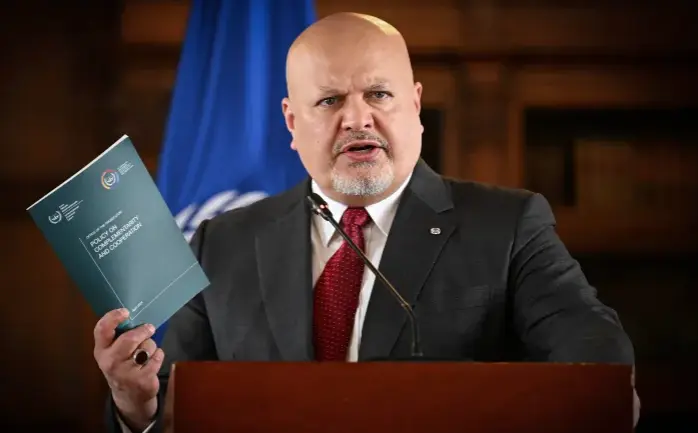
The failure to implement the arrest warrant issued by the International Criminal Court against Israeli Prime Minister Benjamin Netanyahu and his former defense minister Yoav Galant is a "violation of international law," UN rapporteur Giorgos Katrougalos said.


The memorandum, issued on November 21, accuses both Netanyahu and Galant of committing war crimes and crimes against humanity in light of the ongoing war of extermination in the Gaza Strip for more than a year.


In an interview with Anadolu Agency, Katrougalos pointed out that the International Criminal Court's decision to arrest the Israeli Prime Minister and his former Defense Minister "clearly shows that crimes are being committed in Palestine."


France had previously claimed that the ICC's decisions could not apply to heads of state and government, and claimed that the decision to arrest Netanyahu could not be implemented.


For his part, the UN rapporteur confirmed that he "did not hear such a statement from France when a similar accusation was made against Russian President Vladimir Putin," wondering why.


On November 27, French Foreign Minister Jean Barrot explained, according to Anadolu Agency, that “Netanyahu can benefit from immunity under international law,” noting that Paris’ position on the issue of the International Criminal Court will not serve its interests or Europe’s interests.


Duty arrest

Katrougalos pointed out that the mission of the International Criminal Court is to bring to justice those with influence and heads of governments who commit crimes, stressing that countries that do not implement the decision of the International Criminal Court "violate international legitimacy", and that "any person against whom an arrest warrant has been issued must be arrested if he is on the territory of a country that has signed and ratified the Rome Statute."


He added that "acting differently would be a new violation of international law, such as continuing to sell weapons to Israel," noting that countries that do not abide by the decisions of the International Criminal Court "will be partners in the crimes committed."


Katrougalos stressed to Anadolu the need to protect the United Nations system, expressing his concern over Israel's statements towards the international organization, and said, "The only thing that separates international law from complete chaos is the existence of the United Nations, and they must protect it at any cost."


The court's decision came after ICC Prosecutor Karim Khan announced in a statement on May 20 that he was seeking to issue arrest warrants against Netanyahu and Galant on charges of "war crimes."


Khan again asked the court last August to expedite the issuance of arrest warrants against them, in light of Israel’s continued massacres in the Palestinian territories, ignoring the UN Security Council’s resolution to end the war immediately, and the International Court of Justice’s orders to take measures to prevent acts of genocide and improve the catastrophic humanitarian situation in the Gaza Strip.


ARAB AND WORLD

Thu 05 Dec 2024 2:14 pm - Jerusalem Time

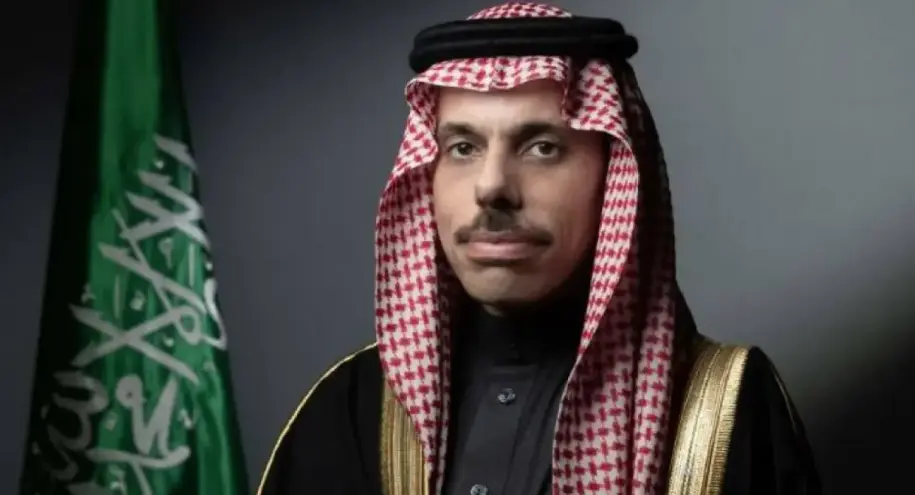
Saudi Foreign Minister discusses situation in occupied territories with Palestinian Prime Minister

Today, Thursday, Prince Faisal bin Farhan, Saudi Minister of Foreign Affairs, received a phone call from the Prime Minister of Palestine and Minister of Foreign Affairs, Dr. Muhammad Mustafa.


During the call, they discussed the latest developments in the Palestinian territories and the efforts being made in this regard.

PALESTINE

Thu 05 Dec 2024 1:47 pm - Jerusalem Time

Israeli newspaper reveals details of new Gaza ceasefire proposal

The Hebrew newspaper Yedioth Ahronoth revealed details of the new proposal for a ceasefire in Gaza, which it said Egypt had recently formulated, but it also addressed the factors that might prevent reaching this agreement.


According to the newspaper, the new proposal is based on a plan for a ceasefire between Israel and the Islamic Resistance Movement (Hamas) in the Gaza Strip for a period of 60 days, during which the occupation army will partially withdraw from the Strip, and during which negotiations will take place to end the war between the two parties and on Hamas’s demand for a complete Israeli withdrawal, with the agreement to be completed by the time US President-elect Donald Trump takes office next year.


Regarding the details of this agreement, the writer Smadar Perry quoted an unnamed official Egyptian source as saying that the Israeli prisoners will not be returned until a week after the agreement goes into effect, and that Palestinian prisoners will be released in exchange for them, without discussing specific numbers or criteria.


On the other hand, the former Israeli negotiator, Avi Kalo, reviewed in another article the motives of the various parties to reach an agreement, noting that there are real obstacles to moving forward in this regard.


Details of the expected agreement

In her article in the newspaper, the writer quoted the Egyptian official as saying, “The Rafah crossing will be transferred to the Palestinian Authority’s administration and supervision,” noting that Hamas has not yet announced a change in its position on the condition of the withdrawal of the occupation forces from the Gaza Strip and the Philadelphi Corridor for signing the agreement.


But she pointed out what the Egyptian official said, "The plan will pave the way for a gradual cessation of fighting in Gaza with the Israeli side withdrawing from the Rafah crossing."


In detail, Perry quoted the Egyptian official as saying, "About a week after the temporary ceasefire goes into effect, the process of returning the remaining Israeli prisoners will begin. At the same time, hundreds of Palestinian prisoners will also be released from Israeli prisons, according to the keys agreed upon between the two sides. During the 60-day ceasefire, Israel will maintain a military presence in Gaza. The proposal also addresses the possibility of Palestinian refugees returning to the northern Gaza Strip, as Hamas demands."


As for the Rafah crossing, according to the plan, it is expected to be managed and supervised by the Palestinian Authority. In previous contacts, Israel raised the possibility of maintaining some surveillance capabilities through cameras at the Rafah crossing. According to the senior Egyptian source, “a joint management committee will be formed from the West Bank and the Gaza Strip, which will include 10-15 members, ‘technocrats, independent Palestinian politicians.’ The committee will be supervised by American representatives.”


The Egyptian source stressed that "the first 60 days will be a test for both sides - Israel and Hamas - and that if the plan holds, it will be the end of the conflict between the two sides."


According to the newspaper, the Egyptian source indicated that the intention of the new move is to complete this step before Trump enters the White House. However, he confirmed that both President Joe Biden and Trump have received reports about the new plan. Hamas has not yet responded positively to the proposal, nor has it announced a change in its positions.


"As far as we know, Hamas still insists on ending the war and a complete Israeli withdrawal from the Gaza Strip," he added.


The writer pointed out that Qatar also returned to center stage, after Trump's new envoy, Steve Witkoff, met with Prime Minister Benjamin Netanyahu and Qatari Prime Minister Mohammed bin Abdulrahman Al Thani in an attempt to reach a ceasefire in the Gaza Strip and a prisoner deal before the inauguration.


She said Hamas negotiators are expected to return to Doha and hold another round of talks soon.


While the writer ignored the position of the Israeli government, which had previously prevented reaching a ceasefire agreement, she was careful to remind that “there is cautious optimism in Israel, because Hamas is still insisting on its demands for an end to the fighting, the withdrawal of the Israeli army from the entire Gaza Strip, and the promise to rebuild the Gaza Strip and allow in massive aid.”


"If Hamas agrees to a symbolic expulsion of its leaders from the Gaza Strip, it may be possible to reach an agreement that includes a cessation of the war, because Netanyahu cannot allow a photo opportunity of Hamas's return to power," a senior Israeli official said earlier this week.


Obstacles

In this context, Kalu discussed in his article for the same newspaper the important factor in accelerating the reaching of an agreement, which is the pressure of the elected US president, which he called the (X) factor, indicating that this agreement achieves the interests of all parties concerned with it.


The former lawyer noted that the warring parties in Gaza now have a shared interest in reaching a partial humanitarian agreement, including a limited ceasefire lasting a few weeks without committing to ending the war. According to the Egyptian proposal, the agreement is a “phased deal” similar to a previous agreement implemented last year, including:

Gradual release of prisoners over the course of weeks.

Temporary ceasefire.

Partial withdrawal of Israeli forces from areas of importance in the Gaza Strip, laying the basis for a permanent ceasefire in the future.


Kalo stressed that the success of the agreement depends on the “political will of both parties,” noting that Hamas, which lacks strong support from Hezbollah and Iran, believes that this temporary calm will enable it to reorganize its ranks inside Palestine. Meanwhile, Israel faces enormous internal pressure to return the prisoners, in addition to the desire to close the Gaza file and devote itself to confronting Netanyahu’s arrest warrants issued by the International Criminal Court before Trump enters the White House.


However, Kalo noted that “it is still too early to cut the ribbon, with the two sides sticking to two points, one of which concerns the mechanism for ending the deal. While Israel seeks to maintain some ambiguity on the issue of ending the war, Hamas insists on a clear agreement that includes the release of prisoners and ends with a permanent ceasefire.”


Another point of contention is “the quantity and quality of the security prisoners to be released in the deal, which is on the doorstep of the hardline Israeli government, in a way that requires political maneuvering that goes beyond the opposition of some extremist government ministers (Itamar Ben-Gvir and Bezalel Smotrich) to the deal.”


PALESTINE

Thu 05 Dec 2024 12:59 pm - Jerusalem Time

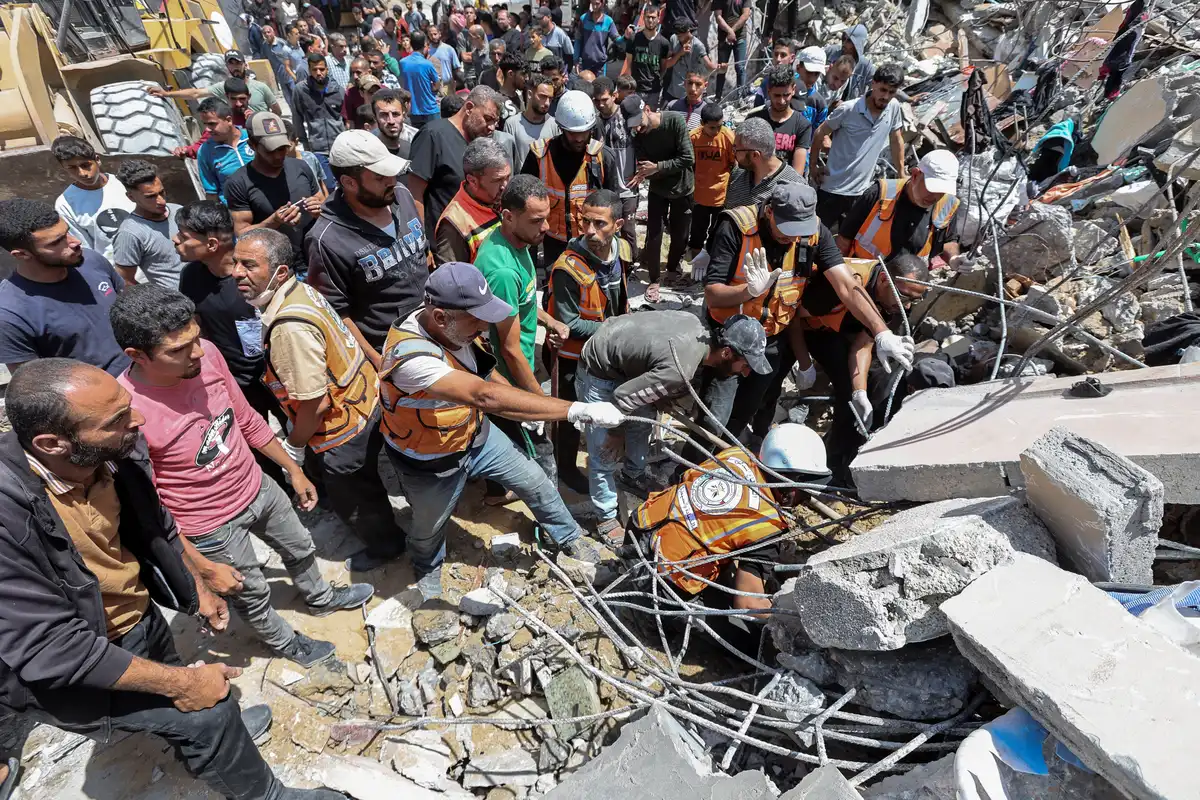
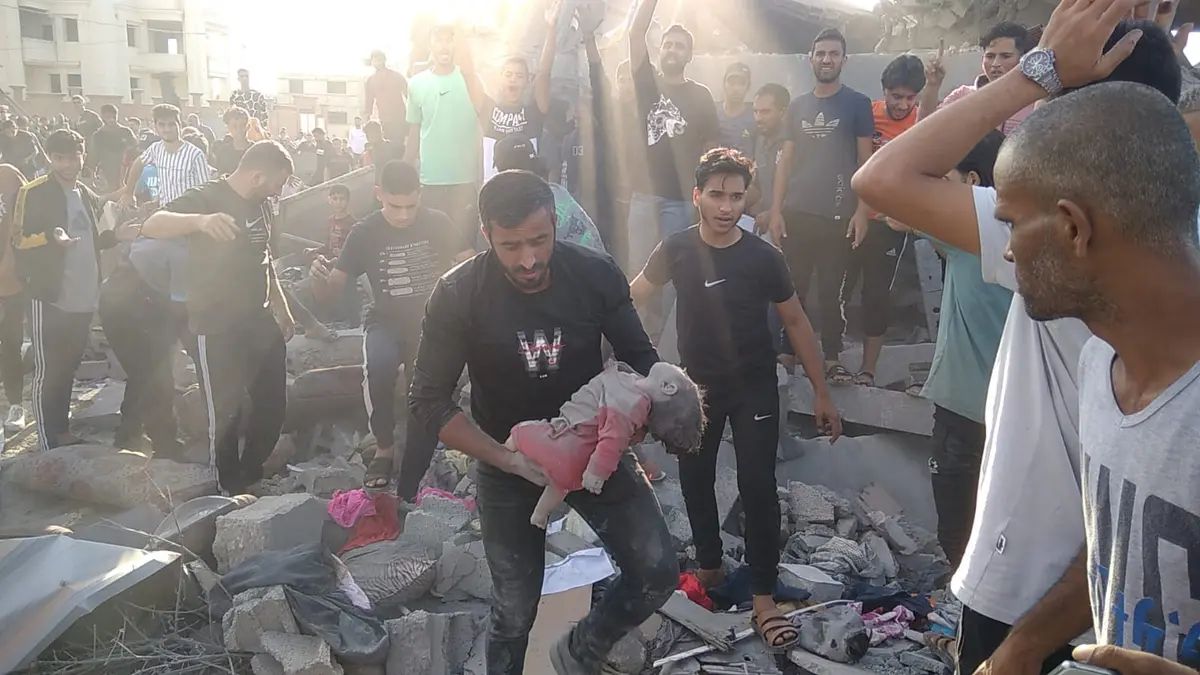
The death toll from Israeli aggression on Gaza rises to 44,580

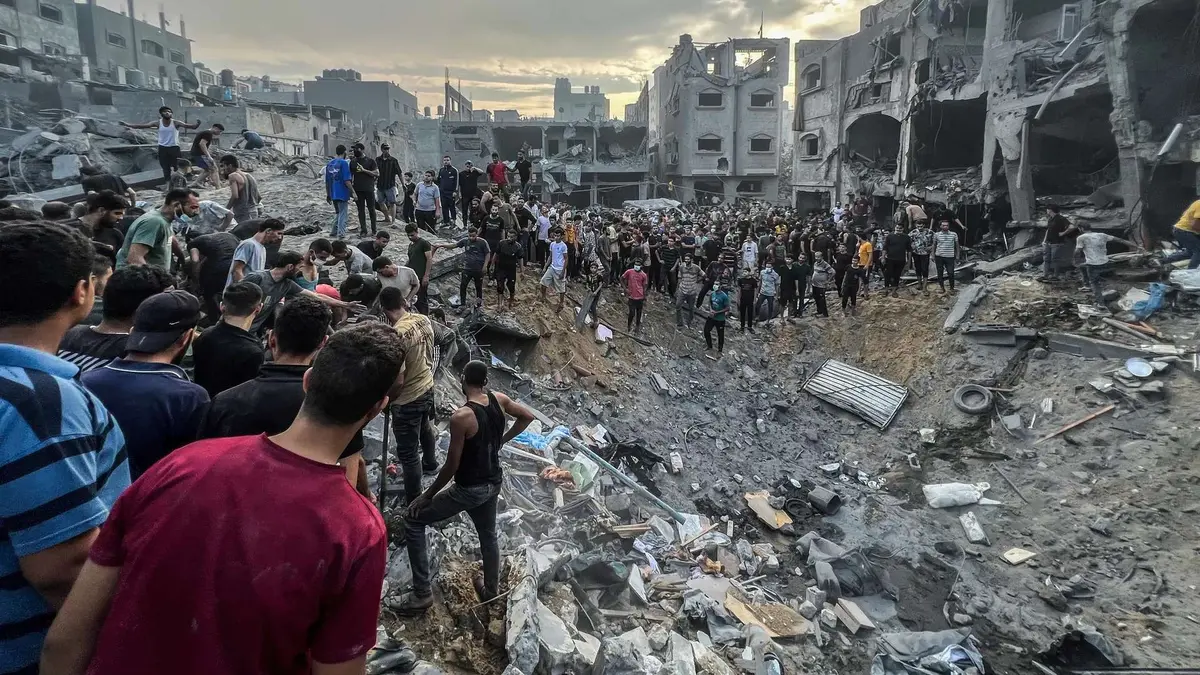
The Ministry of Health in Gaza announced today, Thursday, that the death toll in the Gaza Strip has risen to 44,580, the majority of whom are children and women, since the beginning of the Israeli occupation aggression on October 7.


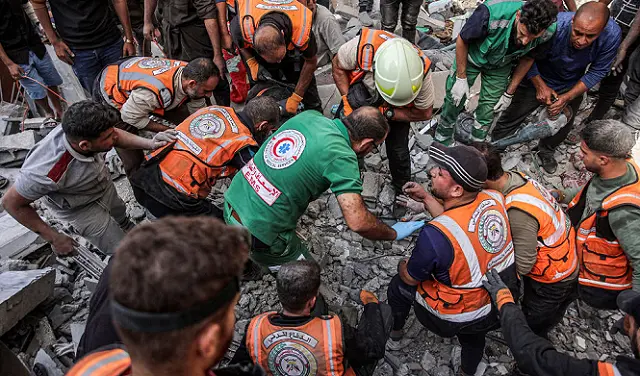
It added that the number of injuries has risen to 105,739 since the start of the aggression, while thousands of victims are still under the rubble.

It  pointed out that the occupation forces committed 5 massacres against families in the Gaza Strip, 48 dead and 201 wounded arrived at hospitals during the past 24 hours.


It explained that a number of victims are still under the rubble and on the roads, and ambulance and civil defense crews cannot reach them.

PALESTINE

Thu 05 Dec 2024 12:57 pm - Jerusalem Time

Bethlehem: Israeli forces cut down trees and destroy irrigation network in Nahalin

Today, Thursday, the occupation forces cut down trees and destroyed an irrigation network for crops in the town of Nahalin, west of Bethlehem.


Local sources reported that the occupation forces cut down about 60 olive and grape trees, and destroyed a water network for irrigating crops and barbed wire in the Wadi Abu Kir area, belonging to citizens Ghanem Shakarna and Abdul Basit Fanoun.


It is noteworthy that the occupation forces have recently escalated their attacks on citizens’ property in Nahalin, which included demolishing homes and agricultural rooms, and uprooting trees.

OPINIONS

Thu 05 Dec 2024 10:01 am - Jerusalem Time

Displacement under fire and fire burning everywhere

op-ed "AlQuds" dot com

op-ed "AlQuds" dot com

Opinion Writer

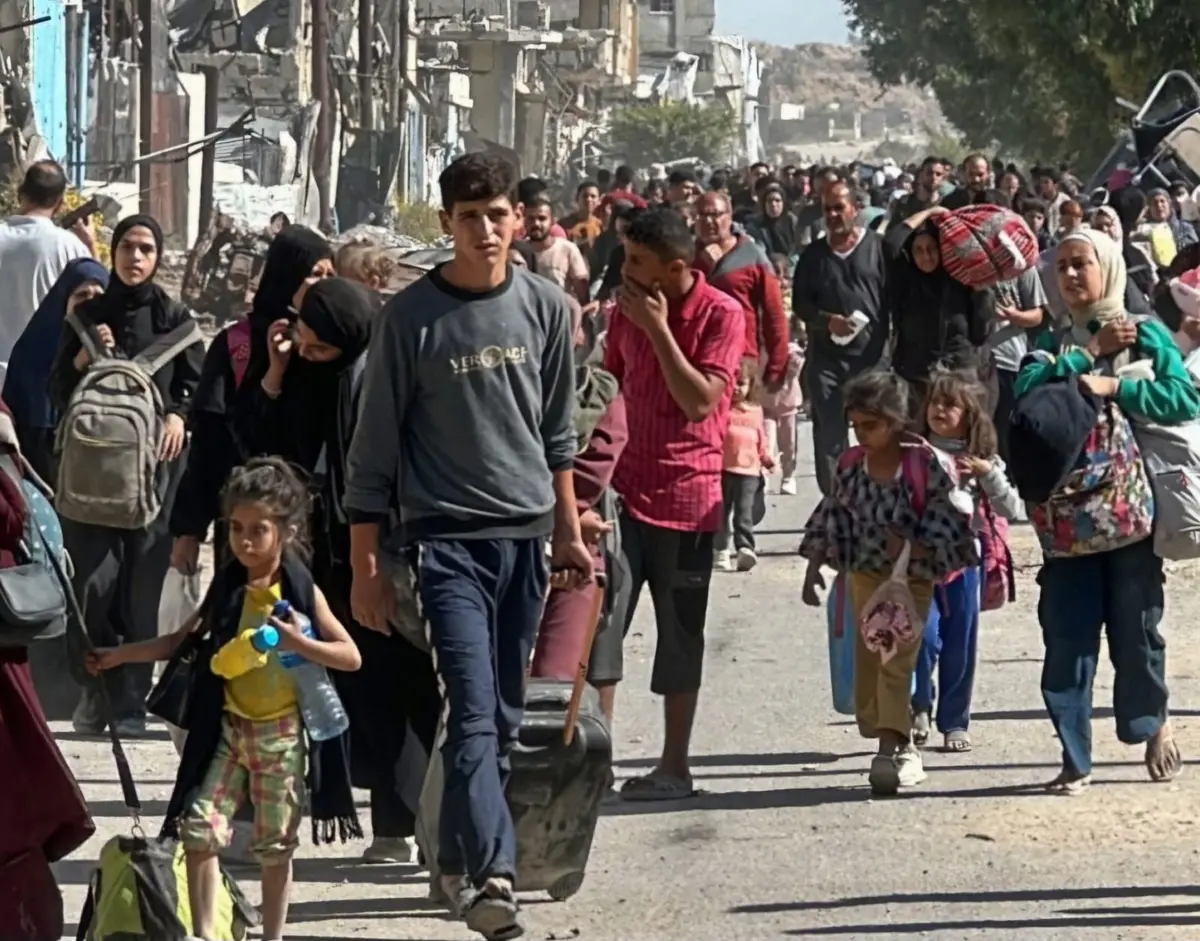
76 martyrs in one day, from the daily massacre of the war waged and executed by the gangs of the Israeli army under the programmed direction of the extremist Netanyahu government, which seeks to cleanse the northern Gaza Strip of its citizens.


Massacres everywhere, burning Palestinians by targeting their tents and shelters to which they flee from the bombing and raids, which are renewed in the new place of displacement, so that the scene is repeated over and over again, far from stability in any place, and in the midst of a displacement journey fraught with danger, where tanks, armored vehicles and armored vehicles covered by helicopters and drones from the air, chase women who leave in fear of the killing game, and under the threat of weapons, leaving behind husbands whose bodies Israel has burned or killed with bullets and bombing, or arrested some of them, while the bodies of children are observed charred from their burning.


These scenes are observed daily by the citizens of the Gaza Strip, as happened yesterday in the massacres of Al-Mawasi and Sheikh Radwan, where the occupation deliberately bombed the homes of the Al-Dalu, Saqallah and Jaarour families, the tents of the displaced and their gatherings, and the food stores in the areas that the occupation calls humanitarian areas.


Israel continues its daily crimes, violating international law, and exceeding that in a hideous and horrifying manner, as it embodies images of criminality, aggression, and cleansing the northern Gaza Strip of innocents, as it carries out a campaign targeting the remaining citizens.


Israel's disregard for human life in Gaza has reached an indescribable level, through its insistence on using all types of weapons, chasing the displaced and tightening the noose around them, amidst a terrible silence for which the international community bears responsibility. This can be elevated to the level of collusion with Israel by running after the directed news that the occupation promotes as if it is interested in reaching a swap deal. This is a situation that cannot be achieved on the ground, due to Israel's insistence on continuing its crimes and genocide. The measures taken by the Israeli army on the ground prove that there are clear Israeli tendencies to continue the occupation of the Strip, and thus continue the crimes of ethnic cleansing and the war of genocide.


The occupation's bombing of the displaced people's tents more than 213 times since the beginning of the war clearly indicates Israel's deliberate targeting of civilians, with Israel admitting that the bombing targets safe areas under the pretext of the presence of activists and militants there.


What languages are left that the Palestinian people can use to address the world, after using all languages in appeals and calls to stop the aggression and the war of extermination everywhere? But it seems that the world and Israel do not understand the language of peace and the call for humanity, but rather run after the language of crime, murder and massacres that Israel has succeeded in adopting despite the governments, bodies and international governmental and official institutions.

OPINIONS

Thu 05 Dec 2024 9:53 am - Jerusalem Time

Gaza and the Mistakes of American Policy

James Zogby

James Zogby

Opinion Writer

History will not be kind to Joe Biden’s presidency in judging his handling of Israel’s genocidal war on Gaza. At best, his response will be judged indifferent.


There are many examples of weakness:

On April 4, 2024, The New York Times published an article titled: “President Biden told Prime Minister Benjamin Netanyahu that future American support will be determined by how Israel treats civilians in Gaza,” which stated:


President Biden on Thursday threatened to condition future support for Israel on how it addresses his concerns about civilian casualties and the humanitarian crisis in Gaza, prompting Israel to commit to allowing more food and other supplies into the besieged enclave in hopes of appeasing him.


The newspaper also reported: “During a tense 30-minute call with Israeli Prime Minister Benjamin Netanyahu, Biden for the first time used American aid to influence the course of the war against Hamas, which has angered many Americans and others around the world.”


After the call, Secretary of State Antony Blinken commented, “If we don’t see the changes we need to see, there will be policy changes.”


Seven and a half months later, another 12,000 Palestinians were killed in the schools, hospitals and mosques where they had sought safety. Tent camps filled with desperate refugees were bombed, and Israel continued to block the delivery of humanitarian aid. The US administration’s “threat” went unheeded.


Then, on October 13, Secretaries of State and Defense Blinken and Lloyd Austin wrote to the Israeli government expressing concern about the “dire” humanitarian situation in Gaza, citing the isolation of the northern part of the Strip, repeated evacuation orders, withholding of humanitarian aid, targeting of aid workers, and other Israeli policies that have negatively affected Palestinians. They gave Israel 30 days to improve the humanitarian situation and protect civilians in Gaza, or face unspecified consequences.


After the Democratic losses in November, some commentators assumed that, with the political pressures lifted, President Biden might move boldly to address the crisis in Gaza and confront Netanyahu and the incoming Trump administration. But four actions taken by the Biden administration over the past week have shown that such hopes were in vain.


As the deadline for the Blinken/Austin letter approached, US and international aid groups and Biden administration humanitarian officials told the ministers that the situation in Gaza had worsened, that deliveries of food, water, and medicine remained woefully inadequate, that aid workers were still under threat, and that famine was looming. As winter approached, they warned, the humanitarian crisis would worsen. Yet on November 12, the US gave Israel a deceptive “success” assessment of “improvements” in Gaza.


On November 20, the United States vetoed a new ceasefire resolution at the UN Security Council, after months of negotiations, which hampered the international community’s efforts to end the war. Most disturbing was the apparent claim by the United States that it opposed the resolution because it did not call for the immediate release of the Israeli hostages, when it specifically called for “an immediate, unconditional and permanent ceasefire and the release of all hostages.”


On the same day, the US Senate voted on three bills opposing the supply of billions of dollars in American weapons to Israel. Supporting senators claimed that supplying these weapons to Israel violated US laws that prohibit their use if they are used in a way that endangers civilians or obstructs humanitarian aid. Ignoring the factual basis for these accusations and the evidence of violations of US laws, the White House issued “talking points” to senators in its own party, accusing them of “refusing to buy weapons for Israel at this moment would benefit Iran, Hezbollah, and Hamas.” The White House’s use of this approach to incite senators in its own party was deeply troubling.


So, it’s clear that President Biden will end his term with no change in heart or policy. Just last month, he repeatedly rejected opportunities to distance himself from Israeli policies.

PALESTINE

Thu 05 Dec 2024 9:46 am - Jerusalem Time

Amnesty International: We have sufficient evidence proving that Israel committed the crime of genocide in the Gaza Strip

Amnesty International said that Israel has committed and continues to commit genocide against the Palestinians in the Gaza Strip.


The organization added in a report issued today, Thursday, that its research found sufficient evidence proving that Israel has committed, and continues to commit, the crime of genocide against the Palestinians in the occupied Gaza Strip.


In its report entitled “You Feel Like You’re Not Human,” the organization documented the genocide committed by Israel against Palestinians in the Gaza Strip. Israel has opened the gates of hell and destruction on Palestinians in the Gaza Strip, blatantly and continuously, with complete impunity, during its military attack on the Strip.


“The report clearly establishes that Israel committed acts prohibited by the Genocide Convention with the specific intent to destroy Palestinians in the Gaza Strip,” said Amnesty International Secretary General Agnes Callamard. “These acts include killing Palestinians in the Gaza Strip, causing them serious bodily or psychological harm, and deliberately inflicting on them living conditions calculated to bring about their physical destruction. For months, Israel has treated Palestinians as subhuman, undeserving of human rights and dignity, and has demonstrated that its intent is their physical destruction.”


“Our damning findings should serve as a wake-up call to the international community: this is genocide, and it must stop now,” Callamard added.


“States that continue to supply arms to Israel at this time must realize that they are failing in their obligation to prevent genocide and risk becoming complicit in genocide,” she continued. “All states with influence over Israel, especially the most important states that supply Israel with arms such as the United States, Germany, and other EU member states, must act immediately to end the atrocities that Israel is committing against the Palestinians.”


Over the past two months, the crisis has been particularly acute in North Gaza Governorate, where besieged residents are suffering starvation, forced displacement and genocide amid relentless bombardment and stifling restrictions on life-saving humanitarian aid.


“Our research has shown that for months, Israel has been committing acts of genocide, fully aware of the irreparable harm it is causing to Palestinians in Gaza, and has gone so far as to disregard countless warnings about the catastrophic humanitarian situation and legally binding decisions of the International Court of Justice ordering Israel to take immediate measures to enable humanitarian aid to reach civilians in Gaza,” Callamard said.


"Israel has repeatedly claimed that its actions are legitimate and can be justified by its military objective of eliminating Hamas, but genocidal intent can exist alongside military objectives and need not be Israel's sole intent," Callamard added.


Amnesty International examined Israel's actions in the Gaza Strip closely and in their entirety, taking into account their frequency and simultaneity, both their immediate effects and their cumulative, mutually reinforcing consequences.


The organization took into account the scale and severity of human losses and destruction over time, and analyzed public statements by officials, and found that prohibited acts were often announced or called for primarily by high-level officials responsible for the war effort.


“Given the pre-existing context in which these acts were committed – dispossession, apartheid, illegal military occupation – one logical and inescapable conclusion is that Israel’s intent is the physical destruction of Palestinians in the Gaza Strip, whether in parallel with or as a means to achieving its military objective of destroying Hamas,” Callamard said.


International law jurisprudence recognizes that the commission of the crime of genocide does not depend on the perpetrator succeeding in his attempt to destroy the protected group, whether in whole or in part; rather, it is sufficient to commit the prohibited acts with the intent to destroy the group as such.


Amnesty International’s report examines in detail Israel’s violations in the Gaza Strip over the nine months between 7 October 2023 and early July 2024. The organization interviewed 212 people, including Palestinian victims and witnesses, individuals from Gaza, and health workers, and conducted field research and analysis of a wide range of visual and digital evidence, including satellite imagery. The organization also analyzed statements by senior Israeli government and military officials, and official Israeli bodies; it shared its findings with the Israeli authorities on numerous occasions, but had received no substantive response at the time of publication.


Unprecedented scope and scale

Israel’s actions since October 7, 2023 have brought the population of the Gaza Strip to the brink of collapse. As of October 7, 2024, its brutal military assault has killed more than 42,000 Palestinians, including more than 13,300 children, and injured over 97,000, many in direct or deliberate indiscriminate attacks, often wiping out entire multi-generational families. The onslaught has caused unprecedented devastation.


Experts say it occurred on a scale and speed unmatched by any other conflict in the 21st century, leveling entire cities, destroying vital infrastructure, agricultural land, and cultural and religious sites, and razing Gaza to the ground, rendering vast areas uninhabitable.


Mohammed, who fled with his family from Gaza City to Rafah in March 2024 and was displaced again in May 2024, described the struggles they faced to survive in horrific conditions:


“It’s like the Day of Judgment here in Deir al-Balah. There’s no room to pitch your tent, so you have to pitch it on the beach. You have to protect your children from insects, from the heat, no clean water, no toilets, and all this while the bombing doesn’t stop. You feel like you’re not even human.”


Israel imposed living conditions in the Strip that created a combination of malnutrition, hunger, and disease, and led Palestinians to a slow and deliberate death. Israel also subjected hundreds of Palestinians from the Strip to incommunicado detention, torture, and other ill-treatment.


Some of the acts investigated by Amnesty International, when taken in isolation, would constitute serious violations of international humanitarian law or international human rights law. But when viewed as a whole, and as the cumulative effects of Israel’s policies and actions, genocidal intent is the only logical conclusion.


Intent to destroy

To establish whether Israel’s specific intent is the physical destruction of Palestinians as such, Amnesty International analysed the general pattern of Israel’s conduct in the Gaza Strip, the dehumanising statements made by Israeli government and military officials, particularly the most senior, calling for their genocide, and took into account the context of Israel’s apartheid regime, the inhumane blockade of the Strip and the 57-year illegal military occupation of Palestinian territory.


In its analysis, the organization also considered alternative arguments such as that Israel was acting recklessly or simply did not care whether it needed to destroy Palestinians in the process, showing a callous disregard for their lives, rather than an intent to genocide them.


But regardless of whether Israel sees the destruction of the Palestinians as a means to destroy Hamas or an acceptable outcome to achieve that goal, the mere fact of viewing the Palestinians as disposable or unworthy of any consideration is in itself evidence of genocidal intent.


Many of the unlawful acts documented by Amnesty International were preceded by statements by officials urging their implementation. Amnesty International has reviewed 102 statements made by Israeli government and military officials, among others, between 7 October 2023 and 30 June 2024 that dehumanised Palestinians or incited or justified genocide or other crimes against them.


The organization identified 22 statements by senior officials responsible for directing the military offensive that appeared to call for or justify genocidal acts, providing direct evidence of genocidal intent.


Such language was repeated frequently, including by Israeli soldiers in the field, as evidenced by audiovisual content verified by Amnesty International, in which soldiers are seen calling for Gaza to be “wiped out” or rendered uninhabitable, and celebrating and cheering the destruction of Palestinian homes, mosques, schools and universities.


killing and causing serious bodily or mental harm

Amnesty International has documented genocidal acts in the Gaza Strip, including killings and causing physical and psychological harm to Palestinians, by examining the findings of its investigations into 15 airstrikes that took place between 7 October 2023 and 20 April 2024, killing at least 334 civilians, including 141 children, and injuring hundreds more. The organization found no evidence that any of these strikes were directed at a military target.


An illustrative example is the Israeli raid on April 20, 2024, which destroyed the home of the Abdel Aal family in the Al-Janina neighborhood east of Rafah, killing Palestinians from three generations, including 16 children, while they were sleeping.


While these cases represent only the tip of the iceberg of Israeli airstrikes, they point to a broader pattern of repeated direct attacks on civilians and civilian objects or deliberate indiscriminate attacks. The attacks have been carried out in ways designed to cause a disproportionate number of civilian deaths and injuries.


Subjecting Palestinians to living conditions intended to destroy them physically

The report documents Israel’s deliberate imposition of living conditions on Palestinians in the Gaza Strip that are designed to gradually lead to their destruction. These conditions have been imposed through three simultaneous patterns that have repeatedly compounded each other’s destructive effects: the sabotage and destruction of life-support infrastructure and other objects indispensable to the survival of the civilian population; the repeated use of broad, arbitrary and vague mass “evacuation” orders aimed at forcibly displacing virtually the entire population of the Gaza Strip; and the denial and obstruction of essential services, humanitarian aid and other life-saving supplies to and within the Strip.


After 7 October 2023, Israel imposed a complete blockade on the Gaza Strip, cutting off electricity, water and fuel. During the nine months covered by this report, Israel maintained an unlawful and suffocating blockade on the Strip, imposed strict controls on access to energy sources, failed to facilitate effective means of delivering humanitarian assistance to the Strip, and prevented the import and delivery of life-saving humanitarian goods and assistance, particularly to areas north of the Gaza Valley; in doing so, Israel exacerbated an already pre-existing humanitarian crisis.

These restrictions, combined with extensive damage to homes, hospitals, water and sanitation facilities, and agricultural land in the Gaza Strip, and mass forced displacement, have led to catastrophic levels of hunger and alarming rates of disease. The impact has been particularly severe and severe on young children and pregnant or breastfeeding women, with long-term consequences for their health expected.


Time and again, Israel has had opportunities to improve the humanitarian situation in Gaza, but for more than a year it has repeatedly refused to take steps that are clearly within its authority, such as opening sufficient crossing points into the Strip, lifting strict restrictions on what can be brought into the Strip, or obstructing the delivery of aid into the Strip, while conditions have continued to worsen.


Through repeated “evacuation” orders, Israel has displaced some 1.9 million Palestinians – 90% of the population of the Gaza Strip – into shrinking and unsafe pockets of land, under inhumane conditions, some of them displaced ten times.


Due to these multiple waves of forced displacement, many Palestinians became unemployed and suffered from deep psychological trauma and suffering, especially since about 70% of the population of Gaza are refugees or the children and grandchildren of refugees, whose towns and villages were subjected to an ethnic cleansing campaign carried out by Israel during the Nakba of 1948.


Although the prevailing conditions quickly became unfit for human life, the Israeli authorities refused to consider any measures that would provide protection for the displaced civilians and ensure that their basic needs were met, which shows that their actions were deliberate.


It refused to allow the displaced to return to their homes in the northern Gaza Strip or to resettle them temporarily in other areas of the occupied Palestinian territory or in Israel, and continued to deny many Palestinians their right under international law to return to the areas from which they were displaced in 1948. Israel did so knowing that there was no safe place for Palestinians in the Gaza Strip to flee to.


Accountability for genocide

“The international community’s resounding and shameful failure for more than a year to pressure Israel to end its atrocities in the Gaza Strip, first by delaying calls for a ceasefire, and then by continuing to supply arms, is and will remain a stain on our collective conscience,” said Amnesty International’s Secretary General Agnès Callamard.


“Governments must stop pretending they are powerless to stop the genocide made possible by decades of Israeli impunity for its violations of international law,” she added. “States must go beyond making statements of regret or dismay, and take strong and sustained international action, however uncomfortable some of their allies may find evidence of Israeli genocide.”


“The issuance of two arrest warrants by the International Criminal Court last month for Prime Minister Benjamin Netanyahu and his former minister Yoav Galant on charges of war crimes and crimes against humanity gives victims hope that long-awaited justice will be served. The world’s nations must show respect for the court’s decision and for the universal principles of international law by arresting these two wanted suspects and handing them over to the ICC,” she continued.


“We urge the Office of the Prosecutor of the International Criminal Court to immediately consider adding genocide to the list of crimes under investigation, and for all states to use all legal avenues available to them to bring perpetrators to justice. No one should be allowed to commit genocide and go unpunished,” she added.

PALESTINE

Thu 05 Dec 2024 9:42 am - Jerusalem Time

Waiting for the new White House arrival... No signs that the fire will be extinguished

Dr. Abdul Majeed Suwailem: Investing in the current reality requires a unified Palestinian leadership and a cohesive political system capable of steadfastness and confrontation

Sawsan Surour: The general scene confirms that Israel does not intend to stop the war on Gaza as long as the situation is in Netanyahu's favor and prolongs the life of his government

Ramzi Odeh: Leaked information indicates the approval of an Israeli plan to build seven settlement blocs in the northern Gaza Strip while imposing a siege on it

Najah Muslim: The current scene indicates a fully-fledged liquidation project... and regional conditions are in crisis

Dr. Suleiman Abu Sitta: The current phase is a turning point in the Palestinian-Israeli conflict amid unstable regional and international conditions


While waiting for Donald Trump to take over the reins of power in the United States on January 20, there are no signs on the horizon that the war on the Gaza Strip will soon end, despite the hopes that some have pinned on the possibility of generalizing the Lebanese model on the Gaza front, and despite the repeated Israeli violations that threaten the ceasefire agreement between Israel and Hezbollah.


The political and diplomatic movement that the region witnessed, and which was crowned by a ceasefire agreement between Hezbollah and Israel that went into effect on November 27, has stopped and there are no American mediators in the region. What has arrived from the United States is the threat that Donald Trump issued even before he entered the White House, while the movement was limited to Palestinian-Palestinian meetings between the Fatah and Hamas movements in Cairo, which resulted, as was unofficially announced, in an agreement to form a community support committee to manage the affairs of the Gaza Strip.


Political writers and analysts who spoke to “I” believe that reaching a ceasefire on the northern front between Lebanon and Israel spread cautious optimism about the possibility of transferring this understanding to the Gaza Strip, but the picture quickly became clear, as the motives that made Israel agree to stop the fighting in the north do not necessarily apply to the Gaza Strip.


The current stage is complex, difficult and cannot wait.


The writer and political researcher, Dr. Abdul Majeed Suwailem, said: Reading the current stage and what the situation is leading to requires an accurate understanding of several basic points of focus.


He explained that the current Palestinian situation, with its fragmentation and division at the level of strategies, and the lack of a real ability to confront the American-backed Israeli project under Arab cover, hinders investment in the results of current events, whether for the sake of steadfastness or to open new horizons.


Suwailem pointed out that investing in the current reality, whether it is difficult or holds opportunities, requires a unified Palestinian leadership and a cohesive political system capable of withstanding, confronting and investing in political changes. However, he expressed his concern about the absence of this situation in light of the current divisions, which makes the expected results largely dependent on the speed of Palestinian action to resolve these issues before it is too late.


He explained that the current stage is complex and difficult, and cannot wait, given the rapid regional and international changes.


He added: The Arab regime, through its positions towards the war, has proven that it does not want to enter into a direct conflict with Israel and the United States, which is not new historically, but the problem lies, according to Suwailem, in the negative role played by some Arab regimes, which almost become involved in the Israeli-American plan, which represents a dangerous loophole in the Palestinian ability to invest regional variables in favor of the Palestinian cause.


The necessity of adopting a new Palestinian approach that goes beyond the state of waiting


Suwailem stressed that unless the Palestinian political system rebels against this Arab situation with a new position that obliges the Arab world to withdraw from this gradual involvement, the Arab situation will remain a cover for greater involvement in Israeli-American plans, at the expense of Palestinian rights.


Suwailem called for adopting a new Palestinian approach that goes beyond waiting and attachment to American solutions.


He stressed the need for the Palestinian leadership to be part of a real liberation movement that resists American hegemony and confronts the Israeli narrative, which seeks to justify the policies of settlement, genocide, wars, and expansion at the expense of the Palestinians.


He explained that Israel, despite its growing fascist appearance and apparent control, is suffering internally from stifling crises that leave it in a state of weakness.


He said: "Israel is no longer the welfare state or the absolute power that it claims to be, but rather a state that is a candidate for further failure and failure, and this must constitute a strong foundation for reviving the Palestinian national state."


Suwailem stressed that the solution lies in establishing a renewed and cohesive Palestinian national state, capable of confronting Israeli plans and preventing the success of the Zionist project in liquidating the Palestinian cause.


Short-lived optimism over Gaza ceasefire after Lebanon


In turn, journalist Sawsan Sarour, an observer and analyst of the Israeli political scene, said: The ceasefire reached on the northern front between Lebanon (Hezbollah) and Israel, which came into effect on the 27th of last month, has spread cautious optimism about the possibility of transferring this understanding to the southern front, in the Gaza Strip, where the Israeli war has been ongoing for more than 418 days.


"The real picture quickly emerged," Surur added, noting that the motives that led the Israeli political system to agree to a ceasefire in the north do not necessarily apply to the south.


She pointed out that the critical and eroding military situation of the Israeli army, in addition to the fatigue suffered by the soldiers as a result of the war with Lebanon, was the main reason that prompted Israeli Prime Minister Benjamin Netanyahu to request a ceasefire.


Sarour stressed that this decision came despite Israel's failure to achieve the declared war goals, which Netanyahu repeatedly stated, most notably returning the Israelis who left or were forced to leave their towns on the northern border to their homes, and eliminating Hezbollah's power despite its achievement of disengagement from Gaza.


Netanyahu and the policy of intimidation and external threats


She pointed out that one of the secrets of Netanyahu's survival in power over the years, since 2009, has been the policy of intimidation and external threats. She said: "The more he succeeds in exaggerating the Iranian threat to the State of Israel, the more he succeeds in attracting the Israeli people who support him, and that is what he did this time as well, by saying that he accepts a ceasefire in Lebanon, in order to confront the greater threat, which is Iran."


Surur expressed her belief that Israeli politicians, led by Netanyahu, believe that neutralizing Hezbollah from the north on the one hand, and intensifying the bombing of Gaza on the other hand, may weaken Hamas’s negotiating position regarding a ceasefire. However, Hamas, despite showing some flexibility, still insists on a ceasefire in order to reach a deal to end the war and exchange prisoners.


She stressed that the situation in Gaza is thorny and complex, as 101 Israelis are still being held in Gaza, and Hamas still controls it, yet Netanyahu does not seem eager to stop the war there.


"The general scene confirms that official Israel does not intend to stop the war on Gaza, as long as this situation serves Netanyahu's interests and prolongs the life of his far-right government, and as long as its main concern is to distract the Israeli public and keep it away from delving into the critical questions related to the abject failure and the extent of its responsibility, especially its Prime Minister Netanyahu, for the events of October 7, 2023," Surur said.


She believed that this scene pushes towards not disclosing the clear and comprehensive Israeli vision for the Gaza Strip after the war, and continuing to deal with the Strip and its people from the perspective of the avenger of the events of the "Al-Aqsa Flood" of October 7, 2023, the avenger who continues to carry out his crimes against defenseless civilians in Gaza, without accountability or supervision.


Indications that the Israeli army intends to remain in Gaza


“Recently, it was revealed that the Netzarim corridor in central Gaza has been expanded, a permanent military base has been established, a new water line from Israel has been installed to supply the military, and a new cellular tower has been added, in a clear indication of the Israeli army’s intention to remain in Gaza for years. Not only that, but the Israeli Housing Minister Goldknopf himself has arrived to see the settlement map in Gaza,” she said.


"There are great sacrifices being made by the people of Gaza, amounting to more than 150,000 martyrs and wounded, and there are military leaders in Israel who have begun to acknowledge the policy of ethnic cleansing being carried out by the Israeli army, especially in northern Gaza. We have begun to hear the truth that the Israeli army and most of the Israeli media have concealed, voices that were in the leadership in the not-so-distant past, such as the Chief of Staff of the Israeli army and former Minister of Security Moshe Ya'alon," Surur pointed out.


She stressed that everything that is happening in Gaza is a painful and difficult labor for the birth of an independent Palestinian state. It is time for the longest occupation in the world to end, and for the Palestinian people to live honored, respected and free in their independent Palestinian state.


Internal Palestinian Consensus and Community Support Committee


She continued, saying: Perhaps the recent Palestinian rapprochement between Fatah and Hamas to form a "community support" committee to manage Gaza after the war is an attempt to build an internal Palestinian consensus that enhances the chances of consensus, especially after the real threats that appeared clearly and specifically in the statements of the Israeli Finance Minister and leader of the Religious Zionism Party, Bezalel Smotrich, that 2025 will be the year of the annexation of the West Bank to Israel. The danger is the same, whether in Gaza or the West Bank.


In contrast, Surur considered that the arrest warrants issued by the International Criminal Court against both Netanyahu and his dismissed Minister of Defense Galant, in addition to a long secret list of officers and soldiers that began to worry the Israeli military system, and the expected decision of the International Court regarding genocide, and the isolation of Israel internationally, in addition to the internal difficulties in Israel, from societal and family disintegration, economic collapse and high cost of living, and a judicial coup, etc., meaning that internal and external pressures will all work against the Israeli state, which will contribute to hurting the Israeli government, and pressuring it to reach an end to the war on Gaza.


The situation in the Palestinian territories is extremely complex.


For his part, writer and political analyst Ramzi Odeh stressed that the situation in the occupied Palestinian territories has become extremely complex, in light of the policies of the Israeli government, which he described as “fascist,” and which is actively seeking to resolve the conflict with the Palestinians by liquidating the Palestinian cause and eliminating the two-state solution.


Awda pointed out that this government, led by the extreme right, may intensify its settlement steps in the West Bank and Gaza Strip, especially if the Donald Trump administration returns to power in the United States.


Awda warned that Israel would take measures to undermine the Palestinian National Authority by imposing a stifling political and financial siege on it. These steps aim to weaken the Authority and make it fail in managing Palestinian affairs.


In the same context, Awda expressed his belief that Israel will not actually be able to resolve the conflict with the Palestinians during the next four years, despite the extremist policies pursued by the current government.


Practical steps to complicate the two-state solution


But he stressed that Israel would take operational steps that would complicate the issue of the two-state solution by imposing a new demographic reality based on expanding the area of settlement, Judaization, and genocide, especially in northern Gaza.


In this context, Awda stressed that the formation of isolated Palestinian population cantons in the West Bank, led by local municipal authorities, would be the most that could be done by the Israelis during the current decade.


He added: "As for the Gaza Strip, leaked information that appears to be reliable clearly indicates the approval of an Israeli plan to build seven settlement blocs in the northern Gaza Strip, while imposing a siege on the Strip from the Netzarim and Philadelphi axes."


He stressed that these plans would pose a real threat to Palestinian national security and would seek to encircle the Palestinian people.


Awda said that the success of previous Israeli plans depends first on the degree of support it can receive from the next Trump administration, and second, on the success of the reconciliation understandings between Fatah and Hamas.


He added: I almost swear that if the division continues and the ability of the Palestine Liberation Organization to take over the administration of Gaza, rebuild it, and negotiate the future of the Strip is disrupted, a disaster will inevitably befall the Palestinian cause.


Systematic genocide and destruction in the Gaza Strip


For her part, Professor of International Relations and Media, Najwa Muslim, stressed that the settlement plans and the rapid Judaization in the West Bank, and the systematic genocide and destruction taking place in the Gaza Strip, reflect a clear trend towards liquidating the Palestinian cause by imposing a new reality that eliminates the dream of establishing an independent Palestinian state.


Muslim added: "The current scene indicates a fully-fledged liquidation project, but the internal crises that are sweeping Israel, in addition to the escalation of the Palestinian popular resistance, may revive the Palestinian cause internationally."


She continued: "This comes in light of the deteriorating regional situation, especially in Lebanon and Syria, and the continuation of normalization efforts with Israel under American leadership, in light of the transfer of power to President-elect Donald Trump next January."


Muslim pointed out that Trump's statements, in which he spoke about "waiting for hell," confirm the continuation of the threatening approach to support Israel and attempt to undermine the steadfastness of the Palestinians.


Muslim concluded by saying: “The current stage imposes a fateful choice: either confront the liquidation project by adopting a unified Palestinian strategy to rebuild the Palestinian state project, or accept the reality of the occupation and its continuation.”


Serious risks and broad and complex scenarios


As for the writer and political analyst, Dr. Suleiman Abu Sitta, he confirmed that the Palestinian issue is currently experiencing a new episode of the long conflict with the Israeli occupation, but this episode is characterized by grave dangers and broad and complex scenarios.


He believes that the current moment represents a critical stage in the Palestinian-Israeli conflict, in light of unstable regional and international conditions.


Abu Sitta pointed out that the Palestinian arena is witnessing an escalation on several levels, whether in the West Bank, the Gaza Strip, or the occupied Palestinian interior. In the West Bank, the settlement policy and attempts to isolate the Palestinians in isolated cantons continue, while the policies of the Israeli government led by the extreme right threaten further escalation, such as Ben Gvir’s statements about banning the call to prayer in mosques, which portends new confrontations with the Palestinians.


He added: In the Gaza Strip, the occupation faces a major challenge in trying to resolve the battle against the resistance. Despite achieving military progress in some areas, it is unable to completely end the resistance, and the human, economic and political cost of these confrontations will remain high for the occupation for a long time.


Regarding the possible scenarios for the conflict, he said: “There is a scenario of an Israeli resolution of the conflict, whereby the occupation may choose escalation with the aim of completely eradicating the Palestinian entity in the West Bank and Gaza. This option is consistent with the vision of the Israeli right, which believes that the Zionist movement’s biggest mistake was not resolving the conflict with the Palestinians early on.”


The decision will not be easy or quick.


However, he stated that the decisive option will not be easy or quick, as the ongoing confrontations will lead to a large-scale escalation, whether in Gaza or the West Bank.


He added that the depletion of the Israeli army in the Gaza Strip and the West Bank will continue, which will weaken the occupation's ability to achieve its goals in the long term.


He continued: "If the occupation moves to end the current war in the Gaza Strip and reduce the aggression on the West Bank, there may be an opportunity for a long-term calm."


Abu Sitta expressed his belief that this scenario might include alleviating the suffering of the people of Gaza, rebuilding the Strip, and achieving relative economic and social stability.


He said: This scenario may extend the period of calm compared to previous confrontations, which provides an opportunity to make political changes that may lead to the establishment of a unified Palestinian state between Gaza and the West Bank, or at least achieve relative stability that enables the Palestinians to confront the challenges of the occupation in a more organized manner.


He pointed out that the Arab region is witnessing a state of instability, whether in Lebanon or Syria, which increases the complexity of the Palestinian situation. The US administration and its allies in the West are also closely monitoring the situation, but their ability to intervene to resolve the conflict or achieve a long-term calm depends on regional and international political changes.


Abu Sitta stressed that the occupation's continuation of the current escalation will lead to more confrontations and mutual attrition, while the option of a long-term calm could achieve relative stability, opening the door to major political changes in the future.


He concluded by saying: "In any case, the Palestinian issue remains the focus of the conflict in the region, and future scenarios depend largely on the decisions of the occupation and the will of the Palestinian people to confront the challenges."


PALESTINE

Thu 05 Dec 2024 9:37 am - Jerusalem Time

The upcoming international conference in June... Will it succeed in saving the two-state solution?

Dr. Dalal Erekat: The international conference represents a real test for international and Arab diplomacy, especially in light of Israel’s opposition to the establishment of a Palestinian state

Talal Okal: The West has become more convinced that the continuation of the Israeli colonial project depends on implementing the two-state solution, which is the least costly option.

Nour Odeh: The conference will not bring about change if it is not preceded by actual steps to curb the occupation’s practices and punish it.. and the world has not presented an alternative to the two-state solution

Dr. Ahmed Rafiq Awad: Arab countries have enormous and globally influential pressure tools and can push towards resolving the Palestinian issue and promoting the two-state solution

Dr. Walaa Qadimat: The French-Saudi move is not symbolic, but rather reflects a joint political will and seriousness to create an international movement to promote the two-state solution option

Muhannad Abdul Hamid: France’s non-recognition of the Palestinian state and its ban on solidarity activities with the Palestinian people raise questions about the seriousness of the conference


In light of the ongoing Palestinian-Israeli conflict and the impasse over political solutions, the international conference scheduled for June 2025, led by France and Saudi Arabia and announced by French President Emmanuel Macron, stands out as a true test of international diplomacy. This conference, which comes in response to a UN resolution calling for a two-state solution, holds great hopes for the Palestinians amidst strong Israeli challenges and opposition to any step towards establishing an independent Palestinian state.


In separate interviews with “I”, writers, political analysts, specialists and university professors believe that international efforts led by Paris and Riyadh reflect a growing desire to revive the peace process, as they are based on a broad international consensus that appeared in the UN General Assembly vote with a majority of 157 countries in favor of a peaceful settlement of the Palestinian issue.


Between optimism about the conference and doubts about the possibility of achieving an actual breakthrough, political analysts, specialists and university professors agree on the importance of the Arab role as a pivotal pressure element in these efforts, as the resources of Arab countries, their economic wealth and the interests of countries with them provide opportunities to promote the two-state solution on the international scene, provided that there is a unified political will to transform diplomatic moves into practical steps that confront Israeli challenges and achieve Palestinian aspirations.


Practical steps beyond mere recognition of a Palestinian state


Dr. Dalal Erekat, Professor of Diplomacy and Conflict Resolution at the Arab American University, confirms that French President Emmanuel Macron’s statements regarding France and Saudi Arabia organizing an international conference in June 2025 to establish a Palestinian state reflect the seriousness of international efforts in this direction, especially since it is the result of the UN General Assembly’s vote on a resolution on a peaceful settlement of the Palestinian issue.


Erekat explains that the UN resolution, which was voted on Tuesday by a majority of 157 countries, calls for a two-state solution, and also includes assigning France and Saudi Arabia to lead an international conference to achieve this goal.


Erekat stressed that this decision reflects an unprecedented international consensus to advance the peace process, with the number of countries supporting it increasing, especially in light of the international coalition launched by the Kingdom of Saudi Arabia in September 2024, which included 94 countries.


Erekat stressed that the conference scheduled to be held next year will be part of international efforts to achieve peace through practical steps that go beyond merely recognizing a Palestinian state, as the conference focuses on fundamental issues such as: ending the Israeli military occupation, defining borders, and addressing the settlement file in translation of what was stated in the recent advisory opinion of the International Court of Justice, which reflects a comprehensive and clear plan to achieve the two-state solution.


She points out that the conference is being held in the context of broad international support led by France and Saudi Arabia, and is a test of multilateral diplomacy towards the Palestinian cause.


Erekat believes that Saudi Arabia's participation in leading the conference gives the Palestinian cause additional momentum, given the pivotal role that Riyadh plays in the Arab and international world.


Erekat explains that the timing of the conference comes months after Donald Trump's return to the White House.


A pragmatic relationship between Trump, Saudi Arabia and the Emirates


Erekat explains that the pragmatic relationship between Trump, Saudi Arabia and the UAE may contribute to strengthening international support for the conference, despite the expected positions of the US administration towards the Palestinian issue, but the common interests between Saudi Arabia and the United States of America are great and important.


She stressed that Saudi Arabia has a clear policy towards the Palestinian issue, which states that any pragmatic agreement with the United States or Israel will not be achieved without reaching a just and comprehensive solution to the Palestinian issue.


Erekat points out that US interests with Saudi Arabia go beyond normalizing relations with Israel, and include areas such as military, oil, and weapons alliances, which gives Saudi Arabia powerful leverage.


Erekat believes that the international conference represents a real test for international and Arab diplomacy, especially in light of the strong Israeli opposition to any step towards establishing a Palestinian state.


She stresses that the Saudi role in this context reflects an important shift, as the Arabs possess effective pressure tools to push the Palestinian issue to the forefront of the international agenda.


Erekat points out that holding the conference in June 2025 could pave the way for a major shift in the course of the Palestinian issue and the possibility of concluding a new peace agreement and settlement with clear features, stressing that this international effort is a historic opportunity that must be invested in to achieve the aspirations of the Palestinian people to establish their independent state with East Jerusalem as its capital.


Failure of attempts to liquidate the Palestinian cause


Writer and political analyst Talal Okal believes that the "Al-Aqsa Flood" attack on October 7, 2023, constituted a significant turning point in the Palestinian and regional scenes, explaining that this development led to the failure of all attempts aimed at liquidating or marginalizing the Palestinian cause, whether by some Arab parties or Western capitalist powers.


Awkal points out that Western countries, which have historically stood by Israel and continued to talk theoretically about the two-state solution, are now more convinced that the continuation of the Israeli colonial project depends on the implementation of this solution.


Awkal explains that for the West, the two-state solution is the least costly option compared to other alternatives, especially with the growing awareness that Israel is unable to secure Western interests on its own, and without continued Western support, Israel's position will be more fragile and weak.


Awkal believes that recent Western moves, embodied by French President Emmanuel Macron’s statements and his call for an international conference on the Palestinian issue, show a degree of seriousness in seeking a sustainable political solution.


According to Awkal, however, these moves remain linked to multiple factors, most notably the nature of the political impasse within Israel, the impact of internal developments there, and the American position, which remains a major determinant in any effective international move.


He stresses that the success of these efforts also depends on the Arab role, as the Arabs possess great strategic capabilities that enable them to influence international policies.


The Two-State Solution Alternative: The Continuing Confrontation


Awkal explains that among these capabilities are: vast energy resources, control over international trade routes, existing peace agreements with Israel, in addition to the possibility of expanding their international options away from American hegemony.


Awkal believes that the two-state solution is still the only viable option on the ground, warning of the disastrous consequences of any other alternative.


Awkal points out that other options mean the continuation of instability in the Middle East region, and the exacerbation of conflicts that will not leave any party immune to their negative effects, stressing that the only alternative to the two-state solution is the option of continued confrontation between Palestine and Israel, which is a scenario that carries long-term risks to regional and international stability.


Awkal points out the importance of activating Arab tools to influence the international scene, as Arab countries are able to use their wealth and economic resources to rearrange international priorities in favor of the Palestinian cause.


Awkal calls for investing in the changes in international equations in favor of achieving a just and comprehensive solution, stressing that Arab options are not limited to submitting to American policies, but rather that sources of economic and political power can be exploited to form real pressure on Israel and its allies.


Awkal believes that the current moment provides a rare opportunity to forcefully re-raise the Palestinian issue on the international stage, provided that there is a unified Arab position and effective political will. Maintaining the current momentum requires working to transform diplomatic moves into practical steps, in a way that serves Palestinian and Arab interests in light of the accelerating regional and international transformations.


The two-state solution is the only internationally agreed solution to end the conflict


Writer and political analyst Nour Odeh, who specializes in diplomatic affairs and international relations, confirms that the two-state solution remains the only internationally agreed-upon solution to end the Palestinian-Israeli conflict.


Awda believes that this option enjoys broad legal and international legitimacy, as it is consistent with Security Council resolutions.


But the problem, according to Awda, does not lie in the applicability of the solution, but rather in the absence of international seriousness and practical measures that transform theoretical commitment into a tangible reality.


Awda points out that talk of a two-state solution is often accompanied by expressions of good intentions, but lacks the actions to support these statements.


Awda says: “Implementing the two-state solution requires effective political and diplomatic moves that force Israel to choose between continuing the occupation or establishing normal relations with the world.”


Awda believes that the international conference scheduled to be held next June, despite its importance, will not bring about change if it is not preceded by actual steps to curb the occupation’s practices and punish it for its crimes, stressing at the same time that the world has not provided a real alternative to the two-state solution, and she says: “Whoever wonders whether the two-state solution is still valid must provide us with another option.”


Awda believes that the international community, despite its clear rejection of the Israeli apartheid and colonial system, is still not prepared to deal with radical alternatives that mean dismantling the entire Israeli system. Therefore, the two-state solution remains the only possible solution, if there is real political will to implement it.


Awda sharply criticizes countries that declare their commitment to the two-state solution, but at the same time turn a blind eye to Israeli policies that undermine this option, saying: “These countries are partners in aborting the two-state solution through their contradictory positions.”


Awda stressed that achieving the two-state solution requires practical measures and not just political statements, pointing out the importance of having real pressure on Israel to stop its violations, including settlements and massacres committed against the Palestinians.


Awda believes that some Arab countries have significant leverage, but she questions the extent to which these governments are prepared to use their political and economic power to confront the occupation.


Awda believes that one of the most important obstacles to achieving real progress in the Palestinian cause is the absence of a unified Palestinian vision capable of drawing a roadmap to push the world towards implementing the two-state solution, stressing that “the absence of Palestinian unity makes it easy for everyone, whether Arabs or the international community, to evade their duties.”


Multiple reasons may cause the conference to fail


Writer and political analyst Dr. Ahmed Rafiq Awad believes that French President Emmanuel Macron’s announcement to hold an international conference chaired by France and Saudi Arabia in June 2025, regarding the establishment of a Palestinian state, reflects the importance of Saudi and French efforts to keep the Palestinian issue present on the international scene.


Awad points out that this step raises fundamental questions related to the suffering of the Palestinian people and the continued arrogance of the Israeli occupation and its violation of international laws.


Awad believes that such conferences, despite their symbolic and diplomatic value in keeping the Palestinian issue in the international spotlight, often fail to achieve tangible results for several reasons.


Awad explains that these conferences usually lack actual pressure on Israel, and lack American support or seriousness, which is a decisive factor in any international move aimed at resolving the conflict. Israel also categorically rejects these conferences and their results and does not deal with them seriously.


Awad points out that these conferences do not provide practical steps capable of curbing settlement expansion or ongoing Israeli violations.


Dr. Awad talks about the decline of the two-state solution, which was once the focus of international efforts to resolve the Palestinian-Israeli conflict, believing that this solution is practically completely behind us, due to Israeli practical practices that undermine the two-state solution.


Awad explains the reasons that led to this decline, including that Israel is clearly working to annex areas classified as “C” in the West Bank through its settlement expansion and expulsion of Palestinians, and Israel is systematically seeking to weaken the Palestinian Authority and reshape it to be less than an authoritarian entity.


According to Awad, among the reasons for this decline is that Israeli policy is moving towards dividing Palestine into separate geographical blocs, which makes the establishment of a geographically contiguous Palestinian state almost impossible. The Israeli street, in its various categories, also rejects the idea of establishing a Palestinian state and prefers the continuation of the occupation despite its costs. In addition, international momentum for the two-state solution has declined, especially with the absence of clear American support.


Awad believes that the US administration is no longer seriously talking about the two-state solution, but rather is referring to “other solutions” that are vague and unclear, which weakens the chances of achieving this solution in the near future.


Awad believes that Arab countries have enormous pressure tools that can effectively influence the international political scene, push towards resolving the Palestinian issue and promoting the two-state solution.


Awad lists the most prominent of these tools, including economic pressures that could be an influential factor, as Arab countries possess natural resources and huge markets that enable them to reconsider their relations with the West to pressure Israel.


Among these tools, according to Awad, are pressures to boycott Israeli goods and products of countries that support it, changing the currency used in economic transactions from the dollar, and preventing Israeli and Western ships and planes that support it from using Arab roads and ports, which could change the form of global trade and transportation.


In addition to economic pressures, Awad points to political pressures represented by a diplomatic boycott of Israel, a refusal to normalize relations with it, and a halt to security cooperation with Israel, whether overt or covert, as a practical step to weaken my family’s position.


Despite the capabilities of the Arab countries, Awad points out that the absence of political will and a collective Arab position constitute a major obstacle to achieving actual results, stressing that these two factors put the Arab world in a state of extreme weakness, which exacerbates Palestinian suffering and increases Israel’s intransigence. He stresses the importance of international conferences as a symbolic diplomatic effort, but they will not be sufficient to bring about radical change in the absence of actual pressures and practical mechanisms to implement the decisions.


Awad believes that the future of the Palestinian cause depends on a radical change in Arab and international positions, away from traditional solutions that have proven their failure over the past decades.


A broader international trend that includes European countries that support the two-state solution


Writer and political researcher Dr. Walaa Qadimat confirms that the recent French move towards playing a pivotal role in the Middle East stems from a clear desire to contribute effectively to resolving regional issues, most notably the Palestinian issue.


Qadeem believes that the Saudi-French partnership to hold an international conference next year on establishing a Palestinian state constitutes a qualitative development that reflects a common political will to promote the two-state solution option, which is considered the main gateway to reviving the peace process in the region.


Qadimat points out that France seeks to strengthen its influence in the Middle East, and this cannot be achieved without taking clear positions on the Palestinian issue. As for Saudi Arabia, its position on the Palestinian issue has remained firm, which it translated through its presentation of the Arab Peace Initiative in 2002, which clearly called for the establishment of an independent Palestinian state.


Qadeemat explains that the recent moves between Paris and Riyadh come within the framework of a broader international trend that includes many European countries that support this option.


Qadeemat believes that the French-Saudi move is not merely a symbolic step, but rather reflects a clear seriousness in creating an international movement aimed at reviving the two-state solution option. She cites statements by French President Emmanuel Macron, who confirmed his readiness to recognize the Palestinian state, but linked this to the “right time,” which reflects France’s traditional positions that combine support for the Palestinians with ensuring Israeli security.


Qadeem believes that the continuation of the two-state solution option depends on the ability of the Arab and international systems to transform it into a tangible reality.


Qadeemat points out that the current transformations in the international system, including the competition between the major powers, cast a shadow over the Palestinian issue and place restrictions on the chances of achieving this solution.


Regarding the potential for Arab pressure, Qaddimat points out that the current Arab situation is suffering from great exhaustion as a result of the political and economic crises that Arab countries are going through, noting that the transformations in the regional arena, such as the developments in Lebanon and Syria, reflect a complex reality that imposes great challenges on any Arab efforts to support the Palestinian cause.


Qadeemat explains that the current regional environment has imposed major obstacles on Saudi efforts to revive the two-state solution. However, Saudi Arabia’s insistence on partnering with France to hold an international conference on the establishment of a Palestinian state in 2025 confirms its firm commitment to playing a pivotal role in this file.


Qadimat stresses the importance of Palestinians investing in this international movement, and says, “The Palestinian reality requires us to seize any initiative and work to invest in it, especially in light of the current circumstances that are characterized by complexity and challenges.”


Qadeem believes that the Saudi position of adhering to supporting the two-state solution reflects a sincere desire to achieve a breakthrough in the Palestinian issue, stressing that the attempt will not cost the Palestinians much, while Qadeem indicates that this movement comes in the context of Saudi Arabia’s efforts to strengthen its regional role, and is a constant in its foreign policy towards the Palestinian issue.


Qadeemat confirms that the Saudi-French move reflects a genuine desire to mobilize international support for the establishment of an independent Palestinian state.


She believes that current initiatives may open the door to new paths to achieve progress in the Palestinian cause, despite the major challenges imposed by regional and international reality.


In view of all this data, Qadeemat confirms that the Saudi-French move represents an opportunity for the Palestinians to work seriously towards investing in this international movement and transforming it into practical steps that contribute to achieving the aspirations of the Palestinian people to establish their independent state.


The danger of the extreme nihilistic policy led by the Netanyahu government


Journalist Muhannad Abdul Hamid explains that the “Al-Aqsa Flood” operation, the “war of extermination” that the occupying state is still waging, the support war initiated by Hezbollah and in which factions from Iraq and Yemen participated, and the unprecedented popular and elite movement in all parts of the world, all of this has revealed the danger of the extremist nihilistic policy led by Benjamin Netanyahu’s government, and has revealed the foolishness of the fascist solution proposed by the new priesthood to the conflict.


Abdul Hamid points out that this policy led to ignoring the solution to the Palestinian-Israeli conflict, and to placing the Palestinian issue on the margins of international and regional interest.


He says: “Netanyahu’s efforts to impose a fascist solution to the conflict through forms of ethnic cleansing and apartheid have destabilized the peoples and countries of the region, opened the door to chaos, turned Israel into a pariah state, and exposed the value system of countries that support a state that practices a war of extermination.”


Abdul Hamid points out that many countries, institutions and leaders have learned their lesson and have re-proposed the two-state solution, which means establishing a Palestinian state, as the only and necessary solution, as it meets the interests of the Palestinian people and the interests of the peoples and countries of the region and the world in stability, calm and coexistence.


Abdul Hamid confirms that for this reason the international coalition to establish the Palestinian state was launched, which includes Arab, Islamic, European and international countries. He also notes that within the framework of this coalition, the convictions of countries vary between those who are enthusiastic and those who are dismissive.


Abdel Hamid stresses that France, under Macron’s leadership, was not as enthusiastic as it was in previous eras. Macron’s leadership, along with Saudi Arabia, in the conference scheduled to be held next June was surprising, and raises question marks about Macron’s seriousness, especially since France continues not to recognize the Palestinian state and continues to ban activities in solidarity with the Palestinian people.


“France did not recognize the Palestinian state, as did Spain, Norway, Scotland and others,” Abdel Hamid says. “His government banned many solidarity activities with the Palestinian people, and, along with Germany, adopted a strange concept of anti-Semitism that mixes hostility to Jews with criticism of the occupying state and its racist and colonial policies. He also shirked his country’s commitment to the International Criminal Court’s decision calling for the arrest of Netanyahu and Galant. These policies raise a question mark about Macron’s seriousness.”


Abdul Hamid believes that according to the characteristics of the conflicting poles, there is no solution other than the two-state solution, and there is no possibility of one party eliminating the other. Israel has tried and is still trying, from its position as the stronger party, to eliminate the Palestinian state and self-determination, including eliminating the rights of refugees, at a time when the official Palestinian institution has retreated from the absolute right to its historical homeland in favor of the relative right represented by a state within the borders of June 4, in harmony with international legitimacy.


Abdul Hamid explains that the overwhelming majority of the world's countries are in favor of this solution, compared to a small international minority that does not exceed 15-20 countries, led by Israel and America. This minority practiced the most heinous forms of tyranny and dictatorship, as it did not respect the positions of the vast majority of the world's peoples and countries to resolve the Palestinian issue, when it thwarted all attempts to implement international resolutions regarding the solution of establishing a Palestinian state.


Abdul Hamid believes that the situation will remain the same as long as Israel is granted the monopoly right to prevent a solution with open American support, and as long as international resolutions remain piled up in the archives and mere ink on paper, and no pressure is exerted and no sanctions are imposed on the occupying state.


Preventing the establishment of a Palestinian state means the continuation of the occupation


Abdul Hamid believes that whoever says that settlements have destroyed the two-state solution, and whoever agrees with that, is accepting the colonial facts that must be retracted and dismantled by Palestinian, Arab and international will.


Abdul Hamid asserts that preventing the establishment of a Palestinian state means the continuation of the occupation indefinitely, and the continuation of the occupation leaves devastating effects on Palestinian society inside and outside Palestine, and produces Israeli fascism and a theocratic state, and Arab societies and countries are not immune from its effects.


Abdul Hamid says: “The reality of the common interest in ending the occupation and its disastrous transformations must be defined and explained. On the basis of recognizing the common interest, it is easy to develop a vision and means of pressure, in terms of pressuring Israeli interests as an alternative to reward, as happened in the Abraham Accords, and exchanging American and European interests in the Arab countries for removing the American and European cover that enables Israel to escape punishment and accountability.”


Abdul Hamid asserts that the apartheid regime in South Africa did not retreat without pressure, sanctions, siege and isolation, and the same applies to Israel. The Arab-Israeli agreements are supposed to prevent the violation and transgression of international law and resolutions, specifically in the area of settlement expansion, piracy of Palestinian resources and ethnic cleansing. When Israel feels that it cannot combine peace, settlement and war, it will be forced to retreat.


PALESTINE

Thu 05 Dec 2024 9:09 am - Jerusalem Time

War on Gaza: Dead and wounded in the Gaza Strip

Three citizens were killed and a number of others were injured today, Thursday, when the occupation bombed a house in the Nuseirat camp in the central Gaza Strip.


Local sources reported that an Israeli army raid targeted a house in the camp, killing three citizens and wounding several others.


Rescue crews also recovered the bodies of 3 martyrs who were killed in the occupation's bombing of the Al-Janina neighborhood, east of Rafah city.


The occupation forces also fired towards the vicinity of the Tal al-Hawa area, and the Mina and Ansar areas in Gaza City, while the occupation forces fired intermittently towards the east of the Maghazi camp in the central Gaza Strip.


The occupation helicopters fired at the center and east of Rafah city, the east of Khuza'a town, and Al-Fakhari east of Khan Yunis in the southern Gaza Strip.


The Israeli occupation forces continue their aggression on the Gaza Strip, by land, sea and air, since October 7, 2023, which resulted in the death of 44,532 citizens, the majority of whom are women and children, and the injury of 105,538 others, in an incomplete toll, as thousands of victims are still under the rubble and on the roads, and ambulance and rescue crews cannot reach them.

PALESTINE

Thu 05 Dec 2024 9:00 am - Jerusalem Time

Washington rejects building permanent Israeli bases in central Gaza and insists on the necessity of Israel's withdrawal

Vedant Patel, deputy spokesman for the US State Department, said on Tuesday that the United States cannot confirm information that Israel is building military bases in the central Gaza Strip, noting at the same time that Secretary of State Antony Blinken has expressed his opposition to any permanent Israeli presence in Gaza since the beginning of the war waged by Israel on Gaza, 14 months ago.


Patel, who was responding to a question from the Jerusalem correspondent about whether what the New York Times reported about the Israeli occupation authorities building military bases in the middle of the Strip indicates the intentions of permanent occupation, said that if the New York Times information is “correct, then this certainly contradicts a number of principles that Secretary Blinken has set.”


“There can be no territorial reduction in Gaza. More than that, there can be no forced displacement of Palestinians from their homes. We will continue to consult with our Israeli partners on this issue, but the most important thing is to achieve a ceasefire, release the hostages, and end this terrible conflict,” he said, stressing that “Israel must not continue to occupy Gaza once a ceasefire is achieved and the threat posed by Hamas is eliminated.”


The newspaper stated in its report that it had observed an acceleration in the construction of this base, in parallel with the demolition of more than 600 buildings in the middle of the Gaza Strip, which indicates that the Israeli army is planning a long-term presence in the Strip.

ARAB AND WORLD

Thu 05 Dec 2024 8:51 am - Jerusalem Time

Israeli occupation launches an arrest campaign in the West Bank

The Israeli occupation forces launched an arrest campaign in the West Bank at dawn and this morning, Thursday.


In Nablus, the occupation forces stormed the old town and its surroundings, amid live bullets, raided a house and arrested citizen Nashat Heron.  


They arrested: Hisham Ibrahim Tayseer Shaheen, Muhammad Ahmad Mazid from the village of Talfit, An-Najah National University student Nour Mahmoud Badran from Qablan, Jamil Al-Araishi and his father from Rujeib, and Ahmad Abdul Latif Hanani from Beit Furik, after raiding their homes, searching them and tampering with their contents.


In the town of Beit Furik, the occupation forces forced a number of families to evacuate their homes, under the pretext of detonating a suspicious object.


In Hebron, Zarif and Qusay Abu Hamdiya were arrested from the Old City of Hebron, and Muhannad Ahmad Al-Hawamdeh from the town of As-Samu in the south.

The occupation forces also stormed several neighborhoods in the town of Beit Ummar, and arrested: Ashraf Muhammad Abu Ayyash (53 years old) and his son Muhammad (16 years old), Amjad Ghatfan Al-Alami (17 years old), Mamoun Ahmad Al-Alami (23 years old), Saif Muhammad Al-Alami (24 years old), Muhannad Muhammad Al-Alami (25 years old), Muhammad Munther Sabarna (22 years old), Musab Munir Radwan Akhlil (26 years old) and Ibrahim Muhammad Ali Sabarna (22 years old), after raiding their homes, searching them and tampering with their contents.

PALESTINE

Thu 05 Dec 2024 8:22 am - Jerusalem Time

Qatar resumes mediation in Gaza, Trump advisor confirms outlines for agreement

Reuters quoted an informed source yesterday, Wednesday, that Qatar has resumed its role as a key mediator to reach an agreement between the Islamic Resistance Movement (Hamas) and Israel, while a Trump advisor spoke about developing a roadmap for implementation within a month or two within the framework of a ceasefire.


The source said that Steve Witkoff, the new envoy of US President-elect Donald Trump to the Middle East, met with Qatari Prime Minister and Foreign Minister Sheikh Mohammed bin Abdulrahman Al Thani and Israeli Prime Minister Benjamin Netanyahu, to begin Trump's diplomatic efforts to reach a ceasefire in Gaza and release detainees before he takes office on January 20.


The source added that Witkoff, the new envoy, traveled to Qatar and Israel in late November.


Reuters also quoted the source as saying that the meetings indicate that Qatar has resumed its role as a key mediator after suspending its mediation last month, adding that Hamas negotiators are likely to return to Doha to facilitate a new round of talks soon.


Trump's Middle East advisor, Massad Boulos, told the French newspaper Le Point that Qatar plays a very important role in mediating between Israel and Hamas, and has been very clear that it is ready to continue to play this role, as has Egypt.


Boulos indicated that the main lines of the ceasefire agreement in Gaza have been determined, and only very small details remain to be settled, related to some names and the number of those released on the Palestinian side, and the period during which the exchange operations must take place.


He confirmed that a roadmap has been drawn up for implementation within a month or two within the framework of the ceasefire in Gaza.


Meanwhile, the Axios website quoted one of Trump's advisors as saying that the president-elect supports the agreement if it is acceptable to Israel, and that the agreement is urgent, because the lives of the detainees are in danger.


The same source indicated that Trump wants to implement the ceasefire deal in Gaza as soon as possible and without delay.


Source: Reuters

ARAB AND WORLD

Thu 05 Dec 2024 8:16 am - Jerusalem Time

Trump's Middle East Adviser Reveals His Vision for the Region's Crises

US President-elect Donald Trump suddenly announced on Sunday that he had appointed Lebanese-American businessman Massad Boulos as his Middle East advisor. Le Point magazine was able to contact him to provide his analysis of the major crises shaking the Middle East in an interview summarized by Armin Arifi for the magazine.


Before getting into the meat of the interview, the French magazine mentioned that Massad Boulos (53 years old) is a Republican who made his fortune selling cars in Nigeria, and was pushed into Trump's inner circle because he is the father of Michael Boulos, one of the US president's sons-in-law who married Tiffany Trump, one of the president-elect's daughters, in 2022.


Boulos expressed his honor at the appointment and being part of Trump's team, but at the same time he pointed out that working in a region that has been suffering for some time is a great responsibility. He explained that his vision is to achieve lasting peace in the Middle East, and that he has 4 years in which he hopes to achieve something sustainable for the future and future generations.


The advisor noted the agreement concluded a week ago between Lebanon and Israel with the contribution of the United States and France, saying that it is very comprehensive and covers all the necessary points, and deals with the entire country, with the disarmament of all armed groups, militias and paramilitary groups.


Lebanon and Hezbollah's weapons

When asked about Hezbollah's right to possess weapons and how to actually disarm them, Trump's son-in-law said that 70% of strategic weapons, missile depots and drones were destroyed during the war, and that the Lebanese army is the one that must disarm the militias and paramilitary groups.


Paul explained that the ceasefire agreement gives the Lebanese army full freedom to begin implementation, and according to the text it is also responsible for controlling the flow of weapons coming from the Syrian border, Beirut airport and the capital's port, all of which are now under its control.


The American advisor was not surprised by the violations committed by the Israeli army of the agreement, and said that the other party is doing the same thing, and there is a 60-day trial period, and that the agreement speaks of the right of each party to defend itself.


Boulos believed that what is important in this agreement is the monitoring committee responsible for its implementation, and that the United States and France must verify that all its details are actually implemented, noting that the implementation of Resolution 1701 was not done at all when it was adopted in 2006, because there was no mechanism to ensure its implementation, and this is a mistake that was corrected under this agreement.


Boulos did not show any desire to rush the election of a president for Lebanon despite the passage of two years since the crisis, but rather said that the representatives can wait two or three months until the matter is done as part of a comprehensive deal.


The advisor did not show any desire to rush the election of a president for Lebanon despite the passage of two years since the crisis, and said that the representatives can wait two or three months until the matter is done as part of a comprehensive deal, which includes all the reforms necessary to rebuild Lebanon and its judicial and security institutions, respect democracy and the Lebanese constitution, in addition to implementing the ceasefire agreement, creating a specific vision for the Council of Ministers, and ensuring the representation of the opposition, which today constitutes nearly half of Parliament.


Masoud Boulos refused to give his opinion on what the United States wants regarding Syrian President Bashar al-Assad, saying that the matter is very complicated in Syria because events are happening very quickly and can change from one hour to the next, stressing that Turkey, Russia, the United States and other countries in the region, including Iran, will have roles to play, preferring not to go into details at the present time.


Advertisement

When asked about the ultimatum that Trump gave to the Islamic Resistance Movement (Hamas) in Gaza to release the Israeli detainees, Masoud Boulos said that the president had become clear to him that there was no longer any reason to delay the release of the detainees because the war was practically over, and therefore Trump believes that the detainees should be released immediately and their fate should not be linked to other issues related to the next day in Gaza.


The priority for the Abraham Accords

Asked about linking the hostage issue to the ceasefire in Gaza, the adviser said that there would be a temporary ceasefire to release the detainees, explaining that the main lines of the agreement had already been determined and only very small details remained regarding a few names and the number of Palestinians to be released, and the duration of the exchanges.


While confirming that the guns have fallen silent in Gaza, the American adviser acknowledged that northern Gaza is still completely besieged by the Israeli army, stressing that the agreement falls within the framework of a temporary ceasefire.


When asked about the possibility of the Trump administration supporting Israel’s full and simple annexation of the West Bank, Mas’ad Boulos said that President Trump has not yet addressed these issues publicly, and said, “What I can tell you is that as of January 20, there will be a very clear and precise policy on this issue, and we all have to respect it.”


Pauls announced Washington's readiness to conduct serious negotiations with the current Iranian regime on three important points in his view: preventing the possession of nuclear capabilities at all, the issue of ballistic missiles, and finally Iran's agents in the region, whether in Gaza, Lebanon, Iraq, or Yemen.


Regarding the normalization of relations between Saudi Arabia and Israel in exchange for a Palestinian state, Trump's advisor said that the roadmap that will lead to the establishment of a Palestinian state represents an important part of the discussions between the United States and Saudi Arabia, adding that the plan proposed by Trump in 2020 (the deal of the century) spoke very clearly about a possible Palestinian state.


As for today - Kamal says the advisor - the president's priority is to resume discussions on the Abraham Accords with Saudi Arabia first, because once an agreement is reached with it, there will be at least 12 Arab countries ready to immediately follow suit.


As for Iran, Massad Boulos says that Trump is clear that he absolutely does not want Tehran to have a nuclear program, and he will exert "maximum pressure" on it, and this has already begun, and Iran has already begun to change its policies in the region, and we saw this in the agreement concluded in Lebanon, and we are observing it today in Syria.


Trump did not talk about changing the regime, and he announced his readiness to conduct serious negotiations with the current regime on 3 important points in his view: preventing the possession of nuclear capabilities at all, the issue of ballistic missiles, and finally Iran's agents in the region, whether in Gaza, Lebanon, Iraq or Yemen.


Source: Le Point

PALESTINE

Thu 05 Dec 2024 8:15 am - Jerusalem Time

Analysts: Hamas-Fatah agreement may pave the way for a ceasefire deal in Gaza

Analysts believe that the agreement between the Islamic Resistance Movement (Hamas) and the Palestinian National Liberation Movement (Fatah) to form a joint committee to manage the Gaza Strip will be an important entry point towards stopping the Israeli war on the Strip.


Agence France-Presse quoted leaders in Hamas and Fatah confirming that the two movements agreed to form a joint committee to manage the Gaza Strip in the phase following the war, and that they called it the "Community Support Committee".


Writer and political analyst Ahmed Al-Hila said - in his speech during the analytical pause "The Course of Events" - that Israeli Prime Minister Benjamin Netanyahu always used the issue of the day after the war and who runs the Gaza Strip, in order to complicate the negotiations.


He recalled that Hamas has announced more than once that it does not seek power in the Gaza Strip, but that the matter can be managed by Palestinian consensus.


Al-Hila considered the agreement between the Fatah and Hamas movements "an essential part and will be an important entry point towards arranging a ceasefire in the Gaza Strip", and noted in this context that Egypt is trying to pull the pretexts out of Netanyahu's hands.


Thomas Warrick, a former US State Department official for Middle Eastern affairs, in his talk during the analytical pause "The Course of Events", recalled that the US administration refuses to have Hamas run the Gaza Strip after the war ends, and for his part, he spoke about US efforts to reach a ceasefire agreement in the Palestinian Strip.


It is noteworthy that the administration of outgoing US President Joe Biden confirmed that it is currently working with Qatar, Turkey and Egypt to reach a ceasefire agreement in Gaza.


According to Yedioth Ahronoth, the military establishment in Israel informed the political level that "the conditions are ripe" to conclude a deal with Hamas after the end of the Lebanon war and the events in Syria, in addition to the change in the US administration.


Trump's Threat

For his part, writer Ihab Jabareen, who specializes in Israeli affairs, said that there are no favorable conditions for any agreement within Netanyahu's government, and he cited a statement by National Security Minister Itamar Ben-Gvir two days ago in which he said that "any agreement that might lead to ending the war in Gaza will lead to his resignation from the government."


Jabareen pointed to the importance of internal and external pressures on the Israeli Prime Minister, and said that his acceptance of the agreement with Lebanon came because of the decision of the International Criminal Court to issue arrest warrants against Netanyahu and his former Defense Minister Yoav Galant, in addition to what Jabareen described as blackmail practiced by France with Netanyahu.


He doubted the existence of a real intention on the part of the US administration to pressure Israel, because - in Jabareen's opinion - it still accuses Hamas and the Palestinian resistance of obstructing negotiations and defends Israel in return.


Regarding the threat of US President-elect Donald Trump with consequences that he likened to hell in the Middle East, if the prisoners held in the Gaza Strip are not released before his inauguration on January 20, the former official at the US State Department for Middle Eastern Affairs explained that Trump is ready to do anything he believes is in the US interest.


He ruled out negotiating with Hamas, but he will pressure the countries that support it and receive its leaders on their lands, and he specifically mentioned Iran.


As for the writer and political analyst Al-Hila, he said that Trump's threat was out of place and was issued in an undiplomatic manner, and he ruled out that it would affect the position of the Hamas movement, because the Gaza Strip is going through something worse, explaining that the one obstructing the negotiations is Netanyahu and Israel, not Hamas, which demands the rights of the Palestinian people and does not set impossible conditions. Source: Al Jazeera

PALESTINE

Thu 05 Dec 2024 8:10 am - Jerusalem Time

70 thousand Palestinians trapped in northern Gaza face starvation, extermination in one of the largest genocidal campaigns in modern history

Palestinian Territory - Nearly 70,000 Palestinians have been trapped for two months without access to food or medicine, as Israeli occupation forces continue to pursue them throughout the northern Gaza Strip. This ongoing situation has resulted in numerous deaths and forced displacements in what many consider one of the most horrific campaigns of genocide in modern history.

Euro-Med Human Rights Monitor has received alarming reports about the dire situation facing the nearly 70,000 Palestinians who are trapped in the northern Strip. This follows the displacement of more than 150,000 people by the Israeli army since the onset of its most recent military operation in the north on 5 October 2024.  Euro-Med Monitor notes that those who remain besieged are experiencing severe famine, as they have run out of all types of food and lack access to clean water. Many have gone days without eating or drinking anything. Meanwhile, Israeli bombings and other military operations continue, targeting shelters as well as what remains of previously destroyed homes. 

    No one can rescue those stuck under the rubble due to the Israeli bombings, as Israel has been blocking civil defense teams from operating   

 The Israeli army has deliberately bombed homes where civilians sought refuge. The most recent incident occurred on Sunday, when the occupation army targeted the Labad family home in Beit Lahia, resulting in the killings of 25 family members. Just two days earlier, Israeli forces also bombed three residential buildings in Jabalia and Beit Lahia, which belonged to the Baba, Al-Araj, and Ahmad families. This attack killed more than 120 residents, leaving an unknown number of victims still trapped under the rubble.

No one can rescue those stuck under the rubble due to the Israeli bombings, as Israel has been blocking civil defense teams in the northern section of the Strip from operating for 41 days now. Consequently, the injured are slowly dying without medical assistance, as they cannot be transported to hospitals, which are unable to function properly under such dire conditions and are frequently subjected to bombings. Furthermore, those who manage to survive their injuries and reach partially operational hospitals face the risk of being targeted by Israeli drones. Even if they do make it to a hospital, they may still die due to a lack of adequate treatment and insufficient medical personnel.

Numerous incidents have occurred in which Israel has used drones, including quadcopters, to target Palestinian civilians who were compelled to leave their homes or shelters in search of food or water.

The Israeli occupation army is committing severe crimes against civilians. Its attempts to completely eliminate the residents of the Jabalia refugee camp have included destroying homes using robots and booby-trapped barrels, in addition to dropping powerful American bombs. Despite Israeli forces’ awareness of the presence of residents in many of the homes and residential blocks, these sites are still being targeted.

The Israeli army has turned Jabalia Camp, the city of Jabalia, Beit Hanoun, and Beit Lahia into piles of rubble, devastation, and total destruction, by wrecking, demolishing, and burning homes and shelters, and targeting all aspects of Palestinian life. As a result, even if the Israeli army withdraws from these areas, it will be nearly impossible for Palestinian civilians to return and live there safely.

The world witnesses these horrific crimes, yet no serious action has been taken to stop what is now considered to be one of the largest genocidal campaigns and humanitarian tragedies in modern times.

This international disregard for the victims constitutes an indelible stain on the forehead of the international community, which continues to exclude Palestinians from the protection of international law and its executive mechanisms. These mechanisms have failed to be applied effectively, due to political biases and international pressure. This situation reflects a global hypocrisy regarding the principles that the international legal system is built upon, demonstrating shameful double standards and a blatant violation of justice and humanity.

The international community’s hesitation to take decisive action in response to Israel’s violations in the Gaza Strip, particularly in the Strip’s northern regions, makes it complicit in these crimes. This inaction serves as a tacit approval for Israel’s actions, allowing it to continue escalating its campaign of genocide, and demonstrates a shocking disregard for the lives and dignity of Palestinians.

It is imperative that the United Nations and the international community intervene immediately to protect 10s of thousands of residents of northern Gaza who are in imminent danger, plus stop the ongoing genocide being perpetrated by Israel across the entire Gaza Strip for the second consecutive year. Actions should include imposing sanctions on Israel, implementing a comprehensive arms embargo, holding the country accountable for its actions, and taking all necessary measures to safeguard Palestinian civilians. Additionally, the enforcement of the arrest warrants issued by the International Criminal Court against the Israeli Prime Minister and Minister of Defense must be prompt, ensuring their surrender to international justice.


OPINIONS

Thu 05 Dec 2024 7:24 am - Jerusalem Time

Biden and Starmer are destroying international law to protect Israel’s genocide

Middle East Eye

Middle East Eye

Opinion Writer

  1. JONATHAN COOK
  2. When everything is exposed as a lie, the biggest liars triumph. The forces of darkness rush in to fill the void. That is the future awaiting us
  3.  For more than a year, those calling for an end to Israel’s slaughter of civilians in Gaza have been relentlessly vilified: as apologists for Hamas, as antisemites, even as supporters of a genocide against Israel and the wider Jewish people.
  4. These smears have been buttressed by western politicians and the media insisting that Israel is conducting a legitimate, “defensive” war with limited aims: supposedly to eradicate Hamas and free a few dozen remaining Israeli hostages.
  5. The bigger picture has had to be swept from view. That Israel has levelled the infrastructure in Gaza needed to sustain life; bombarded Palestinians wherever they have sought refuge; butchered many tens of thousands of civilians – or more likely hundreds of thousands; and actively starved most of the population by withholding aid.
  6. And, overlooked in all of this, Israel has failed to make a significant impact on Hamas’ fighting ability and has almost certainly endangered the lives of the hostages with its indiscriminate bombing campaigns.
  7. Finally, 14 months on, the International Criminal Court (ICC) has struck a major blow against Israel’s tissue of lies and deceptions – as well as the complicity of western elites.
  8. Judges at the war crimes court approved last month the issuing of arrest warrants against Israeli Prime Minister Benjamin Netanyahu and his former defence minister, Yoav Gallant.
  9. After six months of delays, the ICC has agreed, against a background of unprecedented intimidation, to put the pair on trial at The Hague for crimes against humanity, including the targeting of civilians and the use of starvation as a method of war.
  10. Should either step on the soil of any of the 124 member states – including Britain and all of Europe – that state will be obligated to arrest them and transfer them to The Hague.
  11. The charges laid against Netanyahu and Gallant are likely also to bolster the case being made at the ICC’s sister court, the International Court of Justice (ICJ), that Israel’s actions in Gaza meet the legal definition of genocide.
  12. What is clear is that the walls are closing in on Israel, as they are for those who have aided and abetted its crimes. Which includes western political and media establishments.
  13. Collision course
  14. This is a historic – and therefore dangerous – moment for the court and for the international legal order.
  15. The judges have finally plucked up the courage to take on an ally of Washington – in fact, its most favoured client state – rather than continuing to single out the crimes of African dictators or official enemies of the West.
  16. It is a sign of how grave and indisputable Israel’s crimes are, and quite how much the court’s own credibility is at stake should it continue to ignore those crimes, that it has decided to act.
  17. The court is caught in an impossible bind.
  18. To have refused to charge Netanyahu and Gallant would have given the court’s implicit blessing to Israel’s dismantlement, bit by bit, of the laws of war.
  19. It would have confirmed the criticisms of those who say the ICC serves as simply another weapon – a legal one – to be used by the US and Nato against states they dislike.
  20. And it would have licensed other states to cite the Israel exemption as an alibi to commit their own crimes against humanity. The ICC would have doomed itself to irrelevance.
  21. On the other hand, acting against Israel – and thereby against Washington and its European satraps – puts the court directly on a collision course with the West.
  22. It jeopardises the international legal order the court is there to uphold – one developed immediately after the Second World War to prevent the very crimes against humanity that culminated in the Holocaust and the US atomic bombing of Japanese cities.
  23. This is precisely Netanyahu’s goal, as Israel’s Haaretz newspaper reported last week: “Netanyahu intends to turn the ICC arrest warrant against him into a global motion of no confidence against international law and its institutions.”
  24. The likelihood is that Washington will bring the whole edifice tumbling down rather than set a precedent in which it agrees to sacrifice its highly militarised client state, strategically located in the oil-rich Middle East.
  25. Don’t expect much pushback from Europe, even from the capitals where the centrists – rather than the nationalists – reign.
  26. The hypocrisy of the European Union, rhetorically committed to the rule of law and the principle of humanitarianism but in practice entirely beholden militarily, economically and ideologically to the imperial hub in Washington, will soon enough be exposed.
  27. They have only ever been interested in pursuing “humanitarianism” when it has served Washington’s or their own geostrategic agenda – most recently in using Ukraine as the battlefield in which to fight a proxy war against Russia.
  28. Smeared as antisemites
  29. Given the evidence of what Israel has done over the past 14 months – killing hundreds of thousands of civilians, according to the most reliable estimates, and imposing a severe aid blockade – as well as the declarations from Israeli leaders of their intention to make Gaza uninhabitable, it is hard to conceive of how the court could not find Netanyahu or Gallant guilty, were they put on trial.
  30. Or at least, it is inconceivable if legal considerations – rather than political ones – are at the forefront of the judges’ minds. After all, even a former head of the Israeli military, Moshe Yaalon, admitted at the weekend that it is clear Israel is not defending itself in Gaza but “ethnically cleansing” – to use his words – the enclave.
  31. Which is why the campaign to pollute the case with other concerns began immediately. Netanyahu accused the court of being “antisemitic” – as he does to every body that tries to hold him or the Israeli army to account for their flagrant violations of the rules of war.
  32. Netanyahu claimed that Israel was not starving the people of Gaza, even as figures released by the United Nations showed that virtually no food had been delivered over the preceding 40 days to large parts of the enclave. The UN warned that the people there faced “diminishing conditions for survival”.
  33. But according to Netanyahu, the evidence before our eyes is nothing more than a plot to blacken his – and therefore Israel’s – name.
  34. Once again Netanyahu, echoed by his apologists, has imposed a false, binary choice that can only fuel antisemitism. His demand: either back Israel’s genocide in Gaza or expose yourself as a Jew hater.
  35. Palestinians, solidarity activists and human rights organisations are used to this. But now even the judges of the International Criminal Court are being tarred as antisemites. Could there be a quicker path to making antisemitism respectable?
  36. Worst offenders
  37. In their own way, western leaders have subtly reiterated Netanyahu’s trivialisation of antisemitism – and by extension, crimes against humanity and genocide.
  38. Rather than staunchly defend the court and the rule of law, they have desperately tried to shore up the existing narrative: that Israel is the wronged party, not the tens of thousands of Palestinian children killed and maimed by its bombs, and the two million-plus civilians being starved to death by its aid blockade.
  39. As ever, Britain and the US are the worst offenders.
  40. President Joe Biden impugned the court’s motives, calling the decision to enforce international law against Washington’s client state “outrageous”. A White House spokesperson referred to “process errors” in the court’s ruling but could not specify what these supposed errors were.
  41. The US and Israel have refused to ratify the Rome Statute, which founded the ICC, for one reason only: they regard themselves as exempt from the provisions of international law.
  42. In other words, international law is viewed solely as a vehicle for advancing their interests, not as a limitation on their military behaviour. The ICC’s indictments against Netanyahu and Gallant have upended the premise of a “rules-based international order” in which Washington alone sets the rules.
  43. Last week, the Washington Post said exactly that quiet part out loud, stating that the court had no business holding the “elected leaders of a democratic country” to account for the crimes against humanity they are accused of committing.
  44. But even if we accept that false premise – is it only dictators who can commit war crimes? – Israel is not a democratic country by any measure. It is an apartheid, settler-colonial state, as human rights groups, including Israeli ones, have been warning for years.
  45. And its genocide is simply the culmination of a decades-long, zero-sum process in which Israel has sought to eradicate the rival national claims of the native Palestinian people to their homeland.
  46. It is in the DNA of settler-colonial states to expel, segregate or exterminate indigenous populations – as the US should know well from its own history.
  47. On the US right, there are calls to invoke the so-called “Hague Invasion Act” of 2002, should Netanyahu or Gallant be put on trial. That law permits Washington to use military force against the court if it charges US personnel with war crimes.
  48. More immediately, bipartisan support appears to be growing in Washington to revive sanctions against senior ICC officials – a form of intimidation designed to subvert due process and which itself is likely to constitute an international crime.
  49. In 2020, Donald Trump imposed draconian sanctions on the ICC after it announced it was investigating the US and Israel for war crimes, committed respectively in Afghanistan and the occupied Palestinian territories.
  50. Biden dropped the sanctions a few months later, shortly after entering office, but only in return for the ICC “deprioritising” its investigation of US crimes in Afghanistan.
  51. Trump will be in the Oval Office within weeks. The ICC knows it is likely to face his full wrath once more.
  52. Double mendacity
  53. Already European states are jostling to stay on the right side of Washington and ignore their obligations under the Rome Statute.
  54. France, after initially indicating it would enforce the arrest warrant against Netanyahu, recapitulated last week, claiming the Israeli prime minister was "immune" from arrest.
  55. Paris echoed the White House in justifying its decision on the entirely discredited grounds that Israel is not a party to the ICC. As has been repeatedly pointed out, the court has ruled it has jurisdiction in the Palestinian territories, where Israel’s crimes are being committed.
  56. Britain has not gone so far yet as to openly defy the court in its response to the arrest warrants. Instead, it offered the most minimal, mealy mouthed backing.
  57. Keir Starmer, Britain’s prime minister, and his foreign secretary, David Lammy, both lawyers, maintained a studious silence as Netanyahu and Biden besmirched the reputation of the court and the standing of international law.
  58. Yvette Cooper, the home secretary who would have to approve an arrest warrant were Netanyahu or Gallant to arrive in the UK, shrugged off responsibility, pretending she suddenly did not understand the most elementary aspects of British law – or her role.
  59. “That’s not a matter for me,” she told broadcasters in a clearly rehearsed response.
  60. Meanwhile, a government spokesperson commented only that Britain would “comply with its legal obligations” – leaving it unclear how it might interpret those obligations were they ever put to the test.
  61. Notably, Herzi Halevi, the head of Israel’s military and high on the list of Israeli officials who face a future indictment by the ICC, visited the UK last week for a meeting with several counterparts from other nations.
  62. Almost certainly, Starmer’s government issued him with "special mission" immunity beforehand, given the risk that an arrest warrant could have been issued at short notice during his visit.
  63. There is a pattern here hard to miss.
  64. Shortly before the ICC announced its arrest warrants for Netanyahu and Gallant, Lammy condemned Russia at the UN in clear, unequivocal terms for vetoing a Security Council resolution proposed by the UK to protect civilians in Sudan.
  65. Lammy’s concern is that a civil war there has led to ordinary people being subjected, in his words, to war crimes such as “killing, rape and starvation”.
  66. The question then is why is Lammy not equally exercised by Israel’s “killing, rape and starvation” of Palestinian civilians in Gaza. All of these crimes have been documented in horrifying detail over the past year and are central to the ICC’s case against Netanyahu and Gallant.
  67. Why, similarly, did Lammy have no words of opprobrium – as he did for Russia – when the Biden administration two weeks ago vetoed a Security Council resolution for a ceasefire in Gaza to halt the killing of Palestinian civilians and secure the release of the Israeli hostages
  68. Jaw-dropping claim
  69. It is not just the British government’s hypocrisy on show. Lammy and Starmer have had to feign complete ignorance of the most fundamental aspects of international law in denying that Israel is carrying out a genocide in Gaza.
  70. In a jaw-dropping moment a few weeks ago, Lammy claimed that Israel had not killed enough Palestinians in Gaza for its actions to qualify as genocide.
  71. That was doubly mendacious.
  72. Lammy knows that Gaza’s death toll is necessarily a massive undercount. The enclave’s health and governance systems, in utter disarray after more than a year of bombardment, are in no position to record most deaths, even assuming bodies can be unearthed from the rubble and then identified.
  73. But more significantly, no serious lawyer or judge thinks that genocide is determined according to a headcount or a mathematical formula. The Genocide Convention specifically lists forms of genocide – such as the forcible transfer of children from one group to another – that may not entail loss of life.
  74. And as UN Special Rapporteur Francesca Albanese has repeatedly observed, the aim of the Genocide Convention is to recognise genocide at the earliest stage possible so that mass slaughter can be averted. And, in this case, so that Israel is deterred from spreading the genocide from Gaza to the West Bank and East Jerusalem.
  75. As she notes: “Genocide is a process, not an act… No Palestinian is safe under Israeli rule.”
  76. The convention is not there, as Lammy implies, simply to serve as a guidance note in assessing retroactively whether a genocide has taken place after the failure to stop it.
  77. It was this stunning misunderstanding of the law by Lammy that led Albanese to characterise him as a “genocide denier”.
  78. The term could be used just as fairly to describe Starmer.
  79. He told the House of Commons this month that, from his previous work as a human rights lawyer, he could be certain that Israel was not committing genocide in Gaza.
  80. Except, if the evidence from his earlier professional life proves anything at all, it is just how economical he is being with the truth when addressing the destruction of Gaza.
  81. No courage, no conviction
  82. For months, the establishment media have been careful to avoid referencing videos doing the rounds on social media of Starmer readily defining what constitutes genocide in the period before Israel’s slaughter in Gaza began.
  83. One video, from 2014, shows him addressing the International Court of Justice, the ICC’s sister court, to set out what he characterised as the genocidal policies of Serbia in its 1991 siege on the Croatian city of Vukovar, following the break-up of Yugoslavia.
  84. Starmer explained: “Serbian forces carried out a sustained campaign of shelling, systematic expulsion, denial of food, water, electricity, sanitation and medical treatment - bombing, burning, brutal killings and torture, which reduced the city [of Vukovar] to rubble and destroyed its Croat population.”
  85. He clarified why he was calling these acts a genocide rather than an armed conflict. Because, he said, Serbian actions were a “radically disproportionate attack deliberately intended to devastate the town and its civilian population”.
  86. As Starmer well knows, Israel’s crimes in Gaza have been immeasurably worse – and on a far larger scale – than anything suffered by Vukovar. Also unlike Vukovar, in Israel’s case its leaders have not shied away from making clear their genocidal intent towards Gaza.
  87. So how, using Starmer’s own definition, does Israel’s slaughter in Gaza not count as genocide?
  88. Similarly, in July 2020, shortly after he became leader of the Labour party, Starmer issued a video to mark Srebrenica Memorial Day – the anniversary of events in 1995 in which 8,000 Bosnian Muslim men and boys were killed and buried in mass graves by Serbian forces.
  89. Strikingly, Starmer called those deaths a genocide, one that “must never be forgotten”.
  90. If he was so certain the massacre in Srebrenica amounted to a genocide – one small front in a much larger war – how can Israel’s slaughter in Gaza, on an incomparably greater scale, not also qualify as a genocide?
  91. Starmer added that it was incumbent on the West to “use the agony and the anger that crimes like Srebrenica bring to help us find the courage and conviction to stand up and say, ‘Never again’.”
  92. It hardly needs pointing out that, only three years later, Starmer was unable to find the courage or conviction to stand up to either Israel or the US and say “never again” as the Gaza genocide unfolded.
  93. Complicity exposed
  94. Starmer and Lammy’s comments should be seen for what they are: an attempt to subvert the rules of war, in line with Israel and Washington’s wishes.
  95. In their repeated genocide denial, the pair have sought to undermine the standing of the International Court of Justice and its large panel of judges, all esteemed jurists of international law.
  96. The court ruled 11 months ago that a “plausible” case had been made that Israel was committing genocide in Gaza. The situation in the enclave is incalculably worse now.
  97. Starmer and Lammy have treated the ICJ with contempt. And through their evasions and double standards, they are now weakening the standing of the ICC, too.
  98. Starmer’s predecessor, Jeremy Corbyn, has suggested that the British government dare not identify the slaughter in Gaza as a genocide because that “would be admitting their own complicity in one of the greatest crimes of our time”.
  99. Upgrade to paid
  100. Corbyn is right, in part. Doubtless, the ICC’s delay in issuing the arrest warrants reflects its nervousness with where this process it has initiated could ultimately lead.
  101. It will be hard to restrict the charges to Netanyahu and Gallant, or even other Israelis, especially when western leaders, including Biden, Starmer and Lammy, show they deserve to be in the dock alongside them.
  102. Britain has been intimately colluding in Israel’s genocide from the very outset.
  103. It is selling weapons and components vital to the operation of F-35 fighter jets that have been bombing Gaza and killing huge numbers of civilians.
  104. It has been gun-running for Israel too from its Cyprus airbase: the largest number of deliveries of weapons to Israel have been via the RAF.
  105. And from the same airbase, British surveillance planes secretly fly over Gaza numerous times a day to provide Israel with intelligence – intelligence that most likely has been used to target and destroy infrastructure, making the enclave uninhabitable.
  106. And on top of all that, Starmer and his government have been justifying Israel’s war crimes as “self-defence” and pre-empting the judgment of the ICJ on whether Israel is guilty of genocide.
  107. That goes far beyond genocide denial into the realms of active collusion and participation.
  108. Biggest liars triumph
  109. But it is not just about self-preservation. The number of experts calling out the genocide in Gaza grows by the day. Even Israeli Holocaust scholars have added their voices.
  110. One, Omer Bartov, believes not only that there is a genocide unfolding in Gaza but that it is reaching its “final stage”.
  111. Starmer could easily reverse course, using the ICC decision as the moment to declare that Israel has crossed a threshold and that the UK must desist from colluding in the eradication of Gaza.
  112. He has decided not to take that course. He has decided to assist Israel in seeing out its genocide to the bitter end.
  113. In equivocating about whether the UK backs international law, at a moment when Israel and the US are determined to tear it down brick by brick, Starmer is doing something even graver. He is colluding in the dismantlement of the rule of law and its supporting institutions like the ICC.
  114. There is one of only two possible lessons to be drawn here.
  115. Either that Britain never truly supported international law. Its signing up to the Rome Statute and the ICC was always on the assumption that the court was there to punish others. That it would never actually dare try to restrain countries that belonged to a self-declared club of “western democracies”.
  116. Or that Britain, like the rest of Europe, is not really an independent, sovereign state, but an outpost, a protectorate, of an imperial hub in Washington that dictates our foreign policy. Defiance cannot be contemplated because it would not be tolerated.
  117. Or that both are the case.
  118. Either way, the truth is that the idea of a British liberal democracy is unravelling before our eyes. When the guardians of the liberal order, of the rule of law and humanitarianism, are unmasked as charlatans – as is the case with both Starmer and Biden – the forces of darkness rush in to fill the void.
  119. When everything is exposed as a lie, the biggest liars triumph. That is the future that awaits us.

ARAB AND WORLD

Wed 04 Dec 2024 10:47 pm - Jerusalem Time

Lebanese government: Hezbollah accepted army deployment in the south

The Lebanese government confirmed today, Wednesday, that Hezbollah accepted the army’s extension of its authority over the south of the country, noting that the army is authorized to implement Security Council Resolution 1701, according to what was stated in the ceasefire agreement with Israel.


In a press conference after a cabinet session in Beirut, Information Minister Ziad Makary said that the cabinet will meet next Saturday morning in the city of Tyre (south), noting that the army commander will attend the session, during which he will present the army's plan for deployment in the south.


Regarding the readiness of Hezbollah ministers to accept the deployment of the army and the extension of its authority according to the ceasefire agreement, Makari replied, “Of course, this is an agreement approved by the Council of Ministers, and there is approval of it from the Lebanese government and from the Speaker of the House of Representatives (Parliament) Nabih Berri.”


Hezbollah Secretary-General Naim Qassem confirmed in a videotaped speech last Friday that coordination between the party and the Lebanese army "will be at a high level in order to implement the ceasefire agreement." He added, "Our view of the army is that it is a national army, leadership and personnel, and it will be deployed (in the south) in its homeland and our homeland."


Asked about the army's ability to deploy in the south, Makari replied, "We believe in the army, which is tasked with implementing Resolution 1701 with the unanimous approval of the government, and there is no other choice."


Resolution 1701, issued on August 11, 2006, calls for a complete cessation of hostilities between Lebanon and Israel at that time, and the establishment of a zone free of weapons and militants between the Blue Line (the border dividing line) and the Litani River in southern Lebanon, with the exception of the forces of the Lebanese Army and the United Nations Interim Force in Lebanon (UNIFIL).

PALESTINE

Wed 04 Dec 2024 10:25 pm - Jerusalem Time

Israeli occupation army announces the recovery of the body of a detainee from the Gaza Strip

The Israeli occupation army claimed, on Wednesday, that it had recovered the body of a detainee from the Gaza Strip.


The occupation army and the Shin Bet stated that the body of the detainee, Itz Sibriski, was evacuated from the Gaza Strip.

PALESTINE

Wed 04 Dec 2024 10:07 pm - Jerusalem Time

Israeli special forces kidnap wounded young Palestinian from Arab hospital in Nablus

Israeli special forces, "Musta'ribeen", kidnapped an injured person from inside the Arab Specialized Hospital in the city of Nablus, on Wednesday evening.


Sources at the Arab Hospital reported that Israeli special forces infiltrated one of the intensive care rooms inside the hospital and kidnapped a citizen who had been injured as a result of a drone bombing of a vehicle near Tubas yesterday.


It added that the special forces infiltrated the hospital, disguised as women, doctors and sheikhs, and assaulted two members of the medical staff before kidnapping the young man.

PALESTINE

Wed 04 Dec 2024 8:40 pm - Jerusalem Time

Death of a Palestinian prisoner in Israeli occupation prisons

Two Palestinian institutions announced, on Wednesday, the death of a detainee from Nour Shams camp, in the city of Tulkarm, north of the occupied West Bank, in Israeli prisons.


This came in a joint statement by the Commission of Prisoners' Affairs and the Palestinian Prisoners' Club.


The two institutions said that the Civil Affairs Authority (an official contact point with Israel) informed them of "the death of detainee Muhammad Walid Hussein Ali (45 years old) from Nour Shams camp."


They pointed out that prisoner Hussein Ali, "has been detained since November 28, and is a former prisoner who spent about 20 years in the occupation's prisons."

ARAB AND WORLD

Wed 04 Dec 2024 6:46 pm - Jerusalem Time

Haaretz: Gazans have overcome hell, Trump's threat will not free prisoners

The Israeli newspaper Haaretz mocked US President-elect Donald Trump's threat to open the gates of "hell" on the Gaza Strip if the Israeli prisoners held by the Islamic Resistance Movement (Hamas) since the outbreak of the Al-Aqsa Intifada on October 7, 2023 are not released.


On Monday, Trump threatened "those responsible" for the killing of American-Israeli prisoner Omar Neutra - who was previously believed to be alive in Gaza - that there would be "hell to pay" if the remaining prisoners were not released before his inauguration on January 20.


Trump wrote in a message posted on his social media platform Truth that those responsible for Neutra's killing would be "hit harder than anyone in the long and storied history of the United States of America," adding, "Release the prisoners now."


The Islamic Resistance Movement (Hamas) announced on Monday evening that 33 Israeli prisoners held by it had been killed since October 2023, and confirmed that most of them had been killed by the Israeli army’s bombing of various areas of the Gaza Strip.


Arrogance and resonant promises

In a report published by Haaretz, Israeli journalist Rachel Fink mocked the contents of the letter sent by the US president-elect, describing its style as including a series of sentences and resonant promises supported by claims that reflect unparalleled arrogance, power and strength.


She said people forgot that Trump was the same man who had promised during his 2020 campaign, before he first took office, to force Mexico to pay for a wall along its border with the United States, who had always sworn that he would repeal and replace the Affordable Care Act with a new one, eliminate the national debt, set term limits for Congress, and bail out the coal industry.


He forgot his previous claims.

She added that a state of collective amnesia may have made people ignore Trump’s claims that his first administration handled the coronavirus pandemic better than any other country, or that he rebuilt the US military, created the greatest economy in history, and single-handedly brokered peace in the Middle East.


Fink criticized some Israeli officials who cheered Trump's statements, noting that far-right Finance Minister Bezalel Smotrich thanked the president-elect, as did Israeli President Isaac Herzog.


Prime Minister Benjamin Netanyahu commented at the start of the cabinet meeting on Monday, saying that Trump "focused on the right place, which is Hamas, and not on the Israeli government, as is customary."


Hell did not set the prisoners free

The Israeli journalist addressed a message to Trump himself, drawing his attention to the fact that the Gaza Strip has been reduced to ruin and destruction, that tens of thousands of its residents have been killed, and that there are a greater number of wounded and maimed, and that those who remain alive are crowded into temporary tents, while stray dogs roam among the rubble "to feed on the bodies of the dead."


She concluded her message by asking Trump whether he would open the gates of hell on Gaza as he had promised. But she preferred to answer the question herself, saying that the Palestinians had long since passed through hell, and that the breaking news was that that hell had not freed the prisoners.

PALESTINE

Wed 04 Dec 2024 6:36 pm - Jerusalem Time

Prisoners Authority and Prisoners Club: The occupation continues to establish camps for Gaza detainees

The Commission of Prisoners' Affairs and the Palestinian Prisoners' Club said that the Israeli occupation authorities continue to establish new camps to detain more detainees from Gaza, estimated at thousands. The latest of these camps is the Naftali camp, where between 80-90 detainees are being held, according to the accounts of detainees who were recently visited.


The Authority and the Club explained, in a statement today, Wednesday, that this camp is among a number of camps that the occupation created or reused after the war, in light of the continued intensive arrest campaigns that affected thousands from Gaza, in addition to the use of central prisons to detain them.


The Commission and the Club pointed out that based on all the visits that were made during the past period to a number of camps where Gaza detainees are being held, the detention conditions are similar, and again, all those who were visited, stopped at length during the investigation period, where they were all subjected to systematic torture, and conveyed shocking and horrific testimonies, where the occupation soldiers used all means and methods of torture, and turned everything in the prison structure into a tool for torture and abuse.


The lawyer who conducted the visit to three of the detainees in the Naftali camp described that the visit was accompanied by an occupation soldier from the moment of entering the camp until the end of the visit. A container was allocated as a space to complete the visit, divided into two halves containing a closed plastic window, without a telephone, and without lighting. If the door was closed, the lawyer could not see the prisoner.


In this context, the Prisoners’ Authority and the Prisoners’ Club confirm that, to this day, there is no clear data on the number of detainees in Gaza, specifically those held in camps affiliated with the occupation army, noting that the occupation prison administration announced at the beginning of December 2024 that there were (1772) detainees in prisons who were classified as (illegal combatants), and hundreds of them are still subject to enforced disappearance.


According to the statement, one of the detainees who was visited confirmed: “He was arrested last March from Al-Shifa Hospital, even though he was suffering from injuries to his feet as a result of an accident. The occupation soldiers deliberately interrogated him inside the hospital and forced him to sign a paper in Hebrew, without knowing what it contained. They severely beat him after his arrest, which led him to confess to matters that he had nothing to do with.”


It is noteworthy that the most prominent camps that the occupation used to detain Gaza detainees after the war are the camps (Sde Teiman, Anatot, Ofer camp, in addition to Naftali camp), in addition to many camps that it established near Gaza.


The Prisoners’ Authority and the Prisoners’ Club reviewed again the most important facts about the issue of the Gaza detainees and the arrest campaigns, as since the beginning of the war of extermination until today, there is no clear estimate of the number of detainees from Gaza in the occupation’s prisons and camps, and the only available data is what the occupation’s prison administration announced at the beginning of November, (1772) of those classified as (illegal combatants), including four female prisoners held in (Al-Damon) prison, and dozens of children specifically in (Megiddo) prison and (Ofer) camp.


The statement stressed that the institutions were unable to monitor the number of arrests from Gaza in light of the crime of enforced disappearance imposed by the occupation on Gaza detainees since the beginning of the war, whose number is estimated in the thousands.


The statement stated: The accounts and testimonies of the detainees in Gaza constituted a significant shift in the level of brutality of the occupation system, which reflected an unprecedented level of torture crimes, abuse, and starvation, in addition to systematic medical crimes, sexual assaults, and their use as human shields.


The Sde Teiman camp was also a prominent address for torture crimes and horrific medical crimes against Gaza detainees, in addition to what was reported and testimonies of other released detainees about rapes and sexual assaults there, knowing that this camp is not the only place where Gaza detainees are held, as the occupation distributed them to several central prisons and camps, and carried out systematic torture operations against them, parallel to the torture operations in the Sde Teiman camp, including the Negev and Ofer prisons.


He also confirmed that these crimes led to the martyrdom of dozens of detainees, in addition to the field executions that were carried out against others, noting that the relevant institutions announced only (29) martyrs from the detainees of Gaza, and they are among (47) detainees and prisoners who were martyred since the beginning of the war of extermination, while the occupation continues to conceal the rest of the names of detainees who were martyred in the camps and prisons.


The occupation continues to prevent the International Committee of the Red Cross from visiting them, as well as all prisoners and detainees.


It is noteworthy that the occupation is carrying out, to date, wide-scale arrest campaigns in northern Gaza, which have, according to estimates, affected more than 1,000 detainees, noting that these arrest campaigns have affected dozens of medical staff, and to date there is no information available about the fate of those who were recently arrested and are still subject to enforced disappearance.


Attached are the names of a number of detainees held in the Naftali camp: Ashour Daghmash, Hamza Shalouf, journalist Muhammad Abu Shawish, Ghiath al-Madhoun, Salah Abu Shamala, prisoner Khaled Hassan Jadida, Hussein Zaazou, a minor aged 17, Yousef Naaman Aboud, Dr. Muhammad Zaher, head of intensive care at the Indonesian Hospital, Muhammad Tayseer Assaf, a nurse at Kamal Adwan Hospital, and Muhammad Salama Katari.

ARAB AND WORLD

Wed 04 Dec 2024 5:43 pm - Jerusalem Time

Israeli Defense Minister: There is a "chance" for a deal on hostages

Israeli media quoted Israeli Defense Minister Yisrael Katz as saying on Wednesday that pressure on Hamas is increasing to the point that reaching an agreement on the hostages with the movement may be possible.


"There is a real chance this time that we will be able to reach an agreement on the hostages," he added, speaking to soldiers at the Tel Nof air base in central Israel.


"The most important thing in the war is to return the hostages to their homes... This is the ultimate goal that we seek, and we are working in every way to achieve this," he continued.