ARAB AND WORLD

Fri 06 Dec 2024 7:13 pm - Jerusalem Time

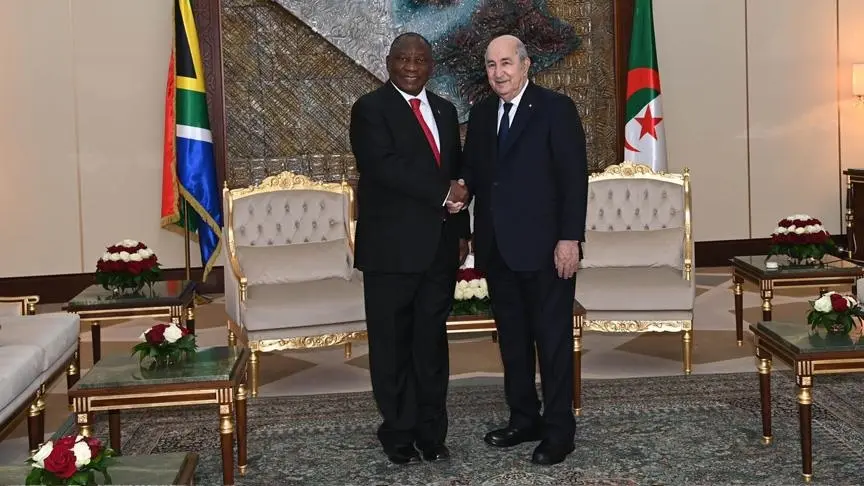
Algeria and South Africa insist on holding Israel accountable before the international judiciary

Algerian President Abdelmadjid Tebboune and his South African counterpart Cyril Ramaphosa stressed, on Friday, the need to hold Israel accountable before the International Court of Justice for its crimes against the Palestinians in Gaza.


This came at a press conference held at the Algerian presidency headquarters, following bilateral talks, at the start of a state visit by Ramaphosa to Algeria at the invitation of Tebboune.


The Algerian President praised "South Africa's efforts to hold the Israeli occupation accountable for its crimes against the Palestinians in the Gaza Strip, before the international judiciary."


He said: "I welcome the lawsuit filed by South Africa at the International Court of Justice against Israel," noting that his country "fully supports it."


Tebboune pointed out that "there is a convergence of views between Algeria and South Africa regarding the preference for negotiated political solutions to resolve crises away from foreign interventions."


He pointed out that "Algeria and South Africa agreed to intensify efforts within the United Nations and the African Union to enhance the role of the continent and work to achieve the demand to reform the UN Security Council system and correct injustice."


Tebboune recalled Africa's request for two permanent seats on the UN Security Council, as it is the only continent not represented by a permanent seat on the Council.


For his part, Ramaphosa said that he informed "the Algerian president of the lawsuit filed by South Africa before the International Court of Justice to hold the occupying Israeli state accountable for its crimes against the Palestinian people in Gaza."


He added that his country "recorded a lack of respect for international law and we filed a complaint against the Israeli occupation and the war crimes it is committing in Gaza and we received great support from many countries."


Ramaphosa added: "We demand respect for international law in Palestine and we stand in solidarity with all oppressed peoples."


He thanked the countries that supported his country's lawsuit against Israel, saying: "South Africa expresses its appreciation for the support we have received from various countries around the world, especially from the government and people of Algeria regarding the initiative to hold the Israeli occupation accountable."


He renewed South Africa's call "for a cessation of hostilities, the release of all hostages and the provision of urgent humanitarian assistance to the people of Gaza who are in dire need of it."


Ramaphosa pointed out that his country "has suffered from the scourge of oppression, occupation and the deprivation of rights, so we stand in solidarity with oppressed peoples everywhere, including in Palestine."


He stressed that "South Africa and Algeria agree that the only permanent solution to this ongoing conflict in Palestine is to achieve the right of the Palestinian people to self-determination."


On December 29, 2023, South Africa filed a lawsuit against Israel at the International Court of Justice for violating the 1948 UN Convention on the Prevention and Punishment of the Crime of Genocide.


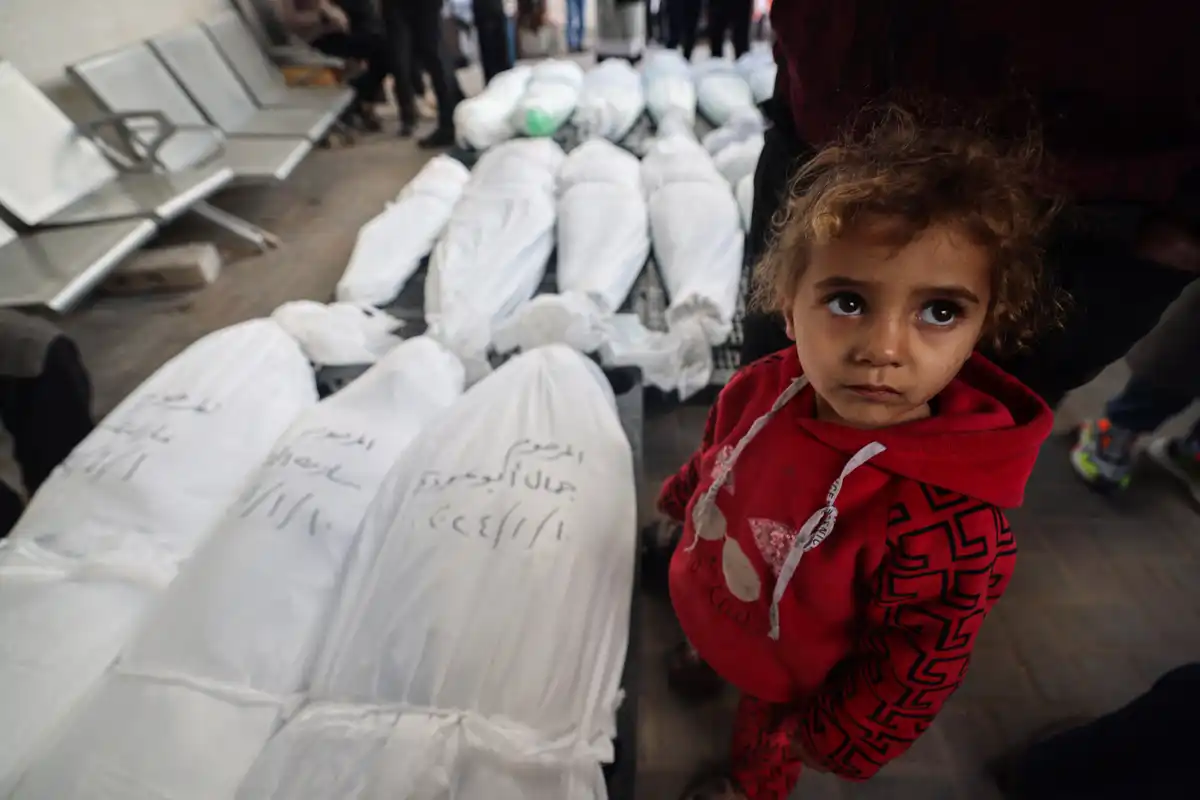
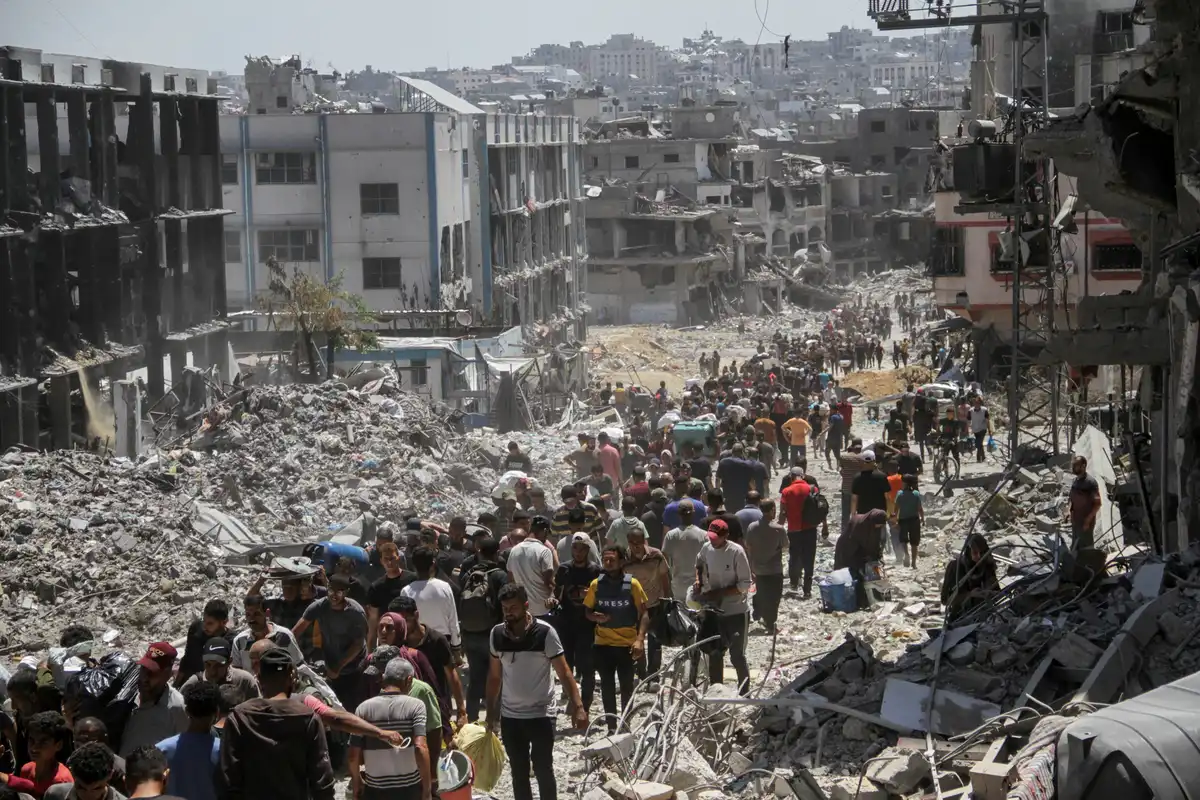
With American support, Israel has been committing genocide in Gaza since October 7, 2023, leaving more than 150,000 Palestinians dead and wounded, most of them children and women, and more than 11,000 missing, amid massive destruction and famine that killed dozens of children and the elderly, in one of the worst humanitarian disasters in the world.


Israel also defies the UN Security Council resolution calling for an immediate end to the war, and the International Court of Justice's orders to take measures to prevent genocide and improve the catastrophic humanitarian situation in Gaza.


Ramaphosa began an open-ended state visit to Algeria on Thursday night, during which he is scheduled to deliver a speech before the country's parliament.

PALESTINE

Fri 06 Dec 2024 6:44 pm - Jerusalem Time

Dead and injuries in Israeli bombing of Gaza and Rafah

Six citizens were killed and others were injured, Friday evening, in an Israeli occupation bombing of the cities of Gaza and Rafah.


According to local sources, four citizens were killed and others were injured when the occupation aircraft targeted a gathering of citizens on Kashko Street in the Zeitoun neighborhood, south of Gaza City, while two citizens were killed in an occupation bombing west of Rafah, south of the Strip.


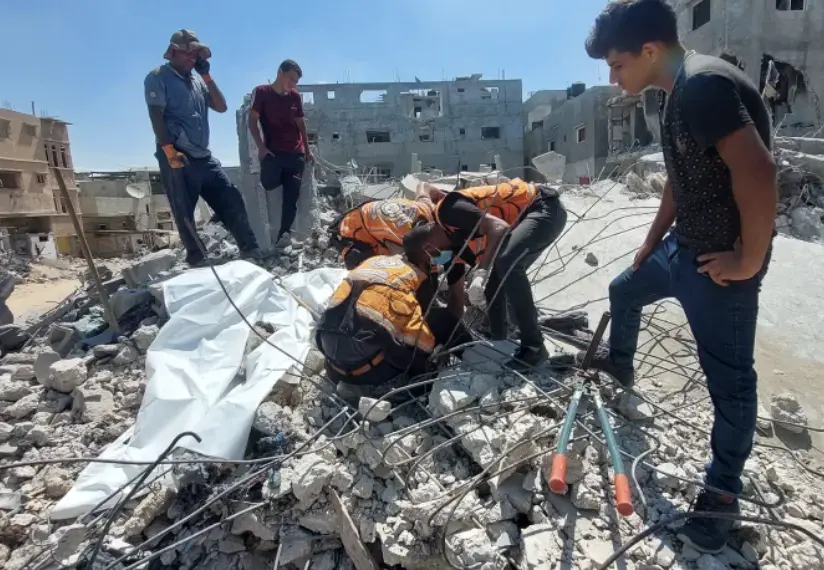
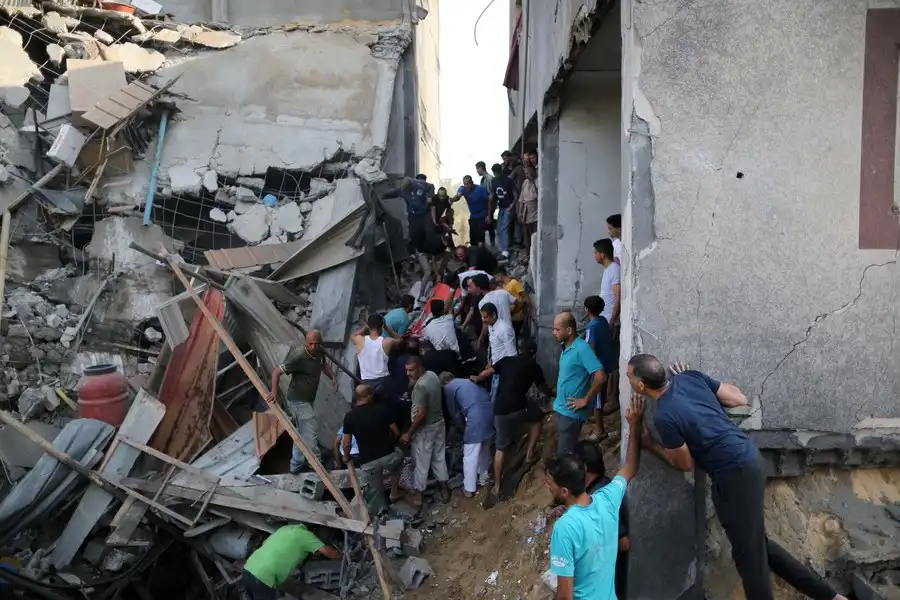
The Israeli occupation forces have continued their aggression on the Gaza Strip, by land, sea and air, since October 7, 2023, resulting in the death of 44,612 citizens, the majority of whom are women and children, and the injury of 105,834 others, in an incomplete toll, as thousands of victims are still under the rubble and on the roads, and ambulance and rescue crews cannot reach them.

ARAB AND WORLD

Fri 06 Dec 2024 6:27 pm - Jerusalem Time

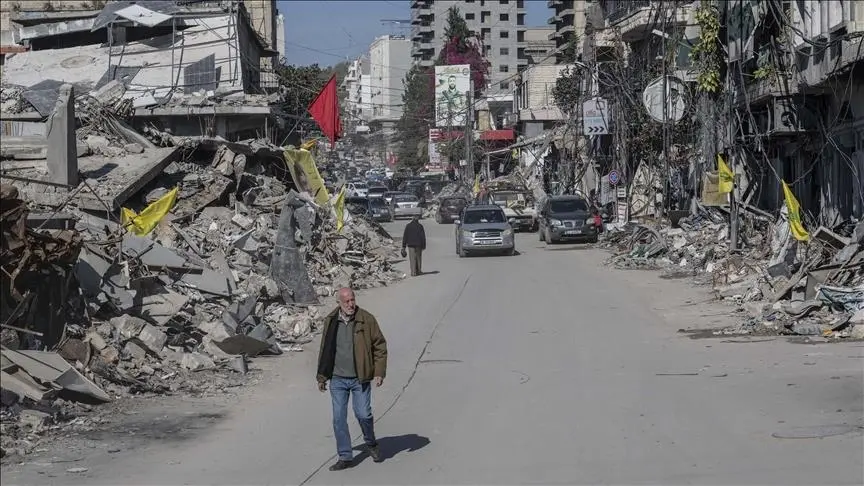
9 Israeli violations of ceasefire on Friday, raising total to 150 in Lebanon

On Friday, the Israeli army committed 9 violations of the ceasefire with Hezbollah, bringing the total number of violations since the agreement went into effect 9 days ago to 150.


This came according to statistics prepared by Anadolu Agency based on the announcements of the official Lebanese News Agency until 16:00 GMT.


According to various news published by the agency, the violations today were concentrated in the Bint Jbeil district in the Nabatieh Governorate (south), the Tyre district in the South Governorate (south), and the Akkar district in the Akkar Governorate (north).


The Israeli violations varied between artillery and missile shelling, machine gun fire, incursions, and air and drone raids.


In Bint Jbeil district, Israeli forces opened fire with machine guns at dawn and morning on a number of towns in the central sector, especially the towns of Aita al-Shaab and Ramyeh.


Meanwhile, the town of Aitaroun in the same district witnessed a number of Israeli violations, including the firing of a number of artillery shells at homes, and extensive combing operations with medium machine guns at night.


In the morning hours, significant movement of Israeli army vehicles and tanks was observed inside the town, in addition to the launch of a rocket, the sound of whose explosion caused confusion and tension among the residents, prompting some of them to leave their homes and leave the town.


An Israeli drone also tried to target a car in the city of Bint Jbeil, the center of the district, but was unable to hit it.


In Tyre district, an Israeli drone exploded in a water tank in the town of Majdal Zun.


In Akkar district, Israeli warplanes raided the Arida border crossing with Syria at dawn, causing damage to the infrastructure and cutting off the road between the two countries.


Since November 27, a fragile ceasefire has prevailed, ending the mutual shelling between Israel and Hezbollah that began on October 8, 2023, and then turned into a full-scale war on September 23.


Under the pretext of confronting "threats from Hezbollah," Israel committed 141 violations of the ceasefire in Lebanon until the end of Thursday, resulting in a total of 14 deaths and 18 injuries, according to a statistic by Anadolu Agency based on data from the Lebanese Ministry of Health.


The Israeli violations varied between artillery shelling, raids, warplane and drone flights, machine gun fire, incursions, and the launching of flares.


These violations prompted Hezbollah to respond on Monday, for the first time since the agreement came into effect, with a missile attack targeting the Ruwaysat al-Alam military site in the occupied Lebanese hills of Kfar Shuba.


Among the most prominent provisions of the ceasefire agreement, according to a document obtained by Anadolu Agency, is Israel's gradual withdrawal to the south of the Blue Line separating Lebanon and Israel within 60 days, and the deployment of Lebanese army and security forces along the border, crossing points, and the southern region.


Under the agreement, the Lebanese army will be the only entity allowed to carry weapons in the south of the country, with the dismantling of military infrastructure and sites, the confiscation of unauthorized weapons, and the establishment of a committee to supervise and help ensure the implementation of these obligations.

ARAB AND WORLD

Fri 06 Dec 2024 5:59 pm - Jerusalem Time

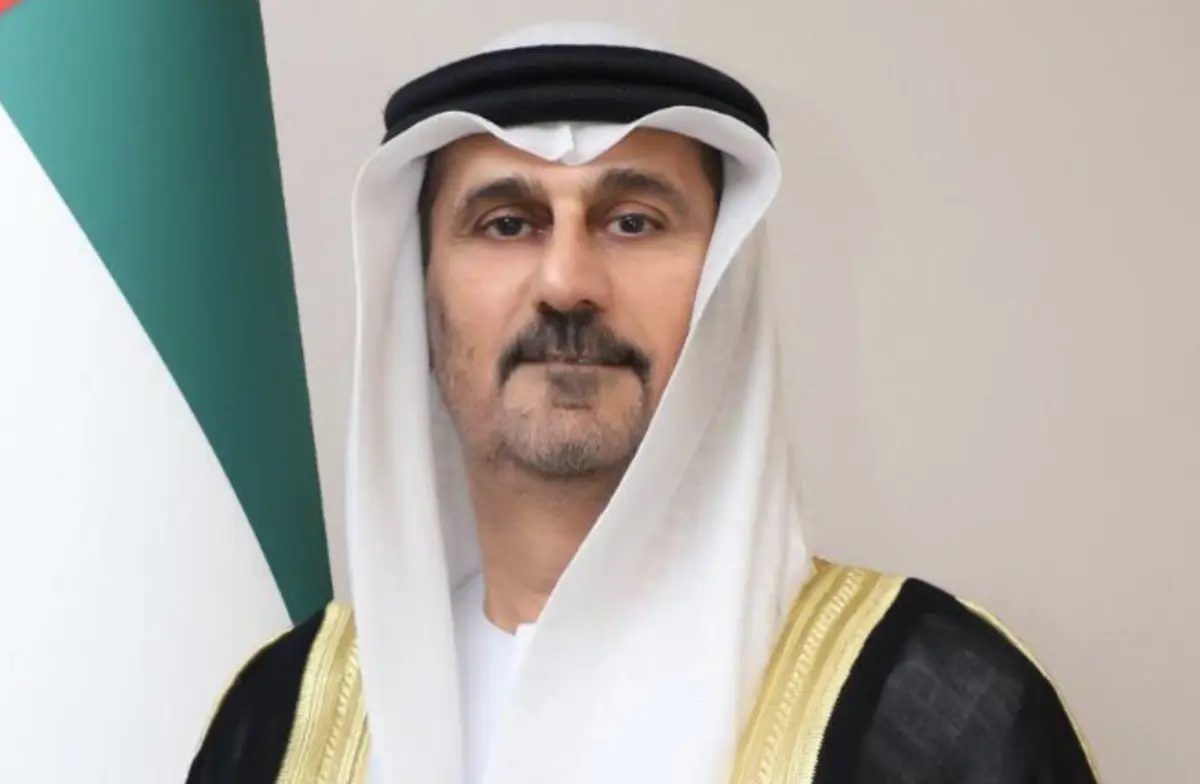
UAE Ambassador to China: UAE-China relations are a distinguished model of strategic partnership

“The diplomatic relations between the UAE and China, whose 40th anniversary we are celebrating this year, are a distinguished model of strategic partnership, as the relations between the two friendly countries are characterised by mutual trust, comprehensive cooperation and a shared vision of global challenges,” said Hussain bin Ibrahim Al Hammadi, UAE Ambassador to China, in a recent exclusive interview with Xinhua News Agency.


The ambassador stressed that through the vision of the leaders of the two countries, bilateral cooperation has been enhanced to include various fields such as clean and sustainable energy, trade, tourism, culture and education. This leadership role has contributed to the signing of strategic agreements, increasing bilateral investments and organising exhibitions, conferences, forums and summits that reflect the commitment of the two countries to developing relations towards broader horizons.


Speaking about economic cooperation, the ambassador said that economic relations represent the fastest growing and developing aspect of UAE-China relations, as China is the UAE’s first trading partner, and the UAE is China’s first trading partner in the Middle East and North Africa region in terms of non-oil bilateral trade, noting the two countries’ determination to reach a volume of bilateral trade of 200 billion US dollars by 2030.


Al Hammadi pointed out that the UAE hosts a large number of Chinese companies operating in a favorable environment that enhances opportunities for growth and innovation, given that the UAE is considered a major attraction center for Chinese investments in the Middle East region, adding, "We also have greater ambitions to expand Emirati investments in China more and more, in the interest of the two friendly peoples and countries."


He added that the UAE was one of the first countries to join the Belt and Road Initiative, which opened a vast gateway of opportunities for the two countries that contributed to expanding bilateral cooperation in all fields. He also pointed out that the UAE's accession to the BRICS group this year is an important step that reflects the UAE's commitment to cooperating with emerging economies in the world to promote global peace, stability and prosperity.


On the other hand, the ambassador said that the cooperation between the UAE and China in the field of renewable energy is witnessing increasing momentum, and that this cooperation reflects a shared strategic vision aimed at enhancing the transition towards clean and green energy and achieving sustainable development. The Al Dhafra Solar Photovoltaic Power Plant project in Abu Dhabi, which is considered one of the largest solar photovoltaic projects in the world, and the Emirates Wind Energy Program in Abu Dhabi, which began operating in 2023, were launched. These two projects were built by Chinese companies, which represents an important step towards achieving the UAE's goals in the field of renewable and clean energy.


Educational and cultural exchange is also one of the main pillars of bilateral relations between the two countries. The ambassador said that educational and cultural exchange programmes have been a major driving force in strengthening UAE-China relations and opening new horizons for academic and cultural cooperation between the two countries.


In this context, Al Hammadi pointed out that the opening of the Sheikh Zayed bin Sultan Al Nahyan Center for Arabic Language and Islamic Studies at Beijing Foreign Studies University was among the most prominent initiatives that formed a bridge to enhance mutual understanding between the peoples of the two countries, while initiatives such as the 200 Chinese Language Schools Project and Confucius Institutes in the UAE played a vital role in promoting the teaching of Chinese language and culture, as the Chinese language is witnessing great demand and widespread spread in the UAE, and is now taught in an increasing number of local schools.


Al Hammadi added that the tourism sector is one of the main areas of cooperation between the two countries, as the total number of Chinese tourists to the UAE reached more than one million visitors in 2023, with more flights organised weekly between the two countries via Emirati and Chinese airlines.


Al Hammadi added, "Today, thanks to the wise leadership of both countries, the two countries are moving steadily towards a prosperous and sustainable future, as they continue to build bridges of communication and joint cooperation for the benefit of the two peoples and for future generations."

PALESTINE

Fri 06 Dec 2024 5:41 pm - Jerusalem Time

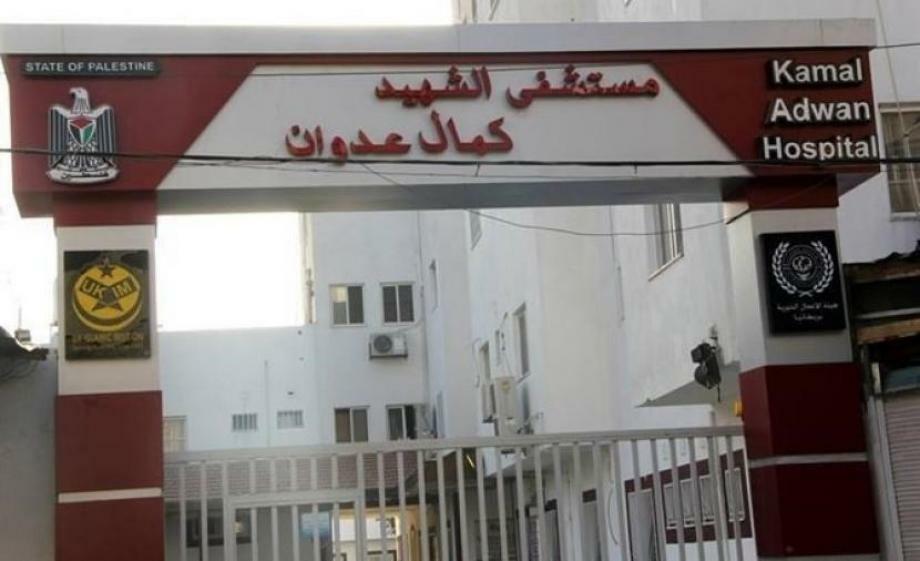
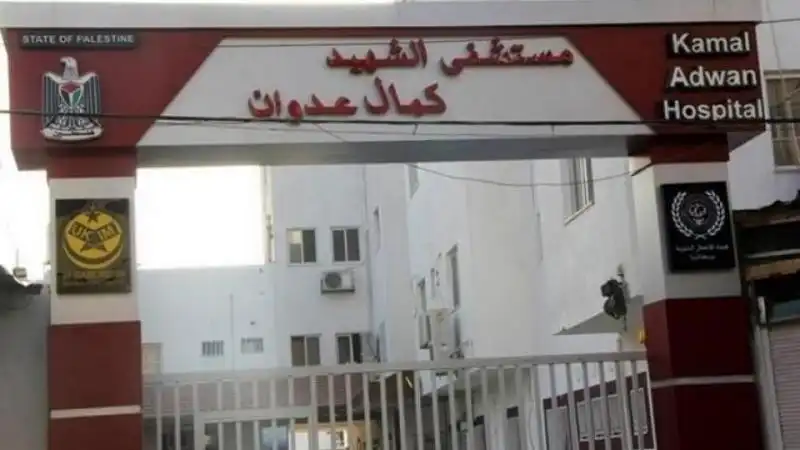
Civil Defense in Gaza: Israeli occupation bombs the vicinity of Kamal Adwan Hospital

Civil Defense in Gaza confirmed that the Israeli occupation forces continuously bombed the vicinity of Kamal Adwan Hospital, and fired from drones at the hospital.


The Civil Defense in Gaza announced the death of at least 29 people and the injury of dozens in the northern Gaza Strip since dawn on Friday as a result of the continued Israeli occupation bombing of the vicinity of Kamal Adwan Hospital.


The Ministry of Health in Gaza announced that the Israeli occupation forces committed three massacres in the Strip during the past twenty-four hours, resulting in 32 dead and 95 wounded people arriving at hospitals.


Since the beginning of the aggression, the death toll has risen to 44,612, while the number of wounded has reached 105,834, according to statistics from the Ministry of Health.


PALESTINE

Fri 06 Dec 2024 4:52 pm - Jerusalem Time

WHO: At least 12,000 patients need medical evacuation from Gaza Strip

The World Health Organization announced the evacuation of 8 patients from the Gaza Strip, which has been subjected to an Israeli war of extermination for 14 months, out of at least 12,000 patients in need of evacuation.


This was stated by the Director-General of the World Health Organization, Tedros Adhanom Ghebreyesus, today, Friday, in a post on his account on the "X" platform.


Ghebreyesus explained that the medical evacuation was carried out by the European Union's Civil Protection Mechanism, noting that 5 patients were transferred to Belgium, 2 to Spain, and 1 to Romania.


He expressed his thanks to the governments that received the patients and all the supporters and partners, noting that at least 12,000 patients in Gaza need medical evacuation.

PALESTINE

Fri 06 Dec 2024 4:35 pm - Jerusalem Time

International newspapers: Gaza moved the world in 2024 and evidence documents Israel's crimes there

International newspapers have highlighted the worsening humanitarian crisis resulting from the ongoing Israeli war on the Gaza Strip, in addition to the rapid field developments in the Syrian file.


The American Wall Street Journal says in a report from inside the Netzarim axis, which separates the north and south of the Strip, that everything there indicates that Israel is planning to control Gaza in the long term.


The newspaper pointed out that "there are two military bases that include mobile shelters, electricity poles, cell towers, and even a synagogue," explaining that Israel has razed the entire area around Netzarim to the ground, including villages, streets, and farms.


The Israeli newspaper Haaretz highlighted what it described as a huge database of evidence, which it said was collected by Israeli historian Lee Mordechai, documenting the war crimes committed by the Israeli army in the Gaza Strip.


According to the evidence, video clips show Israeli soldiers behaving in a manner that contravenes the customs and laws of war, such as shooting a woman and her son while they were raising a white flag, allowing dogs to devour corpses and photograph them, and enjoying scenes of the killing of Palestinians.


In turn, the American newspaper, The New York Times, said that the number of Gaza residents with special needs is increasing and their families are suffering greatly, amidst the fierce war and the many evacuation orders issued by the Israeli army.


The newspaper reported that the suffering of the blind, deaf, and those with physical and cognitive disabilities has been exacerbated by the severe shortage of the capabilities and devices they need, and the damage to roads, sidewalks, and homes with features that assist them.


In the Syrian file, the French website Mediapart saw that the fall of the city of Hama into the hands of the armed Syrian opposition forces "brought down a legend and carried a special symbolism that was more than 40 years old."


The website referred to the Hama events of 1982, in which the regime of the late President Hafez al-Assad killed no less than 20,000 people "in a massacre that it wanted to be a lasting lesson in the memory of every Syrian who thought of disobeying it," adding that "this myth has fallen today."


The American Time magazine published an international report that sheds light on the reality of individual and civil liberties across the world during the current year.


The report points out the role of Gaza in mobilizing the world, noting that this year was distinguished by the fact that solidarity activities with the Palestinians were found everywhere, but they were subjected to suppression, especially in Western countries, through the use of force, where Germany outperformed everyone in this field.

PALESTINE

Fri 06 Dec 2024 4:04 pm - Jerusalem Time

"Health" directs a distress call to stop Israeli occupation's aggression against the health system, patients and the wounded

The Ministry of Health has issued a distress call to the international community, international human rights and health institutions, and the International Committee of the Red Cross, for more action, pressure, and intervention to stop the brutal Israeli occupation aggression against the health system and its staff, and against patients and the wounded.


The ministry said in a statement on Friday that the occupation is targeting treatment centers, bombing them, killing, wounding and arresting those inside them, and preventing them from receiving any medical supplies and support. It pointed out that this aggression, which is internationally and humanitarianally prohibited, is escalating daily, as the occupation forces are bombing hospitals and killing those inside them in front of the entire world, to the point that the targeting has included volunteer medical teams from many countries.


She pointed out that Kamal Adwan Hospital, north of the Gaza Strip, is now being subjected to a new war crime, as the occupation forces are practicing all forms of killing and violence in it and around it, and the remaining wounded inside it are suffering from severe wounds and are in immediate need of treatment.


The Ministry of Health confirmed that the scale of the humanitarian disaster in the southern governorates is horrific and beyond description, as there is no safe health environment, no living conditions that protect citizens from diseases and cold, no potable water, no electricity, fuel, food and medicine.


The ministry said that for more than a year, it has been calling on a daily basis to provide protection for treatment centers, health personnel, ambulance crews and vehicles, and volunteer medical teams, to stop the aggression, and to allow the entry of urgent medical supplies and the exit of the wounded for treatment.


She explained that the number of hospitals that are partially operating in the Gaza Strip is 17 hospitals out of 36, with minimal capabilities in terms of staff, supplies, equipment, fuel and electricity, and they are threatened with stopping work at any moment, and most of the ambulance and health care centers are out of service, noting that about 1050 health workers have been martyred to date, and 136 ambulances have been out of service, in addition to recording more than a thousand attacks on the health sector.


OPINIONS

Fri 06 Dec 2024 3:32 pm - Jerusalem Time

How to End the War in Gaza: Lessons from Lebanon

Washington  Institute for Near Eat affairs

Washington Institute for Near Eat affairs

Opinion Writer

by Stuart Eizenstat, Dennis Ross

 The Lebanon deal shows how Washington and Israel can use their newly gained leverage to resolve the Palestinian crisis.The cease-fire between Israel and Hezbollah brokered by President Joe Biden’s envoy Amos Hochstein is an important achievement. It reflects the lessons that the two of us have learned in a lifetime of diplomacy and statecraft—and those lessons can be applied to Gaza and the broader Middle East by the Biden administration in its remaining days and by the incoming Trump administration.

The first lesson is the crucial importance of backing diplomacy with decisive military power and accurate intelligence in order to secure an achievable political objective. As the United States painfully learned in the Iraq War and in Afghanistan, the use of military force divorced from an achievable political outcome is doomed to fail. Force is a tool, not an end in itself.Israel’s use of force set the stage for diplomacy by dramatically weakening Hezbollah. After accepting Hezbollah’s imposition of a limited war for nearly a year, the Israel Defense Forces and Mossad acted decisively to decapitate Hezbollah’s leadership; disrupt its command, control, and communications; destroy 80 percent of its rocket forces; and dismantle its weapons stocks and infrastructure—below- and aboveground—that it had built up along Israel’s borders. Israel also retaliated against Iran after its October 1 ballistic-missile attack on Israel, destroying Iran’s strategic air and missile defense and 90 percent of its ballistic-missile-production capability. 

In doing so, it reminded us once again of Henry Kissinger’s maxim that you can achieve at the negotiating table only what you have won on the battlefield.A related lesson of good statecraft is recognizing opportunities and moving quickly to act on them. Timing matters, and the Biden administration recognized that Israel’s military achievements had created an opening to mediate a cease-fire between Israel and Hezbollah, working through the Lebanese government. The administration also believed Iran recognized that Hezbollah’s weakness made it vulnerable to its adversaries in Lebanon and that Iran, not wanting to lose the crown jewel of its Axis of Resistance, would want to end the war.Diplomacy also requires good timing. 

The conflict was not ripe for settlement until Hezbollah and Iran had been sufficiently weakened by Israel’s attacks. Only then was Hezbollah willing to abandon its insistence that ending its missile and drone attacks against Israel would first require a permanent cease-fire in Gaza.Additionally, negotiations worked because Israel had clear, limited, and achievable political objectives. The Israelis understood that they could not eliminate Hezbollah; instead, they aimed to ensure that Hezbollah could have no forces south of the Litani River and could not easily rearm there. Both of these steps had been mandated by UN Security Council Resolution 1701 in 2006—but its terms were never enforced, and Hezbollah violated its terms from day one. Hochstein used Israel’s military achievements and the Lebanese government’s desire to reestablish sovereignty over its territory to create a far more serious approach to implementation: As many as 10,000 Lebanese soldiers will be deployed to the border, while the U.S., France, and others will help improve the capabilities of the Lebanese army. 

The U.S. will also provide intelligence to monitor implementation of the agreement, and will chair the committee through which any violation will be immediately addressed. Israel has reportedly received assurances from the U.S. that, if violations are not reversed, it can act militarily.In Gaza, Israel has also successfully destroyed the military threat posed by an adversary—before October 7, 2023, Hamas had five brigades, with 24 battalions. Those are now gone, along with most of its weapons depots, labs, and production facilities. More than 60 percent of its tunnels have been blown up, including some as deep as a 25-story building. But unlike in Israel’s conflict with Hezbollah, in which it set more limited goals, Israeli Prime Minister Benjamin Netanyahu has repeatedly pledged “total victory” over Hamas. Just as Israel could not eliminate Hezbollah—and the U.S. could not eliminate the Taliban in Afghanistan—Israel can defeat Hamas but not eradicate it, as IDF leaders have recognized. Hamas’s ideology has been profoundly destructive to the Palestinian people, and polls show that they know it. 

Israel now needs to translate its military achievements against Hamas in Gaza into a sustainable political outcome. Israel has repeated the mistake in Gaza that the George W. Bush administration made in Iraq and Afghanistan, and failed to marry its military action to achievable political goals at the outset.In Gaza, Israel must avoid either a vacuum, in which Hamas could reemerge, or an indefinite stay, which would guarantee an insurgency. Israel did not adopt the successful model that General David Petraeus employed in Iraq, clearing an area of terrorists and then holding it, while building a better life for civilians. Such a model applied to Gaza would have provided Palestinians with both security from Hamas and confidence that it would not return. Instead, the IDF is still fighting in northern Gaza, even though it has cleared the area multiple times.The most viable alternative is a mixed interim administration. The United Arab Emirates is prepared to be part of a stabilization force in Gaza, and Egypt, Morocco, Jordan, and Bahrain might also participate—not to bail out Israel, but to ensure that it withdraws and to end Palestinian suffering. They would join with others, including the United States and European nations, to administer Gaza. Rebuilding Gaza will be an enormous task in its own right, but it will also require the restoration of law and order, the prevention of smuggling, and the permanent demilitarization of the area.The aim of such an administration would be to have the Palestinian Authority assume control over Gaza in 18 to 24 months. 

The PA today is weak, dysfunctional, and corrupt, but it can be reformed, as it was during Salam Fayyad’s tenure as prime minister from 2007 to 2012. Once reformed, it could assume responsibility for Gaza. But none of this will happen unless there is an end to the war, conditioned on the release of all the hostages, and accompanied by a withdrawal of Israeli forces—which, as in Lebanon, Netanyahu can rightly claim resulted from Israel’s military achievements.

In Gaza, as in Lebanon, Israel has won militarily—and so it must focus now on producing a diplomatic outcome. The Biden administration can again use the leverage of Israel’s military achievements to push a political process in which Arab states and others can come into Gaza, as Secretary of State Antony Blinken has been attempting.Our experience is that personal relationships are crucial to successful diplomacy, especially in the Middle East. President-Elect Donald Trump has great credibility with the Israeli government, and with the Gulf States, including Saudi Arabia. That he has made it clear that he wants the war in Gaza to end no doubt contributed to Netanyahu’s acceptance of the U.S.-brokered cease-fire in Lebanon and adds to the prime minister’s need to find an acceptable way out of Gaza. 

Producing an international and regional administration in Gaza and phasing out the IDF will take some time—and should be done in coordination with the incoming Trump administration. It would be a mistake for Israel to wait for the new administration, as it will take time for Trump to put in place officials who can do what the Biden administration is already doing.The smart application of statecraft has produced a cease-fire in Lebanon, and it has now created an opening to end the war in Gaza. 

Peace in Gaza would also create an opportunity for Trump to expand the Abraham Accords to include the normalization of ties between Israel and Saudi Arabia, which he has declared a priority. The Saudis want a credible pathway to a Palestinian state as the precondition of any deal, while the Israeli public and the current government are not ready to accept that. Trump will need to move quickly to leverage his political capital with the Saudis and Israelis if he hopes to pull off a deal. But if he can, a Saudi-Israeli breakthrough would transform the Middle East, creating a coalition to counter Iranian threats and promoting stability and progress in the region.

OPINIONS

Fri 06 Dec 2024 3:25 pm - Jerusalem Time

Biden’s Moral Failure Was Israel and Not the Pardon of His Son

Counter Punch

Counter Punch

Opinion Writer

Melvin Goodman

The mainstream media is largely ignoring President Joe Biden’s moral failure regarding Israel’s genocidal bombardment of Gaza, but piling on unreasonably regarding the pardon given to his son.  Biden’s unwavering support for Israeli Prime Minister Benjamin Netanyahu’s military campaign could not be more inconsistent with Biden’s overall humanitarian ideals over his long political career.  HIs support for Netanyahu is totally inconsistent with the president’s admirable and ethical 50-year political career, and his propensity for ignoring the plight of the Palestinians over his long career should be condemned.

Biden’s moral failure on Israel received a free pass from the mainstream media, but the response to the pardon has been outrageous and hyperbolic.  The timing of the pardon for Hunter Biden should have received more attention because it followed Trump’s naming of morally challenged men and women to key positions in his second term.  For the most part, these individuals have demonstrated total fealty to the vengeance and revenge that Trump will be pursuing.  Former representative Matt Gaetz has already had to step aside from consideration as Attorney General, and the naming of Pam Bondi as a replacement provides no assurance that the Department of Justice will not be weaponized to go after Trump’s “enemies.”

The naming of Kash Patel as F.B.I. director tells you everything you need to know about the wretches that have been selected thus far.  There is no reason for President Biden to allow his son to enter a cycle of jurisprudence that will be influenced by such corrupt and unworthy individuals.  And then there is the matter of a Pete Hegseth at the Pentagon or a Tulsi Gabbard as an intelligence tsar.  Has there ever been such a ship of fools that was supposed to govern the United States of America?

The mainstream media has been derelict in dealing with Trump and his followers for the past eight years.  The Washington Post’s masthead proclaims that “democracy dies in darkness.”  This turned out to be a self-fulfilling prophecy when the paper’s owner, Jeff Bezos, stopped the publication of an editorial that supported Vice President’s Kamala Harris.  The media have falsely branded Trump as “anti-war.”  This description is belied by the fact that former secretary of defense James Mattis was so worried that Trump would have a nuclear war with North Korea that he slept in gym clothes in case of an emergency.  Another indicator of Trump’s irrationality was the fact that Milley and Esper “only narrowly dissuaded” Trump from ordering 10,000 active-duty troops into Washington in the summer of 2020, according to Bob Woodward’s “War.”

Biden should extend pardons to many others who have been threatened by Trump and his minions.  Trump not only pledged to prosecute the Biden family, but issued additional specific threats to the former chairman of the Joint Chiefs of Staff, General Mark Milley, as well as to such Trump critics as former representatives Liz Cheney and Adam Kinzinger.  Milley certainly feels threatened by the supporters of Trump in view of the fact that he has installed bullet-proof windows in his house as well as blast-resistant curtains at significant personal expense.

Biden should consider pardons for two retired four-star generals who were critical of Trump: Special Operations commander William McRaven, who oversaw the raid that killed Osama bin Laden, and the commander of U.S. and NATO forces in Afghanistan, Stanley McChrystal.  In his first term, according to Woodward’s “War,” Trump threatened to recall both of them to active duty and court-martial them for disloyalty.  The list of enemies goes on and on.

I can’t imagine that any judge or jury would convict such public figures as Representatives Nancy Pelosi and Adam Schiff, but they have been threatened as well.  And what about Dr. Anthony Fauci, one of the true heroes during the Covid nightmare, whom Trump has called an “idiot.”  As a result of Trump’s ugly accusations aimed at Fauci, the good doctor has received credible death threats and, like other Trump critics, has been forced to hire security guards to protect himself and his family.

There is no precedent for the fact that virtually every key official from Trump’s first term has publicly proclaimed that he should never be returned to the White House and should not have even been placed on the ballot.  This list of luminaries includes former vice president Mike Pence, former secretaries of defense James Mattis and Mark Esper, former national security adviser John Bolton, former director of national intelligence Dan Coats, and former secretary of state Rex Tillerson.  Indeed, Trump’s appointees in the first term presented no challenges to confirmation; most of Trump’s current appointees should never be confirmed.

Overall, the mainstream media has been guilty of ignoring the profound political and ethical challenge that Donald Trump and his MAGA supporters represent to the interests of the United States and its citizenry.  For the past eight years, the press has treated Trump as a demagogue and a political aberration, and have tried to make sense out of Trump’s senseless rhetoric.  The New York Times’s view that the Biden pardon will make it “harder for Democrats to defend the integrity of the Justice Department” is particularly obtuse.

Presidential historian Jon Meacham got it right when he stated last month that Trump’s “contempt for constitutional democracy makes him a unique threat to the nation.”  As a president and as a father of a family that has had to deal with more than its share of tragedy, Joe Biden had every right to pardon his son, whose legal problems were made particularly severe because he was the president’s son.

Melvin A. Goodman is a senior fellow at the Center for International Policy and a professor of government at Johns Hopkins University.  A former CIA analyst, Goodman is the author of Failure of Intelligence: The Decline and Fall of the CIA and National Insecurity: The Cost of American Militarism. and A Whistleblower at the CIA. His most recent books are “American Carnage: The Wars of Donald Trump” (Opus Publishing, 2019) and “Containing the National Security State” (Opus Publishing, 2021). Goodman is the national security columnist for counterpunch.org.


PALESTINE

Fri 06 Dec 2024 3:24 pm - Jerusalem Time

Two Palestinians killed in Israeli bombing in the central Gaza Strip

Two citizens were killed today, Friday, in an Israeli occupation forces bombing in the central Gaza Strip.


Wafa News Agency reported that two citizens were killed and another was seriously injured in an Israeli bombing east of Al-Maghazi in the central Gaza Strip.


The occupation aircraft also targeted homes and buildings, while military vehicles opened fire in the Tel al-Hawa neighborhood, southwest of Gaza City.


The Israeli occupation forces have continued their aggression on the Gaza Strip, by land, sea and air, since October 7, 2023, resulting in the death of 44,612 citizens, the majority of whom are women and children, and the injury of 105,834 others, in an incomplete toll, as thousands of victims are still under the rubble and on the roads, and ambulance and rescue crews cannot reach them.

PALESTINE

Fri 06 Dec 2024 3:23 pm - Jerusalem Time

WHO: No warning sign before Kamal Adwan Hospital bombing

The World Health Organization's representative in the occupied Palestinian territories, Rick Peeperkorn, said that the organization had no indication that a warning had been issued before the Israeli occupation forces bombed Kamal Adwan Hospital, north of the Gaza Strip, on Thursday morning.


"Kamal Adwan Hospital is currently operating at a minimum capacity," Peeperkorn added during a press briefing in Geneva via video link.

OPINIONS

Fri 06 Dec 2024 3:22 pm - Jerusalem Time

Netanyahu’s Diabolical Undeclared War Objectives in Gaza

Counter Punch

Counter Punch

Opinion Writer

Jamal Kanj

Israeli Prime Minister Benjamin Netanyahu has declared that Israel’s war on Gaza will continue until achieving what he terms “total victory.” Instead of critically examining Netanyahu’s vague and open-ended objectives, much of the Western media and many governments frame the onslaught as self-defense, and some even normalize the genocide as a “humane” attempt to “free” Israeli captives.

At the same time, the same pundits decontextualized the Palestinian right to self-defense by ignoring that the October 7 revolt was a direct response to over two decades of Israel’s imposed “starvation diet” blockade on Gaza. Exactly, as the West turns a blind eye, and continues to enable Israel’s theft of Palestinian-occupied land in the West Bank to benefit Jewish-only colonies.

Meanwhile, these media outlets downplay or dismiss Israel’s treacherous undeclared war objectives, even to the detriment of Israeli captives and the immense civilian suffering in Gaza.

For over a year, Netanyahu has prioritized an agenda to reoccupy and to ethnically cleanse northern Gaza rather than engage in negotiations for prisoner’s swap. Especially since the release of Israeli captives would undermine one of Netanyahu’s primary pretexts for pursuing his sinister objectives.

This is only possible in the wake of Western leaders embracing Netanyahu’s racist perspective, focusing only on the well-being of Israeli captives, while ignoring the over 10,000 Palestinian hostages held in Israeli jails, and the welfare of the 2.3 million Palestinians in Gaza. For instance, Joe Biden has expressed recently his concern over Netanyahu potentially delaying action to secure the release of Israeli captives until January 20, 2025, while expressing no sympathy for the suffering of Palestinians in 2024 and beyond.

With the conspicuous silence or impotence of world bodies, the Israeli captives became a convenient fig leaf under which Netanyahu saw as an opportunity to reoccupy Gaza. It is worth recalling that in 2005, Netanyahu resigned from the Israeli government in protest against Prime Minister Ariel Sharon’s decision to “disengage” and remove the Jewish-only colonies from the Gaza strip.

Immediately following October 7, Netanyahu launched a genocidal war, disregarding the Palestinian Resistance’s proposal for prisoner’s exchange. His decision to pursue war instead of negotiations was motivated by several factors:

a) Deflect responsibility for the intelligence failure under his watch. b) Evade scrutiny of his role in facilitating external funding to Hamas. d) Execute a campaign of genocide and ethnic cleansing to reoccupy Gaza.

The strategy to ethnically cleanse Gaza was openly advocated by Israel’s racist Finance Minister, Bezalel Smotrich, who three months following October 7 called for Palestinians to leave Gaza. The scion of an Ukrainian immigrant repeated the century-old European Zionist myth of blooming the desert⎯a narrative that not only ignores historical and geographical realities but also contradicts his own Old Testament that once described Canaan, the land of the Filastin (Palestine), as the “land of milk and honey,” before the ancient Hebrews migrated from their original homes to Palestine.

Further, and on January 1, 2024, Smotrich’s fellow racist National Security Minister, Itamar Ben Gvir, declared in a Knesset speech that Israel should never withdraw from any territory it occupies and explained that the establishment of new Jewish-only colonies in Gaza as “an important thing.” The following day, on January 2, Ben Gvir doubled down, stating that displacing “hundreds of thousands” of Palestinians from Gaza would help pave the way for the creation of the new Jewish-only colonies.

More recently, on Monday, November 25, Smotrich declared to the Yesha Council, an umbrella group representing the Jewish-only colonies in the occupied West Bank, “We can and must conquer the Gaza Strip.” He claimed there is “a unique opportunity” with Donald Trump’s election to halve Gaza’s population—a veiled euphemism for ethnic cleansing. On Thursday, November 28, Israeli National Security Minister Itamar Ben Gvir echoed similar calls to “reoccupy the Gaza Strip.”

On the ground inside Gaza, the tools of occupation were more explicit in defining the meaning of Netanyahu’s ostensible mantra: “total victory.” Israeli soldiers posed before an orange banner that read, “Only (Jewish-only) settlement (in Gaza) would be considered victory!” Notably, the orange color harkens back to the banners used by the settler movement in 2005 to protest Sharon’s decision to evacuate the Jewish-only colonies from Gaza.

To this end, and starting October 1st, Israel initiated a new phase of targeted genocide by starvation, blocking food aid trucks from entering northern Gaza, particularly the towns of Beit Lahia, Beit Hanoun, Jabalia and camp Jabalia. And where trucks were allowed in, food aid was swapped with sand bags. Starvation has become so widespread in these areas, women and children are forced to scavenge through mounds of trash for food.

On November 29, Ajith Sunghay, head of the U.N. Human Rights Office for the Occupied Palestinian Territories, stated after visiting Gaza that the “U.N. had been unable to deliver any aid to northern Gaza” due to “repeated impediments or outright rejections of humanitarian convoys by the Israeli authorities.”

Regarding the genocide by terror, U.N. Human Rights Chief Volker Türk reported that residents of northern Gaza are subjected to “non-stop” bombing. Simultaneously, hundreds of thousands have been ordered to evacuate, likely to make way for new Jewish-only settlements.

As part of the forced depopulation of Gaza’s northern region—the most fertile land in the strip—Israel is constructing a topographic barrier to isolate this area from the rest of Gaza. Beginning in early October, Israel carried out extensive controlled explosions, demolishing multi-story buildings to clear a path for a 5.6-mile road cutting across the strip. This road divides Gaza City from the northern towns of Jabalia, Beit Hanoun, and Beit Lahia. Human Rights Watch (HRW) has characterized this widespread forced displacement as part of an official government policy amounting to “crimes against humanity.”

On November 30, former Defense Minister and IDF Chief of Staff Moshe Ya’alon confirmed HRW findings, stating that Netanyahu and “far-right” (racist) elements are waging a war of “occupation, annexation, and ethnic cleansing.” He added, “There is no Beit Lahia, there is no Beit Hanoun.”

The live documented ethnic cleansing in Gaza, much like in 1948, alongside the expansion of Jewish-only colonies in the West Bank, underscores the true undeclared objectives in Israel’s ostensible “total victory.” In this contest, Netanyahu’s deliberate undermining of U.S.-led negotiations for prisoner’s swap exemplifies his quintessential diabolical persona: exploiting the predicament of his own Israeli captives to further his cynical undeclared agenda of slaughtering the “Amalek,” and ethnically cleansing Gaza to pave the way for new Jewish-only colonies.

Jamal Kanj is the author of Children of Catastrophe: Journey from a Palestinian Refugee Camp to America, and other books. He writes frequently on Arab world issues for various national and international commentaries.


OPINIONS

Fri 06 Dec 2024 3:20 pm - Jerusalem Time

The Tectonic Shift: The Gaza Genocide and the Limits of Israeli Hasbara

Counter Punch

Counter Punch

Opinion Writer

Ramzy Baroud

 The ongoing war and genocide in Gaza is unprecedented. Nothing that Israel and its supporters can say or do will avoid the historical accountability of the extermination of the Palestinian people in the Gaza Strip.

The above assertion is critical, both for ending the Israeli occupation of Palestine and achieving Palestinian freedom. This is why.

In all past wars and adjoining war crimes, Israel managed to push the reset button in its relationship with occupied Palestinians.

Following each war, the Israeli hasbara, propaganda machine, would start – utilizing the always-willing western mainstream media – to paint Palestinians in a negative light and to present Israel, a country that is supposedly in a permanent state of self-defense, as the victim, or even the lone defender of western civilization.

This campaign is always paralleled with the whitewashing of Israel in popular entertainment, from Hollywood movies to TV sit-coms, to magazine covers with such titles as “Gorgeous Photos Capture The Unseen Lives Of Female Soldiers In Israel”.

Generally, Western politicians of varied ideologies, along with intellectuals, news talking heads and church leaders all praise, in tandem, the miracle that is Israel.

At the beginning of Israel’s genocidal war in October 2023, for example, British playwright Tom Stoppard said that “before we take up a position on what’s happening now, we should consider whether this is a fight over territory or a struggle between civilization and barbarism.” He, of course, leaned towards the latter.

This Israeli tactic always includes the demonization of Palestinians as well, where the victim becomes the ‘terrorist’ and those under siege become the besiegers. This last claim, in particular, was expressed in the words of former US Secretary of State Madeline Albright who said, in an interview with NBC in August 2000, that “the Israelis feel under siege from the Palestinian rock throwers and the various gangs that have been roaming around.”

Why will those same Israeli tactics fail this time? Indeed, they will fail, not due to Israel’s lack of trying. In fact, Israel is already bracing for the fight of a lifetime.

One new tactic that Israel is already employing in ‘friendly’ countries, like the United States, is the passing of laws to block the mere conversation on the Israeli genocide in Gaza, so that it will have exclusive access to the American public.

On November 14, the US House of Representatives passed two bills: H.R.6408 and H.R.9495. The latter, in particular, aimed at giving the Treasury Secretary the authorization to revoke an organization’s tax-exempt status and decide when the designation would end.

Once these bills pass the Senate and are approved by the president, the most democratic and peaceful expressions of rejecting the Israeli occupation of Palestine and demanding sensible US foreign policy will be equated to a direct violation of the law and, in some cases, to terrorism – as defined by the Department of Treasury, at the behest of the pro-Israeli lobby.

But even these desperate attempts will not quell the anger or distract from the conversation, for the following reasons:

One, not only did Israel commit genocide in the Gaza Strip, but this genocide and extermination are being investigated and are acknowledged by the world’s largest legal institutions, namely the International Court of Justice (ICJ) and the International Criminal Court (ICC).

Two, unlike previous investigations, for example, the Goldstone Report probing the 2008-09 war on Gaza, the international community has already taken some practical steps to hold Israeli war criminals accountable, including an arrest warrant issued on November 21 against Israeli Prime Minister Benjamin Netanyahu and former Defense Minister Yoav Gallant.

Three, those who routinely come to Israel’s defense, the US and other Western governments, are now directly clashing with the very international law they helped articulate after World War II, depriving them of any credibility as ‘neutral’ parties in this conflict.

For example, Biden said that the warrants were “outrageous” while the French Ministry for Europe and Foreign Affairs claimed that Netanyahu and other ministers enjoy immunity since Israel is not a party to the ICC.

Four, despite the inherent bias of western media, Palestinian journalists, isolated and killed in large numbers, managed to communicate the genocide to the rest of the world, making it impossible for Israel to hide its crimes.

Five, the impact of the Israeli genocide on Gaza has already penetrated the various layers of public opinion, unprecedented in history.

Typically, the conversation on Palestine is confined to specific strata of society, reaching academics, social justice activists and other groups interested in politics and global issues.

Today, ordinary people have been made aware of the conversation, to the extent that it is widely believed that anger over Gaza has contributed in determining the outcome of the latest US elections.

In Africa, the growing political and public interest in the Palestinian struggle have re-enlivened the spirit of anti-colonial, liberation struggles on the continent, bringing many countries, from South Africa to Algeria, back to the frontlines of global solidarity.

No amount of Israeli propaganda, unjust laws, unfair categorizations of Palestinians or the hardly-clad models of the IDF, will ever succeed in reversing these realities.

Now, there can be no reset buttons. Rather, the global momentum of Palestine’s liberation will accelerate in the coming months and years.

The price exacted from the Palestinian people for this earth-shattering moment has been high and painful, but the history of all national liberation struggles, Palestine included, demonstrates that the price for freedom is always high.


Ramzy Baroud is a journalist and the Editor of The Palestine Chronicle. He is the author of five books. His latest is “These Chains Will Be Broken: Palestinian Stories of Struggle and Defiance in Israeli Prisons” (Clarity Press, Atlanta). Dr. Baroud is a Non-resident Senior Research Fellow at the Center for Islam and Global Affairs (CIGA), Istanbul Zaim University (IZU). His website is www.ramzybaroud.net


OPINIONS

Fri 06 Dec 2024 3:17 pm - Jerusalem Time

A Strategically Timed ICC Arrest Warrant Request

Counter Punch

Counter Punch

Opinion Writer

By John Whitbeck


On November 27, Karim Khan, the Prosecutor of the International Criminal Court, announced that he is seeking an arrest warrant against Gen. Min Aung Hlaing, the head of Myanmar’s military junta, for his role in the commission of crimes against humanity against his country’s Rohingya minority.

This announcement comes at an awkward moment for American politicians of both parties who have been promising to impose sanctions on the ICC, its Prosecutor, its judges and their families as punishment for the ICC’s “outrageous” issuance of arrest warrants against Benjamin Netanyahu and Yoav Gallant for their roles in the continuing atrocities in the occupied State of Palestine that the International Court of Justice has ruled evidence a “plausible” case of genocide.

Senator Tom Cotton has threatened, in accordance with genuinely outrageous American law, to invade the Netherlands to rescue any Israeli taken into ICC custody, and Senator Lindsey Graham has said, “So to any ally, Canada, Britain, Germany, France, if you try to help the ICC, we’re gonna sanction you. We should crush your economy.”

However, the U.S. State Department has formally called the Myanmar regime’s atrocities against its Rohingya minority a genocide.

Logically, the U.S. government, which praised the ICC for issuing an arrest warrant against President Vladimir Putin, should now praise the ICC Prosecutor for seeking this arrest warrant against Gen. Min Aung Hlaing and urge the relevant panel of judges to issue it promptly.

However, this new arrest warrant request is seriously problematic for Israel’s loyal and obedient servants in Washington, risking, should they either praise it or proceed to sanction the ICC or both, a truly dazzling demonstration of hypocrisy on steroids and a vivid confirmation of Rule No. 1 of the American-dictated “rules-based order“: “It is not the nature of the act that matters but, rather, who is doing it to whom.”

While the timing of the ICC Prosecutor’s announcement is clearly awkward for American politicians, it may well have been strategic for the ICC.

It is worth noting that the ICC commenced its investigation of the Myanmar/Rohingya case in 2019, after its judges had ruled in 2018 that, although Myanmar is not an ICC member state, the court had jurisdiction over crimes that were “completed” on the territory of a member state, Bangladesh, where many Rohingya took refuge.

It is also worth noting that, with the sole exception of the Prosecutor’s announcement in May that he was seeking arrest warrants for Israeli and Palestinian leaders, the ICC has only made public announcements regarding arrest warrants when it has issued them.

In the context of the institutional and personal threats emanating from Washington after the Israeli arrest warrants were issued, it would have made sense for the ICC to seek some way to make it awkward for Washington to carry out these threats, and the Myanmar/Rohingya case may have served as a conveniently ripe, low-hanging fruit to pick for this purpose.

Indeed, Chris Gunness, former UNRWA spokesman and current Director of the Myanmar Accountability Project, has written that the Prosecutor’s announcement is “a masterstroke of timing that exposes the U.S.’s double standards”.

The degree to which the ICC takes these threats seriously was made clear when the President of the ICC, Tomiko Akane, addressed the annual Assembly of States Parties to the Rome Statute of the International Criminal Court on December 2. She warned that “International law and international justice are under threat. So is the future of humanity. The International Criminal Court will continue to carry out its lawful mandate, independently and impartially, without giving in to any outside interference” and detailed how “the court has been subjected to attacks seeking to undermine its legitimacy and ability to administer justice and realize international law and fundamental rights: coercive measures, threats, pressure, and acts of sabotage”.

This new arrest warrant request has so far been greeted with a stunned silence by the American political class, which, ideally, might now prudently reconsider whether it is really desirable to further embarrass and disgrace the United States by sanctioning the ICC and its personnel, as Russia has already done, for trying to apply international law, in accordance with its mandate from its 124 member states, independently and impartially and without fear or favor.

John V. Whitbeck is a Paris-based international lawyer.


OPINIONS

Fri 06 Dec 2024 3:08 pm - Jerusalem Time

A Sober Assessment

Gershon Baskin

Gershon Baskin

Opinion Writer

It is very difficult to assess where we are regarding negotiations to end the war in Gaza and to bring the hostages home.  In September, two Hamas leaders from the Hamas politburo, one of them a member of the Hamas negotiating team, conveyed to me that they were prepared to agree to the “Three Weeks Deal” that I proposed during which time the war would end, all 101 hostages would be returned to Israel in exchange for an agreed number and list of Palestinian prisoners who would be freed from Israeli prisons, Israel would withdraw completely from Gaza and Hamas would no longer rule Gaza – the governance of Gaza would be given to a civilian Palestinian professional technocratic council. The Israeli negotiators responded that the Israeli government and the Prime Minister refused to end the war and Hamas responded that they would not agree to any deal that did not end the war. The Qataris and the Egyptians told me that Hamas demanded a commitment and international guarantees that if they agreed to the format of the Biden-Netanyahu proposal from May, or the July version of the proposal which began the process with a 42-day ceasefire, they would agree to a partial withdrawal of Israeli forces, if in stage two there were guarantees to end the war.   According to the Qataris and the Egyptians, Israel refused to give those guarantees and the Israeli side added additional conditions which substantively changed the original proposal. All of this happened before Yehya Sinwar was killed.


Today, no one knows for sure that if the Hamas leadership outside of Gaza agrees to anything, the remaining Hamas leaders in Gaza have the ability or the willingness to implement the agreement. Since the killing of Sinwar, no one knows if Hamas is willing to give up governance over Gaza or to end the war. Egypt has proposed a number of new ideas, such as releasing a few hostages at the beginning of a ceasefire, mostly, I believe to determine if any agreement made by Hamas leaders outside could be implemented by the Hamas leaders inside of Gaza.  The Egyptians have also tried to get Fatah and Hamas to agree to a government of consensus for Gaza which is not the Palestinian Authority and not Hamas. But the bottom line on the negotiations between Fatah and Hamas is that neither side is willing to allow the other side to rule Gaza and the Egyptian proposal is believed by both sides to empower the other side. It seems like just another attempt at failed Palestinian unity tried so many times before.  The only path towards Palestinian unity will be the next time democratic elections can be held after there is stability and security within Palestine.


The Hamas leadership, as I hear from Palestinian sources, is not only scattered in different locales today, there are also division within the leadership on how to proceed. One issue of agreement among all of the Hamas leaders outside of Gaza seems to be that they all want the war to end. That seems to be the number one priority, but for Hamas, ending the war means a complete withdrawal of Israeli forces from Gaza.  For Hamas, ending the war with Israeli forces remaining in Gaza does not end the war at all.   It also provides endless targets for armed insurgents in Gaza to shoot and try to kill. The Qataris have now renewed their mediation efforts while most of the Hamas leaders have left Qatar.   Many Hamas leaders have gone to Turkey, but from what I hear, they are afraid of Israeli assassinations inside of Turkey. The Qataris, according to various sources do not want all of the Hamas leaders to return to Doha.  Some Hamas leaders come and go to Cairo, but the Egyptians do not want to Hamas leadership to be based there. In fact, Egypt very much wants the 160,000 Gazans who escaped to Egypt to find somewhere else to go. From what I hear from Gazans in Egypt, life in Egypt is very unsecure, living conditions are harsh, they cannot work, and they feel that for many Egyptians, they have overstayed their welcome. There are reports that Hamas leaders may find refuge in Malaysia and some reports have suggested Algeria as well.  Israel tried to see if the Turkish intelligence would be willing to enter to the mediation efforts. My understanding is that they gave a negative answer to the Israeli request. So, the mediation efforts remain in Egypt and in Qatar.  I visited Qatar and met with the Qataris negotiators and my impression was that they were sincere and were making real efforts to reach agreements. But both Egypt and Qatar were most frustrated by the lack of willingness of Netanyahu to end the war and without that, it seems impossible to get agreement from Hamas on the hostages.


My own mediation efforts on behalf of hostage families who requested from me to try to reach a deal with Hamas have hit a brick wall both as a result of my failure to move the “Three Weeks Deal” forward and also because I have been told by the Israeli side not to continue. I have been told that “there are a number of tracks being worked and we don’t want another one”. Hamas has no reason to negotiate with me or even to respond to me when they know that I cannot advance an agreement. My only desire is to help to end this horrific war and to bring the hostages home.   The main reason why I have tried to help since the second day of the war is because over 18 years of negotiating with Hamas, I have developed contacts with eight senior Hamas leaders – all of whom are outside of Gaza today. I don’t have any contacts with the Hamas leaders in Gaza, and to the best of my knowledge all of the mediators have been dealing directly only with Hamas leaders outside of Gaza.  I still firmly believe that there is no replacement for direct contact through back channels.  I have proposed to the Israeli officials to authorize a direct back channel in which I would communicate with Hamas in the presence of the Israeli negotiators and I would take instructions from them and send and receive messages to Hamas in real time. This is what I did during the last five months of Gilad Shalit’s captivity in Gaza, after being in direct contact with Hamas leaders from one week after Shalit was abducted. During the years prior to October 7, I was communicating with Hamas directly and with the official Israeli team in charge of hostages and prisoners.  I even was instructed to speak with Hamas from an office in the Ministry of Defense in Tel Aviv in the presence of the Israeli team.  Over the years I have spoken to Hamas in the presence of Israeli Government Ministers, at their request, and even offered them to take the telephone – none of them ever agreed to speak directly with someone from Hamas.


There are reports that we are close to a deal.  We have heard those reports repeatedly over the past year. I tend not to believe anything in the media about the negotiations. The parties use the media as part of the tactics of negotiations.  It is difficult to be optimistic because in a very sober way, ending the war in Gaza and ensuring that this will be the last Israeli-Palestinian war is only really possible in the context of political steps towards the implementation of the two states solution. If the war ends and Gaza remains under blockade and the West Bank remains under harsh Israeli occupation and control, then we will perhaps have short break from the death and destruction but we will surely return to it sooner rather than later. We have seen very clearly that the military pressure does not rescue hostages, it kills them.


On the positive side, the two-states solution has re-emerged from this war as well as the possibilities for a regional framework for stability, security, and economic development.   That is the approach that the Trump administration is likely to advance. It is also what the Saudis and the Europeans are working on. The Saudis in cooperation with the European Union and Norway have launched the Global Alliance for the Implementation of the Two States Solution. Some ninety countries have joined that alliance.  Israel has been invited to join but has not shown up to any of the meetings - the last one on November 28 in Brussels. The idea of the Alliance is that enough talking has been done and enough declarations, now it is the responsibility of government around the world to take concrete steps that will make the two states solution real. That is a very positive change of attitude and positions by the majority of the international community.


It is quite clear that emerging from this war, we Israelis and Palestinians have a lot of work to do to bring new leaders to our people. There is no positive future for Israel if Netanyahu continues to be the Prime Minister.  There is no positive future for Palestine if Abbas and Hamas remain the leaders of the Palestinian people.  We need new leaders who have had enough of wars and understand that the military solutions are not solutions at all.  There are only political solutions and the only real viable political solution remains the two-states solution. The failures to reach that solution until now have lots of reasons and the changing realities on the ground make it more difficult to reach it than before 30 years. That does not change the fact that both sides have the same right to the same rights. There is no one side which is superior to the other or has more rights to be here. In our reality with seven million Israeli Jews and seven million Palestinian Arabs living on the land between the River and the Sea, there is no way for both sides to have a territorial expression of their identity without dividing the land into two states.  The acceptable formula has been on the basis of the 1967 lines where Jewish Jerusalem is the capital of Israel, and Palestinian Jerusalem is the capital of Palestine.  The Old City of Jerusalem must have no exclusive sovereignty, and the solution agreed to by former Israeli Prime Minister Ehud Olmert and former Palestinian Foreign Minister Nasser Alkidwa is for the Old City of Jerusalem to be under a Trusteeship of five countries of which Israel and Palestine will be two of them.


Now we, the people of Israel and the people of Palestine must create the Israeli-Palestinian Alliance for the Implementation of the Two States solution – that is what my Palestinian partner, Samer Sinijlawi and I are doing.  


The writer is a political and social entrepreneur who has dedicated his life to peace between Israel and her neighbors. He is a founding member of “Kol Ezraheiha - Kol Muwanteneiha” (All of the Citizens) political party in Israel. He is now the Middle East Director for ICO - International Communities Organization, a UK based NGO.

ARAB AND WORLD

Fri 06 Dec 2024 1:48 pm - Jerusalem Time

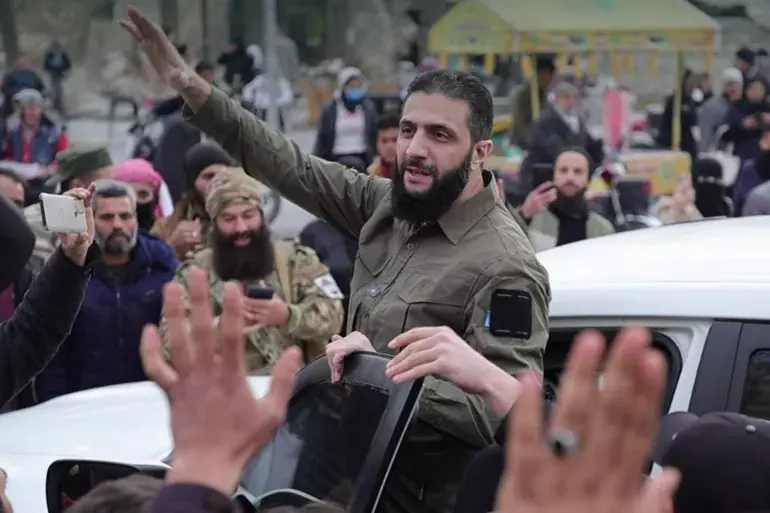
Al-Jolani to CNN: Our goal is to overthrow Assad and establish a state of institutions

CNN quoted Abu Muhammad al-Julani, a leader in the Joint Operations Department of the Syrian opposition, as saying that the goal of the recent moves in Syria is to ultimately overthrow Syrian President Bashar al-Assad.

Al-Jolani said during an exclusive interview conducted with him by the network that the goal of the Syrian revolution is to overthrow the regime, stressing its right to use all available means to achieve this goal.

In his first media interview in years, al-Jolani spoke about plans to form a government based on institutions and a council chosen by the Syrian people, describing the Assad regime as dead.

"The seeds of the regime's defeat were always present within it. The Iranians tried to revive the regime, buy it time, and then the Russians also tried to support it, but the truth is that this regime is dead," he said.

Al-Jolani sent reassuring messages to the residents of the areas controlled by the armed Syrian opposition, and stressed that civilians have nothing to fear in the administration of the areas controlled by the opposition in Syria, adding that "the people who fear Islamic rule have either seen incorrect applications of it or have not understood it correctly."

He also stressed the commitment to the rights of religious and ethnic minorities, noting that these sects have coexisted in this region for hundreds of years, and no one has the right to eliminate them.

PALESTINE

Fri 06 Dec 2024 1:46 pm - Jerusalem Time

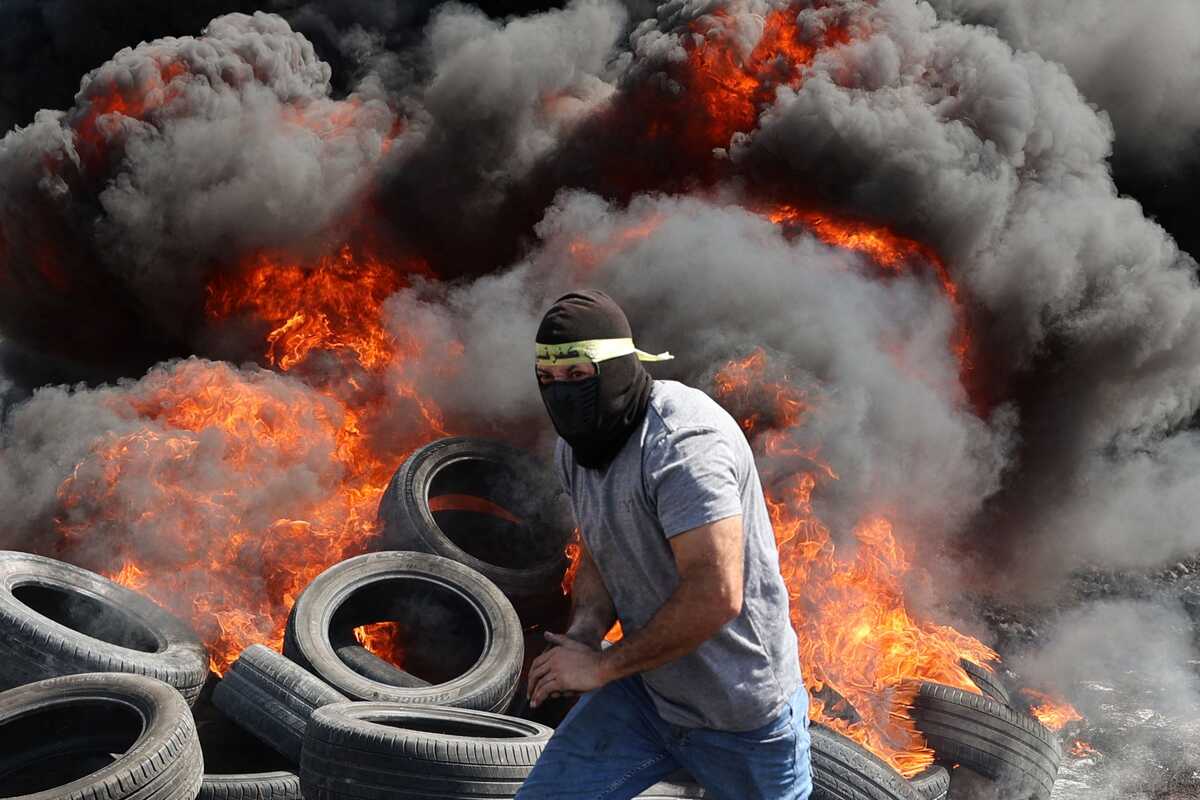
4 injured by bullets in clashes with Israeli occupation east of Nablus

Four citizens were injured by Israeli occupation forces' bullets, today, Friday, during clashes that erupted in the town of Beit Furik, east of Nablus.


Local sources reported that four citizens were injured by live bullets in the lower limbs during the clashes that erupted after the occupation forces stormed the town.

PALESTINE

Fri 06 Dec 2024 11:46 am - Jerusalem Time

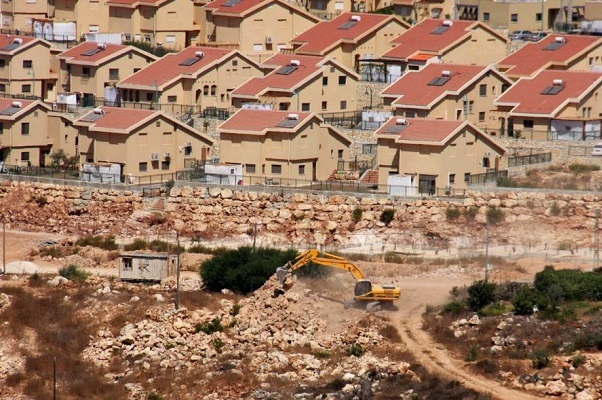
Smotrich advances rapidly in West Bank annexation steps

Israeli Finance Minister and Defense Minister Bezalel Smotrich is making rapid strides in his bid to annex the occupied West Bank, most recently demanding the closure of the Israeli “Civil Administration” responsible for settlement affairs in the West Bank. Settlements in the West Bank are under Israeli civil administration and are not directly subordinate to government ministries. Under Smotrich’s threatened annexation of the West Bank, the settlements would become part of the “state” and would be subject to its ministries.

Speaking to senior officials in the Civil Administration, the minister expressed his hope that it would be closed and the West Bank annexed, adding that he had spoken with Prime Minister Benjamin Netanyahu about the matter. Smotrich added, according to what Yedioth Ahronoth reported on Friday: "I hope that we have a great opportunity with the new administration in the United States to achieve full normalization and bring government offices here." He added: "There will be an organized process, and we are now working to put the plan on the table."


Smotrich noted that he had spoken with Israeli Prime Minister Benjamin Netanyahu about the issue, saying: “This is a serious statement. I sat with the prime minister and we are taking this matter very, very seriously. I also spoke with the ambassador-designate in Washington, Yehiel Leiter. We are trying to create a real process here. There is a lot of work here... and this is a vision that we can achieve.”

The settler leaders in the occupied West Bank have said several times that the “Civil Administration” is not the entity that should provide services to the half a million settlers living in the West Bank. The Israeli far right has tried several times to work on closing it down, but each time there was no real possibility of doing so for various and complex reasons.

Legal and international repercussions of the West Bank annexation plan

The newspaper pointed out that closing the "Civil Administration" has wide-ranging legal and international implications. Before implementing this step by the occupying state, officials will have to answer key questions, including whether the move is legal under international law, and what Israel's position will be toward the area (the West Bank) after the administration is closed.


The Hebrew newspaper pointed out that after a year and a half of measures within the "Civil Administration", which included radical changes in the powers and dealings of the occupation government in the West Bank, it is difficult to say that Smotrich is speaking without foundation, adding, "He and his team are already working on an organized plan to implement the step gradually, especially to exploit the momentum of the administration of US President-elect Donald Trump."

On Thursday, Smotrich announced a decision to confiscate 24,000 dunams of land in the occupied West Bank and annex it as "state land", with the aim of expanding a number of settlements there. Channel 14 reported that the Israeli authorities, led by Smotrich, announced the annexation and confiscation of 24,000 dunams in the West Bank as state land, in a move described as one of the largest in decades.

The channel confirmed that "this decision includes nearly half of the lands that were declared state lands since the Oslo Accords in 1993, as the declared area since then did not exceed 50,000 dunams until last year." No official statement or declaration has yet been issued by the Israeli government, or the office of Prime Minister Benjamin Netanyahu, regarding this.

The private channel indicated that "the settlement of Ma'ale Adumim (east of Jerusalem) will be expanded by about 2,600 dunams to the south, to create a settlement continuity with the settlement of Kedar." According to the channel, the settlements of Migdal Oz and Susya, in the southern West Bank, and Yafet in the Jordan Valley (east) will be expanded. It quoted Smotrich as saying that the decision is "a historic achievement that contributes to strengthening settlements and expanding the lands allocated for infrastructure and settlement projects."

ARAB AND WORLD

Fri 06 Dec 2024 11:42 am - Jerusalem Time

Lebanese Minister: Israeli strikes target two Syrian crossings with Lebanon


Israeli air strikes early Friday hit two border crossings linking Lebanon to Syria, Lebanese Transport Minister Ali Hamieh told Reuters.


Hamieh added that the raids targeted the Syrian side of the border from the Arida crossing in northern Lebanon and the Jose crossing in eastern Lebanon.

PALESTINE

Fri 06 Dec 2024 11:40 am - Jerusalem Time

Arab League: Postponement of the emergency meeting scheduled for Sunday

The Arab League announced today, Friday, that the emergency meeting of Arab foreign ministers, which was scheduled to be held the day after tomorrow, Sunday, at the headquarters of the General Secretariat of the League, has been postponed to a later date.


The emergency meeting, at the joint request of Syria and Palestine, was scheduled to discuss the continued Israeli aggression and massacres against the Palestinian people in the Gaza Strip and the Palestinian territories, the Israeli threats to Iraq, and the current situation in Syria.

PALESTINE

Fri 06 Dec 2024 8:21 am - Jerusalem Time

Channel 14 Hebrew: Israel confiscates 24 thousand dunams in the West Bank

An Israeli channel said that Israeli Finance Minister Bezalel Smotrich announced the confiscation of 24,000 dunams of occupied West Bank land and its annexation as "state land", with the aim of expanding a number of settlements there.


Channel 14 added that the Israeli authorities, led by Smotrich, announced the annexation and confiscation of 24,000 dunams (a dunam equals a thousand square meters) in the West Bank as state land, in a move described as one of the largest in decades.


The channel confirmed that "this decision includes nearly half of the lands that were declared as state lands since the Oslo Accords in 1993, as the declared area since then did not exceed 50 thousand dunams until last year."


The private channel indicated that "the Ma'ale Adumim settlement (east of Jerusalem) will be expanded by about 2,600 dunams to the south, to create settlement continuity with the Kedar settlement."


According to the channel, the settlements of Migdal Oz and Susya, in the southern West Bank, and Yafit in the Jordan Valley (east) will be expanded.


PALESTINE

Fri 06 Dec 2024 8:19 am - Jerusalem Time

A young man was killed by Israeli occupation forces in Balata camp, east of Nablus

A young man was killed by Israeli occupation forces this morning, Friday, during a raid on Balata camp, east of Nablus.


Security sources reported the death of the young man Mustafa Ahmed Mustafa Masha (23 years old) as a result of being shot in the head by the occupation forces in the camp.


The sources added that occupation jeeps stormed the camp amidst the outbreak of clashes, in which the young man, Mishah, was seriously injured and then declared dead.

PALESTINE

Fri 06 Dec 2024 8:17 am - Jerusalem Time

Israeli forces storm Kamal Adwan Hospital and force patients to leave

Local sources said that the occupation forces stormed Kamal Adwan Hospital in the northern Gaza Strip again and forced patients and wounded people to leave it.


Israeli military vehicles penetrated the vicinity of the hospital - located in the town of Beit Lahia - this Friday morning and imposed a siege on it from all sides under heavy fire cover.


Eyewitnesses reported hearing the sounds of Israeli gunfire and artillery shells in the area surrounding the hospital.


Kamal Adwan Hospital is one of the few remaining medical facilities in the area, and since Israel began its aggression on Gaza, the hospital has also been a site of conflict. The Israeli army claimed that the Islamic Resistance Movement (Hamas) was using it, and it has been raided repeatedly since October 7, 2023.


During the current war, Israel has placed Gaza Strip hospitals on its list of military targets under the pretext that they are being used by Palestinian resistance factions, but it has not provided concrete evidence, while international press reports and investigations have refuted this.


Source: Al Jazeera


OPINIONS

Fri 06 Dec 2024 8:16 am - Jerusalem Time

The solution is from the Lord of Heaven!

op-ed "AlQuds" dot com

op-ed "AlQuds" dot com

Opinion Writer


The people of Gaza are helpless in the face of worldly solutions and global prostitution diplomacy, the world's morals have fallen to the bottom, international organizations, bodies and governments do not have a single shred of humanity, and all countries, Arab and foreign, are spectators to what is happening in the Strip from a series of daily killings carried out by Israel, which commits crime after crime, and massacre after massacre, in a scene of cruelty and difficulty, where words cannot give a true description of what is happening in this barbaric fascist attack that the world has never witnessed before, and some are still betting on negotiations while the dead and martyrs are in the hundreds every day, and some are still hoping that diplomatic rounds will bear fruit, and hospitals no longer have places to treat thousands of wounded, and at a time when some people mistakenly believe that the exchange deal, the word of which has been repeated in the news tens of thousands of times, will lift the injustice from the Strip, or end the aggression, they are dreamers living in a fantasy of myths and miracles.

There are no words to describe the scene, all of them were used: war, genocide, massacres, crimes, aggression, shelling, attacks, aircraft, cannons firing shells everywhere, planes, missiles, and drones monitoring the movement of the displaced and killing them on the roads, in an attempt to cleanse the Strip from its north, and continue to strike, kill, and destroy its center, and besiege its south and starve all the people who are looking for a drink of water, or hot soup, or a useful medicine to reassure themselves about their children, the little children, who can no longer distinguish between night and day, as Gaza is in complete darkness, the tents are worn out, the cold is a major disaster for the elderly and the young, and the cloth has become diapers for children.

What is this state that the people of the Gaza Strip have reached, amidst the daily series of killings in which Israel chooses random targets inside the tents of the displaced and the shelters, and bombs violently and launches numerous raids, aiming through them to kill the innocent, and the same old record of the series is repeated daily.

This situation has prompted the displaced to seek solutions from the Lord of Heaven, as a displaced woman from Beit Lahia, surrounded by her children and holding whatever clothes and bags she can find, cries to the Lord of Heaven to perform a miracle and solve it from Him. She is followed by another woman pulling a cart loaded with clothes and screaming because there is no drinking water for her children. A little girl passes by and speaks in front of the camera about the Israeli targeting of Beit Lahia and the dropping of missiles from the air on the tents of the displaced, and she is followed by another woman with the marks of her head injury clearly visible.

The scene continues, and the group photo of the displaced people comes, and the scene of smoke, and the sound of flying, and the smell of death emanating from everywhere. Here is a woman riding a horse-drawn carriage, and the horse is pulling her little child, and an old man who does not know how to manage and walks, weighed down by fatigue and perhaps illness, and a child with a dark forehead concludes the harsh scene, and says: God is sufficient for me, and He is the best Disposer of affairs. There is no solution except from the Lord of the servants.

Yes, Gaza has failed to find worldly solutions, and its people no longer have hope except in the Lord of Heaven, to save them from these tragic conditions that impose on them a harsh and difficult life that is unprecedented in history.

OPINIONS

Fri 06 Dec 2024 8:15 am - Jerusalem Time

The Israeli War on Lebanon: A Harsh Toll and a Fragile Truce

Dr. Maher Al Sharif

Dr. Maher Al Sharif

Opinion Writer

After a limited military confrontation between Hezbollah and Israel, initiated by the party on October 8, 2023, in support of the resistance in the Gaza Strip, and which Israel turned into an open war on Lebanon on September 23, a ceasefire agreement was reached on November 26, stipulating a period of sixty days during which the Israeli army would gradually withdraw from the areas of southern Lebanon it had occupied, and Hezbollah would withdraw its fighters to the north of the Litani River, about 30 kilometers from the border, and the Lebanese army would deploy along the border in cooperation with the United Nations Interim Force in Lebanon (UNIFIL), with an international committee led by the United States of America, and including France, to examine any violations of the agreement.

Some sources reported that Benjamin Netanyahu received a “message of assurance” from the US administration stating that “the Israeli army will be able to attack southern Lebanon in the event of an immediate danger,” such as Hezbollah’s readiness to fire missiles at Israeli sites. He also received a promise from this administration to approve a new arms sale deal to Israel worth $680 million, including offensive ammunition and small bombs (1).

Many observers considered this agreement a success for President Joe Biden, who “can be proud of ending his troubled career with a remarkable diplomatic success,” which encouraged him to announce his administration’s intention “to launch a new effort to reach an agreement to end the fighting in the Gaza Strip and secure the release of the Israeli hostages,” noting that the Axios website does not have much confidence in this, as it estimated that “if we follow the current path, it seems that the crisis in Gaza will continue under the Donald Trump administration” (2).

Harsh toll of Israeli war on Lebanon

On November 29, the Israeli army admitted that it had carried out 12,500 raids against Hezbollah “sites,” while killing 82 soldiers and 47 Israeli civilians during the thirteen months of war. On the other hand, Israeli sources reported that Hezbollah’s rockets, which continued to be fired until the last day of the war, prevented 60,000 people from returning to northern Israel, one of the goals the Israeli government sought when it expanded the scope of the war, and destroyed more than 8,800 buildings, damaged more than 7,000 vehicles, and damaged more than 300 agricultural sites (3).

While the Israeli military claimed to have “eliminated 2,500 Hezbollah fighters,” Lebanese authorities say at least 3,961 Lebanese men and women, mostly civilians, have been killed since October 2023, and some 16,000 others have been wounded. According to the Lebanese government, more than 1.2 million people, or about 20 percent of the population, have been displaced from their homes, with schools, churches and mosques turned into overcrowded shelters. More than 557,000 people have crossed into Syria, according to the United Nations High Commissioner for Refugees, 80 percent of them women and children, often on foot and in difficult conditions due to Israeli airstrikes on crossing points between Syria and Lebanon.

According to the United Nations World Food Programme, 1.3 million people, or 23% of Lebanon’s population, faced high levels of food insecurity during the months of war. Since last September, Israeli airstrikes have left a trail of destruction in southern Lebanon, destroying or damaging homes, schools, health centers and municipal buildings. In the Lebanese town of Tyre, with a population of 120,000, Israeli airstrikes have destroyed hundreds of homes, vital infrastructure and archaeological sites, rendering some neighborhoods uninhabitable.

“More than 50 buildings, between three and 12 floors, were completely destroyed by the strikes,” Mayor Hassan Dbouk told Agence France-Presse, adding that dozens of other buildings were damaged by up to 60 percent. He confirmed that “there is no longer electricity in the neighborhoods most affected by the Israeli raids.” On November 18, an Israeli raid targeted the water company, destroying the building, killing two of its employees, and depriving 30,000 subscribers of water in the city and its suburbs (4).

However, the massive destruction was inflicted on the southern suburbs of Beirut, where hundreds of buildings were destroyed, turning it into a ghost town. Israeli raids also targeted many buildings in the heart of the Lebanese capital, as well as the Baalbek area and large areas in the Bekaa. Faced with the real danger facing Lebanon’s cultural heritage, 300 cultural specialists called on UNESCO on November 17 to work on protecting historical sites such as Baalbek. The following day, the organization placed 34 Lebanese cultural sites under enhanced protection, in accordance with the 1999 Second Protocol to the 1954 Hague Convention, which aims to protect heritage in the event of armed conflict (5).

Since last October, Israeli raids have targeted branches of the Al-Qard Al-Hassan Foundation, which is close to Hezbollah, in the southern suburbs of Beirut, Tyre and Baalbek, which has led to the freezing of the work of this small loan institution, which served as a social safety net for many families in times of financial crisis (6).

The Israeli technological war and its terrifying psychological effects

“I feel trembling every time I hear a loud noise, even if it’s not an explosion,” said Rima, 25, a Palestinian refugee living in the Shatila camp near Beirut’s southern suburbs. “I don’t sleep at night until 7 a.m., when the explosions stop,” she said. “I always feel in danger because of the drones, and I have regular panic attacks.”

“War has become very technological,” says Beirut-based psychoanalyst Dr. Aline Al-Husseini. “We see the slightest explosions on social media, and images of destruction are everywhere. This increases suffering and internal chaos, and reopens all the wounds inherited from previous wars.” She notes that drones “give a sense of surveillance, persecution and anticipation of danger. With explosions, people no longer sleep and suffer from insomnia… Even those living in the affected areas live in fear of death,” which leads experts to say that “Israel is also waging a psychological war using its advanced technologies.”

In this regard, Jad al-Dilati, a human rights researcher, believes that the Israeli psychological warfare began on September 18 and 19, when the communications devices were blown up. Israel “wanted to make us understand that it is a thousand times more technologically advanced; since then, the airstrikes on the country have continued, with drones and missiles tracking their targets to the farthest parts of the country, even in remote areas.” Israel has become “able to choose any building, demolish it, kill everyone inside, and move on as if nothing had happened. It is being filmed live, and we rely on the tweets of the Israeli army spokesman, our enemy, to know whether we will survive or die, even though they are often misleading” (7).

Although Alessandro Accorsi, senior analyst for war technology at the International Crisis Group, is not certain that Israel used the artificial intelligence program that allowed it to “identify and bomb more than 35,000 targets in the Gaza Strip,” he estimates that the Israeli army used bombs in its war on Lebanon “weighing between 450 and 900 kilograms, bombs that many countries, such as the United States, have stopped using to reduce civilian casualties,” while Israel accepted that these bombs would kill “between 40 and 50 or even 100 civilians, depending on the importance of the target,” and caused some powerful explosions that resembled an earthquake (8).

The serious economic effects of war

The Lebanese economy has been reeling from 13 months of war and five years of financial crisis. A new World Bank report estimates the cost of the war to Lebanon at $8.5 billion, and in its “Interim Damage and Loss Assessment for Lebanon,” published on November 14, it notes that 100,000 homes have been destroyed or damaged, and that nearly 170,000 people have lost their jobs. GDP fell from $54 billion in 2018 to $20 billion in 2023, and is expected to fall by another 15% this year. Experts agree that the war has accelerated the decline in GDP, with the overall bill for damage to the country’s infrastructure estimated at $3.4 billion, with many roads and drinking water facilities damaged, while the Lebanese government estimates losses to electricity distribution networks alone at $400 million. Among the sectors that have been hit hardest are tourism, which typically accounts for 25% of GDP, and agriculture, with more than 1,900 hectares of land in the southern governorate of South Lebanon and neighbouring Nabatieh damaged or left fallow by shelling. Some 65,000 olive trees were destroyed by Israeli shelling, causing the price of olive oil to rise by more than 50%. The retail sector has also been hit hard, with economist Walid Abu Suleiman saying that “in times of war, purchases are limited to what is essential,” adding that “50,000 small and medium-sized businesses are suffering from the war today and have had to lay off their employees.”

Ceasefire agreement in the Israeli perspective

Benjamin Netanyahu gave three reasons for agreeing to the ceasefire, saying: “This agreement will enable us to focus on Iran and its nuclear program that threatens Israel’s existence, to replenish our weapons stockpile and to drive a wedge between Hezbollah and Hamas.” In his speech announcing the ceasefire, he promised to engage forcefully on “seven fronts” stretching from Yemen to Syria and from Gaza to Iran, via the West Bank, Lebanon and Iraq, hinting at “continuing and even intensifying the war on a regional scale.” The Israeli war minister said he was prepared to do “everything” to prevent Iran from obtaining nuclear weapons, in an interview broadcast by Channel 14 on Thursday evening, November 28. He added: “I will do everything in my power, and I will exploit all the resources that can be exploited to prevent it from becoming a nuclear power,” and threatened to launch an “intensive war” if the truce with Hezbollah was violated.

The ceasefire agreement elicited mixed reactions in Israel. An Israeli diplomat said: “If we had rejected this agreement proposed by the Americans, we would have risked the UN Security Council calling for a ceasefire on terms that would have been much more difficult for us, and worse, without any guarantee that the United States would impose its veto on it.” Itamar Ben-Gvir, the Minister of Internal Security, denounced the agreement as “a historic mistake that will prevent us from eliminating Hezbollah.” Most mayors and other elected representatives in northern Israel expressed their anger. The mayor of the settlement of Hatzor Haglilit, located on the border with Lebanon, declared that the agreement was “a surrender to terrorists.” (10)

Fragile truce amid repeated Israeli violations

As soon as the ceasefire was announced, tens of thousands of displaced residents rushed to return to their destroyed towns and villages in southern and eastern Lebanon and in the southern suburbs of Beirut, some of them waving Hezbollah flags and pictures of its late leader Sayyed Hassan Nasrallah from the windows of their cars.

As the Lebanese army began to reinforce its deployment in the sector south of the Litani River, in coordination with the United Nations Interim Force in Lebanon (UNIFIL), Israeli violations of the terms of the agreement became more frequent, with Lebanese authorities reporting “isolated incidents of mortar attacks and Israeli gunfire” that injured two civilians trying to return to southern Lebanon. The “Selections from Hebrew Newspapers” bulletin, issued by the Institute for Palestine Studies, reported that Israeli aircraft bombed a building near the town of Al-Bissariyeh in the Sidon district in southern Lebanon, in the first raid carried out on the second day of the ceasefire agreement. Residents of the towns of the Marjeyoun and Hasbaya districts also received communications from the Israeli army, asking those in the area south of the Litani to remain inside and not to leave from 5 pm on Thursday, November 28, until 7 am the following day. It warned residents of 10 villages in southern Lebanon not to return to their homes, then on Saturday urged residents of other villages not to return to them, and announced that the air force had launched raids on military infrastructure near the border crossings between Syria and Lebanon (11).

At the time of writing, the Lebanese National News Agency reported that two people were killed and two others were injured in an Israeli drone strike that targeted a town in Nabatieh Governorate.

CBS News acknowledged that “the outbreak of violence reflects the precarious nature of the ceasefire,” while the Israeli newspaper Haaretz expressed pessimism about the future of the agreement, assuming that Hezbollah “will do everything it can to replenish its ranks with fighters and commanders on the ground, restock its weapons and ammunition depots, and eventually return to southern Lebanon to restore the balance of deterrence against Israel.”

In an interview with the French channel TRT, Khalil Helou, a retired brigadier general in the Lebanese army, said that he was "pessimistic about the scope of this ceasefire, and hopes that the fighting will not resume in a few years," adding: "However, this is a good thing because the displaced will be able to return to their homes, and the destruction will stop." As for Hasni Obeidi, director of the "Center for Studies and Research on the Arab and Mediterranean World" in Geneva, he noted that "this ceasefire has weaknesses, even if it is sponsored by France and the United States," estimating that the Lebanese army "does not have the capacity to fill the security vacuum in the south of the country; therefore, the participation of France, which must monitor the implementation of the agreement, is important," and ruling out the possibility of repeating the Lebanese ceasefire in the Gaza Strip, because "the agreement on Lebanon is the beginning of a diplomatic process, this is certain, but Israel does not want a ceasefire in Gaza."

Conclusion:

Hamas welcomed the ceasefire agreement in Lebanon, and Agence France-Presse quoted a source in the movement as saying that the movement informed "the mediators that it is ready for a ceasefire agreement and a serious prisoner exchange deal, if the occupation commits, but the occupation is obstructing and evading reaching an agreement and continuing the war of extermination." The Israeli Minister of Internal Security, Itamar Ben-Gvir, had announced, in the context of his rejection of the agreement with Lebanon, that "Israel has a historic opportunity to reoccupy the Gaza Strip and encourage the voluntary migration of Israel's enemies" from it, which made the Swiss newspaper "Le Temps" estimate that "Benjamin Netanyahu made promises regarding Gaza to the most extremist parties in his government in order to ease their anger over the truce in Lebanon," and therefore, the truce in Lebanon "may further aggravate the fate of the residents of Gaza, whose lands once again constitute Israel's last major front" (14).

Do all Palestinian forces realize the seriousness of what awaits the afflicted Palestinian people in the Gaza Strip, and rush to agree on a joint plan of action that combines principles and flexibility at the same time, in order to stop the ongoing Israeli war on the Gaza Strip, and thwart the danger of the Israeli government, which is most hostile to the Palestinians, occupying the Strip or large parts of it, and encouraging projects to return settlements to it and displace its residents?

* Researcher and Historian - Institute for Palestine Studies - Beirut

PALESTINE

Fri 06 Dec 2024 8:10 am - Jerusalem Time

Renewed Egyptian mediation.. Will Cairo's efforts succeed this time in completing the stalled deal?

Dr. Amr Hussein: Negotiation rounds in Doha and Cairo are ongoing, but the success of the deal depends on pressuring Netanyahu

Majed Hadeeb: Netanyahu may accept a ceasefire if he is convinced by the security guarantees provided by Egypt within the framework of future arrangements for Gaza

Daoud Kuttab: Overcoming obstacles to mediation requires pressure from within Israel or from the United States of America

Sari Samour: The success of Egyptian mediation depends on Washington’s serious desire and readiness to issue an order to stop the war

Dr. Aql Salah: Hamas and Fatah blocked Netanyahu’s attempts to use the pretext of who rules Gaza by agreeing on a community administrative committee

Nihad Abu Ghosh: The most likely scenario is to achieve a partial deal, but that depends on pressuring Netanyahu and arranging the internal Palestinian situation

Egypt is once again leading the intensive efforts to try to move the ceasefire negotiations in Gaza and conclude a swap deal, amidst great complications, in the face of the possibility of its success in its tasks, and the world is awaiting the fruits of those efforts.

In separate interviews with “I,” writers, political analysts and specialists believe that despite the momentum witnessed by the Egyptian mediation, the intransigent Israeli positions, especially from Prime Minister Benjamin Netanyahu, constitute a major obstacle to achieving any tangible progress. Despite this, serious American pressure remains the main pillar to force Israel to conclude the deal.

The writers, analysts and specialists explain that the Egyptian mediation faces multiple challenges, the most prominent of which is Israel’s refusal to pay the minimum price, which includes ending the war, withdrawing from Gaza, and exchanging prisoners between the two parties. However, despite this, the regional and international circumstances seem ripe for concluding a truce deal.

Intensive efforts to move the stalled negotiations on Gaza

The writer, political analyst, and specialist in international and strategic relations, Dr. Amr Hussein, confirms that the Egyptian state, led by President Abdel Fattah El-Sisi, is making strenuous efforts to move the stalled negotiations regarding Gaza, which have lasted for more than eight months.

Hussein explains that the main obstacle facing these negotiations was the positions of Israeli Prime Minister Benjamin Netanyahu, which hindered any tangible progress.

Hussein believes that the momentum witnessed in the negotiations thanks to the ceasefire agreement between Israel and Hezbollah in Lebanon, in which the parties committed to initial understandings, provided a glimmer of hope for moving the Palestinian file forward.

He points out that Egypt, as the party most concerned with the Palestinian issue, is working tirelessly to stop the war on Gaza, bring humanitarian aid into the Strip, and reach an understanding on joint administration between the Fatah and Hamas movements after the withdrawal of the Israeli occupation army.

Hussein explains that there are challenges facing Egyptian mediation, the most important of which is Netanyahu's insistence on continuing the war, as he refuses to withdraw from Gaza and stipulates a prisoner exchange without stopping military operations, which makes the negotiations very complicated.

Hussein points to another obstacle facing Egyptian mediation, which is the lack of consensus between the Fatah and Hamas movements on managing the Strip after the war. However, Egypt was able to bring viewpoints closer together, and proposed forming a community committee to manage Gaza in the post-war phase.

Another obstacle facing Egyptian mediation, according to Hussein, is the Israeli military expansion along a 5-kilometer-long axis in the Netzarim axis, in addition to the intensive bulldozing operations in Jabalia, which he considers part of an Israeli plan called the “generals’ plan” or “bubbles,” which aims to fragment the Gaza Strip, in addition to Israel’s refusal to withdraw from the Philadelphi axis and its installation of watchtowers and cameras equipped with remote automatic weapons.

Hussein explains that Egypt proposed, according to reports published by the Israeli newspaper Maariv, a temporary truce lasting between 45 and 60 days, including a gradual prisoner exchange and a phased withdrawal of Israeli forces from the Strip, followed by the community committee taking over the administration of Gaza.

On the other hand, Hussein points out that the American position has changed after the presidential elections, as President-elect Donald Trump seeks to release the Israeli detainees before taking office on January 20.

He explains that the US administration is pressing to end the war in Gaza in order to focus on the worsening situation in Syria, making the settlement in Gaza part of its broader strategy in the region.

Hussein points out that the negotiation rounds in Doha and Cairo are continuing, but the success of the deal depends on the parties’ ability to pressure Netanyahu, who sees the continuation of the war as a means of escaping domestic political accountability.

Deal could falter if Israeli detainees are found to have been liquidated

Writer and political analyst Majed Hadeeb explains that since October 7, Egypt has been striving to achieve a ceasefire between Israel and the Palestinian resistance, as part of efforts aimed at achieving justice for the Palestinian cause and establishing peace in the region based on international legitimacy resolutions.

Hadib asserts that Egypt is an acceptable party to the regional and international parties concerned with the Palestinian issue, especially Saudi Arabia, whose role has recently emerged through coordination with Egypt and Qatar to reorganize the Palestinian house, including the stage following the war. Despite the strenuous efforts to conclude a ceasefire deal, which has become imminent, an urgent and pressing question comes to mind: Will this deal hold?

According to Hadeeb, the fate of the deal may falter if it turns out that the Israeli prisoners held by the Palestinian resistance have been liquidated, and this possibility may push Israeli Prime Minister Benjamin Netanyahu to back down from continuing to implement the agreement in order to finally eliminate what remains of Hamas’ influence in the Gaza Strip.

On the other hand, Hadeeb believes that there are several factors that push towards the success of the deal, most notably the expected shift in the US administration from Joe Biden to Donald Trump, as each of them has a different view of the Palestinian issue, especially with regard to the details related to final status solutions.

Among these factors, according to Hadib, is Türkiye’s entry into the mediation line, as the Turkish president plays a personal role in coordinating with Qatar, Egypt, and Hamas to revive the prisoner exchange deal.

Netanyahu, according to Hadeeb, believes that Israel has achieved all its military and political goals in Gaza, by destroying the economic and administrative infrastructure of the Palestinians in the Gaza Strip, and pushing them towards voluntary migration after forced migration failed for many reasons, including not facilitating this for the people of Gaza, especially from Egypt, which closed the crossing and worked to tighten exit procedures. Netanyahu is also facing increasing internal pressure from Israeli public opinion, which has shifted from supporting the continuation of the war to demanding its cessation, especially with the failure to fulfill his promises to release the Israeli detainees without negotiating with Hamas.

Hadeeb points out that Netanyahu may accept and abide by the ceasefire, especially if he is convinced by the security guarantees Egypt has provided him as part of its vision for future arrangements for the Gaza Strip. Among these arrangements is the Palestinian Authority taking over the administration of the Strip as part of efforts to reunify the Palestinian factions under the umbrella of the PLO, in line with the “one package” agreement proposed by Egypt through what is known as the Egyptian paper in 2019.

On the Palestinian side, it is in no one’s interest to put obstacles in the way of achieving a ceasefire, especially Hamas. Hadeeb explains that Hamas seems more open to a ceasefire, especially after the weakness of the “unity of the arenas” that aimed to support Gaza from other fronts such as Lebanon became clear. Likewise, the suffering of the people of Gaza in light of the difficult humanitarian conditions they are living in has pushed the general mood towards accepting any truce that might alleviate their suffering, and might also work to stop the signs of a popular explosion whose features have begun to appear on the horizon after it became clear to the Gazan citizen that Hamas’s current conditions for a ceasefire focus on humanitarian issues more than political ones.

He points out that the American and Egyptian guarantees for the return of the displaced to northern Gaza represent an encouraging factor for Hamas to accept the agreement, even if the outlines of the agreement regarding the Philadelphi Corridor are not clear, as attention is also directed to the Philadelphi Corridor on the Egyptian-Palestinian border, due to the lack of clarity in the details of the Israeli withdrawal from it. However, Israel’s recent steps, such as installing surveillance cameras on the border and directing automatic weapons from high towers, indicate that it does not intend to remain in this corridor for long, but rather seeks transitional arrangements in line with the post-war vision.

The scene is moving towards strengthening Palestinian unity

Hadib touches on another factor in the conclusion of the agreement and its continued implementation, especially on the diplomatic level, where Saudi Arabia emerges as a major player by imposing clear conditions for normalization with Israel, the most important of which is the establishment of a Palestinian state according to the Arab Peace Initiative. Also, with the growing Egyptian-Saudi-Qatari coordination, it seems that the scene is moving towards strengthening Palestinian unity according to a strategy that returns the PLO to the forefront of the negotiating scene.

Hadib confirms that the ceasefire deal is close to being implemented, after regional and international conditions have matured. Egypt and Russia have managed to bring Palestinian viewpoints closer together, including Hamas’s authorization of the Palestinian Authority to manage Gaza, as part of a broader agreement that includes resuming negotiations with Israel to establish a Palestinian state based on the two-state solution.

He stresses that the success of the deal depends on several factors, including: ensuring the continuation of regional and international coordination, ensuring the stability of understandings between the Palestinian factions, and with the approach of the new US administration, the concerned parties seem more keen to exploit the opportunity to achieve a sustainable calm that paves the way for long-term political solutions.

The problem is Israel's unwillingness to reach a solution.

Writer and political analyst Daoud Kuttab confirms that mediation in the issue of exchange between Israel and the Palestinian resistance does not face difficulties from the mediating parties such as Egypt or Hamas, but rather the problem lies in the Israeli side’s unwillingness to reach a solution.

The writers explain that the most prominent obstacles to completing the deal are Israel's refusal to pay the minimum price, which includes ending the war, withdrawing from Gaza, and exchanging prisoners between the two parties.

Writers point out that overcoming these obstacles to mediation regarding concluding the deal requires pressure on Israel from within Israel, or from the United States of America.

The writers explain that mediation and its positive push will not be achieved unless there is strong pressure on the Israeli side to show a desire for a solution.

Writers stress that returning to talk about the deal in parallel with Turkish mediation efforts and the possibility of Qatar returning to participate in the process highlights the importance of the role played by the mediating parties in pushing the negotiation process forward.

He points out that the power of mediation does not come only from the ability of the mediator, whether Egypt, Qatar or Türkiye, but from the desire of the parties to reach a solution.

The writers explain that the situation may be easier with Turkey because it has diplomatic relations with Israel and is a member of NATO, which gives it greater influence in the file, but the greatest difficulty lies in the real Israeli desire for a solution.

Writers stress that negotiations will not progress significantly unless there is a real will on the Israeli side to accept the basic Palestinian demands.

Writers confirm that despite various mediation attempts, the Israeli position remains the main obstacle, which requires greater efforts from the international community, especially the United States, to pressure Israel to make the necessary concessions.

The main obstacle is not in the details.

Writer and political analyst Sari Samour believes that the Egyptian mediation to stop the war in the Gaza Strip, like the efforts of other parties, does not move without clear directives from the American administration, pointing out that Egypt, despite its prominent role, has proven its inability to compel Israel to implement what is agreed upon in the negotiations.

Samour gave the example of the prisoner exchange deal known as the “Shalit deal,” which was carried out under full Egyptian sponsorship in 2011. However, Israel re-arrested dozens of those released ten years ago, without any real Egyptian intervention to release them, perhaps because Egypt was unable to force Israel.

Samour explains that the success of the Egyptian mediation depends on the existence of a serious American desire to stop the fighting and conclude an agreement that satisfies all parties, considering that the main obstacle is not in the details or the differences between the parties, but in the extent of Washington’s readiness to issue an order for a ceasefire.

Samour explains the return of talk about Egyptian mediation and others regarding the possibility of concluding a deal in the Gaza Strip as a result of several intertwined factors, including: the unprecedented rise in the rates of killing and destruction in Gaza, which created a moral crisis for Israel, which began to suffer from the repercussions of the bloody images and scenes on Arab, Islamic and international public opinion.

Also, according to Samour, the fear of the killing of Israeli detainees held by Hamas represents an additional challenge that pushes towards accelerating the negotiations, and Israel is facing great losses due to the continuation of military operations in Gaza, which makes it more open to mediation options.

Samour touched on the impact of the ceasefire agreement between Israel and Hezbollah in Lebanon, and what is happening in Syria, on the general scene, as international parties, led by the United States, seek to contain the situation in the region, which is an important matter in pushing towards concluding the deal in the Gaza Strip.

Samour highlighted the US administration's political calculations, as President Joe Biden seeks to end his term with an achievement in the Middle East, while Donald Trump is trying to prove his ability to impose his political vision as he approaches taking over the reins of power in the White House.

Despite the efforts made, Samour wonders whether these moves are actually aimed at stopping the genocide in Gaza, or whether they are merely attempts to absorb the growing anger of the families of the Israeli detainees and their supporters, and the anger towards the Israeli massacres in the Gaza Strip and their impact on the Arab, Islamic and international street.

Samour stresses that the success of any agreement depends on a real American will, not just advice or suggestions, to achieve a ceasefire by meeting the Palestinians’ conditions, and ensuring a decent life for the Palestinians in Gaza through: the withdrawal of the Israeli occupation, the entry of humanitarian aid, the implementation of an honorable exchange deal, and the reconstruction of the Strip.

Samour stresses that achieving these goals is not impossible, but it requires direct and tangible American pressure.

Netanyahu seeks a deal 'tailored to his needs'

The writer and political researcher Dr. Aql Salah explains that the Israeli Prime Minister Benjamin Netanyahu is still procrastinating and evading the conclusion of the prisoner exchange deal proposed by the Palestinian resistance, headed by the Hamas movement, stressing that Netanyahu has not yet reached the stage of accepting the Palestinian conditions that are appropriate for the sacrifices of the Palestinian people in the Gaza Strip, as Netanyahu seeks a deal "to his size", that is, one that serves his political interests and gives him the opportunity to maintain his government coalition, while he is trying to avoid the political and military losses that may result from this deal.

Salah believes that Netanyahu is facing internal and external pressures that may force him to eventually make concessions to conclude the deal, but overcoming these obstacles is still not possible without intense pressure.

Salah points out that the most important of these obstacles are the hardline positions of the parties in the government coalition, especially the Israeli Ministers of National Security and Finance, Itamar Ben-Gvir and Bezalel Smotrich. Without their approval of the deal, the coalition may collapse, making Netanyahu hesitant to take any step that might threaten the stability of his government.

Another obstacle, according to Salah, is the dilemma of the Israeli withdrawal from the Gaza Strip as part of any agreement to stop the war. This withdrawal, which may take place gradually with international guarantees as proposed by the resistance, is considered in Israel’s view a victory for the resistance and a defeat for Netanyahu.

Salah points out that implementing the withdrawal will also reveal internal differences in Israel and bring up again the corruption and failure files that haunt Netanyahu, which will further complicate his position.

Among other challenges facing the deal, Dr. Aql Salah points to Netanyahu’s refusal to release Palestinian prisoners serving life sentences, including prominent leaders, and he does not want to repeat the experience of releasing Yahya Sinwar, who was released as part of the “Wafa al-Ahrar” deal in 2011.

According to Salah, Netanyahu is seeking to pressure the resistance to reduce its demands regarding the release of Palestinian prisoners, while maintaining a high ceiling of Israeli demands. Among the things Netanyahu may pressure is the possibility of releasing prisoners with high sentences (“life sentences”) and leaders, and the place of releasing prisoners (“deporting them outside the homeland”).

Regarding who will rule Gaza after the war ends, Salah points out that Netanyahu entered the Gaza Strip with the aim of eliminating the resistance, specifically Hamas, but the Palestinian factions, including Hamas and Fatah, blocked his attempts by agreeing on a temporary administration of the Strip through a community administrative committee.

Salah believes that the recent truce that Israel concluded with Hezbollah in Lebanon has reopened the door to the possibility of concluding a similar deal in Gaza, as the international community and the Israelis themselves have asked the question: If Israel is able to agree to a truce in Lebanon, why not implement it in Gaza?

Salah points out that the incoming Trump administration may see the deal as a step that serves its interests, especially if it includes the release of hostages who hold American citizenship, noting that the Qassam Brigades recently published a video of the detainee Idan Alexander, in which he appeals to Trump and the Israeli community to move to conclude a deal that guarantees his release.

According to Salah, Trump's arrival at the White House next January may push Israel to strike a deal that is in line with its geopolitical interests, such as promoting normalization with Saudi Arabia, annexing the West Bank, and ending the Iranian nuclear file.

Salah points out that Israel may exploit this deal to improve its international image, which has become associated with criminality, especially after the increasing international pressure to prosecute the Israeli political and military leadership for the crimes committed in Gaza.

Salah believes that the next stage will witness an escalation in pressure on Netanyahu, whether from within Israel or from the next US administration, which may force him to make unprecedented concessions.

Salah warns that Netanyahu will try to procrastinate as much as possible, as he did with the Biden administration, which put forward terms that Hamas agreed to, but Netanyahu rejected.

Salah stresses that the prisoner exchange deal, if concluded, will ultimately be the result of intense pressure on the Israeli government, and will constitute a real test of Netanyahu’s flexibility in facing his internal and external crises, and the extent of his ability to maintain the balance of his government without compromising his political ambitions.

Factors that create conditions for completing the exchange deal

Writer, political analyst and specialist in Israeli affairs, Nihad Abu Ghosh, believes that there are several factors that create the conditions for completing a prisoner exchange deal between Israel and Hamas, which enhances the chances of success of Egyptian mediation this time.

Abu Ghosh explains that these factors include statements by US President-elect Donald Trump about his desire to release Israeli detainees before he takes office next month, which puts great political pressure on the Israeli government to expedite the completion of the deal.

Abu Ghosh points out that the ceasefire in Lebanon may be applied to Gaza, which puts Israel before the option of stopping the escalation. The Israeli war on the Gaza Strip has also reached a high level of destruction and killing, which makes Israel face increasing international criticism, especially with the International Criminal Court issuing arrest warrants for the occupation government’s Prime Minister Benjamin Netanyahu and former Minister of War Yoav Galant, and expanding the circle of those accused of war crimes.

Abu Ghosh points out that the agreement between the Fatah and Hamas movements to form an administrative committee to manage Gaza constitutes an additional pressure card that could support the achievement of the deal.

However, Abu Ghosh confirms that the Israeli government is facing counter-pressures from the extreme right, which is pushing for the continuation of the war or the occupation of the Strip. Netanyahu also fears that stopping the war will lead to him being held politically or even judicially accountable, which is pushing him to procrastinate in accepting the deal.

Abu Ghosh explains that the closest scenario is to achieve a partial deal in the first stage, but that depends on internal and international pressure on Netanyahu, in addition to arranging the internal Palestinian situation.


PALESTINE

Fri 06 Dec 2024 7:39 am - Jerusalem Time

Washington: Allegations of genocide in Gaza are baseless

US State Department spokesman Vedant Patel said on Thursday that the US President's administration does not agree with the use of the term "genocide" as Amnesty International said in its report on Wednesday regarding what Israel has been doing in Gaza since it launched its war on the besieged Gaza Strip on October 7, 2023.


In response to a question from the Al-Quds correspondent about whether the US administration agrees with Amnesty International in this regard, spokesman Patel said that his country's government opposes this description now, as it opposed it in the past.


"I have seen the report, and I will leave it to Amnesty International to speak on the details of it. As you have heard us say before, we do not agree with the conclusions of such a report. We have said before and continue to find the allegations of genocide to be baseless," Patel said.


"But there is still a vital role for civil society organisations such as Amnesty International, human rights groups and NGOs to play in providing information and analysis regarding Gaza and what is happening," Patel said.


“But again, as I have said before, we do not agree with the previous findings regarding genocide. That does not change the ongoing concern that we have regarding the humanitarian situation in Gaza. It does not change the ongoing concern that we have regarding the impact of this conflict on civilians and civilian casualties. We continue to emphasize at every turn that there is a moral and strategic priority for Israel to comply with international humanitarian law, and that is something that we will continue to raise with partners in the region and directly with Israel,” the spokesman continued.


The Jerusalem correspondent pointed out that Amnesty International concluded that, and before it, Human Rights Watch. And all the UN organizations, and all the human rights organizations around the world, and the Israeli human rights organization B'Tselem, and every other organization says that Israel is committing genocide, and "genocide depends largely on intent, and Amnesty International said that it based its conclusions on repeated statements by Israeli leaders, Israeli officials, and even the president of Israel, certainly, and many other people who said that they are committing genocide... I mean we see that Israel in its war on Gaza has killed at least 44,000 people, including 17,000 children... and deprives them of food and uses deliberate starvation (against citizens and children in Gaza), and deprives them of medicine; anesthesia that is brought in to them, as Schicke CNN reported yesterday that Israel has prevented anesthesia from entering Gaza to treat children with amputated limbs."


The Jerusalem correspondent continued with a question about what the United States of America needs, which truly claims the high moral position in dealing with these issues, and human rights issues, in order for you to say that what is happening is genocide? Because what we see today, and what we are witnessing in northern Gaza, is basically deliberate starvation.

“People, organizations, groups have the right to draw their own conclusions,” Patel responded. “The conclusion that the United States has reached is that these allegations of genocide are unfounded. There are and continue to be a number of avenues within the U.S. government through which we look at what is happening on the ground, and those assessments are ongoing. But I don’t have any update to provide on that.”


In its 296-page report, “You Feel Subhuman”: Israel’s Genocide Against Palestinians in Gaza, Amnesty International found through its research and legal analysis “sufficient basis to conclude that during the nine-month period under review, Israel committed acts prohibited under Articles II (a), (b) and (c) of the Genocide Convention, namely murder, causing serious bodily or mental harm, and deliberately inflicting on Palestinians in Gaza conditions of life calculated to bring about their physical destruction in whole or in part.”


The Israeli government strongly rejected the findings of the report.


“The hateful and fanatical Amnesty International has once again issued a completely false and fabricated report based on lies,” the Israeli Foreign Ministry said in a post on the X platform, commenting on the report. “The terrorist organization Hamas carried out the genocidal massacre on October 7, 2023 against Israeli citizens. Since then, Israeli citizens have been subjected to daily attacks from seven different fronts. Israel defends itself against these attacks in full accordance with international law.”


In a statement, the Israeli branch of the organization — which was reportedly not involved in funding, researching or writing the report — said that “the scale of killing and destruction carried out by Israel in Gaza has reached horrific proportions and must be stopped immediately,” according to The Times of Israel. However, the groups do not believe the events “meet the definition of genocide as set out precisely in the Convention on the Prevention and Punishment of the Crime of Genocide.”


For a conflict to be considered genocide under international law, there must be evidence of specific criminal acts—such as killing members of a particular group—as well as “the intent to destroy, in whole or in part, a national, ethnical, racial or religious group.”


In its report, Amnesty International concluded that “these acts were committed with the specific intent to destroy Palestinians in Gaza.”

PALESTINE

Thu 05 Dec 2024 8:05 pm - Jerusalem Time

Senator close to AIPAC introduces bill in Congress to ban use of the term West Bank


Sen. Tom Cotton (R-Ark.) introduced a bill Thursday that would require all official U.S. documents and materials to use the term “Judea and Samaria,” coined by Menachem Begin’s Likud party, instead of the occupied “West Bank.”


According to Senator Cotton, who is close to the pro-Israel lobby group AIPAC, which had a major hand in his election to his various congressional positions, the bill, titled “The Elimination of Gross Confusion About the True Name of Israel’s Area of Influence by Requiring the Government to Use Judea and Samaria,” would require the use of historically accurate terminology and align U.S. policy language with the geographic and cultural significance of the region.


The legislation was introduced in the House of Representatives by little-known Congresswoman Claudia Tenney (R-NY) as a thank-you to AIPAC.


“The legal and historical rights of the Jewish people in Judea and Samaria go back thousands of years,” said Senator Cotton, who is known for his hostility to the Palestinian cause and his staunch defense of settlements. “The United States must stop using the politically charged term ‘West Bank’ to refer to the biblical heartland of Israel.”


“The Israeli people have an undeniable and indisputable historical and legal claim to Judea and Samaria,” Cotton, who represents one of the poorest and most racist states in the United States, claims. “This bill affirms Israel’s right to its territory. I remain committed to defending the integrity of the Jewish state and fully supporting Israel’s sovereignty over Judea and Samaria,” said Rep. Tenney.

ARAB AND WORLD

Thu 05 Dec 2024 7:40 pm - Jerusalem Time

Hezbollah Secretary-General talks about the agreement with Israel and the battles in Syria

Secretary-General of the Lebanese Hezbollah, Naim Qassem, said that the party went through the most difficult phase since its inception, but it won because "the enemy did not achieve its goals." He also spoke about the consequences of the ceasefire agreement with Israel and touched on the ongoing battles in Syria.

Qassem explained - in a televised speech on Thursday evening - that three basic factors "were related to the victory in the battle, the first of which was the steadfastness of the resistance fighters, the second was the blood of the martyrs, which gave the mujahideen an incentive to continue, and the third was the restoration of the leadership and control structure in the party."

He stated that the ceasefire agreement is "an implementation mechanism for Resolution 1701 and is not a stand-alone one." He added that the resolution stipulates the withdrawal of Israel and prohibits the presence of militants south of the Litani River.

The Secretary-General of Hezbollah accused Israel of committing more than 60 violations of the agreement, noting that the Lebanese government is responsible for following up on this.


During the speech, which was titled “Promise and Commitment... Reconstruction Campaign,” Qassem said that the displacement of the Lebanese - as a result of the confrontation with Israel since October 8, 2023 - is still having repercussions until now, and was “difficult, and included more than 1.1 million displaced persons.”


Regarding the developments in Syria, the Secretary-General of Hezbollah said that what he described as the Takfiri groups there are "tools of Israel and America," stressing that the party will be "alongside Syria to thwart this aggression," as he put it.


He continued, saying: "We are facing a dangerous Israeli expansionist project, and I call on you to support the resistance in confronting Israel." He added that "the Takfiri groups want to transfer Syria from a resistance position to a position that serves the Israeli enemy."


Source: Al Jazeera