OPINIONS

Sun 21 Jun 2026 3:59 pm - Jerusalem Time

A Reading of "The Epic of the Century in Palestine"... Genocide Against Palestinian Children and Generations from the Nakba of 1948 to the War of Annihilation in Gaza

When a picture is stronger than a thousand words, the Jerusalemite researcher Professor Nawaf Al-Zarou documented the crimes and Nazism of the Israeli occupation against Palestinian children in his two encyclopedic works titled "The Epic of the Century in Palestine: Zionist Extermination Against Palestinian Children and Generations from the Nakba 1948 to the War of Annihilation in Gaza 2023-2025." The first volume, whose cover featured the image of six-year-old Hind Rajab, whose body was pierced by 365 bullets, used images and news. The researcher dedicated the second part of the same encyclopedia to narration, presentation, and analysis, spanning over six hundred pages.

The title of the encyclopedia indicates the researcher's reliance on connecting the threads of the issue not as separate events but as an extended process from 1948 to the present, focusing on children and generations, meaning targeting the future and living identity, not just a fleeting military conflict! Therefore, the reader sees that the researcher does not deal with events as a journalistic report but as an encyclopedic work that relies on documentation as a tool to preserve collective memory in the face of attempts at obliteration and distortion, and in confronting the false and misleading Israeli Zionist narrative. He also did not limit himself to narration; rather, he sought to build a legal and moral foundation that condemns the Nazism of the occupation and describes the extermination as an open map against children and generations, transcending time, for the targeting here is not geographical but a demographic targeting of the Palestinian future.

Here, the author presents a hypothesis contrary to the Zionist project; if Israel resorts to wars of despair to break the will of the Palestinian and push them towards surrender or displacement, then the opposing approach emphasizes that the conflict is an extended generational struggle and that the failure of the occupation lies in its inability to erase these generations or end the idea of steadfastness and survival on the land of Palestine.

In a section titled "A Reading of the Strategic Preludes to Zionist Extermination" on page 53, the author discusses the current war of extermination 2023-2025 not as a sudden event or an immediate reaction; rather, as a result of strategic political and military preludes, plans, and philosophy in Zionist thought.

Professor Al-Zarou, with the intelligence of a researcher, managed to maintain a distance of objectivity and academic documentation, despite being one of the Palestinian people's fighters. A court of the Zionist occupation authorities had issued a life sentence against him until his release ten years later during an exchange deal in the seventies of the last century. Despite this, his research and narrative style was not overwhelmed by charged emotion; rather, the author excelled in balancing the focus on showing the injustice of the Palestinian as a victim without falling into the trap of stereotyping the Palestinian as a passive victim, but rather as an influential and resistant actor.

The central idea of the research lies in documentation as an act of continuous engagement and a tool for delayed justice, and in an attempt to deconstruct these essential dimensions of the work, we see that the dialectic of steadfastness and extermination is a dual scene dialectic, as we cannot separate or start from the date of October 7, 2023, as an isolated event; rather, it is a condensation of a full century of conflict and Israeli aggression against everything Palestinian, holding two parallel lines, the legendary struggle and resistance dimension, i.e., documenting the epics of steadfastness and survival on the land of Palestine as a voluntary Palestinian act, and the criminal genocidal Zionist dimension, i.e., documenting the systematic and programmed extermination that targets children and the future.

The author skillfully employed his extensive cognitive tools in real-time documentation to protect the narrative from falsification and ensure that the text does not turn into an emotional political statement that loses its legal value, and protects the recipient – due to repetition – from emotional dullness, habituation to pain, or the routine of the scene, so that he moved with shocking fluidity from documenting the event to documenting the human within the event by deconstructing it – i.e., deconstructing the event – from the moment of death to what was moments before a shirt hanging on a clothesline and to a mother preparing a meal that was not eaten, from Hind Rajab's plea for life to the poetry of Youssef Al-Ashqar (the curly-haired). The idea was not to solicit sympathy for absolute death but; for the life that was amputated, for the simple dreams that a shell assassinated!

"The Epic of the Century in Palestine" is a creative documentary work that humanized the victim in all her human dimensions, moving the recipient away from the scene of misery and into a varied space of the harshness of reality and the victim's stubbornness, which puts him in a state of conscious shock that dazzles him and drives him to want to follow up and take a serious stance against injustice and a bias towards justice, and this is what the streets of the world have felt in their bias towards Palestine and its return to the map of revolutionary resistance action.

The researcher in his encyclopedic works did not assume the role of the traditional historian who waits for the event to end, but rather believes in his role as an engaged human rights historian who collects evidence and testimonies for an inevitable future historical trial.

The contents of the encyclopedia included six detailed chapters and fifteen documents about horrific tales of Zionist brutality in several axes since "Deir Yassin" and (scenes and massacres from the Nakba of 1948 and beyond, and the role of Zionist massacres and slaughters in emptying Palestine and transforming it into "the land of Israel"), a document that does not neglect the names and stories of children whose lives were targeted by the Israeli death machine (and the most moral army in the world!) as its leaders claim.

What adds importance and credibility to this work is the researcher's reliance on live testimonies of journalists who lived through and documented the event, and here, in the same context, I quote an excerpt from an article by the Israeli writer Gideon Levy in Haaretz, which came during an interview with the British surgeon from Oxford, Dr. Nick Maynard, who has been volunteering in Gaza for about seventeen years, saying in the context of his article: "At the end of the week, a two-hour interview conducted by Tucker Carlson with the British surgeon Dr. Nick was published on social media, where he testified about the atrocities he witnessed and what he saw with his own eyes was jaw-dropping; that bodies arrived tied up, and children were executed by shooting their genitals, and infants died of starvation, and premature babies were left by order of the Israeli army inside incubators, and were found dead a few weeks later."

Professor Nawaf Al-Zarou excelled in his documentation of the epics of systematic extermination against all Palestinians, humans, stones, and trees, over years of research and investigation, relying on narratives from Israeli journalists, newspapers, and Israeli references, and condemning them with their own words, in twenty-seven books and encyclopedias, and the last of them will not be (The Epic of the Century in Palestine: Zionist Extermination Against Palestinian Children and Generations from the Nakba 1948 to the War of Annihilation in Gaza 2023-2025).

In conclusion, the purpose of documentation was not merely to monitor victims as much as it was to record how the victim confronts the tools of annihilation, and here I quote what the researcher said: "We will remain in a state of existential, radical, and strategic engagement with the Zionist project and occupation, and we will continue to document the cries of the children and women of Gaza and the moans of its wounded – and I add from my side all of Palestine – as if the day of true and serious judgment comes tomorrow, and we will continue to document the epics of Palestinian steadfastness and survival in the face of that criminal enemy whose criminality and Nazism surpassed all that was committed in wars..."

PALESTINE

Sun 21 Jun 2026 3:59 pm - Jerusalem Time

The US-Iranian Memorandum of Understanding: Gaza at the Heart of Complex Regional Calculations

The United States and Iran signed a memorandum of understanding on June 18, 2026. Despite the official texts making no mention of the Gaza Strip, the Palestinian issue remained the hidden driver of the negotiation paths. This agreement comes at a time when declared American and Israeli efforts to overthrow the Iranian regime or completely dismantle its nuclear file have failed, leading to a state of frustration in Israeli political circles.

The Iranian political system has demonstrated a high capacity for cohesion and effectiveness despite repeated targeting of its military and political leaders and infrastructure. Tehran has succeeded in compensating for its missile and naval capabilities, and has even imposed conditions on the American side that end the economic blockade and open the door for full oil exports, thereby strengthening its position as an indispensable regional player.

The memorandum includes an American commitment to provide at least $300 billion for the reconstruction of Iran in cooperation with regional partners, in addition to the release of frozen assets. This economic shift would free Tehran from external pressures and provide it with a financial surplus that could be directed to strengthen its network of allies in the region, foremost among them the Palestinian resistance.

Iran closely linked the cessation of war on its territory with the de-escalation on the Lebanese front, which is considered an implicit American recognition of Iran's regional role. In return, Tehran did not make new real commitments regarding its nuclear file or the Strait of Hormuz, leaving the technical details for future negotiations to be held within the next sixty days.

A state of anger prevails within the Israeli entity, as the opposition and the ruling coalition considered what happened to be a resounding strategic failure of Benjamin Netanyahu's policies. Calls for Netanyahu's resignation are escalating after his military adventure failed to achieve its objectives, and even led to increasing international isolation for the occupation amidst ongoing genocide crimes.

The potential repercussions on the Gaza Strip oscillate between two contradictory scenarios. The first fears a decline in the priority of Palestine on the Iranian agenda in favor of internal development projects. This approach assumes that Iran's involvement in the regional stability system may push it to reduce its military support for the resistance, thereby allowing Israel to monopolize the Palestinian issue.

The second scenario, however, sees that the growing power of Iran and the failure of the 'New Middle East' project will strengthen the position of the resistance as the first line of defense against the Zionist project. According to this perspective, the improvement of Iran's economic situation will increase its ability to support its allies, especially after Tehran realized that direct confrontation with the occupation has become an unavoidable reality.

Sources reported that intense American pressure recently succeeded in preventing an imminent Israeli attack that aimed to invade the remaining areas in the Gaza Strip. This pressure comes as part of the Trump administration's attempts to make the memorandum of understanding with Iran successful and to pass the 'Peace Council' project in Gaza, away from comprehensive military escalation.

Netanyahu is currently racing against time to achieve any military accomplishment before the upcoming Israeli elections, but opinion polls indicate a significant decline in his popularity. Observers believe that any future Israeli government may be more realistic in dealing with the facts on the ground, to avoid direct confrontation with the new American orientations in the region.

Qatari, Omani, and Pakistani mediation played a crucial role in bridging the views between Washington and Tehran, which President Trump praised during the G7 summit. This mediating role reflects a regional desire to de-escalate and avoid a comprehensive war that would have disrupted global energy supplies and the security of waterways.

Iran's success in imposing a ceasefire in Lebanon as part of the understandings sends a strong signal to the occupation that the resistance fronts remain interconnected. This interconnectedness weakens Israel's ability to impose its conditions in Gaza, as Tel Aviv realizes that any uncalculated escalation could immediately reignite the northern front.

In the short term, Tehran may tend to prioritize de-escalation to ensure the implementation of the memorandum's provisions and benefit from the lifting of economic sanctions. However, this does not mean abandoning political constants towards Jerusalem and Palestine, but rather may be a strategic maneuver to rearrange cards and forces in the face of Israeli hegemony.

The region is undergoing a reshaping, as some Arab countries have begun to reconsider the feasibility of an alliance with Israel in light of the increasing risks of Zionist expansion. This shift may create new common ground between regional powers and the Palestinian resistance, restoring the Palestinian issue's importance as a center of stability in the Middle East.

In conclusion, the risks of escalation remain in light of the presence of an extremist right-wing government in Israel that is trying to thwart any American-Iranian rapprochement. However, the new realities on the ground indicate that the era of Israeli unilateralism in the region is over, and that Gaza will remain the difficult number in any upcoming regional equation.

The failure of American and Israeli goals to overthrow the Iranian regime has made Washington and Tel Aviv more distant and frustrated with the possibility of achieving the New Middle East strategy.

PALESTINE

Sun 21 Jun 2026 3:57 pm - Jerusalem Time

The Power of Stability... International and Regional Moves Pave the Way for a New Phase in Gaza

Dr. Ahmed Rafiq Awad: The ongoing negotiations in Cairo have reached advanced stages on sensitive issues related to the future of weapons in exchange for other measures, including the introduction of stabilization forces.

Majed Hudaib: The arrival of stabilization forces represents a practical indicator reflecting a trend towards providing conditions that allow for the start of the work of the National Committee for the Administration of Gaza, thus opening the way for a new phase.

Dr. Aql Salah: The arrangements regarding the entry of the stabilization force reflect a gradual transition from the phase of war management and ceasefire to the phase of re-engineering the Gaza Strip.

Dr. Suhail Diab: Washington is trying to separate the Palestinian arena from broader regional influences by strengthening the roles of Arab countries and limiting the involvement of regional powers in the Strip's arrangements.

Fadi Abu Bakr: Recent understandings between the United States and Iran have contributed to providing a political margin that allows for the reactivation of international movements related to the Gaza file.

Dr. Walaa Qudaimat: The proposed steps are still slow, and the chances of translating them into practical measures remain linked to the existence of a serious international will to end the tragedy of the Strip.

Ramallah - Exclusive to "Al-Quds" -

The issue of the international stabilization force has emerged in recent days as one of the most prominent topics related to the future of the Gaza Strip, amid talk of the arrival of the vanguard of that force in Israel, and with increasing talk of political and security arrangements being discussed at regional and international levels, in preparation for a transition to a new phase that goes beyond war management towards managing the field and political reality that may arise after the cessation of Israeli military operations.

Writers, political analysts, specialists, and university professors, in separate conversations with "Al-Quds," believe that the escalation of talk about the stabilization force comes in parallel with intensive diplomatic activity led by Arab and international parties, amid assessments that the success of any future arrangements in Gaza will remain linked to the international community's ability to provide security and political guarantees that allow for the implementation of the proposed understandings.

While writers, analysts, specialists, and university professors believe that the proposal of a stabilization force reflects progress in discussions about the "day after" the war, many questions remain about the nature of the tasks of this force, its powers, its relationship with Palestinian and Israeli parties, and its ability to contribute to establishing stability and creating an environment that allows for an end to the humanitarian tragedy experienced by the Strip.

They point out that the re-emergence of the stabilization force issue, coinciding with the understandings between the United States and Iran, reshapes the priorities of international powers in the region.

They believe that the de-escalation of regional tensions has opened a window for moving delayed issues, most notably Gaza, as part of efforts to re-adjust balances and prevent the explosion of new arenas through security and political arrangements for the next phase.

Arrangements and the Role of the Authority in the Next Phase

Writer and political analyst Dr. Ahmed Rafiq Awad explains that there are strong indications of intensive negotiations taking place between the United States and the Palestinian Authority under Saudi sponsorship and support, addressing arrangements for the next phase in the Palestinian territories, especially regarding the Gaza Strip and its administration in the post-war phase.

Awad points out that the discussions include a series of mutual demands between the two sides, where the US administration raises issues related to political and security reforms within the Palestinian Authority, including restructuring the national security forces, amending educational curricula, and changing the mechanisms for disbursing allocations to prisoners, in addition to issues related to the Palestinian political system and its formation mechanisms, including legislative council, national council, and presidential elections.

Awad notes that Washington is demanding that a portion of the clearing funds be allocated to finance what is known as the "Peace Council."

In contrast, the Palestinian Authority, according to Awad, focuses on obtaining a pivotal role in the administration of the Gaza Strip, in addition to demanding a halt to settlement expansion and addressing the crisis of Palestinian workers, considering that these dialogues reflect a real crisis in the search for a party capable of managing the Strip and at the same time enjoying acceptance and trust, which pushes the United States to re-recognize the central role of the Palestinian Authority in any future arrangements.

Awad explains that this vision enjoys Saudi, Arab, and European support, and intersects with the increasing talk about deploying international stabilization forces in the Gaza Strip, as well as with the formation of a committee to manage the Strip with the approval of the Palestinian Authority, which enhances its presence in the "day after" scenario.

Factional Negotiations in Cairo

Awad indicates that the ongoing negotiations in Cairo and contacts between Palestinian factions and mediators, especially Egypt and Turkey, have reached advanced stages on sensitive issues related to the future of weapons in Gaza, through arrangements that include storing or freezing Hamas's weapons under Palestinian, Arab, and international supervision, in exchange for gradual Israeli withdrawals, the start of reconstruction, and the introduction of stabilization forces to maintain security.

The Importance of Regional Stability Starting from the Palestinian Issue

Awad believes that the renewed American interest in the Gaza Strip reflects a growing conviction that the continuation of the current situation in Gaza and the West Bank keeps the region vulnerable to explosion.

Awad considers that Arab and international pressures, along with regional changes and Israel's internal crises, are pushing towards a renewed focus on the Palestinian issue.

Awad believes that the region may be on the verge of a gradual settlement that begins with a complete cessation of the war, the introduction of humanitarian aid, and the start of the reconstruction process, in light of the humanitarian catastrophe already experienced by the Gaza Strip.

Stabilization Force and Political and Security Dimensions

Writer and political analyst Majed Hudaib believes that the renewed talk about international stabilization forces and the arrival of their vanguard in the Palestinian territories carries important political and security dimensions, and reflects tangible progress in the ongoing discussions about the future of the Gaza Strip, pointing out that the circulating data confirms the existence of new arrangements being implemented in parallel with regional and international mediations.

Hudaib explains that recent developments indicate progress in the contacts and negotiations taking place between Hamas and envoys and mediators, under Egyptian and Qatari sponsorship, considering that the talk about the arrival of stabilization forces cannot be separated from the political and security understandings being prepared for the next phase in the Strip.

Introduction to Implementing Any New Arrangements

Hudaib stresses that the presence of stabilization forces is an essential and natural step towards implementing any new arrangements, as the administration of the Gaza Strip and the launch of the work of the national committee tasked with its administration require a different security environment than the current reality.

Hudaib points out that the committee cannot perform its tasks while Israeli control continues over large areas of the Strip, nor can it work effectively while power centers and security and administrative apparatuses affiliated with Hamas continue to exist within the remaining areas.

Hudaib believes that the arrival of these forces represents a practical indicator of progress in implementing the proposed understandings, and also reflects a trend towards providing conditions that allow for the start of the work of the National Committee for the Administration of Gaza, thus opening the way for a new phase characterized by greater security and stability for the residents of the Strip who look forward to ending their humanitarian and living suffering.

Impossibility of Bypassing the Palestinian Authority

Hudaib considers that these developments, in parallel with the talk about a role for the Palestinian Authority, confirm the impossibility of bypassing the Palestinian Authority in any future arrangements, whether by the United States or Israel, pointing out that the Authority represents the politically and institutionally recognized framework regionally and internationally, and that the existing differences relate to administrative mechanisms and individuals more than to the legitimacy of the political entity itself.

Hudaib notes that the implementation of the proposed arrangements could have been achieved earlier if previous international initiatives had been dealt with, including American plans and roadmaps proposed during past years, considering that the continued division and conflict over the administration of the Strip contributed to delaying the arrival at practical solutions.

The Importance of Agreement Among Regional and International Parties

Hudaib emphasizes that the success of any future arrangements depends not only on Palestinian or international understandings, but also requires agreement among various regional and international parties with influence in the Gaza Strip, including a number of Arab countries and influential powers in the political scene, stressing that the implementation of any plan for the administration or reconstruction of the Strip requires broad agreement among stakeholders and influential parties in the region.

According to Hudaib, the gap is still wide between the hopes attached to these movements and the complex field and political reality, but the success of current efforts remains linked to the ability of active parties to reach comprehensive understandings that ensure stability, considering that the Arab role, especially the Saudi role, will be a key factor in rebalancing the region and pushing the process of arrangements for the Gaza Strip towards implementation.

Lack of Clarity

Writer, political researcher, and professor of comparative political systems, Dr. Aql Salah, believes that the scene related to the Gaza Strip still lacks clarity, despite the increasing talk about international arrangements for the administration of the Strip in the next phase, pointing out that many fundamental issues are still hostage to political understandings and changing American positions.

Salah explains that the proposed international stabilization force for the Gaza Strip was agreed upon, according to what is being circulated, within an international resolution issued in late 2025 as part of the second phase of an American plan to end the war.

Salah explains that, according to the proposed visions, the force will include about 20,000 soldiers of different nationalities, led by the United States, and will undertake security and field tasks including disarmament, dismantling military infrastructure and tunnels, in parallel with the establishment of a local Palestinian security apparatus that will be trained and qualified under Egyptian and Jordanian supervision to take over internal security tasks in the future.

Towards a Phase of Re-engineering the Gaza Strip

Salah believes that these arrangements reflect a gradual transition from the phase of war management and ceasefire to the phase of re-engineering the Gaza Strip politically, securely, and administratively, amid advanced contacts between the Palestinian Authority and Washington.

It also means, according to Salah, the establishment of a transitional security umbrella to prevent a security and political vacuum, despite the absence of clear guarantees so far regarding the nature of the future Palestinian role.

Salah points out that the proposed Gaza administration committee does not represent a return to full Palestinian sovereignty, but rather constitutes a technocratic framework for managing services, civil affairs, and daily life, while fundamental sovereign issues, such as security, crossings, reconstruction, funding, and freedom of movement, remain subject to international, regional, and Israeli understandings and supervision.

Attempt to Link Gaza to Palestinian Legitimacy

Salah notes that contacts between the Palestinian Authority and the US administration aim to link Gaza to Palestinian legitimacy in the West Bank, but within American conditions and internal reforms required from the Authority.

Salah believes that current indicators suggest that the expected Palestinian role will focus on civil and service aspects more than sovereign and political aspects.

Salah points out that these developments raise fundamental questions related to the future of the Strip, including which entity will take security decisions, manage crossings, the fate of the Israeli military presence, and the future of Palestinian factions' weapons, in addition to the question of whether the proposed administration committee will be a temporary transitional phase or a prelude to a long-term international guardianship system.

Salah emphasizes that the ongoing movements are still within the framework of ideas, consultations, and political understandings and have not yet moved to the stage of actual implementation or radical solutions.

Ceasefire Has Not Turned into a State of Stability

Salah stresses that the continuation of Israeli military operations, the blockade, and restrictions on humanitarian aid confirm that the ceasefire has not yet turned into a real state of stability.

Salah affirms that any serious move to end the tragedy of Gaza must be based on clear guarantees that include a complete cessation of fighting, Israeli withdrawal, lifting the blockade, opening crossings, and linking Gaza and the West Bank within a unified political and security framework, in addition to launching a real and sustainable reconstruction process.

Gaza Back in the International Spotlight

Political science professor and Israeli affairs specialist Dr. Suhail Diab confirms that the Gaza Strip issue has returned strongly to the regional and international discussion table after the end of the war on Iran and the start of moving other regional files, considering that there are three main indicators confirming that the Strip is once again at the forefront of political and diplomatic attention during the current phase.

Diab explains that the first indicator is the discussions and meetings that took place on the sidelines of the G7 meetings, with the participation of active Arab parties, including Egypt, Saudi Arabia, and Qatar, in addition to individual American-Arab meetings that addressed the future of the Palestinian issue and the Gaza Strip.

Diab believes that these movements reflect an international trend towards addressing outstanding regional issues after the understandings that followed the war on Iran, including Gaza, as well as Lebanon and Syria.

Diab notes that the second indicator is the continuous meetings between Palestinian factions in Cairo, and the accelerating Egyptian and Qatari activity in coordination with international officials, with the aim of finding mechanisms to move to new stages of understandings related to the Strip.

Diab points to the exchange of messages and proposals related to drafting a new roadmap that allows for the re-presentation of the Gaza file at the international level, in light of relative flexibility in some American positions, especially regarding the issue of Hamas's weapons and the possibility of dealing with them within arrangements and conditions that may be acceptable to Palestinians.

The third indicator, according to Diab, is Kosovo's announcement of its readiness to participate with international forces in the Gaza Strip, which reflects the start of practical discussions about the nature and tasks of any potential international forces, including supporting security and administrative arrangements led by a Palestinian technocratic committee.

The Danger of Keeping Gaza Hostage to Israeli Policies

Diab believes that these movements reflect a growing American awareness of the danger of keeping Gaza hostage to Israeli policies, for fear of it becoming part of the broader regional conflict, which imposes high political and security costs on the United States and Israel.

Diab believes that Washington is trying to separate the Palestinian arena from broader regional influences, by strengthening the roles of Arab countries such as Saudi Arabia, Egypt, and Qatar, and limiting the involvement of other regional powers in the Strip's arrangements.

Diab points out that the United States may show some flexibility on some outstanding issues to manage and prevent the escalation of tension, without going to radical solutions to the Palestinian-Israeli conflict.

Diab notes that there are attempts to re-examine the role of the Palestinian Authority in the next phase, although this option has not yet been decided within American decision-making circles.

Direct Reflection of the Results of the War on Iran

Diab believes that what is currently happening is a direct reflection of the results of the war on Iran and the new balance of power in the region, in addition to escalating Arab pressures aimed at accelerating a settlement that prevents the continuation of instability.

Diab points out that current movements focus on crisis management more than resolution, citing the continued absence of a clear vision for linking the West Bank and the Gaza Strip and addressing Israeli policies in the Palestinian territories, expecting this phase to continue at least until the US midterm elections and the upcoming Israeli elections.

Continuous Egyptian Activity

Writer and political analyst Fadi Abu Bakr confirms that the circulating news about the possibility of stabilization forces arriving in the Gaza Strip reflects the renewed momentum in diplomatic efforts and international mediations aimed at addressing the crisis in the Strip, pointing out that recent understandings between the United States and Iran have contributed to providing a political margin that allows for the reactivation of international movements related to the Gaza file.

Abu Bakr explains that current movements intersect with continuous Egyptian efforts, as Cairo is the main mediator in the file, noting that recent statements by Egyptian President Abdel Fattah El-Sisi carried warning messages regarding the continuation of Israeli measures in the Strip, especially the expansion of Israeli control over large areas of Gaza's land.

Abu Bakr affirms that international mediations are still primarily based on the American framework for a solution, as stated in Security Council Resolution 2803, with the aim of maintaining a minimum level of political and humanitarian progress in the Strip despite existing differences over the mechanisms for implementing the plan.

US-Iranian Understanding Created a Political Climate

Abu Bakr explains that the US-Iranian understanding did not directly include Gaza, but it created a political climate that allows for intensified international pressure to push for a ceasefire and oblige Israel and the United States to implement their commitments related to stopping military operations, gradual withdrawal, and creating conditions for the introduction of a technocratic committee and the launch of a reconstruction process.

Abu Bakr believes that opportunities for progress in the Gaza administration file exist, but their success remains dependent on the extent of actual American pressure on Israel, considering that the Israeli government remains the main obstacle to any comprehensive de-escalation path or sustainable settlement, whether in Gaza or in other regional arenas.

Abu Bakr points out that the United States found itself, after the confrontation with Iran, facing increasing international pressure pushing it to contain the escalation and re-adjust the regional scene, especially in light of challenges related to the image of American and Israeli deterrence and the costs of the recent confrontation.

Cooling Down Fronts of Tension in the Middle East

Abu Bakr believes that Washington is currently seeking to cool down fronts of tension in the Middle East and focus on broader strategic priorities related to competing with major international powers such as China and Russia.

Abu Bakr emphasizes that the current differences between Washington and Tel Aviv do not mean a break between the two sides, but rather reflect a transition in the relationship to a new phase based on managing differences within the framework of the existing strategic alliance, with a reordering of priorities and coordination limits in line with American interests in the next phase.

The Proposed Steps Are Still Slow

Writer and political researcher Dr. Walaa Qudaimat explains that there is actual activity currently underway to discuss the future of the Gaza Strip within an international Palestinian framework, in the context of the political and security arrangements witnessed in the region, pointing out that there are clear indications that the Gaza file is now on the agenda of many international parties seeking to find mechanisms for its management and dealing with the repercussions of the ongoing war.

Qudaimat points out that the proposed steps are still slow, and the chances of translating them into practical measures remain linked to the existence of a serious international will to end the humanitarian and political tragedy experienced by the Strip, in addition to being linked to the ability of Palestinian parties to deal with these developments in a way that preserves national rights and the dignity of the Palestinian people.

Qudaimat emphasizes that the success of any future arrangements requires a conscious Palestinian reading of the current political scene, based on responsibility and the ability to foresee future transformations, noting that managing the Gaza file in a way that leads to Palestinian national consensus is still a complex issue and faces challenges that go beyond the Palestinian arena itself.

Qudaimat points out that the future of efforts aimed at ending the crisis in Gaza is largely linked to regional developments and the American role, and to the extent of a genuine desire among international powers to achieve stability in the region.

Qudaimat notes that if there is a real American will to establish regional stability, this will enhance the chances of progress in the Gaza file and end the suffering of its residents.

Despite this, Qudaimat expresses a cautious stance, stressing that she does not view these movements with absolute optimism or pessimism, warning against limiting the proposed solutions to the humanitarian dimension only, without addressing the fundamental political aspects related to the Palestinian issue and the future of the Gaza Strip.


PALESTINE

Sun 21 Jun 2026 3:57 pm - Jerusalem Time

Protests in Tangier, Morocco, Condemn Israel's Participation in International Sailing Championship

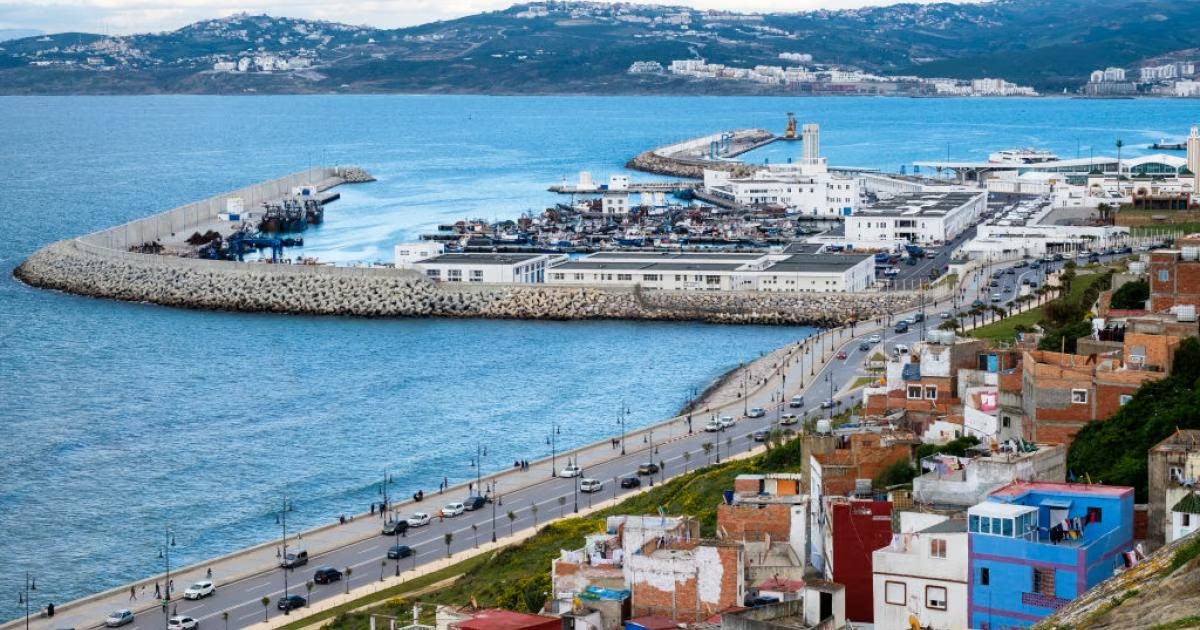
Dozens of activists gathered in the Moroccan city of Tangier on Saturday evening in a protest organized near the 'Marina Tangier' space, expressing their anger at the hosting of an Israeli sports delegation. This popular movement coincided with the start of the Optimist World Sailing Championship, which the coastal city is hosting from June 18 to 28, with wide international participation.

Field sources reported that Moroccan security forces intervened directly to disperse the protest gathering called for by the 'Moroccan Front for Supporting Palestine and Opposing Normalization'. Video documentation showed protesters attempting to raise slogans condemning sports normalization, while authorities imposed a security cordon around the event venue to prevent demonstrators from reaching the vicinity of the championship.

The local administration in Tangier had previously issued a decision prohibiting the organization of any protest vigils related to the championship, warning of the legal consequences of violating this directive. Organizing bodies of the protest stated that the security intervention resulted in the brief arrest of a number of participants, who were later released after the dispersal of the gathering near the recreational port.

The Optimist World Sailing Championship is one of the most prominent sports competitions dedicated to emerging age groups, attracting nearly 300 athletes representing 73 countries this year. Despite the sporting nature of the event, the participation of the Israeli side sparked a wave of criticism from Moroccan human rights and political bodies supporting the Palestinian cause, which view such participations as attempts to normalize relations through the sports gateway.

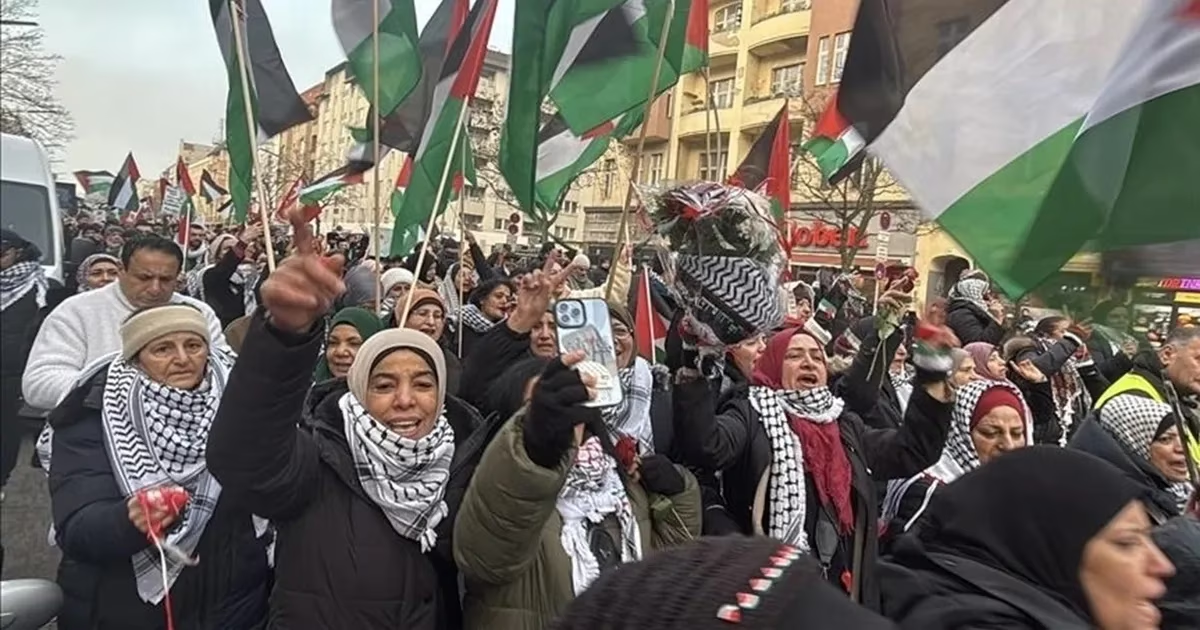
These developments come amidst an escalation of popular movements in various Moroccan cities in recent months, as the Moroccan street continues to express its solidarity with the Gaza Strip and its rejection of normalization agreements. Anti-normalization forces affirm that the continuation of protest activities aims to send a clear message to decision-makers about the necessity of cutting all forms of communication with the Israeli occupation, in line with popular sentiment.

The protest comes within the context of an ongoing popular movement in Morocco that rejects all forms of normalization with the occupation and supports the steadfastness of the Palestinian people.

ARAB AND WORLD

Sun 21 Jun 2026 3:57 pm - Jerusalem Time

Field Escalation Precedes De-escalation: Martyrs in Israeli Raids on Bekaa and Southern Lebanon

The Lebanese Ministry of Health announced a tragic toll as a result of recent Israeli aggressions, with five citizens martyred in the town of Sahmar in the Western Bekaa. Medical sources clarified that among the victims were a child, a woman, and two elderly individuals, reflecting the continued targeting of populated areas before any supposed de-escalation comes into effect.

In a related context, air raids targeted the Rashidieh area in the Tyre district, southern Lebanon, resulting in the martyrdom of two Palestinian refugees. These attacks come as part of a wide military escalation that included several geographical points in the Lebanese interior and south, leaving severe human and material losses among civilians.

The field also witnessed focused assassination operations carried out by drones, targeting a young man riding a motorcycle in the town of Zebdine, leading to his immediate martyrdom. The same scene was repeated in the town of Kafr Sir, where another young man was killed in a similar raid that targeted him while he was riding his motorcycle, indicating an intensification of drone use in pursuing moving targets.

On the military front, media sources quoted an Israeli army official confirming that instructions had been issued by the political level to cease clashes with Hezbollah in southern Lebanon. The official indicated that forces would begin to shift towards defensive operations only, in a step preceding the scheduled time for a comprehensive ceasefire set for the end of the day.

From an analytical perspective, political observers believe that what appears to be a disagreement between Washington and Tel Aviv is merely a division of roles to manage the complex regional crisis. Researcher Ali Hamieh pointed out that Israeli violations of the de-escalation agreement reached record numbers, exceeding 300 violations, emphasizing that this escalation is linked to the balance of power between international and regional axes.

In an interpretation of the Israeli position, researcher Adel Shadid considered that the relationship with the United States remains governed by a close coordination framework despite some differences in viewpoints. He explained that the Israeli government does not deviate from the ceiling set by the American administration but exploits available margins to carry out military operations that serve its field and political objectives.

International pressures continue to regulate the pace of confrontation in the region, at a time when Washington seeks to maintain military pressure tools without sliding into an all-out war. The situation in Lebanon remains hostage to actual commitment to the ceasefire, amid fears of continued violations that could undermine any opportunities for sustainable de-escalation in the near future.

What is happening between the United States and Israel reflects the integration of lines in managing the regional scene, and Israeli violations have exceeded 300 violations.

ANALYSIS

Sun 21 Jun 2026 3:57 pm - Jerusalem Time

Silent Conflict of Interests: How Do Beijing and Moscow's Visions Intersect on the Iranian File?

The rapprochement between Tehran, Beijing, and Moscow is often viewed as a solid, unified bloc confronting the West. However, a closer examination of the essence of these relationships reveals a complex web of divergent interests. While China views Iran through the lens of economy and energy, Russia sees Tehran as a strategic card to rebalance international powers and prevent American unilateralism in managing Middle Eastern affairs.

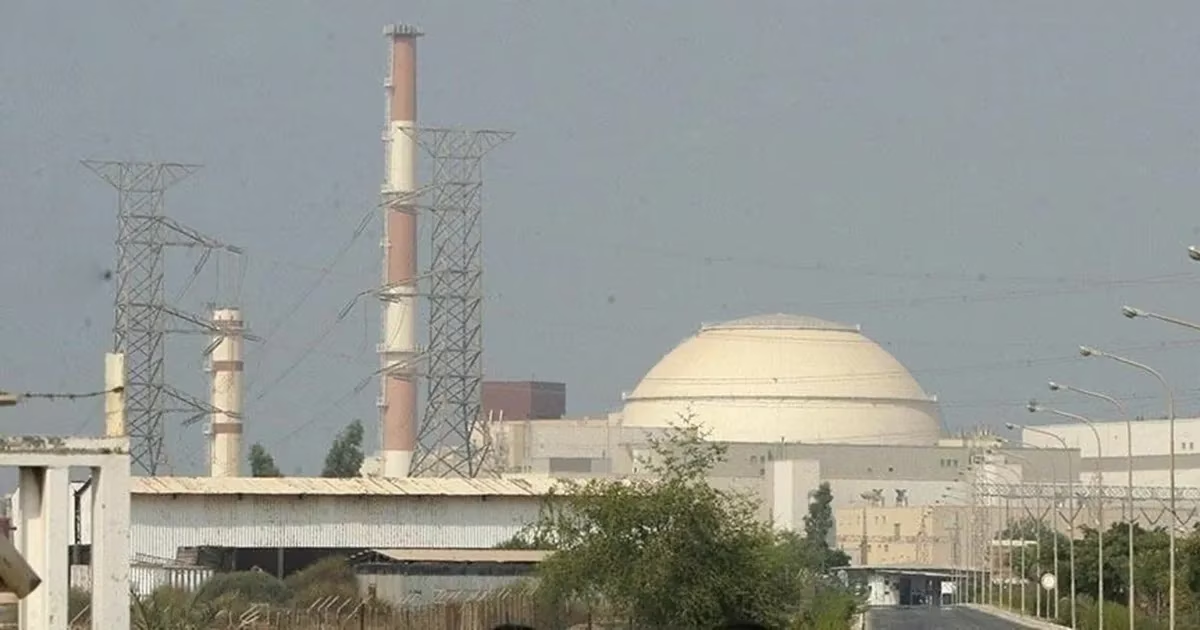
Historically, Iran's nuclear ambitions did not begin as a partnership with the East, but rather with support from the United States and West Germany before the 1979 Islamic Revolution. With the withdrawal of Western companies due to political shifts, Moscow found a golden opportunity to enter the heart of this file by completing the Bushehr reactor and training technical personnel, making it an indispensable partner in the operational structure of the program.

Russia's gains from the Iranian nuclear file extend beyond financial returns; they ensure Moscow a permanent role in the region's most sensitive files. This role was clearly demonstrated in the 2015 agreement, when Russia became a repository for enriched Iranian uranium, making it a technical and political guarantor that prevents Washington from unilaterally shaping regional policies.

Moscow prefers the Iranian file to remain in a long-term 'grey area,' where Tehran possesses an advanced program without reaching an announced nuclear bomb. This situation prevents a nuclear arms race on Russia's southern borders, while at the same time maintaining Iran's constant need for Russian political and technical cover in the face of international pressure.

The war in Ukraine has brought about a fundamental shift in the balance of power between Moscow and Tehran, where the relationship has moved from technical dependence to mutual reliance. This was clearly evident in military cooperation in the field of drones and the exchange of expertise in circumventing Western sanctions, which enhanced Iran's value as an active strategic ally for Russia.

On the other hand, China represents the 'economic lung' that enabled Iran to withstand severe American sanctions. By purchasing oil and signing a 25-year strategic cooperation agreement, Beijing established itself as an indispensable trading partner, benefiting from Iran's geographical location as a link in the Belt and Road Initiative.

The fundamental difference between the two powers is that China ascended from within the global trading system and considers stability essential for its economic growth. Russia, however, still views the world from the perspective of geopolitical conflicts and military balances, which makes their approach to the Iranian file follow different paths despite apparent overlap.

During recent military crises, neither Russia nor China intervened directly, but they provided a political and economic safety net that prevented Iran from being completely isolated. Chinese support in energy markets and Russian diplomatic cover in international institutions formed a bulwark that prevented the collapse of the Iranian state under the weight of external pressures.

The Caspian Sea represents a crucial geopolitical dimension in this tripartite alliance, being a closed sea beyond the reach of American fleets. This northern corridor provided Tehran with a logistical lifeline connecting it to Russia and Central Asia, reducing the effectiveness of military pressures exerted by Washington in southern waterways such as the Gulf and the Strait of Hormuz.

Questions arise about the future of this alliance if Iran fully integrates into the global economy and international trading system. For China, this could mean broader investment opportunities and greater competition, while Russia might lose a significant portion of its political influence based on Tehran's need for mediation and international cover.

Iran's potential integration into the international system could create a conflict of interests with Russia, especially if Iran becomes a competitor in global gas and oil markets. Economic openness could also impose shifts in Iran's internal political structure, which might change the nature of its existing alliances with Eastern powers.

Iran, for its part, plays a delicate balancing act between the Chinese 'Dragon' and the Russian 'Bear' to maximize benefits. It understands that its need for China is primarily economic, while its need for Russia remains linked to national security, the nuclear file, and military power balances in the region.

Talk of a homogeneous 'Eastern axis' overlooks the fact that each party acts according to a purely national agenda that may intersect today and diverge tomorrow. Iran's continued current status serves Russia's strategic interests, while China might prefer a more stable and open Iran to boost trade and energy flows.

In conclusion, the tripartite alliance remains subject to major international transformations and Iran's ability to maneuver between Western pressures and Eastern interests. The question will remain about Beijing and Moscow's willingness to support Tehran if the confrontation with the West reaches a point of no return that threatens their vital interests.

Russia does not want an openly nuclear Iran, but it also does not seem enthusiastic about completely ending the program; the grey area is its preferred playground for influence.

ARAB AND WORLD

Sun 21 Jun 2026 8:21 am - Jerusalem Time

Switzerland Negotiations Between Washington and Tehran Begin: Will the 'Islamabad Memorandum' End Decades of Conflict?

US-Iranian relations entered a new phase with the start of a round of official negotiations in the Swiss resort of Bürgenstock, today, Sunday. This step comes after the memorandum of understanding signed between the two parties came into effect, amidst international anticipation of what these talks will yield in redrawing the balance of power in the Middle East.

Pakistan had officially announced the start of these talks, which fall under the framework of what is known as the 'Islamabad Memorandum of Understanding'. This memorandum, signed electronically by Presidents Donald Trump and Masoud Pezeshkian, aims to put an end to escalating tensions and open a sustainable negotiation path between the two powers.

The first technical sessions in Switzerland focus on developing precise mechanisms for implementing the memorandum's provisions and ensuring both parties adhere to mutual commitments. This path represents a necessary prelude to moving on to more complex and sensitive issues in later stages of the ongoing diplomatic dialogue.

Qatari and Pakistani mediation played a pivotal role in bridging the views between Washington and Tehran to reach this point. Sources reported that regional efforts focused on formulating flexible positions that allow overcoming initial obstacles and building trust bridges lost for many years.

Despite the optimistic atmosphere, challenges arise regarding the definition of 'allies' in the memorandum, which has sparked reservations and escalation from the Israeli side. Observers believe that the ambiguity in some texts was intentional to facilitate signing, but it now faces difficult tests on the ground.

The presence of the Qatari Prime Minister and Foreign Minister, Sheikh Mohammed bin Abdulrahman, in Switzerland reflects the seriousness with which mediators view the success of this round. Doha, through its long experience in this file, seeks to ensure that fragile understandings do not collapse under the pressure of field escalation.

For its part, Tehran views this memorandum as a gateway to broader agreements that guarantee its national security and enhance its regional presence. Iranian sources confirm that adherence to the diplomatic path is linked to the extent of the other party's response to demands for lifting the suffocating economic blockade.

The past period witnessed field tension, represented by Iran's closure of the Strait of Hormuz, a step it described as a response to Israel's non-compliance with the truce provisions. This escalation is closely linked to the situation in southern Lebanon, placing the Lebanese front as a pressure element on the negotiating table.

Analyses indicate that the current memorandum guarantees a sixty-day truce on various fronts, but it does not mean a definitive end to the conflict. The primary goal is to provide a calm environment that allows discussion of major issues of concern to the international community, foremost among them navigation security.

The issue of the Strait of Hormuz stands out as a top priority in the first phase of negotiations due to its direct impact on global energy prices. Washington seeks to secure the flow of oil, while Tehran demands guarantees that end its imposed economic isolation and allow it to freely export its resources.

The second phase of the dialogue is scheduled to open the thorny Iranian nuclear file with all its technical and political details. This phase includes discussions on freezing enrichment operations and the fate of major nuclear facilities such as 'Natanz' and 'Fordo' that Washington demands be dismantled.

The United States stipulates the establishment of surprise and direct inspection mechanisms for Iranian facilities, in addition to addressing the fate of tons of enriched uranium. In contrast, Iran insists that any concession in this file must be met with a comprehensive and complete lifting of all sanctions imposed for decades.

Experts believe that the success of the Switzerland negotiations depends on the parties' ability to separate regional issues from the bilateral track. However, the close link between Tehran and its allies in the region, such as Hezbollah, remains a crucial factor that could lead to the success or failure of the entire process.

The real test for the international community and mediators lies in transforming this temporary truce into lasting and comprehensive peace. The intertwined interests and historical complexities make the journey to finding a final agreement a perilous path, but it remains the only option to avoid a widespread military confrontation.

The current phase requires pushing for the start of negotiations between Washington and Tehran, where sovereign issues such as the Strait of Hormuz and regional security will be put on the table for discussion.

ARAB AND WORLD

Sun 21 Jun 2026 8:21 am - Jerusalem Time

Challenges to the Success of the Washington-Tehran Memorandum of Understanding: The Role of Qatari Mediation and Opportunities for Regional Stability

The recently signed Memorandum of Understanding (MoU) between the United States and Iran puts an end to more than 110 days of military confrontations that lacked realistic strategic planning. Field realities have proven the difficulty of resolving a conflict of miscalculations through military force alone, which opened the door for diplomacy and mediators to offer mutual concessions that defuse a comprehensive regional explosion.

The State of Qatar, along with the Sultanate of Oman and Pakistan, played a pivotal role in bridging viewpoints and the deep chasm between Washington and Tehran. This role was evident in the intensive communications conducted by US President Donald Trump with His Highness Sheikh Tamim bin Hamad Al Thani, which reflected high American appreciation for Qatari efforts in achieving this political breakthrough.

During the G7 summit held in France last week, President Trump praised the courage of the Qatari leadership and its role in avoiding the continuation of war with Iran. Trump affirmed in his statements that Qatari mediation was effective and resulted in significant progress, describing the Emir of Qatar as a person who genuinely seeks to achieve peace and stability in the region.

For his part, Iranian President Masoud Pezeshkian, in a phone call with the Emir of Qatar, expressed his appreciation for Qatar's efforts supporting regional security. Pezeshkian thanked Doha for its role that led to the current MoU, especially after the electronic signing that paves the way for the agreement to come into actual effect.

The MoU signed at the Palace of Versailles includes 14 clauses that constitute the first phase of a diplomatic process extending for sixty days. This phase aims to build trust and avoid military escalation, with a focus on ending the blockade and opening the Strait of Hormuz to international navigation and global energy trade.

The agreement includes a clear Iranian commitment not to seek nuclear weapons, with enriched material stockpiles placed under the supervision of the International Atomic Energy Agency. More complex issues are scheduled for discussion in the second phase, after ensuring all parties' commitment to implementing the initial understanding's clauses.

In return, the United States pledges to cooperate with regional partners to develop a comprehensive plan for Iran's reconstruction and economic development. This includes issuing necessary financial licenses and unfreezing Iranian assets, as incentives aimed at ensuring Tehran's continued adherence to the de-escalation clauses.

Despite this progress, serious challenges threaten the sustainability of the agreement, most notably US intelligence assessments indicating an Israeli attempt to thwart the understandings. This threat is clearly evident in the continued military escalation in southern Lebanon, which informed sources consider the biggest test of the will of the parties signatory to the memorandum.

The agreement faced harsh criticism from within the American Republican Party, with some hawks and conservatives describing it as a 'strategic mistake.' Ministers in Benjamin Netanyahu's government also expressed strong opposition to the American-Iranian rapprochement, prompting Trump to respond in angry language reflecting his insistence on moving forward with his new path.

The MoU calls for a permanent ceasefire on all fronts, ensuring respect for Lebanon's sovereignty and stability. It also emphasizes the necessity of securing navigation in the Strait of Hormuz without imposing fees, a vital demand for the Gulf Cooperation Council countries that were affected militarily and economically during the previous period of escalation.

In the next phase, Iran needs to build bridges of trust with its neighbors in the Gulf, especially after the threats to vital infrastructure and energy facilities. The success of Qatari mediation, supported by the Gulf, is an important step towards activating 'supportive diplomacy' aimed at protecting common interests and preventing the region from turning into a war of attrition.

The fundamental question remains about the current US administration's ability to curb Israeli recklessness and prevent the far-right from undermining the agreement. The continuation of the conflict serves personal and electoral agendas for some parties, while the agreement represents a realistic way out that spares the global economy the risks of energy supply disruptions.

The success of this memorandum fundamentally depends on adherence to the specified 60-day timeline to reach a final and comprehensive agreement. Qatari diplomacy remains the guarantor and mediator capable of defusing lingering crises, based on balanced relations with all parties to the conflict in the region.

Without Qatar, we might still be at war with Iran. Emir Tamim is a wonderful person who seeks peace.

OPINIONS

Sun 21 Jun 2026 8:04 am - Jerusalem Time

Netanyahu: From the Center of Power to an Unwanted International Political Ghost

Dr. Ibrahim Nairat

Opinion Writer

Dr. Ibrahim Nairat

Benjamin Netanyahu is no longer merely a prime minister in Israel; he has become the embodiment of an extended political crisis, both internal and external, that transcends his person to affect the image of the state itself. With years of governance, successive wars, and deep internal divisions accumulating, the idea of his continued stay in power is being raised not only as an internal political matter but as a factor determining Israel's position in the international system.

Within Israel, consensus around Netanyahu is eroding rapidly. The man who long presented himself as a “guarantor of security and stability” has become, in the eyes of his opponents, a symbol of polarization, division, and the breakdown of trust between society and state institutions. With his alliance with hardline religious right-wing forces, his governments have transformed into an arena for open internal conflict, which only calms down to flare up again.

In this context, Netanyahu no longer enjoys widespread acceptance as before. The circle of those who reject him within and outside the Israeli political scene is expanding, to the point where his presence has become a source of unprecedented controversy and division. His margin of acceptance as a unifying leadership option has shrunk, while he is increasingly viewed as a polarizing factor rather than a balancing element.

Externally, Netanyahu's image has begun to take on a more complex character. He is no longer seen merely as a difficult political partner, but as a figure who burdens Israeli diplomacy and is gradually transforming into an internationally unwanted political ghost in some circles. The increasing criticisms of settlement policies, the management of the war in Gaza, and the deteriorating relationship with some Western capitals are all factors that have made his political presence a subject of escalating reservations, even among circles that were traditionally unconditionally supportive of Israel.

In this context, a current is crystallizing within Israel that believes moving beyond the Netanyahu era is no longer an ordinary political option, but a necessity to reset the relationship between internal and external affairs. This current, extending from the center-right to the political center, presents it as an entry point for restoring Israel's image and rebuilding trust with allies, especially in the West, who have become more sensitive to the rhetoric and policies of the hardline right.

However, the fundamental paradox lies in the fact that this potential shift does not necessarily mean a change in the essence of policies. Even the forces proposed as alternatives to Netanyahu do not offer a radically different vision regarding the Palestinian issue; instead, they tend to manage the conflict rather than resolve it, and to transitional solutions rather than final settlements. In other words, the political face may change, but the deep structure of policies largely remains the same.

Nevertheless, any Israeli repositioning towards the Palestinians, even if initially accompanied by clear internal reservations and caution, could open a different political window in the medium and long term. The Gaza war and its accompanying humanitarian and international political repercussions have contributed to the crystallization of a broader and clearer international will towards the necessity of reviving the path to resolving the Palestinian issue, instead of keeping it in a state of chronic conflict management. Although these shifts will not be quick or smooth, the accumulation of international pressure and the changing mood in some influential capitals may gradually push towards reopening the political file more seriously, even if it begins with limited transitional steps.

On the other hand, Netanyahu remains a formidable political player. The network of alliances within the Knesset, the strength of Likud, and the ability to reposition himself are all elements that give him a chance to stay or return even in moments of weakness. Therefore, talk of his political end is still premature from the perspective of power calculations.

Despite this, the gap between Netanyahu and an increasing number of international partners is widening, to the extent that his very presence has become a factor of tension in some issues. Here lies the essence of the shift: the question is no longer just whether he stays or leaves, but whether he has become part of the problem in the eyes of many, instead of being part of the solution.

In conclusion, it can be said that Netanyahu has not only revealed the limits of Israeli politics but has also exposed the hidden intentions within it, proving that Israel is not a single homogeneous political entity, but rather more than one “Israel,” where conflicting projects and visions about the state, society, and the future intertwine.

Ultimately, it does not seem that Israel is facing merely a change of government, but a deeper test related to the form of the state, its image, and the limits of its ability to adapt to internal and external changes. Between Netanyahu's stay or departure, the most important truth remains that an entire political era is approaching its end, even if the names have not yet been decided.

OPINIONS

Sun 21 Jun 2026 7:56 am - Jerusalem Time

Vance heads to Switzerland to revive negotiations with Iran amid escalating tensions in the Strait of Hormuz and the Lebanese front

Washington - Said Arikat - 21/6/2026

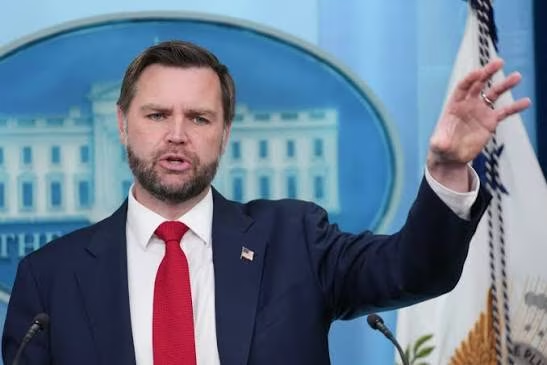
US Vice President JD Vance headed to Switzerland for a new round of negotiations with an Iranian delegation, in an attempt to push forward the stalled settlement process between Washington and Tehran, at a time when fears of an expansion of regional tension are increasing after the renewed clashes between Israel and Hezbollah in Lebanon, and the return of the Strait of Hormuz to the forefront of security and economic crises.

Before departing from Andrews Air Force Base, Vance said that he would only stay in Switzerland for a day or two, stressing that the priorities of the talks would focus on the Iranian nuclear file and efforts to consolidate a ceasefire on the Lebanese front. He added that these two files constitute the main محور of the current talks, expressing his hope for tangible progress on both tracks.

This round of negotiations comes amid a new escalation in the Gulf region, after the Iranian armed forces announced the closure of the Strait of Hormuz, one of the most important maritime passages for oil transport and global trade, which raised fears of widespread disruptions in international shipping and energy markets.

In an indication of the expanding regional sponsorship of the negotiations, the Pakistani Ministry of Foreign Affairs announced that a high-level delegation had departed for Switzerland to participate in the new round of talks. The delegation includes Prime Minister Shahbaz Sharif and Army Chief Marshal Syed Asim Munir, as part of Islamabad's role as a mediator between Washington and Tehran in recent months.

The ministry also confirmed that a Qatari delegation would join the meetings, reflecting the increasing efforts made by regional countries to keep channels of dialogue open and prevent the region from sliding into a wider confrontation that could include more than one conflict arena.

In contrast, Iranian state media reported the arrival of the Iranian delegation in Zurich, where talks with US officials are expected to begin on Sunday. The delegation is headed by Iranian Parliament Speaker Mohammad Bagher Ghalibaf, and includes Foreign Minister Abbas Araghchi, Deputy Secretary of the Supreme National Security Council Ali Bagheri, and Foreign Ministry Spokesperson Ismail Baghaei.

These negotiations acquire exceptional importance in light of the increasing interconnectedness of regional issues, as the nuclear file is no longer separate from military developments in Lebanon or from the security of maritime passages in the Gulf, which makes any progress or setback in the talks an influential factor in the overall regional balances.

Negotiations beyond the nuclear file

The composition of the participating delegations and the nature of the issues raised reveal that the current negotiations are no longer limited to the Iranian nuclear program, as was the case in previous rounds. The US administration realizes that any sustainable agreement with Tehran requires addressing the associated regional security files, foremost among them Lebanon and maritime navigation security. The involvement of Pakistan and Qatar also reflects a trend towards building a broader regional framework for future understandings. Therefore, the success of this round will be measured by its ability to produce simultaneous political and security understandings, not merely by achieving technical progress on nuclear issues.

Strait of Hormuz returns as a strategic pressure card

Iran's announcement of the closure of the Strait of Hormuz serves as a reminder of the importance of this card in regional power calculations. Tehran realizes that the strait represents a vital artery for the global economy, and that any disruption in it immediately affects energy prices and international supply chains. Therefore, the Iranian message appears to go beyond the direct military dimension to an attempt to strengthen its negotiating position before the talks begin. However, using this card also carries significant risks, as it could push the United States and its allies to adopt more hardline positions if the threat to international navigation is considered part of Iran's pressure strategy.

Lebanon becomes a crucial test for diplomacy

It appears that the Lebanese front has become one of the most prominent tests for the ongoing diplomatic efforts between Washington and Tehran. The continued clashes between Israel and Hezbollah threaten to undermine any progress made at the negotiating table, and also provide additional pretexts for forces rejecting a settlement to thwart it. In this context, the US administration seeks to link any broader understanding with Iran to security arrangements that ensure sustainable calm on the Lebanese border. However, the success of this path will remain contingent on the willingness of regional parties to make mutual concessions, which has not yet been sufficiently indicated.

PALESTINE

Sun 21 Jun 2026 7:56 am - Jerusalem Time

Paris Grants Honorary Citizenship to Palestinian Civilians and Journalists in Gaza and the West Bank

The Paris City Council has officially approved a decision to grant honorary citizenship to Palestinian civilians residing in the Gaza Strip and the West Bank, in addition to media personnel working in the occupied territories. This symbolic step comes as an expression of deep solidarity with the Palestinian people amidst the ongoing conflict and the harsh conditions faced by the residents there.

The decision received widespread support from the left-wing majority within the municipal council during a session that saw a notable diplomatic presence, represented by the Palestinian Ambassador to France, Hala Abu Hasira. The announcement was met with warm applause from those present, indicating the political support for the Palestinian cause within the corridors of the French capital's local administration.

Paris Deputy Mayor, the socialist Emmanuel Grégoire, affirmed that this honor goes beyond being merely a symbolic gesture; rather, it represents a moral commitment to a just peace. Grégoire, who presented the proposal in cooperation with Deputy Mayor Audrey Pulvar, explained that through this decision, the city seeks to extend moral support to a people facing existential challenges.

Although this honorary citizenship does not entail any legal or administrative rights for the recipients, it carries strong political implications aimed at highlighting the deteriorating humanitarian situation. The decision specifically focuses on protecting civilians, especially children and women, who pay the highest price as a result of the siege and ongoing military operations since October 2023.

The decision also allocated a special space to honor Palestinian journalists, in recognition of the grave dangers they face while conveying the truth from the field. Documented statistics indicate that approximately 252 Palestinian journalists have been killed in conflict zones, making it necessary to send an international message demanding the protection of media personnel and ensuring freedom of the press.

This honor is part of a political tradition followed by the city of Paris since 2001, where it has previously granted similar awards to peoples suffering from humanitarian crises and wars, such as the residents of the Nagorno-Karabakh region and the Ukrainian capital Kyiv. Through these initiatives, the municipal council seeks to solidify Paris's position as a city that embraces global humanitarian causes and supports the rights of peoples to self-determination.

Honorary citizenship is not just a symbol; it is a commitment to peace. We extend our hand to an entire people.

PALESTINE

Sun 21 Jun 2026 7:56 am - Jerusalem Time

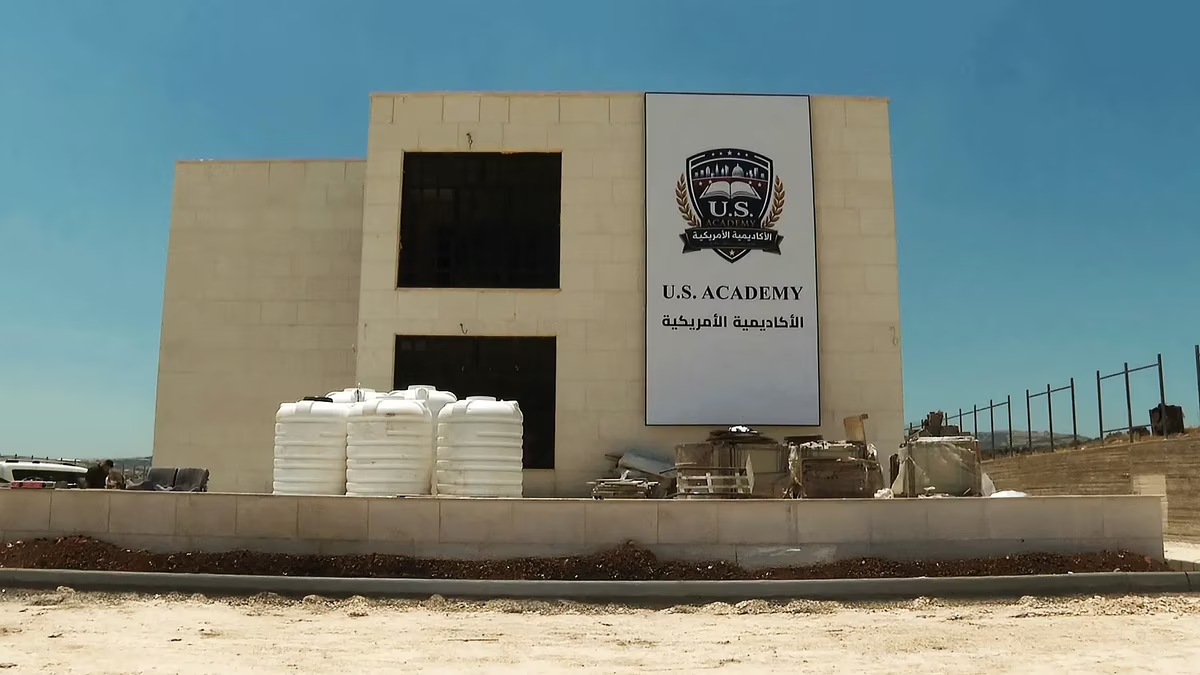
Expatriate Investments Under Settlement Fire: A $5 Million School Becomes a Barracks to Protect Itself in Ramallah

On the outskirts of the village of Deir Dibwan, east of Ramallah, a modern educational edifice was planned to rise, combining investment ambition with a national mission. The school, designed by Palestinian-American investor Abdul Jawad, aimed to serve Palestinian students and returning community members from the United States, providing a comprehensive educational environment with advanced sports facilities and playgrounds.

However, this educational dream, which cost nearly $5 million, collided with a bitter reality imposed by continuous settler attacks in the area. Settlers set up a settlement tent near the construction site and began a series of attacks that included stealing building materials and school contents, turning the project into a daily confrontation zone.

Sources reported that investor Abdul Jawad, who usually resides in California, was forced to leave his life there and return to the West Bank to oversee his threatened project. Abdul Jawad confirmed that the scale of the attacks prompted him to change the school's engineering plans, shifting the focus from open spaces to building high walls and tightening security measures.

The investor explained that the school, which was supposed to be a beacon of knowledge, now requires round-the-clock strict guarding and a security fence surrounding it. He pointed out that settler attacks were not limited to theft but also led to the displacement of some residents who lived in the area surrounding the educational project.

The crisis is exacerbated by the investor's loss of access to his entire 16-dunum land, as restrictions and attacks prevent him from utilizing more than 10 dunums. This reality has made the project owner feel that his school might turn into something resembling a prison due to the forced protection measures imposed by the settlement reality.

The case of the Deir Dibwan school is not an isolated incident but part of a growing pattern targeting the properties of Palestinian expatriates in areas north of Ramallah. Human rights activists confirm that settlers exploit the absence of landowners abroad to carry out systematic seizures and change facts on the ground under the protection of occupation forces.

In this context, lawyer Yasser Alqam from the town of Turmus Ayya revealed that he is following hundreds of legal files related to the seizure of lands belonging to Palestinian citizens holding American nationality. Alqam explained that these cases reflect the extent of the widespread targeting faced by expatriates who decided to invest in their homeland.

Despite dozens of official complaints submitted to the American Embassy and the State Department in Washington, the results are still absent on the ground. Legal experts indicate that the lack of effective international response encourages settlers to continue their attacks against the properties of citizens holding foreign nationalities.

These pressures have led some expatriates to make fateful decisions to return permanently to protect their families and properties, as is the case with citizen Zaher, who returned from Georgia. Zaher, who lived a stable life in the United States, decided to stay in the town of Turmus Ayya to be close to his daughter and grandchildren after the danger of settlers approached their home.

These stories in the villages and towns of Ramallah paint a picture of a battle of steadfastness fought by Palestinian expatriates to preserve their existence and connection to the land. Between struggling educational projects and confiscated lands, the biggest challenge remains how to protect private property amidst escalating settlement policies that spare no one.

The project, which was supposed to include playgrounds and swimming pools, now needs a fence and guards day and night to protect it from settler attacks.

PALESTINE

Sun 21 Jun 2026 7:56 am - Jerusalem Time

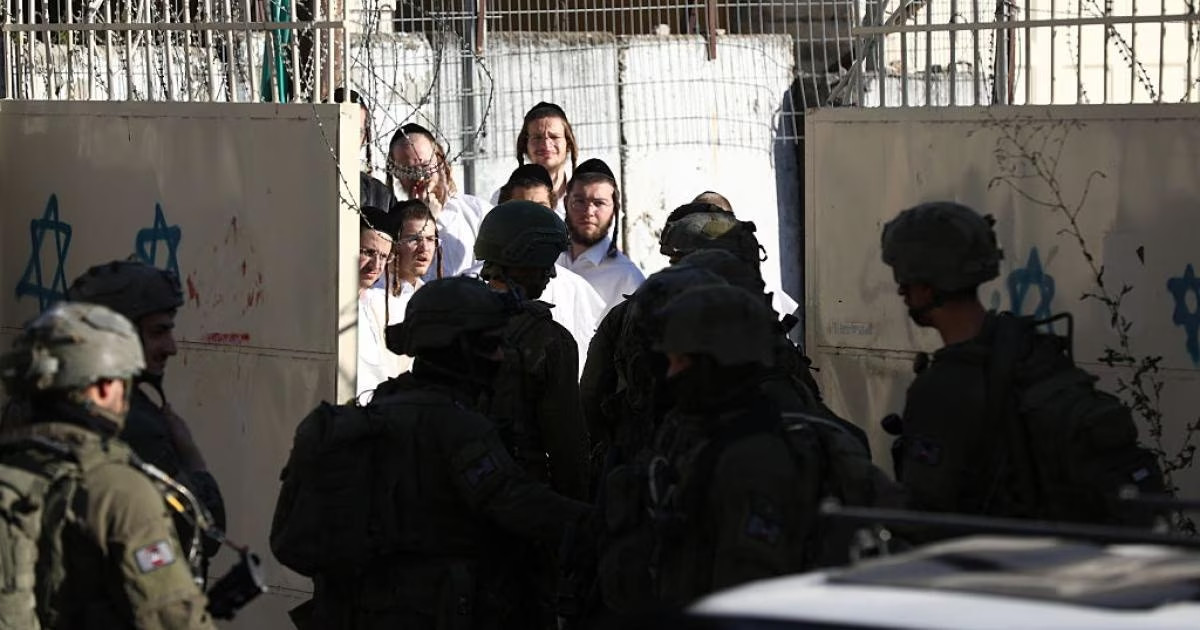
Injuries from settlers' bullets and widespread incursions target Al-Fawwar refugee camp north and south of Hebron

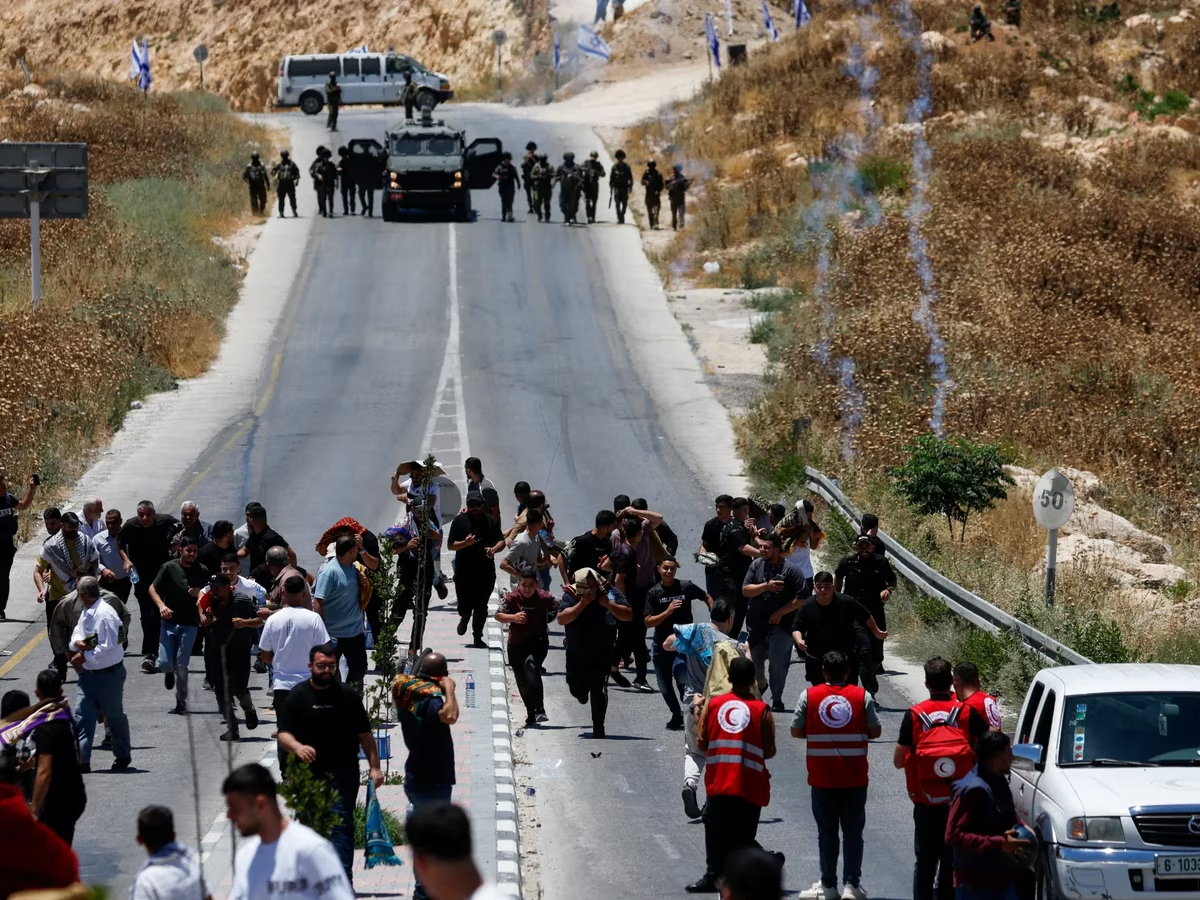
The Hebron Governorate, in the southern occupied West Bank, witnessed a new field escalation today, Saturday, represented by widespread incursions carried out by Israeli occupation forces, coinciding with attacks carried out by groups of armed settlers. Field sources reported that the occupation forces stormed Al-Fawwar refugee camp south of the city, where violent confrontations erupted with Palestinian youths who confronted the military vehicles.

The sources stated that the occupation soldiers abused the camp residents and assaulted a number of citizens, including a young man who was tied up and forced to sit on the ground for hours. Israeli forces heavily used live ammunition and tear gas canisters, leading to cases of suffocation among residents inside their homes, which were not spared from random raids.

In the context of ongoing violations, search operations and tampering with contents targeted the home of the Director-General of the Palestinian Prisoners' Club, Amjad Al-Najjar, where forces destroyed property and detained its residents. This step comes as part of a systematic policy targeting national symbols and human rights institutions in various cities and camps of the West Bank to intimidate the population.

Regarding settler attacks, three Palestinian citizens sustained varying injuries after an attack carried out by extremist settlers on the town of Surif, northwest of Hebron. The Palestinian Red Crescent Society confirmed that its teams dealt with two live bullet injuries belonging to a father and his son, who were immediately transferred to the hospital to receive necessary treatment due to their moderate injuries.

Settler attacks in Surif were not limited to shooting, but also included severe physical assault on another young man, causing him severe bruises and a broken jaw. These attacks occurred under direct protection from the occupation army, which later intervened to impose a security cordon and establish military checkpoints, especially near Bilal Bin Rabah School, hindering the movement and travel of citizens.

Official data issued by the Wall and Settlement Resistance Commission indicates a frightening escalation in the pace of violence, with over 1600 attacks recorded in May alone. These violations were distributed between direct military operations by the army and attacks carried out by settler militias, reflecting a complementarity of roles to displace Palestinians and seize their lands.

Since last October 7th, the West Bank has been in a state of turmoil amid the continued fall of martyrs and injured, with the number of martyrs exceeding 1100 Palestinians. These figures are accompanied by unprecedented arrest campaigns targeting thousands, amid deteriorating humanitarian and security conditions due to the imposed siege and repeated daily incursions.

Israeli army and settlers carried out 1659 attacks last May, including killings, destruction, and forced displacement.

ARAB AND WORLD

Sun 21 Jun 2026 7:56 am - Jerusalem Time

Spanish Judiciary Refers Sanchez's Wife for Trial and Bans Her from Traveling

Spanish Prime Minister Pedro Sanchez received a new political and legal blow following the decision by investigating judge Juan Carlos Peinado to refer his wife, Begoña Gómez, for formal trial. This step comes as part of extensive investigations related to suspicions of financial corruption and abuse of influence, increasing pressure on the current socialist government.

The judicial decision included strict precautionary measures against Gómez, as she was ordered to immediately surrender her passport and banned from leaving Spanish territory until further notice. The judge also obliged her to appear before the court twice a month to ensure the follow-up of legal procedures, amid accusations of using her connection to the prime minister to secure illegal commercial contracts and professional advantages.

For its part, the ruling Socialist Party rushed to defend the prime minister's wife, describing the judicial procedures as part of an arbitrary politically motivated persecution campaign. The party affirmed in a statement that this case, which began about two years ago, lacks solid legal foundations, considering it an attempt by right-wing parties to undermine government stability.

In a related context, Pedro Sanchez stressed his innocence and the innocence of those close to him, indicating that these investigations are part of a systematic plan aimed at removing him from power. Although the prime minister's name was not directly mentioned as a defendant in the case documents, the increasing investigations involving his family members and political allies put him in a critical position before Spanish public opinion.

The judicial pursuits are not limited to Sanchez's family but have extended to include former Prime Minister José Luis Rodríguez Zapatero, who is under investigation by the Supreme Court. Suspicions revolve around his leadership of a lobbying network that exerted illegal influence on public authorities in favor of airlines and private entities, which Zapatero denies outright.

The ongoing investigations also affect a number of prominent figures in the Socialist Party, including the former Minister of Transport, who held the position of the third-highest-ranking official in the party. These cases focus on accusations of receiving bribes in exchange for facilitating government contracts in the energy sectors, in addition to suspicious deals for purchasing medical supplies during the COVID-19 pandemic crisis.

These successive judicial developments paint a complex picture for Pedro Sanchez, who is considered one of the most prominent resilient leftist leaders on the European continent. With the trials approaching, the Spanish public awaits the outcome, amid sharp political polarization between the government and the opposition, which is exploiting these issues to strengthen its position.

Begoña Gómez has been subjected to arbitrary judicial and political persecution for two years, and what happened today is merely an extension of this process.

ARAB AND WORLD

Sun 21 Jun 2026 7:53 am - Jerusalem Time

Diplomatic Crisis Erupts Between Washington and Rome: Trump Attacks Meloni, Italy Responds by Canceling Official Visit

US-Italian relations witnessed a sudden and sharp escalation following a verbal attack by President Donald Trump on Italian Prime Minister Giorgia Meloni. During a recent television interview, Trump claimed that Meloni was previously a great admirer of his, but he expressed his unwillingness for this admiration to continue due to what he described as Italy's failure to support NATO's efforts in securing vital waterways.

Trump referred in his speech to disagreements that emerged during the last G7 summit hosted by France, where he criticized the role of European allies in securing the Strait of Hormuz. The American president considered that the Italian leadership was not up to the required level in standing with the United States on sensitive strategic issues, which led to a cooling in the relationship that was previously described as friendly.

Trump's attack did not stop at general policies but extended to personal stances, as he claimed in statements to Italian media that Meloni 'begged' him for a commemorative photo with him during the international summit. Trump added that he agreed to the request out of pity only, indicating that she was very keen to get that photo to strengthen her political position, which sparked a wave of widespread anger in Italian political circles.

For her part, Italian Prime Minister Giorgia Meloni quickly responded via a video broadcast on social media platforms, in which she described Trump's narrative as 'completely fabricated'. Meloni expressed her deep astonishment at the US president resorting to such a method in dealing with his country's close allies, stressing that these actions have been repeated in previous situations without clear justification.

Meloni criticized what she described as the contradiction in Trump's positions, noting that he shows unjustified firmness towards Western allies while appearing more lenient with leaders of international countries hostile to the West. She considered that this approach weakens the united front of the United States and Europe in confronting common global challenges, calling for the necessity of respecting the sovereignty and national dignity of allied countries.

In a remarkable diplomatic development, Italian Foreign Minister Antonio Tajani announced the cancellation of his official visit to the United States scheduled for next week. Tajani confirmed that this decision came in direct response to the statements he described as 'insulting' against his country's prime minister, considering that insulting Meloni is an insult directed at the Italian state with all its institutions and people.

Tajani's visit was supposed to include high-level meetings in Washington on June 21 and 22, but the current tension prevented its completion. The Italian minister explained that his country cannot overlook such dangerous and offensive words, stressing that international relations must be built on mutual respect and not on making inaccurate personal claims.

The roots of this dispute, according to informed sources, go back to differing views on the military operations carried out by the Trump administration in the Middle East, specifically against Iranian targets. Rome had previously expressed clear reservations about Washington's handling of this issue, which created a gap in security and political coordination between the two capitals, the effects of which have become clearly visible in recent statements.

Observers believe that this public clash represents a negative turning point in the course of relations between Rome and Washington, especially in light of the challenges facing NATO. With the continued exchange of accusations, the question remains about the ability of back-channel diplomatic channels to contain the crisis and prevent its escalation in a way that could affect strategic cooperation between the two countries in the near future.

The dangerous and offensive words directed by President Trump to Prime Minister Giorgia Meloni insult all of Italy.

PALESTINE

Sun 21 Jun 2026 7:53 am - Jerusalem Time

Occupation admits killing of 'Maglan' unit soldier in fierce battles in southern Lebanon

The Israeli occupation army announced on Saturday evening the killing of one of its soldiers during the intense confrontations in southern Lebanon, bringing the number of Israeli military fatalities to five soldiers since the signing of the recent memorandum of understanding between the United States and Iran. The military statement clarified that First Sergeant Ari Nir was killed during field clashes, less than one day after the army admitted the death of four other soldiers in similar battles.

Official data issued by the occupation authorities indicate that the total number of fatalities among the army and civilian contractors since the outbreak of confrontations with Hezbollah on March 2nd has reached 36. This toll comes at a time when the pace of military operations on the northern border is escalating, putting additional pressure on the military and political leadership in Tel Aviv.

Media sources reported that combat operations have been intensely concentrated for two days in the strategic Ali al-Taher Hill area, where the battles are described as the most violent in weeks. This area is considered a vital stronghold in the current confrontation, given its geographical nature and the fortifications that the occupation claims exist in its vicinity.

The killed soldier belonged to the special 'Maglan' unit of the Commando Brigade, an elite unit specialized in carrying out missions behind enemy lines and dealing with sensitive targets. This unit is usually tasked with destroying complex military infrastructure and dealing with tunnels, which indicates the dangerous nature of the mission the force was carrying out on Ali al-Taher Hill.

Sources in the occupation army claimed that Ali al-Taher Hill contains an extensive network of tunnels, used as a central operations room to manage Hezbollah's military activities in the area. The occupation claimed that this network played a pivotal role in directing field operations over the past years, which explains the army's insistence on penetrating this specific point.

Regarding the details of the operation that led to the soldier's death, sources stated that the attack occurred around 1:30 AM on Friday-Saturday. Hezbollah fighters targeted a fortified military position where occupation soldiers were entrenched, using a combination of rocket barrages and suicide drones in a coordinated attack.

Initial estimates by the occupation's security agencies indicate that the fatal injuries resulted directly from a drone explosion inside the targeted site. Despite attempts to counter the attack, the simultaneous launch of rockets with the drone's flight led to the dispersal of air defenses and caused human casualties among the stationed force.

This blow comes amid a state of shock within the Israeli military establishment following the killing of a battalion commander in the armored corps last Friday. According to technical reports, the army believes that the previous attack was carried out by a drone carrying an anti-tank missile, a qualitative tactic used for the first time in this confrontation.

For its part, the occupation army continues its claims of imposing a siege on groups of Hezbollah fighters inside the tunnels in the operational area, affirming the continuation of its military activity despite announcements of de-escalation. The military leadership claims that these movements do not violate the ceasefire agreement, but rather fall within the framework of 'dealing with direct threats'.

However, the continuous flow of news of dead and wounded from southern Lebanon reflects a field reality that contradicts official statements about security control. These developments confirm that the northern front remains inflamed and capable of draining Israeli elite forces, despite all international efforts aimed at stabilizing the calm.

The Israeli casualty belongs to the special Maglan unit, which is one of the elite units usually tasked with carrying out complex operations within sensitive combat zones.

PALESTINE

Sun 21 Jun 2026 7:53 am - Jerusalem Time

Thousands of demonstrators in Berlin condemn Israeli aggression on Gaza and Lebanon

Thousands of demonstrators gathered in the heart of the German capital, Berlin, on Saturday, in a massive public march to express their absolute solidarity with the Palestinian and Lebanese peoples. This popular movement came in protest against the escalating pace of attacks launched by the Israeli occupation army on the Gaza Strip and Lebanese cities, amidst increasing international demands for a ceasefire and the protection of civilians.

The march began from the historic 'Oranienplatz' in the 'Kreuzberg' district, where participants walked towards the famous 'Sonnenallee' in the 'Neukölln' district. German security authorities imposed a strict cordon and extensive precautionary measures along the demonstration route to ensure control over the large crowds that flocked from various districts of the capital.

Protesters raised their voices loudly to condemn the Israeli occupation policies in the occupied Palestinian territories, directing harsh criticism at the German government for its continued export of weapons to the occupying state. Demonstrators considered that German military support directly contributes to the continued suffering of children and women in the targeted areas, demanding that the German Chancellor and political leadership immediately review these positions.

The demonstration witnessed a dense display of Palestinian and Lebanese flags, along with banners written in several languages carrying strong messages such as 'Stop the Genocide' and 'Gaza Under Fire'. Participants also made sure to carry pictures of Palestinian prisoners held in occupation prisons, to highlight their cause and humanitarian suffering under the current circumstances.

Demonstrators chanted enthusiastic slogans demanding freedom for Palestine and an immediate end to the occupation, describing what is happening in the Gaza Strip as a crime of genocide that requires urgent international action. The event concluded peacefully at the intersection of 'Pannierstraße' and 'Sonnenallee', after the participants delivered a firm message rejecting international silence towards the crimes committed against civilians.

This is not a war, this is a genocide.. Israel bombs and Germany supports.

LATEST NEWS

Sun 21 Jun 2026 7:53 am - Jerusalem Time

Gabard drops a bombshell on her last day: Intelligence documents accuse Fauci of funding 'Wuhan' research and concealing COVID's origin

On her last day as head of the US National Intelligence, Tulsi Gabbard dropped a major intelligence bombshell by declassifying a package of sensitive documents and communications. Gabbard stated that these documents reveal what she described as the 'true story' behind the origin of the COVID-19 virus, shedding light on previously unpublished behind-the-scenes details of pandemic management.

The released documents placed Anthony Fauci, the most prominent figure in managing the health crisis in the United States, at the heart of serious accusations related to funding controversial biological research in Wuhan, China. The accusations included deliberate manipulation of intelligence assessments and providing inaccurate testimonies under oath before the US Congress.

Gabbard explained in a video clip that Fauci, as director of the National Institute of Allergy and Infectious Diseases, oversaw the direction of millions of taxpayer dollars to fund 'gain-of-function' research. This research focused on bat coronaviruses within the Wuhan Institute of Virology, research now believed to have been the spark for an unintentional lab leak.

The Office of the Director of National Intelligence confirmed in an official statement that these documents were the result of a comprehensive year-long review aimed at declassification. The statement indicated that this step comes in implementation of presidential directives aimed at achieving maximum transparency for the American people regarding the origins of the pandemic that paralyzed the world.

The leaked communications revealed how Fauci collaborated with 'politicized' professional leaders within the intelligence community to conceal facts related to his role in funding that research. The statement alleged that this collaboration was primarily aimed at diverting attention from the lab leak hypothesis and solidifying the narrative of the virus's animal origin.

Intelligence reports painted an accusatory picture of Fauci, pointing to his exploitation of close relationships within decision-making circles to push agendas linked to major pharmaceutical companies. The documents accused him of pursuing the development of 'universal vaccines' with a market value estimated in trillions of dollars, benefiting from his position as the country's most important medical commentator during the pandemic.

In a related context, Gabbard stated that Fauci pressured for the accelerated publication of research papers she described as 'fake' to support the natural origin hypothesis of the virus and refute any doubts about the laboratories. These papers were used as legitimate scientific tools to mislead public opinion and control dissenting information across various digital platforms.

The documents included testimonies from whistleblowers within the intelligence community who confirmed being subjected to retaliation and job threats for objecting to information manipulation. These employees reported that the message conveyed to them was explicit: conform to the official narrative or face severe professional penalties and setbacks in their careers.

Gabbard considered that what happened goes beyond a mere scientific disagreement; it is a practical application of the 'deep state' rules in covering up major mistakes and abusing power. She accused politicized leaders of undermining the authority of the elected president by preventing him from accessing vital facts that were necessary to make decisions protecting national security.

It is worth noting that Tulsi Gabbard had submitted her resignation from her position last May, citing compelling family circumstances related to her husband's illness. She left her position amidst a celebratory atmosphere from her staff, but she chose for her farewell moment to be linked to opening one of the most controversial and mysterious files in modern history.

What happened was not just a scientific disagreement, but the use of deep state tactics to cover up mistakes and abuse of power.

ARAB AND WORLD

Sun 21 Jun 2026 7:52 am - Jerusalem Time

Trump reveals secret operations in the Strait of Hormuz and the disabling of Iranian radars

US President Donald Trump revealed details of military and security operations carried out by the US military in the Strait of Hormuz region over the past two months, confirming that US forces succeeded in removing dozens of ships from the vital waterway without Iranian defenses being able to detect them. Trump explained that this field success came as a result of the complete destruction of Iranian radars, which made Iranian forces unable to see or track naval movements in the region.

Speaking to international media, Trump reviewed precise figures about these operations, indicating that one night last week saw 25 ships removed, followed by another night in which 22 ships were withdrawn, and then 19 ships on a subsequent night. The US President affirmed that these repeated movements were carried out nightly and regularly, reflecting the United States' complete operational control over navigation in that strategic region.

Trump stressed that military pressure and the tightened naval blockade were the primary drivers that pushed the Iranian leadership to the negotiating table in an unprecedented manner, describing the anticipated memorandum of understanding as potentially amounting to unconditional surrender. He added that he negotiated from a position of real strength after neutralizing and destroying vital parts of the Iranian military arsenal, considering that the option of de-escalation was necessary to avoid a global economic recession that long wars could cause.

In the context of his warning against Tehran's nuclear ambitions, the US President claimed that Iran's acquisition of a nuclear weapon would have posed an immediate existential threat to the region, alleging that Tehran would have used it within the first week of possessing it. He concluded his remarks by indicating that the Israeli presence would have been in imminent danger were it not for US interventions and the strict policies pursued by his administration to undermine Iranian offensive capabilities.

We removed 25 ships from the Strait of Hormuz on one night last week, and the Iranians did not know because we destroyed their radars.

ARAB AND WORLD

Sun 21 Jun 2026 7:52 am - Jerusalem Time

Trump hints at imposing fees in Strait of Hormuz ahead of Switzerland negotiations with Iran

US President Donald Trump on Saturday hinted at the possibility of imposing American fees in the strategic Strait of Hormuz, indicating that this measure could be taken if ongoing negotiations with Iran fail. This threat comes as the announced 60-day ceasefire period approaches its end, placing additional pressure on the upcoming dialogue table.

Trump's statements coincide with the final preparations for the official talks between Washington and Tehran to begin at the Bürgenstock resort in Switzerland on Sunday. These meetings fall within the framework of the 'Islamabad Memorandum of Understanding,' which aims to end the ongoing military conflict between the United States and Israel on one side, and the Islamic Republic of Iran on the other.

The talks, which were scheduled to be held last Friday at the same resort, were postponed as the parties seek to reach a final and comprehensive agreement. These negotiations primarily focus on addressing the thorny issues related to Iran's nuclear and ballistic missile programs, and ensuring the stability of international waterways.

Through his 'Truth Social' platform, Trump affirmed his commitment not to impose any fees in the Strait of Hormuz throughout the current ceasefire period. However, he stressed that the United States would exercise its right to impose those fees after the deadline expires, unless an agreement is reached that satisfies American aspirations and secures its interests in the region.

The US President justified this approach by stating that it comes as compensation for the security and military services Washington has provided to protect Middle Eastern countries. He explained that the purpose of these fees is to cover the exorbitant financial costs incurred by the US Treasury in the past, and what it may bear in the future to secure the region.

In a related context, US Vice President J.D. Vance departed Washington for Switzerland to represent the US administration in this crucial round. In press statements before his departure, Vance expressed cautious optimism about the possibility of achieving a tangible breakthrough in the nuclear file, which represents the cornerstone of bilateral disagreements.

The Vice President indicated that the agenda of the talks would give top priority to the ceasefire file in Lebanon, in addition to nuclear issues. Vance affirmed that his presence in Switzerland would be for a short period, but he hopes to lay solid foundations for a lasting agreement that ends the state of military tension on multiple fronts.

For its part, Pakistani authorities announced high-level participation in the Bürgenstock talks, with Prime Minister Shehbaz Sharif and Army Chief of Staff Asim Munir representing Islamabad. Pakistan plays a pivotal role as a technical and political mediator to bridge the views between the two arch-rivals, Washington and Tehran.

The Pakistani Foreign Ministry confirmed that the meetings would include representatives from the United States and Iran, with the presence of mediators from Qatar and Pakistan to ensure the smooth conduct of negotiations. These steps complement the Memorandum of Understanding digitally signed in mid-June between Presidents Trump and Pezeshkian, which laid out a roadmap for peace.

The 'Islamabad Memorandum of Understanding' includes 14 basic clauses aimed at ending hostilities and resolving disputes through diplomatic channels. Among the most prominent provisions of the memorandum are the full reopening of the Strait of Hormuz to international navigation and the lifting of the US naval blockade imposed on Iranian ports in exchange for specific nuclear and security commitments.

No fees will be imposed in the Strait of Hormuz during the ceasefire period, unless imposed by the United States if no agreement is reached.

PALESTINE

Sun 21 Jun 2026 7:52 am - Jerusalem Time

Injuries in widespread settler attacks on West Bank towns under occupation protection

Various areas of the occupied West Bank witnessed a new wave of systematic settler attacks on Saturday evening, targeting citizens' homes and properties. These attacks took place under the direct protection of Israeli occupation forces, leading to clashes in several areas and a number of Palestinians sustaining various injuries.

In the Hebron Governorate, a citizen and his son were injured by live settler fire during an attack targeting the town of Surif, northwest of the city. Medical sources confirmed that ambulance crews transported the injured to the hospital for treatment, while occupation forces stormed Al-Fawwar refugee camp to the south to secure the movements of settler groups.

In the Ramallah Governorate, local sources reported that armed settlers stormed the town of Turmus Ayya, where they grazed their sheep in olive groves and among citizens' homes. The attackers besieged a house in the eastern part of the town in an attempt to storm it, before the occupation army intervened to provide them with security cover.

In a related context, residents of the town of Sinjil confronted an attack carried out by an armed group of settlers on the western part of the town. Eyewitnesses stated that occupation forces quickly stormed the area to secure the settlers' withdrawal, amid a state of extreme tension that prevailed in the town due to repeated threats.

Nablus Governorate was not spared from these attacks, as settlers attacked the home of the Tubasi family in the village of Jalud with stones. This family faces daily attacks and continuous harassment from settlers residing in an illegal outpost established around their home with the aim of forcibly displacing them.

Another group of settlers also stormed the entrance to the village of Burin, south of Nablus, and began firing live ammunition indiscriminately at Palestinian youths. Despite the intense fire targeting citizens, no human casualties were reported, but the attack caused a state of panic and material damage to properties.

These field developments come amid a noticeable escalation in the pace of settler attacks in the West Bank, which have taken on a more organized and violent character since October 2023. These attacks coincide with the widespread military operations carried out by the occupation army in various Palestinian cities and refugee camps.

Official Palestinian data indicates that the ongoing Israeli escalation in the West Bank, including occupied Jerusalem, has led to the martyrdom of 1169 Palestinians and the injury of more than 12,000 others. These figures reflect the extent of the systematic targeting of the Palestinian presence in the occupied territories.

Regarding arrests and displacement, reports documented the arrest of nearly 23,000 citizens since the beginning of the escalation, in addition to the displacement of approximately 33,000 people from their homes. These policies continue amid international silence regarding the crimes committed by settlers with official protection from the Israeli military establishment.

Our teams dealt with two injuries from live bullets to a father and his son during a settler attack on the town of Surif, and they were transferred to the hospital for treatment.

ARAB AND WORLD

Sun 21 Jun 2026 7:52 am - Jerusalem Time

Background to US insistence on pushing Syria towards military intervention in Lebanon

Syrian President Ahmed Al-Sharaa took a firm stance, refusing to comply with increasing American pressure aimed at dragging Damascus towards military intervention in the Lebanese arena. Al-Sharaa affirmed that reports about Syrian forces entering Lebanon are nothing more than rumors, emphasizing his country's commitment to respecting Lebanon's unity and working to stop the war instead of expanding its scope.

In a notable development during the G7 summit held in the French city of Evian, US President Donald Trump renewed his call for the new Syrian regime to play a direct military role in Lebanon. Trump suggested that Syria take on the task of dealing with the Hezbollah issue, in a clear attempt to find an alternative to Israeli forces in the field confrontation.

Political readings indicate that the American administration is trying to market the idea of re-employing armed groups present in Syria to perform sectarian-tinged combat roles within Lebanese territory. This approach raises deep concerns about turning the conflict into a regional war of attrition fueled by sectarian divisions.

Despite this American desire, realistic obstacles prevent the implementation of this scenario, foremost among them being the categorical Lebanese rejection of any foreign intervention. While a limited number of Lebanese media and political voices have called for seeking assistance from Damascus, the national consensus tends towards preserving Lebanese sovereignty.

Observers believe that rational political forces in Beirut agree that the issue of disarming Hezbollah is a purely internal matter that falls to the Lebanese state institutions. Involving any foreign forces in this complex issue could lead to an uncontrollable explosion of the security situation.

Reports warn that employing foreign fighters present in Syria, estimated at about 200,000 fighters of various nationalities, in a mission inside Lebanon will ignite a major sectarian war. The scope of this war will not be limited to inside Lebanon but its effects will extend to include the entire Arab region.

International procrastination in resolving the fate of these foreign fighters in Syria intersects with scenarios sought by Trump and Netanyahu to entrench sectarian conflicts. The goal appears to be to form new fighting fronts that serve Israeli interests under the guise of regional interventions.

On the regional level, the American desire faces strong Turkish reservations, as Ankara affirmed its rejection of any pressure pushing Syria towards military involvement in Lebanon. The Turkish leadership considers that any such move would directly threaten Turkish national security.

Recent Turkish statements expressed a deep awareness of the dangers of attempts to impose a new fait accompli in the region, especially concerning biblical ambitions. Ankara believes that its national security is strategically linked to the stability of surrounding Arab capitals such as Damascus and Beirut.

As for the Arab world, there is no political coverage for Trump's proposal, as central countries such as Saudi Arabia and the Arab Republic of Egypt show clear opposition to Syrian intervention. This unified Arab stance weakens the chances of success for any American pressure in this direction.

Questions remain about the reason for Trump's insistence on proposing this option despite its lack of legal and political justifications and regional acceptance. It seems that the American administration is looking for a way out that reduces the human and material costs for its allies in the region at the expense of the stability of neighboring countries.

In conclusion, President Ahmed Al-Sharaa's stance represents a bulwark against attempts to internationalize the Lebanese crisis through the Syrian gateway. Maintaining regional balance requires respecting the national sovereignty of states and refusing to turn fighters into tools in cross-border sectarian conflicts.

Disarming Hezbollah is the responsibility of the sovereign Lebanese state, not a task entrusted to foreign forces or external interventions.

PALESTINE

Sun 21 Jun 2026 7:48 am - Jerusalem Time

Exams Amidst Rubble: Gaza Students Face High School Exams in Cafes and Tents

Tens of thousands of high school students in Palestine are preparing for their final exams under exceptional circumstances imposed by the ongoing aggression. Students in the Gaza Strip face a bitter reality that forces them to seek virtual examination halls in cafes and tents. These students lack traditional seat numbers and known school addresses, replaced by anxiety and the search for a stable internet signal and a power source to ensure they can take their exams via the electronic system.\n\nStudent Suwar Mohammed, displaced in Deir al-Balah, embodies the tragedy of an entire generation that has not set foot in regular schools for three years. After her home in Gaza City was destroyed, a tent became her only study place, lacking the basic elements of quiet and privacy amidst the intense drone surveillance that never leaves the sky, putting students' nerves on constant alert hours before the fateful exams begin.\n\nIn the town of Al-Zawaida, student Tala Affana lives a daily struggle with noise and explosions that deprive her of concentration at night. Tala, who lost her father and home at the beginning of the war, insists on continuing her education despite having to walk long distances, up to 6 kilometers daily, to reach rudimentary educational centers, trying to maintain her academic excellence for which she was known before the outbreak of hostilities.\n\nStudent Abdullah Nour expresses his concern about technical obstacles that could undermine years of self-study. Abdullah, who was displaced from the Shuja'iyya neighborhood after his home was destroyed, had to print educational materials at his own expense and rely entirely on his mobile phone. He now fears a sudden internet outage in the middle of the examination process, which could threaten his university future.\n\nIn contrast to this determination, stories of brokenness and oppression emerge. Student Hamza Abu Bayd decided not to take the exams this year, feeling unprepared. Hamza, who replaced school desks with arduous tasks of securing water and firewood for his family, believes that the conditions of displacement and forced labor in bakeries have robbed him of his right to education and made studying a luxury he cannot afford.\n\nFor its part, the Ministry of Education and Higher Education confirmed the completion of all arrangements for holding the exams, stating that the total number of applicants reached about 91,000 male and female students. The ministry indicated that exams would be held in person in the West Bank, while the field conditions in the Gaza Strip necessitated the adoption of a fully electronic system for the period from June 20 to 29.\n\nOfficial sources reported that the ministry conducted experimental tests to simulate the electronic system in Gaza to ensure technical issues were addressed before the official launch. However, the biggest challenge remains the students' ability to access the internet amidst the widespread destruction of infrastructure and the complete reliance on personal initiatives and public cafes to provide network connectivity.\n\nStatistics issued by the ministry indicate the scale of the catastrophe that has befallen the education sector, with more than 21,000 students and educational staff martyred since October 2023. These figures reflect the enormity of human losses affecting the high school generation, with estimates indicating the martyrdom of about 4,000 students who were supposed to be in examination halls today.\n\nIn the West Bank, exams continue until July 8 in regular classrooms, with technical teams providing support to students. Despite relative stability compared to Gaza, the occupation prevented 65 students from taking exams due to their continued detention in prisons, adding another dimension to the suffering of Palestinian students under occupation.\n\nStudents in Gaza rely entirely on PDF files and digital materials stored on their phones, in the absence of paper textbooks and notebooks. This forced shift towards digital education was not a choice but a necessity imposed by the siege and the destruction of printing presses and educational warehouses, making mobile phone charging a difficult daily task preceding studying.\n\nBereaved families in Gaza remember their children who passed away before achieving their academic dreams, such as the brilliant student Omar Nour, who was martyred while studying on his mobile phone. These stories cast a shadow of sadness over the exam atmosphere, as survivors proceed, carrying the wills of their colleagues who perished under the rubble, trying to snatch success from the heart of the tragedy.\n\nEducational sources confirm that the success of this exam session in Gaza represents a challenge to policies aimed at keeping the Palestinian generation ignorant and destroying its future. Despite the absence of direct institutional care within the Strip, the individual will of students and their families remains the primary driver for the continuation of the educational process at any cost, even if it is from inside a displacement tent.\n\nConcerns about "technical glitches" remain the biggest worry for applicants in Gaza, as any server malfunction or coverage interruption could mean the loss of an entire academic year. Families appeal to international bodies to provide protection for facilities that offer internet services to students during this sensitive period to ensure exams proceed without obstacles.\n\nThe sight of students spread out on the ground in cafes and tents, holding their phones to take fateful exams, will remain a testament to a harsh historical phase in the life of the Palestinian people. It is a battle of awareness and survival fought by the high school generation in Gaza, affirming that the desire to learn transcends the limits of destruction, displacement, and systematic killing.\n\nThe mobile phone has become the school, the desk, and the library; there are no paper books or notebooks, just digital files exhausted by the continuous search for a means of charging and an internet signal.

ARAB AND WORLD

Sat 20 Jun 2026 9:27 pm - Jerusalem Time

Escalating Financial and Security Repression Against Pro-Palestine Student Movement in French Universities

French academic circles are experiencing a state of escalating tension amid authorities' tightening punitive measures against student movements condemning the Israeli aggression on the Gaza Strip. Student sources reported that the prestigious Sorbonne University has become an arena for legal and security confrontations aimed at undermining solidarity activities that began in October 2023.
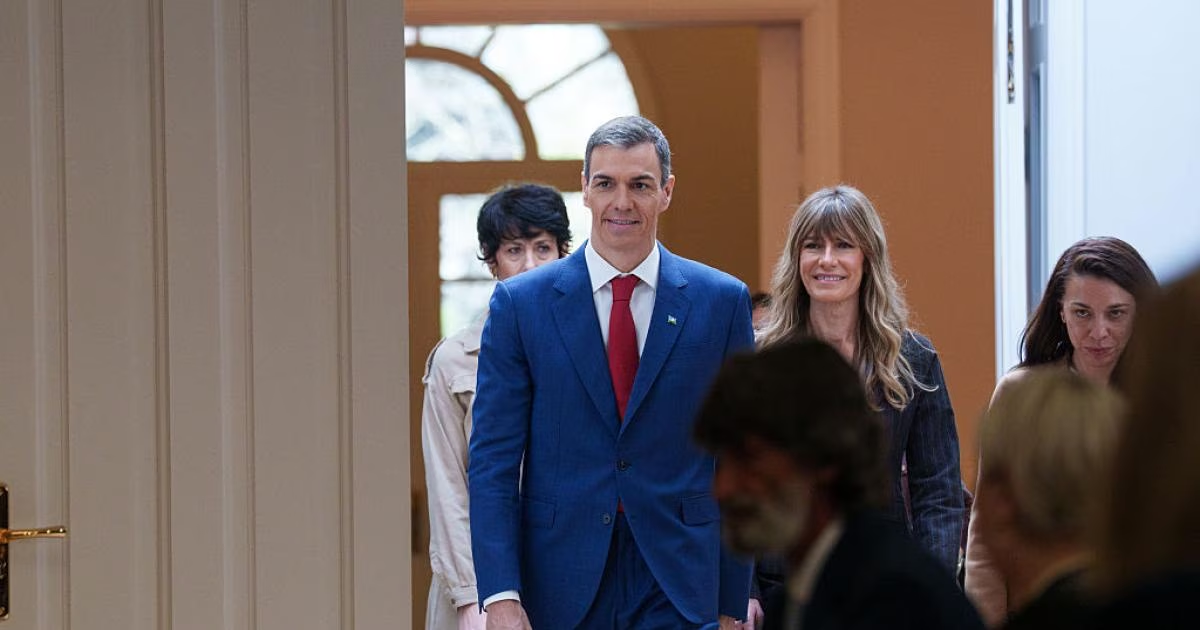
Field data indicates that French authorities have moved to a new phase of restriction, including imposing exorbitant financial fines and intensive disciplinary referrals. This shift comes in the context of government attempts to impose what it calls 'public order' within university campuses, amidst accusations from student organizations of violating freedom of expression.

Rania, a student at Sorbonne University and a member of the Palestine Committee, stated that security policy has evolved from direct arrests to exercising suffocating economic pressure on activists. She explained that financial fines have become a means of intimidating students, with the total value of violations in one protest exceeding 35,000 euros.

The student affirmed that the student demands are clear and consist of the necessity to end all forms of cooperation between French universities and Israeli academic institutions. The movement also emphasizes the need to stop partnerships with arms manufacturing companies that contribute to supplying the occupation army with military equipment used in Gaza.

Activists accused the Sorbonne University administration of engaging in relations with Israeli institutions that incite its students to enlist in military service in the occupation army. Protesters demanded facilitating procedures for receiving Palestinian students displaced from the Gaza Strip to enable them to complete their education in France as an alternative to these partnerships.

For her part, Sofia, a member of the Student Union Federation, described the recent security interventions as a blatant assault on legally guaranteed public freedoms. She noted that police forces used excessive force to disperse a peaceful sit-in that lasted for hours, and photographed participants' IDs to threaten them with subsequent prosecution.

In an incident reflecting the extent of the repression, a student named 'Tiba' faces legal prosecution by her university on charges of 'anti-Semitism' based on a purely political stance. The case dates back to the student deleting accounts related to the occupation army from a student communication group, which the administration considered an overstep requiring prosecution.

In turn, Ibrahim, a member of the 'Communist Youth' organization, revealed that university administrations resort to disciplinary committees as a tool to suppress solidarity symbols. He explained that merely raising the Palestinian flag or posting solidarity flyers within university corridors has become sufficient reason to summon students and rigorously investigate them.

Sources reported that security violence was not limited to pushing and shoving but also included direct physical assaults during the dispersal of protests within the university campus. Observers believe that this close coordination between university administrations and police agencies aims to stifle dissenting voices against Israeli policies on the European continent.

Student protests in France continue despite these pressures, with participants asserting that their struggle will continue until full transparency regarding university investments is achieved. Students demand disclosure of contracts concluded with French defense companies that supply weapons to conflict zones, considering this an ethical responsibility.

Amidst this controversy, the French government defends its measures as a strict application of the law and a prevention of any disturbances that might affect the educational process. However, human rights circles warn that these measures could lead to the creation of a repressive educational environment lacking political pluralism and freedom of opinion.

In conclusion, the scene in French universities remains open to further escalation, with student movements insisting on continuing demonstrations and sit-ins. This wave of protests is the largest of its kind in France in years, putting authorities to a real test of democratic principles and human rights.

The state has begun targeting activists economically by imposing exorbitant fines exceeding 35,000 euros, instead of merely traditional arrests.

PALESTINE

Sat 20 Jun 2026 9:27 pm - Jerusalem Time

The Tragedy of Child Jamil Ghoneim: Two Years of Forced Separation Between Gaza and Hebron

The tragedy of forced displacement of Palestinians is embodied in the story of child Jamil Ghoneim, now 32 months old, who lives divided between two bitter realities: a cramped refugee tent in the Gaza Strip with his parents, and a hospital room in the city of Hebron in the occupied West Bank where he resides with his grandmother.

The chapters of this suffering began about two years and eight months ago, when infant Jamil was forced to leave the Gaza Strip at just ten months old, seeking treatment for a pulmonary artery obstruction in his heart, a medical journey that was supposed to last only a few weeks.

The ongoing war and the closure of crossings prevented the child from returning to his family's embrace, turning the short treatment journey into a long estrangement that severed the geographical and social arteries between Gaza and the West Bank, and forced the family to communicate only through phone screens.

In the displacement tent in Gaza, the father and mother observe the details of their child's growth, whom they left as an infant and who is now a child running and learning to speak. Their eyes overflow with anguish as they watch his movements and laughter from behind the rigid screen glass, unable to touch him.

Sources reported that child Jamil utters innocent cries with broken words, expressing his desire to return to Gaza, while his mother, stuck in the Strip, tries to calm him with promises of meeting and outings, which are killed by the reality of the imposed military siege.

The mother expresses her burning heart despite her joy at hearing his voice, emphasizing that virtual communication does not compensate for his presence in her embrace, especially since he is the family's first male child whose childhood was stolen away from his parents' care.

For his part, the father describes the psychological pain he experiences seeing his son grow up in pictures, pointing to the emergence of a frightening psychological barrier as the child has begun to shy away from them and does not recognize their true features due to their forced absence from his daily life.

Their sorrow intensifies during holidays and special occasions, as the mother sees displaced children with their mothers while her son remains alone in Hebron, raising her fears that he might not recognize her if their first future meeting ever happens.

On the other side in Hebron, the grandmother lives a double suffering. She bears the responsibility of raising a young child in difficult circumstances, while missing her sick husband in Gaza who needs her constant care due to his repeated comatose episodes.

The grandmother explained that child Jamil lived long periods of the war without communicating with his parents due to internet outages, which increased the child's psychological detachment and confusion, as he does not understand why he is away from his home.

Field sources revealed the presence of about 42 individuals stranded in the hospital accommodation in Hebron, living in similar conditions and demanding to return to the Gaza Strip, describing their stay there as akin to imprisonment despite the relative safety.

The father confirms that the tragic situation cannot be described in words, as the child becomes more aware day by day and discovers the absence of his parents, making his life in the hospital accommodation lack the family warmth and natural affection that any child his age needs.

Humanitarian appeals continue to end the suffering of Jamil and dozens of similar cases, amidst the occupation's intransigence and the closure of crossings that tear apart the Palestinian social fabric and prevent family reunification between parents and their children.

The story of the Ghoneim family remains a living testament to the brutality of policies that separate families, where video remains the only link for a family separated by a suffocating siege that disregards the sanctity of childhood and does not heal the wounds of hearts burning with longing.

I saw my son's childhood from behind the screen, I see him growing up before me in pictures and videos while the siege deprives us of embracing him.

LATEST NEWS

Sat 20 Jun 2026 9:26 pm - Jerusalem Time

Trump boasts of superiority over Hitler and Stalin in 'global influence'

US President Donald Trump sparked a wave of controversy after showing remarkable enthusiasm for being evaluated on par with historical figures associated with dictatorship and power. According to press reports, Trump agreed with an analysis that sees the fundamental difference between him and leaders like Hitler, Stalin, and Mao Zedong as lying in his possession of power and influence that surpasses what they achieved in their eras.

The story began when Trump reposted a short text praising his leadership abilities, in which the author considered that history has known strong men distinguished by conquest and intimidation, but they lacked the comprehensive global impact that Trump enjoys today. The US President commented on this proposition by saying: 'Sounds good to me,' a clear indication of his acceptance of this bold historical comparison.

Trump introduced the author of this analysis, named Dave King, as a 'presidential historian,' but journalistic investigations revealed the man's true identity. It turned out that King is not a historian at all, but a Scottish-born businessman residing in South Africa, who previously served as chairman of Rangers Football Club, which raises questions about the accuracy of Trump's classifications of his sources.

The first meeting between Trump and King occurred in a sporting context far from historical research centers, specifically during a golf match in Florida. It appears that King seized the opportunity to convey his vision of Trump's 'greatness' compared to ancient conquerors like Attila the Hun, Genghis Khan, and Napoleon, which was immediately well-received by the president aspiring to return to the White House.

These details were included in a new book titled 'Change of System,' authored by journalists Maggie Haberman and Jonathan Swan, scheduled for release next week. The book recounts the behind-the-scenes of the first months of Trump's ambitions for a second term, relying on hundreds of interviews conducted with his aides and inner circle over three continuous years.

Press sources reported that Trump boasted about these comparisons to New York Times reporters during an interview in March. When asked about his place in history, he asked his aides to bring a two-page document he received from the alleged 'historian,' and began reciting the names of historical leaders, explaining how their authority did not match that of the President of the United States.

During that interview, Trump claimed that historical leaders maintained their influence by instilling fear in the hearts of their people, asking indignantly who would dare to do that in the modern era. However, his admiration for the document reflected a deep desire to be seen as a pivotal figure whose power transcends the traditional recognized boundaries of democracy.

The new book does not stop at historical comparisons but also reveals political behind-the-scenes related to Trump's potential administration and his thinking about major appointments. Among the surprises reported by the authors is that Trump seriously considered appointing his Republican rival and Florida Governor, Ron DeSantis, to the position of Secretary of Defense, despite their public rivalry.

Regarding foreign policy, the book quoted shocking statements by Trump about the Ukrainian crisis, where he expressed his dislike for the Ukrainian state as a political entity. Trump merely praised Ukrainian women, referring in his usual manner to their repeated success in Miss Universe pageants, which he previously owned the rights to.

The book also highlights Trump's personal and behavioral aspects within the Oval Office, describing unusual scenes of the leader of the superpower. In one account, Trump was seen manually attempting to affix gold ornaments to a marble fireplace mantel using 'super glue,' a scene reflecting his excessive attention to aesthetic details and visual delight.

Trump's comments about his constant winning and his complaints about press coverage were also present in the recorded interviews for the book, where he said: 'Basically I was winning every time, and I'm tired of winning and getting bad press.' These statements reinforce the narcissistic image that his political opponents try to establish about him in election campaigns.

Observers believe that Trump's pleasure in being compared to authoritarian rulers is not new, but rather an extension of years of statements in which he expressed admiration for leaders like Vladimir Putin and Kim Jong Un. This tendency towards the 'strong man' raises concerns among democratic circles in the United States about the form of a potential second Trump term.

The book, based on more than 1000 interviews, paints a complex picture of a president who sees himself in a constant struggle with the 'deep state' and the media, while seeking historical legitimacy that places him above everyone. These leaks come at a sensitive time with the approaching heated presidential race, increasing the intensity of political polarization in the American street.

In conclusion, these narratives remain rich material for discussion about Trump's leadership psychology and how he sees himself as a unique phenomenon in human history. While his supporters see it as evidence of confidence and strength, his opponents see it as a dangerous indicator of authoritarian tendencies that could threaten American constitutional institutions if he returns to power.

The vast difference between these historical leaders and President Trump is their lack of the global influence he enjoys.

ARAB AND WORLD

Sat 20 Jun 2026 9:26 pm - Jerusalem Time

UN criticism and French-Spanish opposition to EU plans to establish 'return centers' for migrants

The UN High Commissioner for Human Rights, Volker Türk, has sharply criticized the new rules approved by the European Union regarding the deportation of migrants. Türk warned that these measures could lead to serious human rights violations, especially concerning the transfer of migrants to third countries that do not guarantee their protection.

The UN official expressed deep regret over the adoption of this law, emphasizing that European countries are legally and morally obligated to protect human rights within their territories. He affirmed in his statements that states' obligations towards migrants and refugees cannot be delegated or transferred to other parties outside the continent's borders.

The European Parliament had previously approved a package of stricter laws last week aimed at accelerating deportation processes. These rules include the possibility of concluding agreements with countries outside the bloc to establish so-called 'return centers,' where migrants whose applications have been rejected are detained pending their deportation.

Türk clarified in an official statement that the detention of vulnerable groups, including children, and their transfer to third countries represents a highly sensitive exercise of state power. He noted that this approach entails significant risks that could affect human dignity and violate applicable international conventions.

The High Commissioner stressed the necessity of keeping the protection of human rights and human dignity at the heart of any legislation or practical application of migration policies. He called on European authorities to review these texts to ensure they do not conflict with the fundamental principles upon which the international human rights system was founded.

Current data indicates that the European Union only succeeds in implementing about 20% of deportation orders issued against irregular foreign residents. This low percentage creates widespread political pressure from currents advocating for stricter and more decisive migration policies.

In this context, Türk affirmed that international law and refugee law categorically prohibit the return of any person to a place where they may face persecution or violations. He described the principle of 'non-refoulement' as a cornerstone that all states must respect under all circumstances.

The UN official also pointed out that deportation decisions should not be collective but must be based on a careful individual assessment of each case. He demanded that all legal appeal procedures be completed before any actual step is taken to remove migrants from European territory.

For his part, French President Emmanuel Macron entered the crisis, announcing Paris's opposition to the establishment of 'return centers' in third countries. Macron questioned the effectiveness of these centers, noting that he has not yet seen a successful model for them in practice.

The French President questioned the extent to which these policies align with the core values that Europe believes in and defends in international forums. He affirmed that France prefers more effective return policies but within a framework that respects the fundamental principles of the European Union and does not deviate from its humanitarian context.

In the same vein, Spanish Prime Minister Pedro Sánchez joined the front of opponents, describing the plan as potentially leading to the waste of huge economic resources. Sánchez explained that Europe needs to utilize its limited resources for more sustainable solutions instead of spending them on external detention centers.

These divergent positions reflect a state of deep division within the European Union on how to deal with irregular migration. While some countries push for more strictness, human rights organizations and international parties warn against sliding towards policies that undermine fundamental human rights.

EU countries cannot simply delegate their human rights obligations to third countries.

PALESTINE

Sat 20 Jun 2026 9:26 pm - Jerusalem Time

5 Palestinians martyred in Gaza as occupation continues to violate ceasefire agreement

Five Palestinian citizens were martyred early Saturday morning in a series of airstrikes carried out by Israeli occupation aircraft targeting a home and civilian gatherings in various areas of Gaza City. Medical sources at Al-Shifa Hospital confirmed the arrival of the bodies of two young girls and their parents, due to a direct targeting of their home located near the Aviation intersection in the city center, which led to the destruction of the house on its inhabitants.

Eyewitnesses reported that the Israeli raid unexpectedly targeted the Safadi family home, resulting in the martyrdom of the couple Hussein and Rana Safadi, and their two daughters Zeina, 6 years old, and Lana, 13 years old. The shelling also caused varying injuries among family members and neighbors, all of whom were transferred to medical centers for treatment amidst a state of panic in the residential neighborhood.

In a related context, an Israeli drone targeted a group of passersby near the Safawi roundabout north of Gaza City, leading to the martyrdom of citizen Ahmed Munir Al-Zaza (38 years old). Medical sources clarified that the shelling also resulted in a woman sustaining moderate injuries, amid the continued intensive flight of drones in the sector's airspace despite existing truce agreements.

For its part, the government media office in Gaza issued a detailed report revealing that the Israeli occupation committed 3338 violations of the ceasefire agreement since its entry into force on October 10, 2025. The report indicated that these violations led to the martyrdom of 1012 people and the injury of more than 3200 others, in addition to the arrest of about 100 citizens during the past months.

On the humanitarian front, the government office noted a severe deterioration in aid flow, as only 54,000 trucks entered the sector out of 150,000 that were supposed to arrive under the agreement. Sources stated that the Israeli commitment to allowing aid and fuel entry did not exceed 36%, which exacerbated the living and health crises for the besieged population in various governorates.

Regarding freedom of movement through crossings, the report clarified that the occupation allowed only 7417 people to travel out of more than 20,000 humanitarian cases that were scheduled to depart via the Rafah land crossing. These strict restrictions come despite the reopening of the Palestinian side of the crossing last February, with thousands of wounded and sick still awaiting their turn to travel abroad for treatment.

On the ground, local sources monitored movements of occupation vehicles and what are known as 'yellow cubes' in the Tuffah, Shuja'iyya, and Beit Lahia areas, in an attempt to narrow the residential spaces available to Palestinians. These developments come amidst a heavy toll from the ongoing war of annihilation since October 2023, which has left more than 73,000 martyrs and destruction affecting 90% of the infrastructure and civilian facilities in the sector.

Israel committed 3338 violations of the ceasefire agreement since its implementation, killing 1012 Palestinians during that period.

PALESTINE

Sat 20 Jun 2026 9:26 pm - Jerusalem Time

6 Martyrs in Raids and Intense Artillery Shelling on Gaza Strip Since Dawn

Palestinian medical sources reported on Saturday morning an increase in the number of casualties from military attacks on the Gaza Strip to 6 martyrs and a number of injured. These injuries and deaths were distributed across different geographical areas as a result of intensified airstrikes and artillery shelling that has not stopped since the early hours of dawn, amid ongoing field operations in various axes.

In details of the targeting in Gaza City, 4 citizens were martyred and others were seriously injured as a result of a direct aerial bombardment that targeted a residential apartment in the densely populated Thalatheeni Street in the city center. The northern area of the Strip was also attacked by a drone belonging to the occupation forces near the Safatawi intersection, leading to additional injuries among civilians who were transferred to nearby hospitals for treatment.

In the southern part of the Strip, the Mawasi Rafah area witnessed a field escalation, represented by tanks firing their artillery and heavy machine guns towards displaced persons' tents and residential areas. This coincided with intensive movements of warships offshore, which fired indiscriminately and heavily, increasing the state of panic among citizens in those coastal areas.

In Khan Yunis city, military vehicles stationed in the southern areas continued intensive shelling operations, with attacks focused on the eastern neighborhoods of the city. The forces carried out widespread demolition operations of residential blocks and homes belonging to citizens, leading to massive material destruction and rising columns of smoke that covered the sky of the area, in a step aimed at changing the geographical features of the place.

These rapid field developments come at a time when international warnings are escalating about the collapse of the health and service systems within the Strip. Hospitals suffer from a severe shortage of medical equipment and necessary medicines to treat the wounded, threatening an increase in the number of deaths among the injured who do not receive adequate healthcare due to the ongoing siege and targeting of vital facilities.
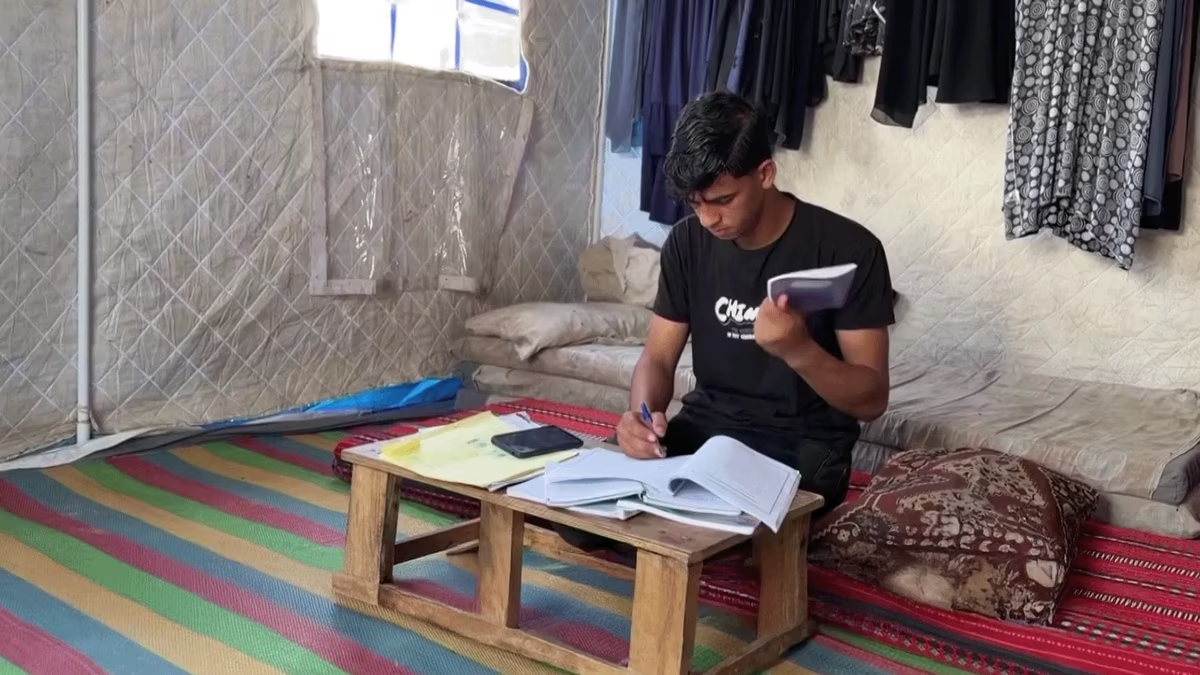
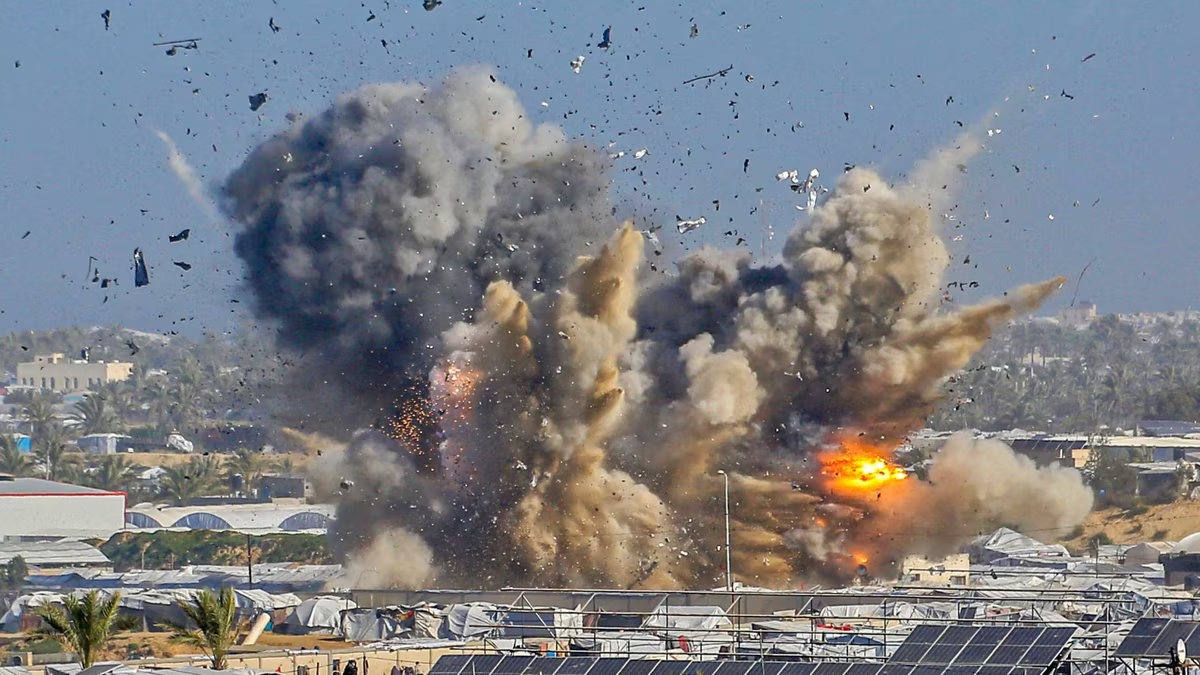
Medical sources recorded the martyrdom of 6 Palestinians and the injury of others with varying degrees of wounds as a result of a series of aerial and artillery targetings since the early hours of dawn.

OPINIONS

Sat 20 Jun 2026 9:26 pm - Jerusalem Time

Trump Rages in Private Meetings at Israel for Trying to Drag Him Back into His War with Iran

Washington Message

Washington - Said Arikat - 20/6/2026

Amidst the accelerating field and diplomatic developments on the Middle East front, informed sources revealed to "Zaytou" website on Saturday a state of intense anger experienced by US President Donald Trump behind the scenes of the White House, due to what he considers deliberate Israeli attempts to drag him back into the quagmire of his war on Iran. According to the report, Trump, who has become desperate to exit a war his advisors describe as "catastrophic and unpopular," appears ready to grant Tehran a stunning diplomatic victory as the price for ending US military involvement.

Details conveyed by four individuals with direct knowledge of the President's mood show that Trump is leveling sharp accusations against the Israeli government and its Prime Minister, Benjamin Netanyahu, accusing them of trying to thwart his endeavor to withdraw from "a war they chose together." The source of presidential anger, according to these accounts, is focused on Israel's continued launching of deadly raids on Lebanon, despite the existence of a fragile US-Iranian memorandum of understanding (MOU) calling for a ceasefire there. Trump believes that Tel Aviv is deliberately undermining this understanding to push Washington back into a comprehensive confrontation with Iran, a scenario the US President categorically rejects at this stage.

A close advisor to Trump quoted the President as saying, charged with anger: "He curses a lot about this." An administration official was more explicit when he told "Zaytou": "At least for now, the President is angrier at the Israelis than he is at the Iranians." This presidential mood is no longer just a fleeting annoyance; it has, according to the same sources, transformed into a firm conviction that Israel is seeking to "deceive" him in order to reignite a regional war that Trump considers an existential threat to his political legacy and future ambitions.

"Zaytou" sources indicate that the continuous pressure from Israeli leaders on the Americans to abandon the MOU with Iran, along with the continuation of military operations in Lebanon, has led to a completely opposite result than what Tel Aviv had hoped for. Instead of pushing Trump towards adopting a tougher stance, these practices have made him more determined to move in the opposite direction, drawing closer to the option of a settlement with Tehran and ending the war. The scene reveals one of the deepest undeclared crises in the history of the US-Israeli alliance, where narrow national interests intersect with the personal calculations of a president who places "big deals" above all else.

Trump's state of anger towards Israeli behavior reveals a fundamental shift in the concept of the "strategic alliance" that previous US administrations have always revered. The current President, immersed in the "America First" doctrine, views the Iranian war as an electoral and political burden that threatens his image as a peacemaker. Analytically, this position reflects a transactional understanding of international relations; as long as Israel obstructs the MOU and provokes Tehran, in Trump's view, it transforms from an ally into an adversary that hinders the implementation of his vision based on a rapid withdrawal from the quagmires of the Middle East, even if it costs the undermining of Washington's regional influence.

There is another equally important dimension, related to Israel's own calculations, which seem to be betting on Trump overcoming his objections under pressure from lobbies and the security establishment. But this bet carries a major risk, as the man who did not hesitate to dismiss defense ministers and advisors for personal reasons may take confusing diplomatic retaliatory steps against Tel Aviv. From an analytical perspective, the continuation of raids on Lebanon despite the US-Iranian understanding places Israel in the position of openly challenging presidential will, which opens the door to the possibility of Washington reducing its military involvement in the Eastern Mediterranean, leaving Israel to face alone the repercussions of any potential regional explosion.

As for the MOU, the story highlights the fragility of agreements sponsored by conflicting interests. Iran sees in the moment of American hesitation an opportunity to extract strategic gains without a long-term war, while Trump transforms into a pragmatic player who wants a "deal" that withdraws his troops and returns him to the American public as a victor. The profound comment here is that Trump's shift away from the Israeli position is not a fleeting tactic, but the beginning of redrawing the map of alliances in the region, where Washington is looking for quick exits, and may find in coordination with Tehran, not with Netanyahu, a forced passage, casting thick shadows on the future of stability in Lebanon, Iraq, and Syria.