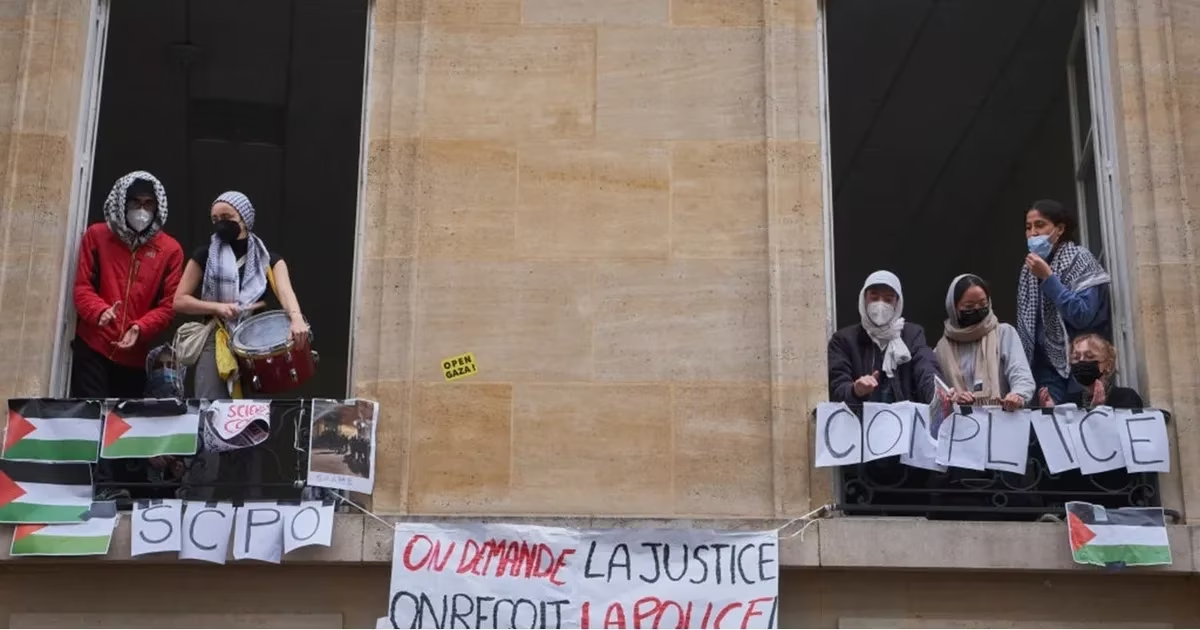







French academic circles are experiencing a state of escalating tension amid authorities' tightening punitive measures against student movements condemning the Israeli aggression on the Gaza Strip. Student sources reported that the prestigious Sorbonne University has become an arena for legal and security confrontations aimed at undermining solidarity activities that began in October 2023.
Field data indicates that French authorities have moved to a new phase of restriction, including imposing exorbitant financial fines and intensive disciplinary referrals. This shift comes in the context of government attempts to impose what it calls 'public order' within university campuses, amidst accusations from student organizations of violating freedom of expression.
Rania, a student at Sorbonne University and a member of the Palestine Committee, stated that security policy has evolved from direct arrests to exercising suffocating economic pressure on activists. She explained that financial fines have become a means of intimidating students, with the total value of violations in one protest exceeding 35,000 euros.
The student affirmed that the student demands are clear and consist of the necessity to end all forms of cooperation between French universities and Israeli academic institutions. The movement also emphasizes the need to stop partnerships with arms manufacturing companies that contribute to supplying the occupation army with military equipment used in Gaza.
Activists accused the Sorbonne University administration of engaging in relations with Israeli institutions that incite its students to enlist in military service in the occupation army. Protesters demanded facilitating procedures for receiving Palestinian students displaced from the Gaza Strip to enable them to complete their education in France as an alternative to these partnerships.
For her part, Sofia, a member of the Student Union Federation, described the recent security interventions as a blatant assault on legally guaranteed public freedoms. She noted that police forces used excessive force to disperse a peaceful sit-in that lasted for hours, and photographed participants' IDs to threaten them with subsequent prosecution.
In an incident reflecting the extent of the repression, a student named 'Tiba' faces legal prosecution by her university on charges of 'anti-Semitism' based on a purely political stance. The case dates back to the student deleting accounts related to the occupation army from a student communication group, which the administration considered an overstep requiring prosecution.
In turn, Ibrahim, a member of the 'Communist Youth' organization, revealed that university administrations resort to disciplinary committees as a tool to suppress solidarity symbols. He explained that merely raising the Palestinian flag or posting solidarity flyers within university corridors has become sufficient reason to summon students and rigorously investigate them.
Sources reported that security violence was not limited to pushing and shoving but also included direct physical assaults during the dispersal of protests within the university campus. Observers believe that this close coordination between university administrations and police agencies aims to stifle dissenting voices against Israeli policies on the European continent.
Student protests in France continue despite these pressures, with participants asserting that their struggle will continue until full transparency regarding university investments is achieved. Students demand disclosure of contracts concluded with French defense companies that supply weapons to conflict zones, considering this an ethical responsibility.
Amidst this controversy, the French government defends its measures as a strict application of the law and a prevention of any disturbances that might affect the educational process. However, human rights circles warn that these measures could lead to the creation of a repressive educational environment lacking political pluralism and freedom of opinion.
In conclusion, the scene in French universities remains open to further escalation, with student movements insisting on continuing demonstrations and sit-ins. This wave of protests is the largest of its kind in France in years, putting authorities to a real test of democratic principles and human rights.
The state has begun targeting activists economically by imposing exorbitant fines exceeding 35,000 euros, instead of merely traditional arrests.
Share your opinion
Escalating Financial and Security Repression Against Pro-Palestine Student Movement in French Universities