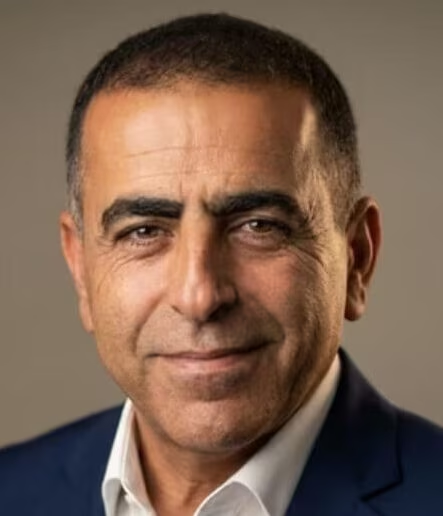








Dr. Ibrahim Nairat
Benjamin Netanyahu is no longer merely a prime minister in Israel; he has become the embodiment of an extended political crisis, both internal and external, that transcends his person to affect the image of the state itself. With years of governance, successive wars, and deep internal divisions accumulating, the idea of his continued stay in power is being raised not only as an internal political matter but as a factor determining Israel's position in the international system.
Within Israel, consensus around Netanyahu is eroding rapidly. The man who long presented himself as a “guarantor of security and stability” has become, in the eyes of his opponents, a symbol of polarization, division, and the breakdown of trust between society and state institutions. With his alliance with hardline religious right-wing forces, his governments have transformed into an arena for open internal conflict, which only calms down to flare up again.
In this context, Netanyahu no longer enjoys widespread acceptance as before. The circle of those who reject him within and outside the Israeli political scene is expanding, to the point where his presence has become a source of unprecedented controversy and division. His margin of acceptance as a unifying leadership option has shrunk, while he is increasingly viewed as a polarizing factor rather than a balancing element.
Externally, Netanyahu's image has begun to take on a more complex character. He is no longer seen merely as a difficult political partner, but as a figure who burdens Israeli diplomacy and is gradually transforming into an internationally unwanted political ghost in some circles. The increasing criticisms of settlement policies, the management of the war in Gaza, and the deteriorating relationship with some Western capitals are all factors that have made his political presence a subject of escalating reservations, even among circles that were traditionally unconditionally supportive of Israel.
In this context, a current is crystallizing within Israel that believes moving beyond the Netanyahu era is no longer an ordinary political option, but a necessity to reset the relationship between internal and external affairs. This current, extending from the center-right to the political center, presents it as an entry point for restoring Israel's image and rebuilding trust with allies, especially in the West, who have become more sensitive to the rhetoric and policies of the hardline right.
However, the fundamental paradox lies in the fact that this potential shift does not necessarily mean a change in the essence of policies. Even the forces proposed as alternatives to Netanyahu do not offer a radically different vision regarding the Palestinian issue; instead, they tend to manage the conflict rather than resolve it, and to transitional solutions rather than final settlements. In other words, the political face may change, but the deep structure of policies largely remains the same.
Nevertheless, any Israeli repositioning towards the Palestinians, even if initially accompanied by clear internal reservations and caution, could open a different political window in the medium and long term. The Gaza war and its accompanying humanitarian and international political repercussions have contributed to the crystallization of a broader and clearer international will towards the necessity of reviving the path to resolving the Palestinian issue, instead of keeping it in a state of chronic conflict management. Although these shifts will not be quick or smooth, the accumulation of international pressure and the changing mood in some influential capitals may gradually push towards reopening the political file more seriously, even if it begins with limited transitional steps.
On the other hand, Netanyahu remains a formidable political player. The network of alliances within the Knesset, the strength of Likud, and the ability to reposition himself are all elements that give him a chance to stay or return even in moments of weakness. Therefore, talk of his political end is still premature from the perspective of power calculations.
Despite this, the gap between Netanyahu and an increasing number of international partners is widening, to the extent that his very presence has become a factor of tension in some issues. Here lies the essence of the shift: the question is no longer just whether he stays or leaves, but whether he has become part of the problem in the eyes of many, instead of being part of the solution.
In conclusion, it can be said that Netanyahu has not only revealed the limits of Israeli politics but has also exposed the hidden intentions within it, proving that Israel is not a single homogeneous political entity, but rather more than one “Israel,” where conflicting projects and visions about the state, society, and the future intertwine.
Ultimately, it does not seem that Israel is facing merely a change of government, but a deeper test related to the form of the state, its image, and the limits of its ability to adapt to internal and external changes. Between Netanyahu's stay or departure, the most important truth remains that an entire political era is approaching its end, even if the names have not yet been decided.
Share your opinion
Netanyahu: From the Center of Power to an Unwanted International Political Ghost