OPINIONS

Wed 10 Jun 2026 12:29 pm - Jerusalem Time

Palestinian Elections


President Mahmoud Abbas already issued a decree on February 2, 2026 calling for PNC elections on November 1, 2026, and on June 4, 2026 he ratified the 2026 PNC electoral system. The new system sets the PNC at 350 members: 200 from the Palestinian Territory constituency and 150 from Palestinians abroad and in the diaspora.

The June 4 electoral system says that elected PLC members shall serve as PNC members during their term, and that their membership counts within the 200 seats allocated to the Palestinian Territory. It also says that if PLC and PNC elections are held simultaneously, the seats allocated to the Palestinian Territory will automatically be filled by the elected PLC members.

So the political implication is powerful:

If the 200 homeland seats of the PNC are to be filled by elected PLC members, then real PNC elections inside Palestine require PLC elections too - or at least a clear legal workaround.

That opens an important article angle:

Abbas Has Opened the Door - Now He Must Walk Through It

Abbas cannot call for democratic renewal of the PLO through PNC elections while avoiding the central democratic test inside Palestine: elections for the Palestinian Legislative Council. If 200 PNC seats are linked to the PLC, then the path to PLO renewal must pass through elections in Gaza, the West Bank, and East Jerusalem.

1. Elections must include Gaza, the West Bank, and East Jerusalem.Without all three, the election will lack national legitimacy.

2. Hamas cannot be allowed to run as an armed militia.Any list should have to accept “one authority, one gun,” the PLO political program, and peaceful democratic competition. This seems consistent with the recent direction of Abbas’s electoral rules, which emphasize proportional representation and participation under the PLO framework.

3. Israel will try to block East Jerusalem voting.That must be confronted internationally now, not one week before the vote. Israel has no say in this issue and there are many ways for Jerusalemites to vote without any Israeli interference. This needs to be planned and implemented – Remember Jerusalem is the largest Palestinian city in Palestine.

4. The diaspora component is revolutionary but difficult.The new system allows elections abroad where possible, and where not possible, selection through assemblies, consensus, or appointment. That could broaden representation - or become another mechanism for control if not monitored.

5. This is the opening for a new Palestinian democratic alternative.A new party like Samer Sinijlawi’s “New Path” could argue that the PNC/PLC elections are not simply institutional reform. They are the first real chance in two decades to return legitimacy to Palestinian politics.


OPINIONS

Wed 10 Jun 2026 9:28 am - Jerusalem Time

Yes, we are different..

We celebrate the occasion of the head of state, King Abdullah, assuming his constitutional powers, with pride and glory, without obligation or flattery, or official imposition, authorized by tools, authorities, and incentives, but the motives are self-driven, national, and patriotic, imposed by what we live, of reassurance, duty, and the requirements of a dignified life. We are not pampered, yes, we are certainly not rich, but we live in a homeland of national reassurance, and a homeland of bias and support for the Palestinian people, and we adhere to our national values and their necessities, as Muslims and Christians, and as human beings who deserve the fundamentals of life, each according to their circumstances and data, their standards and aspirations, always. We are not a model, yet we are not at the end of the spectrum, we have security and stability, and pluralism and democratic margin, and keys to access decision-making institutions, making us as citizens, professionals, partisans, and civil society leaders, to be through unions, municipalities, parties, and the House of Representatives, alongside civil society organizations and the media, partners in decision-making. We have a political system, no matter what observations we record about it, but it is not characterized by violence, repression, and depriving others of expression and protest, and demanding change and correction, and accepting the idea and approving the idea if it possesses objectivity and responds to the requirements of our multiple needs. We celebrate the administration of the state, by the head of state, and we all have a view and evaluation of what has happened, throughout the past quarter-century, with a critical spirit, national motives, and progressive aspirations, which we have lived by comparing to what is around us, and with us, so our souls settle, and we are all hope and optimism for a better tomorrow, which we make together, through stability and respect, and acknowledging the importance of ballot boxes, for unions, for municipalities, for parties, for the House of Representatives, so that we may truly reach what was initiated: parliamentary party governments based on the votes of the parliamentary majority, expressing the majority of Jordanians' bias towards those who represent them. We celebrate, we pause, as a monitoring station for what was, and for what will be, prosperity will not come to us, but we work for it, jobs will not come to us, but we create the factors of their existence, their backgrounds, we succeed in our universities, schools, and institutes, but this requires effort and hard work, and therefore I say together we preserve what we are in and on, and together we make a better tomorrow for our people, and this Jordan that we make is the lever for Palestine, and this is the source of what we boast about, and this has not been and will not be except by the wisdom of the head of state and his dedication and we are with him, and to him, but we are all together for the sake of Jordan to which we belong and live in and it lives in us and with us.

PALESTINE

Wed 10 Jun 2026 9:28 am - Jerusalem Time

Clearance Crisis.. An Israeli Strategy to Undermine the Authority and Impose a New Reality

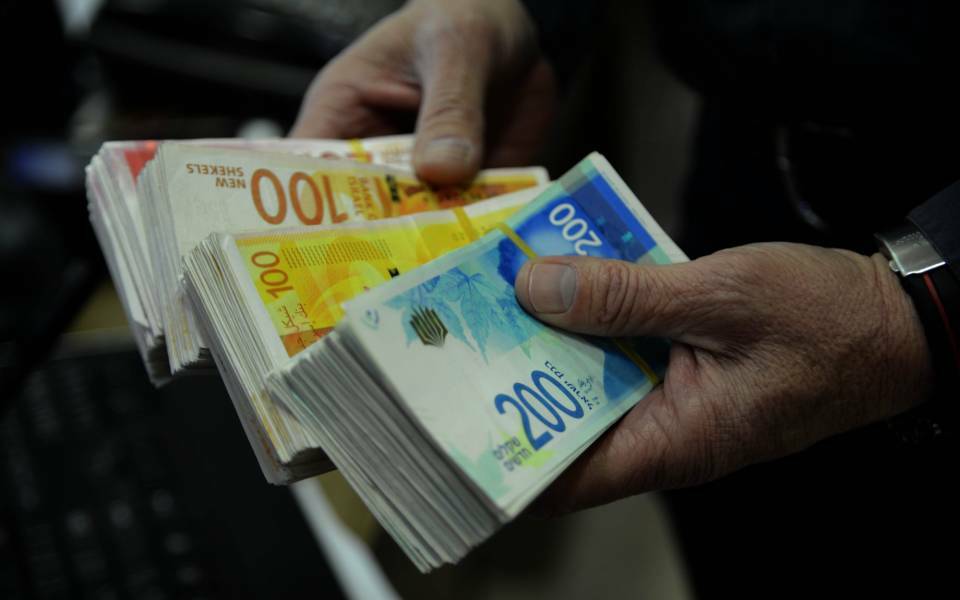
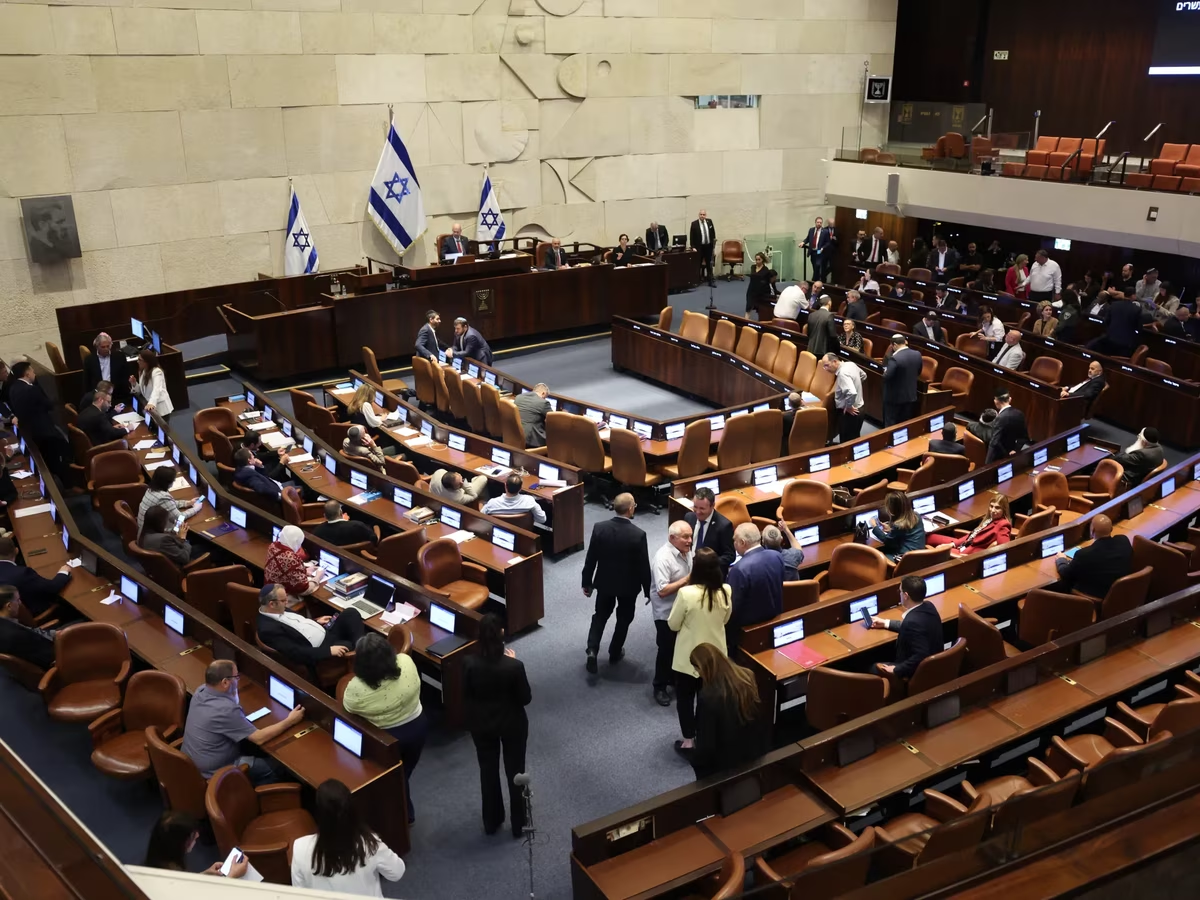
Musaif Musaif: There is a continuous Israeli approach, not new to the current stage, aimed at preventing the Authority from strengthening its economic capabilities and consolidating its political presence. Jihad Harb: Israel seeks to hold the Authority responsible for any operations to push it to exert more pressure on society and prevent any acts of resistance to the occupation. Ayham Abu Ghosh: Israel's continued policy of deductions and withholding clearance funds may lead, in the coming months, to the Authority's inability to fulfill its obligations. Muhammad Al-Rajoub: The danger lies in establishing a new equation in dealing with withheld clearance funds, making them a permanent tool for pressure and blackmail, even if future understandings are reached. Hasna Al-Rantisi: The deeper danger is the decline in planning ability due to linking deductions to changing Israeli estimates, which transforms public financial management into a "monthly survival" operation. Suleiman Bisharat: These policies aim to create a state of organized collapse within Palestinian society to open the way for increased pressure and push for seeking emigration. Ramallah – Exclusive to "Al-Quds" – Fears are growing over the repercussions of the recent decision by the Israeli Knesset to deduct additional amounts from clearance funds to compensate those Israel calls victims of operations carried out by Palestinians, amid warnings that the move is not limited to its direct financial effects, but reflects a growing Israeli trend to transform the most prominent Palestinian revenues into a permanent political and economic pressure tool, deepening the crisis facing the Palestinian Authority and limiting its ability to fulfill its basic obligations. Economic experts, writers, and political analysts, in interviews with "Al-Quds," believe that the new deductions come within a continuous path aimed at tightening control over Palestinian financial resources and gradually depleting them, by expanding the scope of deductions and linking them to internal Israeli decisions and legislation, which threatens to reduce revenues that constitute the main source of financing the general budget, and places vital sectors, foremost among them health, education, and social services, under increasing pressure, warning that Israel's continued withholding of funds and accumulated deductions may push the Authority into a more critical financial stage, with rising levels of public debt and declining ability to financial planning and development spending. They point out that the repercussions of the crisis will not be limited to official institutions, but will extend to local markets, the private sector, and living standards, at a time when fears are growing of consecrating a reality in which clearance funds become a long-term tool of blackmail and pressure, threatening Palestinian economic and social stability in the coming years. Political-Economic Attack The researcher at the Palestinian Economic Policy Research Institute "MAS," Musaif Musaif, warns of the political and economic repercussions of the recent Israeli decision to deduct additional amounts from Palestinian clearance funds for those Israel describes as victims of Palestinian operations, considering that the move comes within the framework of a "political-economic attack" aimed at weakening the Authority and undermining its ability to perform its basic functions. According to Musaif, the new deductions cannot be separated from a continuous Israeli policy aimed at paralyzing the work of the Palestinian Authority and keeping it at the minimum level of ability to provide services to its citizens, explaining that the goal is to make Palestinian institutions unable to fulfill their basic obligations, especially in the sectors most closely related to the lives of citizens. He points out that the effects of the crisis have begun to appear clearly in the health sector, where the Ministry of Health and hospitals face increasing challenges as a result of the escalating financial crisis, which directly affects patients and health services, stressing that targeting this sector leaves deep effects on citizens' view of the Authority's institutions, because health and living services represent the most sensitive issues for the Palestinian public. Weakening the Palestinian Position Musaif believes that the seriousness of these measures is not limited to deepening the current financial crisis, but extends to weakening the Palestinian position in any future negotiations, considering that Israel seeks to raise the ceiling of its demands in exchange for lowering the ceiling of Palestinian demands to the lowest possible level. Musaif points out that the difficult living conditions experienced by Palestinians, including restrictions on movement and the spread of checkpoints and military gates, in addition to tens of thousands of workers stopping work inside Israel, may turn into pressure cards used by the Israeli government during any upcoming arrangements or understandings. Regarding the talk about the possibility of a breakthrough in the financial crisis before the end of the year, Musaif doubts the ability of European or American promises to bring about a real change in the Palestinian financial reality, pointing out that the crisis preceded the war on Gaza by years and continued continuously. Musaif confirms that any external financial support, no matter how large, will remain emergency and temporary support that does not address the roots of the structural crisis suffered by Palestinian public finances. Undeclared Bankruptcy Musaif explains that the Palestinian Authority faces an "undeclared bankruptcy," clarifying that financial solvency indicators have reached unprecedented levels, in light of the rise in public debt and the decline in the ability to meet financial obligations. He stresses that all Israeli deductions from clearance funds are illegal measures and violate the Paris Economic Agreement and international norms, affirming that the Israeli government's attempts to give these deductions legal cover through Knesset legislation do not change their legal status. Musaif confirms that the policy of weakening the Palestinian Authority economically and politically is not new to the current stage, but represents a continuous Israeli approach aimed at preventing the Authority from strengthening its economic capabilities and consolidating its political presence. Tightening Control over Palestinian Revenues Political writer and analyst Jihad Harb confirms that Israel's approval of new measures and legislation related to clearance funds falls within a continuous path aimed at tightening financial and political pressure on the Palestinian Authority, by tightening control over Palestinian revenues collected by Israel under the Oslo Agreement and the Paris Protocol, and opening new avenues for their deduction and confiscation. Harb explains that one of the main goals of this policy is to push the Palestinian Authority towards a state of exhaustion and self-incapacity, by reducing its ability to fulfill its basic obligations towards citizens, pointing out that clearance funds constitute approximately two-thirds of the Palestinian Authority's revenues, which makes any additional deductions have a direct impact on its future ability to provide public services, pay salaries, and manage the work of government institutions. Holding the Authority Responsible Harb also points out that Israel seeks to hold the Palestinian Authority responsible for any operations carried out by Palestinians against settlers or Israeli soldiers, by imposing increasing financial burdens on it, with the aim of pushing it to exert more pressure on Palestinian society and prevent any acts of resistance to the occupation, regardless of their nature or forms. He confirms that these policies are part of a broader strategy to deplete Palestinian financial capabilities, both at the level of the Authority and society, through almost complete control over Palestinian financial resources and deepening the existing economic crisis. Harb notes that this approach is not new, as its features began to appear clearly in 2019 with the deduction of amounts related to prisoners' allocations and the families of martyrs, before the deductions expanded after October 7, 2023, to include funds allocated to the Gaza Strip within the Palestinian budget. Harb explains that the deductions are no longer limited to Israeli government decisions, but have also extended to judicial decisions allowing the transfer of Palestinian funds as compensation to Israelis affected by the operations. Harb stresses that the new move reflects an Israeli trend to burden the Palestinian Authority with the social compensation costs borne by Israel for its citizens who are injured or disabled as a result of these operations, which opens the door for more deductions and entrenches Israeli control over Palestinian clearance funds and deepens the financial crisis facing the Authority. Deep Impacts Economic journalist Ayham Abu Ghosh believes that the Israeli Knesset's decision to deduct more clearance funds to compensate what Israel calls victims of operations reflects the current Israeli government's continued adoption of financial and political policies aimed at weakening the Palestinian Authority and pushing it towards more financial crises, leading to threatening its ability to continue and perform its basic tasks. He explains that clearance funds represent about 68% of the Palestinian Authority's revenues, which makes any new deductions have a direct and deep impact on the Palestinian financial situation if there is a breakthrough in the crisis of withheld clearance funds. Abu Ghosh believes that all Israeli measures in recent years indicate a gradual path towards drying up these revenues or reducing them to the lowest possible extent, through multiple tools, including direct deductions and lawsuits filed against the Palestinian Authority, which are used to justify withholding more funds. Internal Israeli Political Dimensions Abu Ghosh points out that the decision also has internal political dimensions in Israel, as it may be related to the competition between the components of the Israeli right and the endeavor to gain more electoral support by adopting more hardline positions towards Palestinians. Abu Ghosh explains that some parties and forces participating in the ruling coalition previously announced their opposition to the Oslo Agreement and expressed their desire to end the role of the Palestinian Authority or reduce its presence. Regarding the economic repercussions of the new decision, Abu Ghosh confirms that the Palestinian financial crisis has reached unprecedented levels after more than two and a half years of continuous deductions and the withholding of large parts of clearance funds, which forced the Authority to rely almost entirely on local revenues. Impact on Vital Sectors Abu Ghosh explains that this reality has cast a shadow over vital sectors, foremost among them health and education, which face increasing financial pressures and real risks to the continuity of services provided in them, pointing out that the Palestinian public debt has exceeded 15 billion dollars, equivalent to about 48 billion shekels, at a time when the Authority has largely exhausted local financing and borrowing tools. Abu Ghosh warns that the continuation of deductions and the withholding of clearance funds may lead, in the coming months, to the Authority's inability to fulfill its obligations, whether towards employees or in terms of operating expenses necessary for the continuation of basic services. Abu Ghosh estimates that there is a possibility that Israel may in the future release a limited part of the withheld clearance funds, but after fixing the new deductions and turning them into a fait accompli, which entrenches continued Israeli control over an increasing part of Palestinian revenues. Broader Israeli Strategy Academic and researcher in public administration and political science Muhammad Al-Rajoub warns of the escalating political and economic repercussions of the new Israeli Knesset approval of deducting hundreds of millions of shekels annually from Palestinian clearance funds, considering that the move goes beyond being a financial or punitive measure related to security and political circumstances, to form part of a broader Israeli strategy aimed at reshaping the relationship with Palestinians and imposing a new economic and political reality. Deep Political and Economic Messages Al-Rajoub explains that the decision to deduct amounts equivalent to the value of damages that Israel claims resulted from operations carried out by Palestinians against settlers and Israelis, and to transfer these funds to the affected parties and then to the Israeli treasury, carries deep political and economic messages that go beyond its direct financial value. Al-Rajoub confirms that Israel has moved from using clearance funds as a temporary pressure card to trying to transform deductions into a permanent and institutional mechanism based on internal legislation and laws that give it legal cover to continue withholding funds and disposing of them according to its political and security priorities. Al-Rajoub points out that the most dangerous aspect of the decision is that it entrenches the concept of "financial collective punishment," as its consequences are not borne by specific parties or individuals, but are reflected in the entire Palestinian society, from employees and retirees to workers in various sectors, which leads to transferring the conflict from its political and security level to the daily living level of citizens. Redefining the Economic Relationship with the Authority Al-Rajoub explains that this policy also seeks to redefine the economic relationship with the Palestinian Authority in a way that empties any talk of financial independence of its content, clarifying that the Authority's heavy reliance on clearance funds makes Israeli control over Palestinian revenues a more influential political control tool than many other pressure tools. He believes that the decision falls within a broader policy aimed at weakening the Palestinian Authority and reducing its ability to perform its basic functions, pointing out that deepening the financial crisis will lead to an increase in the general budget deficit, and places the government before difficult choices that include expanding borrowing, or reducing expenditures, or continuing to pay salaries incompletely and postponing financial obligations due to the private sector and various institutions. Al-Rajoub believes that the first repercussions of the deductions will appear on public employees' salaries, which will directly affect the purchasing power of citizens and the economic movement in local markets, given the pivotal role that government salaries play in driving the Palestinian economic cycle. Reducing Resources Allocated to Vital Sectors Al-Rajoub points out that the continuation of deductions will also lead to a reduction in resources allocated to vital sectors such as health, education, infrastructure, and social services, which will affect the level of services provided to citizens and lead to a gradual erosion of the ability of public institutions to perform their tasks. He notes that the social repercussions of the crisis may be the most dangerous, through increasing poverty and unemployment rates, expanding the circle of social needs, and deepening the feeling of frustration and uncertainty about the future. Al-Rajoub warns that the decline in the ability of official institutions to fulfill their obligations may lead to an erosion of trust in them and weaken institutional stability. A New Equation in Dealing with Clearance Funds Al-Rajoub explains that the new deduction gains its seriousness from establishing a new equation in dealing with already withheld clearance funds, so that these funds become a permanent tool for political pressure and blackmail, even if future understandings are reached regarding their release, considering that Israel seeks to keep the Palestinian economy hostage to its decisions, and prevent Palestinians from possessing the minimum level of financial independence and economic stability in the coming years. Impacts on Palestinian Financial and Social Stability Economic journalist Hasna Al-Rantisi warns of the escalating political and economic repercussions of the Israeli decision to deduct more clearance funds, considering that its seriousness lies not only in the amount of deducted funds, but in the political implications it carries and the long-term effects it leaves on Palestinian financial and social stability. Al-Rantisi explains that Israel deals with the clearance file as a tool of pressure and political punishment, by burdening the Palestinian treasury with the cost of what it describes as damages resulting from resistance operations, which transforms Palestinian tax funds from a due financial right into an open fund for compensating Israelis and financing obligations decided unilaterally by the Israeli government. Gradually Draining Clearance Funds Al-Rantisi believes that this policy practically opens the way for gradually draining clearance funds until they are zeroed out, which creates increasing economic and social pressures that are difficult to contain. Al-Rantisi points out that clearance funds represent more than two-thirds of the Palestinian Authority's revenues, and their value is close to the total salary and wage bill in the public sector, which makes any new deductions have direct repercussions on the lives of citizens in the future. Al-Rantisi explains that the matter is not limited to being a financial figure in the budget, but is reflected in the income of thousands of Palestinian families, and leads to a decline in purchasing power, market contraction, and a decline in the level of basic services, especially in the health and education sectors. Towards Making the Ceiling of Deductions Open Al-Rantisi confirms that one of the most dangerous aspects of the new decision is making the ceiling of deductions open and subject to annual increases according to Israeli estimates and internal decisions that Palestinians have no ability to review or object to, especially after the introduction of new items including property tax compensation and compensation for injured Israelis and families of those killed. Al-Rantisi points out that the repercussions of these policies have become clear in the salary file, as the Palestinian Authority has been experiencing incomplete salary payments since 2023, which has directly affected employees and economic activity. Al-Rantisi explains that government salaries constitute one of the most important drivers of the Palestinian economic cycle, and any decline in them affects consumption, merchants' sales, and families' ability to meet their financial obligations, and also increases pressure on the banking sector. The Crisis Extends Beyond Salaries Al-Rantisi notes that the crisis due to the withholding of clearance funds extends beyond salaries, as it affects health and educational services and service infrastructure, and leads to the accumulation of debts between the government, the private sector, and citizens, which creates a continuous series of economic crises. Al-Rantisi confirms that the deeper danger lies in the decline in financial planning ability as a result of linking deductions to changing Israeli estimates, which transforms public financial management into a "monthly survival" operation instead of planning for development and investment, and deepens the crisis of trust between citizens and the government, with an increasing feeling among citizens that they are fulfilling their financial obligations at a time when the government is unable to fulfill its basic obligations, which threatens to accumulate increasing social and economic pressures in the coming period. Institutionalization and Legitimization of Financial Piracy Political writer and analyst Suleiman Bisharat believes that the Israeli Knesset's approval of new deductions from clearance funds to compensate what it calls victims of operations carried out by Palestinians represents a transition from individual and temporary measures to a stage of "institutionalization and legitimization" of the financial piracy practiced by Israeli governments in recent years, especially through the decisions of Israeli Finance Minister Bezalel Smotrich regarding the seizure and deduction of Palestinian funds. Bisharat explains that the decision establishes a systematic process aimed at the main financial resource of the Palestinian Authority, which is clearance funds, pointing out that this step directly contradicts the Paris Economic Protocol and the agreements signed between the Palestine Liberation Organization and Israel, which stipulate that Israel collects taxes and transfers them to the Palestinian side in exchange for specific fees related to the collection process, and not disposing of these funds or deducting them for political and security purposes. Undermining the Entire Palestinian Structure Bisharat believes that the issue goes beyond the framework of financial pressure or traditional political blackmail, to fall within a broader policy aimed at undermining the entire Palestinian structure. According to Bisharat, the economy constitutes the backbone of Palestinian society, and its continuous targeting aims to weaken the ability of Palestinians to withstand and continue, and to transform society into a fragile structure suffering from accumulated crises that make it less able to face political and economic challenges. He confirms that these policies fall within Israeli efforts to create a state of organized collapse within Palestinian society, which opens the way for increased economic and social pressures that may push numbers of Palestinians to seek opportunities for emigration or departure as a result of the decline in living standards and economic stability. Bisharat explains that the targeting is not limited to the economic aspect only, but extends to the Palestinian institutional structure, as continuous deductions lead to weakening the institutions of the Palestinian Authority and reducing their ability to work and provide services, which hinders the building of stable institutions capable of performing their functions according to the Palestinian political and administrative system. Deepening the Escalating Economic Crisis Regarding the financial repercussions, Bisharat warns that the decision will deepen the already escalating economic crisis, in light of the difficult financial reality that the Palestinian Authority has been experiencing for years. He points out that the continued deduction of clearance funds will increase the fragility of the Palestinian economy and limit its ability to manage daily life requirements, in addition to its direct impact on vital sectors. Bisharat notes that indicators of decline have begun to appear clearly in basic sectors such as education and health, which face increasing pressures due to a lack of financial resources, warning that the continuation of these policies may push these sectors to more dangerous levels of decline, leading to a state of gradual collapse. Bisharat confirms that Israel, by continuing to deduct and withhold clearance funds, seeks to perpetuate the state of Palestinian economic and institutional weakness, and push Palestinians of all components towards a comprehensive crisis affecting the economy, public services, and societal structure, as part of a policy aimed at creating a state of organized and continuous collapse of the Palestinian reality.


OPINIONS

Wed 10 Jun 2026 9:28 am - Jerusalem Time

From the Illusion of Peace to the Logic of Hegemony: The Israeli Transformation Reveals the Crisis is in the Nature of the Project, Not in the Rejection of Settlement

For many decades, Western and Israeli discourse has been dominated by a political narrative stating that the essence of the Arab-Israeli conflict lies in the Arabs' and Palestinians' rejection of peace and their unwillingness to accept Israel as a final political reality in the region. According to this perception, Israel presented itself as a party seeking settlement and coexistence, while the fundamental problem, according to this narrative, lay with the Arab side, which had not adapted to historical transformations and had not accepted their outcomes.However, the course of events over the past decades, and the accumulated intellectual and political transformations witnessed in Israel, necessitate a re-examination of this premise from its foundation. The crisis does not seem to be solely linked to the issue of accepting or rejecting Israel, nor is it exclusively related to the 1967 borders or to security and negotiation arrangements. Rather, it is more deeply connected to the nature of the Zionist project itself, and to the logic that has governed its development from its inception to the present moment.Zionism was not merely a political movement seeking to create a safe haven for persecuted Jews in Europe; it was a national settler-colonial project aimed at establishing a new political entity by reshaping the geography, demography, and political identity of Palestine. Most Zionist currents, despite their ideological differences, started from a fundamental assumption: the priority of establishing a state with a Jewish majority and exclusive Jewish sovereignty over the land.It is true that Zionism was not a single, homogeneous current; it included Labor Zionism, Revisionist Zionism, Religious Zionism, and other diverse currents. However, these differences often revolved around means and tactics more than around ultimate goals. These currents, to varying degrees, shared the pursuit of ensuring a stable Jewish majority, maintaining security and military superiority, and preventing any political arrangements that might threaten the Jewish character of the state.Hence, one of the common mistakes in reading Israeli transformations is the belief that Israel suddenly shifted from moderation to extremism, or from a peace project to an expansionist project. The reality is that what we are witnessing today does not necessarily reflect the birth of a new project, but rather reveals more clearly the latent implications within the project for many decades.The so-called Israeli peace camp was more inclined to manage the conflict through diplomatic and political tools that allowed for the preservation of international legitimacy and the reduction of the cost of control, while the rising nationalist and religious currents tend to express the same goals directly without the need for the rhetorical cover that prevailed in previous stages. In other words, the fundamental shift lies not only in changing goals, but in moving from a stage where hegemony was managed with the language of settlement to a stage where it is openly declared with the language of force.Here, the importance of viewing the Israeli case within a broader framework related to settler-colonial projects in modern history emerges. Major settler-colonial experiences, whether in North America, Australia, South Africa, or French Algeria, did not view the indigenous populations as equal partners in sovereignty, but rather as a demographic and political problem that must be dealt with through exclusion, containment, or social and political re-engineering.This does not mean a complete congruence between these experiences and the Israeli case, as each experience has its historical and political specificities. However, the comparison reveals a recurring pattern in which the settler-colonial project seeks to combine control over land with the reduction of the political weight of the indigenous population. From this perspective, a significant aspect of the ongoing Israeli dilemma can be understood: Israel seeks to retain the largest possible area of land, but at the same time fears the demographic and political consequences of granting Palestinians full political rights within this area.Hence arises the structural dilemma facing the Israeli state: how can it combine control over almost all the land, maintain a Jewish majority, and continue to present itself as a democracy at the same time? This question has been one of the main drivers of Israeli policies towards Palestinians over the past decades, and it explains a significant aspect of Israel's chronic hesitation towards any final settlement based on full political equality.However, understanding current Israeli transformations also requires introducing another, more important variable: the variable of surplus power.In the realistic literature of international relations, states in normal circumstances seek to achieve security and survival. However, possessing power that far exceeds the requirements of direct defense may push some states to shift from the logic of security to the logic of hegemony. When military, economic, and technological superiority transforms into sustainable surplus power, the state becomes more capable of reshaping its surrounding regional environment instead of merely adapting to it.This is what appears to have gradually happened in the Israeli case after the 1967 war. Israel emerged from that war not only with clear military superiority, but also with a growing sense of its ability to redraw regional balances according to its own interests. Over time, with increasing Western support, the decline of the Arab system, and the disintegration of several central states in the region, Israel gradually began to transition from a state primarily concerned with survival to a state capable of influencing the shape of the regional environment itself.From a strategic perspective, surplus power not only changes a state's capabilities but also changes its way of thinking. The more the balance of power shifts in favor of a particular party, the less incentive it has to make substantial concessions, and the greater its ability to impose facts unilaterally. Therefore, it was not surprising that stages of increasing Israeli superiority coincided with the expansion of settlements, the deepening of security control, and the raising of political demands.From this angle, an important historical paradox can be explained: the more Palestinian and Arab concessions increased, the less the conflict approached a final solution, as the imbalance of power only grew. Palestinian recognition of Israel did not stop settlement, the Oslo Accords did not lead to the establishment of an independent Palestinian state, and waves of Arab normalization did not produce a parallel transformation within Israeli political thought towards a comprehensive final settlement.The reason for this is that the conflict, from the perspective of a growing segment of the Israeli elite, is no longer viewed as a border dispute that can be resolved through traditional settlements, but rather as an ongoing process of managing the geopolitical sphere to ensure the continuation of Israeli superiority and prevent the emergence of any power centers capable of challenging it in the future.The rise of nationalist and religious currents has reinforced this trend unprecedentedly. These currents do not view the West Bank as merely a disputed area, but rather as part of the historical and religious domain of the Jewish people. Within this perception, regional settlement becomes less important than establishing long-term control over the land, and the conflict gradually transforms from a political conflict to a conflict related to identity, creed, and history.This transformation has also been accompanied by a relative decline of liberal forces within Israel and the rise of forces more willing to openly use terms like annexation, decisive action, displacement, and demographic reshaping. Herein lies the importance of the current moment; it not only reveals transient political changes but also reflects deeper transformations in the nature of the ruling elite and its vision for the future of the region.The war that followed the events of October 7, 2023, revealed these transformations more clearly. The discussions within Israel were not limited to security and deterrence but extended to questions concerning the future of Palestinian existence itself, the political and demographic reshaping of Gaza, and the possibility of eliminating any prospect for an independent Palestinian political entity.At this specific point, it becomes difficult to explain Israeli behavior based solely on the concept of security. Security explains part of Israeli policies, but it alone does not explain the continuous settlement expansion, nor does it explain the rejection by many Israeli currents of any form of genuine Palestinian sovereignty, nor does it explain the increasing tendency to reshape the regional environment to ensure continued Israeli superiority for decades to come.The most important development revealed by current Israeli transformations is the gradual transition from the logic of a state seeking security to the logic of a power seeking to manage hegemony. In this context, the conflict is no longer merely a dispute over borders or negotiable security arrangements, but becomes part of a broader project to reorganize the political and geopolitical sphere in the Middle East according to a balance of power overwhelmingly tilted in Israel's favor.Therefore, the real question is no longer: Why have successive peace attempts failed? But rather: Is it even possible to produce sustainable peace under a project that possesses a significant surplus of power, views the continuation of its strategic superiority as a condition for its survival, and considers reshaping its surrounding environment as part of its national security?The answer to this question will be crucial not only for understanding the future of the Palestinian issue but also for understanding the future of the entire regional system in the Middle East.========================The most important development revealed by current Israeli transformations is the gradual transition from the logic of a state seeking security to the logic of a power seeking to manage hegemony.

OPINIONS

Wed 10 Jun 2026 9:23 am - Jerusalem Time

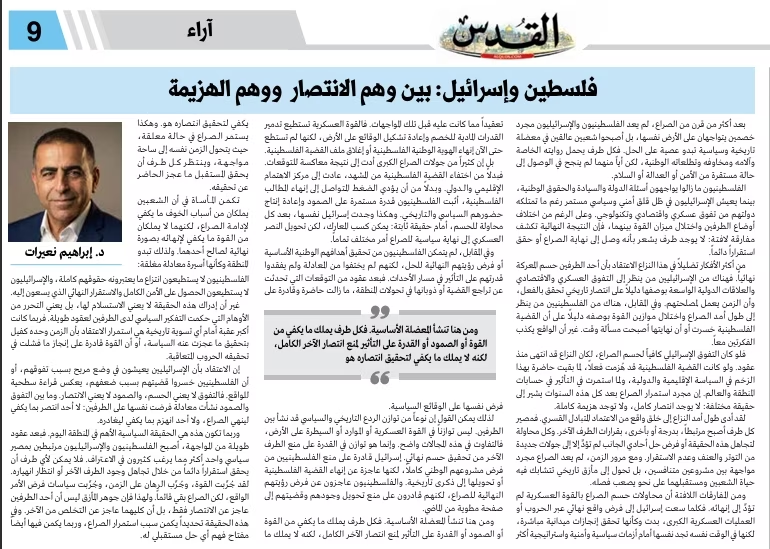
Palestine and Israel: Between the Illusion of Victory and the Illusion of Defeat

Dr. Ibrahim Nairat

After more than a century of conflict, Palestinians and Israelis are no longer merely adversaries confronting each other on the same land. Instead, they have become two peoples trapped in a historical and political dilemma that appears intractable. Each side carries its own narrative, pains, fears, and national aspirations, yet neither has succeeded in achieving a stable state of security, justice, or peace.

Palestinians continue to face questions of statehood, sovereignty, and national rights, while Israelis live under constant security and political anxiety, despite their state's military, economic, and technological superiority. Despite the differing circumstances of the two parties and the imbalance of power between them, the ultimate outcome reveals a striking paradox: neither side feels it has reached the end of the conflict or achieved lasting stability.

One of the most misleading ideas in this conflict is the belief that one side has definitively won the battle. Some Israelis view their military and economic superiority and extensive international relations as evidence of a historical victory already achieved, and that time is working in their favor. Conversely, some Palestinians view the prolonged nature of the conflict and the imbalance of power as evidence that the Palestinian cause has been lost or that its end is only a matter of time. However, reality refutes both ideas.

If Israeli superiority were sufficient to resolve the conflict, the dispute would have ended decades ago. And if the Palestinian cause had truly been defeated, it would not remain present with such momentum in regional and international politics, nor would it continue to influence the calculations of the region and the world. The mere continuation of the conflict after all these years indicates a different reality: there is no complete victory, and there is no complete defeat.

The prolonged nature of the conflict has created a reality of forced interdependence. The fate of each party has become linked, to some extent, to the decisions of the other. Every attempt to ignore this reality or impose a unilateral solution has only led to new cycles of tension, violence, and instability. Over time, the conflict has ceased to be merely a confrontation between two competing projects; it has transformed into a historical impasse where the lives and futures of the two peoples are intertwined in an inseparable way.

It is a striking paradox that attempts to resolve the conflict by military force have not led to its end. Whenever Israel has sought to impose a final reality through wars or major military operations, it has appeared to achieve immediate field successes, but at the same time, it finds itself facing political, security, and strategic crises more complex than before those confrontations. Military force can destroy the material capabilities of the adversary and reshape realities on the ground, but it has not yet been able to end Palestinian national identity or close the file of the Palestinian cause.

Indeed, many major rounds of conflict have led to results contrary to expectations. Instead of the Palestinian issue disappearing from the scene, it has returned to the center of regional and international attention. And instead of continuous pressure leading to the end of Palestinian demands, Palestinians have demonstrated a continuous ability to endure and reassert their political and historical presence. Thus, Israel has found itself, after every attempt at resolution, facing a constant reality: battles can be won, but transforming military victory into a political end to the conflict is an entirely different matter.

Conversely, Palestinians have not been able to achieve their fundamental national goals or impose their final vision for a solution, but they have not disappeared from the equation nor lost their ability to influence the course of events. After decades of predictions that the issue would decline or dissolve into regional transformations, it remains present and capable of asserting itself on political realities.

Therefore, it can be said that a kind of historical and political deterrence balance has emerged between the two parties. This is not a balance in military power, resources, or control over land, as the disparity in these areas is clear. Rather, it is a balance in the ability to prevent the other side from achieving a definitive resolution. Israel is capable of preventing Palestinians from fully implementing their national project, but it is unable to end the Palestinian issue or turn it into a historical memory. Palestinians are unable to impose their final vision for the conflict, but they are capable of preventing their existence and their cause from being relegated to a closed chapter of the past.

Hence arises the fundamental dilemma. Each side possesses enough power, resilience, or influence to prevent the other's complete victory, but not enough to achieve its own victory. Thus, the conflict continues in a suspended state, where time itself becomes a battleground, and each side awaits the future to achieve what the present has failed to accomplish.

The tragedy lies in the fact that both peoples have enough reasons to fear to perpetuate the conflict, but not enough power to end it definitively in favor of one. Therefore, the region seems to be captive to a closed equation: Palestinians cannot seize what they consider their full rights, and Israelis cannot obtain the complete security and final stability they seek.

However, recognizing this reality does not mean surrendering to it, but rather freeing oneself from the illusions that have governed political thinking on both sides for decades. Perhaps the biggest obstacle to any historical settlement has been the continued belief that time alone is sufficient to achieve what politics has failed to do, or that force can accomplish what successive wars have failed to achieve.

Believing that Israelis live in a comfortable position due to their superiority, or that Palestinians have lost their cause due to their weakness, reflects a superficial reading of reality. Superiority does not mean resolution, and resilience does not mean victory. And between superiority and resilience, an equation has imposed itself on both sides: no one has won enough to end the conflict, and no one has been defeated enough to leave it.
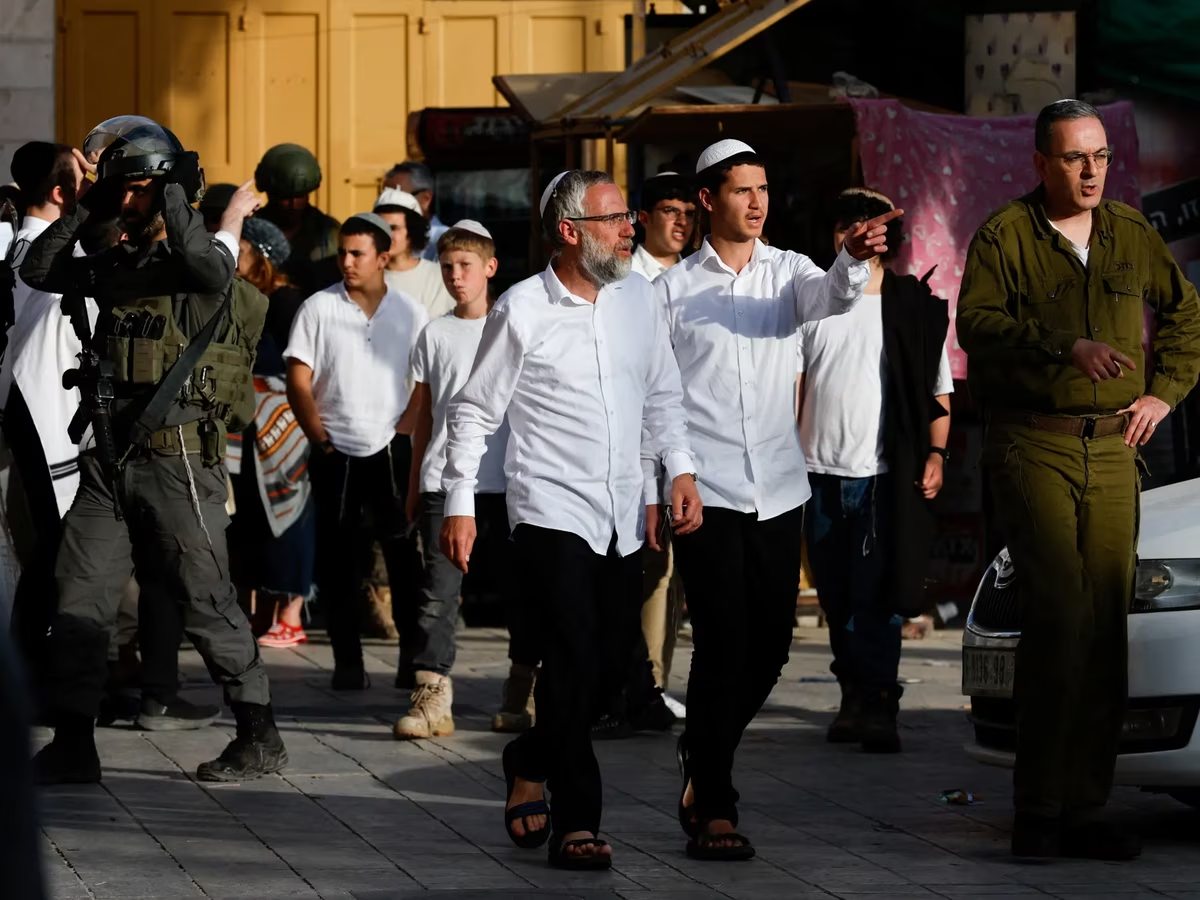
And perhaps this is the most important political truth in the region today. After long decades of confrontation, Palestinians and Israelis are linked by a single political destiny more than many wish to admit. No party can achieve lasting stability by ignoring the existence of the other or waiting for its collapse. Force has been tried, betting on time has been tried, and policies of imposing a fait accompli have been tried, but the conflict has remained.

Therefore, the essence of the impasse is not that one side is merely incapable of victory, but that both are incapable of getting rid of the other. And in this very truth lies the reason for the continuation of the conflict, and perhaps also the key to understanding any future solution to it.

PALESTINE

Wed 10 Jun 2026 8:20 am - Jerusalem Time

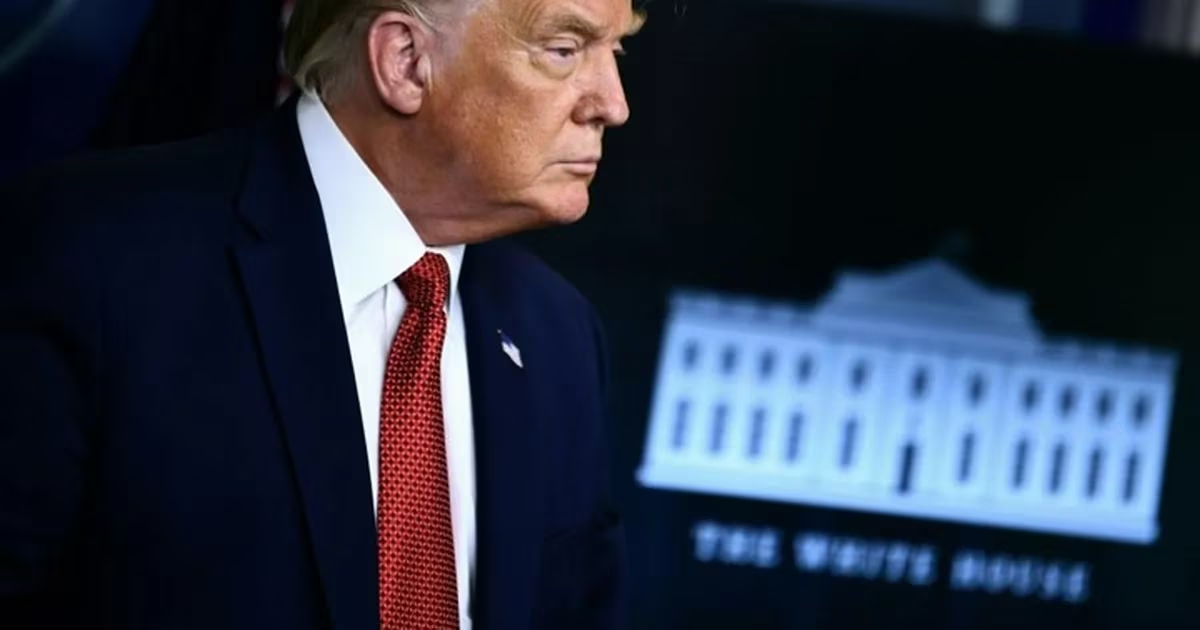
One Hundred Days of Confrontation: Trump Faces a Strategic Dilemma in the Iran-Israel Conflict

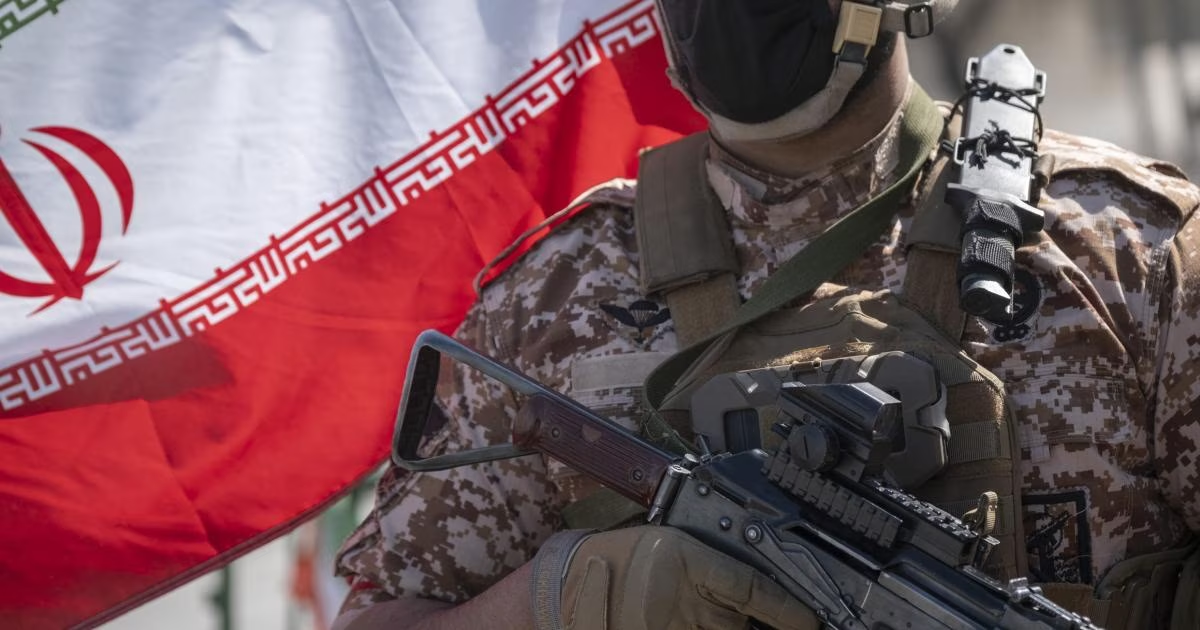
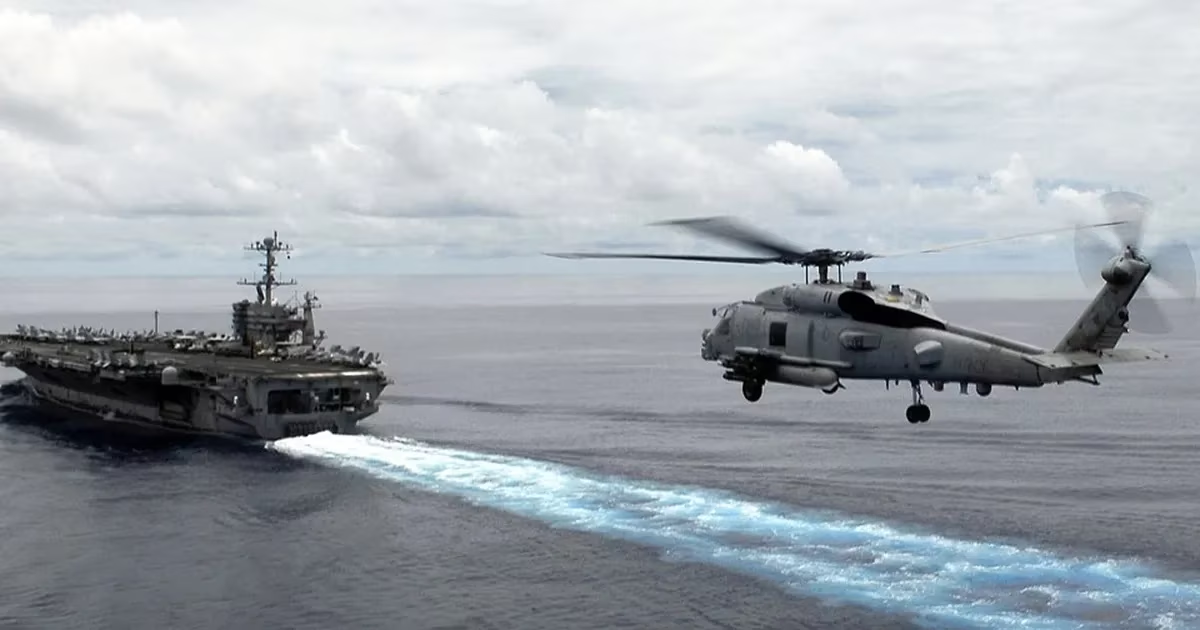
Hebrew press reports indicate that US President Donald Trump finds himself today mired in what they described as the 'Middle East quagmire,' after one hundred days have passed since the outbreak of military confrontation in which the United States is participating alongside Israel against Iran. These developments contradict Trump's electoral promises to avoid bloody conflicts in the region at all costs.

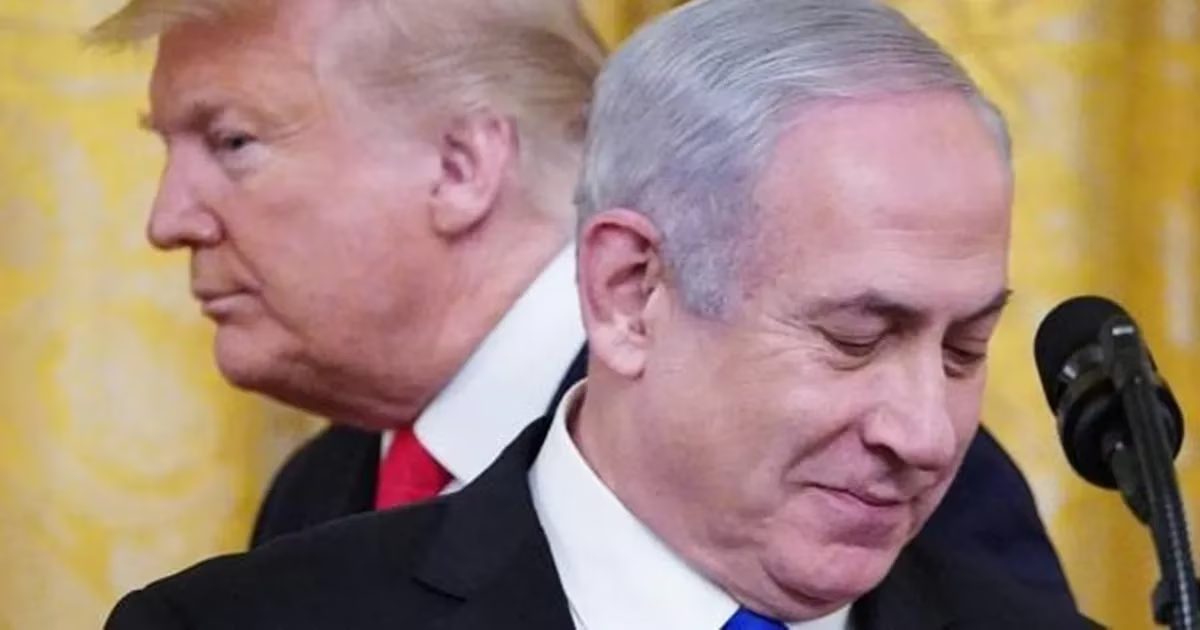
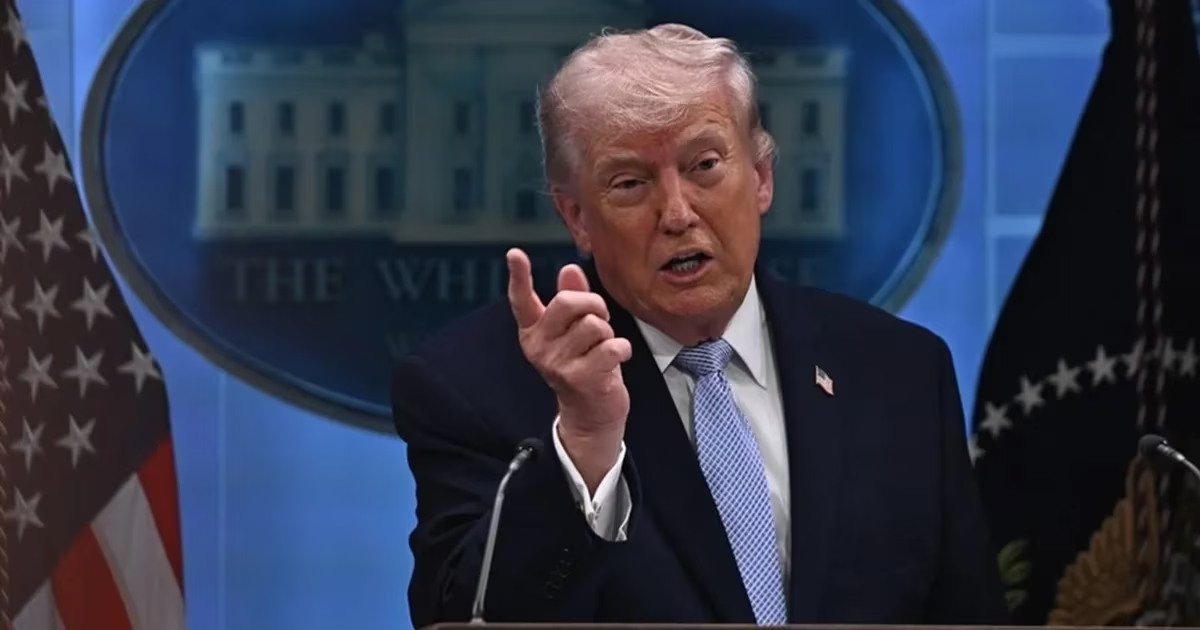
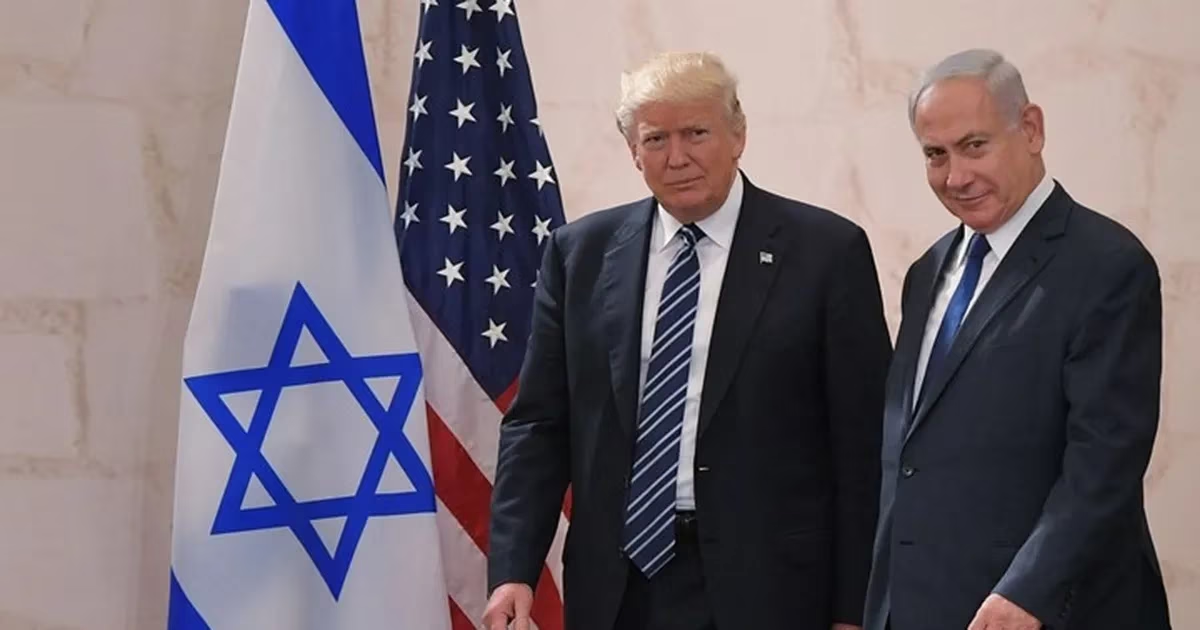
In recent days, Trump has tried to demonstrate his full control over the course of political and military events, stating in a press interview that he is the ultimate decision-maker in Washington. Trump affirmed that the Prime Minister of the occupation, Benjamin Netanyahu, will find himself compelled to accept the formula that the US administration is preparing for an agreement with Tehran, emphasizing that Tel Aviv's options have become limited.

However, the realities on the ground imposed a different rhythm, as the US President was forced to issue urgent appeals via social media platforms demanding an immediate ceasefire between the two parties. These calls came in the wake of an escalation on the ground that revealed the difficulty of controlling the pace of direct confrontation between Tehran and Tel Aviv, putting American credibility on the line.

In a related context, international press sources indicated that the war, which began on February 28, has clearly started to show the limits of American military power in the region. Despite periods of tactical calm, the strategic dilemma persists without a clear horizon for resolution, amid ongoing major security challenges.

Washington faces a tangible failure in imposing a counter-naval blockade on Iranian ships, which has enabled Tehran to impose an effective closure of the vital Strait of Hormuz to navigation. Strategic experts warn that this field failure could translate into a harsh diplomatic defeat for the United States, weakening its influence in other international issues.

For his part, Trump defended his policy in recent media interviews, denying that he had backed down on his promises to end 'endless wars.' He described the current conflict as merely a 'short trip' that would soon end, but security reports confirm that Iranian capabilities exceeded the US administration's expectations, leading to the dissipation of illusions about a quick resolution to the conflict.

The crisis of dwindling US ammunition stockpiles stands out as one of the most dangerous repercussions of this confrontation, as it has begun to directly affect America's deterrent capability on other fronts such as Europe and Asia. Analysts believe that the depletion of military resources in the Middle East weakens the US position against rival great powers and creates security vulnerabilities in vital spheres of influence.

Regarding bilateral relations, sources revealed a sharp and personal tension between Trump and Netanyahu, reaching the point of exchanging insults in closed phone calls. The reason for this American anger stems from the large-scale Israeli military operations in Lebanon, which Trump believes complicate his efforts to reach a comprehensive settlement with the Iranian side.

Despite the pressures exerted by the White House on the Israeli government, which is politically dependent on Washington, the US administration has not yet succeeded in extracting any substantial concessions from Tehran. This stalemate places Trump in a complex political dilemma, as no easy exits are in sight that would preserve the US administration's face.

At the conclusion of a media meeting with press sources, Trump showed clear irritation with questions addressing the possibilities of Netanyahu rebelling against American wishes. When asked if he would support Israel if it decided to return to war against Iran unilaterally, the US President abruptly ended the interview, evading a clear answer about future scenarios.

I make all the decisions, and Netanyahu will have no choice but to accept the agreement we are preparing with Tehran.

OPINIONS

Wed 10 Jun 2026 8:19 am - Jerusalem Time

Beyond the Cold Numbers: Human Stories Extinguished by the Fires of War

Ramallah - “Alquds ” dot com

Ramallah - “Alquds ” dot com

Opinion Writer

News reports and daily dispatches fill our screens with thousands of numbers detailing war casualties, but these figures hide a painful question: how can lives and heroism be reduced to a mere fleeting digital counter? Every number displayed on the screen represents a complete life story, dreams prematurely extinguished, raising questions about leaders' awareness of the magnitude of the tragedy they are creating with their own hands.

Decision-makers do not seem to grasp the void left by the departed in the hearts of their families and friends, or the bitterness of loss that accompanies those who survived death. Behind every victim lies a network of human relationships torn apart, and a pain that cannot be described in words, transcending the dry reports recited in international forums.

When loved ones depart, their memories, attitudes, and words remain etched in the soul, surrounding those who remain like unsetting shadows, where pain mixes with surrender to the bitter reality of separation. It is the cycle of life that imposes its end on everyone, but longing remains burning to reclaim fleeting moments or shared scenes that shaped the features of our human identity.

These departed individuals represent the heroes of personal stories for those who knew them, their voices and words providing warmth and security in moments of need and weakness. Their absence is not merely a physical absence, but an uprooting of an essential part of the living's memory, making one feel that they are no longer as they were before the tragedy.

The impact left by the departed within us cannot be replaced or compensated in any way; it is a deep wound in the soul that refuses to heal with the passage of time. Small details, from a tone of voice to an old text message, remain the last refuge for those trying to cling to the threads of a beautiful past.

Behind the coldly presented statistics, we find thousands of people silently suffering from the absence of support and hope, and from the loss of those who represented their entire lives. These victims were not mere military targets or numbers in a political equation, but pillars of homes that collapsed over their occupants, both morally and materially.

It is a stark irony that decisions made by a very limited number of people, no more than a handful, lead to the loss of tens of thousands of innocent lives. These leaders justify their actions by seeking security and peace, while reality indicates that they are sowing the seeds of destruction and ruin everywhere.

Reality poses a fundamental question about the concept of security built on the corpses of the innocent, and whether peace can truly be achieved through the shedding of more innocent blood. What is actually happening is the generation of feelings of hatred and resentment in the hearts of survivors who lost their loved ones without any fault of their own, making peace more distant than ever.

Continuing the path of violence only leads to tearing apart the social fabric and destroying the future, as collective memory becomes laden with unforgettable pains and stories of injustice and oppression. The power used to end human lives can never be a means to build stable or secure societies.

The world must stop viewing conflict victims as mere statistics and begin to see the human face of every individual who fell in these absurd wars. Restoring humanity begins with recognizing that every soul lost is an irreplaceable loss for all humanity, not just a number in a press release.

Ultimately, hope remains that living consciences will grasp the magnitude of the tragedy, and that the killing machine, which distinguishes neither child from elder, nor dream from reality, will stop. Loyalty to the departed requires serious work to stop the bloodshed and ensure that their stories do not become just a forgotten memory in the annals of history.

Can security and peace be achieved with more blood? And with more hatred filling the hearts of the living over the loss of their loved ones for no reason?

ARAB AND WORLD

Wed 10 Jun 2026 8:19 am - Jerusalem Time

Middle East Quagmire: Trump's Drive for Control Collides with Iranian Resistance

US President Donald Trump's political ambitions face a severe test in the Middle East, where his usual tendency towards dominance clashes with a complex military reality involving Iran. Despite the displays of power that have characterized his career, the escalating crisis has begun to place clear limits on his ability to impose his will on allies and adversaries alike.

In a striking escalation of rhetoric towards his closest ally, Trump asserted that Israeli Prime Minister Benjamin Netanyahu would be forced to agree to a deal formula negotiated by Washington with Tehran. Trump stressed in press statements that he holds the ultimate decision-making power, a clear indication of his rejection of any Israeli moves that might undermine the path set by the US administration.

The White House's pressure did not stop at diplomatic statements but extended to direct directives via social media demanding an immediate ceasefire. These calls came at a sensitive time as Trump tries to prevent the region from sliding into a comprehensive confrontation that could derail his electoral promises to end foreign wars.

One hundred days after the outbreak of military confrontation last February, Trump finds himself stuck in the same 'quagmire' he previously warned against and criticized his predecessors for. Despite the tactical truce recently announced by Tehran and Tel Aviv, the deep roots of the conflict remain without radical solutions appearing on the near horizon.

Observers and former US State Department officials believe that Trump waged a 'war of choice' built on mistaken assessments of the balance of power in the region. Overestimating US military effectiveness, while underestimating Iranian defensive and offensive capabilities, led the situation to a stalemate from which it is currently difficult to exit.

Iran's effective control over the Strait of Hormuz represents one of the most prominent challenges that the US administration has failed to address despite imposing a counter-blockade. This closure of the vital shipping lane has given Tehran enormous economic leverage, capable of directly influencing global energy prices and the calculations of American voters.

Domestically in the US, warnings are escalating from military experts belonging to hardline research centers, indicating that Trump may be forced to conclude a 'bad deal' to avoid strategic defeat. They fear that rushing to end the conflict could entrench Iran's influence in international waterways without offering real concessions on its nuclear file.

Trump expressed his growing frustration with internal pressures and criticisms dogging his administration regarding the pace of military or diplomatic action. He called on his critics to calm down and wait, claiming that things would ultimately end in his favor, even though the reality on the ground indicates complexities that go beyond mere media optimism.

Compared to the US invasion of Iraq, the current war with Iran highlights the limits of American firepower and the rapid exposure of its inability to achieve a quick resolution. While Baghdad fell in weeks, Tehran proved a greater ability to maneuver and wage attrition, making the 'short adventure' Trump promised enter its fourth month without tangible results.

Experts warn that any additional escalation could lead to a dangerous depletion of US ammunition stockpiles, weakening Washington's military position on other fronts such as Europe and Asia. This depletion places the administration before choices, the least bad of which is bitter, between costly escalation or a retreat that could be interpreted as strategic weakness.

The volatile relationship between Trump and Netanyahu plays a pivotal role in complicating the scene, especially after the violent raids launched by the occupation forces in Lebanon. Trump revealed a sharp phone call with Netanyahu, expressing his anger at moves that could drag the United States into a wider conflict it does not desire.

Despite Trump's ability to exert strong influence over Netanyahu, given the latter's need for American support to ensure his political survival, the biggest challenge remains on the Iranian side. Diplomatic sources confirm that Washington has not yet succeeded in changing the strategic calculations of the leadership in Tehran, which represents the major sticking point.

Recent opinion polls indicate widespread public dissatisfaction with involvement in this war, which raises concerns for the Republican Party as the midterm elections approach. This public pressure reduces Trump's room for maneuver and forces him to seek a quick exit that saves face with his electoral base.

Ultimately, the 'dealmaker' finds himself facing a real test of his ability to manage a major international crisis where military and economic interests intertwine. The outcomes of this confrontation, whether it ends with a comprehensive agreement or continues as a war of attrition, will have a profound impact on the future of American influence in the region and on Trump's own political ambitions.

I am the decision-maker, and Netanyahu will have no choice but to accept the agreement that the United States negotiated with Iran.

PALESTINE

Wed 10 Jun 2026 8:19 am - Jerusalem Time

Lebanon Between the Hammer of the Battlefield and the Anvil of Diplomacy: The Conflict of Legitimacies in the Face of Regional Re-engineering

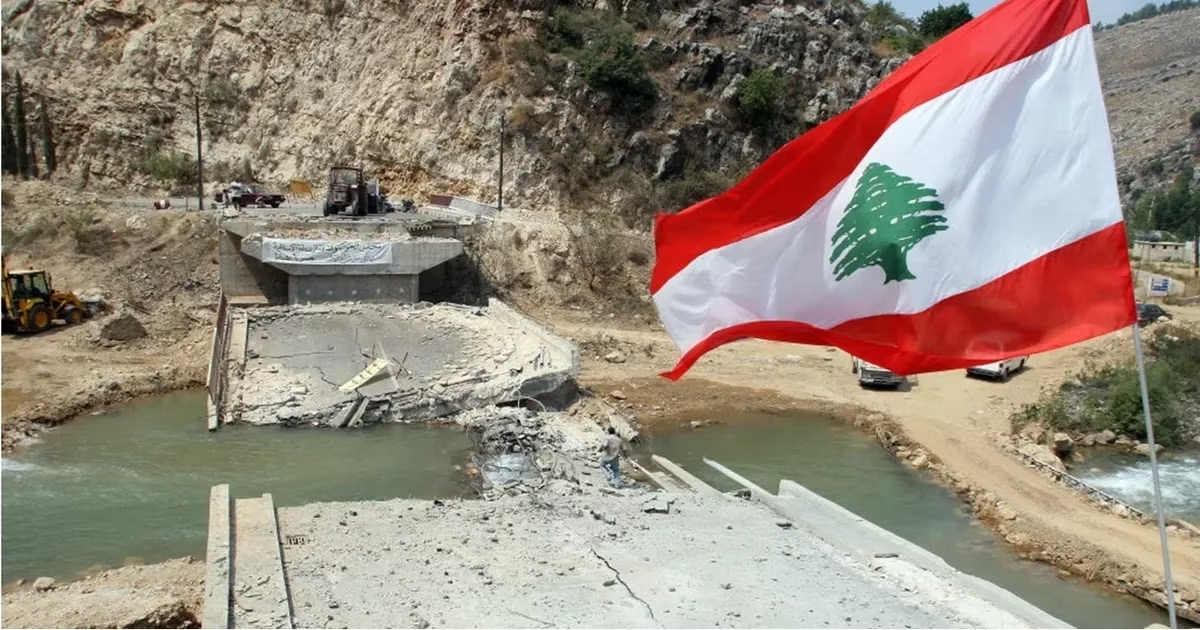
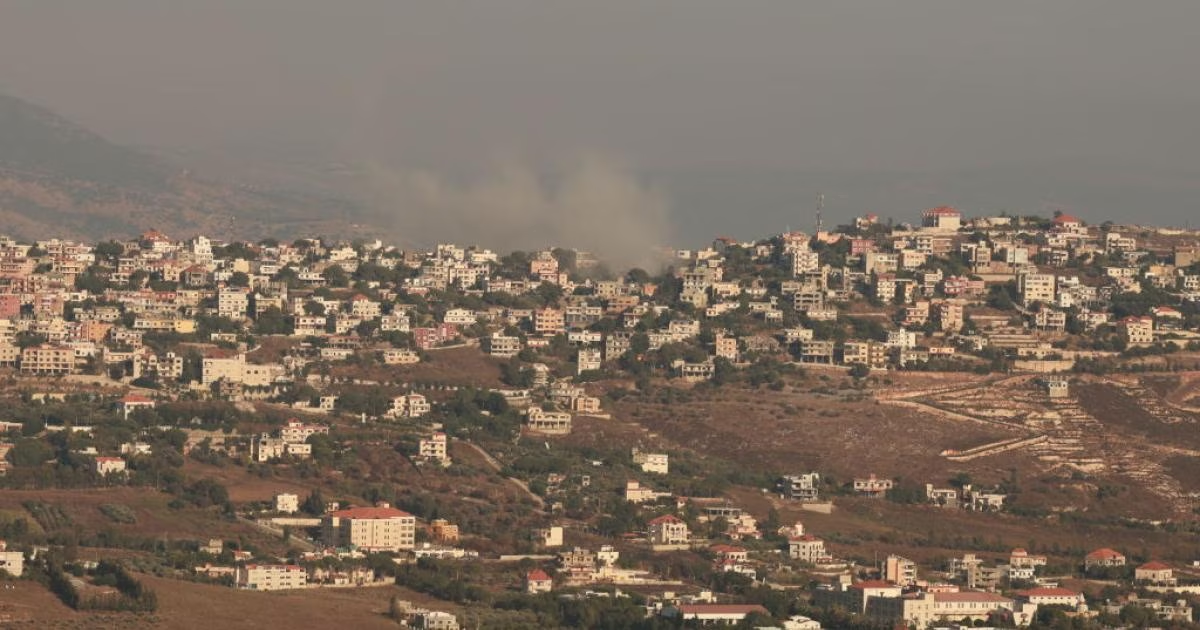
The Lebanese body, burdened by a legacy of complex crises, is passing through a strategic turning point, the most dangerous in its modern history, where this transformation places the state entity before difficult existential questions. Lebanon finds itself compelled to choose between two parallel paths that are vying to shape the scene; the first is represented by the 'legitimacy of politics' led by official institutions, and the second is the 'legitimacy of war' imposed by field realities.

The 'legitimacy of politics' is manifested in the diplomatic attempts made by the Lebanese state to find political solutions and impose a ceasefire that protects what remains of the infrastructure. This constitutional legitimacy seeks to regain the initiative through international channels to ensure civil peace and prevent the country from sliding into an irreversible comprehensive collapse.

In contrast, the 'legitimacy of war' emerges as a reality that Hezbollah derives from its military arsenal and the philosophy of resistance, which it sees as a necessary deterrent tool to confront the imbalance of power. This vision considers military operations in the south as the only way to protect Lebanese territories from Israeli ambitions and the brutal encroachment that threatens national sovereignty.

On the military front, the current Israeli strategy is based on the theory of 'front separation,' an attempt to dismantle the concept of 'unity of fronts' adopted by resistance forces. Through its military separation policy, Israel aims to isolate each front separately, seeking to strip adversaries of the tactical power cards provided by supporting fronts.

Israeli ambitions do not stop at securing the northern borders only, but extend to include a strategic desire to re-engineer the security environment of the entire region. Tel Aviv relies on its aerial and technological superiority to impose new terms of surrender that guarantee its long-term hegemony and change the traditional rules of engagement in the region.

For its part, Iran emerges as a pivotal player who sees the Lebanese front as the cornerstone of its regional security doctrine, as Tehran rejects any settlement formula that isolates the fronts from each other. Iranian diplomacy pushes towards affirming the interconnectedness of paths, considering that dismantling this interconnectedness represents a direct threat to its strategic depth and geopolitical gains.

Through its support for resistance fronts, Tehran seeks to formulate a new deterrence equation that protects its influence extending from Baghdad to Beirut in the face of Western pressures. This approach represents a direct response to international attempts to curb Iran's role and separate the Lebanese track from other thorny regional issues.

The international approach, especially the American one, shows clear duality in managing the Lebanese crisis through what can be described as 'conditional diplomacy.' While Washington ostensibly calls for de-escalation, it conditions stability on the literal implementation of international resolutions, foremost among them Resolution 1701, which stipulates the sole authority of the Lebanese army.

Forces opposed to Western policies view these diplomatic moves with suspicion, considering them an attempt to achieve political gains that Israel failed to extract on the battlefield. This international division deepens the state of paralysis in reaching a real and unconditional ceasefire, leaving Lebanon as an arena for settling major scores.

In turn, the Arab position oscillates between providing generous humanitarian support and the file of displaced persons, and cautious political withdrawal from the crisis. This situation reflects apprehension about providing any cover that might contribute to strengthening Iranian influence or legitimizing the presence of weapons outside the framework of official Lebanese state institutions.

The absence of effective strategic Arab action has led to the transformation of the role of central capitals from leading balances to merely observing the results on the ground. This political vacuum left Beirut exposed at a critical historical moment, as the country lacks a strong Arab umbrella capable of imposing a balance that protects its sovereignty.

A deep reading of the course of events confirms that Lebanon has become an advanced entanglement line in an international conflict that is redrawing trade routes and energy projects in the Middle East. The issue is no longer merely a border dispute, but rather part of a complex birth pang to redistribute economic and political spheres of influence with iron and fire.

It becomes clear day after day that temporary diplomatic palliatives will not achieve sustainable stability for Lebanon, and adventurous field bets alone may not be enough to protect the entity. Salvation requires internal strategic awareness that understands the nature of major balances and works to formulate a national contract that brings together all forces under the umbrella of the state.

In conclusion, the future of Lebanon remains suspended between its ability to absorb the 'legitimacy of politics' and control the 'legitimacy of war' within a unified national framework. Without this consensus, the fires burning in the region may consume what remains of the Lebanese entity, making it a victim of regional projects that transcend the limits of its small geography.

The current Lebanese scene is nothing but an advanced entanglement line in a fierce international and regional conflict in which trade routes and spheres of influence are being redrawn with iron and fire.

LATEST NEWS

Wed 10 Jun 2026 8:18 am - Jerusalem Time

Aoun reveals details of the 'experimental zones' plan and denies communication channels between Trump and Hezbollah

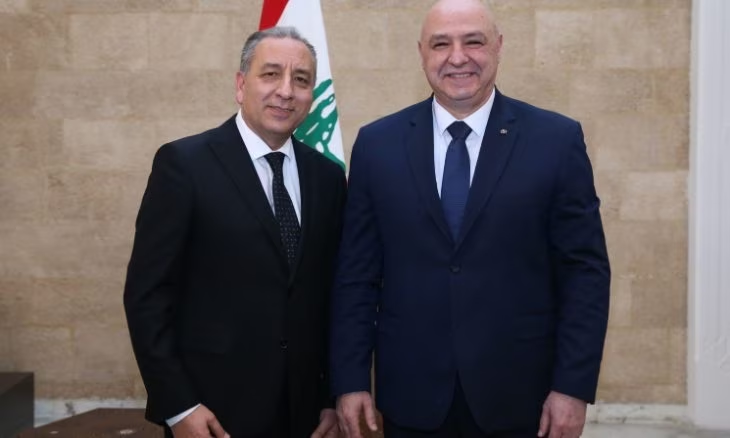
Since assuming the presidency, Lebanese President General Joseph Aoun has sought to consolidate the concept of the state and restore its lost prestige amidst regional tensions. Aoun emerges as a leading figure attempting to balance military firmness with political realism, placing Lebanon's national interest above any sectarian considerations or external pressures that could destabilize the fragile stability.

Regarding the issue of Hezbollah's weapons, President Aoun adopts an approach based on responsible dialogue and the necessity of confining weapons to the legitimate institutions of the state. The presidency has engaged in lengthy discussions aimed at sparing Lebanon the repercussions of regional wars, based on a firm conviction that the decision of peace and war must remain exclusively in the hands of the Lebanese state alone.

Information indicates that President Aoun does not adopt the language of direct confrontation but rather relies on wisdom and patience in addressing thorny issues. He believes that building a strong and independent state cannot be achieved in the presence of parallel military decisions outside the framework of official institutions, which he seeks to enshrine through available diplomatic and political channels.

On the political communication front, sources revealed that the current relationship between Baabda Palace and Hezbollah is directly severed, with contacts limited to secondary channels. The President closely follows the positions of the party's leadership, expressing his surprise at some people's description of the ongoing negotiations as futile, questioning the available alternatives in light of the current field results.

In a related context, President Aoun expressed his surprise at reports circulating about direct contacts between US President Donald Trump and Hezbollah. He clarified that American communication was made through the Lebanese Ambassador in Washington, Nada Maawad, praising her role in representing the Lebanese state and protecting its interests in international forums.

The President strongly defends the performance of Lebanese diplomacy in Washington, noting that the efforts made have succeeded in moving stagnant files and prompted high-level interventions from the US administration. Aoun rejects attempts to belittle the official Lebanese representation or to attribute diplomatic successes to unofficial parties.

On the ground, the President relies on the 'experimental zones' proposal as a first step to stabilize southern Lebanon. The plan includes the deployment of Lebanese Army units in specific areas, including Eastern and Western Zawtar, Yahmar, and Beaufort Castle, to serve as a model for imposing national sovereignty.

The President believes that current circumstances may not allow for a comprehensive and immediate ceasefire or a complete Israeli withdrawal simultaneous with the withdrawal of Hezbollah elements to north of the Litani. Nevertheless, the equation of 'Dahiyeh versus settlements' remains in the field calculations, with a warning against using the Lebanese arena as a platform for settling regional scores between major powers.

Domestically, there is clear harmony between the presidency and the government led by Nawaf Salam, which annoys some parties attempting to stir up discord between the Serail and Baabda. President Aoun mocks analyses that speak of marginalizing the Prime Minister's role, emphasizing that the existing cooperation aims to manage state affairs during this critical phase.

Regarding the relationship with Parliament Speaker Nabih Berri, it is based on mutual respect and continuous consultation on major national issues. President Aoun praised Berri's historical role in building the South in media statements, confirming that coordination between them has not been interrupted despite security circumstances that impose restrictions on direct visits.

President Aoun categorically denies the existence of any secret agreements preceding his election as president, considering what is being circulated in this regard as mere slander. He cited statements by Hezbollah MPs who confirmed that their vote for him was a choice to avoid a constitutional vacuum and not the result of a prior political deal with any party.

Regarding the military institution, the President affirms that the army leadership operates under the umbrella of political authority and fully adheres to its directives. He clarified that the visit of Army Commander General Rudolph Hekal to Pakistan was scheduled long ago and carries no political implications or messages related to the recent field escalation.

Visitors to the palace believe that President Aoun has a clear vision for exiting the current crisis by strengthening the role of legitimate institutions and adhering to national sovereignty. Aoun stresses that Lebanon must return to its natural position as an independent state that maintains balanced relations with the international community and the Arab hinterland, away from the policy of axes.

Finally, the President emphasizes the importance of Lebanese unity in confronting the existential challenges facing the country. He affirms that the only way to protect Lebanon is to rally around state institutions and its national army, and to reject any attempts to mortgage the Lebanese decision to external interests that do not serve the people's aspirations for security and stability.

Let Sheikh Naim Qassem tell me what he wants? Does he want to fight? Let him go and fight, and we have seen the results.

PALESTINE

Wed 10 Jun 2026 8:18 am - Jerusalem Time

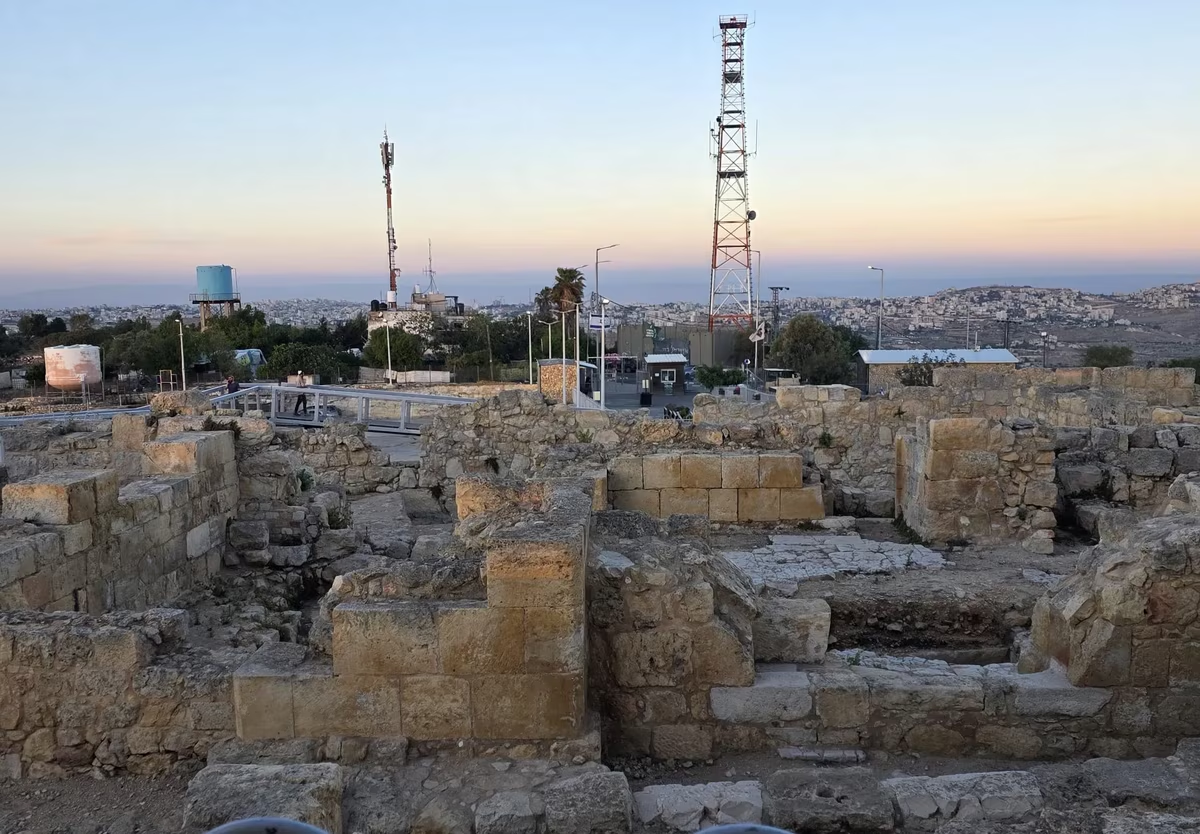
Prophet Samuel: A Jerusalemite Village Swallowed by Settlement Under the Guise of 'Heritage'

The village of Nabi Samuel, located northwest of occupied Jerusalem, is engaged in a bitter existential struggle that extends beyond land to the core of Palestinian identity. Once a strategic link between Jerusalem and Ramallah, the occupation's measures have transformed the village into an isolated enclave inhabited by approximately 400 Palestinians living under a strict siege and suffocating military restrictions.

In the latest chapter of this targeting, the occupation authorities issued a decision to confiscate about 110 dunams of land from the village and the neighboring town of Beit Iksa, directly targeting the vicinity of the ancient Nabi Samuel Mosque. These confiscations include endowment lands and historical shrines, raising serious concerns about changing the geographical and demographic landscape of the area under the pretext of tourism development.

Local sources reported that the occupation seeks, through this step, to tighten its control over the mosque, whose lower floor was previously converted into a synagogue. These moves come within the context of a systematic policy to seize Palestinian archaeological sites and replace the Islamic historical narrative with a settlement narrative that imposes a new reality by force of arms.

For its part, the Nabi Samuel Village Council warned that the occupation has given residents a short deadline to object to the confiscation decisions before Israeli courts, procedures that are considered superficial in the absence of justice. The council clarified that the plan aims to transform the area into a tourist facility including hotels and restaurants serving settlers, thus entrenching the permanent Judaization of the surroundings.

The roots of suffering in the village date back to 1971, when residents were subjected to forced displacement from the vicinity of the mosque to the eastern side, followed by a series of restrictions. The village's land area has shrunk from 4500 dunams to only about 2261 dunams as a result of settlement expansion and the construction of the apartheid wall that tore apart the region.

On the ground, the residents of Nabi Samuel live in what resembles an 'open prison,' where they can only enter or exit through the 'Jib' military checkpoint. The occupation authorities require residents to possess special magnetic cards that classify them as 'new residents,' and their daily movement is subject to the whims of the soldiers stationed at the village's only entrances.

Citizens from the village confirmed that military restrictions have affected the simplest details of life, including preventing the reception of first-degree relatives or the entry of electrical appliances and furniture without prior security coordination. This siege has led to the social and economic isolation of the village and has turned the lives of resilient families into a series of arduous daily challenges.

In a related context, previous excavations carried out by the occupation authorities themselves revealed the presence of artifacts dating back to Islamic and Crusader eras, without finding any evidence to support Israeli historical claims. Despite this, the occupation institutions continue to falsify historical facts to justify control over the site and convert it into a 'national park' affiliated with the occupation municipality.

Observers believe that the Israeli Knesset's approval of the 'Heritage Authority in Judea and Samaria' project represents a green light for accelerating creeping annexation operations in the West Bank. This new legal trend grants settlement civil institutions broad powers to manage Palestinian archaeological sites away from traditional military frameworks, thus facilitating the imposition of Israeli sovereignty.

The village of Nabi Samuel acquires extreme strategic importance as it constitutes a geographical 'connecting node,' and controlling it is an essential part of the 'Greater Jerusalem' project. This project aims to connect the major settlement blocs surrounding Jerusalem, such as 'Givat Ze'ev' and 'Ma'ale Adumim,' to create a geographical settlement continuum that disrupts Palestinian connectivity.

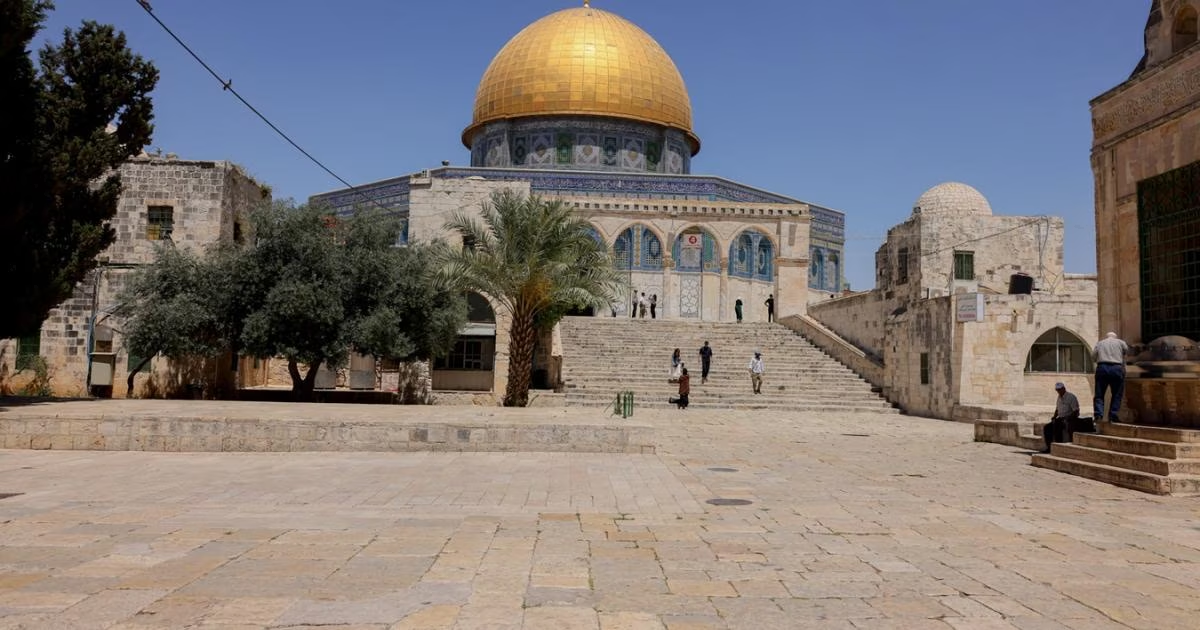
Human rights sources indicated that what is happening in Nabi Samuel is not isolated from what is happening in other sites such as Sebastia and the Ibrahimi Mosque, where 'antiquities laws' are employed as political tools par excellence. These policies are considered field tests to impose a similar reality in the future on the blessed Al-Aqsa Mosque in the heart of occupied Jerusalem.

Farmers in the village face severe difficulties in cultivating their remaining lands, as they are prevented from erecting any fences or agricultural facilities to protect their crops. This economic constriction aims primarily to push residents to voluntarily leave their lands after it became impossible for them to live a dignified life under the arbitrary measures of the 'Civil Administration.'

The conversion of the mosque into a synagogue and the isolation of residents behind walls and checkpoints reflect the ugliest face of the apartheid policies practiced by the occupation authorities in Jerusalem. Despite all these pressures, the people of Nabi Samuel cling to their existence, considering their steadfastness in their homes as the last line of defense for the identity of the place and its ancient history.

In conclusion, the Nabi Samuel file remains a testament to attempts to erase Palestinian memory and falsify geography, amidst international silence regarding the violation of conventions that protect heritage sites. The village continues to resist the 'silent annexation' plans led by the far-right government, striving to preserve what remains of Palestinian space in the vicinity of the Holy City.

The occupation employs heritage and antiquities laws as tools to control Palestinian sites and redefine their identity according to the Israeli narrative.

ARAB AND WORLD

Wed 10 Jun 2026 8:18 am - Jerusalem Time

Trump's Dilemma in the Gulf: A War Without Exit and Stalled Negotiations Under the Weight of Oil

US President Donald Trump finds himself today confronting a bitter reality: the failure of his promises to end the conflict with Iran. After his announcement on May 23rd of an imminent historic agreement, the cannons continue to speak instead of the diplomats. The situation on the ground indicates a continuous exchange of fire between American and Iranian forces, putting the credibility of the US administration to the test before local and international public opinion.

The military escalation took a dangerous turn last week, when an Iranian drone attack targeted Kuwait International Airport, causing severe damage to the vital facility. The matter did not stop there; last Sunday, Iran launched ballistic missiles towards the occupying state, which quickly responded militarily, further igniting the interconnected regional fronts.

At the heart of this crisis, the closure of the Strait of Hormuz stands out as the most dangerous economic weapon used by Tehran, as traffic there has almost completely stopped, except for very limited passages. This closure threatens the lifeline of about 20 percent of global oil supplies, prompting analysts to warn of a historic jump in prices that could reach $150 per barrel if the blockage continues until next July.

Domestically, Trump faces pressure from the hardline wing of the Republican Party, where former Secretary of State Mike Pompeo led a campaign of criticism against the leaked terms of the proposed agreement. Pompeo considered that offering financial concessions to Tehran represents a repetition of the 'sin' of the 2015 agreement concluded by Barack Obama, an agreement that Trump has long ridiculed and described as weak and shameful.

The White House's response to these criticisms came sharply from Communications Director Stephen Cheung, who publicly attacked Pompeo, considering that he knows nothing about the art of silent negotiation. However, it seems that these right-wing pressures have paid off, as Trump retracted his initial offer and presented a tougher counter-offer, leading to the freezing of current negotiations and their reaching a dead end.

Iranian demands seem impossible for the Trump administration, as Tehran stipulates the immediate release of $12 billion of its frozen assets in exchange for reopening the Strait of Hormuz. It also demands an additional $12 billion as a goodwill gesture during a sixty-day negotiation period to discuss its nuclear file, which puts Trump in an embarrassing position before his electoral base, whom he promised 'maximum pressure.'

Trump clearly avoids any large-scale ground military involvement, justifying this by his desire not to repeat Jimmy Carter's failed experience in rescuing hostages in 1980. This caution reflects the president's desire to avoid 'nuclear dust' and the human and political costs of open wars, but at the same time, it leaves him stuck in a status quo characterized by continuous attrition with no horizon for a solution.

In an attempt to escape reality, Trump sometimes resorts to the virtual space, where he has repeatedly posted posts imagining a complete Iranian surrender and the signing of 'brilliant victory' documents. These wishes clash with a reality on the ground that proves that the superior air power of the United States and the occupying state has not yet succeeded in forcing the Iranian regime to submit to extreme American conditions.

Analyzes indicate that Trump faces the same dilemma that previous presidents faced in Vietnam and Afghanistan: that military superiority does not necessarily mean political victory. The Iranian regime views this conflict as an existential battle, which gives it a greater ability to withstand blows and strategic patience, applying the saying 'You have the watches, and we have the time.'

The American economy continues to show resilience, especially in the stock market, which gives Trump room to maneuver and promote his economic successes despite military failure. But this resilience is threatened with collapse if global oil reserves continue to run out, as 'Oxford Economics' warns that the ability to withstand the closure of the strait has very short time limits.

Trump has cornered himself by demanding 'unconditional surrender' from Iran, while using limited military tools that are insufficient to change regimes. This contradiction between ambitious goals and available means has given Tehran an opportunity to control the global scene by controlling energy flows, turning a barrel of oil into an international political pressure tool.

Experts believe that the best scenario Trump can aspire to now is to return to square one, i.e., accepting conditions similar to the Obama agreement from which he withdrew. This exit would require paying huge sums of money under different names, which could be described as the 'most expensive retreat' in Trump's political career, as he would be forced to buy stability at a high price.

The harsh experience in the Gulf may push the American president to reconsider the feasibility of launching new wars or intervening in complex conflicts in the Middle East. Wars that begin as 'short adventures' often turn into long-term attrition, especially when the adversary faces an existential threat that makes him willing to sacrifice everything for survival.

Ultimately, the question remains open as to who will cry first in this confrontation. While Trump bets on his economic strength and his ability to promote, Iran bets on the factor of time and geography. The inevitable result so far is that the world is paying the price of this conflict from its energy security and regional stability, awaiting a deal that may not come soon.

War is not just a targeting operation, and victory is not necessarily achieved by those who have the largest number of bombs; will is more important than weapons.

PALESTINE

Wed 10 Jun 2026 8:18 am - Jerusalem Time

Hamas: We showed flexibility towards Cairo's proposals, and the occupation hinders the implementation of the plan to end the war

The spokesman for the Islamic Resistance Movement (Hamas), Hazem Qassem, affirmed that the movement and resistance factions showed a positive spirit and high flexibility towards the proposals put forward by the mediators during the recent rounds of dialogue in the Egyptian capital, Cairo. Qassem explained that these discussions focused primarily on the mechanisms for implementing US President Donald Trump's plan aimed at ending military operations in the Gaza Strip and administrative arrangements for the next phase.

Sources indicated that the diplomatic moves led by Egypt, Qatar, and Turkey resulted in the formulation of approaches described by the movement as 'acceptable' by all parties that participated in the Cairo meetings. The movement's spokesman stressed that the resistance dealt with these proposals with national responsibility to ensure a cessation of aggression and achieve the interests of the Palestinian people in the besieged Strip.

In a related context, the movement's leadership issued an urgent appeal to the mediators and guarantor states of the agreement to exert real and effective pressure on the Israeli occupation authorities. This demand comes in light of the continued Israeli violations of the ceasefire agreement reached last October, as the movement seeks to compel the occupation to adhere to the existing truce provisions.

Qassem revealed a heavy toll of continuous Israeli violations, confirming that the aggressions carried out by the occupation army since the signing of the agreement have resulted in the martyrdom of about a thousand Palestinians. He considered that the continuation of this escalatory policy aims to undermine peace opportunities and thwart international efforts aimed at stabilizing the field conditions in Gaza.

Regarding the political track, the spokesman explained that the actual implementation of the peace plan requires compelling the occupation to implement the remaining entitlements of the first phase of the agreement without procrastination. He also stressed the need for Israel to accept logical and reasonable approaches regarding the paths of the second phase, warning that Israeli procrastination puts the entire region on the brink of a volcano.

The movement strongly criticized the role played by the Gaza Peace Council and its executive director, Nikolay Mladenov, holding them partly responsible for the recent escalation. Hamas accused Mladenov of incitement against the Gaza Strip and the resistance factions, demanding that he adhere to the provisions of the plan to end the war and avoid setting complex conditions that could hinder diplomatic efforts.

The issue of disarming the factions remains a fundamental point of contention, as the resistance categorically rejects this clause included in the 15-point UN roadmap. The factions adhere to their position that their weapons should not be touched until the occupation forces completely withdraw from all territories of the Gaza Strip, and international guarantees are in place to protect the Palestinian people from any future aggression.

The ball is now in the court of the occupation and the Gaza Peace Council, and mediators must pressure to stop the continuous Israeli violations.

PALESTINE

Wed 10 Jun 2026 8:17 am - Jerusalem Time

Field escalation in southern Lebanon: Martyrs in intense raids and a qualitative infiltration operation confuses the occupation

Villages and towns in southern Lebanon witnessed a dangerous military escalation today, Tuesday, as official sources reported the martyrdom of two people due to violent Israeli airstrikes targeting the towns of Adchit and Zifta. These attacks come amid continued concentrated aerial and artillery shelling targeting wide areas in the southern Lebanese interior.

Field sources confirmed that Israeli warplanes launched raids targeting the town of Yater and the vicinity of the town of Majdal Zoun, in addition to a series of airstrikes on the town of Sajed. The shelling also targeted the vicinity of the city of Tyre from the eastern side, leading to widespread destruction of properties and infrastructure in those areas.

In an updated toll of the ongoing aggression, Lebanese Ministry of Health data indicated an increase in the number of martyrs to 3666, while the number of injured exceeded 11321 since the beginning of last March. These figures reflect the systematic targeting of populated areas in southern Lebanon.

On the field level, Hezbollah announced the execution of eight military operations targeting positions and gatherings of the Israeli occupation army at various border points. The party clarified in its statements that its fighters achieved direct hits among Israeli forces, forcing an armored force to retreat and withdraw from its positions.

Hezbollah's operations included the use of kamikaze drones that targeted a command center belonging to the Israeli army in the border town of Naqoura. A newly established military site in the town of Maroun al-Ras was also targeted, as part of the response to the continuous Israeli aggressions on Lebanese villages.

In a remarkable development, Hezbollah fighters targeted an Israeli force that was entrenched inside a building in the town of Qantara, where the statement confirmed achieving an accurate and direct hit. An Israeli military vehicle was also targeted at the southeastern outskirts of the town of Zawtar al-Sharqiya using appropriate weapons.

On the other hand, a state of security alert prevailed on the Israeli side after a gunman was spotted crossing the Lebanese border into the occupied territories. Hebrew media sources reported that the gunman was wearing Hezbollah's military uniform and was equipped with a machine gun, quantities of ammunition, and a knife.

Hebrew reports stated that the gunman opened fire at Israeli army forces infiltrating the border areas before he was dealt with. The sources indicated that the operation took place in the Upper Galilee region, specifically in the geographical area between the settlements of Misgav Am and Manara.

The Israeli army command deployed special forces from naval commandos to the border area to participate in extensive search operations. These movements come amid conflicting reports about the number of gunmen who crossed the fence, with some reports indicating the possibility of a second gunman in the area.

Journalistic sources from occupied Jerusalem clarified that the gunman managed to bypass the first security fence and remained in the military zone preceding the second fence. This incident is considered a major security breach that raises questions about the effectiveness of Israeli defensive measures along the northern border with Lebanon.

In a related context, Israeli raids continued on other towns in the South, with reports of 14 people killed and dozens injured in scattered attacks in recent hours. Israeli attacks focus on cutting supply lines and targeting what the occupation describes as Hezbollah's military infrastructure.

These developments coincide with the continued intensive overflights of Israeli warplanes and reconnaissance aircraft in the skies of southern Lebanon, reaching the capital Beirut. The border region is experiencing a state of high alert amid mutual threats and the expansion of the scope of field confrontations between the two sides.

The gunman who crossed the border was wearing a Hezbollah military uniform and was found with a weapon, a knife, and ammunition.

PALESTINE

Wed 10 Jun 2026 8:17 am - Jerusalem Time

Horrific Testimonies Reveal the Use of Rape and Systematic Torture Against Palestinian Detainees

A new investigative report has uncovered shocking details regarding severe violations and sexual violence crimes committed inside Israeli detention centers against Palestinian detainees. The data is based on live testimonies from survivors and former detainees, in addition to documented reports from the United Nations and international and Israeli human rights organizations such as 'B'Tselem'.

The collected testimonies indicate a systematic pattern of physical, psychological, and sexual violence practiced during interrogation and detention processes. Survivors from the Gaza Strip recounted harsh details of being subjected to severe beatings and deliberate humiliation, which in several cases included direct sexual assaults under the supervision of soldiers and with the participation of guard dogs.

Former detainee Mohammed Al-Bakri gave a detailed testimony about being raped on April 10, 2024, coinciding with the Eid al-Fitr holiday. Al-Bakri, who was a government employee, explained that he was subjected to torture, restraint, and forced into humiliating acts before being sexually assaulted by a group of soldiers.

Al-Bakri described the difficult moments he experienced with seven other detainees, where they were stripped of their clothes and blindfolded amidst a barrage of mockery and laughter from the soldiers. He confirmed that the assault operations were documented through photography by Israeli forces and continued for periods ranging from twenty to thirty minutes of continuous abuse.

In a related context, the investigation conveyed the testimony of another detainee, referred to by the pseudonym 'Job', who was subjected to rape by Israeli female soldiers using artificial tools. 'Job' reported that the soldiers were clapping and filming the scene with their phones, in an attempt to break his human dignity during his interrogation about the events of October 7.

These individual testimonies intersect with broader reports issued by international bodies such as 'Human Rights Watch' and Amnesty International, which have warned of widespread ill-treatment. These organizations have considered Israeli practices in detention centers to amount to war crimes and grave violations of international humanitarian law.

The United Nations has listed Israel among the blacklists associated with sexual violence in conflict zones, amid increasing accusations of using gender-based torture. UN experts believe that these practices aim to 'dehumanize' the Palestinian detainee and destroy their psychological ability to continue living.

On the political and legal front within Israel, a state of impunity prevails, as internal investigations have not led to actual convictions against those involved. Despite the previous detention of ten security personnel on suspicion of involvement in assaults at the 'Sde Teiman' camp, political pressure later led to their release.

The 'Sde Teiman' file sparked widespread controversy after video clips showing sexual assaults were leaked, which Prime Minister Benjamin Netanyahu described as a 'propaganda attack' against the state. Instead of focusing on prosecuting the perpetrators, the officer suspected of leaking the video to the media was arrested.

Inside the Israeli Knesset, some members have gone so far as to openly legitimize these violations, with Likud party member Hanoch Milwidsky stating that 'everything is permissible' towards detainees. These statements reflect the political environment that provides legal and moral cover for soldiers to commit their crimes without fear of prosecution.

UN Special Rapporteur Francesca Albanese affirmed that the goal of this violence is not merely physical harm, but rather to destroy the morale of the victims. She explained that the use of rape as a torture tool leaves indelible psychological scars and aims to dismantle the social fabric of Palestinians by targeting their dignity.

Experts in international law indicate that distinguishing between individual incidents and a systematic pattern is key to international accountability in criminal courts. The accumulation of testimonies and human rights reports proves that what is happening is not isolated excesses, but rather a practiced policy that enjoys support or acquiescence from the highest leadership levels.

International accountability efforts face significant obstacles in the absence of executive mechanisms that impose sanctions for ongoing Israeli violations. Nevertheless, these investigations and testimonies remain important historical and legal documents that may be used in the future to prosecute those responsible for these crimes before international justice.

The report concludes that the absence of political solutions and legal accountability leaves Palestinian detainees vulnerable to further abuse amidst the ongoing war. The file of violations in Israeli prisons remains open to wide international and human rights repercussions, with increasing demands for an independent and comprehensive international investigation.

Torture, especially rape and other forms of sexual violence, destroys the human mind and its ability to rebuild itself or live its own life.

PALESTINE

Wed 10 Jun 2026 8:17 am - Jerusalem Time

From Rubble to Tents: Khan Yunis Displaced Adapt Iron from Destroyed Homes to Face Summer and Siege

Amidst the sharp rise in summer temperatures, the spread of skin diseases, and daily suffering, displaced families in Khan Yunis are forced to invent harsh solutions to survive. Many citizens have begun extracting iron rods from the rubble of walls and concrete ceilings of homes destroyed by the occupation, with the aim of erecting supports for their temporary tents, which no longer protect them from the sun's heat or weather fluctuations.

This forced step comes as a result of the severe scarcity of available alternatives and the insane rise in the cost of obtaining ready-made tents or the wood needed for construction. Despite the grave dangers facing the displaced while working on crumbling concrete blocks, the need to secure even a simple shelter drives them to embark on this arduous daily adventure among the ruins.

Field sources reported that the family of citizen Ahmed Abu Daqqa is an example of this suffering, as its members are busy retrieving iron rebar to repair their dilapidated tent. Abu Daqqa uses thick rebar of specific measurements to provide greater protection and secure the corners of the shelter, emphasizing that these metals, which were once part of their domestic stability, are now their only means of resilience.

Extracting iron is no longer limited to personal use; it has transformed into a nascent trade in the crowded alleys of displacement camps. Displaced people are eager to buy these rebars as an alternative solution amidst the continued closure of crossings and the prevention of essential materials from entering, making the rubble of destroyed homes an unofficial market that provides the minimum requirements for camping.

Citizen Ibrahim, known as Abu Mustafa, spends long days breaking huge concrete blocks using simple hand tools to extract and sell iron. Through this arduous work, Abu Mustafa seeks to secure a meager amount ranging from 50 to 60 shekels daily, an amount that barely suffices to sustain himself and secure his family's basic living needs amidst exorbitant prices.

On the ground, the Ministry of Health in the Gaza Strip announced the martyrdom of 8 Palestinians during the past twenty-four hours, raising the total death toll from the ongoing war of extermination since October 2023 to about 73,000 martyrs. These figures coincide with the continued field violations affecting all segments of Palestinian society in the besieged Strip.

In a related context, the Union of Fishermen's Committees stated that occupation forces carried out a pursuit operation against fishermen's boats off the coast of Gaza, resulting in the arrest of 9 fishermen and their abduction to an unknown destination. These maritime attacks further tighten the noose on the remaining livelihoods of the population, who are already suffering from food insecurity.

Despite the ceasefire agreement being in effect since October 10, 2025, the Israeli occupation continues to launch sporadic attacks and raids in various areas of the Strip. This complex field reality places Gaza residents between difficult choices, where the search for safety is mixed with the dangers of working among the rubble and under intermittent shelling.

These iron rods, which were once the pillars of our warm homes, have now become the only support preventing our tents from collapsing over our heads.

PALESTINE

Wed 10 Jun 2026 8:17 am - Jerusalem Time

European Sanctions on Smotrich and Ben Gvir: Punitive Measures or Attempts to Cover Up Continued Support?

A group of Western countries, including France, the United Kingdom, Canada, Australia, New Zealand, and Norway, announced a new package of sanctions targeting settlers and settlement entities, in addition to Israeli Finance Minister Bezalel Smotrich. This step came in response to what these countries described as 'horrific violence' perpetrated by settlers against Palestinians in the occupied West Bank, which Israel considered disgraceful and utterly unacceptable measures.

Observers believe that these sanctions, despite their symbolic nature, do not reflect a genuine intention to punish Israel as a state, but rather fall within attempts to hide behind ineffective measures to continue providing financial and military support to Netanyahu's government. The countries that announced the sanctions continue to supply Tel Aviv with necessary equipment, raising questions about the seriousness of their commitment to stopping systematic violations in the occupied Palestinian territories.

In this context, former British MP Claudia Webbe affirmed that Western governments do not ignore violations but refuse to directly punish the Israeli state. Webbe clarified that the continued arming of Israel constitutes a clear violation of international obligations, noting that sanctions should target the entire government and not just individuals or limited-impact settlement organizations.

Reports indicate that Benjamin Netanyahu's government continues to expand the settlement project without regard for international pressure, having approved the construction of 22 new settlement outposts in February alone. Although opinion polls in countries like Britain show widespread public rejection of arming Israel, the official stance remains far from taking actual steps to stop this funding.

For his part, Dr. Mustafa Barghouti, Secretary-General of the Palestinian National Initiative, called on communities and organizations supporting Palestine to intensify pressure on European governments. Barghouti pointed out that Europe contributes about 19% of the weapons used in the war on Gaza, making the current sanctions merely a means to alleviate embarrassment in front of peoples who reject the aggression.

Barghouti believes that what is required of the Palestinian Authority is to exert real pressure to push Europe towards a comprehensive commercial and military boycott of Israel. Sanctions targeting only settlements remain insufficient to protect the two-state solution, which is being slaughtered daily by Israeli policies supported by the occupation army and direct government funding.

In an analysis of the political impact of these sanctions, Israeli affairs expert Dr. Mohannad Mustafa believes that these measures merely harm the 'victim' narrative that Israel promotes internationally. However, they do not fundamentally affect existing policies, as long as strategic and financial American support for settlements continues uninterrupted.

Mustafa explained that punishing ministers as individuals does not necessarily mean punishing the governmental system that legitimizes settlements and provides them with huge budgets. Despite the diplomatic sensitivity shown by Tel Aviv towards these decisions, its commercial and economic interests with the European continent still exist, as Israel exports a quarter of its production to European markets.

On the ground, Paris had prevented National Security Minister Itamar Ben Gvir from entering its territory last month due to his involvement in incitement and harassment of activists. Ben Gvir and Smotrich are key pillars of the current government coalition, and both adopt extremist positions calling for the displacement of Palestinians and the expansion of Israeli control over the entire West Bank.

Other countries such as Ireland, Spain, and Slovenia joined the list of countries that imposed restrictions on the entry of these ministers, a step reflecting the widening gap between Tel Aviv and European capitals. However, this diplomatic ban remains below Palestinian expectations, which demand comprehensive economic sanctions and a complete ban on arms exports.

Britain, for its part, recently announced targeting 6 settlement entities and one individual with financial sanctions, warning of further measures if the situation on the ground does not improve. These decisions are based on UN investigations that proved the involvement of Israeli authorities in protecting settler attacks that led to martyrs, injuries, and the displacement of Palestinian families.

In response, the Israeli Foreign Ministry sharply attacked these countries, considering that the sanctions aim to impose a political stance on the conflict under the guise of combating violence. Tel Aviv accused Western capitals of failing to protect Jewish communities from 'anti-Semitism,' in an attempt to divert attention from the essence of the violations committed in the occupied territories.

The question remains about the extent to which these escalating European pressures can curb settlement expansion in light of absolute American protection. Agricultural and industrial projects in settlements receive direct funding from American right-wing entities, which reduces the effectiveness of any European sanctions not officially and seriously adopted by Washington.

In conclusion, analysts agree that the shift in the European position, although slow and partial, represents the beginning of the erosion of the international immunity that Israel has enjoyed for many years. But this shift requires a genuine political will that translates individual sanctions into collective punitive policies affecting the joints of the state that manages and supports the settlement and occupation system.

These sanctions reveal the determination of Western countries to hide behind punishing some individuals to continue supporting Israel and supplying it with weapons.

OPINIONS

Wed 10 Jun 2026 8:17 am - Jerusalem Time

Erosion of Institutions and the Summoning of Parallel Powers: A Reading on the Phenomenon of the 'State of Intermediaries'

Ramallah - “Alquds ” dot com

Ramallah - “Alquds ” dot com

Opinion Writer

Observers in many developing countries are struck by the phenomenon of the growth of individuals and groups operating in ambiguous spaces, where roles intertwine between the state and society, and between the authority of law and the power of actual influence. These groups, appearing under various names such as auxiliary organizations or parallel guards, reflect a flaw in the structure of the modern state, which is supposed to exclusively hold the right to use legitimate force.

In the contemporary Egyptian scene, names like Sabry Nakhnoukh and Ibrahim El-Argani have emerged as symbols of this widespread debate. The discussion around them is not limited to them as individuals but extends to what they represent: a shift in the nature of the relationship between official authority and unofficial actors. This shift indicates a gradual transition from a state of established institutions to what can be called a 'state of intermediaries'.

Analysts believe that political regimes' reliance on these networks grants them a kind of political flexibility that official institutions, constrained by legal texts, lack. In cases where the authority wishes to implement measures that do not conform to strict legal frameworks, these unofficial networks provide an effective tool for greater freedom of action, away from oversight.

These tools also contribute to lowering the direct political cost for the ruling regime, allowing it to disclaim responsibility for certain practices by attributing them to local intermediaries. This approach provides the regime with room for maneuver and denial before the international community or local public opinion when human rights or legal violations occur.

The necessity of these intermediaries emerges in managing security and social vacuums in marginalized or troubled areas that official agencies may not be able to fully control. Here, the 'thug' or local influential leader becomes a partner in maintaining social order in exchange for privileges or implicit recognition of their influence.

Furthermore, some regimes seek through these forces to create new loyalties that break the traditional elites' monopoly on influence and wealth. The use of unconventional power elements deters old influential figures and reshapes the map of local powers, ensuring absolute loyalty to the central authority, away from bureaucratic complexities.

However, this strategy carries serious strategic risks that threaten the stability of states in the long run, as it necessarily leads to weakening the prestige of official institutions and eroding citizens' trust in the rule of law. Prioritizing personal influence over institutional competence creates a fertile environment for corruption and cronyism.

Over time, these parallel forces transform from mere temporary tools into independent power centers with their own agendas and interests, which may later conflict with the state's own directions. Recent history in countries like Russia, Iraq, and Syria provides clear examples of how auxiliary militias can become a structural burden that is difficult to dismantle.

Reliance on individuals instead of laws makes the political system hostage to these individuals. As soon as the person is absent or their interests change, the entire entity shakes. Meanwhile, states that invest in building institutions remain capable of continuity and power transfer without their fundamental functions or national security being affected.

Institutions, by their nature, bequeath stability and sustainability because they are based on abstract rules that do not change with individuals. The personalization of power, however, bequeaths structural fragility. No matter how strong and decisive these groups may seem at the present moment, they remain parasitic entities living at the expense of the state's true power.

The summoning of 'thugs' or illegal forces is an implicit admission of the state's inability to perform its basic functions through legitimate channels. This inability opens the door to the erosion of the social contract that binds citizens to the state, where the search for protection and influence outside the framework of law becomes the norm rather than the exception.

International experiences have proven that security and political solutions based on 'organized thuggery' are short-term solutions, often ending in internal conflicts over influence and resources. Forces created in the dark do not accept living long under the light of law and always seek to expand their areas of influence at the expense of national sovereignty.

Therefore, the real challenge for any regime seeking stability lies in returning to the principles of the modern state and strengthening the role of oversight and judicial institutions. Strengthening the army, police, and judiciary as professional national institutions is the only guarantee to prevent societies from sliding into chaos or gang rule.

In conclusion, the fundamental question facing these countries remains: Do they want to build a state of institutions that protects everyone, or a state of intermediaries that protects narrow interests? The answer to this question will determine the fate of political and social stability in the coming decades, away from the false glitter of power provided by intermediaries.

States that link their influence to individuals become hostage to them, while states that build strong institutions can change individuals without shaking.

PALESTINE

Wed 10 Jun 2026 8:17 am - Jerusalem Time

UN investigation: Israeli authorities involved in settler attacks in the West Bank

An international investigation committee affiliated with the United Nations confirmed that Israeli authorities bear direct responsibility for settler attacks that resulted in casualties and the displacement of Palestinian families in the West Bank. The report issued on Tuesday clarified that Israeli security forces do not merely remain silent, but rather provide field protection to settlers during their assaults.

The committee concluded in its findings that Israeli institutions enabled settler groups by providing direct financial and military support. It noted that this support comes amid a general climate of impunity, reinforced by judicial bodies and law enforcement agencies that condone violent settler practices.

The report monitored a sharp escalation in the pace of attacks on Palestinian villages and agricultural lands since the beginning of 2023, with a 130% increase recorded. These assaults included serious incidents in which masked groups participated under the watchful eyes and escort of security forces, who intervened to protect them and prevent Palestinians from defending themselves.

For its part, the Israeli mission in Geneva quickly rejected the results of the UN report, claiming that it relies on baseless allegations. The mission accused the international committee of attempting to create a moral equivalence between resistance factions and Israeli civilians, in an attempt to evade legal responsibility for the actions of settlers.

In a related context, the Israeli army claimed that its operations in the West Bank are exclusively aimed at combating terrorism and maintaining public security. The army claimed in a statement that it condemns all forms of violence, noting that any misconduct by soldiers is subject to review and internal investigation, which field human rights reports deny.

UN data indicates that last year saw the killing of seven Palestinians and the injury of more than 800 others as a result of settler attacks, which have become almost daily occurrences. The committee warned that the increasing involvement of security forces in these attacks has led to the collapse of the actual distinction between the role of the soldier and the role of the settler in the occupied territories.

The report stressed that this systematic violence is not random, but rather used as a tool to promote state policies aimed at the illegal annexation of land and the displacement of indigenous populations. The committee documented horrific cases including kidnapping and abuse of children, reflecting the brutality of officially supported settlement practices.

Among the shocking cases reported, the kidnapping of a twelve-year-old girl and her younger brother in April 2025 at gunpoint. Settlers took them to an olive grove and tied them to trees with plastic restraints, an incident that reflects the extent of intimidation faced by minors.

Former Indian judge S. Muralidhar, head of the committee, described the situation in the West Bank as 'intolerable,' stressing the urgent need to put an end to these attacks. Muralidhar called on the international community to exert real pressure on the Israeli government to dismantle settlement outposts and curb the rampant violence.

In Palestinian reactions, Wasel Abu Yousef, a member of the PLO Executive Committee, said that the report proves the extent of complicity between the occupation army and settlers. He added that arming tens of thousands of settlers with modern weapons has turned them into organized militias operating under state cover to displace and kill Palestinians.

Internationally, six Western countries, including France, Britain, and Canada, announced severe sanctions against settlers and settlement entities involved in the violence. French sanctions notably included Finance Minister Bezalel Smotrich, who was banned from entering French territory due to his role in inciting and supporting settlements.

Currently, about 750,000 settlers live in hundreds of illegal settlements and outposts scattered throughout the West Bank and East Jerusalem. These groups continue to carry out daily attacks aimed at creating a new demographic reality, amid increasing international calls for sanctions and accountability for those responsible for these violations before international courts.

The continuous daily attacks by Israeli settlers on Palestinians are intolerable and must end.

ARAB AND WORLD

Wed 10 Jun 2026 8:16 am - Jerusalem Time

Sanchez Challenges Trump: How Did Spain's Prime Minister Become the 'Conscience of Europe' in the Iranian Crisis?

Press sources reported that Spanish Prime Minister Pedro Sanchez has emerged as one of the most prominent and influential leaders on the international stage within the European political scene. This transformation followed his firm stances against the policies of the US administration led by Donald Trump, especially concerning the Iranian file, which made him the focus of global media attention at recent European summits.

Despite the significant challenges Sanchez faces within Spain, including a struggling government coalition and corruption scandals pursuing those close to him, his international presence has seen a qualitative leap. He has transformed from a leader whom journalists focused on questioning about local affairs, to a leader whose statements on critical issues affecting the security of the continent and the world are eagerly awaited by major capitals.

The roots of this ascent date back to late February, when Sanchez emerged as the only EU leader who explicitly condemned the military attack launched by the United States and the occupation on Iran. The Spanish Prime Minister described these operations as 'illegal,' a stance observers considered more courageous and clear than the reserved positions taken by the leaders of France and Germany.

Sanchez did not stop at verbal condemnation; he took practical steps by preventing American warplanes from using joint military bases or crossing Spanish airspace. This decision angered US President Donald Trump, who described Spain as a 'terrible and unfriendly' country, threatening to impose trade sanctions and seek its expulsion from NATO.

According to analyses, the fierce attack from the White House backfired, contributing to the transformation of the isolated Spanish position into a general European trend. EU leaders quickly rallied in solidarity with Madrid in the face of American threats, making Sanchez the 'moral leader' of the Union in confronting Trump's confrontational policies.

Spanish Foreign Minister José Manuel Albares believes that his country was not isolated in its positions but played a leading role that encouraged others to follow. Albares affirmed that Sanchez's commitment to the principles of international law and human rights guides Spain's foreign policy amidst current global turmoil.

Reports indicate that Sanchez enjoys relative immunity to American economic pressures, given the limited trade exchange between the two countries compared to nations like Germany. Furthermore, Spain's success in achieving a boom in renewable energy has reduced its dependence on energy crises linked to the Middle East, giving Madrid greater room for political maneuver.

Sanchez's political formation dates back to his experience in Bosnia and Herzegovina in 1997, where he worked as an economic advisor within the UN mission in Sarajevo. That experience, according to his memoirs, immunized him against the 'scourge of nationalism' and made him believe in the necessity of defending the multilateral world order and international institutions in the face of hate speech.

Domestically, the situation in Spain remains complex, with opinion polls showing that over 60% of citizens do not trust their prime minister despite his international popularity. The right-wing opposition exploits corruption issues to launch continuous attacks against him, describing him as 'synonymous with corruption' and demanding early elections to end the political stalemate.

Nevertheless, Sanchez has demonstrated an exceptional ability for political survival, managing to return to lead the Socialist Party after being ousted in 2016 through a popular campaign he led himself. His allies describe him as a 'fighter' with high resilience in adapting to crises, which enabled him to form the first coalition government in modern Spanish history.

Regarding the Palestinian issue, Sanchez took a prominent stance that angered the Israeli occupation, describing military operations in the Gaza Strip as 'genocide.' This position, despite causing a diplomatic crisis with Tel Aviv, strengthened his standing among popular bases in Spain and Europe that oppose wars and human rights violations.

Political experts believe that Sanchez may resort to strengthening his international presence to compensate for his weak domestic position and the difficulty of passing legislation in a divided parliament. Confronting Trump's policies resonates widely with the European majority, who see the American president as a threat to the continent's stability and democratic system.

Amid American threats to increase military spending, Sanchez has maintained his stance against increasing defense allocations, a position that enjoys widespread popular support in Spain. He is seen as a progressive figure who refuses to be drawn into arms races, preferring to invest in sustainable development and diplomatic solutions to international conflicts.

In conclusion, Pedro Sanchez faces a real test of balancing his international ambitions with his domestic commitments until the end of his term in 2027. His struggle with the Trump administration and his challenge to military policies in the region will remain a key axis defining the features of European leadership in the coming years.

Spain was never alone; we were simply at the forefront, leading so that others could follow.

PALESTINE

Wed 10 Jun 2026 8:16 am - Jerusalem Time

Knesset Approves Law to Legalize Confiscation of Palestinian Clearance Funds

The Knesset General Assembly finally approved, on Tuesday, a law that legalizes the confiscation of funds from the Palestinian Authority's clearance revenues. The approval came in the second and third readings, making this measure an enforceable law, after it had previously relied on individual ministerial decisions.

The proposed law, submitted by Likud MK Avihaï Boaron, received the support of 29 out of 120 members, while only 5 members opposed it. The new legislation aims to freeze funds that the occupation authorities claim the Palestinian Authority allocates as salaries for prisoners and the families of martyrs.

Under the provisions of the law, the Ministerial Committee for National Security Affairs will determine the amounts to be deducted annually, based on periodic reports submitted by the Minister of Finance. This step is considered an escalation in the financial war waged by the occupation government against official Palestinian institutions.

The new mechanism stipulates that the deducted funds will be transferred directly to the treasury of the occupation state, with priority given to settling debts resulting from Israeli court rulings. These rulings relate to compensation demanded by Israelis who claim to have been harmed by operations carried out by Palestinians in recent years.

Current Israeli Finance Minister Bezalel Smotrich had consistently deducted these compensations from clearance funds under administrative instructions. However, the new law transforms this practice into a binding legislative text, thereby reducing the scope for legal or political maneuver to stop these deductions.

For its part, the Palestinian Ministry of Foreign Affairs expressed its absolute rejection of this law, describing it as an expansion of the theft of the Palestinian people's money. The ministry affirmed in an official statement that this measure falls within a systematic colonial policy aimed at financially undermining the Palestinian entity.

The Palestinian Foreign Ministry stressed that this step represents a blatant violation of the agreements signed between the two sides, especially the Paris Economic Protocol. It also considered that the Israeli legislation disregards the rules of international law that govern the relationship between the occupying power and the occupied people.

Clearance funds are taxes collected by Israel on goods imported for Palestinians through border crossings that it fully controls. These funds are the main source of the Palestinian Authority's budget, primarily used to cover public employee salaries and operational expenses.

According to the Paris Economic Protocol signed in 1994, Israel charges a 3% commission for collecting these taxes on behalf of the Authority. The annual value of these commissions received by the occupation treasury amounts to approximately 102 million US dollars.

Since 2019, the occupation authorities have adopted a policy of financial deductions under various security and political pretexts, plunging the Palestinian Authority into a suffocating financial crisis. This policy has led to the Authority's inability to meet its financial obligations and pay full salaries to its employees for several years.

Observers believe that the legalization of these deductions by the Knesset aims to exert maximum political pressure on the Palestinian leadership amid current tensions. These laws also contribute to deepening the living crisis in the West Bank and Gaza Strip due to declining purchasing power and the halt of development projects.

Human rights and economic institutions warn that the continued Israeli piracy of Palestinian funds could lead to a complete collapse of the Authority's service system. This law comes at a time when the Palestinian territories are witnessing a significant escalation on the ground, further complicating the political and economic landscape.

The new law represents a colonial measure that falls within a systematic policy of illegally seizing and deducting Palestinian funds.

ARAB AND WORLD

Wed 10 Jun 2026 8:16 am - Jerusalem Time

By Trump's decision.. US Army prepares to carry out first military executions in 6 decades

The United States is moving towards breaking a legal and military tradition that has lasted for more than six decades, as the military establishment has not carried out any execution since 1961. These moves come amid the Trump administration's efforts to reactivate maximum penalties and strictly enforce the law within the armed forces.

Media reports revealed an operational plan launched last February under the name 'Operation Resolute Justice,' aimed at ending the long suspension of death sentences issued against military personnel. The plan includes complex logistical procedures, including coordination between military authorities and the Federal Bureau of Prisons to ensure the execution of sentences according to specified timelines.

New directives stipulate the transfer of convicted military personnel from the military disciplinary barracks in Kansas to the federal execution facility in Terre Haute, Indiana. This transfer must take place within 150 days of the final presidential approval of their sentences.

Despite the initiation of technical and logistical procedures, the final word remains with President Donald Trump, who has the constitutional authority to approve the execution. This issue is considered one of the most sensitive due to its impact on the core of US military justice and the Uniform Code of Military Justice (UCMJ).

The list of condemned individuals who may face the gallows or lethal injection includes four former military personnel convicted of crimes that shook American public opinion. Prominent among these is former Major Nidal Hasan, responsible for the infamous Fort Hood shooting in 2009, which resulted in the deaths of 13 people.

The list also includes former Private Ronald Gray, who was convicted in 1988 of committing a series of horrific murders and rapes. Former President George W. Bush approved his execution in 2008, but federal judicial intervention halted the execution at that time.

The third name is former Staff Sergeant Timothy Hennis, who faced a complex judicial path that ended with his conviction through DNA evidence. Hennis was convicted of raping and murdering a woman and her two daughters, which brought the case back to military courts that ruled for his execution.

Also prominent is the name of Hasan Akbar, a former sergeant in the Corps of Engineers, who was convicted of attacking his colleagues at Camp Pennsylvania in Kuwait in 2003. His attack, using hand grenades and gunfire, resulted in the deaths and injuries of American soldiers before the invasion of Iraq began.

These steps reflect Trump's desire to expand the scope of the death penalty at the federal level, which he confirmed through previous executive orders. This policy contrasts with the approach of the previous Biden administration, which had temporarily suspended federal executions.

This trend sparks sharp division in American society and among legal circles, with supporters believing that justice has been long delayed for these victims. In contrast, opponents argue that the return to military executions opens a door to ethical and legal debate about the president's broad powers.

Statistics indicate that 27 US states still retain the death penalty in their laws, despite varying rates of actual execution between states. Meanwhile, 23 other states have chosen to abolish the penalty entirely and replace it with life imprisonment, reflecting the significant legislative disparity within the country.

Current US laws prohibit the execution of minors at the time of the crime or those with proven intellectual disabilities. However, the four cases currently under consideration have completed all stages of legal appeal, making presidential approval the only obstacle to execution.

Amid the White House's silence on official comment so far, observers are awaiting the final decision that could change the face of military justice. If these executions take place, they will be recorded as a historic event ending a long era of freezing maximum penalties within the US military.

Executing the sentences requires final approval from the President of the United States, placing the fateful decision solely in Donald Trump's hands.

PALESTINE

Wed 10 Jun 2026 8:16 am - Jerusalem Time

Hamas warns against targeting Al-Aqsa Mosque landmarks and calls for general mobilization

The Hamas movement issued strong warnings against the continued targeting of historical and essential landmarks within the courtyards of the blessed Al-Aqsa Mosque by the Israeli occupation. In a press statement, the movement affirmed that these recent actions, which affected four main landmarks, represent a blatant violation and a dangerous escalation aimed at changing the Islamic identity of the holy sites.

Sources clarified that the new Israeli policy relies on emptying historical landmarks and facilities under flimsy and baseless security pretexts. The latest of these targets was the Dome of Moses, located in the southwestern part of the mosque, which is an integral part of the architectural and historical fabric of the holy place for Muslims.

The movement called on the masses of the Palestinian people to declare general mobilization, intensify their presence in the courtyards of Al-Aqsa Mosque, and travel to it from everywhere. It stressed that popular resistance and an intensified Palestinian presence are the guarantors of thwarting the Judaization schemes that the extremist right-wing occupation government seeks to impose as a fait accompli.

In a related context, reports issued by the International Jerusalem Foundation indicated that the occupation police have escalated the pace of pursuing administrative facilities belonging to the Waqf in recent weeks. The reports showed that the four landmarks targeted were used as administrative headquarters for the Islamic Waqf affiliated with Jordan, which adds a dangerous political dimension to these steps.

Hamas directed an urgent appeal to Arab and Islamic countries to stand by their historical and religious responsibilities towards the first of the two Qiblas and the third of the two Holy Mosques. It demanded immediate diplomatic and political action at all international levels to stop the Israeli encroachment, prevent the desecration of Al-Aqsa Mosque, and prevent the imposition of temporal and spatial division.

The movement also urged scholars, parties, and intellectual currents in the Arab and Islamic world to mobilize material and human energies to support Jerusalem and its people. It affirmed that the Palestinian people will not stand idly by in the face of attempts to obliterate the Arab and Islamic identity of the holy city, and will not surrender to the policies of extremist ministers in the occupation government.

The movement concluded its statement by emphasizing that the circle of popular anger is expanding with every new aggression against Al-Aqsa Mosque, holding the occupation fully responsible for the repercussions. It stressed that historical and religious rights in Jerusalem are inalienable and non-negotiable, and that defending them is a sacred duty that falls on the shoulders of all free people in the world.

The occupation's targeting of four essential landmarks in Al-Aqsa will increase the circle of anger and woes upon this brutal occupation.

OPINIONS

Wed 10 Jun 2026 8:15 am - Jerusalem Time

Hormuz confrontation reveals limits of American deterrence and deepens rift with Israel over Iran

Washington's Message

Washington – Said Arikat – 10/6/2026

News Analysis

The confrontation between the United States and Iran has entered a more sensitive and dangerous phase after the downing of a US Apache helicopter over the Strait of Hormuz, followed by direct American strikes targeting Iranian air defense sites and radars, and an Iranian response with missiles and drones against American targets in the region. While the developments initially appeared to be just another episode of mutual military escalation, their political and strategic dimensions reveal deeper shifts related to the future of the conflict, the limits of Israeli influence within Washington, and the reliance on military force as a means to reshape regional balances.

US President Donald Trump quickly blamed Iran for downing the helicopter, confirming the pilots' survival, before ordering military strikes that the Pentagon described as “defensive and proportionate.” Trump affirmed that the response was strong and decisive, emphasizing that the United States cannot allow its forces to be targeted without a response. However, the incident, despite its military symbolism, also revealed the fragility of the security situation in one of the world's most sensitive maritime passages, through which a large percentage of global energy trade passes.

Although initial American investigations suggested the helicopter was subjected to hostile action linked to Iranian means, they did not definitively determine the nature of the incident or whether the targeting was intentional. In contrast, Tehran denied direct responsibility, indicating that the incident might be a result of the intense military tension in the region. However, the conflicting narratives did not prevent the crisis from quickly escalating to a phase of mutual strikes, turning the Strait of Hormuz from an arena of economic and strategic pressure into a direct military engagement zone between the two powers.

This escalation comes at a time when Trump faces a complex political and strategic dilemma. The US President, who built a large part of his political discourse on the promise of ending “endless wars,” finds himself compelled to resort to military force in the Middle East. While he consistently asserts that he does not want an all-out war with Iran, the facts on the ground are pushing his administration to take gradual military steps to maintain the prestige of American deterrence and protect forces deployed in the region.

However, the importance of the crisis is not limited to the American-Iranian dimension. Recent developments have once again highlighted the growing divergences between Washington and Benjamin Netanyahu's government regarding how to deal with Iran and the future of the region. While Israel pushes for tightening military pressure and expanding confrontation fronts, the US administration seems increasingly convinced that political solutions and verifiable and monitorable understandings might be less costly and more effective than engaging in open conflicts with no clear end.

This divergence becomes more significant as US officials continue to affirm that Washington's strategic goal remains to prevent Iran from acquiring nuclear weapons and to reach an understanding that ensures the security of international navigation and regional stability. Vice President J.D. Vance's statement, describing the ongoing agreement being negotiated with Iran as “a great achievement for the American people, whether Israel likes it or not,” reflected a growing trend within the US administration towards separating direct American interests from the political calculations of the Israeli government.

These positions reveal a significant decline in Netanyahu's ability to influence the course of American policy towards Iran compared to previous years. While successive Israeli governments were able at different stages to push Washington towards more hardline options, the current administration seems more inclined to manage the crisis within a ceiling that prevents sliding into a wide regional war. The disagreements that emerged over recent Israeli military operations in Lebanon and Syria have also reinforced the impression that Israeli influence within American decision-making circles is no longer absolute as it once was.

In contrast, the crisis has raised fundamental questions about the effectiveness of the Israeli security approach based on expanding the circle of military confrontations. Despite Israel's immense military superiority and continuous American support, Israel has not been able to achieve lasting stability or end sources of tension in the region. Instead, repeated wars and extended military operations from Gaza to Lebanon, Syria, and Iran have contributed to deepening regional crises rather than resolving them.

Critics of Israeli policies argue that the fundamental problem lies not in a lack of military power, but in the absence of a political solution to the roots of the conflict, and in the continued occupation, settlement expansion, and deprivation of the Palestinian people of their national and human rights. These policies, according to their critics, have not provided security for Israelis, nor have they granted Palestinians the minimum of justice or dignity, but rather have contributed to producing successive cycles of violence and instability.

In conclusion, the Hormuz crisis reveals that military force, no matter how superior, is no longer capable alone of imposing sustainable political outcomes. Iran has demonstrated its ability to maneuver and impose costs on its adversaries despite sanctions and pressures, while Washington has discovered that influence is not measured solely by the size of the military arsenal, but also by the ability to manage crises and forge settlements. As for Israel, which has long presented its military superiority as the primary guarantee of security, it finds itself facing a reality that confirms that true security is not achieved by force alone, but by addressing the political causes that keep the region captive to open conflicts.

The Hormuz crisis reveals that the American administration has begun to view regional stability from a perspective gradually differing from the vision promoted by the Netanyahu government. While Israel believes that increasing military pressure on Iran represents the shortest path to weakening it, Washington seems increasingly convinced that any widespread confrontation could threaten American economic and military interests in the Gulf and the world. From this, one can understand the American insistence on keeping negotiation channels open despite the exchange of strikes. The current disagreement is not only about tactics but reflects a growing divergence in the definition of interests and priorities between the two allies, a divergence that may deepen in the coming period.

Recent developments have also shown once again that Israeli and American military superiority has not succeeded in producing a stable regional security system; rather, excessive reliance on force has contributed to expanding and perpetuating crises. From Gaza to Lebanon, Syria, and Iran, military operations are repeated without being able to remove the political causes of conflicts. Moreover, the continued Israeli occupation of Palestinian territories, settlement expansion, and the deprivation of Palestinians of their national rights undermine any possibility of achieving lasting stability. Therefore, the current crisis appears to be additional evidence that true security cannot be based on military deterrence alone, but on political justice and sustainable settlements that address the roots of conflicts, not just their manifestations.

PALESTINE

Wed 10 Jun 2026 8:15 am - Jerusalem Time

Study warns of financial separation risks: Is digital currency a solution to Gaza's liquidity crisis?

A recent scientific paper issued by Al-Zaytouna Centre for Studies and Consultations discussed the severe cash liquidity crisis afflicting the Gaza Strip, warning of the repercussions of financial separation on the unity of the Palestinian system. The study, prepared by researcher Raed Mohammed Helles, indicated that the ongoing war since October 2023 has extensively destroyed banking infrastructure, leading to unprecedented monetary imbalances in the local market.

The study clarified that the roots of the crisis are not new, but rather stem from structural factors accumulated over years, most notably an excessive reliance on paper currency and weak electronic payment systems. The destruction of bank branches and ATMs, along with communication outages, has led to a near-complete paralysis in citizens' ability to access their accounts and financial savings.

Research sources indicated that the cessation of traditional money flow channels had a catastrophic impact on the money supply, as money transfers from the West Bank and UNRWA staff salary transfers stopped. The prevention of workers from accessing their workplaces and the halt of arrivals from abroad also caused a drying up of liquidity sources that used to feed the markets in the Strip.

This severe shortage resulted in the emergence of serious economic distortions, most notably the rise of cash withdrawal commissions to record levels, burdening citizens. The study also observed a significant expansion of the informal economy and an increase in the phenomenon of hoarding money outside the official banking system, which deprived financial institutions of their ability to manage economic activity.

In light of these conditions, proposals have emerged calling for the adoption of a digital currency or a local electronic financial system as an alternative solution to overcome the paper currency shortage crisis. Supporters of this approach see it as an effective means to facilitate daily transactions and reduce the costs of money circulation amidst the imposed blockade and the destruction of traditional banking facilities.

Conversely, the researcher warned against treating digital currency as a purely technical solution, emphasizing that it carries political and institutional dimensions that could affect the future of the Palestinian entity. The study considered that establishing an independent monetary system in Gaza could lead to the permanent entrenchment of financial and political separation between the Gaza Strip and the West Bank.

The paper addressed the risks of weakening the regulatory role of the Palestine Monetary Authority, which would lose its ability to unify supervision over the financial sector. It also warned that digital transformation might open the door to high levels of external oversight and control over the economic activity of the population through non-national technological platforms.

On the technical front, the study confirmed that the current environment in Gaza does not provide the minimum requirements for the success of any large-scale digital financial project. The ongoing crises of electricity, communications, and internet represent a fundamental obstacle to the stability of digital systems and ensuring their continuous operation amidst the destruction of infrastructure.

The study also pointed to social challenges related to the limited digital financial literacy among broad segments of Palestinian society in the Strip. Added to this is the general lack of trust in electronic systems under complex security conditions, making it difficult to convince the public to fully transition to digital means.

Instead of rushing towards solutions that might further complicate the political scene, the study proposed a set of practical alternatives that operate within the framework of the existing financial system. It called for the necessity of pressing for the reactivation of channels for introducing paper currency into the Strip and rehabilitating damaged bank branches to return to service as quickly as possible.

The paper emphasized the importance of strengthening the role of the Palestine Monetary Authority in managing the crisis, while expanding the use of officially approved electronic payment methods. It considered that developing digital wallets under the Palestinian legal umbrella is the safest path to preserve the unity of financial institutions and prevent the emergence of parallel entities.

The study called for decisive measures to curb the monopolization of cash liquidity and combat the phenomenon of high commissions imposed by some unofficial parties. It believed that reactivating the monetary cycle requires cooperation between the public and private sectors to reduce the costs of financial transactions and facilitate the movement of funds among citizens.

In conclusion, the paper concluded that the liquidity crisis is one of the harshest consequences of the war and blockade, but its treatment should not come at the expense of national unity. It warned that any ill-considered step towards a separate digital currency could serve agendas aimed at permanently separating Gaza from the comprehensive Palestinian system.

The final recommendations emphasized the need to focus on reforming structural imbalances and rebuilding what the occupation destroyed within a unified national vision. Preserving the unity of the financial system remains the safety valve to protect the Palestinian economy from total collapse and ensure the continuity of financial services for all citizens without discrimination.

Establishing an independent monetary system in Gaza could directly impact the financial relationship between the Strip and the West Bank and the nature of existing Palestinian monetary supervision.

ARAB AND WORLD

Wed 10 Jun 2026 8:15 am - Jerusalem Time

Potential US Presidential Candidate Pledges to Deport 100 Million People, Including Naturalized Citizens

Gregory Bovino, a former official with the US Customs and Border Protection agency, has announced his intention to run in the 2028 presidential election with a controversial political platform. Bovino's vision includes a pledge to deport approximately 100 million people from US territory, a number that far exceeds the current number of undocumented immigrants in the country. Observers believe this proposal represents the peak of hardline rhetoric on immigration within American political circles.

The details published on Bovino's exploratory campaign website indicate that deportations would not be limited to those lacking official documents. Instead, the plan would extend to include categories with stable legal status, including immigrants holding permanent residency 'Green Cards' and citizens who have acquired US nationality through naturalization. This move is unprecedented in American political discourse, as it targets citizens who enjoy full constitutional rights.

Sources monitoring US affairs reported that official estimates for the number of undocumented residents in the United States do not exceed a few million people. Consequently, targeting a figure of up to 100 million would necessarily mean emptying the country of a large segment of its population who contribute to the economic and social fabric. This figure has raised major questions about the legal and logistical mechanisms that a presidential administration could follow to implement such a massive plan.

The potential candidate's plan includes extensive structural changes within the Department of Homeland Security and all institutions involved in enforcing immigration laws. Through this program, Bovino seeks to re-engineer security policies to be more stringent in confronting what he describes as demographic challenges. His political discourse directly links the influx of immigrants with changes in the national identity of the United States, which resonates with some right-wing electoral bases.

These statements have been met with a wave of sharp criticism from human rights organizations and constitutional law experts, who described the proposal as unrealistic and a violation of fundamental rights. Critics argue that targeting naturalized citizens for deportation strikes at the core principle of citizenship and creates a state of instability for millions of families. Economic experts also warned that deporting such a massive number would lead to the collapse of vital sectors that rely heavily on immigrant labor and foreign expertise.

In a related context, political analysts believe that Bovino is attempting to replicate previous political experiments that rely on populism and extreme nationalist rhetoric to attract voters. These moves come at a time when the United States is experiencing sharp divisions over issues of identity and borders, making immigration a fertile ground for early electoral tug-of-war. These statements reflect the growing influence of the hardline wing that calls for unprecedented measures to control the demographic composition.

Although the presidential election is still far off, the introduction of such programs places immigration at the forefront of upcoming political discussions. International and local circles are monitoring the extent to which this rhetoric can gain popular momentum in light of the legal challenges it may face in federal courts. Questions remain about the seriousness of these pledges or whether they are merely a propaganda tool to rally support in the early stages of the presidential race.

The plan goes beyond undocumented immigrants to also target permanent residents and naturalized citizens in a radical reshaping of demographic identity.

PALESTINE

Wed 10 Jun 2026 8:15 am - Jerusalem Time

The occupation approves plans to resume aggression on Gaza and Cairo negotiations on the arms file falter

Hebrew media sources revealed that the Chief of Staff of the Israeli occupation army, Eyal Zamir, approved new operational plans aimed at resuming widespread military operations in the Gaza Strip. These military moves come at a sensitive time when the Egyptian capital, Cairo, is witnessing intensive negotiation rounds between Palestinian factions and international mediators to try to stabilize the fragile truce.

The reports clarified that the plans adopted by Zamir were presented by the commander of the Southern Command, Major General Yaniv Asor, who stressed the necessity of imminent military action. Military leaders in the occupation army believe that resuming fighting has become a strategic necessity in the absence of any international force capable of implementing the provisions for disarming the resistance in the Strip.

Israeli security sources claimed that the Hamas movement succeeded during the past months of truce in significantly restoring its military and organizational capabilities. These sources claimed that the movement rebuilt damaged tunnel networks, in addition to reactivating command and control centers that were targeted in previous rounds of escalation.

In the context of field preparations, the occupation army is preparing for the possibility of returning to large-scale fighting, taking advantage of the relative calm on the Lebanese and Iranian fronts. Senior officials in the Southern Command are seeking to accelerate the implementation of these approved plans to ensure that the factions are not given more time to strengthen their defenses.

Despite military pressures, sources indicated that the political leadership in Tel Aviv has not yet given the final green light to launch a widespread attack. However, Prime Minister Benjamin Netanyahu demanded accelerating logistical and field preparations in anticipation of any imminent political decision to expand the scope of operations.

On the ground, the occupation continues its control over what is known as the 'Yellow Line', which isolates large areas of the Gaza Strip and divides it geographically. Through this buffer line, Israel seizes about 60% of the Strip's area, which tightens the noose on Palestinian movements and prevents the return of normal life to the eastern areas.

In the political track, sources following the Cairo talks reported that Palestinian factions showed flexibility regarding the principle of 'confining weapons' in Gaza. The factions agreed that weapons would be under the supervision of an agreed-upon national Palestinian body, as a step to cut off Israeli pretexts for continued aggression.

However, this progress clashes with Israeli intransigence supported by international conditions, as Tel Aviv insists on handing over all weapons to international stabilization forces. Israel bases this demand on the vision put forward by the previous US administration within what is known as the Trump plan, which the factions completely reject.

An informed Palestinian official confirmed that the arms file currently represents the only and fundamental point of contention that hinders reaching a final and comprehensive agreement. He explained that mediators in Egypt, Qatar, and Turkey are trying to bridge the gap through conditional formulations, but the gap remains wide between the resistance's vision and Israeli demands.

For his part, the spokesman for the Hamas movement stated that the movement dealt positively and with high flexibility with the proposals presented by the mediators during the recent meetings. He pointed out that the movement seeks to end the war and ensure national administration of the Strip, confirming the achievement of approaches he described as acceptable were it not for the interventions that hinder implementation.

He stressed that the actual implementation of any understandings requires exercising real pressure on the occupation to stop its continuous violations of the truce. He added that the occupation is required to commit to completing the provisions of the first phase of the agreement before moving to any paths related to the future security of the Strip.

These developments come amid a catastrophic humanitarian reality, as government media office data indicate the death of about a thousand martyrs since the start of the supposed truce last October. These figures reflect the extent of continuous Israeli violations that have not stopped despite the presence of mediators and initial agreements.

Considering the total toll of the ongoing war of extermination since 2023, the number of martyrs has reached about 73,000, most of whom are women and children. The Israeli military machine also destroyed more than 90% of the infrastructure in the Strip, making living there a daily challenge for millions of displaced people.

The scene in Gaza remains suspended between the option of military escalation hinted at by the occupation leaders, and the slim chances of success for the Cairo negotiations. In light of the resistance's insistence on protecting its weapons and the occupation's rejection of any national formula, the possibilities of renewed escalation remain the closest to the field reality.

Israel cannot be content with the current situation given the activity along the buffer lines, and the army will be forced to launch a widespread attack sooner or later.

ARAB AND WORLD

Wed 10 Jun 2026 8:15 am - Jerusalem Time

Military Escalation in the Gulf: Washington Bombs Iranian Targets, Tehran Vows Decisive Response

The Gulf region witnessed a dangerous military escalation between the United States and the Islamic Republic of Iran, following Washington's announcement of a series of airstrikes against targets inside Iranian territory. This military move came in response to the downing of a US 'Apache' attack helicopter during a patrol mission over the strategic waters of the Strait of Hormuz.

In the first official reaction from Tehran, Iranian Foreign Minister Abbas Araqchi affirmed that his country would not stand idly by in the face of any aggression targeting its sovereignty or national security. Araqchi stressed that the Iranian armed forces are fully prepared to respond to any threat, indicating that the time for silence on attacks has passed.
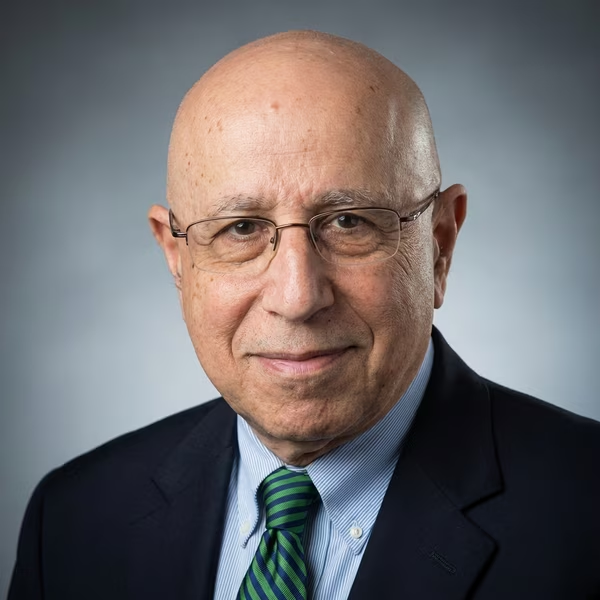
Through a post, the head of Iranian diplomacy considered Washington's recourse to military option as a reflection of its failure to achieve its political agenda through other means. He sent a firm message to foreign forces present in the region, calling on them to leave immediately to ensure their safety, recalling what he described as the tragic fate of invaders in the region's history.

For his part, US President Donald Trump defended the bombing decision, describing the American response as 'very strong' and commensurate with the scale of the targeting that the American helicopter was subjected to. Trump explained in media statements that the United States was forced to act to protect its military prestige and ensure that such incidents do not recur.

Trump had previously revealed that the US military had briefed him on the details of the advanced helicopter's downing, confirming the survival of the two pilots on board despite the complete destruction of the aircraft. The US President indicated that silence on the downing of the 'Apache' was not an option for the US administration under the current circumstances.

In the field context, the US Central Command 'CENTCOM' announced that military operations effectively began on Tuesday evening, Eastern US time. The military statement described these strikes as falling under the category of 'self-defense,' aiming to undermine Iranian capabilities that threaten navigation and international forces.

US military sources claimed that this operation represents a measured and appropriate response to what they described as 'unprovoked Iranian aggression' in international waters. CENTCOM did not disclose the precise list of targets hit by the bombing, merely stating that they targeted facilities linked to the recent attack.

Coinciding with these statements, media sources reported hearing violent explosions shaking wide areas in southern Iran, specifically in regions near the Strait of Hormuz. News focused on explosions occurring on Qeshm Island and in Sirik city, which caused a state of alert among Iranian civil defense forces.

Local news agencies confirmed that the echoes of the explosions reached the strategic city of Bandar Abbas, which includes vital facilities and important naval bases. A state of anxiety prevailed among local residents with the continued intensive air traffic in the skies of the maritime border region during night hours.

Cautious calm returned to the targeted areas hours after the bombing, as Iranian state television announced the end of the attacks and the return of life to normal in Qeshm and Jask. Despite this, authorities in Tehran have not yet issued any detailed statements regarding the extent of material losses or casualties resulting from the American strikes.

These field developments come at a very sensitive time, as Washington and Tehran are engaged in complex negotiations to end the state of war that erupted last February. These talks have been ongoing since the truce came into effect in April, amidst international hopes of reaching a formula that ends the armed conflict in the region.

Despite the recent military escalation, President Trump showed a degree of political optimism, indicating the possibility of reaching a comprehensive agreement with the Iranian side within a few days. Observers believe that military strikes may be a means of pressure and improving negotiation terms before the final sitting at the table.

These rapid events reflect the complexity of the Iranian-American file, where bullets intertwine with diplomacy in a hazy scene. While the front lines are ablaze with explosions, political channels remain open to try to contain the situation and prevent it from sliding into a comprehensive regional war.

Anticipation remains the master of the situation in the coming hours, awaiting the outcome of the counter-Iranian moves that Araqchi vowed. The international community is cautiously monitoring the extent of both parties' ability to exercise restraint and return to the negotiation path that Trump referred to in his recent statements.

Our mighty armed forces will not leave any attack or threat unanswered, and foreign forces must leave our region if they want safety.

ARAB AND WORLD

Tue 09 Jun 2026 8:47 pm - Jerusalem Time

Washington intercepts Iranian missiles over Israel amid conflicting success assessments

The regional arena witnessed rapid military developments following the Iranian missile attack targeting Israeli territory, with informed sources revealing the direct involvement of US forces in attempts to counter these missile barrages. Reports indicated that Washington used its defense systems in the region to launch interceptor missiles aimed at protecting Israeli airspace and reducing the damage caused by Iranian projectiles.

In statements quoted by international media, a US official confirmed that his country's forces had indeed launched interceptor missiles during the attack last Sunday. The official explained that this step came within the framework of the US commitment to Israel's security, noting that the military operations took place at a very sensitive time of direct confrontation between Tehran and Tel Aviv.


Despite confirmation of the intervention, a state of ambiguity still surrounds the actual results of these interceptions, as military circles in Washington are conducting precise and comprehensive assessments. These reviews aim to determine the accuracy of US interceptor missiles in hitting their targets, and whether they actually succeeded in neutralizing missile threats before they reached their ground targets.

There was a clear discrepancy in official accounts regarding the effectiveness of this intervention, as the US source previously indicated the possibility that no direct interception operation of Iranian missiles had succeeded. This denial contradicted statements issued by military officials in the Israeli occupation army, who spoke of a decisive and direct American role in shooting down a number of projectiles during the attack.

Intelligence estimates indicate that the process of determining 'what hit what' requires additional time due to the intensity of the attack and the multiplicity of defense systems involved in countering it. Washington seeks through these investigations to understand potential gaps in its defense systems and to develop its response to ballistic and cruise missile attacks that may recur in the future.

Incoming reports also confirmed that the United States did not limit itself to the recent intervention, but rather depleted large quantities of its stock of interceptor missiles in the region since the escalation began last February. This continuous logistical and military support aims to strengthen the Israeli defense system, which faces unprecedented pressures due to repeated attacks from multiple fronts.

On the diplomatic and joint military front, Israeli sources revealed the existence of high-level and continuous coordination with the US Central Command 'CENTCOM'. This coordination was evident in the intensive communications conducted by Israeli Chief of Staff Eyal Zamir with US military leaders to ensure the unification of defensive efforts and the exchange of real-time intelligence information.

Sources explained that Admiral Brad Cooper, commander of the US Central Command, was in constant contact with the Israeli side during the night hours that witnessed the Iranian attack. This communication aims to manage airspace in a way that prevents collisions between aircraft and interceptor missiles, and ensures maximum effectiveness in countering attacks coming from the east.

On the other hand, Israeli Prime Minister Benjamin Netanyahu announced a halt to poor Israeli attacks on Iranian targets for the time being. However, no official statement has been issued confirming a ceasefire agreement, leaving the door open for the possibility of renewed confrontation at any moment based on developments on the ground.

International circles are closely monitoring this close military coordination between Washington and Tel Aviv, due to its implications for the balance of power in the region. Observers believe that direct US intervention sends a clear deterrent message to Israel's adversaries, but at the same time places US forces in the direct line of targeting if the conflict expands.

Amid ongoing assessments, questions remain about the ability of joint defense systems to withstand large-scale and coordinated attacks. Technical and engineering teams are currently analyzing data extracted from radars and sensors to determine the trajectories of missiles that successfully penetrated the defensive envelope, and to ascertain the reasons for this partial failure.

In conclusion, the field scene remains prone to further escalation despite the cautious calm that followed the attack, as US and Israeli forces remain on high alert. These developments confirm that US involvement in defending Israel has gone beyond political and logistical support to actual combat participation in the air, which changes the traditional rules of engagement in the region.

Assessments are still ongoing within military and intelligence decision-making circles to determine what hit what in the aftermath of the mutual strikes.

ARAB AND WORLD

Tue 09 Jun 2026 8:46 pm - Jerusalem Time

US military helicopter crashes near Strait of Hormuz, crew rescued

A US Army helicopter crashed in an area near the strategic Strait of Hormuz, international press sources reported early Tuesday. Initial reports confirmed that rescue teams successfully evacuated and secured the military aircraft's crew without any human casualties.

The sources indicated that the true reasons behind the helicopter's crash in this sensitive area remain unclear, as no official statement has been issued specifying whether the incident resulted from a technical or mechanical malfunction affecting the aircraft, or if it was a direct targeting by Iranian fire amid ongoing tensions in the region.

International military circles are monitoring the repercussions of this incident, which comes at a sensitive time when the Strait of Hormuz is witnessing intense military movements. US authorities are expected to launch a comprehensive investigation to ascertain the circumstances of the incident and determine responsibilities.

It was not immediately clear whether the helicopter was shot down by Iranian fire or suffered a mechanical failure.