







Washington's Message
Washington – Said Arikat – 10/6/2026
News Analysis
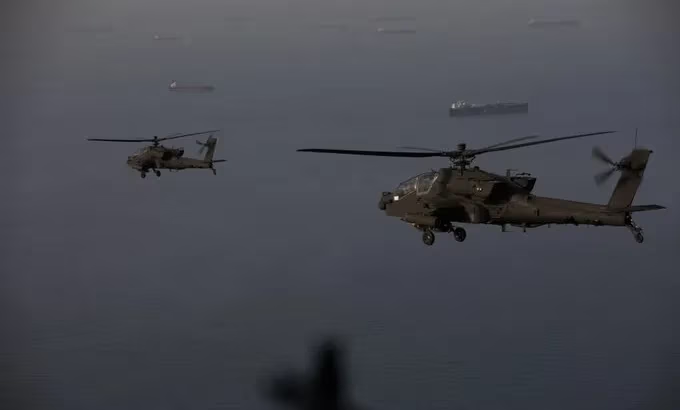
The confrontation between the United States and Iran has entered a more sensitive and dangerous phase after the downing of a US Apache helicopter over the Strait of Hormuz, followed by direct American strikes targeting Iranian air defense sites and radars, and an Iranian response with missiles and drones against American targets in the region. While the developments initially appeared to be just another episode of mutual military escalation, their political and strategic dimensions reveal deeper shifts related to the future of the conflict, the limits of Israeli influence within Washington, and the reliance on military force as a means to reshape regional balances.
US President Donald Trump quickly blamed Iran for downing the helicopter, confirming the pilots' survival, before ordering military strikes that the Pentagon described as “defensive and proportionate.” Trump affirmed that the response was strong and decisive, emphasizing that the United States cannot allow its forces to be targeted without a response. However, the incident, despite its military symbolism, also revealed the fragility of the security situation in one of the world's most sensitive maritime passages, through which a large percentage of global energy trade passes.
Although initial American investigations suggested the helicopter was subjected to hostile action linked to Iranian means, they did not definitively determine the nature of the incident or whether the targeting was intentional. In contrast, Tehran denied direct responsibility, indicating that the incident might be a result of the intense military tension in the region. However, the conflicting narratives did not prevent the crisis from quickly escalating to a phase of mutual strikes, turning the Strait of Hormuz from an arena of economic and strategic pressure into a direct military engagement zone between the two powers.
This escalation comes at a time when Trump faces a complex political and strategic dilemma. The US President, who built a large part of his political discourse on the promise of ending “endless wars,” finds himself compelled to resort to military force in the Middle East. While he consistently asserts that he does not want an all-out war with Iran, the facts on the ground are pushing his administration to take gradual military steps to maintain the prestige of American deterrence and protect forces deployed in the region.
However, the importance of the crisis is not limited to the American-Iranian dimension. Recent developments have once again highlighted the growing divergences between Washington and Benjamin Netanyahu's government regarding how to deal with Iran and the future of the region. While Israel pushes for tightening military pressure and expanding confrontation fronts, the US administration seems increasingly convinced that political solutions and verifiable and monitorable understandings might be less costly and more effective than engaging in open conflicts with no clear end.
This divergence becomes more significant as US officials continue to affirm that Washington's strategic goal remains to prevent Iran from acquiring nuclear weapons and to reach an understanding that ensures the security of international navigation and regional stability. Vice President J.D. Vance's statement, describing the ongoing agreement being negotiated with Iran as “a great achievement for the American people, whether Israel likes it or not,” reflected a growing trend within the US administration towards separating direct American interests from the political calculations of the Israeli government.
These positions reveal a significant decline in Netanyahu's ability to influence the course of American policy towards Iran compared to previous years. While successive Israeli governments were able at different stages to push Washington towards more hardline options, the current administration seems more inclined to manage the crisis within a ceiling that prevents sliding into a wide regional war. The disagreements that emerged over recent Israeli military operations in Lebanon and Syria have also reinforced the impression that Israeli influence within American decision-making circles is no longer absolute as it once was.
In contrast, the crisis has raised fundamental questions about the effectiveness of the Israeli security approach based on expanding the circle of military confrontations. Despite Israel's immense military superiority and continuous American support, Israel has not been able to achieve lasting stability or end sources of tension in the region. Instead, repeated wars and extended military operations from Gaza to Lebanon, Syria, and Iran have contributed to deepening regional crises rather than resolving them.
Critics of Israeli policies argue that the fundamental problem lies not in a lack of military power, but in the absence of a political solution to the roots of the conflict, and in the continued occupation, settlement expansion, and deprivation of the Palestinian people of their national and human rights. These policies, according to their critics, have not provided security for Israelis, nor have they granted Palestinians the minimum of justice or dignity, but rather have contributed to producing successive cycles of violence and instability.
In conclusion, the Hormuz crisis reveals that military force, no matter how superior, is no longer capable alone of imposing sustainable political outcomes. Iran has demonstrated its ability to maneuver and impose costs on its adversaries despite sanctions and pressures, while Washington has discovered that influence is not measured solely by the size of the military arsenal, but also by the ability to manage crises and forge settlements. As for Israel, which has long presented its military superiority as the primary guarantee of security, it finds itself facing a reality that confirms that true security is not achieved by force alone, but by addressing the political causes that keep the region captive to open conflicts.
The Hormuz crisis reveals that the American administration has begun to view regional stability from a perspective gradually differing from the vision promoted by the Netanyahu government. While Israel believes that increasing military pressure on Iran represents the shortest path to weakening it, Washington seems increasingly convinced that any widespread confrontation could threaten American economic and military interests in the Gulf and the world. From this, one can understand the American insistence on keeping negotiation channels open despite the exchange of strikes. The current disagreement is not only about tactics but reflects a growing divergence in the definition of interests and priorities between the two allies, a divergence that may deepen in the coming period.
Recent developments have also shown once again that Israeli and American military superiority has not succeeded in producing a stable regional security system; rather, excessive reliance on force has contributed to expanding and perpetuating crises. From Gaza to Lebanon, Syria, and Iran, military operations are repeated without being able to remove the political causes of conflicts. Moreover, the continued Israeli occupation of Palestinian territories, settlement expansion, and the deprivation of Palestinians of their national rights undermine any possibility of achieving lasting stability. Therefore, the current crisis appears to be additional evidence that true security cannot be based on military deterrence alone, but on political justice and sustainable settlements that address the roots of conflicts, not just their manifestations.
Share your opinion
Hormuz confrontation reveals limits of American deterrence and deepens rift with Israel over Iran