OPINIONS

Wed 18 Feb 2026 8:29 pm - Jerusalem Time

Keeping Palestinians in Place… and Out of the Equation

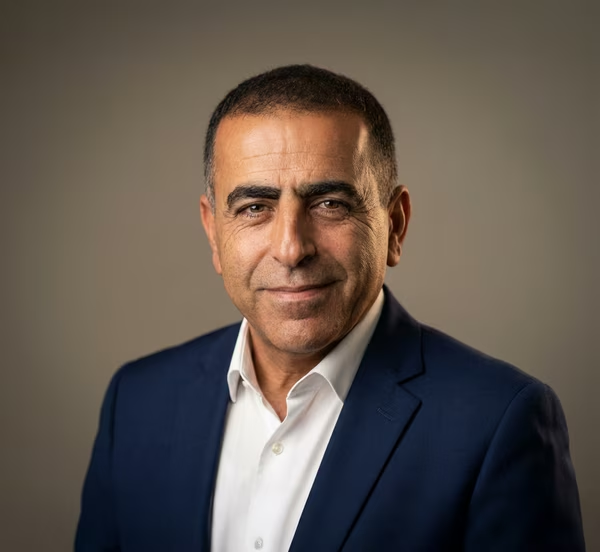
Dr. Ibrahim Nairat

Opinion Writer

When Ali Jarabawi distinguished between physical transfer and legal transfer, he was not looking for a new term as much as he was trying to read a profound transformation in the tools of the Palestinian-Israeli conflict. In 1948, the scene was clear and shocking: direct expulsion, mass uprooting, and a forceful reshaping of the demographic map. The goal then was to settle the conflict on the ground by reducing the Arab presence to the minimum possible.

But 1967 presented Israel with a different equation. The land expanded, but the population did not disappear. Suddenly, it found itself facing a large Palestinian human mass that could not be easily uprooted, not only for demographic reasons, but because the world had changed, and the cost of overt displacement became politically and morally higher. At this moment, the shift began: the question was no longer how to remove people from the land, but how to keep them in it without them owning it.

Thus, what can be called “legal transfer” was born. The Palestinian remains on his land, but he is separated from its keys. The borders are not in his hands, the resources are not in his hands, the airspace is not in his hands, the security decision is not in his hands. Daily life seems relatively normal—schools, markets, institutions—but sovereignty is absent. Control is no longer noisy as in scenes of mass expulsion, but has become quiet, organized, and legally framed.

In this model, there is no need for displacement trucks. A complex legal and administrative system is sufficient to rearrange the relationship between man and land, so that the body remains in place while the land is managed from outside. Control here is less confrontational with the international community, and seemingly less morally costly, but it is more entrenched in the long run.

And it seems that the current reality represents the culmination of this logic. Settlement expansion, reclassification of lands, strengthening control over strategic areas, and complicating the administrative structure in the West Bank and Jerusalem, all reflect one philosophy: consolidating control while keeping the population. The goal is no longer mass expulsion as in the mid-20th century, but creating a suffocating and oppressive environment that pushes towards “silent migration,” making the Palestinian presence fragile, limited in sovereignty, and restricted in potential.

At the heart of this transformation stands the Oslo station. When the Palestinian Authority was established, it was presented as a transitional step towards an independent state. But with the faltering political path, it gradually transformed into an entity that manages the population within a narrow ceiling of powers. The issue was no longer about liberating the land as much as it became about managing society under occupation.

Here, the most dangerous transformation occurred: the redefinition of responsibility.

Before the establishment of the Authority, as in the First Intifada, society moved on its own initiative. Popular committees managed daily life, and initiative came from the grassroots. No one waited for an official signal. After the establishment of the Authority, however, the question was repeated with every escalation: What will the Authority do? Not what will we do?

The existence of an official authority repositioned political action. Initiative shifted from society to the institution, and with it, the logic of confrontation changed. The Authority, by virtue of being an authority, prioritizes internal stability, preventing chaos, and maintaining public order. This is a logic of administration, not a logic of a liberation movement.

The paradox is that the Authority is popularly demanded to act, but it operates within arrangements that do not grant it control over land, borders, or resources. It is an authority without sovereignty. If it escalates, it risks its very structure. If it refrains, it is accused of inaction. In this gray area, the model of administration is entrenched instead of the model of liberation.

Thus, what resembles a “compromise” is formed on the ground: no independent Palestinian state, no single state with equal rights, but a continuation of Israeli control with limited Palestinian self-rule. A model that postpones resolution but does not cancel it, and manages the crisis instead of solving it.

This reality may provide short-term tactical gains for Israel, as it avoids major decisions related to withdrawal or granting full political rights. But it does not solve the structural contradiction at its core. Keeping an entire people without sovereignty, while continuing to control their land and resources, does not produce lasting stability, but rather reproduces the conflict in a new form.

The question is how can control over land be combined with depriving the population of sovereignty or equality? How long can this contradiction be managed without exploding again?

Unless a political horizon is opened that recognizes full rights—whether through two real states or one state with equal rights—the current formula will remain a temporary management of a deep historical crisis.

At the heart of this equation, Palestinian society faces a difficult test: Will it remain waiting within a tightly managed system, or will it redefine its position as an actor, not an object of control?

Perhaps here, specifically, lies the most important question for the next phase.
ARAB AND WORLD

Wed 18 Feb 2026 8:29 pm - Jerusalem Time

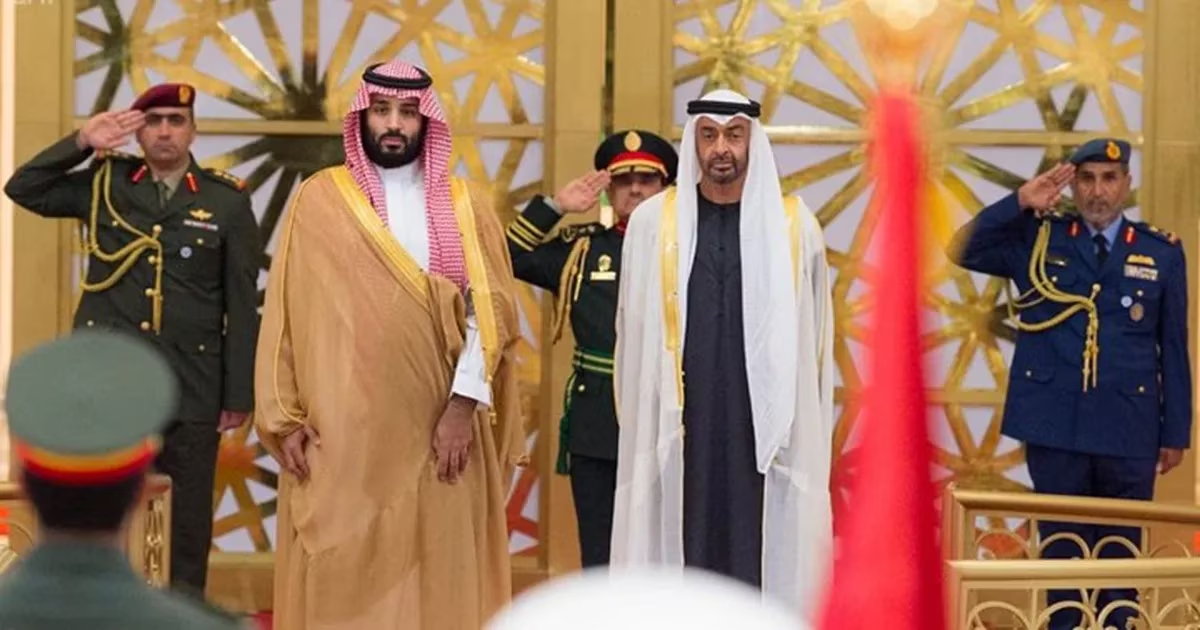
Economist: 'Cornerstone' Cracks - Saudi-UAE Dispute Threatens Dire Consequences for the Region

International press reports indicate that Saudi-Emirati relations are undergoing a period of escalating tension that has surpassed the usual diplomatic decorum between the two countries. Sources pointed out that the fraternal tone that once dominated official statements now starkly contradicts the reality on the ground, especially after indirect clashes occurred in thorny regional issues.

The Economist magazine stated that the main turning point began to clearly crystallize last December, when Riyadh accused Abu Dhabi of threatening its national security and bombed an Emirati arms shipment in Yemen. This covert military escalation reflected the depth of the dispute over influence in the Arabian Peninsula and the Horn of Africa, putting common interests at risk.

On the diplomatic front, it appears that direct communication channels between senior officials in the two countries have largely broken down, with effective dialogue ceasing and being replaced by sharp media rhetoric. According to sources, media platforms supported by both countries have been unleashed to launch mutual attacks, something unprecedented given the strict censorship usually imposed by Gulf capitals.

In Sudan, the dispute manifested in supporting the two sides of the armed conflict, with Saudi Arabia backing the Sudanese army, while the UAE is accused of providing financial and military support to the Rapid Support Forces. Riyadh views this intervention as a direct threat to the security of the Red Sea, which it considers a vital sphere of influence that cannot be divided between two competing parties.

As for the Yemeni file, the move by the UAE-backed Southern Transitional Council to seize territories belonging to Saudi-backed forces led to an escalation of the situation on the ground. Saudi pressure forced the Transitional Council to retreat, a step observers considered an attempt to reduce Emirati influence in the southern and eastern governorates of Yemen.

Economically, companies operating in the region have begun to feel the brunt of this dispute through newly introduced bureaucratic obstacles and delays in granting work visas to employees of companies based in the UAE. Diplomatic sources also reported the detention of commercial trucks at land borders, indicating the use of the economic card as a tool for political pressure.

Figures indicate that the volume of trade between the two countries reaches $31 billion annually, making any economic rupture a costly gamble for both sides. However, the competition to attract foreign investment and Riyadh's transformation into a regional business hub has intensified tensions with Dubai, which dominated this role for decades.

In the context of sovereign comparisons, the divergence in visions regarding political Islam and dealing with separatist forces in the region stands out, with Abu Dhabi tending towards completely eradicating Islamist movements. In contrast, Riyadh shows greater flexibility in accommodating some Islamist groups within its political balances, which irritates the Emirati side.

The dispute also extends to the stance on the Israeli occupation, where the UAE pursued full normalization in 2020, while Saudi Arabia still sets conditions related to Palestinian rights. This divergence in managing sensitive issues has led to the emergence of a 'clash of narratives' in which each party accuses the other of being beholden to external interests or falling under the influence of pressure groups.

Despite analysts ruling out a comprehensive blockade similar to what happened with Qatar in 2017, concern prevails in diplomatic circles over the continuation of a 'no peace, no war' situation. Experts believe that deep-rooted economic ties may prevent a complete collapse, but they will not prevent the continuation of fierce competition in international arenas.

In a notable development, Qatar, which was previously the target of a blockade, began to play a mediating role to bridge the views between Riyadh and Abu Dhabi. The Emir of Qatar held intensive meetings this February, including with the Saudi Minister of Defense and the President of the UAE, in an attempt to defuse the crisis before it is too late.

Other countries such as Egypt, Bahrain, and Turkey are participating in quiet diplomatic efforts to contain the situation, given the importance of Gulf stability for Arab national security. However, reports confirm that these efforts have not achieved tangible progress so far, given each party's adherence to its strategic positions in regional conflict files.

Observers believe that the UAE, which possesses an efficient army and a diversified economy, no longer wishes to play the role of 'junior partner' in Saudi foreign policy. This shift in Emirati political identity clashes with the new Saudi vision that seeks to consolidate its absolute leadership of the Arab and Gulf region.

In conclusion, the question remains about the extent to which the two countries can separate legitimate economic competition from political confrontation that could burn everything in already volatile issues. The continuation of this dispute could lead to a redraw of the map of alliances in the Middle East, serving other regional powers that are closely monitoring the scene.

The dispute between the two countries, like any rivalry in the Gulf, is a mix of the personal and the political, and has now turned into an open clash of narratives.

PALESTINE

Wed 18 Feb 2026 8:19 pm - Jerusalem Time

Annexation and Displacement Plans: Ministers in the Occupation Government Announce Intention to Cancel Oslo and Extend Sovereignty

Israeli Energy Minister Eli Cohen announced that the government is moving forward with actual measures to extend what he described as 'Israeli sovereignty' over the occupied West Bank territories. Cohen, in statements reported by media sources, considered this step a restoration of what he called 'the legacy of the fathers,' a clear reference to the occupation's intention to legitimize settlements and establish permanent control over the occupied territories.

For his part, Finance Minister Bezalel Smotrich revealed the features of the government's next phase, emphasizing that it will work intensively to cancel the Oslo Accords signed with the Palestinian side. Smotrich stressed during a party conference that the strategic goal is to definitively prevent the establishment of a Palestinian state and to impose full Israeli law on all occupied Palestinian territories without exception.

Smotrich's political vision included explicit calls for what he described as 'voluntary emigration' of Palestinians from the West Bank and Gaza Strip, considering this path the only solution to end the conflict. These statements come at a time when international warnings are escalating regarding the occupation's attempts to change the demographic and legal reality in the occupied territories through veiled forced displacement policies.

Regarding field control, the Finance Minister clarified that plans to expand settlements will not be limited to the West Bank but will also include the Negev and Galilee regions to strengthen the Jewish presence. This approach aims to integrate urban and rural settlements and develop the agricultural sector in those areas, to ensure a demographic superiority that serves long-term Israeli national goals.

Last week witnessed serious legal moves, as the Ministerial Committee for National Security decided to begin the process of registering land in the West Bank for the first time since 1967. This decision paves the way for converting vast areas of Palestinian land into 'state land,' which facilitates their sale to settlers or their allocation for military and security purposes belonging to the occupation.

Media sources confirmed that the land registration project grants the Israeli government broad powers to officially transfer land ownership to the army, security agencies, and settlers. Smotrich considered this legal step aimed at thwarting any unilateral international or Palestinian moves, while Defense Minister Yisrael Katz described it as a fundamental pillar for strengthening Israeli control.

On the Gaza Strip front, Smotrich renewed his extremist calls for the necessity of fully re-occupying the Strip and forming a military government to manage its civil and security affairs. His proposed plan includes establishing new settlement outposts within Gaza, in parallel with continued pressure to encourage residents to leave the Strip under the weight of difficult living and security conditions.

In contrast, these plans faced sharp criticism from opposition leader Yair Lapid, who described Smotrich's vision as an 'illusion' that deviates from the field and political reality. Lapid pointed to major security challenges in Gaza, warning that sliding towards direct military administration would cost Israel exorbitant prices it cannot bear in the long run.

Lapid drew attention to the fact that the current reality in Gaza indicates a role for the Palestinian Authority, especially at the Rafah crossing where officially affiliated employees are present. He clarified that the passports of arrivals and departures are stamped with Palestinian Authority stamps, which refutes the claims of the far-right about the ability to erase the official Palestinian presence from the scene.

These rapid developments come amid categorical Palestinian rejection and widespread Arab and international condemnation, as these steps are considered a blatant violation of international law and United Nations resolutions. Observers warn that the implementation of these plans will ignite the situation in the entire region and eliminate any remaining opportunities for achieving a just political settlement.

Canceling the Oslo Accords is part of a governmental vision to impose full sovereignty and reorder control over the Palestinian territories.

PALESTINE

Wed 18 Feb 2026 8:19 pm - Jerusalem Time

Occupation confirms confiscation of 14 archaeological sites in Sebastia and continues demolition operations in the West Bank

The Israeli occupation authorities issued an official decision to confirm the confiscation of 14 archaeological sites in the town of Sebastia, located north of the occupied West Bank. This measure aims to transform these historical lands into what is called 'state land,' in preparation for extending full Israeli sovereignty over them and permanently preventing Palestinian citizens from accessing them.

This step comes within the framework of a broader plan by the occupation government aimed at seizing vast areas of West Bank land under flimsy legal and historical pretexts. This policy, which relies on registering lands as 'state land,' represents a strategic shift in dealing with Palestinian archaeological areas since the 1967 occupation.

Field sources reported that the town of Sebastia is subjected to a fierce settlement attack, with dozens of buses carrying settlers and foreign visitors flowing daily to the archaeological sites under the protection of the occupation army. These systematic incursions aim to entrench the settlement presence and confiscate the historical rights of Palestinians to their land and cultural landmarks.

Residents of the town were shocked in August of last year by a decision to convert about 1775 dunams, which is equivalent to one-third of the town's area, into a 'national park.' The occupation authorities base these confiscations on biblical claims that the area was the capital of an ancient kingdom, in an attempt to legitimize control over Palestinian cultural heritage.

In parallel with the confiscation decisions, the occupation army escalated its military operations in various governorates of the West Bank, where bulldozers carried out demolition operations of citizens' homes in the city of Hebron. Demolition operations began in the early morning hours, displacing Palestinian families amid the continuation of the policy of collective punishment and the destruction of infrastructure.

In the northern West Bank, occupation forces imposed a tight siege on a number of villages and towns located south of Nablus city, including the town of Aqraba, which suffers from repeated attacks. These areas are subjected to continuous night raids and home invasions, interspersed with physical assaults and field interrogations with local residents with the aim of intimidating them.

Regarding arrests, the Palestinian Prisoners' Club revealed shocking figures reflecting the scale of Israeli escalation, with over 9,000 Palestinians documented as arrested since the beginning of 2025. The total number of detainees since October 7, 2023, has risen to over 23,000 arrests, including all segments of Palestinian society.

For his part, the spokesperson for the UN Secretary-General, Stéphane Dujarric, criticized the recent Israeli moves aimed at imposing sovereignty over West Bank lands. He affirmed in press statements that these decisions lack any legal legitimacy and constitute a blatant violation of international law and relevant UN resolutions concerning Palestinian rights.

Observers believe that these accelerating policies of land confiscation and home demolitions aim to create a new geographical and demographic reality that prevents the establishment of a contiguous Palestinian state. Through these repressive measures, the occupation seeks to empty areas classified as 'archaeological' or 'vital' of their original inhabitants and replace them with settlers permanently.

The decisions taken by the Israeli government regarding imposing its authority over lands in the West Bank are illegal and contrary to international law.

PALESTINE

Wed 18 Feb 2026 8:18 pm - Jerusalem Time

Military escalation by the occupation in Gaza as the first day of Ramadan arrives

The first signs of the blessed month of Ramadan in the Gaza Strip began amidst a new field escalation, as occupation forces continued their violations of the existing truce agreement. Field sources reported that occupation vehicles carried out a series of attacks, ranging from concentrated artillery shelling to intense gunfire, disrupting the Ramadan atmosphere in the targeted areas and increasing the state of security tension.

In detail of the field developments, the occupation artillery directly targeted the eastern areas of the Al-Bureij refugee camp in the central Strip, causing panic among the displaced and residents. Concurrently, military vehicles stationed on the borders renewed their machine-gun fire towards the eastern neighborhoods of Khan Yunis city to the south, while local sources monitored sniper operations targeting the movements of citizens in the eastern outskirts of Gaza City.

The aggression did not stop there but extended to the city of Rafah, in the far south of the Strip, where occupation vehicles opened fire near the strategic 'Morag' axis. Border areas in Khan Yunis also came under continuous barrages of fire launched from the sand berms behind which the occupation forces are stationed, reflecting a determination to disrupt any state of field stability at the beginning of the holy month.

These field attacks come as a continuation of a bloody day witnessed by the Strip yesterday, Tuesday, which resulted in the martyrdom of a child and the injury of three other citizens, including an elderly man, due to scattered targeting. These data confirm the exacerbation of the humanitarian suffering of the Strip's residents who face harsh conditions, where the pain of loss and siege is mixed with the sanctity of fasting days under the weight of continuous military threats.

Occupation forces continued their violations of the truce agreement in the Gaza Strip through a series of attacks that included gunfire and artillery shelling.

PALESTINE

Wed 18 Feb 2026 8:17 pm - Jerusalem Time

International Rejection of the "Peace Council": Mexico and Spain Reject Trump's Attempts to Hijack the Palestinian Cause

Said Erikat

Opinion Writer

Washington – Saeed Erikat – 2/18/2026

In a striking diplomatic scene, the "Peace Council" launched by US President Donald Trump's administration is facing unprecedented international embarrassment after Mexico officially refused to join it, aligning with a firm Spanish stance. This rejection stems from the deliberate exclusion of the Palestinian Authority from the negotiation table.

At her press conference on Monday morning, Mexican President Claudia Sheinbaum unequivocally announced her rejection of the American invitation, emphasizing that the fundamental flaw lies in the absence of the Palestinian side. Sheinbaum stated: "Since we recognize Palestine as a state, it is extremely important for both Israel and Palestine to participate. But the meeting was not planned on that basis." This position was not isolated, as Spanish Prime Minister Pedro Sánchez had previously expressed a similar rejection, stressing that the council operates "outside the framework of the United Nations" and excludes the Palestinian Authority, which Madrid considers the sole legitimate partner for peace.

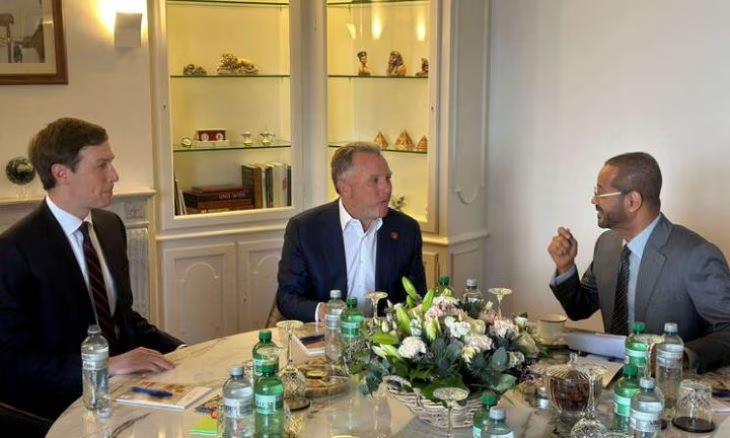
Notably, Mexico did not merely reject the invitation but chose the role of an observer, allowing it to monitor developments without granting legitimacy to the council's decisions. It thus joins a growing list of European and established countries such as France, Germany, Greece, and New Zealand, all of whom have expressed reservations about the council's broad powers and its attempt to circumvent international legitimacy. It appears that Trump's attempt to create a parallel entity to the United Nations, concentrating power in his hands and those of his "son-in-law Jared Kushner" to reconstruct Gaza according to a purely real estate vision, has collided with the wall of defending international law and the right of Palestinians to represent themselves.

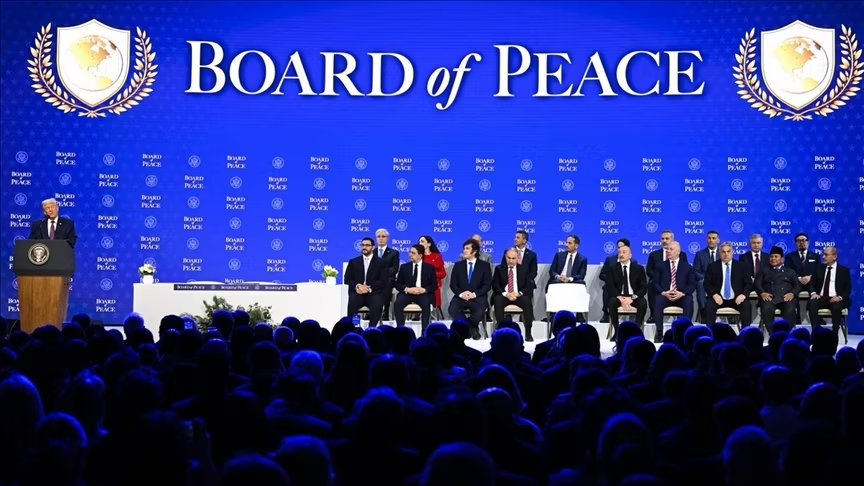
The "Peace Council," chaired by Trump, is scheduled to meet in Washington on Thursday morning, February 19, 2026.

Experts believe that what Donald Trump is doing through the so-called "Peace Council" is nothing more than a crude attempt to hijack the Palestinian cause and exploit it in a real estate deal under the guise of reconstruction. By completely excluding Palestinians, including the Palestinian Authority (which the United States supports), the American president proves that he is not seeking a just peace, but rather imposing a new guardianship that entrenches the reality of occupation and nullifies the role of the international community represented by the United Nations.

The rejection by both Mexico and Spain is not just a fleeting diplomatic stance; it is a slap to attempts to marginalize international law. Furthermore, the attempt to make peace a "privilege" that Washington distributes according to its narrow interests, rather than a "right" for the Palestinian people, is considered the real reason behind the failure of all previous initiatives. This new council will remain merely a faded facade of hegemony unless the true owners of the land are involved.

Experts also believe that while Trump thinks he can buy loyalties with billions of dollars for Gaza's reconstruction, Mexico, under Sheinbaum's leadership, proves that political principles are more valuable than any suspicious funding. The council requires huge donations of up to one billion dollars for permanent membership, as if the cause of an entire people can be subjected to public auction. Mexico's choice of an observer role is a clever message: "We are for peace, but not at the expense of Palestinian rights."

A Latin American diplomat told Al-Quds newspaper's correspondent in Washington that: "This position restores credibility to independent Latin American diplomacy and serves as a model for countries that want to maintain their international relations without becoming a tool in the game of axes." The diplomat, who requested anonymity and not to mention the country he represents, added: "While Trump bets on money, Mexico bets on reason and justice, and there is a vast difference between the two bets."

PALESTINE

Wed 18 Feb 2026 8:17 pm - Jerusalem Time

Pakistan conditions its participation in Gaza force on US guarantees and rejects disarming the resistance

Informed government sources reported that Pakistan is seeking explicit guarantees from the United States of America regarding the nature of the tasks assigned to its forces potentially to be sent to the Gaza Strip. These moves come within the framework of international arrangements to establish a stabilization force, with Islamabad emphasizing that its role should be limited to maintaining peace and security without engaging in direct confrontations.

Pakistani Prime Minister Shehbaz Sharif is scheduled to travel to Washington D.C. tomorrow, Thursday, to participate in the first official meeting of the Peace Council launched by US President Donald Trump. This meeting will be attended by high-level delegations from at least 20 countries to discuss security and political arrangements for the next phase in the Palestinian territories.

Expectations indicate that President Trump will announce during the meeting a massive plan for the reconstruction of the Gaza Strip, estimated at billions of dollars, in parallel with providing technical details about the international stabilization force. This force will operate under a United Nations mandate and aims to secure the Strip during the transitional period following the cessation of military operations.

Sources close to the Pakistani Prime Minister's office reported that Sharif wishes to clarify the strategic objectives of the stabilization force and the entity to which it will be administratively subordinate before making a final decision. The Pakistani government also attaches great importance to knowing the field chain of command to ensure that the mission does not deviate from its agreed humanitarian and security path.

Sources confirmed that the Pakistani position is firm in rejecting any role related to disarming the Islamic Resistance Movement (Hamas), considering it a red line that cannot be crossed. One official explained that the Pakistani army is ready to contribute thousands of soldiers to traditional peacekeeping missions, but it will not be a party to any internal conflict or disarmament operations.

Trump's 20-point plan relies primarily on forming a security force from major Islamic countries to oversee economic recovery and reconstruction operations. Washington sees Pakistan's joining as a qualitative addition given its army's long experience in dealing with complex conflicts and counter-insurgency operations in difficult geographical areas.

On the diplomatic front, leaked documents revealed that the European Union has already opened communication channels with the transitional governance structures recently formed in the Gaza Strip. The European bloc is considering providing financial and technical support to the National Committee for the Administration of Gaza, which began its actual work in mid-January to manage civil affairs.

A document issued by the European External Action Service showed that EU foreign ministers will hold a crucial meeting in Brussels on February 23 to discuss the situation on the ground. The meeting aims to formulate a unified European position on mechanisms for supporting stability in the Strip and determining the extent of contributions to urgent development projects.

Although most European governments preferred not to officially join the Washington-led Peace Council, they decided to send representatives as observers to ensure coordination. The European Commissioner for the Mediterranean, Dubravka Šuica, will attend the Washington meeting to follow the details of the American peace plan and ensure its compatibility with the European vision for a solution.

The European Union affirmed in its internal correspondence that full non-membership in the Peace Council does not mean abandoning the commitment to the success of comprehensive de-escalation efforts in the region. Brussels seeks to maintain its role as a key player in providing humanitarian aid and supporting Palestinian civil institutions away from sharp political tensions.

In the context of technical support, the European Union Police Support Mission intends to contribute to the qualification of Palestinian security and civilian personnel and provide them with the necessary equipment. These efforts will focus on building criminal justice institutions and training civilian police to ensure the rule of law and protect public and private property during the reconstruction period.

We are ready to send troops, but they can only be part of a peace mission; we will not participate in disarming Hamas, as this is out of the question.

PALESTINE

Wed 18 Feb 2026 8:16 pm - Jerusalem Time

American plan to recruit 'criminal gangs' and armed militias to manage security in Gaza

International press sources have revealed tendencies within the administration of US President Donald Trump to rely on organized crime gangs and drug smuggling networks to form the nucleus of new police forces in the Gaza Strip. These plans come amidst American efforts to find a security alternative to the Hamas movement, with warnings from military leaders and Western allies about the danger of this step and its repercussions on stability.

Reports indicate that Israel directly supports these proposals, having already armed and supported some factions and armed militias since the outbreak of confrontations in October 2023. These groups are formed based on family and tribal ties, but their long record of organized crime raises deep concerns among Palestinian civilians who do not trust these formations.

Field reports have documented these militias' involvement in widespread looting of humanitarian aid trucks in recent months, in addition to committing murders and kidnappings. What adds to the gravity of the scene is the presence of elements within these groups who previously declared their allegiance to the Islamic State organization or fought in its ranks in neighboring conflict zones.

Senior military leaders in the United States, along with officials from Britain and France, have expressed grave concern about the proposed peace plan faltering due to the absence of reliable security partners on the ground. They believe that relying on criminal elements will lead to the collapse of any attempt to establish stability, and will turn the Strip into an arena of permanent chaos under the supervision of illegitimate forces.

In a related context, Jared Kushner, President Trump's son-in-law, emerged as a pivotal figure in drafting the 20-point peace plan, which includes the establishment of temporary residential clusters called 'safe zones'. This plan aims to isolate Palestinian residents in areas controlled by the Israeli army and its loyal militias, away from the influence of resisting Palestinian factions.

The first of these residential clusters is currently being built on the ruins of the former city of Rafah, an area under the influence of the Israeli-backed 'Popular Forces' militia. This group faces explicit accusations of drug smuggling and control over vital resources, which puts residents before difficult choices between displacement or submission to gang authority.

Kushner is working in coordination with Aryeh Lightstone, an official at the Abraham Accords Institute, who is managing the planning for Gaza's future from a Tel Aviv hotel. Billionaire investors aspiring to invest in the sector after the war are participating in these discussions, which has led some sources to describe this group as the 'Hilton Club' that adopts an ideological vision far from the reality on the ground.

Western officials question the feasibility of this approach, asserting that attempting to impose unpopular family militias will not succeed in gaining the trust of the Palestinian street. Observers believe that residents view these groups as tools in the hands of the occupation, and that attempting to replace an existing authority with criminal gangs will lead to a renewed and more violent explosion of the situation.

Concerns are growing that the US administration will use the residents' rejection of these militias as a pretext for continued military operations, under the guise of 'cleansing' areas of those sympathetic to the resistance. This approach could give Israel a permanent green light to reignite the war at any time, under the pretext of the Palestinians' failure to seize the opportunity for 'liberation' offered by the American plan.

Despite the ambiguity surrounding the names of the militias nominated to carry out security tasks, the White House has not denied these reports. Names such as 'Dughmush family' and 'Jaysh al-Islam' emerge as parties suspected of links to extremist organizations and previous international kidnapping operations, which raises major question marks about the security standards applied in vetting.

In the search for field leaders, political circles circulated the name of Jamal Abu Hassan, the former security official in the Palestinian Authority, to lead the new police force. Figures such as Hussam Al-Astal also appeared, who explicitly announced his coordination with the Israeli side and his readiness to participate in the administration of Gaza in the post-war phase, based on his previous security background.

The US administration is currently trying to rally international support to fund these forces, with Trump announcing pledges of $5 billion for reconstruction and the formation of an international stabilization force. This international force is supposed to operate under the umbrella of the United Nations to coordinate with the Israeli army, while local militias take on repressive and security tasks within residential neighborhoods.

However, reality indicates that these plans face significant financial and legal obstacles, as well as widespread popular and political rejection. The international community fears that funding militias involved in crimes will lead to international legal prosecutions, especially with the documentation of these groups' violations against unarmed civilians during the current war.

In conclusion, it seems that Gaza's security future is teetering between the hammer of occupation and the anvil of armed gangs that Washington seeks to legitimize. With no horizon for a comprehensive national political solution that includes all Palestinian components, these proposals remain mere attempts to impose a fragile security reality based on 'the power of arms and crime' instead of legitimacy and law.

A number of senior American military leaders have expressed concern that the peace process proposed by Donald Trump will not succeed without reliable security partners.

PALESTINE

Wed 18 Feb 2026 8:16 pm - Jerusalem Time

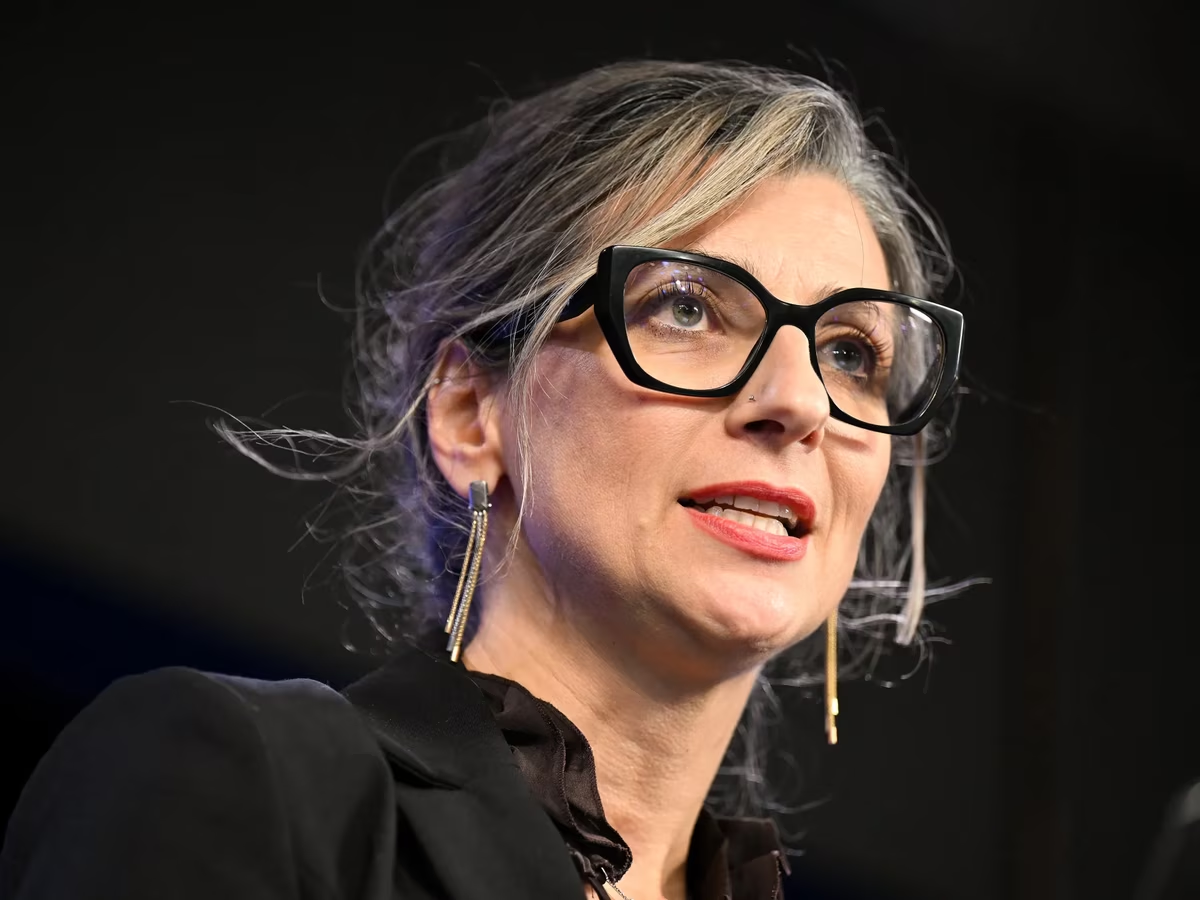
150 International Figures Accuse French Foreign Ministry of 'Misinformation' Against UN Rapporteur Albanese

More than 150 prominent international figures, including former ministers and diplomats, have directly accused French Foreign Minister Jean-Noël Barrot of systematic 'misinformation'. This comes after the French minister called for the resignation of the UN Special Rapporteur for the Occupied Palestinian Territories, Francesca Albanese, from her position based on statements inaccurately and distortedly attributed to her.

The roots of the crisis trace back to actions by French presidential camp deputies on February 10, who demanded the withdrawal of Albanese's UN mandate, claiming she classified Israel as a 'common enemy of humanity'. The Foreign Minister adopted this stance the following day, describing her statements as 'outrageous and reprehensible' and containing justification for the events of October 7 and unacceptable analogies.

In an open letter issued today, Wednesday, the signatories, representing several countries such as the Netherlands, Greece, Denmark, and Argentina, refuted the official French claims. The international figures affirmed that Albanese never described Israel as an enemy of humanity, but rather that the attack on her aims to tarnish her reputation and obstruct her human rights work in documenting violations in the occupied territories.

The signatories emphasized that the UN Rapporteur was recalling a fundamental principle of international law, which is the necessity of accountability for grave crimes that are not subject to political whims. The letter called on the French Foreign Ministry to retract its position and correct the false information it publicly promoted against the UN official, to preserve the credibility of French diplomacy.

For her part, Francesca Albanese strongly responded to these accusations, describing them as 'completely false and distorted'. She clarified in media statements that her previous remarks were taken out of context, as she was referring to the system that allows the continuation of genocide and apartheid without accountability, considering the absence of justice as the true enemy of the international community.

Sources indicated that Albanese had previously spoken at a forum about the existence of a 'common enemy' represented by international silence and the military and financial support that fuels crimes in Gaza. She affirmed that most countries in the world have, in one way or another, contributed to facilitating these violations by providing political and logistical cover for Israel, which necessitates a comprehensive legal and ethical review.

In a clarifying interview, the UN Rapporteur reiterated that she did not target the state of Israel as an entity with the description 'common enemy', but rather condemned the international system that grants impunity to perpetrators of crimes. She considered that attempts to silence her through distortion would not deter her from performing her duty to highlight the suffering of Palestinians and demand the application of international law to all without exception.

Accountability for grave violations of international law is a legal obligation, not a political option, and the accusations against me are false and distorted.

PALESTINE

Wed 18 Feb 2026 8:16 pm - Jerusalem Time

Single indictment against an Israeli soldier for looting in Gaza despite documentation of hundreds of violations

Hebrew media sources revealed official data issued by the Israeli occupation army, indicating that only one criminal indictment has been filed against a soldier for looting Palestinian property during the ongoing genocide war in the Gaza Strip. This single legal action comes amidst widespread human rights reports and videos documenting systematic theft and vandalism carried out by occupation forces against Palestinian civilian property.

Sources clarified that the aforementioned indictment resulted from a 'plea bargain' concluded with a reserve soldier, where the military court sentenced him to only 60 days in prison, in addition to 30 days of community military service. This sentence is considered extremely lenient and disproportionate to the scale of documented crimes, which showed soldiers boasting about seizing private belongings from citizens' homes in Gaza and Lebanon.

Reports confirmed that this isolated case represents only 'the tip of the iceberg' of violations committed by ground units during military operations, as hundreds of reports and documentations have not resulted in any actual punitive measures against those involved. This judicial behavior indicates a policy of turning a blind eye adopted by the occupation army towards crimes committed against Palestinian property, which encourages soldiers to continue looting and destruction without legal deterrence.

These developments come after the prisoner exchange agreement and ceasefire came into effect on October 10th, following a bloody two-year genocide war. This war left a catastrophic toll of victims exceeding 72,000 martyrs and 171,000 injured, in addition to widespread destruction affecting most residential neighborhoods and vital facilities in the besieged strip, making life there almost impossible.

Regarding material losses, international estimates indicate that the Israeli aggression caused the destruction of approximately 90% of civilian infrastructure in the Gaza Strip, including hospitals, schools, and water and electricity networks. The United Nations estimated the total cost of rebuilding what the war machine destroyed at about $70 billion, amidst an unprecedented humanitarian and economic crisis experienced by the residents of the strip.

This case represents only the tip of the iceberg in light of videos showing soldiers vandalizing and looting Palestinian property.

PALESTINE

Wed 18 Feb 2026 8:16 pm - Jerusalem Time

Storm of anger at the Berlin Film Festival due to attempts to marginalize the Palestinian issue

The corridors of the Berlin International Film Festival witnessed a massive wave of anger and protests, following attempts by the administration to impose restrictions on political expression and marginalize discussions related to the genocidal war waged by the Israeli occupation in the Gaza Strip. International artists and directors expressed their dissatisfaction with these trends, which they considered an attempt to tame art and isolate it from the bitter human reality.

American director and artist Mark Ruffalo mocked these restrictions, confirming in a post on the 'X' platform that attempting to make politics a forbidden topic at this particular time is reprehensible. Ruffalo added that artists feel an urgent need to express their positions to remind the world of their creative identity linked to issues of justice.

Tension escalated with more than 80 current and former festival participants signing an open letter, in which they directed scathing criticism at the administration for its complete silence regarding the crimes committed in Gaza. The signatories demanded that the festival take a clear moral stance consistent with its history of supporting humanitarian causes.

Statements by the head of the jury, Wim Wenders, ignited the anger after he called on filmmakers to stay away from politics and focus only on artistic aspects. Participants considered this call a retreat from cinema's pioneering role in shedding light on human tragedies and international violations.

In a prominent protest step, the famous Indian writer Arundhati Roy announced her withdrawal from the festival's activities, expressing her rejection of the policy of silencing voices. Prominent cultural figures accused the festival administration of direct censorship of artists who tried to convey the voice of the victims in Palestine.

The signatories of the protest letter, including Palestinian artist Saleh Bakri and director Mike Leigh, affirmed that the separation between cinema and politics is an illusion that cannot be achieved in an interconnected world. They stressed that art derives its value from its ability to confront injustice and stand by the oppressed everywhere.

The letter pointed to a widespread movement within the global film industry, where more than 5,000 film professionals, including Hollywood stars, refuse to cooperate with complicit Israeli institutions. This number reflects the extent of isolation that cultural circles have begun to impose on entities supporting the occupation.

Artists criticized the blatant contradiction in the positions of the Berlin Festival, which had previously issued strong and clear solidarity statements regarding other international crises such as the war in Ukraine. They considered that ignoring the Palestinian tragedy represents a double standard in the moral principles that the festival claims to adhere to.

The open letter called on the festival administration to fulfill its moral duty by clearly stating its opposition to the genocide and crimes against humanity committed by the occupation army. It also demanded an end to all forms of protection that the festival provides to Israel from international criticism and demands for legal accountability.

Among the signatories were prominent names in the world of cinema such as Tatiana Maslany, Peter Mullan, and Tobias Menzies, in addition to directors Lukas Dhont and Nan Goldin. This diversity of names reflects an international consensus among creators on the need to break the barrier of silence regarding what is happening in the occupied Palestinian territories.

Media sources reported that the festival has turned into a kind of 'media capital' for protests, as the administration's attempts to contain the escalating anger have failed. Political discussions have imposed themselves in every seminar and film screening, challenging the official desire to neutralize art from current issues.

Observers believe that this crisis puts the Berlin Festival to a real test of its credibility as a global platform that supports freedom of expression. The demands are no longer limited to symbolic solidarity, but extend to the need to take concrete measures to end involvement in polishing the image of the occupation through cultural forums.

Artists concluded their letter by emphasizing that cinema will remain a tool for resistance and revealing facts, no matter how great the pressures of censorship. They stressed that history will record the positions of cultural institutions at this critical moment, either aligning with human values or accepting subservience to narrow political agendas.

It is somewhat strange that talking about politics suddenly becomes a forbidden topic at the Berlin Film Festival, especially at this moment when everyone wishes to remind the world that they are artists.

ISRAELI AFFAIRS

Wed 18 Feb 2026 8:16 pm - Jerusalem Time

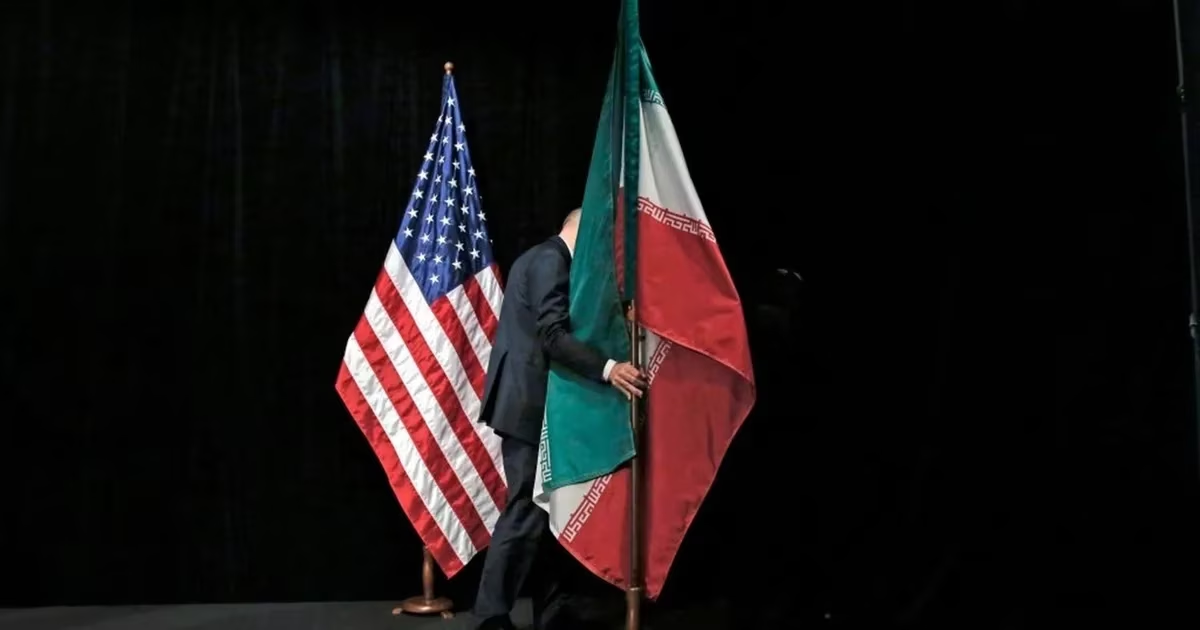
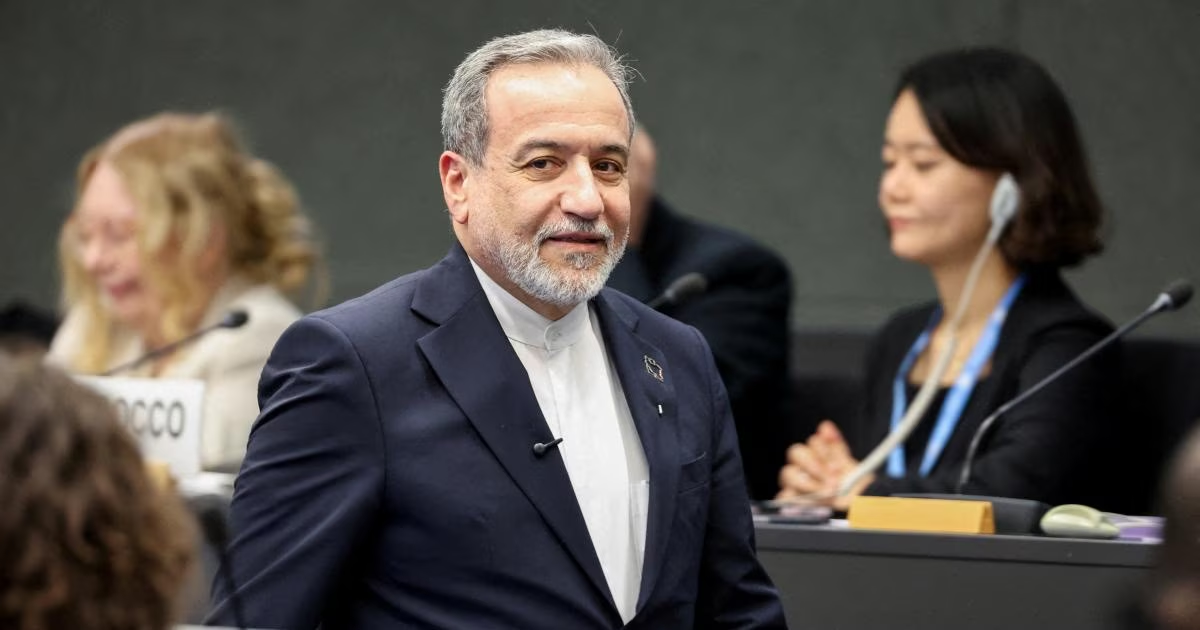
Hebrew analyses warn of Tehran's cunning in Geneva negotiations and anticipate escalation in the West Bank

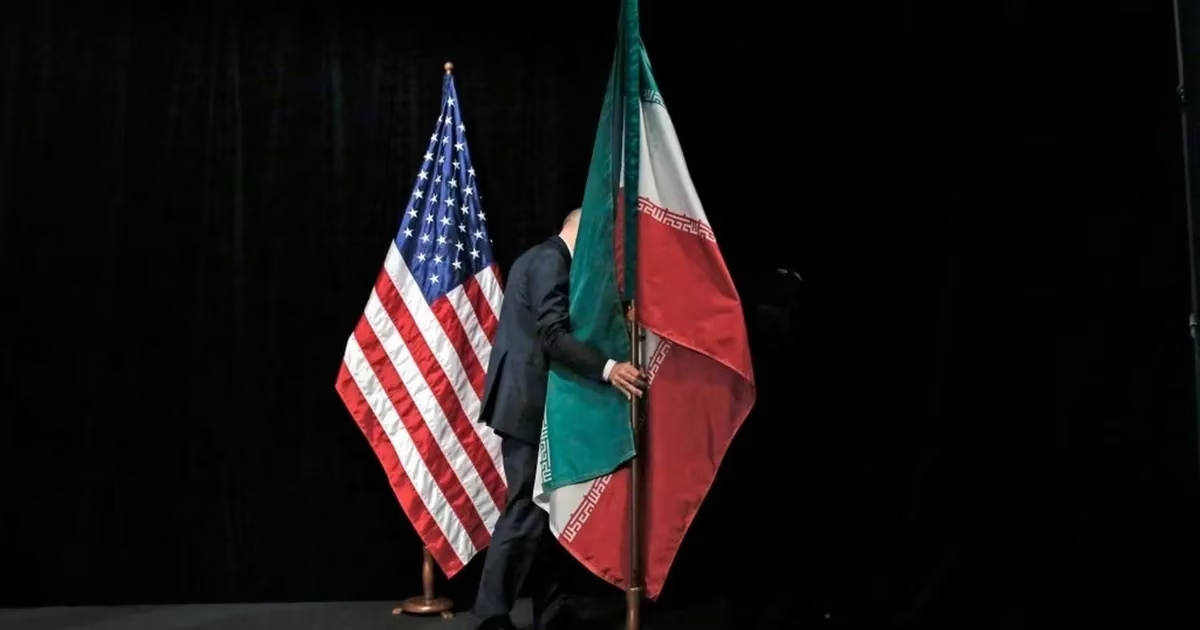
Hebrew media reports indicate that the current situation between the United States and Iran is characterized by escalating tension despite ongoing diplomatic channels, with Ma'ariv newspaper warning against excessive optimism regarding the outcomes of the Geneva talks. Sources pointed out that military history proves that wars often erupt as a result of escalating mutual threats, even in the presence of announced negotiations between conflicting parties.

Israeli interpretation of the situation suggests that Tehran is pursuing a strategy of buying time and demonstrating political cunning, exploiting negotiations to strengthen its symbolic and field cards. Hebrew circles believe that Iran's gamble primarily relies on testing the patience of the American administration and its ability to withstand the economic and political pressures resulting from the state of no peace and no war in the region.

In the context of field escalation, sources noted that the Iranian Revolutionary Guard deliberately sent strong messages during the negotiation rounds by conducting military maneuvers simulating the closure of the Strait of Hormuz. These moves aim to emphasize Tehran's ability to choke global shipping, as about a quarter of the world's oil supplies pass through this vital strait, representing a strategic vulnerability for Washington.

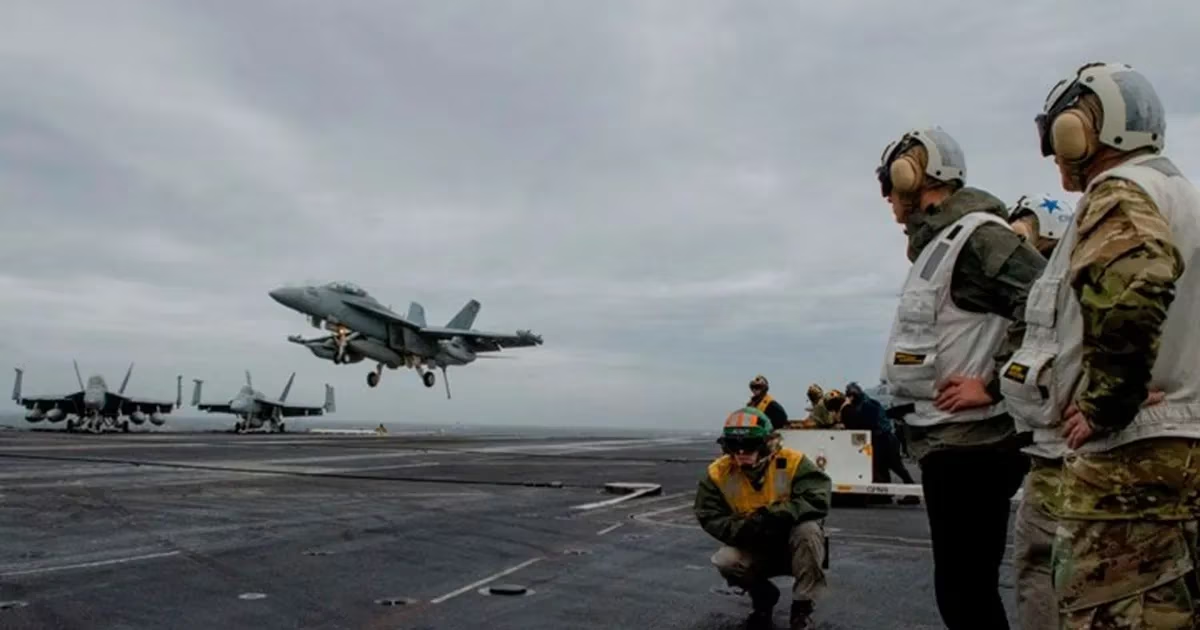
For his part, Iranian Supreme Leader Ali Khamenei threatened to target and sink aircraft carriers and American naval vessels recently deployed to Gulf waters, a move described by sources as an attempt to embarrass the American leadership. Tehran realizes that any military conflict in this sensitive region will lead to catastrophic economic repercussions feared by the White House, giving the Iranian negotiator more room for maneuver.

On the other hand, Israeli Prime Minister Benjamin Netanyahu, in cooperation with the Chief of Staff, announced raising the highest state of alert among defensive and offensive forces to confront any potential scenarios. This mobilization coincides with ongoing daily military operations launched by the occupation army in various areas of the West Bank and Lebanon, in an attempt to deter what it describes as imminent threats.

Occupation intelligence estimates indicate that Iran is actively seeking to incite Palestinians to open a new front of confrontation in the West Bank, exploiting the approaching holy month of Ramadan to escalate the situation. Based on these estimates, the occupation army intensified its field presence and deployed special units and the Commando Brigade in refugee camps and Palestinian cities to carry out widespread arrest campaigns.

Reports concluded that Tehran possesses multiple options to activate 'proxies' in the region, including Hezbollah in Lebanon and resistance factions in the Gaza Strip and Syria, in the event of any direct attack. Occupation security agencies are closely monitoring these movements, considering that coordination between these fronts represents the biggest challenge that may face regional stability in the coming period.

Iranians are more capable of buying time and more cunning in negotiation, and the matter is related to when American patience runs out.

PALESTINE

Wed 18 Feb 2026 8:16 pm - Jerusalem Time

Unprecedented Humanitarian Crisis: International Organizations Begin Withdrawal from Gaza Under Pressure of Occupation Restrictions

Major international relief organizations have begun procedures to withdraw their staff from the Gaza Strip, a dangerous field development that portends an exacerbation of the humanitarian catastrophe experienced by the Strip's residents. This step comes in response to severe restrictions imposed by the occupation authorities, which set a deadline at the beginning of next month for the cessation of activities of dozens of humanitarian bodies.

Informed sources reported that the occupation authorities notified about 37 international organizations, including long-standing European and British institutions, of the expiration of their legal registration to operate in the Palestinian territories. The occupation authorities stipulated that to renew this registration, detailed lists of local staff names and accurate information about funding sources must be provided.

These measures have raised widespread fears of a complete collapse of the relief system within the besieged Strip. The concerned organizations considered these demands a blatant violation of the principles of data protection and the confidentiality of humanitarian workers, which threatens the independence of their field operations.

International bodies affirmed that complying with Israeli conditions exposes the lives of their local staff to direct risks and security persecutions. They also stressed that this policy undermines bridges of trust between international donors and aid beneficiaries in affected areas.

Among the organizations threatened with cessation are institutions that form the backbone of relief work, such as 'Action Against Hunger' and 'ActionAid'. The list also includes 'Alliance for Solidarity' and 'Campaign for the Children of Palestine', which manage vital projects in the food and water sectors.

According to media sources, the decision also affected 'CARE' and 'DanChurchAid' and the 'Danish Refugee Council'. These institutions are responsible for securing basic needs for thousands of displaced people who have lost their homes and livelihoods during the ongoing war.

Israeli notifications also included the 'International Disability Alliance' and the 'Japan International Volunteer Center', in addition to multiple branches of 'Doctors of the World'. These entities play a pivotal role in providing specialized healthcare and psychological and social support to vulnerable groups.

Among the most prominent organizations that have begun to reduce their presence are 'Doctors Without Borders' with its various branches, 'Mercy Corps', and the 'Norwegian Refugee Council'. These organizations manage emergency medical and food programs that cannot be replaced given the massive destruction inflicted on local institutions.

Field reports warned that the cessation of 'Oxfam' and the 'International Rescue Committee's' work would create a humanitarian gap that cannot be filled in the short term. Hundreds of thousands of Palestinian families depend entirely on the aid provided by these entities to survive.

Several institutions have already begun closing their offices in Gaza and the West Bank, and have started evacuating their international staff before the specified deadline. This relief vacuum will immediately lead to the cessation of the distribution of ready-to-eat meals and essential health baskets to prevent epidemics.

Damage is expected to affect therapeutic feeding programs for children suffering from severe malnutrition in the northern and southern parts of the Strip. Basic healthcare services provided to pregnant women will also cease, increasing the risks of maternal and infant mortality.

Mobile clinics and first aid points, which form a vital lifeline in areas where hospitals have been destroyed, are also threatened with complete cessation. This will exacerbate the spread of infectious diseases associated with water contamination and a lack of safe food for displaced populations.

The danger is not limited to the service aspect but also extends to the absence of field monitoring and independent documentation of violations and humanitarian conditions. These organizations are considered international witnesses to what is happening on the ground, which the occupation seeks to obscure through these restrictions.

These rapid developments come at a time when the political track is witnessing a clear stumbling block in moving to the second phase of the ceasefire agreement. This overlap between political pressures and humanitarian needs increases the suffering of the Strip's residents who face harsh living conditions.

The new Israeli conditions affect the core of humanitarian work and its independence, exposing local staff to direct risks and undermining trust with donors.

ARAB AND WORLD

Wed 18 Feb 2026 8:15 pm - Jerusalem Time

Unprecedented American Military Buildup in the Region.. Portents of a Comprehensive Confrontation with Iran

Media reports, citing informed sources, revealed on Wednesday extensive American military movements indicating the approach of a direct military confrontation with Iran. The sources confirmed that the US military has completed more than 150 military cargo flights dedicated to transporting advanced weapon systems to its bases in the Middle East region, amid an unprecedented escalation of political and field tensions.

The past twenty-four hours witnessed a remarkable escalation with the arrival of 50 additional fighter jets of the latest global models, including F-35, F-22, and F-16 aircraft, to enhance offensive air capabilities in the region. Observers believe that this massive military buildup, coinciding with an escalating rhetoric from President Trump, puts the US administration on a path from which it is difficult to retreat without extracting substantial concessions from Tehran regarding its nuclear file.

Sources quoted officials in the Trump administration as saying that the current movements are not merely a show of force or an attempt at deception, but rather actual preparations for a military operation that may begin very soon. The officials explained that the nature of the current president and his advisors tends towards military decisiveness if Iranian intransigence continues, making the option of a major war closer than ever before.

Estimates indicate that the anticipated operation will not be a limited or swift strike, but is likely to turn into a comprehensive military campaign lasting several weeks and targeting the infrastructure of the Iranian regime. This campaign is expected to be broader in scope and more impactful than previous military operations witnessed in the region, aiming to bring about a radical change in regional power balances.

In a related context, sources reported that there is high-level coordination for launching a joint military campaign between the United States and Israeli occupation forces, aimed at undermining the influence of the Iranian regime and directly threatening its existence. These plans are considered more dangerous than previous confrontations, as preparations are being made for them to be a decisive blow that surpasses in intensity previous wars witnessed in the region over the past decades.

For his part, US Vice President Vance stated that diplomatic talks have reached a dead end in certain aspects, indicating that the President has set clear red lines that the Iranian side has not yet shown willingness to adhere to. Vance affirmed in press statements that the US administration will not be lenient in addressing these issues, which reinforces the hypothesis of resorting to the military option as a last resort to impose American conditions.

The Trump administration is closer to engaging in a major war in the Middle East than most Americans realize, and it may begin very soon.

PALESTINE

Wed 18 Feb 2026 8:15 pm - Jerusalem Time

Martyr in Khan Yunis on the first day of Ramadan, and the European Union considers supporting the Gaza management committee

A young Palestinian man was martyred by Israeli occupation forces in the city of Khan Yunis, south of the Gaza Strip, coinciding with the first day of the holy month of Ramadan. Medical sources at Nasser Hospital confirmed that the victim fell as a result of direct gunfire near the Bani Suhaila roundabout in the eastern part of the city, reflecting an escalation on the ground at a time when residents had hoped for relative calm.

Since the early morning hours, the eastern areas of Khan Yunis city have witnessed intense gunfire from Israeli military vehicles stationed at deployment points. These attacks extended to include the 'Moraj' axis north of Rafah city, in addition to artillery shelling targeting the eastern outskirts of Al-Bureij refugee camp in the central Strip, causing a state of panic among citizens.

In Gaza City and its north, occupation forces continued their field violations by targeting the eastern areas of Beit Lahia city with heavy machine gun fire. Artillery shelling also targeted the vicinity of Al-Sikka Street in the Al-Zaytoun neighborhood southeast of Gaza City, and despite the intensity of the fire, no human casualties have been reported in those areas so far.

These Israeli military movements come within a series of continuous violations of the ceasefire agreement that came into effect on October 10, 2025. Observers believe that the continuation of these operations threatens the collapse of fragile understandings and increases the suffering of the besieged residents who face harsh humanitarian conditions with the beginning of the holy month.

On the political front, Turkish President Recep Tayyip Erdogan expressed his aspirations that the 'Peace Council' would play a crucial role in establishing the foundations of permanent stability in the Gaza Strip. Erdogan stressed that achieving a comprehensive ceasefire is the primary demand, describing what is happening in Gaza as a real test for the global conscience and human values.

Turkish Foreign Minister Hakan Fidan is scheduled to represent his country at the upcoming meeting of the Peace Council in the US capital, Washington, tomorrow, Thursday. This meeting aims to discuss ways to enhance de-escalation and develop international mechanisms to ensure that military confrontations are not repeated, and to provide political cover for relief and reconstruction operations in the next phase.

In turn, the Islamic Resistance Movement 'Hamas' issued an urgent appeal to the Peace Council for the necessity of immediate action to stop the repeated Israeli violations of the truce agreement. The movement demanded in a statement the necessity of obliging the occupation to the declared principles for achieving peace, stressing that international silence encourages the Israeli side to continue its field violations.

In a remarkable political development, documents issued by the European External Action Service revealed the European Union's intention to provide tangible support to the National Committee for the Management of Gaza. The documents, which were seen by journalistic sources, indicated that Brussels has already begun communication channels with the transitional governance structures that have recently been formed to take over the reins in the Strip.

The European Union is exploring the possibility of providing the necessary resources to enable the National Committee to perform its administrative and service tasks, in a step aimed at enhancing institutional stability. These proposals are expected to be officially circulated during the meeting of the foreign ministers of the EU member states scheduled to be held in Brussels on February 23rd.

These European and international moves represent an attempt to create a new political reality in Gaza away from the continuous cycle of violence, despite the significant field challenges. The success of these efforts remains dependent on the extent of commitment to the ceasefire and the ability of international parties to pressure for an end to military attacks targeting civilians in the Strip.

I hope that the Gaza Peace Council will contribute to achieving permanent stability, a ceasefire, and the desired peace in the Strip, as the issue of Gaza is a test of consciences.

PALESTINE

Wed 18 Feb 2026 8:15 pm - Jerusalem Time

Determination to Return: Thousands of Palestinians Disrupt Displacement Plans via Rafah Crossing

The Rafah border crossing is witnessing moving humanitarian scenes as Palestinians stranded abroad continue to flock to the Gaza Strip, a move that reflects popular determination to return despite the massive destruction left by the war. Since the reopening of the crossing on February 2nd, stories of families who were not deterred by years of genocide or loss of homes from returning to their roots have been unfolding, dealing a strong blow to the displacement and settlement plans promoted by Israeli parties.

Citizen Fida Omran describes her arrival in Gaza as a restoration of the soul, as she was reunited with her father in Nasser Hospital in Khan Yunis after a long treatment journey abroad. Omran affirmed that the services available abroad could not compensate her for the warmth of her homeland, advising Palestinians to hold on to their land and not to think of leaving, stressing that 'there is no better place than Gaza' despite the harsh current conditions.

For its part, government sources in Gaza revealed the existence of deliberate Israeli obstacles aimed at slowing down movement through the crossing, as the occupation did not adhere to the agreed-upon numbers under the ceasefire understandings. The sources explained that the occupation practices a policy of procrastination and harassment against returnees, in a desperate attempt to deter them from returning to the Strip and keep them in a state of forced diaspora.

Field data indicates that about 80,000 Palestinians abroad have officially registered their names to return to the Gaza Strip, a number that sends clear political messages to decision-makers in Tel Aviv. Observers believe that this massive turnout for return, even in the absence of basic necessities of life, represents a frustration of Israeli efforts aimed at emptying the Strip of its inhabitants and turning it into a buffer zone or settlements.

Returnee Tahani Omran recounted harsh details about the treatment returnees received from the occupation army at the crossing, where she was subjected to abuse and interrogation for hours while handcuffed and blindfolded. Tahani affirmed that these repressive measures aim to intimidate Palestinians, but she stressed that the will to stay is stronger than the machine of oppression, saying: 'We were born in Gaza and we will die in it.'

In a related context, young Hossam Al-Mansi expressed his immense joy at meeting his seven children after a treatment journey in Egypt, affirming that the soil of Gaza is worth the world and everything in it for him. Despite praising the medical care he received in Egyptian hospitals, he stressed that the feeling of belonging to the homeland cannot be compensated, calling on everyone to stand firm on the soil of the Strip no matter the sacrifices.

Political analyst Iyad Al-Qara considered that the arrival of the first batch of returnees represents a 'practical failure' of the displacement project adopted by the occupation government with the support of international parties. Al-Qara explained that the decision to return has two dimensions; one humanitarian related to reuniting fragmented families, and the other national political reflecting a deep popular awareness of the necessity of confronting ethnic cleansing plans.

Al-Qara pointed out that Palestinian national upbringing proved its effectiveness during the war, as displaced people insisted on returning to their destroyed homes in the northern Strip immediately after the truce came into effect. This collective behavior reflects the failure of the occupation to break the will of Palestinians, which explains the state of annoyance and violations practiced by the army against returnees through the Rafah crossing at present.

Reports indicate that the occupation authorities tried to entice some returnees with money in exchange for returning to Egypt or security cooperation, but these attempts were met with outright rejection. These testimonies confirm that the occupation uses all means, from intimidation to enticement, to reduce the population in Gaza, but it clashes every time with the nature of the Palestinian person clinging to his land.

Statistically, sources stated that the occupation's adherence to the number of travelers through the crossing did not exceed 29% during the past two weeks, which hinders the return of thousands of stranded people. Out of 2,800 travelers who were supposed to cross, only 811 people were able to move, which puts the international community before its responsibilities regarding the occupation's continuous violations of agreements.

In light of this catastrophic reality, there are still more than 22,000 wounded and sick people in the Gaza Strip waiting for the opportunity to travel to receive necessary life-saving treatment. This crisis is exacerbated by the continued destruction of 90% of the health and civilian infrastructure, making the Rafah crossing the only lifeline that the occupation is trying to choke by all means and methods.

The emergency Arab summit had adopted a plan for the reconstruction of Gaza at a cost of 53 billion dollars, aimed at stabilizing Palestinians in their land and preventing any attempts at forced displacement. The plan includes comprehensive development and housing projects extending for five years, but its implementation remains dependent on the permanent opening of crossings and the cessation of Israeli restrictions imposed on the entry of basic materials.

The scenes of hugs and tears at the gate of the crossing summarize the story of a people who refuse to be broken, as Palestinians prefer to live in tents on the ruins of their homes over a life of exile. This popular determination represents the first and strongest barrier against any international or regional projects aimed at liquidating the Palestinian issue through the gateway of displacement or alternative settlement.

In conclusion, the Rafah crossing file remains a real test of the extent of international parties' commitment to ensuring freedom of movement for Palestinians, especially in light of statistics that confirm the scale of the humanitarian catastrophe. With the continued flow of returnees, Palestinians prove day after day that the land belongs to its owners, and that all attempts at uprooting will only increase their attachment to their identity and their legitimate right to live on their national soil.

Upon our arrival in Gaza, our souls were restored and our breaths returned, and nothing compares to the feeling of being among family and loved ones despite all the suffering.

ANALYSIS

Wed 18 Feb 2026 8:15 pm - Jerusalem Time

Ideology Labs: How Are Alternative Beliefs Created and Identities Engineered?

Consciousness engineering, at its deepest levels, shifts from guiding political and consumer public opinion to laboratories for manufacturing ideologies and alternative beliefs. While the political engineer targets the conscious mind, the ideological engineer works to penetrate the subconscious and being to completely re-engineer human sentiment. This penetration is clearly manifested in ideology's ability to transform intellectual elites into tools in the hands of nationalist or fascist projects, where innate logic is disabled in favor of a false certainty designed to isolate minds from human self-evident truths.

Language is the fundamental and primary building block of any ideological system, where it is not used as a means of communication but as a tool for mental framing. The engineer deliberately undertakes a widespread process of replacement and substitution of terms, withdrawing words with innate connotations and planting in their place booby-trapped terms that capture emotion before reason awakens. Through this linguistic poisoning, occupation in the recipient's consciousness may transform into liberation, and promiscuity becomes openness, making acceptance of the term an implicit acceptance of the underlying intellectual system.

Narrative engineering comes as a second step to build the nervous system of ideology, where epic stories are crafted to give followers a sense of heroism and meaning. This process relies on professional historical montage that exaggerates certain events and obscures others to create a narrative that justifies mental alienation. This mechanism was used in ancient Greek epics to unite warring kingdoms, and more recently in the creation of European nationalisms that depicted the nation as a metaphysical entity possessing the right to absolute control.

Zionist ideology stands out as a stark example of narrative engineering, having exploited ancient historical events like the Babylonian captivity to transform them into an eternal license to uproot the Palestinian people. The Zionist engineer managed to hack historical consciousness by replacing lived reality with a sacred narrative illusion that justifies the crime. By this logic, the settler sees himself as an heir to the prophets, not a usurper of the land, revealing the danger of leaping over time to serve colonial agendas.

Engineering then moves to the stage of dismantling collective identity and replacing it with artificial identities through a process of societal atomization. The engineer realizes that a person belonging to a family, tribe, or established history is resistant to domestication, so they seek to break organic ties. Once individuals are transformed into separate atoms, it becomes easy to penetrate their consciousness and reprogram them after stripping them of the social filter that protected them from external manipulation.

The analogy between the experience of the 'New Soviet Man' and the 'American Dream' reveals a unity of purpose despite different means in resetting history. While the Eastern laboratory sought to forcibly erase innate history in favor of narrow party loyalty, the Western laboratory worked to melt identities in the crucible of the illusion of individual success. In both cases, the individual was stripped of their deep roots to become a cog in a machine or a fragile atom dissolving into an artificial consumer history.

Despite the apparent power of these laboratories, they suffer from structural vulnerabilities that make them fragile against the rock of reality and moments of truth. Ideological engineering fails when language cannot beautify ugliness, and when humans discover that the epic narrative does not provide them with dignity or bread. This gap between word and reality is the black hole that swallows ideologies, where simple truth possesses immense explosive power once spoken.

The fall of the Berlin Wall served as a historical model for the collapse of ideology when people decided to stop living within a lie. The system did not fall due to army cannons, but by individuals' decision to reclaim their innate consciousness and reject the narrative that tried to convince them that prison was paradise. Similarly, crises in the Western system, such as the subprime mortgage crisis, expose the falsity of identity based on consumption when millions find themselves destitute without social support.

In South Africa, the apartheid system collapsed when the narrative of 'racial superiority' clashed with the reality of isolation and economic collapse. The system's leaders admitted that the words on which the narrative was built no longer matched lived reality, and the oppressed stopped believing that their servitude was an inevitable fate. This collapse proves that coercive engineering, no matter how precise, remains unable to withstand the victim's realization of their humanity and their rejection of stereotyping.

Religion, with its transcendent reference, represents the last line of defense that prevents the individual from dissolving into the narratives of operators and man-made ideologies. Religious beliefs possess self-immune mechanisms that make the individual resistant to abduction, prompting extremist ideologies to attempt to suppress or contain religion. At the height of its extremism, ideology tries to cultivate alternative beliefs that sanctify the party or the market to fill the spiritual void left by materialism.

The essence of divine messages has always been an act of liberation, moving humanity from the authority of creation to the vastness of the Creator. Despite attempts by some elites throughout history to ideologize these messages and turn them into tools of tyranny, the essence of revelation remains a light that exposes falsehood. The individual with a conscious belief represents the greatest threat to the ideological engineer, because they possess the courage to gaze at the truth and reject subservience to anyone other than God.

Islamic reference stands out with self-correction and self-criticism mechanisms that provide the believer with acquired immunity against systematic ideological manipulation. The philosophy of Sharia is based on sovereignty and liberation, requiring submission to the Creator to be free from the power of all created beings and material systems. This liberation prevents the individual from being merely a cog in a machine, making them an active being who possesses the reins of their will, away from the pressures of operators.

Sharia addresses human nature and calls for the use of reason to criticize falsehood and contemplate the universe, instead of the stereotyping that ideology seeks. Islamic values of justice, honesty, and dignity are existential constants that do not change with changing political or economic interests. This comprehensiveness makes religious reference a compass that protects humans from abduction, and confirms that their dignity is derived from being a vicegerent on Earth.

In conclusion, consciousness remains the sharpest weapon that burns the jailer, the cell, and the artificial ideological narrative all at once. The ultimate choice lies between being a servant to the agendas of operators, or being free, rejecting stereotyping, and protecting one's heart and mind from penetration. Reclaiming the occupied sentiment is the first step towards true liberation, and it is the cornerstone in confronting all forms of contemporary consciousness engineering.

Ideology is a process of meaning abduction; it begins by poisoning language, then builds foundational myths, to end by dismantling identity and planting new loyalty.

PALESTINE

Wed 18 Feb 2026 9:52 am - Jerusalem Time

Widespread International Consensus: 85 Countries Condemn Occupation's Attempts to Change West Bank Demographics and Demand an End to Annexation

The halls of the United Nations in New York witnessed extensive diplomatic activity, as 85 countries issued a joint statement on Tuesday condemning recent Israeli actions aimed at entrenching and expanding settlements in the occupied West Bank. The signatory countries expressed their deep concerns that these moves are directly intended to bring about a radical change in the demographic composition of the Palestinian territories, threatening to eliminate any future opportunity for stability in the region.

This massive international stance came in the wake of a series of legislative decisions taken by the occupation authorities, including the approval of laws facilitating land purchases by settlers, in addition to government directives to accelerate land registration processes in the West Bank, which has been under occupation since 1967. The signatory countries considered these steps to be an actual prelude to illegal annexation operations that defy international will.

The list of signatories to the statement included major international powers, foremost among them France, China, and Russia, along with influential regional blocs such as the European Union and the League of Arab States. The joint statement emphasized that unilateral Israeli decisions completely contradict the international legal obligations imposed on the occupying power, stressing the need for an immediate reversal of these policies, which are rejected by the international community in their entirety.

The statement warned that the continuous pursuit of changing the legal character and demographic status of the occupied Palestinian territories, including East Jerusalem, constitutes a blatant violation of relevant United Nations charters and resolutions. Sources indicated that this move reflects a state of international consensus that current Israeli practices cross red lines and threaten to undermine the international order based on respect for territorial sovereignty.

In a related context, UN Secretary-General António Guterres entered the crisis, demanding that the Israeli government immediately halt these measures and adhere to international legitimacy. Guterres based his demand on assurances issued by the International Court of Justice, which stressed that these practices are illegal and directly contribute to destabilizing stability and security in the Middle East region.

Statistical data issued by the international organization indicates a frightening and unprecedented acceleration in the pace of settlement expansion during the current Israeli government led by Benjamin Netanyahu. Reports clarified that this pace has significantly doubled, especially in the period following the events of October 7, 2023, reflecting an exploitation of current circumstances to impose a new reality on the ground that will be difficult to change in the future.

On the ground, more than 500,000 settlers currently live in settlements established on West Bank lands, alongside approximately three million Palestinians who face continuous restrictions. Observers believe that this settlement expansion represents a ticking time bomb that threatens the remaining opportunities for implementing a two-state solution, as Palestinian geography is being fragmented, preventing the establishment of a contiguous and viable state.

This widespread international movement reflects the increasing tension towards the policies pursued by the occupation government, which aim to undermine opportunities for reaching a comprehensive and just peace agreement. The signatory countries affirmed at the conclusion of their statement that the continuation of these violations will only lead to further escalation, calling on the international community to take concrete steps to ensure the protection of Palestinian rights and halt settlement encroachment.

These unilateral decisions completely contradict Israel's obligations under international law and must be immediately reversed.

ANALYSIS

Wed 18 Feb 2026 9:52 am - Jerusalem Time

Trump's "Peace Council" and Gaza: Grand Promises, Vague Mandate, and a Political Project Disguised as Reconstruction

Said Erikat

Opinion Writer

The "Peace Council" called for by US President Donald Trump — scheduled to convene in Washington on February 19 — is being marketed as a historic breakthrough in Gaza's recovery. The US administration states that member countries will announce pledges exceeding five billion dollars for humanitarian aid and reconstruction, along with a commitment to "thousands of elements" to form an international stabilization force, in addition to a local police system. However, the fundamental question, behind the branding, promotional shots, and self-congratulatory atmosphere, remains unanswered: no one knows exactly what this council is supposed to do, what authority it claims, or what it can realistically achieve.

Trump launched the initiative in January and celebrated its formation in Davos last month, presenting it as a platform for "global peace." As usual, his language was extreme and exaggerated, with a promise that starts in Gaza but extends far beyond it. The Washington meeting will be the first official gathering since the council's establishment, but it seems closer to an event prepared for a theatrical political announcement than a genuine working summit: declared funds, promised personnel, and a Washington-led American narrative of "restoring order."

However, the public description of the council seems more like a political slogan than a viable international mechanism. A reconstruction fund, a stabilization force, and a "local police" structure are not interchangeable terms that can be used loosely; rather, they require clear mandates, legal frameworks, chains of command, rules of engagement, host party consent, and accountability mechanisms. Trump's insistence on chairing the council himself further raises doubts about it being a truly multilateral body, reinforcing the impression that it is an American-directed coalition, aiming to bypass institutions that limit American maneuverability.

This suspicion is already reflected in the membership list. More than twenty countries have accepted Trump's invitation, including Israel, Qatar, Saudi Arabia, Turkey, and Egypt. But the striking absence of major European allies is not a detail. Several European governments have expressed, publicly and implicitly, concerns that the council was designed to replace the United Nations. Their refusal is not merely symbolic, but a practical blow: any serious reconstruction effort requires long-term funding, technical expertise, and political legitimacy — elements for which the European role is indispensable.

The institutional symbolism, in turn, was deliberate. The name of the "United States Institute of Peace" was changed in December to the "Donald J. Trump Institute of Peace," after the administration had weakened the institute by dismissing a large number of its board members and staff, as part of the "government efficiency management" campaign that targeted foreign aid and semi-independent institutions. Thus, a platform historically dedicated to peacebuilding was transformed into a personal political monument, reinforcing the impression that the council is not a neutral initiative, but a vehicle bearing Trump's brand and working to concentrate credit and decision-making in one hand.

Financial claims should also be treated with caution. Five billion dollars seems like a striking figure in headlines, but it is a small part of what Gaza's recovery requires. A joint damage and needs assessment prepared by the United Nations, the European Union, and the World Bank last year estimated that reconstruction could exceed 70 billion dollars and take years. In comparison, the council's pledges seem more like a down payment — and even that is conditional on the funds being real, new, and disbursable, not just recycled commitments at a media event.

The credibility gap widens further with the "master plan" promoted by Jared Kushner, Trump's son-in-law and real estate businessman who helped negotiate the ceasefire between Israel and Hamas. Kushner presented a vision that includes hundreds of skyscrapers, new cities, and a coastal tourist area. He claimed that construction could take two or three years and require investments of at least 25 billion dollars, while insisting that the coming months would be dedicated to delivering aid. This plan, in its form, resembles Gulf "mega-city" projects, but in its political content, it is closer to a colonial fantasy: redevelopment without sovereignty.

Gaza is not an empty land awaiting investors. It is a shattered territory emerging from widespread displacement, destroyed infrastructure, and unresolved political authority. Reconstruction is not just about pouring concrete; it includes property rights, land disputes, the return of displaced families, the legitimacy of governance, and border control. A tourist area cannot be built on a political vacuum, and skyscrapers do not answer the question: who governs? Who secures? And who speaks for the Palestinians?

As for the security aspect, this is where the council's ambitions seem most concerning. Trump says that member states will commit thousands of elements to an international stabilization force and local police, but he did not clarify whether Israel would accept the presence of this force, or whether it would operate independently, or whether it would become a barrier that allows Israel to formally withdraw while maintaining strategic dominance. For Palestinians, the term "stability" may become merely a euphemism for external security management — a new system of control re-marketed as humanitarian concern.

Trump also reiterated a key demand in his announcement: that Hamas commit to "complete and immediate disarmament." This demand is an essential part of the American framework, but it is also the most politically explosive. Disarmament cannot be imposed by decree; it requires a political settlement, legitimate governing authority, and a credible security alternative. Without that, the call for disarmament seems closer to terms of surrender than to peacebuilding, threatening any ceasefire with collapse under the weight of humiliation and distrust.

The timing of the council meeting is not accidental. It comes after a second round of indirect US-Iranian talks in Geneva, following a previous round in Oman. Trump has repeatedly threatened to strike Iran if it does not curb its nuclear program, while Secretary of State Marco Rubio insisted that the president prefers negotiated solutions. Iranian Deputy Foreign Minister Majid Takht Ravanchi said the ball was "in the American court" to prove seriousness. This synchronicity reveals a recurring pattern: performative diplomacy on one front, while employing coercive pressure on another.

Ultimately, the "Peace Council" may not be an institution as much as a political tool: a means for Trump to claim ownership of Gaza's future, push allies into alignment, and offer an alternative to UN-centric legitimacy. Whether the council will become an effective mechanism or end up marginalized without impact will depend on what happens after February 19: will the money actually be disbursed? Who will lead any security force? And do Palestinians have a real role beyond being the subject of others' plans?

So far, the council's grand name conceals an empty core: a promise of peace without a plan.

ARAB AND WORLD

Wed 18 Feb 2026 9:51 am - Jerusalem Time

The Israeli Lobby "UN Watch" Behind the European Attack on Albanese

Said Erikat

Opinion Writer

An unprecedented wave of political and media targeting is escalating in European and international circles against the UN Special Rapporteur on human rights in the occupied Palestinian territories, Francesca Albanese, after the promotion of a video clip presented as documenting a statement in which she describes Israel as "the common enemy of the world." This clip quickly became a ready pretext adopted by several European governments to demand her resignation, in a scene that observers see as a blatant example of how carefully crafted disinformation can turn into an official pressure tool against a UN official.

However, the issue, according to circulating data and human rights and media reports, is not related to a "controversial" statement as some parties tried to portray it, but rather to what resembles a "moral execution" process based on questionable material, even accused of fabrication and deliberate manipulation. The circulated clip does not reflect the content of Albanese's speech in its original context, but rather suggests that she said a phrase she did not say, or that its meaning was turned upside down through selective editing that serves a specific political goal: silencing one of the clearest UN voices on the Palestine issue.

The fingers of accusation point directly to an organization with a name that suggests moral oversight and commitment to the UN Charter, "UN Watch," which is nothing but an explicit pro-Israel lobby, playing a propaganda and political role under the guise of "human rights monitoring." The irony is that this organization, despite its controversial nature, enjoys a status that allows it access to the corridors of the UN in Geneva, and operates from within a space that is supposed to be dedicated to protecting human rights, not undermining them.

According to observers, "UN Watch" has a clear hostile record against Albanese, which cannot be separated from the nature of its work. In 2025, the organization tried to prevent the renewal of her accreditation as UN Special Rapporteur on Palestine, but failed through the public and institutional channels. After the "open path" to her removal failed, human rights organizations say that the organization moved to another, more dangerous path: fabricating a misleading narrative and circulating it widely until it becomes a "political truth" that can be built upon.

The video, which was launched to incite public opinion against Albanese and create a state of shock around her, appears to be fabricated (or at least designed in a way that produces a meaning she did not intend or say). Observers confirm that the full version of her speech does not include the circulated phrase, and that what happened was an excerpt or montage aimed at producing an extremely extremist statement that governments could easily exploit in their campaign. Some go so far as to say that what happened is not just a "misunderstanding," but a calculated disinformation operation, part of a propaganda war aimed at removing Albanese from her position by any means.

The seriousness of the issue increases with the statements of Craig Mokhiber, former UN Commissioner for Human Rights, who described "UN Watch" as a "despicable" entity with a long history of "dirty tricks" against human rights defenders. Mokhiber publicly demanded the withdrawal of the organization's accreditation within the UN, considering that it should not even approach international institutions, because it exploits its consultative status to distort UN staff, disrupt its work, and launch organized smear campaigns against anyone who criticizes Israel.

In a very clear accusation, Mokhiber pointed out that the organization was founded in the 1990s by Morris Abram, described as a former pro-Israel lobbyist and former US ambassador, and that its actual function from the beginning was to attack and distort human rights defenders in favor of Israel. He also said that the organization masters a consistent strategy based on spreading lies and accusing critics of Israel of "anti-Semitism" to silence them, while the UN continues to grant it consultative status with the Economic and Social Council, allowing it access to UN corridors and using them as a platform for pressure, harassment, and distortion.

Most controversially, Mokhiber indicated that the organization benefits from US political support within UN missions in Geneva and New York, which grants it undeclared immunity and ensures the continuation of its influence. It did not stop there, as he said that members of the US Congress regularly allow it to provide briefings to legislative committees, where it defames UN officials and their procedures, and turns the international institution into a permanent target for campaigns of doubt and incitement.

As for the video itself, circulating indicators suggest that its first source on the internet may be directly linked to the leadership of "UN Watch." Policy expert Martin Konishni noted that the first appearance of the clip was in a post by the organization's director, Hillel Neuer, a name associated in the eyes of critics with a clear propaganda role in defending Israel and all its crimes against Palestinians. Observers believe that this detail alone is enough to explain the rapid spread of the video, and the way it was pushed to the forefront of the European political discussion.

Despite the unraveling of the controversy surrounding the video's authenticity, and despite the availability of what indicates that it is misleading material, a number of Western governments continued to deal with it as if it were documented, and continued to target Albanese as if the truth meant nothing. Human rights activists believe that this behavior not only exposes the fragility of some European capitals' commitment to the standards they boast about, but also reveals their willingness to adopt ready-made narratives even if they prove to be based on disinformation, as long as they serve a political goal of silencing an annoying UN voice.

Ultimately, the issue does not seem to be just a disagreement over a sentence or a video clip, but a scandalous test of the independence of the UN system and its ability to protect its officials from organized smear campaigns. It also poses a direct question to the international community: Are UN institutions turning into an arena where propaganda battles are waged for the benefit of pressure groups, or do they remain a platform that is supposed to protect international law and defend human rights, not be used to settle political scores with those who demand its application?

This incident reveals a structural flaw that goes beyond Francesca Albanese to the nature of the UN's work itself, where pressure groups with political agendas have become able to infiltrate the UN sphere and exploit it as an arena for attack instead of oversight. The most dangerous thing is that disinformation does not remain within the realm of propaganda, but quickly moves to the level of political decision when governments pick it up and officially reproduce it. Here the question arises: Who holds the disinformer accountable when they hide under the guise of "consultative" status within the international organization?

What is happening highlights a sharp moral paradox: "human rights" slogans are raised in Europe, while a UN rapporteur is targeted for her human rights work through a video of questionable authenticity. The continued official dealing with misleading material, even after doubts have been raised about it, means that some capitals are not looking for the truth but for a political justification. In such cases, fighting disinformation becomes a test of moral sovereignty, not just a fleeting media discussion.

PALESTINE

Wed 18 Feb 2026 9:50 am - Jerusalem Time

Widespread Escalation in the West Bank: Injuries, Incursions, and a Military Operation in Salfit

Cities and towns in the occupied West Bank witnessed a new wave of incursions and attacks carried out by Israeli occupation forces and groups of settlers, resulting in injuries, arrests, and property destruction. Field sources reported that a Palestinian citizen was injured by live occupation fire during an incursion into the city of Dura, south of Hebron, where the operation involved extensive firing of gas and sound grenades, raiding commercial shops, and tampering with their contents.

In Ramallah Governorate, settlers launched a violent attack targeting the Al-Ara'ra Bedouin community located between the towns of Rammun and Deir Dibwan, resulting in injuries among local residents. Residents of the area stated that the attackers were heavily armed, while occupation forces intervened to secure the settlers' withdrawal after they carried out their assault on the Bedouin community.

Bethlehem Governorate was not spared from this escalation, as a Palestinian was shot and another sustained bruises following an attack by settlers on citizens' homes in the village of Al-Rashayda. Violent confrontations erupted between residents and settlers who attempted to intimidate families and destroy their private property under military protection.

In the context of the systematic demolition policy, occupation bulldozers demolished a home in the town of Al-Khader, southwest of Bethlehem, under the pretext of building without a permit in areas classified as 'C'. This step comes after a series of notices received by homeowners in the area, as part of attempts to impose urban restrictions on Palestinians.

Regarding field military operations, occupation forces carried out a widespread operation in the city of Salfit that lasted for several hours, including raiding and thoroughly searching the homes of released prisoners. The forces also temporarily forced a number of families to evacuate their homes and converted them into military observation points during the incursion.

In the northern West Bank, occupation forces deployed large military reinforcements, including more than 15 armored vehicles, to the city and camp of Jenin, where the vehicles patrolled streets and residential neighborhoods. These movements caused a state of confusion and severe tension among residents, coinciding with incursions into other villages and towns in the governorate.

In occupied Jerusalem, the occupation authorities forced the family of the elderly Ahmed Khader to self-demolish their home in the town of Sur Baher, to avoid paying exorbitant financial fines. Local sources explained that the family was forced to take this bitter step to avoid a fine of up to 80,000 shekels if occupation mechanisms carried out the demolition operation.

In the eastern Ramallah countryside, specifically in the village of Yabroud, settlers stole a number of sheep after attacking the outskirts of the village and destroying agricultural facilities and pens. The attack was accompanied by indiscriminate gunfire towards citizens who tried to confront the settlers and protect their land and livestock.

In the city of Al-Bireh, occupation forces arrested a young man from the Al-Hashimiya neighborhood after raiding the neighborhood and his home. His identity or where he was taken has not been revealed yet. The Red Crescent also reported that a Palestinian was injured by occupation fire near the Jabara military checkpoint south of Tulkarm, where he was transferred to the hospital for treatment.

Official Palestinian data indicates that the pace of attacks in the West Bank has escalated unprecedentedly since the start of the aggression on the Gaza Strip, with the number of martyrs reaching 1114. Medical and human rights sources also recorded approximately 11,500 injured Palestinians and nearly 22,000 others arrested amid ongoing repression campaigns.

Since the start of the war on Gaza, occupation forces have intensified their attacks in the West Bank through killing, arresting, and displacing to impose new realities on the ground.

PALESTINE

Wed 18 Feb 2026 9:50 am - Jerusalem Time

Documents reveal Epstein's role in transferring Israeli security technologies from Gaza to Nigeria for the UAE

Recent documents from the files of the late American businessman Jeffrey Epstein have revealed a pivotal role he played in mediating major infrastructure deals for 'DP World' in Nigeria. Correspondence dating back to 2018 shows Epstein's efforts to grant the Emirati company direct influence in strategic West African ports before his death in prison in 2019.

The correspondence, recently published by the US Department of Justice, clarified that Epstein facilitated communication channels between the former head of Nigeria's sovereign wealth fund, Gideon Zeitlin, and Sultan Ahmed bin Sulayem, then chairman of DP World. These discussions aimed to establish and operate vital shipping terminals in the Nigerian regions of Lagos and Badagry.

The revelation of these documents coincides with bin Sulayem's dismissal from his position a few days prior, following reports confirming his strong relationship with Epstein. The Emirati company's management insisted on full control over the ports as a condition for investment, a hurdle it had faced since its first attempts to enter the Nigerian market in 2005.

Epstein's role was not limited to commercial mediation; he also worked to involve influential American figures to facilitate political and financial arrangements. Among these figures was Kathryn Ruemmler, former legal counsel in the Obama administration, who recently resigned from her senior position at 'Goldman Sachs'.

The documents indicate that the economic trajectory of the ports was closely linked to security and intelligence cooperation. Epstein's relationship with former Israeli Prime Minister Ehud Barak extended for over a decade and included investments in cybersecurity and Israeli military industries targeting the African market.

In 2014, with rising security unrest in Nigeria, Ehud Barak introduced Israeli security companies to the Nigerian government under the banner of counter-terrorism. Barak leveraged his international network to promote technologies described as 'field-tested,' a clear reference to their use against Palestinians in Gaza and the West Bank.

Among the most prominent technologies transferred to Nigeria was the 'Basel' biometric system, the same system used by the occupation at the Erez crossing to regulate the passage of Palestinian workers. This system relies on advanced facial recognition and hand measurement technologies and was marketed as an effective security solution for Nigerian facilities.

Barak and his partner Gary Fegel invested millions of dollars in 'FST Biometrics,' a company specializing in facial recognition systems, founded by a former head of Israeli military intelligence. Pilot projects for these technologies were launched in Nigerian universities to monitor dormitories and classrooms under the pretext of security.

Financial records show that Epstein provided a $1 million loan to Barak for investment in the 'Reporty Homeland Security' emergency response platform. These security partnerships were not merely fleeting investments but aimed to open doors for political and economic influence in vital sectors such as oil.

In 2013, Epstein helped Barak propose joint projects with international businessmen to enhance Israel's presence in Africa. Barak traveled to Nigeria to attend undeclared security conferences where he met with senior military and political leaders to pave the way for these investments.

Security cooperation resulted in the installation of a $40 million internet surveillance system produced by the Israeli company 'Elbit' in Nigeria. Despite parliamentary controversy sparked by the project, relations continued to expand to include World Bank-backed partnerships for developing cyber infrastructure.

DP World's interests once again intersected with this security network, as Epstein's relationship with bin Sulayem helped set the stage for major economic agreements. These moves preceded the signing of the 'Abraham Accords' in 2020 by years, indicating long-term strategic coordination.

After official normalization, the Emirati company attempted to acquire the Israeli port of Haifa, linked to gas fields in the Mediterranean. Although it did not win the deal, the documents confirm that economic rapprochement between Dubai and Tel Aviv was proceeding on parallel tracks involving security, energy, and ports.

These leaks prove that the Epstein and Barak network acted as a bridge for transferring Israeli repressive expertise from the occupied territories to the African continent. Thus, technologies used in the siege of Gaza became a commercial commodity used to enhance the influence of regional companies in emerging markets.

I hope your friend's visit to Tel Aviv is more effective than his efforts in Africa.

PALESTINE

Wed 18 Feb 2026 9:45 am - Jerusalem Time

US moves to establish an international military base south of Gaza with the participation of Morocco and other countries

The diplomatic and military steps led by the US administration to impose a new reality in the Gaza Strip under the name of an "international stabilization force" are accelerating. Media sources reported that Washington has made significant progress in discussions with Morocco, Greece, and Albania to send military units to participate in this force, amid indications suggesting that Morocco will likely be the first Arab country to officially join this international formation.

Hebrew reports stated that these contacts come within the context of comprehensive security and political arrangements being prepared by the United States for the post-war phase in the besieged Strip. These moves aim to find international security alternatives to manage the field situation, coinciding with US pressure to involve regional and international parties in bearing security and administrative responsibilities within Gaza.

On the ground, informed sources revealed direct coordination that took place in recent days between representatives of the US command headquarters in the "Kiryat Gat" area and the command of the Southern Command in the Israeli occupation army. These discussions focused on arrangements for entering the geographical area located between the cities of Rafah and Khan Yunis in the southern part of the Strip, in preparation for the inauguration of a permanent international military presence.

Leaked plans indicate Washington's intention to build a massive military base in the southern Gaza Strip, to serve as the main headquarters for the multinational force and representatives of the participating armies. US forces are expected to be accompanied by contractors and engineers to finalize the construction plans, with actual construction operations scheduled to begin before the end of February.

In a related context, military authorities in Indonesia announced the preparation of about a thousand soldiers as a first batch for potential deployment in the Gaza Strip by early April. The Indonesian army spokesman clarified that this force could expand to reach eight thousand soldiers by June, provided a final political decision is issued by the supreme command in Jakarta.

This Indonesian move is linked to an anticipated visit by President Prabowo Subianto to the US capital, Washington, this week, where he will participate in the first meeting of what is known as the "Peace Council." This council, chaired by US President Donald Trump, is considered the cornerstone of the American plan aimed at ending the conflict in Gaza and reshaping security arrangements.

The UN Security Council granted legal cover for these moves in November 2025, when it approved the establishment of the "Peace Council" as an international framework for managing the crisis. These steps come within the vision of the Trump administration, which seeks to integrate international and regional powers in managing the affairs of the Strip, ensuring the end of direct military operations and the transition to a phase of stability.

For its part, the Indonesian Ministry of Foreign Affairs hastened to clarify its position, emphasizing that any military participation does not in any way mean recognition of the Israeli occupation or normalization of relations with it. Jakarta stressed in an official statement its categorical rejection of any attempts aimed at forced displacement or demographic change in the Palestinian territories, considering its position on the rights of the Palestinian people to be firm.

Indonesian sources concluded by affirming that the tasks of its forces will be humanitarian and non-combatant in nature, and will not interfere with the disarmament of any of the Palestinian parties. Jakarta also stipulated obtaining explicit approval from the Palestinian Authority before sending any soldier, to ensure that the international presence is coordinated with Palestinian legitimacy and in accordance with approved international mechanisms.

Indonesia's military participation in the international stabilization force does not mean normalizing relations, and will only take place with the approval of the Palestinian Authority and for humanitarian missions.

ARAB AND WORLD

Wed 18 Feb 2026 9:45 am - Jerusalem Time

Between Mars and Venus: A Reading of the Roots of Strategic Disagreement Between America and Europe

The debate surrounding American historian Robert Kagan's book 'Of Paradise and Power' has re-highlighted the deep divergence in strategic visions between the two sides of the Atlantic. Since the Iraq War in 2003, a conviction has solidified among American conservatives that the end of the Cold War did not negate the role of power in shaping the international order, which contradicts the European approach.

Kagan's famous metaphor that 'Americans are from Mars and Europeans are from Venus' embodies the core of the disagreement; where Washington prefers to use military force to resolve conflicts, European capitals tend towards diplomacy and international law. This cultural disparity has created a strategic gap that widens with every new international crisis faced by both parties.

Conservatives in the United States view Europe as an entity living in a state of political naivety, where the old continent spends on its social welfare and neglects to strengthen its defense capabilities. Analytical sources confirm that this American approach sees Europe as a 'reckless mother' who calls on Washington whenever it faces a bitter reality, as happened in the two World Wars.

Historically, the United States has not only provided military support to Europe but also contributed through the 'Marshall Plan' to the reconstruction of the continent devastated by internal conflicts. Nevertheless, American grumbling continues regarding what they consider European inaction in protecting troubling borders, especially in light of the current Russian-Ukrainian war and the millions of refugee crises.

At the height of the disagreement over Iraq, the term 'Old Europe' emerged, coined by Donald Rumsfeld to describe the traditional powers in the West, in contrast to 'New Europe' in the East and Center. This division reflected an American desire to bypass traditional European reservations and seek allies more aligned with hard power policies.

On the other hand, Europeans are proud of their continental model, which succeeded in containing historical conflicts, especially after the unification of Germany. European political culture adopts the principle of seeking common ground, considering that a neighbor is not necessarily an enemy, but rather part of an interconnected system where everyone depends on each other.

One cannot deny Europe's cultural influence on the United States, as the emigration of intellectuals and artists fleeing Nazism contributed to breaking American intellectual provincialism. These immigrants, especially German Jews, brought with them intellectual and artistic experiences that contributed to shaping contemporary American modernity in several fields.

In the first third of the last century, Paris was a true laboratory for American creators who sought individual freedom away from conservatism in their homeland. Great names like Hemingway and Scott Fitzgerald would not have reached their creative maturity without passing through the 'City of Light' and the modernist salons that included Picasso and Matisse.

Despite this cultural influence, conservative America remains unimpressed by European 'intellectual gifts,' and considers war and military standards as the primary measure for its judgments. Indeed, McCarthyism at a certain era represented a defensive reaction to repel cosmopolitan influences coming from Europe and contain their impact in major cities like New York.

Ultimately, the conflict between the two visions appears to be a struggle between a future derived from high technologies and a fixed past, and a European vision that promises a future not beholden to history. While Washington insists on its technological and military leadership, Europe remains committed to its soft power as a strategic option to face the challenges of a changing world.

Americans are from Mars and Europeans are from Venus; a metaphor that has drawn the widening gap in the strategic culture of both parties.

ISRAELI AFFAIRS

Wed 18 Feb 2026 9:44 am - Jerusalem Time

Israeli warnings of 'international isolation' and absolute dependence on Trump threaten the future of the occupation

The occupying state has recently been facing a continuous political earthquake that is reshaping the rules of the international game and the global balance of power. In light of the Russian-Ukrainian war and the escalating tensions between Washington and Beijing, Israel finds itself in a dilemma, searching for a stable place on the map of the new powers currently taking shape.

Micha Avnimelech, a former official in the Israeli Ministry of Finance and a strategic expert, believes that Israel is suffering from a state of anxiety and humiliation as a result of the events of the past two years. He pointed out that the rise of extremist forces seeking to impose absolute control from the river to the sea hinders any real efforts to achieve regional and international stability.

Avnimelech explained that attempting to curb the right-wing religious currents within the Israeli government has become an arduous task fraught with serious challenges. He considered that the excessive use of force and disregard for the principles of international law have made Israel an undesirable party in international forums, deepening its political isolation.

The strategic expert strongly criticized the approach taken by Prime Minister Benjamin Netanyahu, describing it as a dangerous dependence on the United States and President Donald Trump. He stressed that Trump primarily represents his personal and political interests, which may not necessarily align with the long-term strategic interests of the occupying state.

He also noted that Netanyahu's policy is limited to attempts to flatter and humble himself before Trump during his frequent visits, with almost complete neglect of building alliances with other international partners. He warned that building national strategies on one volatile and unpredictable person is a grave mistake for which Israel may pay a heavy price.

Avnimelech described Trump's presidency as potentially a fleeting event in history, while the damage Israelis have inflicted upon themselves will remain. He pointed out that the state acts based on narrow tactical considerations and fanatical messianic tendencies instead of rational thinking that seeks sustainable solutions.

After Israel was previously classified as a desirable partner for regional cooperation, the expert believes that today it alienates its potential partners with its hostile actions. Israelis are now viewed in the international arena as troublemakers and a source of instability, rather than contributors to building security and economic alliances.

The analysis touched upon Israeli behavior in the Gaza Strip and the West Bank, describing it as destructive and flagrantly violating international norms. He affirmed that this behavior, driven by extreme ideological motives, has led to an unprecedented internationalization of the conflict, weakening Israel's negotiating position.

Avnimelech indicated that the strong entry of countries like Turkey and Qatar into the Gaza issue, and the continued control of the Hamas movement over the Strip, reflects a clear strategic loss for the occupation. Despite military achievements on the ground, Israel is still far from achieving any tangible political victory that can be cashed in internationally.

The expert warned that Netanyahu's political rhetoric attempts to conceal this strategic failure, but reality proves that international pressure is increasing to align only with Washington's interests. He considered that the absence of a political horizon and the continuous rejection of respectful dialogue with regional countries are pushing Israel towards a political abyss.

Avnimelech called for the immediate return to open dialogue with moderate elements in the Middle East and with the international community in general. He stressed that readiness to reach an agreement that includes the Palestinian Authority is the only way to save what remains of Israeli gains and prevent the collapse of its standing.

He emphasized that the military and technological power Israel possesses must be coupled with political maturity and a broad vision capable of making concessions and compromises. He called on serious political forces within the entity to develop a comprehensive and realistic plan that enables them to return to active participation in the international arena before it is too late.

This analysis comes at a time when major powers such as Russia, China, and Iran are seeking to strengthen their regional and international influence at the expense of traditional balances. Moreover, the ambitions of Gulf states to transform their wealth into effective political power may intersect with the interests of the occupation and further complicate its strategic position.

In conclusion, the expert warned that the continuation of the current approach will turn Israel into merely a 'dish on the world's tables' to be divided by major powers according to their interests. He stressed that survival requires a radical change in leadership and political orientations, and moving away from the messianic illusions that are leading the state towards political suicide.

Strategies are not built on one person and their interests, nor on a volatile and unpredictable president like Trump.

PALESTINE

Wed 18 Feb 2026 9:43 am - Jerusalem Time

Between the intimidation of Albanese and the acquittal of 'Palestine Action': Western double standards in confronting facts

Diplomatic circles have recently witnessed a remarkable escalation against the UN Special Rapporteur on the Occupied Palestinian Territories, Francesca Albanese, with French Foreign Minister Jean-Noël Barrot demanding her dismissal from her post. This stance was met with sharp criticism from French MP Arnaud Le Gall, who considered the demand a capitulation to the occupation's narrative and a distortion of the facts presented in international reports.

Germany was not far from this scene, as its foreign minister joined the call for Albanese's resignation, expressing his country's anger at the UN rapporteur's statements. This coordinated wave comes under the pretext of 'anti-Semitism,' the traditional weapon wielded against anyone who documents the systematic violations and apartheid policies of the occupation.

The direct targeting of Albanese is not due to a fleeting remark made in a media forum, but rather stems from her rigorous legal reports that have become a reference for international courts. Her documents have formed a fundamental basis for prosecuting occupation leaders before the International Criminal Court and the International Court of Justice, which has disturbed the powers supporting Israel.

Instead of adhering to human rights law, Paris and Berlin chose to follow a path that intimidates international organizations and threatens their independence. This behavior reflects a state of political hypocrisy and double standards, where international justice is sacrificed to protect a colonial system that practices genocide in Gaza.

Western dealings with Albanese have unmasked regimes that claim to protect international law while remaining silent about war crimes. This intimidating approach primarily aims to sideline international witnesses and allow the occupation to escape punishment, which is entirely consistent with hardline American attitudes towards UN organizations.

The incitement against Albanese reminds us of the continuous Israeli attack on UN Secretary-General António Guterres and his designation as persona non grata. It is a systematic policy aimed at criminalizing humanitarian and human rights work, and preventing international institutions from revealing the truth of what is happening on the ground in the Occupied Palestinian Territories.

The French-German position is shameful given the number of victims in Gaza and the West Bank, where the number of martyrs and injured has exceeded a quarter of a million people. Instead of punishing the occupying state for its crimes, arrows are directed at those who demand justice for the victims and an end to the killing machine and forced displacement.

In contrast, a glimmer of hope emerged from the British judiciary, which issued a decision to acquit activists from the 'Palestine Action' movement of terrorism charges. These activists, who targeted arms companies supplying the occupation, secured judicial recognition of the legitimacy of their protest against genocide, delivering a blow to those complicit in Israeli crimes.

The acquittal of 'Palestine Action' represents a moral scandal for the countries attempting to intimidate Albanese, and confirms that public and legal conscience is beginning to stir against the Zionist narrative. This judicial victory strengthens the position of civil and legal resistance to the occupation in the heart of Western capitals that have long supported the aggression.

The UN rapporteur's documents remain sufficient to take firm international stances that curb Israeli terrorism, including imposing sanctions and severing diplomatic relations. However, Western rhetoric about supporting peace remains empty unless it is linked to obliging Israel to end its occupation and dismantle the apartheid system that Albanese courageously documented.

Attempts to divert attention from a people subjected to genocide will not succeed in obscuring the historical truth being written today with Palestinian blood. The world that witnesses the intimidation of human rights defenders is the same world where millions come out to condemn Zionist colonialism and its criminal leaders.

Francesca Albanese will remain a unique model of courage in a time of international hypocrisy, and her ability to withstand American and European pressures gives hope to the victims. Her battle is not personal; it is a battle to preserve what remains of the credibility of international law in the face of the law of the jungle.

The violation of international law and its transformation into a tool to serve the powerful will not pass without legal and moral resistance from the free people of the world. The acquittal of the 'Palestine Action' movement is clear evidence that justice can prevail even in the most complex and politically pressured judicial systems.

In conclusion, the crimes of the occupation will remain immortalized in human memory as one of the most heinous crimes of the modern era, and intimidation will not succeed in silencing the voice of truth. The dismantling of the colonial narrative has already begun, and victory for justice in Palestine is a victory for all humanity against the forces of injustice and hypocrisy.

The French-German demand for Albanese's dismissal contributes to the American effort and the Israeli endeavor to escape punishment.

ARAB AND WORLD

Wed 18 Feb 2026 9:43 am - Jerusalem Time

Shuttle Diplomacy in Geneva: Witkoff and Kushner Lead Simultaneous Negotiations on Iran and Ukraine Files

Recent diplomatic moves by US President Donald Trump, entrusting his favored envoys, Steve Witkoff and Jared Kushner, have sparked controversy in international political circles. The Swiss city of Geneva witnessed intensive shuttle rounds led by the duo, navigating two of the most complex global crises in one day: the Iranian nuclear file and the Russian-Ukrainian war.

Observers believe that this approach reflects Trump's penchant for striking major deals and his persistent pursuit of rapid diplomatic achievements that could qualify him for the Nobel Peace Prize. However, the simultaneous negotiations in one location and at a close timing have raised questions about the ability to focus and achieve tangible results in issues that have been protracted and complicated.

Diplomatic activities in Geneva began with a focus on the Iranian file, where indirect talks lasting about three and a half hours took place between the American team and Iranian Foreign Minister Abbas Araghchi. These discussions were mediated by Oman and under strict security measures, with participants indicating slight progress without reaching an imminent final agreement.

According to informed sources, the continuation of the diplomatic path gives Washington room for maneuver, as Trump continues to bolster military mobilization near Iran to send a message that the military option is still on the table. This ongoing tension keeps the Middle East in a state of anticipation, amid fears of things escalating into a comprehensive regional confrontation.

The American delegation had barely finished its meetings concerning Iran before moving directly to the Intercontinental Hotel to begin another round of negotiations related to the Ukrainian crisis. These talks, scheduled to last for two days, aim to find a formula to end the war, which Trump promised to extinguish in record time during his election campaign.

Despite the media buzz surrounding these meetings, expectations of a major breakthrough in the Ukrainian file remain low among many analysts. This war is the largest in the European continent since the end of World War II, making a quick settlement extremely difficult and complex.

Foreign policy experts, including former advisors in the Obama administration, criticized this approach, describing it as focusing on quantity rather than diplomatic quality. They pointed out that addressing two issues the size of Iran and Ukraine simultaneously could lead to a dispersion of efforts and weaken the American negotiating position against seasoned adversaries.

In a related context, regional sources close to Tehran expressed their doubts about the sincerity of American intentions, likening the situation to an emergency room trying to treat two critically ill patients with one doctor. This analogy reflects the concern that the lack of continuous care for each file separately could lead to a dismal failure on both tracks.

Analysts also drew attention to the background of envoys Witkoff and Kushner, who belong to the New York real estate world, considering that they lack the necessary political depth to face professional negotiators. The absence of Secretary of State Marco Rubio from these talks was notably observed, despite his extensive experience in international political affairs.

For its part, the White House, through spokeswoman Anna Kelly, defended this approach, affirming that Trump and his team are making extraordinary efforts to bridge viewpoints and stop the bloodshed. Kelly rejected the criticism directed at the team, emphasizing that the ultimate goal is to conclude lasting peace agreements that end raging conflicts.

Defenders of Witkoff and Kushner rely on their past successes in striking unconventional deals, such as the Abraham Accords and mediation efforts in the Gaza war. They believe that the absolute trust the President places in them gives them decision-making authority that transcends the traditional bureaucracy that has failed to resolve these crises for many years.

However, the reduction of State Department and National Security Council staff under Trump's administration has raised additional concerns about the technical and logistical support available to these envoys. Successful diplomacy requires an army of experts and advisors to draft the precise details of agreements, which the current team may lack given the new structure.

The question remains whether this 'shuttle diplomacy' will succeed in breaking the international stalemate, or if it will be merely a political show that ends without real results. The coming days in Geneva will be crucial in determining the course of American relations with both Moscow and Tehran in the next phase.
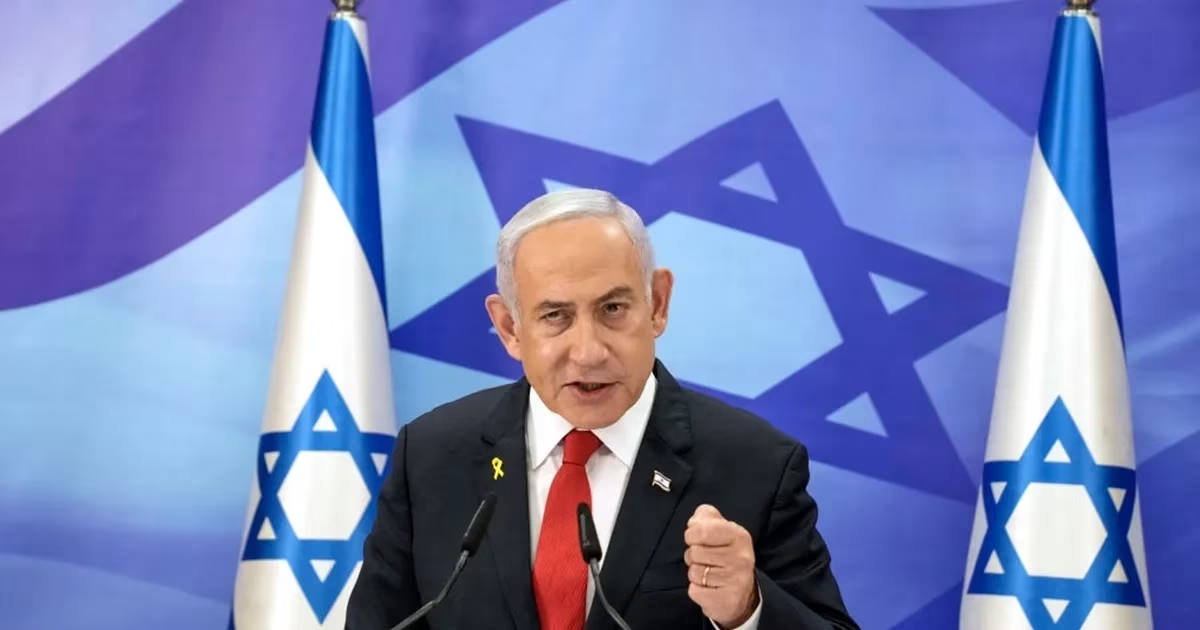
In conclusion, the international community awaits the results of these meetings with extreme caution, as any failure in Geneva could lead to military escalation in Ukraine or a nuclear confrontation with Iran. The ability of Trump's 'dealmakers' to tame these major crises remains under the microscope of a true test before the entire world.

Entrusting a team consisting of Witkoff and Kushner to solve all the world's problems is, frankly, a shocking reality.

PALESTINE

Wed 18 Feb 2026 9:43 am - Jerusalem Time

United Nations: Occupation's procedures to register West Bank lands as 'state property' are illegal and destroy the two-state solution

Stéphane Dujarric, Spokesperson for the UN Secretary-General, affirmed that the recent decisions taken by the Israeli government to impose its authority over vast areas of the occupied West Bank are illegal. He clarified in press statements that these steps explicitly violate the rules of international law and relevant UN resolutions concerning Palestinian rights.

These warnings come after the occupation government, for the first time since 1967, approved a draft resolution allowing it to begin seizing vast Palestinian lands by registering them under the name 'state property'. This new legal path aims to legitimize control over the lands and facilitate settlement expansion deep into the West Bank.

For his part, Dujarric warned that these measures would provide cover for the occupation authorities to facilitate the expulsion of Palestinians from their homes and dispossess them of their historical land ownership. He pointed out that such moves lead to undermining security and social stability in the West Bank, especially given the catastrophic humanitarian conditions in the Gaza Strip.

In the context of Palestinian reactions, the Islamic Resistance Movement (Hamas) stressed that this decision represents a blatant attempt to steal land and impose a new settlement reality by force of arms. The movement described the step as legally null and void, as it emanates from an occupying authority that lacks any legitimacy over the occupied Palestinian territories.

The UN spokesperson indicated that the international organization would continue to raise this issue in public forums and with member states, calling on the UN Security Council and influential powers to take urgent action. He urged the international community to uphold its legal and moral responsibilities to stop these violations that threaten peace and security in the region.

Dujarric also warned that current Israeli policies, supported by statements from ministers in Benjamin Netanyahu's government, directly aim to undermine any future opportunity for a two-state solution. He affirmed that Secretary-General António Guterres would continue to pressure world capitals to push for a serious political process that ends the occupation.

In conclusion of his statements, the Spokesperson for the Secretary-General emphasized that there is no alternative to the two-state solution to ensure the achievement of a sustainable and just peace that serves the peoples of the region, stressing that losing hope in political paths is not an acceptable option. This coincided with widespread condemnation from 80 countries and international organizations of Israel's unilateral actions that entrench illegal annexation.

Israeli measures will make it easier to remove Palestinians from the West Bank and dispossess them of their land ownership, which destabilizes the situation at a time when crises are escalating.

ARAB AND WORLD

Wed 18 Feb 2026 9:43 am - Jerusalem Time

Geneva Nuclear Negotiations: Initial Understandings on Principles Amidst Mutual Threats

The second round of indirect negotiations between Iran and the United States concluded in the Swiss capital, Geneva, amidst indicators oscillating between diplomatic optimism and military warnings. Tehran affirmed that this round achieved positive breakthroughs compared to its predecessor, despite the continued regional tension overshadowing the political scene in the region.

Press sources quoted an American official confirming that the talks made tangible progress on several issues, while noting that the devil lies in the details that are still under discussion. The Iranian delegation is scheduled to return to Tehran for consultations, and will return within the next two weeks with practical proposals aimed at resolving the outstanding issues.

For his part, Iranian Foreign Minister Abbas Araghchi stated that both parties succeeded in formulating initial understandings on the major principles that will govern any future agreement. Araghchi clarified that work is currently underway to exchange drafts of the potential agreement document, warning that the path to a final solution is still long due to the complexity of the core issues.

In contrast to these diplomatic atmospheres, an escalating rhetoric emerged from Iranian Supreme Leader Ali Khamenei, who threatened to deliver a devastating blow to US forces in the event of any military confrontation. Khamenei considered Iran's missile capabilities a red line that cannot be negotiated, emphasizing that Washington has no right to interfere with national deterrence programs.

International reports indicate that Tehran may be prepared to offer temporary technical concessions, including a halt to uranium enrichment for up to three years. These proposals also include the possibility of transferring part of the enriched uranium stockpile to a third party, likely Russia, in an attempt to build bridges of trust with the international community.

Observers believe that these Iranian steps aim to extract economic and commercial gains from Washington, in exchange for a temporary freeze of sensitive nuclear activities. However, these proposals remain contingent on the extent of the US administration's response to demands for lifting economic sanctions that have stifled the Iranian economy for years.

In an interpretation of the Iranian position, analysts described the Iranian Foreign Ministry's statements as a cautious welcome lacking real guarantees. Informed sources confirmed that the biggest obstacle lies in the historical lack of trust between the two sides, as Tehran demands legal guarantees that prevent any future US administration from withdrawing from the agreement.

On the American side, it appears that President Donald Trump's administration is currently inclined to give diplomacy a chance instead of direct military action. Former US State Department advisors explained that Washington aims through these talks to reduce the likelihood of armed conflict in the Middle East through limited trade-offs.

Experts in international relations believe that what is happening in Geneva is more of a 'crisis management' process than a pursuit of a comprehensive and final agreement. The current Iranian goal is focused on creating an international narrative that portrays Tehran as a flexible party seeking peace, thereby removing pretexts from the hands of parties pushing for military escalation.

Academics believe that any partial agreement that may be reached, especially if limited to the nuclear file without addressing regional influence, will face strong opposition. Such understandings are expected to provoke the Israeli side, which views any easing of pressure on Iran as a direct threat to its national security.

The ballistic missile issue remains a major stumbling block in the negotiations, as Washington insists on including it in any comprehensive deal, while Tehran considers it an integral part of its sovereignty. This fundamental divergence in views makes it difficult to predict the success of future rounds in achieving a real breakthrough that ends the decades-long crisis.

The political flexibility shown by American officials behind closed doors has not yet translated into practical steps on the ground, especially regarding the sanctions file. Political circles are awaiting the outcome of the meeting in the next two weeks, where the new Iranian proposals will serve as a real test of the parties' seriousness in reaching a settlement.

In conclusion, the Geneva negotiations remain an important station in the path of the Iranian-American conflict, but they remain fraught with risks and complexities. While diplomacy seeks a way out, the language of military threat remains present in the background, making regional stability dependent on difficult-to-achieve understandings between the two powers.

The talks witnessed positive developments and understandings were reached on key principles, but this does not mean that a final agreement is imminent.

ISRAELI AFFAIRS

Wed 18 Feb 2026 9:43 am - Jerusalem Time

An Israeli Reading of Washington and Tehran's Options: Is Trump Paving the Way for a Tactical Agreement Away from War?

Hebrew journalistic circles have discussed the expected trajectories of the relationship between the United States and Iran, in light of escalating field tensions and increased American military deployments in the region. Analytical readings questioned the possibility of a third option that transcends the dichotomy of a comprehensive nuclear deal or direct military confrontation, especially with recurring reports of aircraft carrier movements.

The sources considered that the current geopolitical reality might not be confined to two polar options, but rather that a tactical agreement might be being prepared, allowing all parties to exit the crisis without declaring surrender. This analysis comes at a time when the echo of American air reinforcements resonates, coinciding with diplomatic meetings between Trump administration envoys and the Iranian Foreign Minister in Geneva.

Military movements raise a fundamental question about Trump's objectives, and whether he is sending troops to launch an actual military campaign or to impose a new zone of control that makes the cost of refusing negotiations prohibitive for Tehran. Observers believe that this approach represents the core of Trump's negotiating doctrine, which relies on creating a tangible threat to break stalemates in complex issues.

Hebrew analyses recalled the 2017 experience with North Korea, when Washington used extreme rhetoric that ultimately led to the historic Singapore summit. Although that path did not lead to complete nuclear disarmament, it achieved a significant tactical shift in managing the conflict and mitigating direct threats.

In the Russian-Ukrainian arena, Trump applied a dual ultimatum strategy by pressuring all parties involved in the conflict to reach settlements. He hinted at stopping aid to Kyiv in the absence of flexibility, and threatened Moscow with a qualitative weapon to break the truce if it did not cease fire, reflecting a strict pragmatic approach.

The current military buildup against Iran indicates an attempt to use a 'big stick' to bring about political movement similar to what happened in other international issues. When the alternative to an agreement becomes dangerous and costly, parties begin to consider compromises that were previously classified as impossible, which may open the door for partial deals.

The 'third option' is known as a tactical deal that differs fundamentally from historical strategic agreements that seek to resolve conflicts from their deep roots. This path represents a practical mechanism for risk management, aiming to contain the current situation and prevent its explosion without the need for major sovereign concessions from any party.

This agreement's principle is based on 'silence for oxygen,' a solution designed to manage the crisis rather than perfectly end it. This path is expected to require the Iranian side to relinquish some tactical assets, such as reducing certain levels of uranium enrichment or restricting the movements of proxies in the region.

In return, Tehran will receive much-needed 'economic oxygen' amidst crippling sanctions, through exemptions allowing oil sales and the unfreezing of some financial assets. This trade-off aims to alleviate internal Iranian pressure in exchange for regional security guarantees requested by Washington and its allies.

As for the American side, this agreement achieves what is described as 'industrial peace' and freezes the status quo at a controllable point. This path allows Trump to fulfill his electoral promises related to avoiding involvement in costly and perpetual wars of attrition in the Middle East.

The Israeli reading confirms that Trump prefers tangible and quick results over lengthy negotiations that may not lead to immediate outcomes. Therefore, the display of military power serves a dual purpose: deterrence on the one hand, and improving negotiating terms at the table on the other, to ensure real Iranian concessions.

The question remains about the Iranian regime's ability to accept such tactical trade-offs without it appearing as a strategic retreat to its people and allies. However, increasing economic pressures may push decision-makers in Tehran to maneuver within the 'third way' to avoid a comprehensive confrontation scenario.

Movements in Geneva and the buildup in the region's waters indicate that we are facing an advanced stage of diplomatic and military 'finger-pointing.' The coming weeks are likely to see a clearer crystallization of this tactical path, especially if American pressure succeeds in pushing Tehran to the negotiating table with new conditions.

In conclusion, Hebrew sources believe that current American policy is redefining the rules of engagement with Iran by integrating direct military threat with conditional economic opportunities. This mix aims to create a new reality in which all parties are forced to accept half-solutions to avoid the major catastrophe that could result from any armed conflict.

The third way is a tactical agreement and a risk management mechanism based on the principle of silence for oxygen, not an ideal agreement to resolve the conflict from its roots.