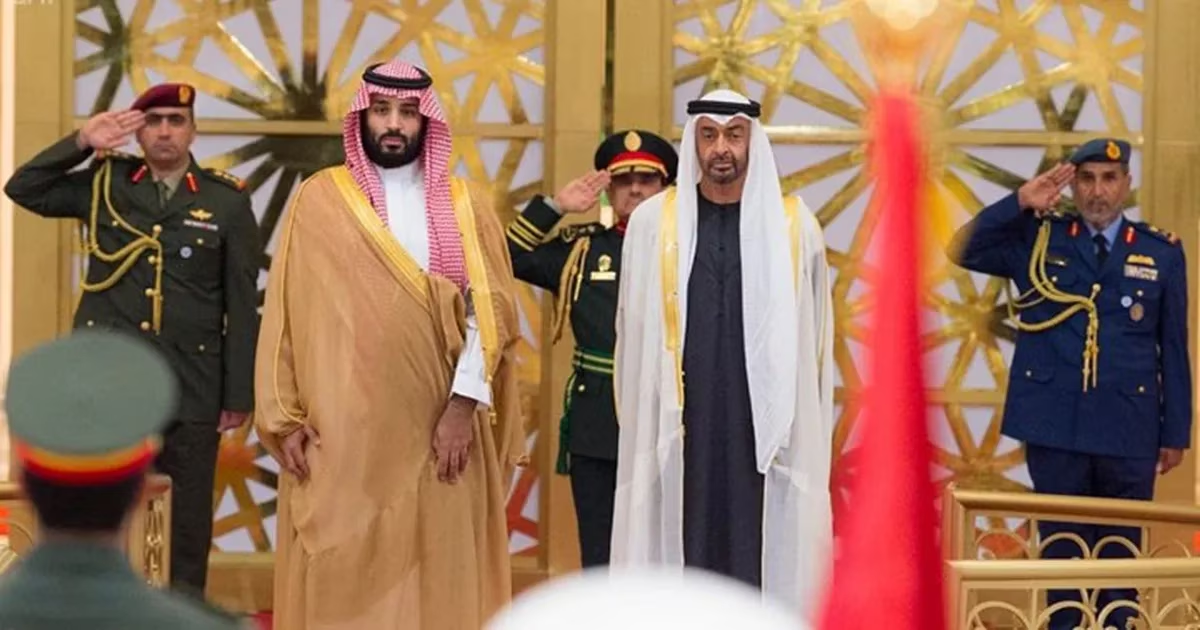







International press reports indicate that Saudi-Emirati relations are undergoing a period of escalating tension that has surpassed the usual diplomatic decorum between the two countries. Sources pointed out that the fraternal tone that once dominated official statements now starkly contradicts the reality on the ground, especially after indirect clashes occurred in thorny regional issues.
The Economist magazine stated that the main turning point began to clearly crystallize last December, when Riyadh accused Abu Dhabi of threatening its national security and bombed an Emirati arms shipment in Yemen. This covert military escalation reflected the depth of the dispute over influence in the Arabian Peninsula and the Horn of Africa, putting common interests at risk.
On the diplomatic front, it appears that direct communication channels between senior officials in the two countries have largely broken down, with effective dialogue ceasing and being replaced by sharp media rhetoric. According to sources, media platforms supported by both countries have been unleashed to launch mutual attacks, something unprecedented given the strict censorship usually imposed by Gulf capitals.
In Sudan, the dispute manifested in supporting the two sides of the armed conflict, with Saudi Arabia backing the Sudanese army, while the UAE is accused of providing financial and military support to the Rapid Support Forces. Riyadh views this intervention as a direct threat to the security of the Red Sea, which it considers a vital sphere of influence that cannot be divided between two competing parties.
As for the Yemeni file, the move by the UAE-backed Southern Transitional Council to seize territories belonging to Saudi-backed forces led to an escalation of the situation on the ground. Saudi pressure forced the Transitional Council to retreat, a step observers considered an attempt to reduce Emirati influence in the southern and eastern governorates of Yemen.
Economically, companies operating in the region have begun to feel the brunt of this dispute through newly introduced bureaucratic obstacles and delays in granting work visas to employees of companies based in the UAE. Diplomatic sources also reported the detention of commercial trucks at land borders, indicating the use of the economic card as a tool for political pressure.
Figures indicate that the volume of trade between the two countries reaches $31 billion annually, making any economic rupture a costly gamble for both sides. However, the competition to attract foreign investment and Riyadh's transformation into a regional business hub has intensified tensions with Dubai, which dominated this role for decades.
In the context of sovereign comparisons, the divergence in visions regarding political Islam and dealing with separatist forces in the region stands out, with Abu Dhabi tending towards completely eradicating Islamist movements. In contrast, Riyadh shows greater flexibility in accommodating some Islamist groups within its political balances, which irritates the Emirati side.
The dispute also extends to the stance on the Israeli occupation, where the UAE pursued full normalization in 2020, while Saudi Arabia still sets conditions related to Palestinian rights. This divergence in managing sensitive issues has led to the emergence of a 'clash of narratives' in which each party accuses the other of being beholden to external interests or falling under the influence of pressure groups.
Despite analysts ruling out a comprehensive blockade similar to what happened with Qatar in 2017, concern prevails in diplomatic circles over the continuation of a 'no peace, no war' situation. Experts believe that deep-rooted economic ties may prevent a complete collapse, but they will not prevent the continuation of fierce competition in international arenas.
In a notable development, Qatar, which was previously the target of a blockade, began to play a mediating role to bridge the views between Riyadh and Abu Dhabi. The Emir of Qatar held intensive meetings this February, including with the Saudi Minister of Defense and the President of the UAE, in an attempt to defuse the crisis before it is too late.
Other countries such as Egypt, Bahrain, and Turkey are participating in quiet diplomatic efforts to contain the situation, given the importance of Gulf stability for Arab national security. However, reports confirm that these efforts have not achieved tangible progress so far, given each party's adherence to its strategic positions in regional conflict files.
Observers believe that the UAE, which possesses an efficient army and a diversified economy, no longer wishes to play the role of 'junior partner' in Saudi foreign policy. This shift in Emirati political identity clashes with the new Saudi vision that seeks to consolidate its absolute leadership of the Arab and Gulf region.
In conclusion, the question remains about the extent to which the two countries can separate legitimate economic competition from political confrontation that could burn everything in already volatile issues. The continuation of this dispute could lead to a redraw of the map of alliances in the Middle East, serving other regional powers that are closely monitoring the scene.
The dispute between the two countries, like any rivalry in the Gulf, is a mix of the personal and the political, and has now turned into an open clash of narratives.


Share your opinion
Economist: 'Cornerstone' Cracks - Saudi-UAE Dispute Threatens Dire Consequences for the Region