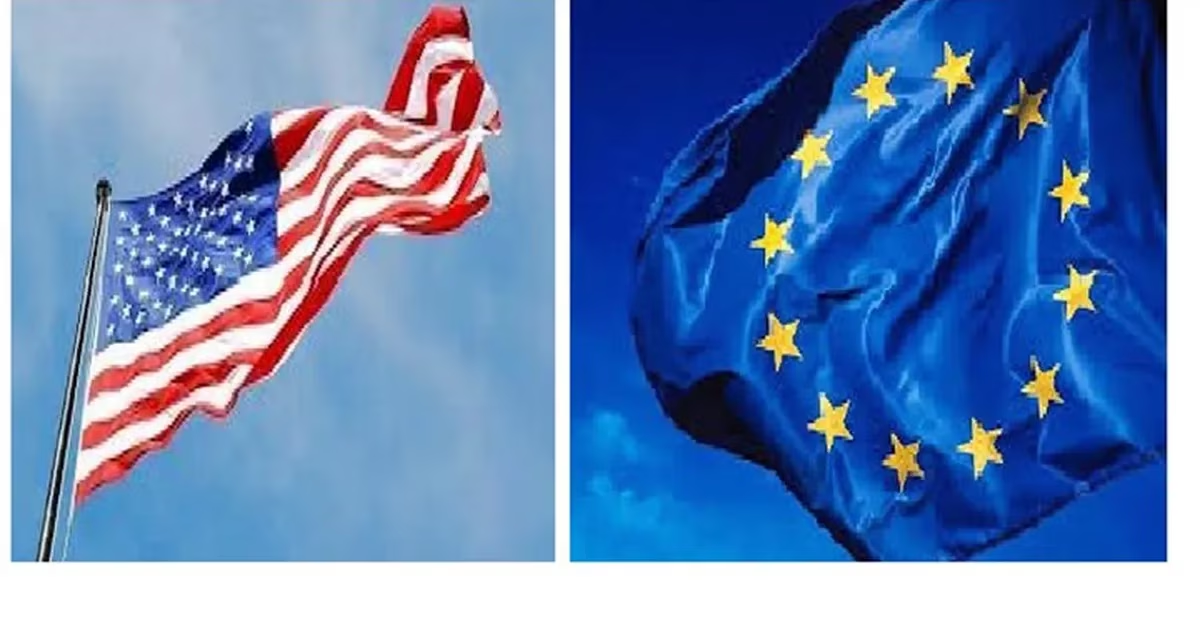







The debate surrounding American historian Robert Kagan's book 'Of Paradise and Power' has re-highlighted the deep divergence in strategic visions between the two sides of the Atlantic. Since the Iraq War in 2003, a conviction has solidified among American conservatives that the end of the Cold War did not negate the role of power in shaping the international order, which contradicts the European approach.
Kagan's famous metaphor that 'Americans are from Mars and Europeans are from Venus' embodies the core of the disagreement; where Washington prefers to use military force to resolve conflicts, European capitals tend towards diplomacy and international law. This cultural disparity has created a strategic gap that widens with every new international crisis faced by both parties.
Conservatives in the United States view Europe as an entity living in a state of political naivety, where the old continent spends on its social welfare and neglects to strengthen its defense capabilities. Analytical sources confirm that this American approach sees Europe as a 'reckless mother' who calls on Washington whenever it faces a bitter reality, as happened in the two World Wars.
Historically, the United States has not only provided military support to Europe but also contributed through the 'Marshall Plan' to the reconstruction of the continent devastated by internal conflicts. Nevertheless, American grumbling continues regarding what they consider European inaction in protecting troubling borders, especially in light of the current Russian-Ukrainian war and the millions of refugee crises.
At the height of the disagreement over Iraq, the term 'Old Europe' emerged, coined by Donald Rumsfeld to describe the traditional powers in the West, in contrast to 'New Europe' in the East and Center. This division reflected an American desire to bypass traditional European reservations and seek allies more aligned with hard power policies.
On the other hand, Europeans are proud of their continental model, which succeeded in containing historical conflicts, especially after the unification of Germany. European political culture adopts the principle of seeking common ground, considering that a neighbor is not necessarily an enemy, but rather part of an interconnected system where everyone depends on each other.
One cannot deny Europe's cultural influence on the United States, as the emigration of intellectuals and artists fleeing Nazism contributed to breaking American intellectual provincialism. These immigrants, especially German Jews, brought with them intellectual and artistic experiences that contributed to shaping contemporary American modernity in several fields.
In the first third of the last century, Paris was a true laboratory for American creators who sought individual freedom away from conservatism in their homeland. Great names like Hemingway and Scott Fitzgerald would not have reached their creative maturity without passing through the 'City of Light' and the modernist salons that included Picasso and Matisse.
Despite this cultural influence, conservative America remains unimpressed by European 'intellectual gifts,' and considers war and military standards as the primary measure for its judgments. Indeed, McCarthyism at a certain era represented a defensive reaction to repel cosmopolitan influences coming from Europe and contain their impact in major cities like New York.
Ultimately, the conflict between the two visions appears to be a struggle between a future derived from high technologies and a fixed past, and a European vision that promises a future not beholden to history. While Washington insists on its technological and military leadership, Europe remains committed to its soft power as a strategic option to face the challenges of a changing world.
Americans are from Mars and Europeans are from Venus; a metaphor that has drawn the widening gap in the strategic culture of both parties.






Share your opinion
Between Mars and Venus: A Reading of the Roots of Strategic Disagreement Between America and Europe