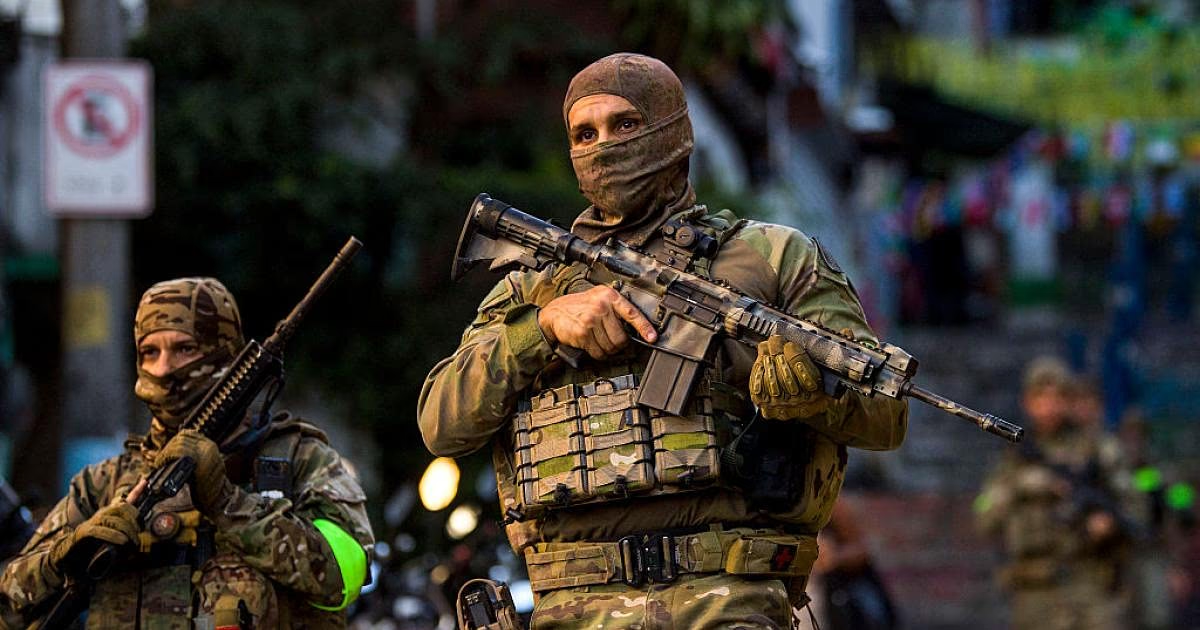







Official correspondence from the Brazilian Ministry of Foreign Affairs has revealed a state of extreme concern within the government regarding recent US policies, with Foreign Minister Mauro Vieira warning of the possibility of Washington resorting to military force within Brazilian territory. These warnings come in the wake of the US administration's decision to classify the country's major criminal groups as terrorist organizations, which Brasília considers a pretext for interfering in its sovereign affairs.
Diplomatic sources confirmed that leftist President Luiz Inácio Lula da Silva expressed strong opposition to this US approach, considering that granting terrorist status to criminal gangs aims to legitimize cross-border military interventions. The Brazilian government believes that this classification, from its perspective, gives Washington the right to pursue and target the leaders of these groups anywhere in the world without coordination with the concerned countries.
Reports indicate that Brazilian concerns are based on military precedents carried out by the Donald Trump administration since his return to the White House in 2025, where US forces launched deadly attacks against gangs in Venezuela and strikes at sea. The new US list included the groups 'Primeiro Comando da Capital' and 'Comando Vermelho', which Washington accuses of operating extensive international drug trafficking networks that extend beyond Brazilian borders.
In his message to Parliament, Minister Vieira explained that this US classification could be used to justify coercive measures against Brazilian national institutions under the guise of counter-terrorism. He stressed that the Brazilian state rejects any infringement on its territorial integrity, warning that US interpretations of international law in this context pose a direct threat to the national security of independent states in Latin America.
Domestically, the US stance has caused a sharp political division, as the right-wing opposition in Brazil quickly welcomed Washington's decision, considering it a necessary step to combat organized crime. Opposition forces accused the Lula da Silva government of being lax in confronting the gangs, amidst a charged electoral atmosphere preceding the presidential elections scheduled for next October.
International political circles are cautiously monitoring developments in this matter, especially with the increasing US military operations against drug cartels in the region, sometimes without sufficient evidence. The question remains about Brazil's ability to curb the new US tendencies, given Washington's insistence on using military tools to confront security challenges that were previously classified within the framework of police and judicial cooperation.
This classification could be used to justify cross-border measures against Brazilian institutions, and there is a risk of the United States resorting to the use of military force against national territory.
Share your opinion
Brazil warns of potential US military intervention on its territory under the pretext of counter-terrorism