






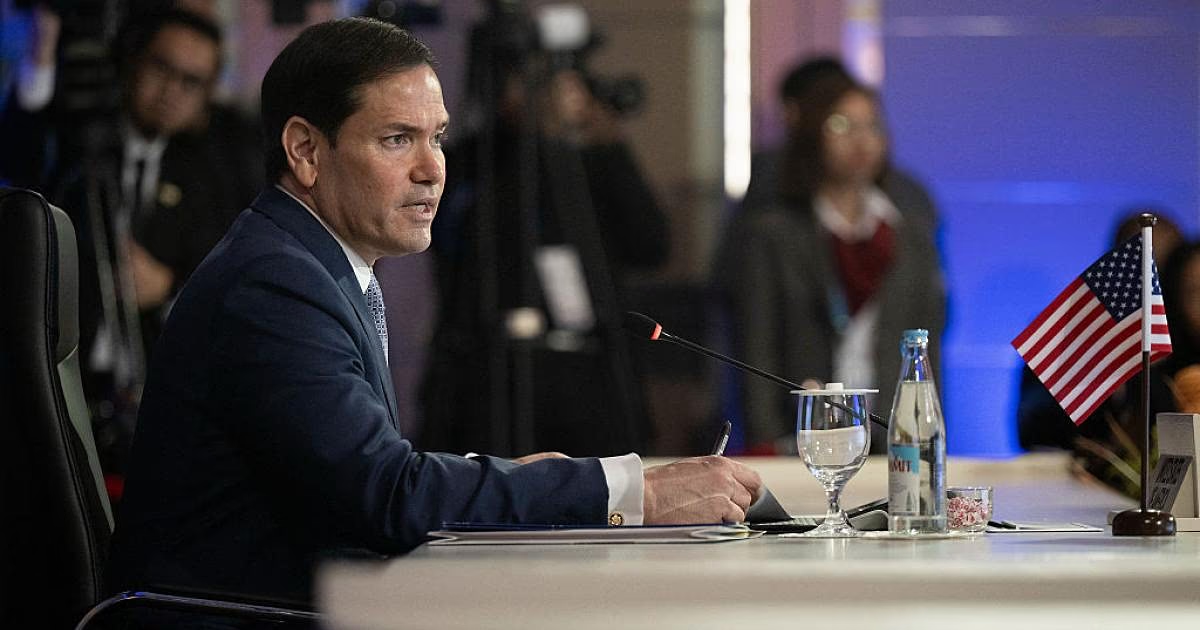
US Secretary of State Marco Rubio announced that the United States continues to keep diplomatic channels open to resolve the escalating conflict with Iran, noting that Tehran has not yet shown serious engagement with negotiation pathways. Rubio clarified during a meeting with his counterparts at the 'ASEAN' association in the Philippines that Washington is ready for dialogue provided there is genuine will from the other side.
Rubio stressed that the US administration will not hesitate to take decisive steps to protect its interests and those of its allies in the region if Iranian intransigence continues. He indicated that the main obstacle to de-escalation lies in the absence of parity in seriousness, emphasizing that commitment to diplomacy requires concrete actions on the ground, not just statements.
These statements come at a sensitive time when the region is witnessing intensive diplomatic efforts to save the temporary ceasefire agreement, amid reports of a new proposal for a ten-day cessation of hostilities. This proposal aims to revive the understandings reached last June, which collapsed due to mutual military escalation in international shipping lanes.
On the ground, sources reported that the US Central Command continued its airstrikes on Iranian sites for the eleventh consecutive night, aiming to undermine Tehran's ability to threaten navigation. Loud explosions were heard in various areas including Tabriz, Sirik, and Chabahar, while Iranian authorities activated air defense systems in the capital, Tehran.
Regarding regional mediation, Iranian Interior Minister Eskandar Momeni visited Pakistan to strengthen communication channels and convey messages between Tehran and Washington. Tehran asked Islamabad to continue its efforts to de-escalate tensions, in an attempt to avoid a comprehensive confrontation that could affect vital Iranian and nuclear facilities.
The US Secretary of State warned of the danger of controlling the Strait of Hormuz, considering that imposing any conditions or fees on passing ships represents a precedent that threatens global trade. Rubio affirmed that this issue does not concern the Middle East alone, but its repercussions extend to Southeast Asian countries that rely entirely on energy supplies passing through these waterways.
In a related context, international concerns escalated following threats by the Houthi group to impose a naval blockade on Saudi ports and target oil tankers at the entrance to the Red Sea. These threats led to a change in the route of three giant oil tankers that were heading to China and India, as they preferred to pass through the Suez Canal to avoid the turbulent Yemeni coasts.
For his part, US President Donald Trump hinted at military action against the Houthis if they carry out their threats to close the Bab al-Mandab Strait, noting that the waterway remains open for now. Trump revealed a heavy toll from the four-month conflict, announcing the death of 18 American soldiers in confrontations related to the escalation with Iran and its proxies.
The disruption of navigation routes in the Straits of Hormuz and Bab al-Mandab led to a jump in global oil prices, with Brent crude exceeding $91 per barrel. Observers believe that the continuation of maritime threats will reduce the available alternatives for oil exports, putting immense pressure on the global economy and energy security in importing countries.
In Tehran, the 'Khatam al-Anbiya' Air Defense Headquarters threatened to directly target the interests of the United States and its allies if nuclear facilities are attacked. These threats reflect the magnitude of the gap between the two sides, despite the continued existence of back channels trying to prevent a slide into a wide-ranging regional war whose end cannot be predicted.
ASEAN foreign ministers expressed their grave concern about the repercussions of this crisis on economic stability in their region, calling for ensuring freedom of air and sea navigation. The ministers warned that any long-term disruption in energy supplies would lead to severe inflationary crises affecting the livelihoods of millions in Southeast Asian countries.
International circles are awaiting the outcome of the coming days, especially with Trump's vow to strike the 'Jabal al-Fa's' area in Iran in response to recent attacks. With the collapse of previous memorandums of understanding, it seems that the dispute over freedom of navigation and mechanisms for regulating passage in international straits has become the most prominent knot preventing a return to the negotiating table.
If they are serious, we are serious, and if not, we will take the necessary measures to protect our interests and the interests of our allies.
شارك برأيك
Washington Doubts Tehran's Seriousness, Rubio Hints at Measures to Protect International Navigation