






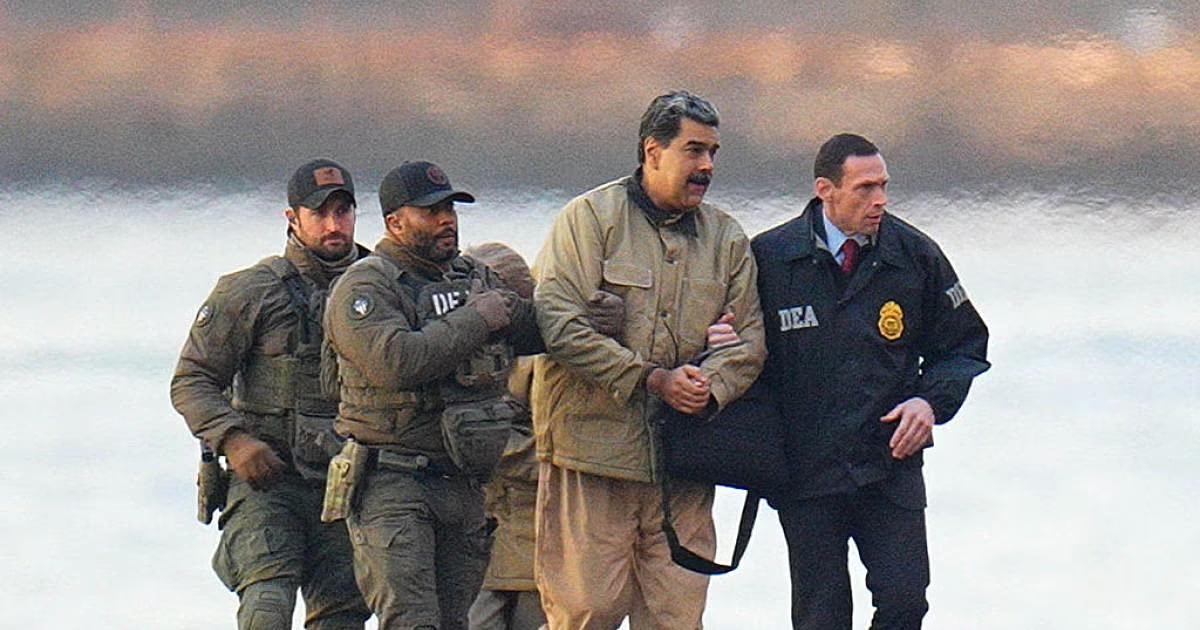
International press sources have revealed an unprecedented escalation of American influence in Venezuela, with US Secretary of State Marco Rubio now described as the de facto ruler of the country from his office in Washington. This development follows the military operation carried out by the United States, which resulted in the arrest of President Nicolas Maduro last January, opening the door to a transitional phase under direct supervision from the US administration.
Reports indicate that Rubio's influence has extended to managing natural resources and financial decisions for the interim government led by Delcy Rodriguez. Media sources quoted officials close to the White House as saying that President Donald Trump expressed his desire for Rubio to be the next leader of Venezuela, having previously suggested sending him to reside permanently in the capital, Caracas, to oversee the ongoing transformations.
Despite Rubio remaining in Washington, he manages sensitive files in Venezuela via phone and modern communication tools, leading observers to liken his situation to that of Paul Bremer, the civilian administrator who governed Iraq after the US invasion in 2003. The current administration in Caracas relies on direct directives from Washington in distributing resources and managing the suffocating economic crises plaguing the country.
The leaked information was based on interviews with more than 12 officials and figures close to decision-making circles in Washington and Caracas, all of whom confirmed that Rubio holds the financial reins. The American plan, as Rubio previously announced, aims to prevent the complete collapse of the Venezuelan state before transitioning to an economic recovery phase that ensures Western companies access to the energy market.
The Venezuelan oil sector stands out as one of the most important priorities on the current American agenda, as Washington seeks to secure the flow of supplies and open the door for American investments. Rubio personally oversees the drafting of new oil policies aimed at reintegrating the Venezuelan economy into the global system after years of isolation and sanctions imposed during Maduro's era.
Regarding the relationship between Washington and the interim government, sources revealed daily and intensive communication between Rubio and Delcy Rodriguez via WhatsApp. These conversations go beyond official political issues to include side discussions and precise coordination on media movements, with Rodriguez requesting prior approval from the US administration before making statements to international media outlets.
These arrangements reflect the unequal nature of the relationship between the two parties, as the statements of the top Venezuelan official are subject to careful review by American officials before publication. This scene indicates the extent of Washington's dominance over the new authority in Caracas, raising questions about the degree of independence of Venezuelan national decision-making in the current phase.
Analysts believe that this model represents an embodiment of the 'hard power' policy pursued by the Trump administration, where conditions are imposed on defeated parties with little regard for traditional principles of sovereignty. This approach recalls old colonial practices that the United States had abandoned decades ago, especially in its historical spheres of influence in Latin America.
In a related context, sources reported that Washington transferred quantities of enriched uranium from an old reactor in Venezuela to its territory, in a move described as securing sensitive materials. This step is part of a series of security measures taken by US forces to ensure that dangerous technologies or resources do not fall into the hands of hostile parties during the transitional period.
Despite close American supervision, the interim government faces significant challenges related to popular legitimacy, as it did not come through the ballot box but as a result of direct military intervention. Internal and international demands are growing for the necessity of launching a genuine political transition process that leads to free and fair elections, away from the continuous external tutelage represented by Rubio's office.
Intelligence reports warn that excessive reliance on American support could lead to counterproductive results if tangible economic stability, felt by the Venezuelan citizen, is not achieved. The absence of the rule of law and reliance on 'remote management' could hinder the attraction of long-term investments that the country needs to rebuild its dilapidated infrastructure after years of mismanagement.
The question remains open as to how long Washington will continue to manage Venezuela's affairs from abroad, and whether this strategy will actually lead to a stable democratic system. While the US administration insists that its goal is stability, critics argue that Washington is rebuilding Venezuelan institutions in a way that primarily serves its geopolitical and economic interests.
Rubio exerts influence over a sovereign state in a manner similar to the role played by US civilian administrator Paul Bremer in Iraq after the 2003 invasion.
شارك برأيك
Rubio, the 'de facto ruler': How Venezuela is run from Washington offices after Maduro's overthrow