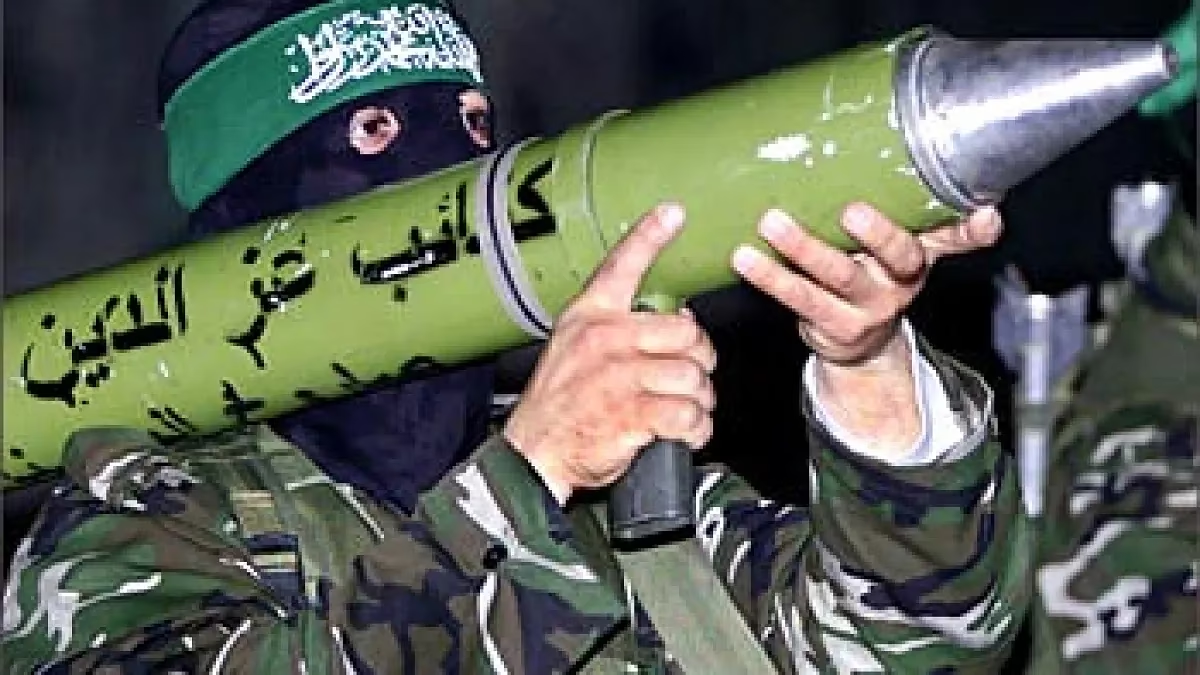







The Islamic Resistance Movement (Hamas) announced a pivotal political and administrative step by deciding to dissolve the governmental emergency committee in the Gaza Strip and transfer all its tasks to the National Committee for Gaza Administration, which emerged from the Peace Council. Observers believe that this shift ends nearly two decades of the movement's direct control over the reins of governance in the Strip, and comes at a sensitive time coinciding with ongoing Cairo negotiations regarding the Peace Council's amended proposal to implement a ceasefire agreement.
This step presents Israel with new challenges in how to deal with the emerging administrative reality, especially with questions being raised about the possibility of separating the humanitarian file from the weapons file. These developments coincide with the ongoing deep humanitarian crisis in the Strip, where field reports indicate that the occupation continues its military operations, which have claimed the lives of more than a thousand martyrs since the last ceasefire announcement, with continued military control over about 70% of Gaza's area.
On the ground, the occupation authorities continue to manipulate the movement of border crossings, allowing only about 200 aid trucks to enter daily, which represents a clear violation of international humanitarian protocols. This reality necessitates the presence of a new administrative body capable of dealing with the international community and alleviating the burden of the siege imposed on the population suffering from a severe shortage of basic necessities.
For his part, Dr. Ibrahim Freihat, Professor of International Conflicts, considered Hamas's decision to represent a strategic transition from 'governing authority' to 'managing influence'. He explained that this step ends the phase in which the movement combined the tasks of governance and resistance work, while emphasizing that this shift does not in any way mean the end of the movement's political role in the general Palestinian scene.
Freihat identified four main axes that will form the core of discussions in the coming phase, starting with ending direct administration and the potential security and administrative vacuum that may follow. He also stressed that the reconstruction file and determining the political horizon for the Strip will be the real test of the National Committee's success in establishing itself as a legitimate and effective alternative for managing Gaza's affairs.
In a related context, a state of cautious anticipation prevails in the Gaza Strip among residents who hope that this step will contribute to breaking the political stalemate and stopping the continuous Israeli attrition operations. Analysts believe that the general mood tends to support any direction that opens serious prospects for the future of governance, away from the pretexts used by Israel to justify its continuous aggression under the claim of 'Hamas rule'.
The Israeli obstacle emerges as the biggest challenge to this transformation, as Tel Aviv stipulates the disarmament of Palestinian factions as a prerequisite for any progress in political or humanitarian files. In contrast, Hamas and the rest of the factions reject linking the weapons file to relief needs, proposing a formula for restricting heavy weapons and handing them over to a consensual Palestinian authority according to a special protocol to be set by the National Committee.
Informed sources indicate that the factions participating in the Cairo dialogues seem to agree on this formula, which in some aspects intersects with US administration statements about the necessity of dealing with heavy weapons as a priority. However, the American position remains not encouraging enough to pressure the Israeli side to accept these new administrative arrangements without impossible conditions.
At the regional level, experts believe that Washington's preoccupation with Iran and Lebanon files weakens the momentum of international pressure to achieve a breakthrough in Gaza. Also, the transformation of the Peace Council into a non-governmental organization may weaken its international legitimacy, giving Israel more room for maneuver and action away from strict international oversight, especially with the upcoming Israeli elections in October.
Observers warned against the proposed 'humanitarian zone' project in Rafah under the supervision of Ali Shaath and the protection of an international force, considering it an attempt to divide the Strip and entrench geographical separation. Some believe that this plan may keep the option of displacement open by crowding thousands of Palestinians into narrow border areas, which Hamas seeks to prevent by announcing the dissolution of its government and demanding the National Committee's responsibility for the entire Strip.
Analytical insights concluded that the top priority must focus on the relief aspect and completely separate it from security and political complexities to prevent Gaza from turning into a state of permanent attrition. Experts also stressed the need for the Palestinian leadership to present unified national initiatives to prevent the transitional phase from turning into a sustainable reality of destruction and marginalization, citing previous examples where reconstruction stalled for many years.
Hamas's step represents a transition from governing authority to managing influence, ending the phase that combined governance and resistance without ending its political role.
شارك برأيك
Strategic Shift in Gaza: Hamas Dissolves its Government Committee and Hands Over Administration to the National Committee