






The Arabian Gulf region witnessed an unprecedented security escalation early Thursday morning, as Qatar, Bahrain, and Kuwait declared a state of maximum alert to confront increasing regional threats. Qatari authorities raised the security threat level to its highest degrees, issuing urgent appeals to citizens and residents to remain indoors and follow safety instructions issued by the Ministry of Interior until further notice.
In Manama, sirens blared across Bahrain, while official sources confirmed that air defense systems began intercepting aerial attacks described as Iranian in origin. The Bahraini Ministry of Interior urged everyone to remain calm and immediately proceed to the nearest safe places, while following official updates through accredited channels to avoid rumors.
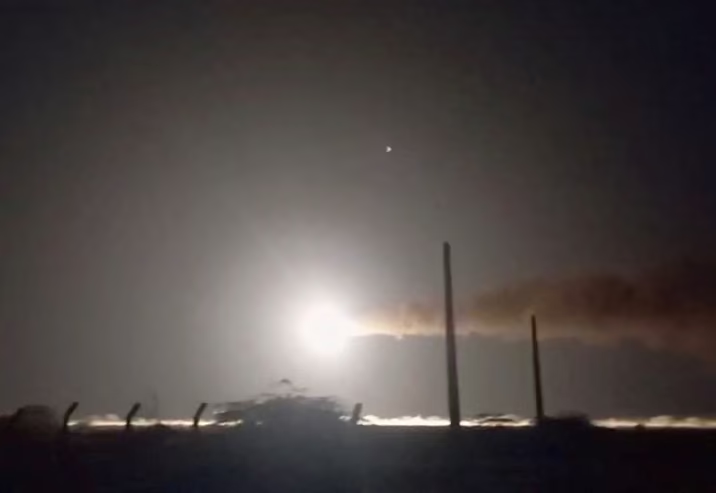
Concurrently, the General Staff of the Kuwaiti Army announced that its air defenses engaged in widespread interception operations against missile attacks and hostile drones that penetrated its airspace. Military sources clarified that the sounds of explosions heard in various areas are a direct result of successful interception operations carried out by defensive systems to protect vital installations.
This Gulf alert followed explicit Iranian threats, as media outlets quoted military sources in Tehran stating the Iranian army's intention to launch large-scale attacks targeting American bases deployed in the region. These threats come in response to a series of violent airstrikes launched by US forces on sites within Iranian territory in recent hours.
For its part, the US military confirmed the start of additional and expanded strikes against Iranian military targets, under direct guidance from President Donald Trump, who vowed a 'harsh night' for Tehran. The US Central Command clarified that these operations aim to undermine Iran's ability to threaten international navigation in the Strait of Hormuz, holding it responsible for the recent escalation against commercial vessels.
Field reports from inside Iran reported hearing violent explosions in the coastal city of Bushehr, in addition to a complete power outage in large parts of the southern city of Chabahar. Despite reports of explosions near the Bushehr nuclear plant, Iranian sources denied any material damage to the nuclear facility so far.
In the strategic city of Bandar Abbas, Iranian air defenses participated in attempts to intercept what they described as 'hostile targets' flying in the region's sky. Local news agencies confirmed that the sounds of explosions shook the cities of Sirik and Bandar Abbas, reflecting the widening scope of direct military confrontation between Washington and Tehran.
US officials indicated that Wednesday's raids were more comprehensive than previous operations, targeting advanced coastal radars and anti-ship missile launch sites. This US strategy aims to cripple Iranian defensive and offensive capabilities in vital waterways to force Tehran to halt its continuous attacks.
In a related context, the US President warned that the United States would not hesitate to launch larger attacks if Iranian threats to US interests and its allies in the region continued. Trump stressed that US forces are on high alert to respond to any attempt to target its soldiers or military bases hosted by countries in the region.
On the diplomatic front, a state of international concern prevails regarding the region sliding into a full-scale war that could lead to the collapse of the global economy and the cessation of energy supplies. Major capitals are closely monitoring developments in the coming hours, especially with Gulf countries directly entering the circle of targeting and defensive response.
The Qatari Ministry of Interior activated emergency messaging systems via mobile phones, warning of potential security threats and urging everyone to stay in 'safe places'. These measures are the strictest taken by Doha in years, indicating the seriousness of the threats facing the region amid the current conflict.
The Kuwaiti Army stressed in its latest statement the necessity for citizens to adhere to security and safety instructions, confirming that the armed forces are working around the clock to secure the airspace. The statement indicated that air monitoring systems are accurately tracking any suspicious movements in regional airspace to deal with them immediately before they reach their targets.
In Iran, the 'Mehr' agency reported that air defenses are still in continuous engagement in the southern regions, with unknown warplanes continuing to fly over military sites. Iranian coastal cities are experiencing a state of panic with repeated explosions and rising columns of smoke from some targeted sites.
In conclusion, the situation in the Gulf remains open to all possibilities, with continued military buildups and the exchange of missile strikes between the warring parties. Political circles are awaiting whether international efforts will succeed in containing the situation, or if the region is heading towards a major confrontation whose outcomes cannot be predicted.
Air defenses are currently countering missile attacks and hostile drones, and the sounds of explosions are a result of intercepting these targets.
شارك برأيك
Full Military Alert in the Gulf: Qatar Raises Readiness, Air Defenses Counter Attacks in Kuwait and Bahrain