






A state of anxiety and confusion is escalating among hundreds of thousands of Palestinian refugees in the Gaza Strip, following successive reports about plans to exclude the United Nations Relief and Works Agency (UNRWA) from providing its vital services. The agency represents the primary pillar on which the population relies for education, healthcare, and food aid, especially in light of the ongoing aggression and harsh humanitarian conditions.
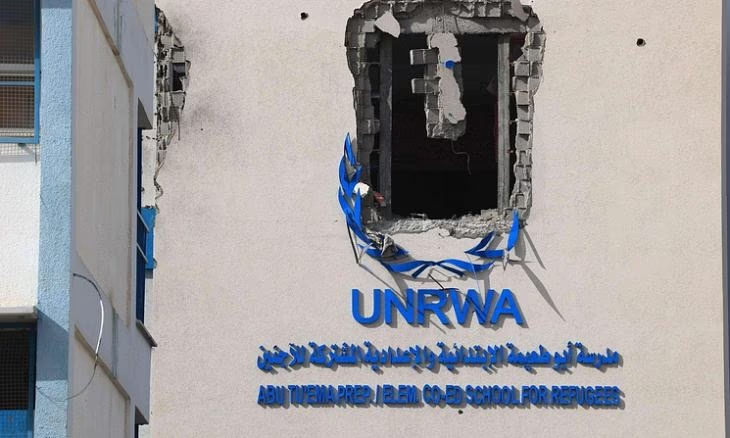
On the ground, sources reported that a school belonging to the international agency in the town of Khuza'a, east of Khan Yunis, suffered severe damage as a result of Israeli airstrikes targeting the area. This incident highlights the dangers facing the educational infrastructure managed by the international organization, which serves thousands of students who are now without homes or safe schools.
Many Palestinian families consider their lives to have been organically linked to the agency for many decades, as UNRWA is the sole source of income for thousands of employees. Afaf Siam, a refugee who works with her husband in the agency's education sector, confirms that any harm to the organization means the loss of livelihood stability for her entire family, especially since her daughter also works as a nurse in its clinics.
Siam adds that UNRWA is not just a donor, but an integral part of the social and economic fabric of Gaza, where successive generations have graduated from its schools. She believes that reducing services will lead to catastrophic consequences that go beyond the material aspect to depriving young people of job opportunities and professional growth within their besieged community.
For his part, young Izz al-Din al-Najjar recounts his experience with the agency's services that have accompanied him since birth, noting that UNRWA clinics were his family's first refuge for receiving treatment. Al-Najjar confirms that the agency's schools were not just classrooms, but an educational environment that helped refugees face difficult life challenges and build their national and intellectual personalities.
Al-Najjar points out that food aid, especially the periodic distribution of flour every three months, represents a safety valve for families suffering from food insecurity. He warns that the absence of this support in light of the current economic collapse will expose the lives of hundreds of thousands to the risks of real famine, exacerbating the unprecedented humanitarian crisis in the Strip.
On the political front, analysts believe that targeting UNRWA goes beyond administrative and financial aspects to an attempt to liquidate the political symbolism of the refugee issue. Political analyst Talal Abu Rukba confirms that the agency is the most prominent international witness to the 1948 Nakba, and that its existence is legally linked to United Nations resolutions concerning the right of return and compensation.
Abu Rukba explains that UNRWA serves about 75% of the population of the Gaza Strip, which makes its role pivotal and beyond the capabilities of other local and international institutions. He believes that attempts to transfer its powers to alternative relief agencies are primarily aimed at stripping Palestinians of their status as refugees and turning them into mere displaced persons in need of temporary humanitarian aid.
Political analyst warns that ending the agency's mandate will necessarily lead to the closure of camps as historical evidence, paving the way for resettlement projects and the dissolution of national identity. This dangerous shift threatens Palestinian political rights and empties the issue of its internationally recognized legal content for decades.
In the crowded alleys of the camps, there is a feeling that the world is abandoning its commitments to the victims, as refugees see UNRWA as the 'lifeline' that cannot be replaced. Other international institutions, despite their importance, do not have the political mandate or the massive infrastructure that the agency possesses in the fields of sustainable education and health.
Reports indicate that any change in UNRWA's status will leave a huge gap in basic services that no other entity can fill in the short term. The agency's hospitals and schools operate within an integrated system built over 75 years, and its collapse means the collapse of the entire social and service system in the Gaza Strip.
Refugees emphasize that adhering to UNRWA is adhering to historical rights, not just a search for a livelihood or free treatment. Every ration card or school certificate issued by the agency carries within it international recognition of their status as refugees awaiting return to their homes from which they were forcibly displaced.
In light of the continued raids targeting UN facilities, international demands for the protection of UNRWA headquarters and the assurance of its continued funding are increasing. Observers believe that international silence regarding the targeting of schools and clinics gives a green light to undermine the international system established to protect human rights in conflict zones.
In conclusion, the fate of millions of refugees remains dependent on international political decisions, while the people of Gaza continue their daily struggle for survival. UNRWA, despite all pressures, remains the only remaining symbol of international commitment to an issue that is the longest in modern history, and any retreat from supporting it represents a stab in the side of international justice.
Suspending UNRWA does not only mean closing an institution, but for us it means suspending our lives, livelihoods, and the future of our children.
شارك برأيك
Fears of lifeline collapse.. Gaza refugees warn of consequences of UNRWA service suspension