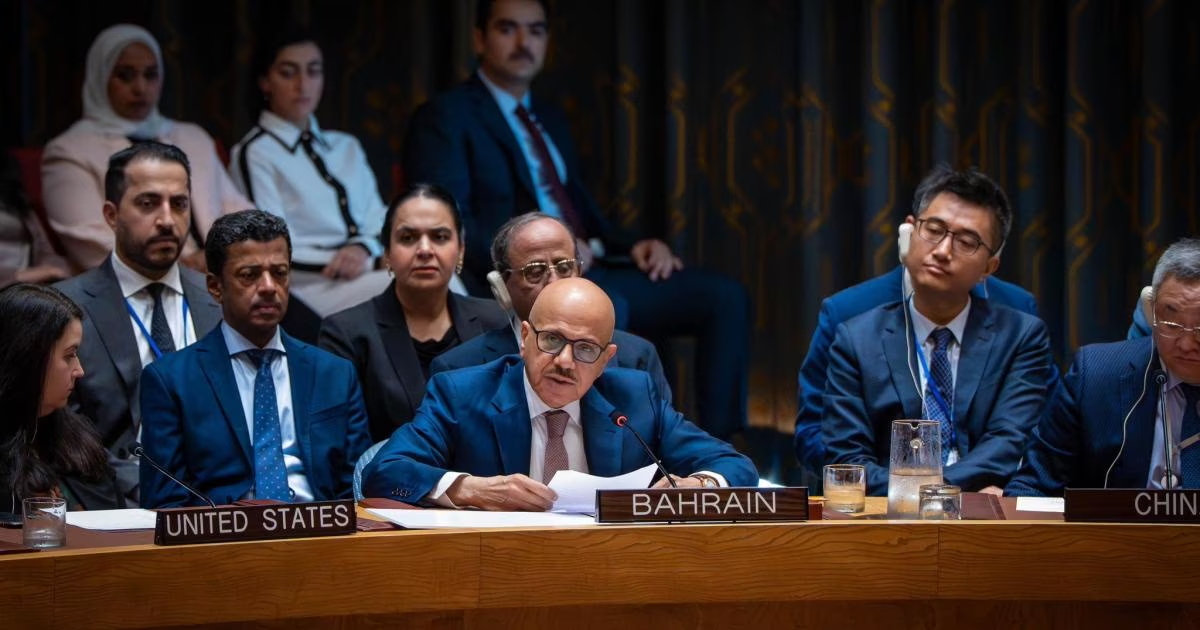







The UN Security Council in New York witnessed an emergency session, requested officially by the Kingdom of Bahrain, to discuss the serious repercussions of recent Iranian attacks that targeted the Kingdom's territories. During the session, Manama stressed the necessity of an immediate halt to what it described as 'repeated Iranian aggressions,' affirming that they targeted vital civilian sites far from military objectives.
Bahraini Foreign Minister Abdullatif Al Zayani attended the session, where he presented to the Council members details of the recent escalation on the ground. Al Zayani explained that these diplomatic moves stem from the Security Council's responsibility to maintain international peace and security, expressing his hope that the international community would not stand by idly in the face of this blatant challenge.
In his speech, the Bahraini minister affirmed that the attacks his country was subjected to are not merely fleeting or isolated incidents, but rather part of a series of aggressions that began in late February of this year. He pointed out that these operations continued provocatively even after international understandings aimed at de-escalating the situation in the region were reached.
Al Zayani revealed a painful human toll as a result of these attacks, announcing the death of three people and the injury of about 465 others, including a large number of women and children. He explained that the precise nature of the chosen targets indicates prior planning to strike civilian infrastructure that residents rely on in their daily lives.
Bahrain's discourse refuted Iranian claims that attempted to justify the strikes by saying they targeted military sites, questioning the moral or legal justification for striking water desalination plants and populated residential areas. Al Zayani stressed that the facts on the ground refute the Iranian narrative and prove that the aggressions were systematic and directly targeted civilians.
The minister indicated that these attacks represent a clear violation of the memorandum of understanding signed between Tehran and Washington on June 18, which aimed to cease military operations. He considered that the continued missile and drone bombardment undermines all efforts aimed at achieving stability in the Arabian Gulf region.
In a related context, diplomatic sources noted that Bahrain provided technical evidence to the Security Council proving the involvement of regional parties in directing these strikes towards non-military targets. Manama affirmed that the silence of the international community could encourage further violations that threaten international shipping lanes and global energy supplies.
Bahrain had previously announced in June that it had been subjected to a wave of drone and missile attacks, holding Tehran fully responsible for these hostile acts. These developments come at a time when the region is witnessing complex political and military tensions despite diplomatic de-escalation attempts.
For its part, the Iranian Revolutionary Guard had previously claimed that its operations were in response to American strikes targeting sites inside Iran. However, the Bahraini side affirmed that involving its territories and civilian facilities in this conflict is an unjustified aggression against the sovereignty of an Arab state and a member of the United Nations.
The memorandum of understanding referred to by the Bahraini minister included provisions related to a ceasefire and the lifting of the naval blockade on Iran in exchange for reopening the Strait of Hormuz to international navigation. It appears that the continuation of the attacks puts these agreements at risk and threatens the collapse of the fragile understandings reached under international auspices.
In conclusion of his speech, Al Zayani called on the Security Council to take firm measures to deter the aggressor and protect member states from external threats targeting their national security. He considered that the credibility of the international organization is now at stake in testing its ability to enforce respect for international law and protect civilian assets from military targeting.
Political circles are awaiting the outcomes of the Security Council meeting, whether resolutions or final statements, amid international division on how to deal with the Iranian file. Bahrain insists that the solution begins with an immediate and comprehensive cessation of all hostile operations and ensuring that vital facilities are not targeted again in the future.
The credibility of the Security Council is measured by its ability to protect states and deter the aggressor, and we demand an immediate halt to these systematic attacks.
شارك برأيك
Bahrain calls on Security Council to stop 'Iranian aggressions' and confirms targeting of civilian facilities