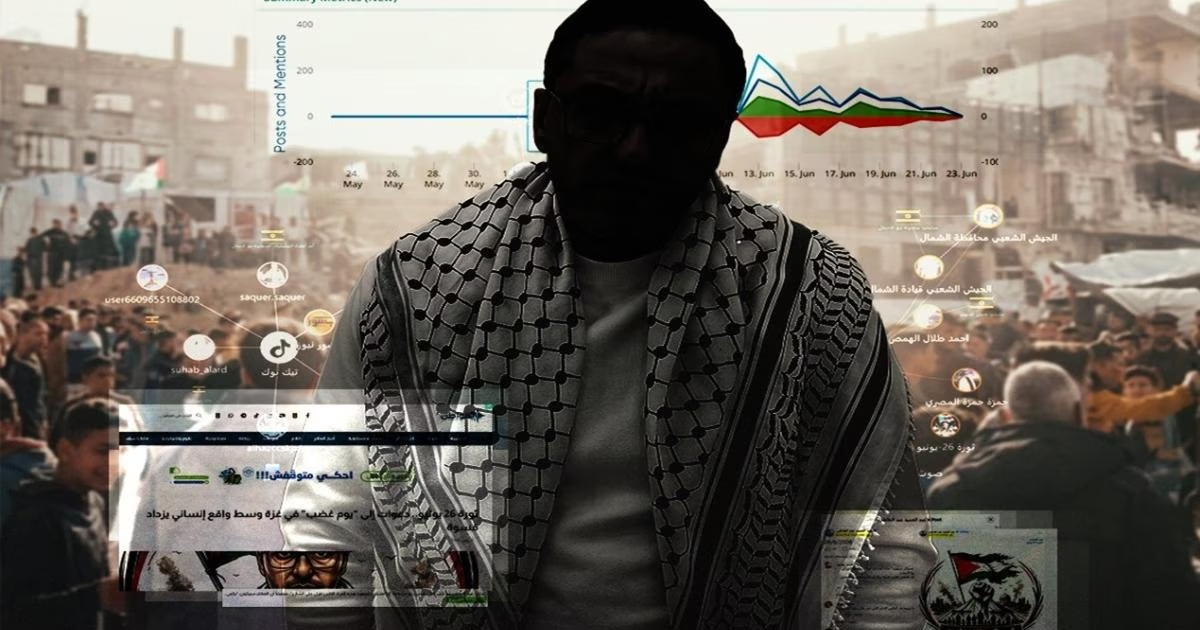







A recent technical investigation has uncovered intriguing details regarding calls for protests in the Gaza Strip on June 26th. The investigation clarified that these calls began from an individual account before transforming into a widespread digital campaign, with technical indicators showing it to be a coordinated activity managed by entities linked to the Israeli occupation.
The spark for this campaign originated from an account named 'Abdul Hamid Abdul Ati', who on June 8th, posted the hashtag '#June26Revolution' without providing clear details initially. It was later revealed that Abdul Ati holds the position of editor-in-chief of a media platform called 'Al-Muwatin' (The Citizen), which was the first to promote these calls and describe them as an anticipated popular movement.
By tracking geographical data, a stark contradiction emerged in the identity of those behind the campaign; it was found that Abdul Ati manages his accounts from Egypt despite claiming to be present inside Palestine. Domain registration records for 'Al-Muwatin' platform also revealed that it is registered in the United Arab Emirates and is technically linked to a digital marketing company in Dubai.
Participation was not limited to individual accounts; news platforms from various countries joined the fray, deliberately amplifying the hashtag. Prominent among these platforms were the Lebanese 'Asia News Agency' and 'Daily Beirut', in addition to the 'Jusoor News' platform, whose account is managed by individuals in Egypt and the United States.
The investigation monitored direct involvement of suspicious field entities, as the official page of the 'Ashraf Al-Mansi' militia, which cooperates with the occupation, was the first to respond to the call. This militia explicitly called for demonstrations against the Hamas movement, reinforcing suspicions about the political and security objectives behind this digital move.
In terms of numbers, the hashtag achieved widespread reach, accumulating approximately 160 million views in less than two weeks, but this spread was not natural. Analysis showed that about 60% of the interaction was automated reposting, while the percentage of genuine comments did not exceed 7%, indicating the use of 'electronic armies'.
Regarding the geographical distribution of participants, the United States topped the list with 16% of total posts, followed by Egypt with 7%, and then Turkey. This distribution confirms that the campaign does not reflect the pulse of the street within the Gaza Strip, but rather is an attempt to influence it from outside through directed virtual spaces.
The name 'Mustafa Asfour' emerged as one of the main drivers of the campaign from Britain, where he published dozens of inflammatory posts. His activity included publishing photos and conversations he claimed were leaked from security agencies in Gaza, but technical examination proved them to be fabricated images that underwent clear digital alterations to mislead public opinion.
As the scheduled date approached, new fake accounts appeared, announcing the postponement of the 'revolution' until July, under the pretext of completing arrangements. It was found that these accounts were created concurrently with the launch of the campaign in June and do not belong to any known organizational or union body within the Palestinian territories, which confirms their intelligence nature.
These accounts used fake names such as 'The Popular Army' to promote their statements, names associated with outlaw groups. It was also noted that these pages heavily promote videos of figures known for their hostility to the resistance and their permanent presence outside the Gaza Strip, such as Louay Khaled and Hamza Al-Masry.
Technical experts pointed out that the campaign attempted to exploit the catastrophic humanitarian situation and the suffering experienced by the residents of the Strip due to the ongoing aggression. The participating platforms sought to redirect popular anger towards the Palestinian resistance, using terminology and narratives that perfectly matched the media propaganda of the Israeli occupation.
One of the important observations recorded by the investigation was that the central accounts that amplified the campaign echoed the narrative of 'human shields'. This is an accusation constantly promoted by the occupation army to justify its targeting of civilians and vital facilities in the Gaza Strip, revealing the unity of source and objective between the digital campaign and the occupation's goals.
The investigation concluded that the 'June 26th uprising' was nothing more than a widespread digital disinformation operation lacking any popular base on the ground. The results confirmed that the absence of a single organizational structure and the multiplicity of external broadcasting sources prove that the movement was an attempt to penetrate the Palestinian internal front at a sensitive time in the conflict.
In conclusion, sources emphasized the need to be cautious of digital content of unknown origin that targets the morale of Palestinians. They clarified that public awareness in Gaza was the impenetrable barrier against the success of these campaigns, which are managed from operations rooms in capitals far from the reality of the field and its true suffering.
Analysis showed the presence of inauthentic digital behavior, coordinated and synchronized from outside the Gaza Strip, exploiting humanitarian conditions to direct popular anger.
شارك برأيك
Investigation reveals the hidden aspects of calls for a 'June 26th Revolution' in Gaza: A coordinated digital campaign led by external accounts