






Washington Message
Washington – Said Arikat - 27/6/2026
US President Donald Trump escalated his political and ideological attack on the progressive wing within the Democratic Party, describing his opponents as "atheist communists" and "animals," in a sharp speech he delivered at the Faith and Freedom Coalition conference in Washington D.C., coinciding with a lengthy post he published on the "Truth Social" platform exceeding 400 words, carrying unprecedented accusations against American progressive forces, warning of what he considered an existential threat to the United States.
The escalation came after the successes achieved by progressive and democratic socialist candidates in the New York City primaries, with the support of Mayor Zohran Mamdani, which Trump considered an indication of the expansion of the leftist current within the Democratic Party, and its transformation into a political force capable of influencing the future of national elections.
Trump said that what he described as "hardline communists" represent "the most dangerous threat facing the United States since its founding 250 years ago," considering that their ideas do not only target the economy, but also the religious and social identity of Americans. He claimed that this current "will close churches and kill people," alleging that assassinations are an essential part of its political doctrine, without providing evidence to support these accusations.
In an attempt to mock his opponents, Trump said he could become "the greatest communist in history" if he promised Americans free housing and free food, but he added that such policies would lead the country, in his words, to poverty and economic collapse and turn the United States into a state incapable of competing.
This speech comes within the framework of the election campaign in which Trump relies on mobilizing his conservative and evangelical base, by presenting the political conflict as an existential confrontation between religious and conservative values on the one hand, and radical leftist ideas on the other. His choice of the "Faith and Freedom Coalition" platform reflects his keenness to address one of the most important components of his electoral base, which played a pivotal role in his political rise in recent years.
Observers believe that Trump's language has gone beyond traditional political criticism to rhetoric based on intimidation and sharp polarization, as he portrays political opponents as an existential threat, not just electoral rivals, a style that has become a prominent feature of his discourse since entering political life.
This discourse reflects a growing trend in American politics based on transforming electoral competition into a moral and cultural battle, rather than a competition over programs and policies. When an opponent is portrayed as an enemy of the nation and religion, the space for democratic dialogue shrinks in favor of mobilization and fear rhetoric. The danger of this approach increases when it comes from a former president seeking to return to the White House, because his words not only affect his supporters, but also redraw the boundaries of public debate and push society towards more polarization and division.
Trump's statements also reveal the success of the progressive current in establishing itself as an influential player within the Democratic Party, which has led Republicans to consider it the main threat in the upcoming elections. The intense focus on New York victories reflects an understanding that shifts within the Democratic Party may extend to other states, thereby changing the nature of political competition. However, exaggerating this danger through descriptions such as "communism" and "destroying America" also reflects an electoral exploitation of historical fears associated with the Cold War more than with the current political reality.
The use of phrases such as "they will close churches" and "they will kill people" raises questions about the limits of political discourse in the United States, especially in light of the escalation of social tensions and political violence incidents in recent years. Language that relies on intimidation may achieve short-term electoral gains, but it also carries the risks of deepening societal divisions and weakening trust in democratic institutions, especially when serious claims are made without clear evidence, which opens the door to the spread of misinformation and the promotion of conspiracy theories among the public.
Trump's statements do not appear to be merely a reaction to local election results, but rather part of a broader electoral strategy based on mobilizing the conservative right-wing base by portraying the upcoming elections as a battle to save the United States from a radical transformation in its political and cultural identity. However, the continuation of this approach may make public discourse more severe, and reduce the chances of bipartisan consensus, at a time when the United States faces economic, social, and international challenges that require a greater degree of national consensus, not more political division.
شارك برأيك
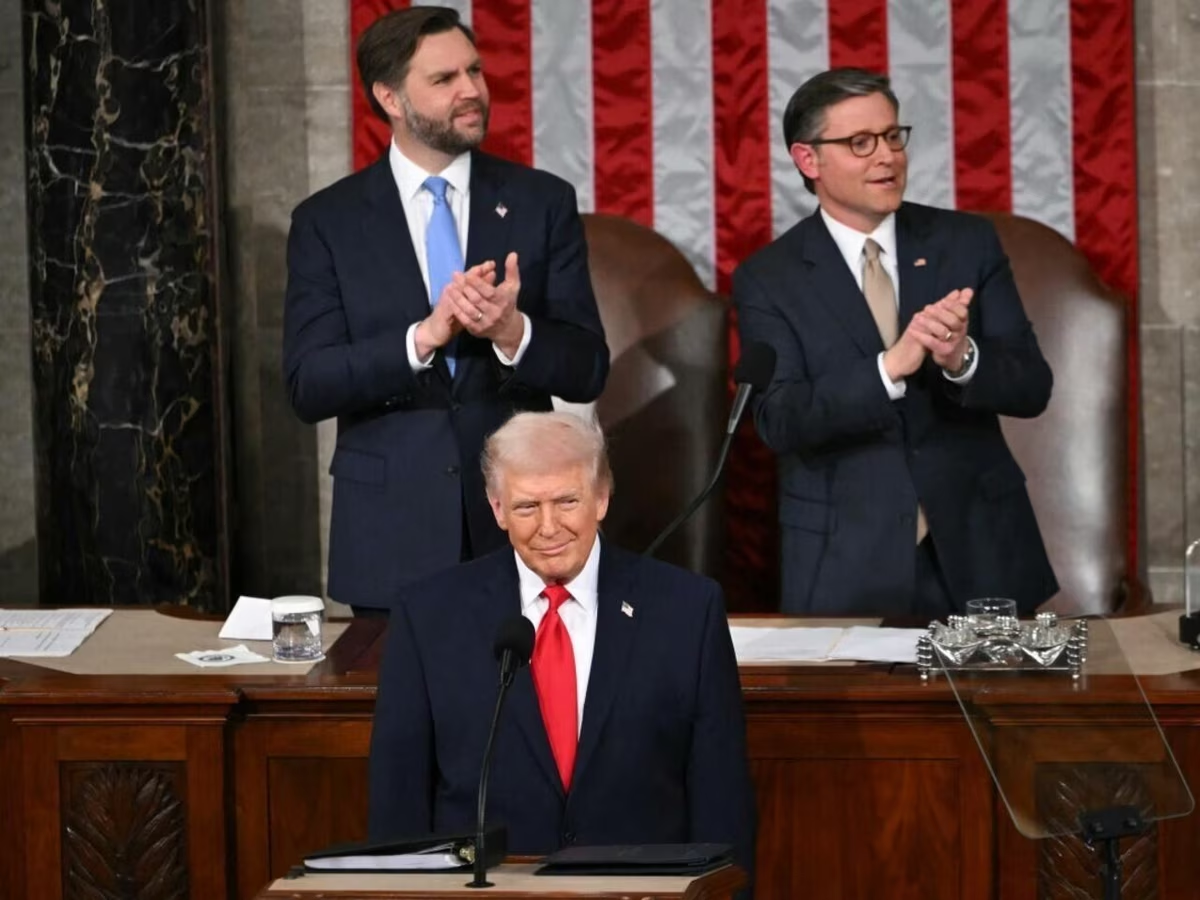
Trump escalates rhetoric against the left: Progressive Democrats "most dangerous threat" to America since its founding