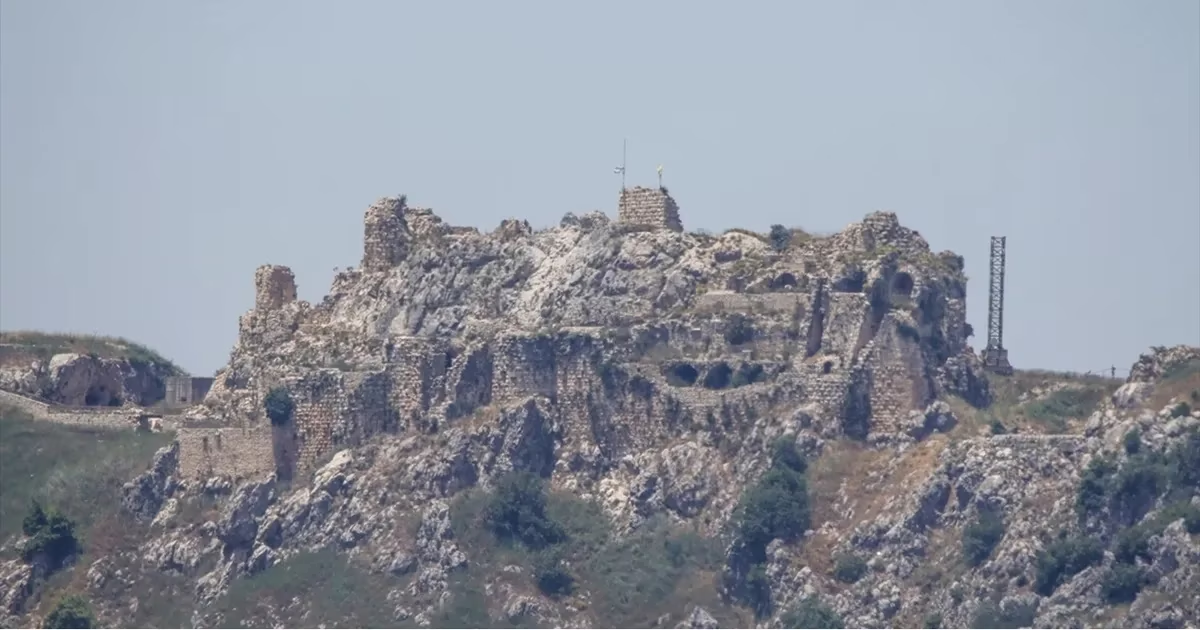







Hebrew media sources, quoting leaders in the Israeli occupation army, reported the discovery of what they described as a large-scale military infrastructure belonging to Lebanese Hezbollah, located beneath the historic Beaufort Castle in southern Lebanon. The commander of the military operation claimed that forces found fortified facilities including a fully equipped field hospital and operating rooms, indicating that these fortifications were a fundamental part of Hezbollah's defense lines.
The Israeli general responsible for the mission stated that the destruction of this infrastructure followed precise monitoring operations, emphasizing that the biggest challenge facing his forces was not only the ground fortifications but also the continuous threat posed by Hezbollah's drones. He explained that these drones represent a significant technical and military obstacle to the movements of the occupation army in the border region.
According to the Israeli narrative, the unit tasked with carrying out the attack on the Jabal al-Shaqif area had been on high alert for two full years, undergoing intensive training in methods of storming fortified positions. Sources mentioned that the military plans for this operation were presented to the Chief of Staff of the occupation army at least three times, and implementation was postponed each time for undisclosed reasons.
The military commander described the site as a "real underground city," designed to withstand long periods without aerial detection or artillery shelling. He claimed that the discovered system contains strategic stores of food and water sufficient for combat elements for several continuous months without the need for external supplies, reflecting the complexity of Hezbollah's logistical planning.
Regarding the medical aspect, the Israeli army claimed that the underground hospital includes medical beds and advanced surgical equipment capable of providing healthcare to the wounded at levels comparable to traditional hospitals. Hebrew sources considered that the presence of such medical facilities deep within the fortifications aims to maintain the combat capability of the elements in the event of widespread ground confrontations.
Israeli claims also included the seizure of massive quantities of military equipment and qualitative weapons inside the fortified warehouses in the vicinity of the castle. The report indicated the discovery of hundreds of explosive devices prepared for planting along roads and mountain passes, with the aim of obstructing any ground advance by Israeli occupation army vehicles in the area.
The military commander stressed in his statements that the combat system built by Hezbollah in this area is extremely complex, and was specifically designed to counter the Israeli army's ability to cross the Litani River. He considered these fortifications to represent the pinnacle of the party's military engineering, combining harsh natural terrain with reinforced concrete underground facilities.
Hebrew sources claimed the existence of evidence indicating what they described as an "Iranian connection" in equipping and preparing these strategic sites, alleging that the engineering expertise and necessary funding for building such underground cities came from external sources. The Israeli occupation army did not immediately provide concrete evidence to support these claims, which have been repeated in previous reports about the party's facilities.
These developments come amid escalating tension on the northern front, where the Israeli occupation army, by disseminating this information, seeks to highlight the extent of the challenges it faces in southern Lebanon. Beaufort Castle is considered a strategic and historical site overlooking vast areas of the Upper Galilee and southern Lebanon, making control of its vicinity a vital military objective.
In conclusion, Hebrew reports confirmed that the military operation in the Shaqif area was one of the most difficult battles fought by special units recently due to the geographical nature and defensive fortifications. The Israeli announcement remains within the framework of a unilateral narrative, on which no official comment has been issued by Hezbollah or the Lebanese authorities so far.
It is an underground city in every sense of the word, comprising a system that provides food and water for months, and a hospital equipped with beds to treat the wounded at the highest level.
شارك برأيك
Israeli claims of discovering a "medical and military city" under Beaufort Castle in southern Lebanon