






The massacre in the border town of Marwahin, which occurred on July 15, 2006, remains a living testament to the brutality of the Israeli occupation during the July War. On that day, the forced displacement route from the village towards the city of Tyre turned into a mass execution site for civilians, for whom raising white flags above their simple truck offered no protection.
The tragedy began when the occupation army issued strict orders to the residents of Marwahin to evacuate their town immediately under threat of intense shelling. Faced with this threat, the residents initially tried to take shelter in a UN facility, but circumstances prevented them from staying there, forcing them to risk taking the rugged displacement route.
The displaced boarded a 'pickup' truck belonging to a citizen nicknamed 'Abu Kamel', and children filled the back of the truck, clearly visible to any reconnaissance aircraft. Despite witnesses' affirmations of white flags being raised, symbolizing their civilian identity, the occupation's missiles did not hesitate to tear apart the bodies of those on board at the intersection of the town of Tayr Harfa.
This treacherous attack resulted in a horrific massacre that claimed the lives of 23 civilian martyrs, including 14 children and 7 women, according to documentation by international human rights organizations. Entire families were annihilated in this targeting; the Al-Abdullah family lost 13 of its members, while 6 members of the Ghannam family were martyred in a matter of moments.
Marwahin village is located in the Tyre district, atop Mount Balat overlooking northern occupied Palestine, and is inhabited by about 3,000 people from the 'Al-Qleitat' clan. This village is considered one of the sensitive border points that has faced repeated aggressions, but the 2006 massacre remained the deepest wound in the memory of its residents and South Lebanon in general.
Survivors recount painful details of those moments, where the truck's engine broke down minutes before the targeting, making it an easy target for Israeli malice. While 'Umm Kamel' survived because she chose to stay in a neighboring village, she lost her husband and grandchildren who had come to spend their summer vacation in their peaceful village.
The occupation forces were not content with the initial shelling; they prevented rescue and civil defense teams from reaching the site for long hours by targeting anything that moved. The bodies of the martyrs remained in the open for a period before being transported and temporarily buried in a mass grave in the city of Tyre, to later return to the soil of Marwahin after the cessation of aggression.
This massacre comes within the context of the July War, which erupted after Hezbollah's capture of two Israeli soldiers on July 12, 2006. Israel then launched a comprehensive aggression that lasted 33 days, causing massive destruction to Lebanese infrastructure and leading to the martyrdom of about 900 citizens and the injury of thousands.
Historical reports indicate that the Israeli aggression that year was not merely a reaction, but a premeditated military operation aimed at breaking the will of the Lebanese. However, the Israeli 'Winograd' Committee later concluded that the war constituted a major strategic failure for the military and political establishment in Tel Aviv.
Combat operations ended on August 14, 2006, following the issuance of UN Resolution 1701, which stipulated a cessation of hostilities and an expansion of UNIFIL's mandate. Despite the silence of the guns, stories like the Marwahin massacre continued to remind the world of the occupation's blatant violations of international humanitarian law.
Documenting these massacres in the 'Unforgettable Memory' files aims to preserve the Palestinian and Lebanese narrative in the face of attempts to erase it. The massacre in Marwahin is not just a number in the records of war, but a story of children slaughtered while dreaming of returning to their homes in peace.
Marwahin borders the villages of Al-Zaloutiyeh, Shehin, and Ramiya, forming part of the western sector that witnessed the fiercest confrontations and aggressions. The relationship of the people of these villages with their land remains strong, despite their proximity to Israeli settlements built on stolen Lebanese and Palestinian lands such as 'Zar'it'.
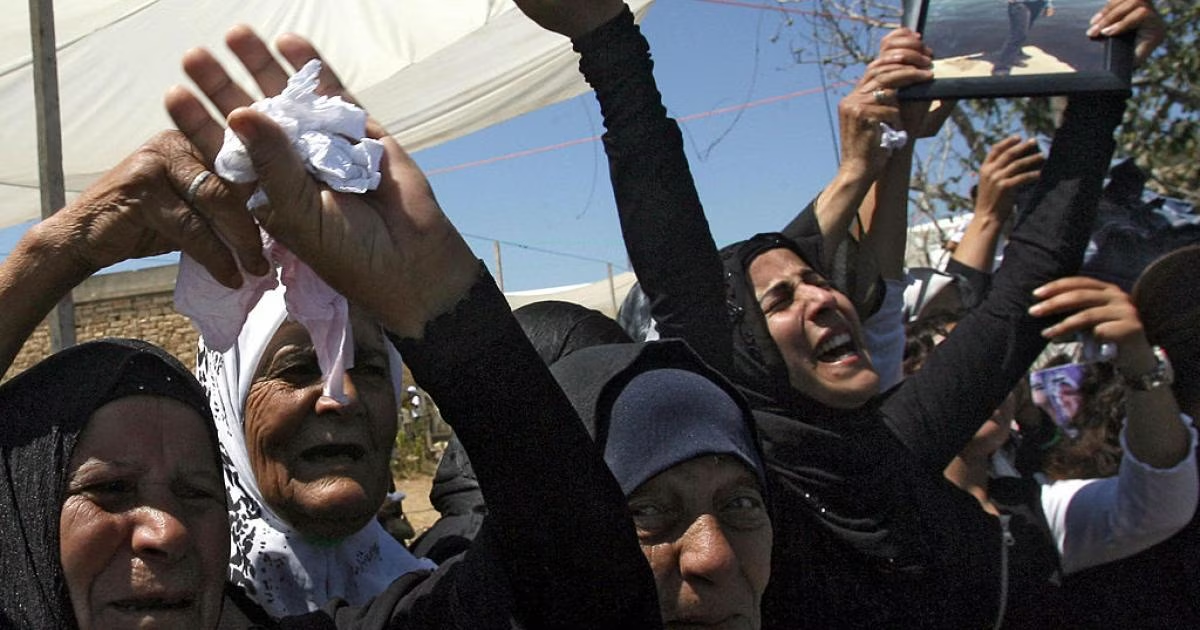
Every year, the people of the South remember their victims with tears and prayers, affirming that the right to justice does not expire. The images of the funerals of the Marwahin martyrs, which filled the streets of Tyre and the village later, remain an icon of Lebanese steadfastness in the face of a killing machine that does not distinguish between a child and a fighter.
Marwahin today, with all its pain and hope, remains a witness to a pivotal stage in the history of the Arab-Israeli conflict. Through the sacrifices of its people, it confirms that white flags may be raised in a plea for peace, but in the eyes of the occupation, they are merely a signal to identify new targets for shelling.
The white flags raised above the displaced persons' truck did not deter the occupation army from committing one of the most heinous massacres of the July War.
شارك برأيك
Marwahin Massacre 2006: When Occupation Missiles Targeted White Flags and Children's Bodies