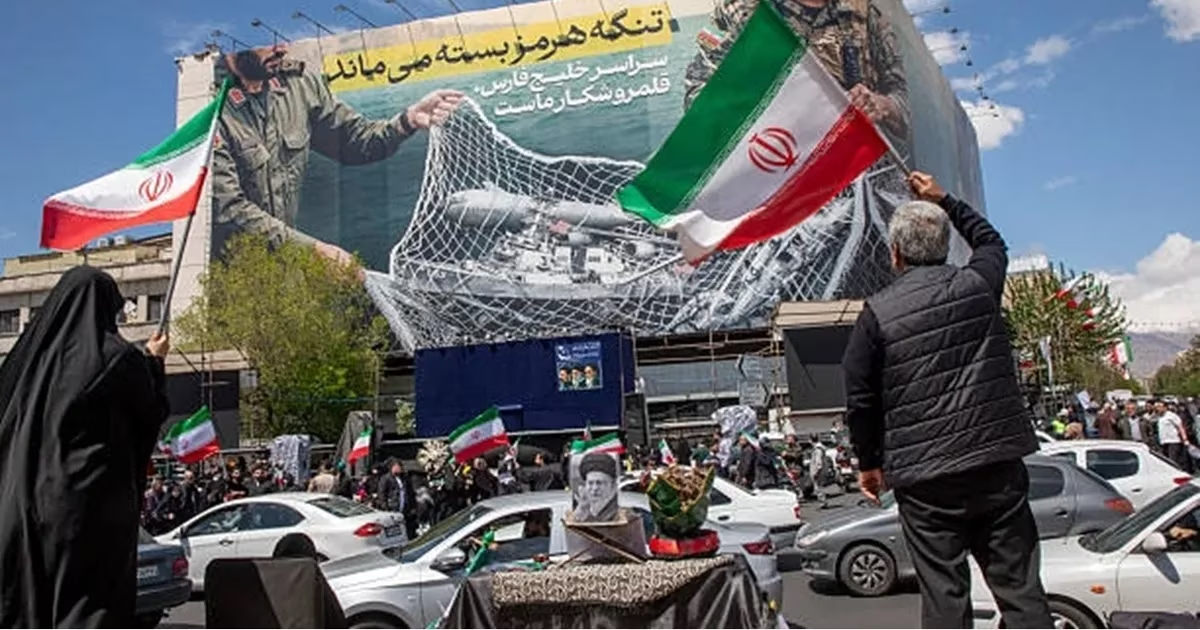







The word 'defeat' today seems closer to a realistic description of what the United States is facing amidst the ongoing war, as signs of losing international prestige have clearly begun to emerge with the conflict entering its second month. Official statements from the White House reveal a state of political predicament, as observers believe that extensive American involvement was not a strategic necessity for national interests as much as it was a response to internal pressures.
The Zionist lobby and Zionist Christian currents play a pivotal role in guiding the compass of the current American administration, using financial and media pressure tools and political blackmail. The events after October 7 revealed the penetration of these forces into decision-making joints, which pushed Washington to adopt narratives that facts proved false, placing the American nation before a deep internal review of its identity and global role.
Historically, the United States showed reservations towards Jewish immigration until the end of World War II, but major shifts in the balance of power in 1945 enabled Jewish groups to strengthen their positions. This rise was not a coincidence, but rather a result of a precise understanding of international variables, which reminds us of what the Russian writer Dostoevsky wrote in his famous article 'The Jewish Question' about the hidden endeavors to influence societies.
On the other side of the Atlantic, the European position, especially in France and Spain, shows a fundamental divergence from the American vision towards Israel. Historical Europe views the entity as a geographical barrier or a means to dispose of the Jewish question away from the continent, while Washington goes far in adopting the Zionist project as an organic part of its global strategy, which has created a gap in interests between allies.
Political readings indicate that many European countries secretly wish for the United States to emerge 'broken' from this confrontation to rebalance power within the old continent. This ambition is not limited to Europe alone but extends to rising great powers such as China and Russia, who are closely monitoring the scene and seizing opportunities to reduce America's sole global influence.
On the ground, the downing of American aircraft raised questions about the entry of advanced air defense technologies into the conflict arena, which may indicate undeclared technical support from international powers. These qualitative developments in Iranian military capabilities, and their resilience in the face of threats, have imposed a new reality that has pushed international parties to seek negotiated paths and a temporary ceasefire to avoid sliding into an all-out confrontation.
The American propaganda machine tries to inflate limited military operations, such as rescuing pilots, to cover up the failure to achieve major strategic goals during the war. However, global public awareness has become more capable of exposing these media ploys, as rhetorical festivals are no longer able to hide the reality of field setbacks and the absence of tangible achievements on the ground.
The Arab world, and its peoples in particular, are watching this American decline with much anticipation, recalling the pains of the invasion of Iraq in 2003 and the setbacks that preceded it. Resilience in the face of American arrogance reopens the files of Arab national security that were shaken, especially after the humiliating way former American leaders dealt with the region's countries and their wealth.
Events have proven that the ability to control vital files such as energy, and to stand firm against military threats, can break the barrier of fear for other countries. The policy of 'no' that has begun to resonate in international political circles reflects a global exasperation with the 'demonic arrogance' practiced by Washington based solely on its material power, without regard for human values or international law.
The official Arab system finds itself today compelled to discuss the concept of national security away from the American umbrella, which has proven its complete bias. Fears that the spark of conflict will extend to other countries in the region necessitate the building of independent defensive and political strategies, relying on self-reliance and protecting national capabilities from continuous external blackmail.
The great paradox today lies in the continuous widening of the gap between the awareness of peoples and the practices of politicians, which portends a major historical event that may change the face of the region. This growing awareness is the true fruit of the popular steadfastness in Gaza and Palestine, which has reordered global priorities and revealed the reality of the powers that claim to protect democracy while practicing the most heinous forms of oppression.
Russia and China, as competing poles, fully realize that the erosion of American prestige in the Middle East necessarily means accelerating the birth of a multipolar world order. Despite caution in official statements, geopolitical movements indicate implicit support for anything that would drain American capabilities and engage them in long-term regional conflicts that weaken their global grip.
In conclusion, the 'arrogance of power' that has characterized American foreign policy for decades today seems to be digging the pit into which this hegemony will fall. History teaches us that empires that rely on military oppression and disregard the rights of peoples always end in decline, and what we see today may be the actual beginning of the end of the unique American era.
The waiting for the 'historical circumstance' that will change the balance is no longer just wishes, but has become a reality shaped by the steadfastness of anti-hegemonic forces and the erosion of traditional alliances. The events of this war will remain a turning point in the history of international relations, as history will record how the arrogance of power turned into a factor of weakness that ultimately led to the retreat of the unipolar power before the will of the peoples.
The 'arrogance of power' practiced by the United States may turn into a deep pit into which its global hegemony will fall.
شارك برأيك
Erosion of American Prestige: Does the World Agree on Washington's Decline?