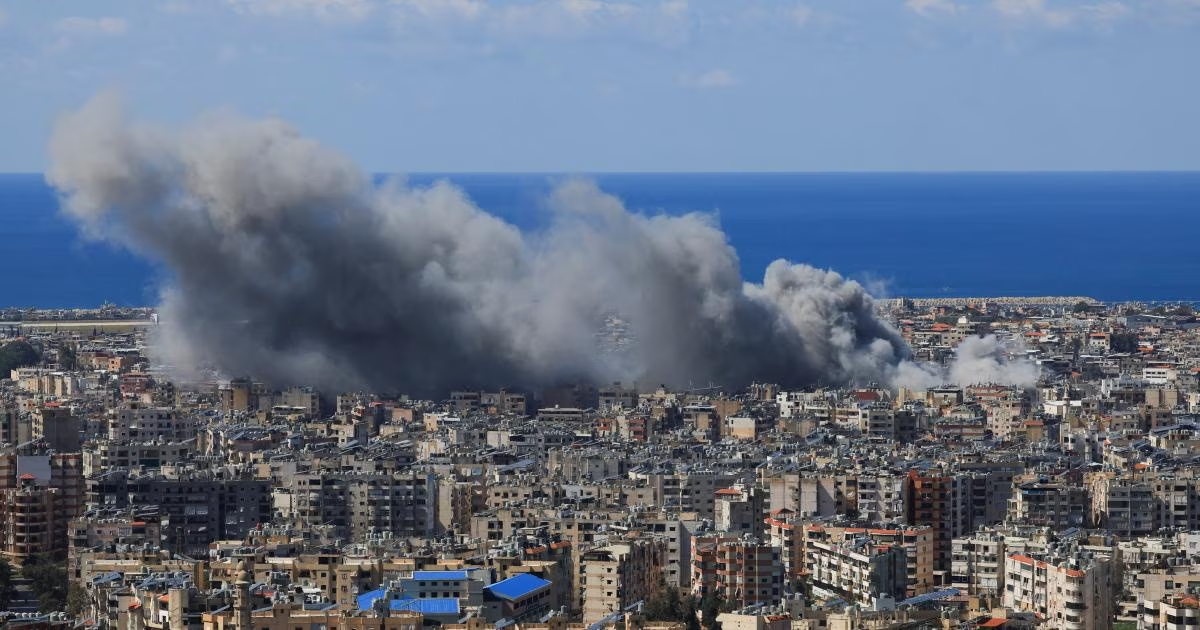







Israeli occupation aircraft intensified their violent raids today, Monday, on the southern suburbs of Beirut and several areas in southern Lebanon, targeting what they described as financial headquarters belonging to the Al-Qard Al-Hasan institution. These aerial attacks resulted in the martyrdom of one person and the injury of 12 others with varying degrees of injuries, amidst intensive and continuous low-altitude drone flights over the capital Beirut.
In the south, the raids targeted the towns of Tyre and Jouya, leading to the martyrdom of two paramedics while performing their humanitarian duty, while a Lebanese citizen was martyred and another seriously injured after their home was destroyed in the town of Shukin. Local sources also reported the martyrdom of a municipal police officer in the town of Shebaa due to being directly targeted by a missile from an Israeli drone.
On the ground, the occupation army announced that forces from Division 36 began implementing what it described as 'precise raids' targeting Hezbollah's military infrastructure in border villages. These ground movements coincide with the aerial and artillery bombardment that has not stopped since the early morning hours along the front lines and residential areas.
In response, Hezbollah retaliated with a series of rocket operations, announcing that it had targeted the Kiryat Shmona settlement with an intensive rocket barrage. The party also confirmed shelling the 'Za'eef' air defense base in the occupied city of Haifa, emphasizing that these operations come in response to the targeting of civilians and vital installations in Lebanon.
On the domestic political front, the Lebanese Parliament took an exceptional decision to extend its legislative term for an additional two years, which means postponing the elections that were scheduled for next May. The decision was made by a majority of 76 votes against 41 opposing deputies, and the Parliament's presidency justified this step by the compelling security circumstances and the ongoing aggression against the country.
The parliamentary session witnessed a remarkable presence of deputies from the Loyalty to the Resistance bloc, headed by Mohammed Raad, at a time when Lebanon is suffering from sharp political divisions over how to deal with the war. This extension is the fourth of its kind since 2013, as the council had previously extended its term several times due to successive political and security crises.
For his part, President Joseph Aoun expressed the Lebanese state's readiness to resume indirect negotiations to discuss the necessary security arrangements to stop the escalation. Aoun affirmed that he conveyed this position to influential international capitals, stressing that the decision to confine weapons to the state will be implemented according to the army command's plan once security conditions improve.
President Aoun warned against attempts to target the army institution or its leadership at this critical time, describing such attempts as 'suspicious' and serving external goals aimed at undermining state authority. He pointed out that questioning the army's capabilities is consistent with attempts to drag Lebanon into broader regional conflicts that do not serve the national interest.
In striking statements, Prime Minister Nawaf Salam said that Lebanon has no interest in being drawn into the ongoing conflict between the United States and Israel on one hand, and Iran on the other. Salam stressed that the top priority currently is an immediate cessation of fighting, considering that the process of handing over Hezbollah's weapons is a separate process that must follow de-escalation.
Salam clarified that the Lebanese government has not yet received integrated initiatives to stop the war, but merely ideas put forward for discussion at the international table. He revealed that the only guarantees Beirut has received relate only to neutralizing the airport and the roads leading to it from Israeli shelling to ensure the continued movement of supplies.
Regarding the legal status of the resistance's weapons, the Prime Minister affirmed that Hezbollah's military and security activities have become 'illegal' from the perspective of the current government. He added that this position represents the official orientation of the state and must be implemented, while at the same time emphasizing that Lebanon will not accept a peace that imposes Israeli conditions on it.
Moving to the Gaza Strip, Israeli violations of the fragile ceasefire agreement continued, with 3 Palestinians, including two children, martyred in shelling that targeted displaced persons' tents in the Al-Sawarah area. Medical sources reported that the number of victims of violations since last October has risen to 641 martyrs, threatening the collapse of existing security understandings.
Reports from Gaza indicate massive destruction affecting about 90% of civilian infrastructure since the start of the war of extermination in October 2023. The United Nations estimates the cost of rebuilding what the occupation destroyed at about $70 billion, amidst the continued siege and intermittent military operations targeting civilians and paramedics.
In conclusion, Lebanon and the Gaza Strip are living in a state of cautious anticipation with the escalation of aerial raids and ground operations. While political parties in Beirut are trying to arrange the internal house by extending the parliament's term, the field remains the primary driver of events amidst the absence of a clear horizon for a diplomatic solution that ends the suffering of the displaced and civilians.
Hezbollah's military and security activities have become illegal, and this is the government's position and must be implemented.
شارك برأيك
Bloody Israeli escalation in Lebanon and parliament extends its term by two years amid the war