






Washington - Said Arikat - 3/5/2026
News Analysis
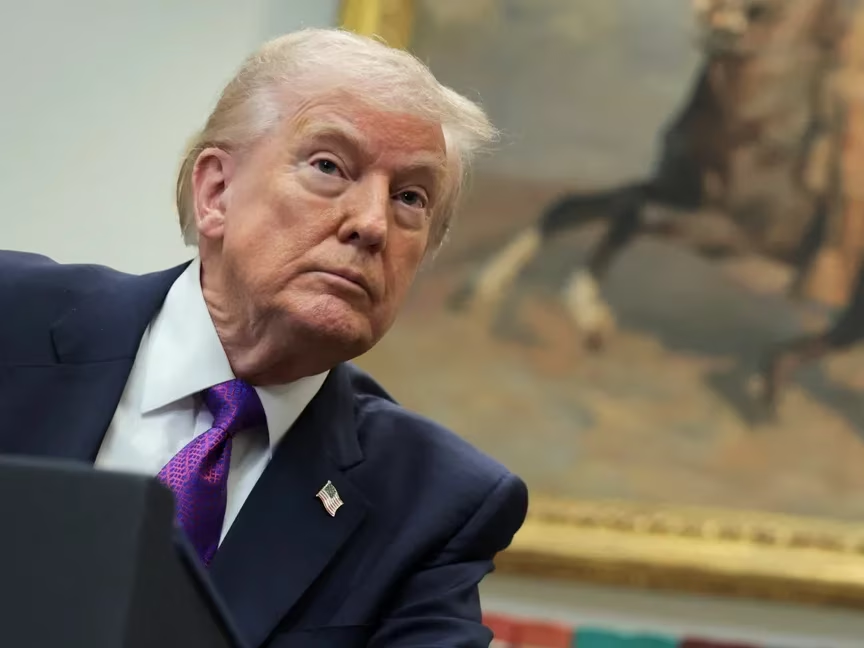
US President Donald Trump's statements regarding the future of leadership in Iran have sparked widespread controversy, after he explicitly declared that he believes he should have a personal role in choosing the next Iranian leader. In an interview with an American news website, Trump said that the son of the late Iranian Supreme Leader, Mojtaba Khamenei, is "unacceptable to him," stressing that the United States wants "someone who brings harmony and peace to Iran." The US President did not stop at this position, but emphasized that he "must be involved in the selection process."
These statements come in the wake of the American-Israeli military strikes that assassinated Iranian Supreme Leader Ali Khamenei last Saturday, in a dramatic development that reshaped the equations of conflict between Washington and Tehran. According to Iranian sources, Mojtaba Khamenei survived the strikes that targeted leadership positions in Iran, and is seen within the religious and political establishment as one of the most prominent candidates to succeed his father as Supreme Leader.
Mojtaba Khamenei is a mid-ranking cleric, but he has close ties with the "Revolutionary Guard," which has made him an influential figure within the Iranian power structure in recent years, despite his relative absence from media appearances. Therefore, the mention of his name as a potential successor to his father does not seem surprising in light of the complex balances within the Iranian system.
However, what was striking about Trump's statements was not merely his rejection of this option, but the direct way in which he expressed his position. He said that he "must be involved in the appointment," comparing it to previous American experiences in influencing political balances in other countries, in reference to Venezuela. This type of statement opens the door to deep questions about the nature of American goals in the current war, and whether they go beyond military deterrence to an attempt to reshape the Iranian political system.
Politically, these statements reveal a clear shift in American discourse. At the beginning of the American-Israeli aggression, the war was presented as a defensive step aimed at preventing security threats and re-establishing deterrence. But the talk now about choosing the next Iranian leadership suggests that the goal is no longer limited to militarily weakening Iran, but extends to directly influencing the future of its political system.
This shift brings to mind the experiences of American intervention in the Middle East over the past two decades, when military operations began with limited objectives before gradually turning into projects to re-engineer political systems. In many of those cases, reality proved that changing regimes from the outside is a much more complex process than decision-making centers in Washington imagine.
Trump's statements also put the United States in a contradictory position with its traditional discourse about respecting the sovereignty of nations. The public call to participate in choosing the leader of another country represents an unprecedented level of direct political intervention, even in the context of the intense conflicts that have characterized American-Iranian relations since the 1979 Islamic Revolution.
Even more noteworthy is that this position also contradicts the political discourse that Trump himself adopted for years. He built a large part of his political popularity on criticizing long wars in the Middle East, and on rejecting the "nation-building" policies associated with the administration of former Republican President George W. Bush. However, the call today to intervene in determining the Iranian leadership seems, in the view of many observers, a direct extension of those policies that Trump strongly criticized.
This contradiction reflects a clear paradox between political discourse and practical reality. The president who repeatedly pledged to avoid costly wars and deep foreign interventions finds himself today speaking in a language very similar to the language that prevailed during the years after the September 11 (2001) attacks, when Washington sought to redraw the political map of the Middle East.
This trend also raises fears that the current war may gradually expand towards more ambitious and complex goals. Recent history shows that wars that begin under the banner of deterrence or defense can quickly turn into regime change projects, a path that often leads to long-term entanglement. The mere talk of choosing the next Iranian leadership means that Washington is already thinking about the form of power that will succeed the current leadership, and not just about how to end military operations.
But such a path carries significant political risks. A leadership that is seen within Iran as the product of foreign intervention will likely face a severe legitimacy crisis, which could lead to further instability rather than achieving the "harmony and peace" that Trump spoke of.
In this context, observers believe that the US President's statements reveal a renewed tendency in American policy based on the belief that military power can rearrange political systems in the world according to the American vision. However, previous experiences in the region indicate that societies are not reshaped by external decisions, and that attempts to impose change from outside often produce longer and deeper crises than planned.
Here lies the great paradox. The president who repeatedly promised his voters to avoid Middle East wars and not engage in "nation-building" projects finds himself today speaking in a language that suggests the reproduction of the very model that led the United States to long and costly wars in the region. While intervention in choosing the Iranian leadership is presented as a step towards achieving stability, many analysts fear that such an approach will lead to the exact opposite: opening a new chapter of conflict and instability in one of the world's most sensitive and complex regions.
شارك برأيك
Trump Wants to Choose Iran's Next Leader: A New American Tendency to Shape Regional Regimes