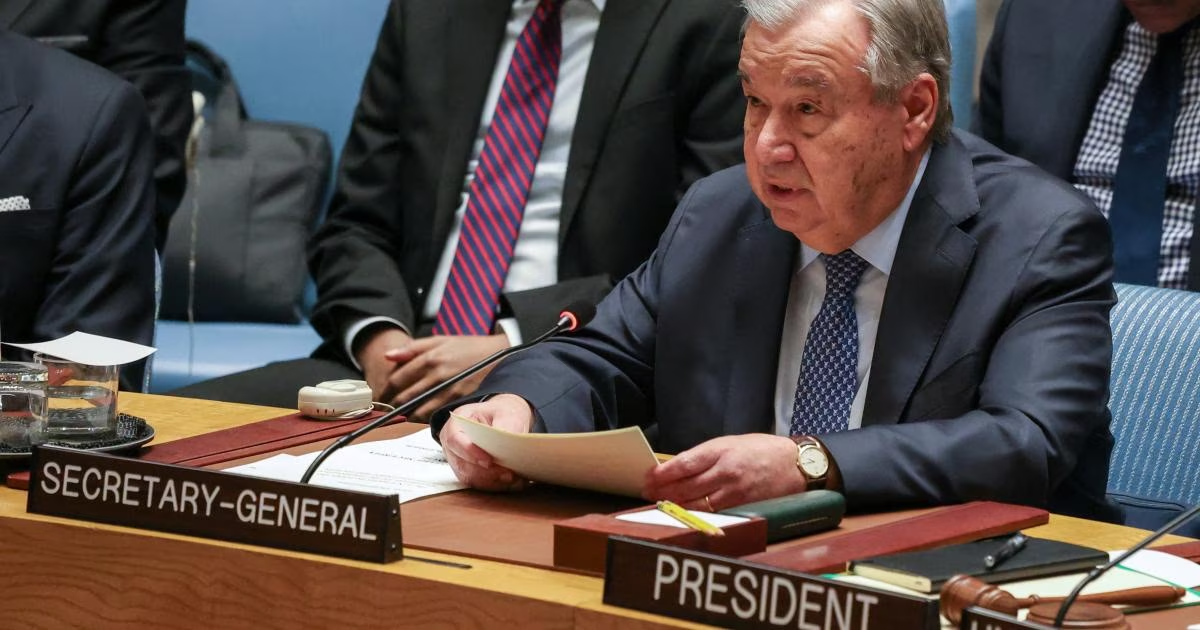







Stéphane Dujarric, the Spokesperson for the UN Secretary-General, expressed deep concerns about the Middle East sliding into a comprehensive conflict that transcends current borders. Dujarric stressed the need for all parties involved in the confrontations to cease military escalation and immediately resort to dialogue to end the escalating crisis.
These warnings come amidst a military aggression launched by Israel and the United States on Iranian territories since late February, which has resulted in heavy human losses. The attacks targeted high-ranking officials in the Iranian state, led by Supreme Leader Ali Khamenei and a number of prominent security officials, which has complicated the field situation unprecedentedly.
In response, Tehran continues its military responses by launching barrages of missiles and drones towards Israeli targets, in addition to targeting what it describes as American interests in several Arab countries. These mutual attacks have caused civilian casualties and severe damage to infrastructure, including ports and residential areas.
In statements to Arab media from New York, Dujarric affirmed that the civilian population bears the brunt of this bloody conflict. He pointed out that the continuation of military operations increases the suffering of citizens who find themselves caught in the crossfire of a conflict they did not choose, warning that the humanitarian impact has begun to extend to global levels.
UN Secretary-General António Guterres had strongly condemned these military actions during his speech to the Security Council last Saturday. Guterres described these actions as hostile to the principles and charter of the international organization, emphasizing that the use of force in international relations is a blatant violation of regulating laws.
The UN spokesperson recalled the content of Article Two of the United Nations Charter, which prohibits the threat or use of force against the territorial integrity or political independence of any state. Dujarric criticized the mutual attacks that targeted countries not party to the initial conflict, considering it a dangerous expansion that threatens regional and international stability.
In the context of diplomatic efforts, Dujarric revealed extensive contacts made by Guterres in the past few days with active parties, including representatives of the Gulf Cooperation Council. The Secretary-General also held meetings with Iranian officials in a serious attempt to de-escalate and open channels for direct communication between the conflicting parties.
UN efforts were not limited to the regional aspect but also included direct and clear communication with the US administration, where Guterres met with National Security Advisor Michael Waltz and the US Ambassador to the United Nations. These meetings aim to pressure for a cessation of hostilities and to warn against the consequences of continued violence that fuels hatred in the region.
Dujarric clarified that the UN Secretary-General does not possess magical tools to compel states to negotiate, but he does possess the will and ability to exert all possible diplomatic efforts. He affirmed that the choice now rests with the leaders: either to proceed with a destructive conflict or to return to the path of negotiations that ensures the protection of lives and property.
The spokesperson for the Secretary-General stressed that any military conflict must be followed by a phase of legal and moral accountability immediately upon its conclusion. He called for the necessity of respecting the sovereignty of states towards each other and stopping the bloodshed that drains the region's resources and destroys future development opportunities for its peoples.
Dujarric concluded his remarks by indicating that every day the peaceful solution is delayed means more death and destruction of vital facilities and private property. He warned that rebuilding what the war has destroyed will require many years and vast sums of money, at a time when the region is already suffering from immense humanitarian needs and accumulated economic challenges.
Civilians in this conflict are the most affected and pay the highest price, similar to other conflicts, and what we want to see is a cessation of these activities and a return to negotiations.
شارك برأيك
UN warnings of regional conflict spiraling out of control and emphasis on civilians paying the highest price