






Current political readings indicate that the region is heading towards a new pattern of mobile wars, where fronts emerge, open, and freeze according to the interests of regional powers. Whether Iran is directly present or neutralized, its structural complexities remain an influential factor in the action-reaction equation.
The conflict in the Middle East is no longer poised to be a single, major, decisive confrontation, but has transformed into a series of escalating power tests. These tests move between geography, politics, and economics, creating a state of continuous attrition in the inflamed arenas.
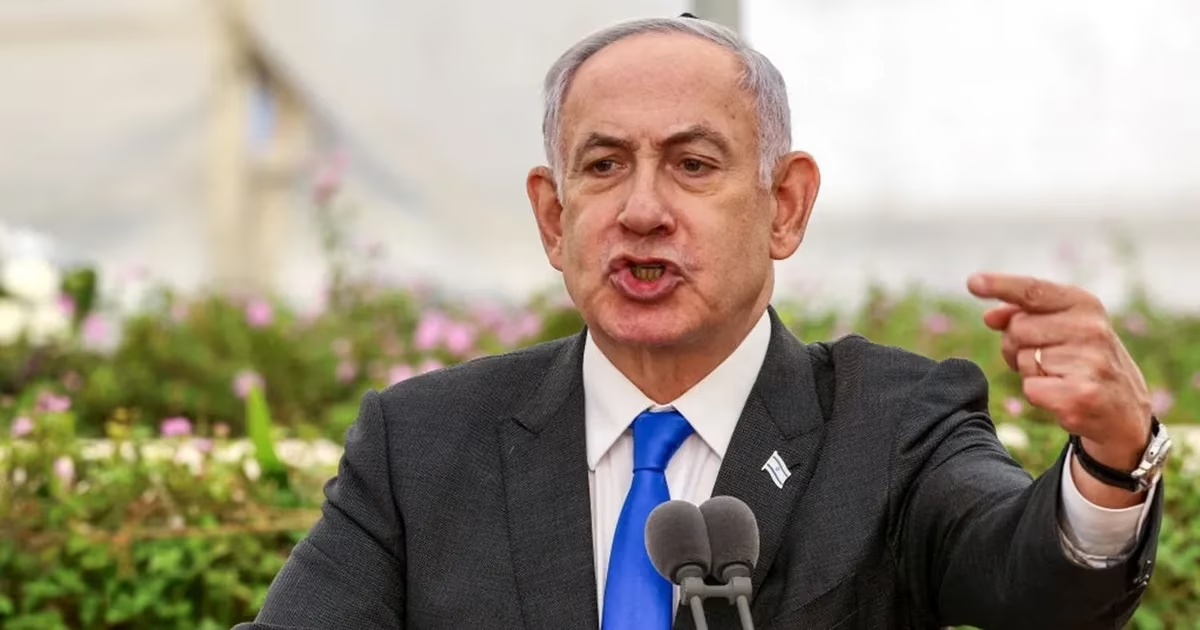
Benjamin Netanyahu's recent statements delineate a new regional phase that transcends traditional media consumption. He spoke clearly about dividing the region into warring axes, describing regional powers as wounded or hostile axes that must be contained.
Netanyahu proposed the idea of establishing a third axis led by Tel Aviv, aiming to include countries that oppose the ideological orientations of the Shiite and Sunni axes. This proposal placed the UAE, Greece, and India at the core of the new formation, reflecting a desire to re-engineer alignments.
This shift in Israeli discourse reflects a strategic transition from a policy of conflict management to a policy of comprehensively redefining the enemy. The focus is no longer limited to the Iranian threat but has expanded to include any political structure that adopts the project of resistance or political Islam.
This dual description allows for the building of flexible alliances that transcend traditional contradictions between states, with the unifying theme being the control of environments that harbor opposing projects. The reference to an axis specific to Israel suggests a long-term strategic framework that intersects with energy interests and maritime corridors.
In this vision, Greece represents a vital gateway to the Eastern Mediterranean, while India emerges as a rising partner in alternative trade corridors connecting East and West. As for the UAE, it plays the role of the central financial and logistical player in this proposed system.
We are witnessing a serious attempt to establish a network of interests that goes beyond the purely military dimension to formulate an integrated system of influence. This proposal intersects with international shifts, especially within conservative American circles that advocate for reducing external costs.
Statements by American figures, such as Senator Josh Hawley, reflect a tendency to support regional arrangements based on functional alliances that bear the burdens of confrontation. This approach does not mean a complete American withdrawal, but rather a redistribution of roles to manage conflicts through reliable regional partners.
This Israeli proposal comes at a moment when the resistance axis is clearly exhausted due to continuous economic and military pressures. Tel Aviv is also exploiting the profound shifts in the Sunni environment that followed the Arab Spring waves to establish new political realities.
The Israeli reading assumes that the current moment is opportune to change the balance of power before any unexpected strategic shifts occur. Therefore, talking about the third axis is not just a description of reality, but a declaration of intent to build a new reality by force.
The fundamental question remains about the nature of the regional response to these moves, and whether other powers will be content with a cold repositioning? Historical experience indicates that the building of solid alliances often precedes major explosions and existential conflicts.
The region today appears to be at a transitional stage open to high-risk possibilities, where alignments harden and the spaces for political settlement narrow. Accelerating the race of axes could lead to counterproductive results that increase tension instead of preventing it.
In such historical moments, wars are not merely the result of miscalculation, but can be the product of cold planning aimed at reproducing balance. Accordingly, the title of the next phase may go beyond containing threats to reach imminent direct confrontations.
The shift in Israeli discourse reflects a transition from a conflict management approach to an approach of redefining the enemy and expanding the framework of confrontation.
شارك برأيك
Alliance Wars and the Re-engineering of the Region: A Reading of Netanyahu's Vision for the Three Axes