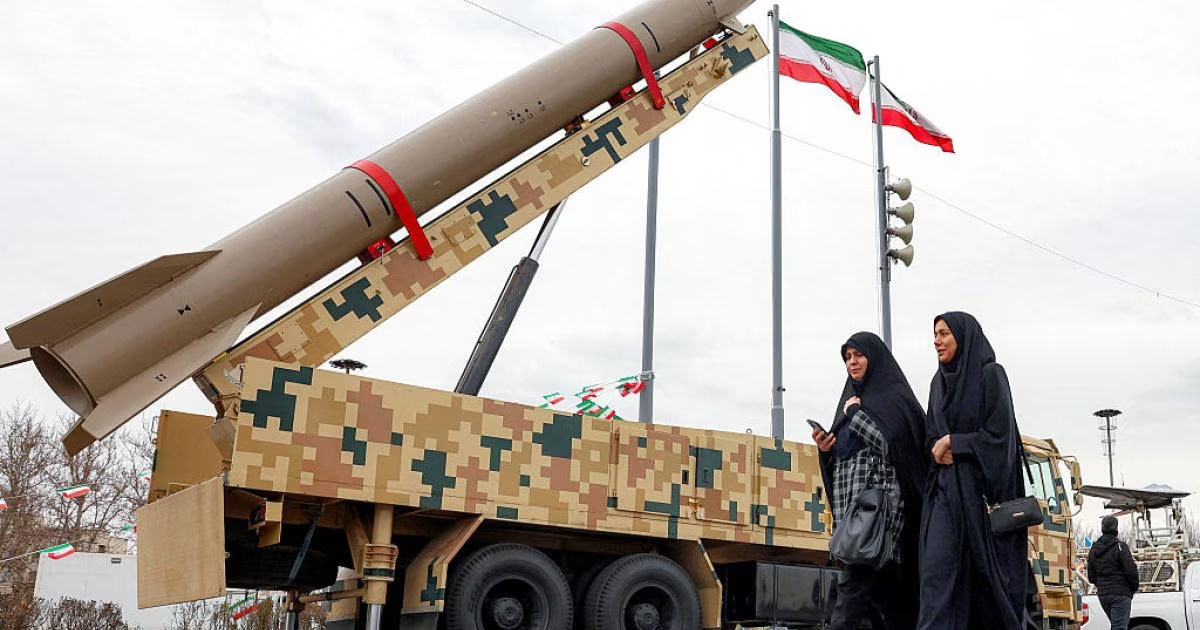







Informed sources indicate that US intelligence reports do not support recent claims made by President Donald Trump regarding Iran's imminent acquisition of intercontinental ballistic missiles. The sources clarified that current technical assessments raise major questions about the justifications put forward by the White House for threatening military action against Tehran.
The US President had stated during his 'State of the Union' address to Congress that Iran was rapidly developing missiles that would soon reach the American heartland. Trump considered this development a direct threat requiring decisive action, as part of his effort to rally public opinion behind his escalating policies towards the Iranian regime.
In contrast, two informed sources confirmed that there has been no fundamental change to the annual assessment submitted by the US Defense Intelligence Agency for 2025. This assessment clearly indicates that Iran may need a full decade, specifically until 2035, to be able to produce a militarily viable intercontinental ballistic missile.
For her part, White House spokeswoman Anna Kelly defended the President's stance, noting that Trump is right to highlight the serious risks posed by Iranian military programs. Kelly said that concerns about Tehran acquiring intercontinental missile technology remain a top priority for the current US administration.
Technical experts believe that even if Tehran receives technological support from allies such as China or North Korea, the process would take a long time. These experts estimate that producing a missile ready for actual combat operations requires at least eight years of continuous testing and development.
In the same context, press reports quoted US intelligence agencies as believing that Tehran is still years away from possessing long-range offensive capabilities. These assessments come at a sensitive time when the region is witnessing intense US military reinforcements coinciding with stalled nuclear negotiations between the two sides.
The White House has not yet provided additional details or concrete intelligence evidence to support the narrative presented by Trump to Congress. Observers describe this approach as the most aggressive towards Iran in decades, with Trump linking the missile program and support for armed groups to justify any future action.
Trump also claimed that Iran had begun rebuilding its nuclear facilities that were subjected to US raids last June, asserting that those sites had resumed operations. Despite these statements, no public reports have emerged confirming the resumption of activity at the three main sites previously targeted by US airstrikes.
For his part, US Secretary of State Marco Rubio adopted a tone that seemed more reserved than the President's statements, describing Iran as 'on a path' to acquiring these weapons. This phrasing reflects an attempt to balance tough political rhetoric with the technical reality imposed by intelligence reports.
On the other hand, Iran continues to deny its pursuit of nuclear weapons, asserting that all its activities fall under peaceful and research purposes. Iranian Foreign Minister Abbas Araqchi stressed that his country is not developing long-range missiles, and that its current arsenal is exclusively for self-defense.
Araqchi clarified in press statements that the range of Iranian missiles is predetermined with a ceiling not exceeding two thousand kilometers, which is sufficient to respond to regional threats. Tehran insists that its missile program is a sovereign right not subject to negotiation, despite increasing international pressure to restrict its ballistic capabilities.
Data from the International Atomic Energy Agency indicates that Iran halted its military nuclear program in 2003, despite continuing to enrich uranium. However, the high levels of enrichment raise international concerns about the possibility of converting the program to a military path in a short time.
Iran currently possesses the largest ballistic missile system in the Middle East, capable of reaching targets in Europe and surrounding US bases. Analysts believe that the development of Iranian space launch vehicles provides it with technical expertise that could be converted in the future into intercontinental missiles if the political decision is made.
However, David Albright, president of the Institute for Science and International Security, asserts that Tehran still lacks the technology to protect nuclear warheads during re-entry into the atmosphere. Experts conclude that the gap between political rhetoric and on-the-ground reality remains wide, especially with the damage to Iranian facilities from recent Israeli strikes.
Intelligence reports do not contain anything to support Trump's claim that Tehran will soon be able to develop a missile capable of reaching American territory.
شارك برأيك
US Intelligence Reports Refute Trump's Claims on Iranian Intercontinental Missiles