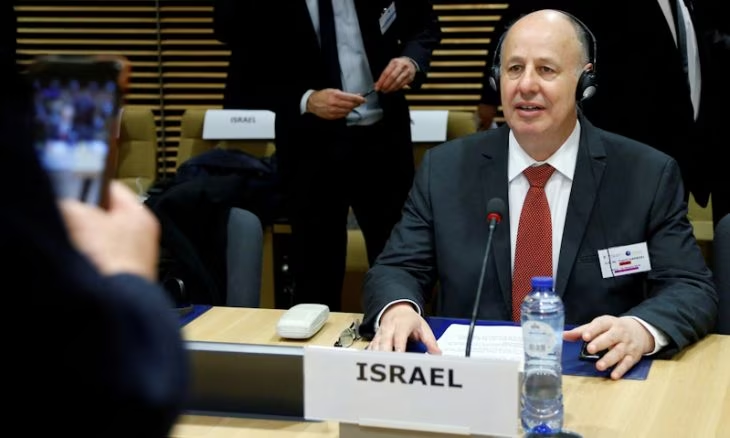







Former Israeli National Security Advisor, Tzachi Hanegbi, warned against underestimating the combat capabilities and spiritual resilience of enemies, noting that the next surprise might be closer than decision-makers in Tel Aviv imagine. In an extensive analytical article, Hanegbi pointed out that the scene in Gaza resembles the ambiguity surrounding the Iranian file, where questions remain about the effectiveness of international agreements and their ability to stop support for regional proxies, or the possibilities of an American strike and its repercussions.
The former official explained that the ongoing war, despite Israel's field gains, has produced tactical successes for the Palestinian side, some of which have turned into long-term strategic achievements. Hanegbi believed that there are four major shifts that have harmed Israeli interests: first, the dissipation of normalization opportunities with Saudi Arabia in the foreseeable future; and second, the strong return of the Palestinian issue and the two-state solution to the international forefront after years of marginalization.
Regarding supporting fronts, Hanegbi noted that the war created an unexpected enemy in Yemen in the form of the Houthi group, which has caused various damages to the occupation and continues to show no retreat from continuing attacks. He also considered that the legal prosecutions by the International Criminal Court against Benjamin Netanyahu and Yoav Gallant constitute a strategic constraint that affects the freedom of movement of the Israeli leadership and places it under unprecedented international pressure.
Hanegbi, who recently left his post following disagreements with Netanyahu, concluded that Israel's enemies believe that victory is their ally as long as they maintain their existence and resistance. He affirmed that the Palestinian side has shown exceptional resilience for two full years without surrender, considering that absolute American support for Israel failed to break their will or push them to raise the white flag as was hoped in initial assessments.
The article touched upon the achievements made by Palestinians from their perspective, as they succeeded in freeing hundreds of high-sentence prisoners and managed to impose international isolation on Israel. According to Hanegbi, this Palestinian reading of events will push them to rise from the rubble with renewed energy, meaning that the conflict has not ended with the destruction of military infrastructure but may take more complex forms in the near future.
Hanegbi stressed the need not to repeat the intelligence and political errors that preceded the events of October 7, recalling that Israeli assessments after Operation 'Guardian of the Walls' indicated Hamas's deterrence and weakening. He explained that reality proved that Yahya Sinwar's reading of the conflict was completely different from Israeli assessments, as he was preparing for a strategic attack at a time when Tel Aviv believed it had contained the threat.
In conclusion of his analysis, the former advisor predicted that plans to destroy Israel would return to form the basis of enemy movements in a phase that might be earlier than expected. He called on the Israeli leadership to remain in a state of constant vigilance and continuous skepticism, with the necessity of maintaining internal unity to face the existential challenges produced by the current war and its regional and international repercussions.
Even the full alignment of the United States with our side did not push the Palestinians to raise a white flag, as they consider survival and existence a victory.
شارك برأيك
Former Israeli National Security Advisor: Palestinians Did Not Raise the White Flag Despite American Support