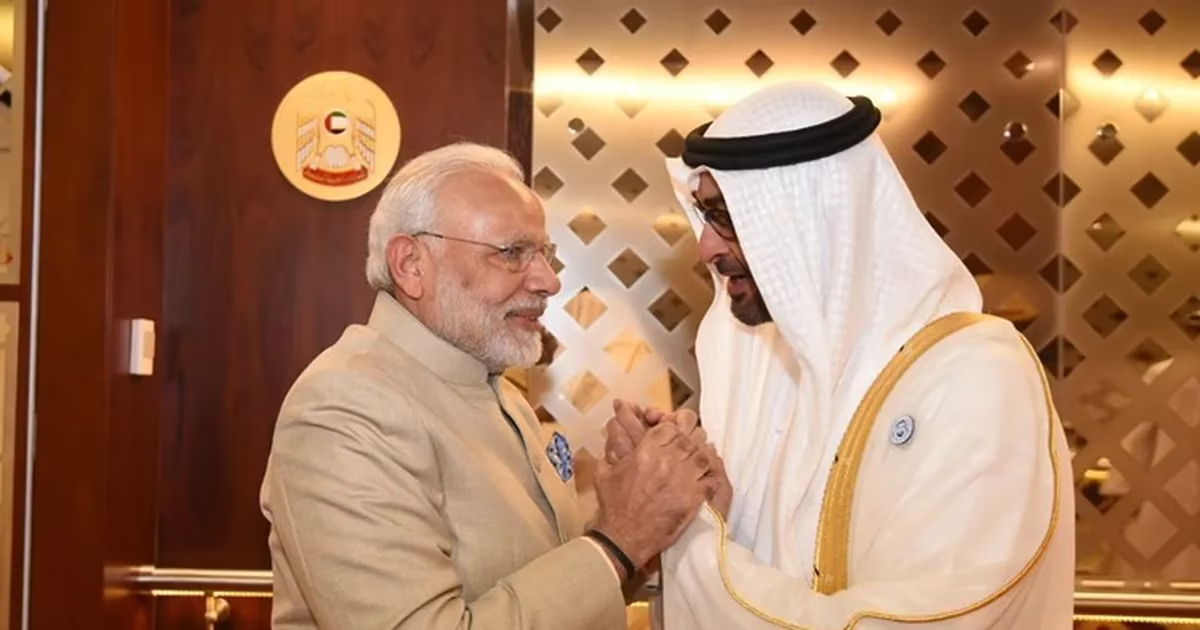







Diplomatic circles in Tel Aviv are observing with increasing interest the growing strategic relations between the United Arab Emirates and the Republic of India, seeing in them the formation of a new economic corridor that redraws the balance of power in the region. Observers point out that this alliance goes beyond traditional commercial dimensions to solidify Abu Dhabi's position as a strategic partner for a rising superpower, providing the Israeli occupation with a foothold within a stable regional system, away from escalating tensions in other issues.
In an interpretation of the Gulf scene, a former advisor to the presidency of the occupying state considered that recent Emirati moves reflect political maturity in dealing with regional pressures, especially in light of the fierce competition with Saudi Arabia. He explained that Mohammed bin Zayed's visits to New Delhi and Moscow aim to secure wide margins for maneuver in Central Asia, and ensure energy flows away from traditional dominance, which gives Abu Dhabi a high capacity to influence the global energy map.
On the other hand, analysts believe that recent Saudi behavior expresses a strategic predicament resulting from complex economic challenges, as Riyadh tries to assert its dominance by pressuring international companies to relocate their headquarters. Reports reveal that these pressures, which have reached the point of indirect confrontations in regional issues such as Yemen, reflect concern about the widening financial deficit and the difficulty of fulfilling the huge promises associated with Vision 2030 in light of current changes.
Economic data based on international reports issued in December 2025 indicate a structural gap between the two neighboring economies, as the public debt ratio in Saudi Arabia jumped 16-fold within one decade to reach 32% of GDP. This acceleration in borrowing raises questions about the sustainability of major projects, especially with the 25% decline in Aramco's profits, which caused a shake in the Kingdom's financial confidence in recent months.
In contrast, the UAE maintains remarkable financial stability, relying 78% on real productive sectors including tourism, logistics, and finance, away from artificial government spending. Economic sources confirm that Abu Dhabi has succeeded in achieving balanced growth of 4.8%, utilizing its huge reserves to purchase global strategic assets instead of depleting them to cover the financial deficit, which enhances its attractiveness as a stable financial center.
Regarding attracting investments, the disparity in figures is clear; while Riyadh aimed to attract $100 billion in foreign direct investment, it only succeeded in actually collecting between $12 and $20 billion. This failure to achieve investment targets places additional pressure on the Saudi decision-maker, who finds himself compelled to fulfill huge external investment commitments in the United States and other countries at a time when liquidity is urgently needed domestically.
Emirati leadership understands that 21st-century conflicts are not decided by traditional military confrontations or media campaigns, but by controlling logistical corridors, ports, and pipelines. From this perspective, Abu Dhabi has worked to solidify its position as the owner of the alternative energy artery heading towards Europe, thereby overcoming geopolitical complexities associated with Russia and Iran, and directly linking major gas reserves to Western markets.
Israel's reading of the scene concluded that the 'Emirati pillar,' along with India, represents the solid foundation for what is called the 'Indo-Abrahamic Alliance,' a project that Tel Aviv sees as a guarantee for its national security and economic expansion. It appears that the occupation has made its choice to align with this axis, which demonstrates strategic patience and the ability to maneuver among major powers, considering that the stability of this alliance is the real guarantee for survival in a changing regional environment.
The Emirati pillar, alongside the Indian pillar, is the true basis for the Israeli structure in the region within what is known as the Indo-Abrahamic Alliance.
شارك برأيك
Strategic Shifts: Why Israeli Circles Prefer Alliance with UAE and India Over Riyadh?