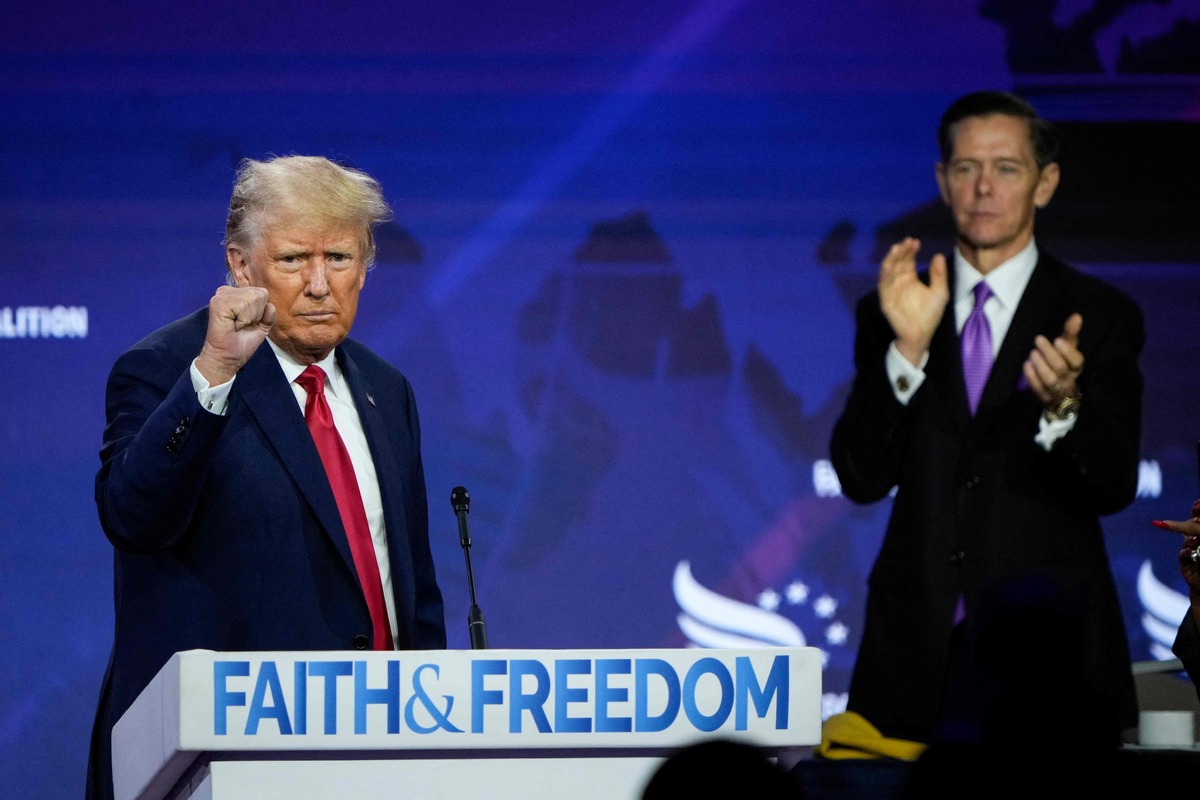







US President Donald Trump announced on Thursday that the United States had sent a "huge fleet" of warships towards Iran, a move with clear strategic implications, but one that – according to him – does not reflect a direct desire to use military force. Trump affirmed, in his remarks to reporters aboard Air Force One returning from Davos where he inaugurated the "Peace Council," that his administration prefers political and diplomatic solutions, while keeping all options on the table if developments necessitate it.
The US President explained that the military movement comes within the framework of what he described as "preventive deterrence," stressing that Washington is monitoring the situation in Iran "closely," amid escalating tensions against the backdrop of internal protests and sensitive regional issues. He added: "We have a huge fleet heading in that direction, and we may not have to use it," indicating that the military presence is primarily aimed at political pressure and preventing escalation, not igniting it.
In a related context, Trump reiterated his claim that his public threats led the Iranian authorities to back down from executing 837 protesters. He said: "They said they canceled the executions, they didn't postpone them," considering this as evidence of the effectiveness of his administration's "maximum pressure" policy towards Tehran. However, these statements were not supported by independent confirmations from human rights organizations or UN sources, which raises questions about the accuracy of this narrative.
The dispatch of the American fleet near the Iranian coast reflects Washington's continued reliance on military deterrence as a tool for political pressure. The American administration realizes that any direct confrontation with Iran would be costly regionally and internationally, and therefore prefers to display force rather than use it. This approach is consistent with the American doctrine of "peace through strength," but at the same time, it raises the level of tension and makes the margin for strategic error more dangerous.
Trump's statements regarding the cancellation of death sentences in Iran fall within his usual political discourse that links threats with humanitarian outcomes. However, the absence of independent documentation weakens the credibility of this claim and reveals the instrumentalization of the human rights file within a political and media battle. Human rights issues, when used as leverage, may lose their moral dimension and turn into a bargaining tool.
In a remarkable development, Trump touched upon what he called the "Peace Council," indicating that he theoretically has the right to remain its president for life after his presidential term ends. He said: "I have the right to stay if I want... we'll see what happens," adding that he is unsure if he wants to continue, even though the charter allows it. This statement drew widespread criticism, given its implications regarding the concentration of political influence outside traditional democratic frameworks.
Trump affirmed that the Peace Council could play a pivotal role in complex issues, foremost among them the situation in Gaza, and perhaps in other international crises. He indicated that the Council would work in coordination with the United Nations, denying accusations that Washington seeks to marginalize or replace the international organization through it.
The US President revealed that countries such as Russia offered to contribute more than a billion dollars to fund the Peace Council, the same amount required for permanent membership in the Council. In contrast, he acknowledged strong opposition from major countries such as the United Kingdom and France, while other countries, including Italy and Poland, expressed their desire to join, pending the completion of internal constitutional procedures.
It is worth noting that the idea of a "Peace Council" raises a deep problem related to the future of the international system. The attempt to create parallel frameworks to the United Nations reflects a loss of confidence in multilateral institutions, but at the same time threatens to dismantle international legitimacy. The participation of major countries in this council may enhance its influence, but it will open the door to a more divided global system less capable of producing consensus.
Regarding the controversy surrounding the bruise on his hand, Trump explained that he bumped into a table, and that his aspirin intake led to a change in skin color, indicating that the matter carries no alarming health implications, despite the repeated appearance of similar bruises over the past year.
شارك برأيك
Trump: A huge American fleet is heading to Iran, I hope we don't have to use it