






Washington – Said Arikat
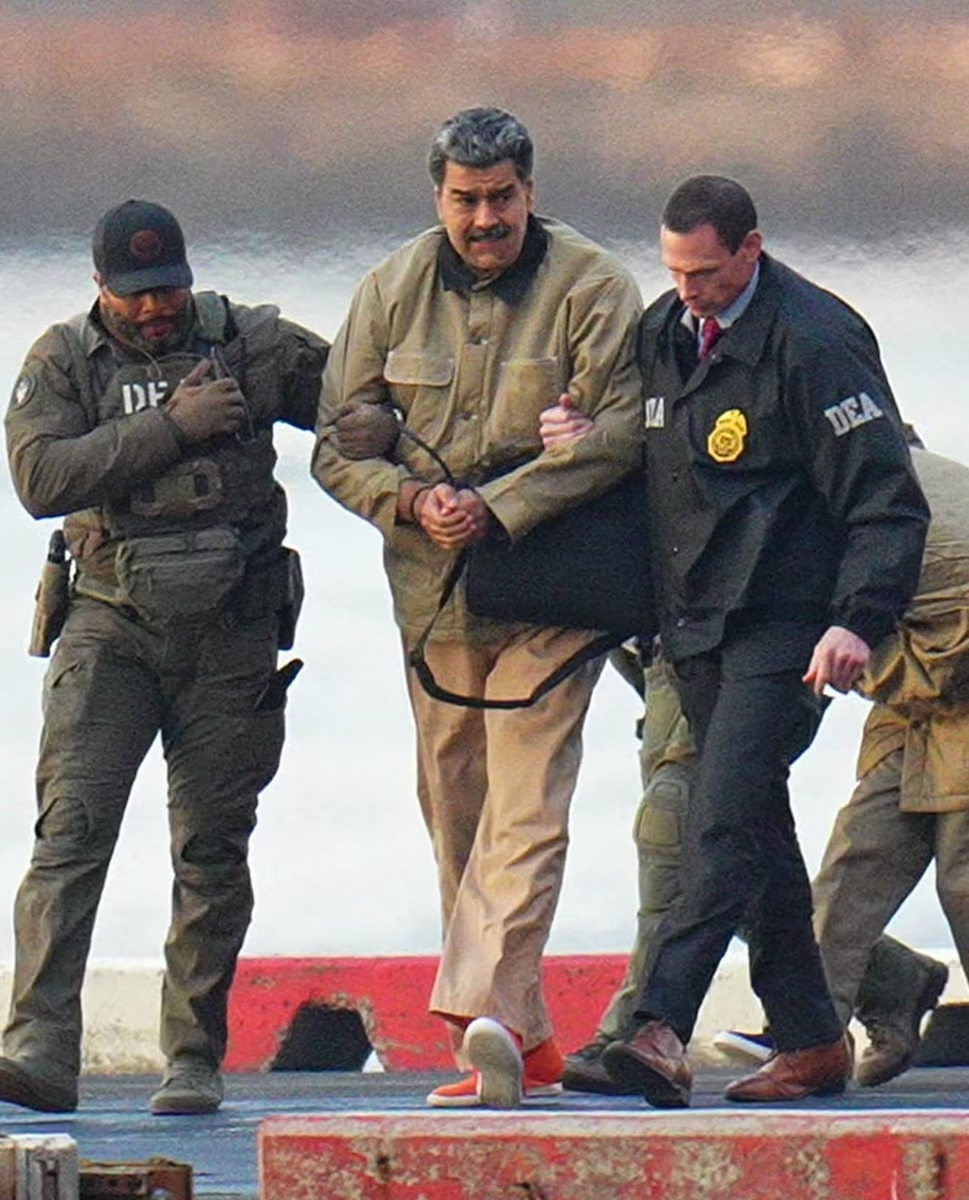
In a remarkable development reflecting the scale of the shift in the relationship between the United States and Venezuela, US President Donald Trump presented a broad package of demands to the new Venezuelan President, Delcy Rodriguez, after she took the constitutional oath following the overthrow of former President Nicolas Maduro in a US military operation that sparked widespread international controversy.
According to US officials and converging media reports, Washington seeks to reshape the political, security, and economic landscape in Venezuela, considering the new phase a "historic opportunity" to end the influence of its adversaries in Latin America, primarily Russia, China, Iran, and Cuba.
Cutting International Alliances at the Forefront of Demands
Topping the list of American demands is a clear call to sever strategic, military, and security ties with Moscow, Beijing, Tehran, and Havana. Washington accuses these countries of using Venezuela as a platform to expand their political and intelligence influence in the Western Hemisphere, which it considers a direct threat to US national security.
Diplomatic sources indicate that the US administration is not content with merely reducing the level of relations but demands concrete steps, including ending military agreements, expelling foreign advisors, and halting any intelligence cooperation with these countries.
Security and Anti-Drug Efforts
On the security front, Washington is pressuring the new government to enhance cooperation in combating drug trafficking. The United States accuses previous governments in Caracas of complicity with international trafficking networks, an accusation officially denied by Venezuela.
US demands include restructuring security agencies, facilitating the work of American agencies, and exchanging intelligence information, a move observers see as an attempt to rebuild American influence within Venezuelan state institutions.
Oil and Economy: The Heart of the Equation
Economically, the oil sector is a key focus of the American vision. Washington demands redirecting Venezuelan oil exports away from countries classified as adversaries and opening the energy sector to American companies after years of sanctions and isolation.
In this regard, President Trump said on his Truth Social platform on Tuesday: "I am pleased to announce that the transitional authorities in Venezuela will deliver between 30 and 50 million barrels of high-quality, sanctioned oil to the United States of America. This oil will be sold at market price, and I, as President of the United States of America, will oversee the management of its proceeds to ensure they are used for the benefit of my people in Venezuela and the United States! I have asked Secretary of Energy Chris Wright to implement this plan immediately. The oil will be transported by storage tankers and delivered directly to discharge ports in the United States. Thank you for your attention to this matter!"
Initial talks have already begun on resuming oil exports to the United States, which could provide an economic lifeline for Caracas, but at the same time raises questions about the level of economic sovereignty in the coming phase.
Political Reforms and Elections
Politically, Washington calls for a "real democratic transition," including launching a process of constitutional reforms and organizing free elections. However, the US administration has not announced a clear timeline, reinforcing the impression that these demands are being used as a negotiating leverage rather than an immediate commitment.
Analysts believe that the easing of sanctions and the provision of financial aid will be conditional on the new government's response to these terms.
Caracas's Reaction: A Delicate Balance
For her part, President Rodriguez adopted a cautious tone. She condemned the US military intervention as a violation of the country's sovereignty, but at the same time called for dialogue and avoiding escalation, emphasizing that Venezuela needs stability and reconstruction.
This stance reflects a clear attempt to balance external pressures with maintaining a minimum level of internal legitimacy in a country suffering from a deep economic and social crisis.
Divergent International Positions
The US moves were met with sharp criticism from Russia, which described them as "neo-colonial threats," warning of serious repercussions for regional stability. China and Iran also expressed concern about the precedent of military intervention and the imposition of political dictates.
In contrast, some Latin American countries remained silent, while others expressed caution about escalating tensions in the region.
The American demands from the new Venezuelan government reflect a clear direction to reassert US influence in Latin America using a mix of military force and economic pressure. Washington is not content with regime change but seeks to re-engineer Venezuela's alliances and regional role. However, this approach carries real risks, as it could deepen internal divisions and provoke popular resistance against any government perceived as subservient to external dictates.
For President Rodriguez, the current phase represents an extremely difficult political test. Full compliance with US demands could provide her government with rapid economic support, but it could weaken her national legitimacy. Conversely, rejecting these conditions could expose the country to further pressure and isolation. Caracas's ability to maneuver between these two options will determine the shape of the Venezuelan state and its political future in the coming years.
شارك برأيك
Comprehensive American Demands from New Venezuelan President to Allow Oil Exports