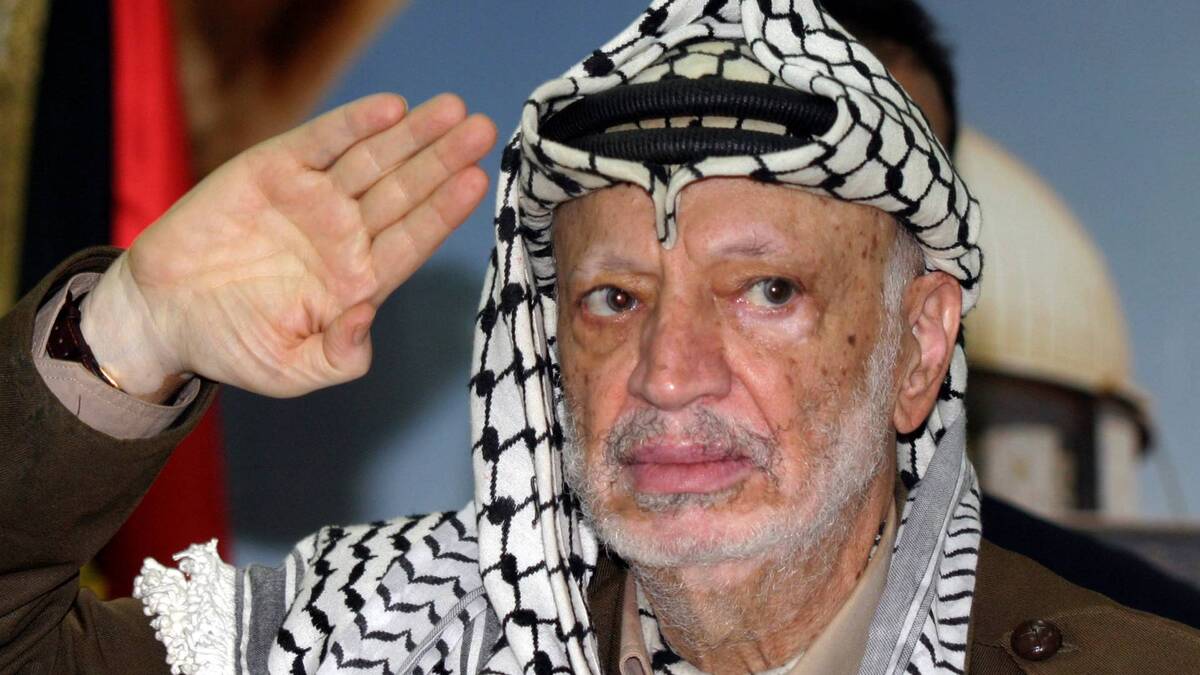







The speech was historic by all measures; Arafat transformed the discussion from mere "humanitarian aid and refugee relief" to a political issue centered around "inalienable national rights."
Today, the world stands at the anniversary of one of the most important milestones in the history of the Palestinian cause. Fifty-one years ago, specifically on November 13, 1974, the late President of the Palestine Liberation Organization, Yasser Arafat, stood for the first time at the podium of the United Nations General Assembly.
This was not just a speech, but an official declaration that the Palestinian issue is not a refugee problem, but a matter of a people demanding their right to self-determination and national independence.
On that day, Arafat delivered his famous speech, concluding with his iconic phrase: "I come to you bearing an olive branch in one hand and a freedom fighter's gun in the other... do not let the green branch fall from my hand."
After more than half a century, amid the rapid and tragic developments currently unfolding in the region, this speech seems to be resonating anew, carrying the same questions and demands.
Arafat's ascent to the UN podium was a direct result of profound political transformations that followed the October 1973 War.
A few weeks before the speech, specifically at the Arab summit in Rabat in October 1974, the Palestine Liberation Organization received comprehensive Arab recognition as the "sole legitimate representative of the Palestinian people."
This Arab cover opened the door to the international community. The United Nations responded by issuing Resolution 3210, which called for the PLO to participate in discussions on the "Palestine issue."
This was the first time an invitation was extended to a leader of a national liberation movement to address the General Assembly.
He was not a man asking for charity, but a leader demanding independence.
The immediate result of this speech was the issuance of UN Resolution 3236 just a few days later, which recognized for the first time the inalienable rights of the Palestinian people, foremost among them the right to self-determination, the right to sovereignty and national independence, and the right of return.
The 1974 speech marked the beginning of international legitimization of the Palestinian struggle. In the years that followed, the issue underwent sharp turns.
After the first intifada in 1987, which brought the issue back onto the global map, the most significant announcement came at the Palestinian National Council in Algeria in 1988.
There, the PLO announced its acceptance of Resolution 242, and thus implicitly accepted the "two-state solution" and the existence of Israel on 78% of historic Palestine.
This concession, which was considered "painful" yet "realistic," opened the door to "peace agreements."
The process reached its peak with the "Oslo Accords" in 1993. Yasser Arafat stood in the White House garden to shake hands with Israeli Prime Minister Yitzhak Rabin, following mutual recognition between the organization and Israel.
The agreement stipulated the establishment of a "Palestinian Authority" with limited self-rule in parts of the West Bank and Gaza Strip, as a transitional phase lasting five years, ending with negotiations on a final status.
Things did not go as planned. The "Camp David 2" negotiations in 2000 failed to reach a final solution.
Months later, the second intifada erupted. In 2004, Yasser Arafat passed away as a martyr, besieged in his headquarters in Ramallah.
The years that followed witnessed significant events: the Israeli withdrawal from Gaza in 2005, the internal Palestinian division in 2007, Hamas's control over the Strip, and the entrenchment of the Israeli blockade.
The scene appears more grim. The peace process has completely frozen. Settlement expansion in the West Bank and occupied Jerusalem has reached unprecedented levels, effectively eliminating the chance for the "two-state solution" that was the basis of "Oslo."
The "Abraham Accords" also led to the normalization of relations between Israel and Arab countries without linking it to ending the occupation.
This anniversary comes at a time when the region, especially in Gaza and the West Bank, is witnessing one of the most violent and destructive rounds of conflict in modern history.
After 51 years, the "olive branch" that Arafat raised in his hand remains fragile and struggles to survive.
The Palestinian people, who gained recognition of their right to self-determination in 1974, still find themselves in the same place today,


شارك برأيك
"Do not let the green branch fall from my hand" .. The memory of Arafat's historic speech that established the right to self-determination before the United Nations.