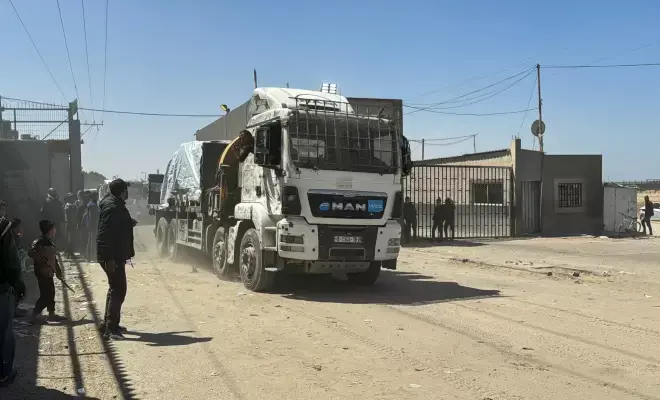







While aid has begun to gradually enter the besieged Gaza Strip, nearly all humanitarian agencies say it is insufficient to prevent a "widespread famine that is significantly increasing death tolls."
Last Sunday (27/7/2025), Israeli occupation authorities announced that they would halt military activities in some areas to allow more aid to enter Gaza, following international outrage over the spread of famine and deaths resulting from malnutrition caused by the Israeli military assault and restrictions on aid.
However, humanitarian organizations say that the amount of aid that has entered the sector is inadequate, and without more food, an increasing number of Palestinians will die of hunger, especially children.
NBC News examined the amount of aid that has entered Gaza during the week since Israel announced the new system, and how it meets the needs of citizens.
Counting the Aid
Humanitarian aid is currently entering Gaza through three methods: aerial drops, distribution by the Gaza Humanitarian Foundation (GHF) supported by the United States and Israel, and by the United Nations and other relief organizations using "humanitarian corridors" established by the Israeli army last week.
The Gaza Humanitarian Foundation, which began distributing aid in the sector in late May, has faced widespread condemnation due to the deaths of hundreds of people, often at the hands of Israeli soldiers, near its aid sites, and due to its limited distribution. Last Sunday, GHF distributed about one million meals, and at least 1.2 million more meals from Monday to Wednesday, and 1.3 million meals on Thursday. GHF apparently did not publish the number of meals distributed on Friday, but announced on Saturday that it had distributed at least 1.7 million meals.
In a country with a population of about two million, this averages to about half a meal to just under a full meal per person per day.
According to the station, the Israeli military branch responsible for overseeing the entry of aid into Gaza, the Coordinator of Government Activities in the Territories (GOCAT), allowed approximately 230 trucks to enter Gaza daily from last Sunday to Thursday, according to data published online. It states that these trucks are in addition to "the hundreds" already in the sector waiting to be received by relief organizations, but it did not disclose the exact number. The Coordinator of Government Activities in the Territories did not respond to a request for more information about the total number of trucks waiting to be received.
According to data from the Coordinator of Government Activities in the Territories, at least 920 aid trucks were collected and distributed that were allowed to enter the sector by the United Nations and other humanitarian organizations from last Sunday to Thursday. Before the start of the Israeli assault on Gaza, about 500 trucks loaded with aid entered Gaza daily, according to the British Red Cross and other organizations. The chart below illustrates how the amount of aid entering Gaza significantly increased during the ceasefire between Israel and Hamas, before stopping during the Israeli blockade, with only minimal amounts entering in the months following its lifting.
Monthly Aid Entering Gaza
The months following Israel's lifting of its comprehensive blockade on aid, which lasted nearly three months, saw some of the lowest levels since the beginning of the war.
When asked by NBC about the number of trucks allowed to enter Gaza that were collected by humanitarian organizations on Friday and Saturday, the Coordinator of Government Activities in the Territories did not respond immediately.
Although the Coordinator of Government Activities in the Territories published information about the trucks that entered Gaza and were collected by relief organizations on its social media pages over the past week, it has not updated its electronic dashboard related to aid entering Gaza since Monday, despite international focus on this issue.
According to the World Food Program, only about two-thirds of the food quantity requested by the UN agency from the Israeli authorities has been approved for entry into Gaza as of Thursday since the Israeli army began tactical ceasefire periods.
How Did Israeli Restrictions Cause the Hunger Crisis?
The hunger crisis in Gaza significantly worsened in March after Israel imposed a blockade preventing aid from entering Gaza (on March 2, 2025), amid a ceasefire with Hamas (which Israel violated on March 18, 2025).
Israel lifted the suffocating blockade in May, but only allowed limited aid to enter the sector, most of which was distributed by


شارك برأيك
The volume of aid that has reached Gaza since Israel announced the easing of restrictions is very small.